
Revision Notes
Cambridge IGCSE Environmental Management (0680): Conservation and management of energy resources – Revision Notes
Condensed notes on energy management strategies, blue and green hydrogen and heat pumps, with payback and saving calculations, for Cambridge IGCSE 0680.
- Subject
- Environmental Management
- Level
- IGCSE
- Topic
- Topic 1 – Natural Resources
- Author
- Marlbridge Academic Team
- Updated
- Reviewed by
- Azam Siddique (what this means)
Aligned to Cambridge IGCSE Environmental Management (0680), 2027-2029. Official specification .
Syllabus page (what it covers and how it is assessed): Cambridge IGCSE Environmental Management.
Syllabus points this page covers
0680
- 1.5 Conservation and management of energy resources
Found an error? Report a correction.
Need help with this topic? Request a free trial class for IGCSE Environmental Management (0680).
Condensed notes for sub-topic 1.5. For strategies at different scales, three worked calculations and an annotated discuss answer, see the Conservation and management of energy resources study guide.
The eight strategies (1.5.1), sorted
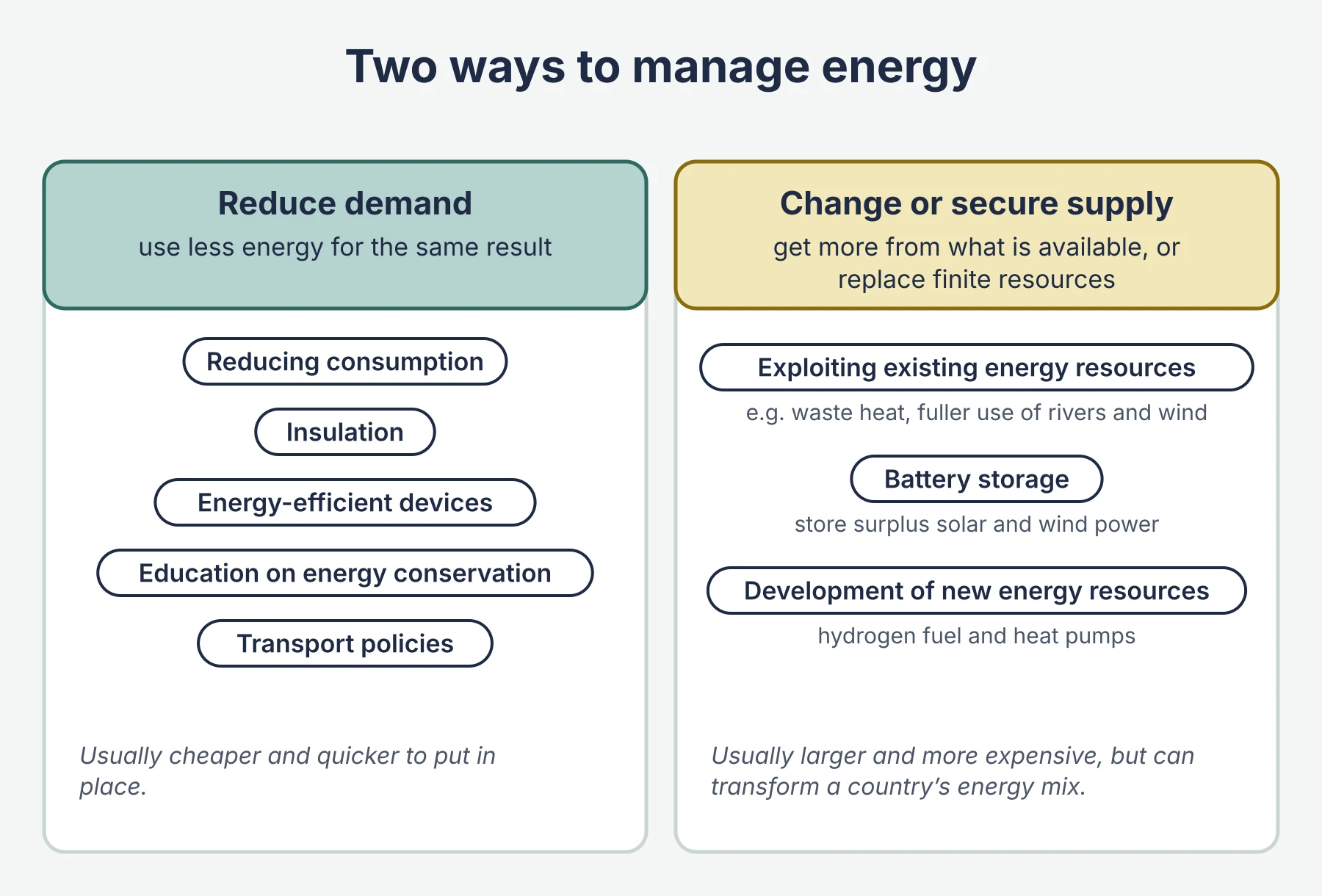
Reduce demand
- Reducing consumption: use less, such as switching off devices and lowering thermostats.
- Insulation: slow heat loss through roofs, walls, windows and gaps.
- Energy-efficient devices: LED bulbs, efficient appliances, fuel-efficient and electrically propelled vehicles.
- Education on energy conservation: campaigns, energy labels, school programmes.
- Transport policies: public transport, cycle lanes, car sharing, congestion charges, fuel taxes.
Change or secure supply
- Exploiting existing energy resources: get more from resources and infrastructure already available, such as existing fields, rivers or waste heat.
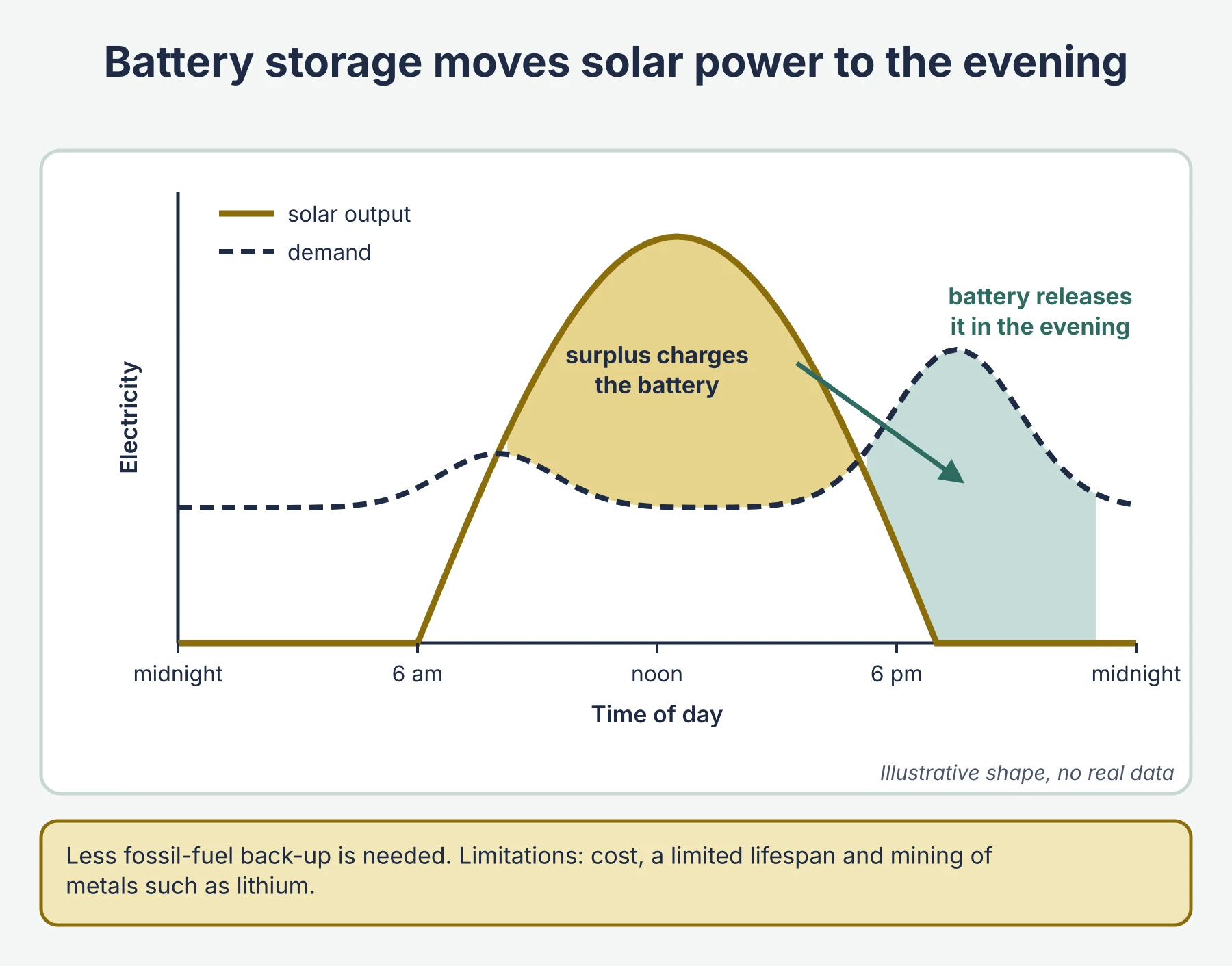
- Battery storage: store surplus electricity, especially from solar and wind, for later use.
- Development of new energy resources: hydrogen fuels and heat pumps.
Benefit and limitation for each
| Strategy | Benefit | Limitation |
|---|---|---|
| Reducing consumption | Free; immediate | Depends on habits changing |
| Insulation | Large heating savings; repays its cost | Up-front cost; hard to fit in some buildings |
| Efficient devices | Same service, less energy | Higher purchase price |
| Electrically propelled vehicles | No exhaust; cleaner city air | Only as clean as the electricity; cost; charging points |
| Exploiting existing resources | Uses infrastructure already built | May extend fossil fuel use |
| Education | Low cost; long-lasting change | Slow; hard to measure |
| Transport policies | Cuts petroleum use and congestion | Costly to build; charges unpopular |
| Battery storage | Helps solve intermittency | Expensive; mined metals; limited lifespan |
| New energy resources | Reduce fossil fuel dependence | Expensive; new infrastructure needed |
New energy resources (1.5.2)
| Resource | How it is produced or works | Benefit | Limitation |
|---|---|---|---|
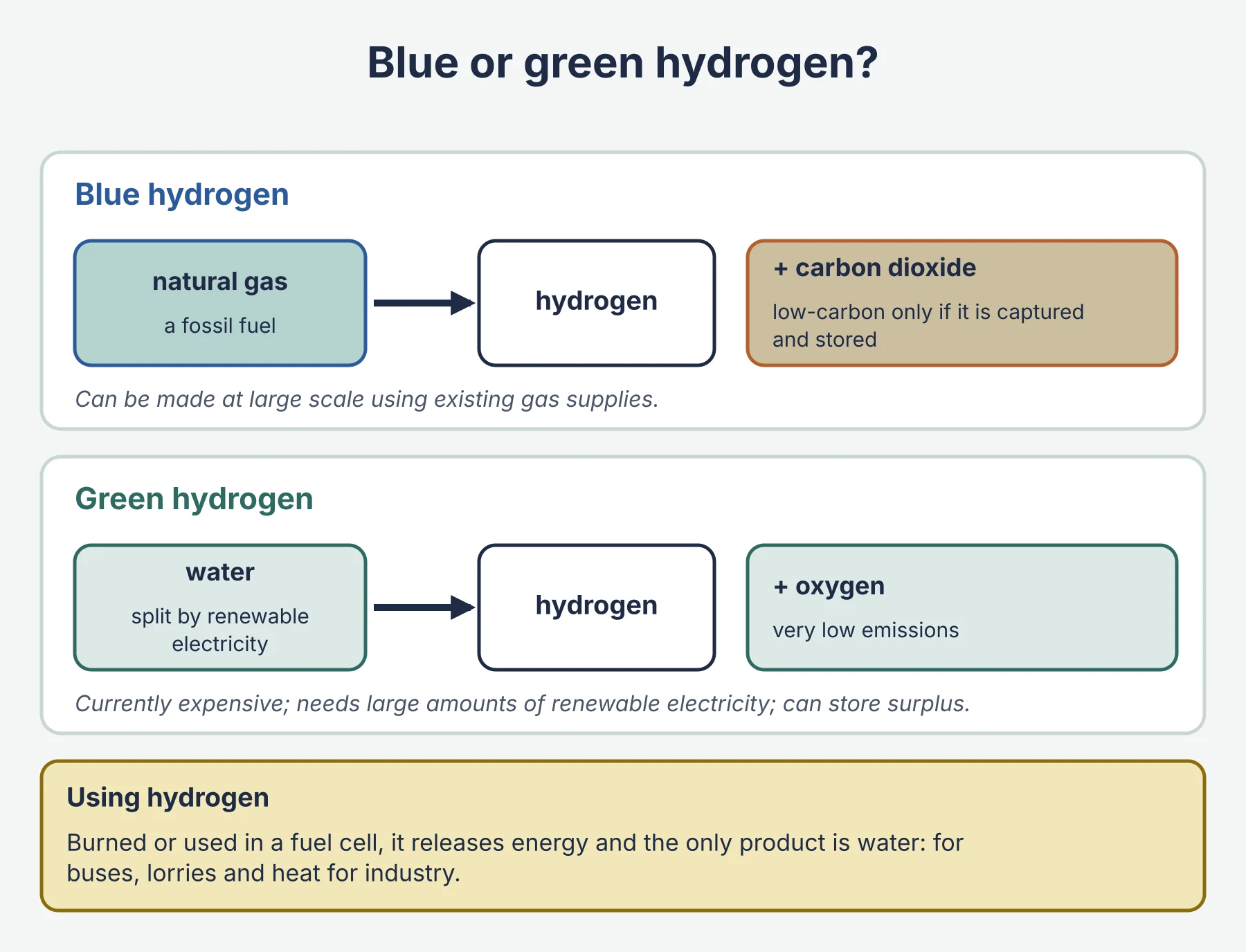
| Blue hydrogen | Produced from natural gas | Large scale; uses existing gas supply | Releases carbon dioxide unless captured; still fossil-based |
| Green hydrogen | Produced using renewable resources (renewable electricity splits water) | Very low emissions; stores surplus renewable power | Expensive; needs large amounts of renewable electricity |
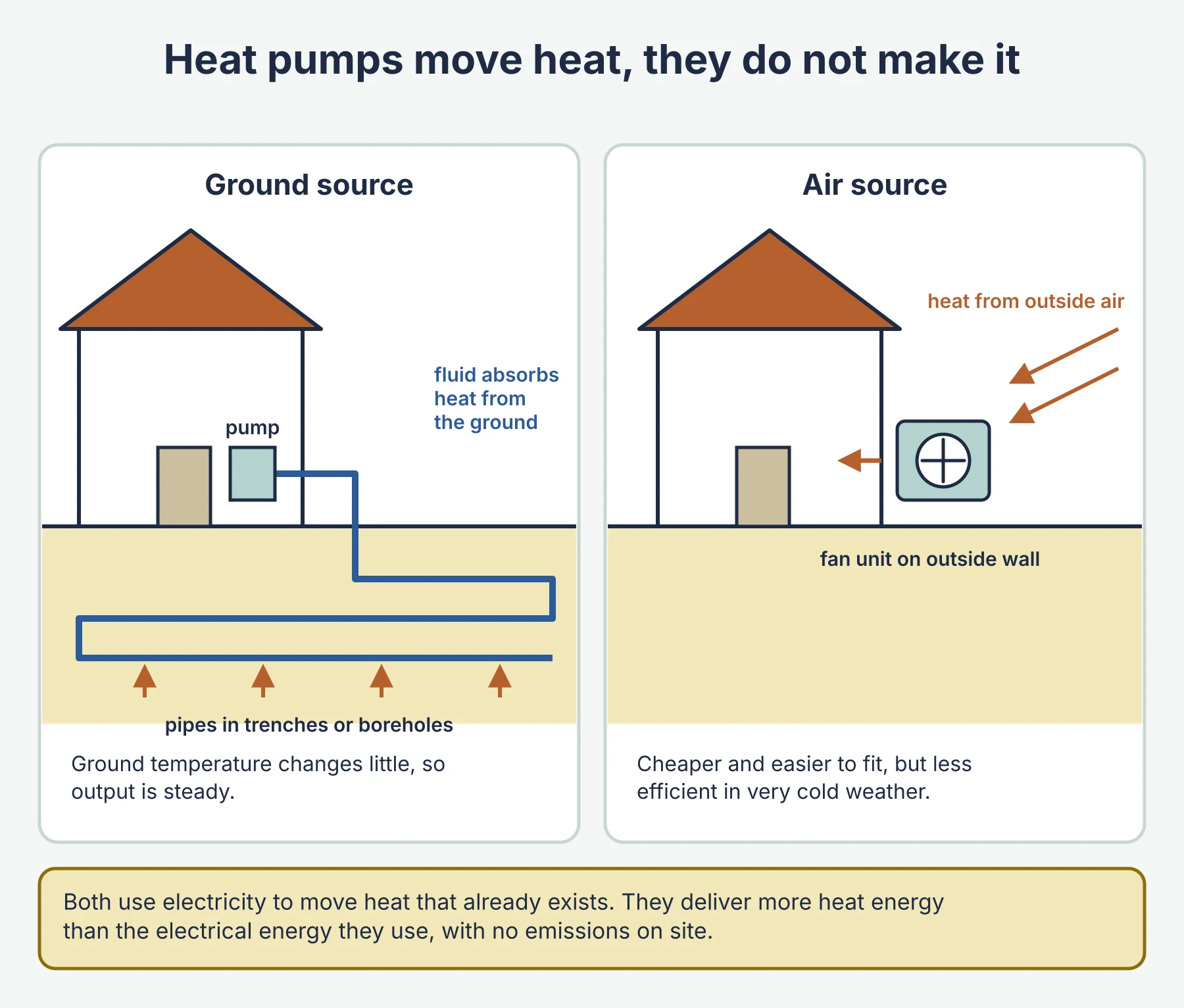
| Ground source heat pump | Transfers heat from the ground through buried pipes | Steady output all year | High cost; needs land for trenches or boreholes |
| Air source heat pump | Transfers heat from the outside air | Cheaper and easier to fit | Less efficient in very cold weather |
Hydrogen facts: using it in a fuel cell or burning it produces only water; it is hard to store and transport because it is a very light, flammable gas.
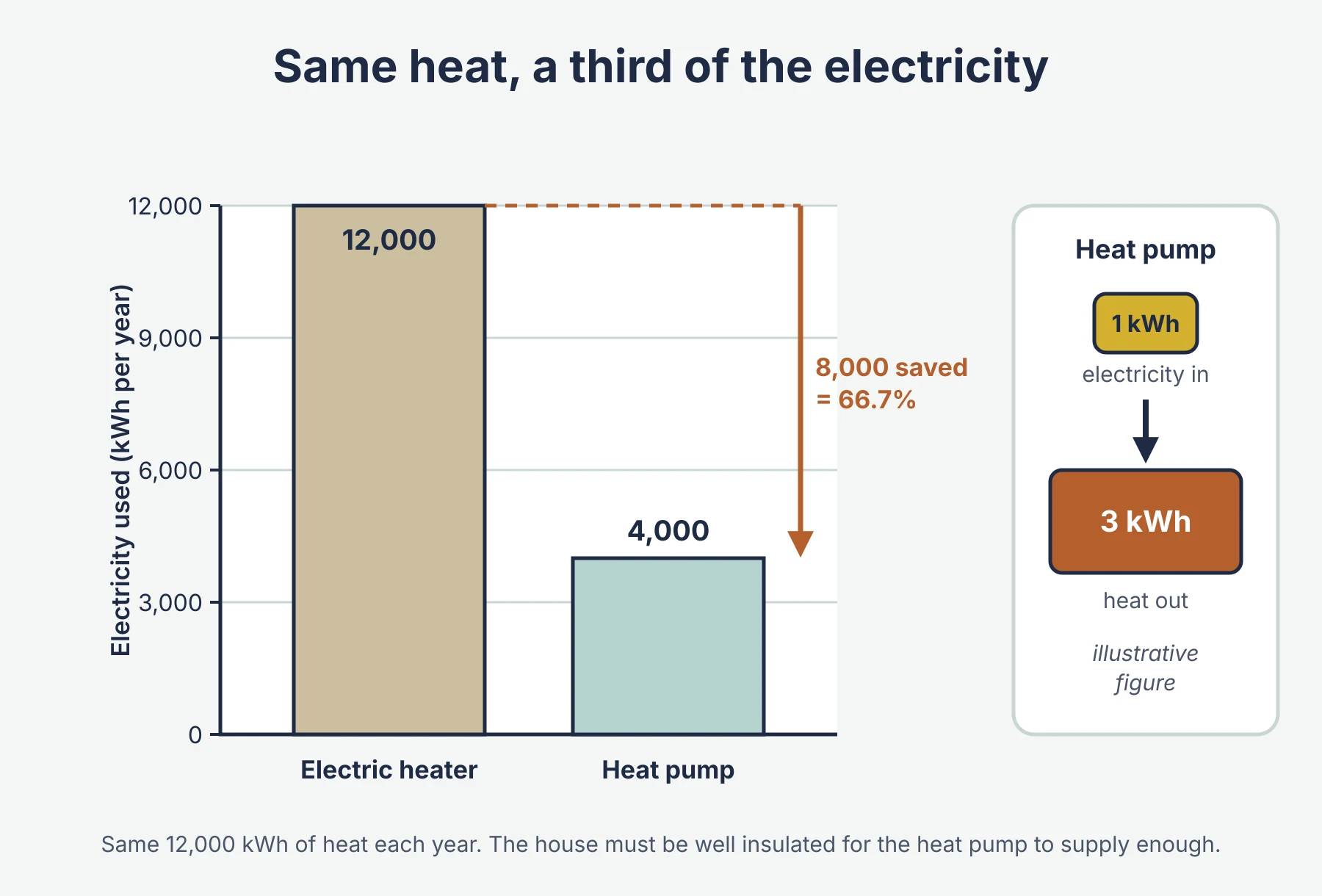
Heat pump facts: they use electricity but deliver more heat than the electrical energy they use; they work best in well-insulated buildings; no emissions on site.
Calculations to practise
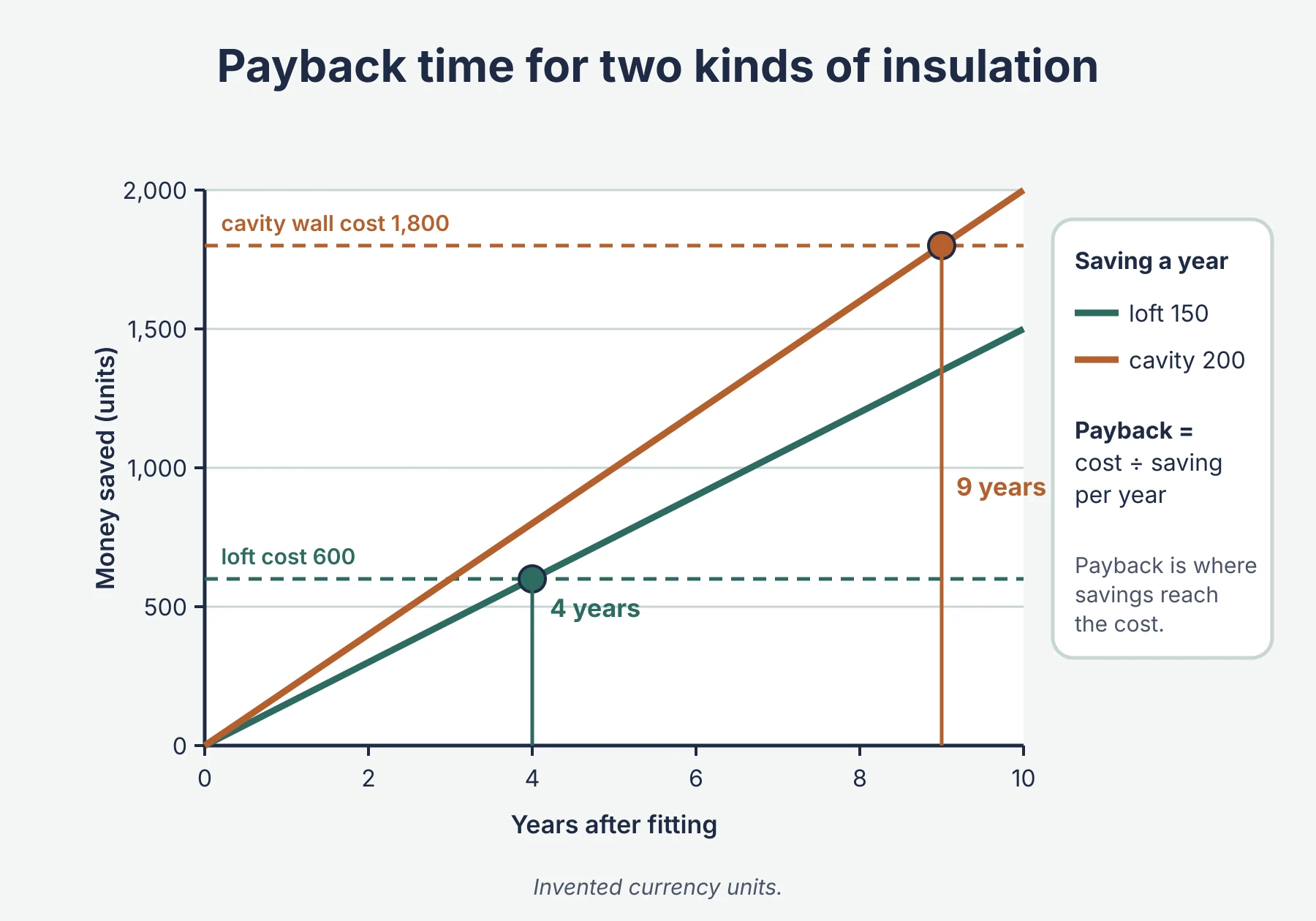
- Payback time (years) = cost ÷ saving per year.
- Energy (kWh) = power (kW) × time (h). Divide watts by 1,000 to get kilowatts.
- Percentage saving = saving ÷ original × 100.
Quick checks:
- Double glazing costing 3,000 and saving 250 a year: payback 3,000 ÷ 250 = 12 years.
- A 2 kW heater used 4 hours a day uses 2 × 4 = 8 kWh a day.
- Cutting use from 500 kWh to 400 kWh is a saving of 100 ÷ 500 × 100 = 20%.
Matching strategy to scale
- Household: reducing consumption, insulation, LED bulbs, rooftop solar with a battery, heat pump.
- Town or business: efficient lighting and motors, electric buses, park-and-ride, waste heat.
- Government: building regulations, efficiency standards, grants, fuel taxes, rail investment, green hydrogen funding, education campaigns.
Key terms
| Term | Meaning |
|---|---|
| Energy conservation | Using less energy, or using it more efficiently |
| Fuel cell | Device that combines hydrogen with oxygen to produce electricity, giving water as the product |
| Intermittent | Not available all the time, such as wind and solar output |
| Payback time | Time for savings to equal the cost of an improvement |
| Electrically propelled vehicle | Vehicle driven by electric motors, such as an electric car, bus, train or tram |
Exam traps
- Heat pumps transfer heat; they do not create it, and they need electricity.
- Blue hydrogen = natural gas; green hydrogen = renewable resources.
- Electric vehicles shift emissions to power stations if the grid uses fossil fuels.
- In a discuss answer, every strategy needs a benefit and a limitation.
- Payback time is cost divided by annual saving, not the other way round.
Self-test
- Name four strategies from 1.5.1 that reduce demand.
- What is blue hydrogen produced from?
- What is green hydrogen produced using?
- What is the only product when hydrogen is used in a fuel cell?
- How does a ground source heat pump heat a building?
- Give one advantage of an air source heat pump over a ground source heat pump.
- Why does battery storage help renewable energy?
- Give one limitation of electrically propelled vehicles.
- Insulation costs 900 and saves 180 a year. What is the payback time?
- How much energy does a 1.5 kW kettle use in 0.2 hours?
- Give two transport policies that reduce petroleum use.
- Why do heat pumps work best in well-insulated buildings?
Answers
- Any four: reducing consumption, insulation, energy-efficient devices, education, transport policies.
- Natural gas.
- Renewable resources (renewable electricity splitting water).
- Water.
- Fluid in buried pipes absorbs heat from the ground; the pump transfers and concentrates it to heat the building.
- Cheaper and easier to install; needs no land for trenches.
- It stores surplus electricity when the sun shines or the wind blows and releases it when needed.
- Any one: emissions depend on how the electricity is generated; high cost; few charging points; batteries need mined metals.
- 900 ÷ 180 = 5 years.
- 1.5 × 0.2 = 0.3 kWh.
- Any two: bus lanes, park-and-ride, cycle lanes, congestion charges, fuel taxes, car sharing, rail investment.
- Less heat escapes, so the pump’s steady, moderate heat output is enough to keep the building warm.
Where to go next
Practise with the Conservation and management of energy resources practice questions, then revise the Fracking revision notes.
Related resources
-
Revision notes
Cambridge IGCSE Environmental Management: Land — Revision Notes
Recall notes on soils and crop growth, food production and soil erosion for Topic 2 Land of Cambridge IGCSE Environmental Management 0680, 2027-2029 series.
Environmental Management · Cambridge · IGCSE
Revise topic -
Study guides
Cambridge IGCSE Environmental Management (0680): Energy resources
Fossil fuel formation, renewable and non-renewable classification, electricity generation and the factors driving energy demand, for Cambridge IGCSE 0680.
Environmental Management · Cambridge · IGCSE
Read guide -
Practice questions
Cambridge IGCSE Environmental Management (0680): Energy resources – Practice Questions
Original questions with answers on fossil fuel formation, classifying energy resources, electricity generation and energy demand for Cambridge IGCSE 0680.
Environmental Management · Cambridge · IGCSE
Try questions
Get free revision emails (optional)
Occasional emails with practice questions, worked explanations and links to free resources for the qualification and subjects you choose. No spam, and you can unsubscribe from any email. The free tools on this site never need an email.