
Study Guides
Cambridge IGCSE Environmental Management (0680): Extraction of rocks, ores and minerals
Mining methods, the factors behind extraction decisions, the impacts of mining and how damaged land is restored or repurposed, for Cambridge IGCSE 0680.
- Subject
- Environmental Management
- Level
- IGCSE
- Topic
- Topic 1 – Natural Resources
- Author
- Marlbridge Academic Team
- Updated
- Reviewed by
- Azam Siddique (what this means)
Aligned to Cambridge IGCSE Environmental Management (0680), 2027-2029. Official specification .
Syllabus page (what it covers and how it is assessed): Cambridge IGCSE Environmental Management.
Syllabus points this page covers
0680
- 1.2 Extraction of rocks, ores and minerals
Found an error? Report a correction.
Need help with this topic? Request a free trial class for IGCSE Environmental Management (0680).
Sub-topic 1.2 follows a mine through its whole life: deciding whether a deposit is worth extracting, choosing a method, living with the impacts while it operates, and dealing with the damaged land when it closes. Two of its six statements ask you to discuss, so expect extended answers based on a source about a proposed or working mine.
What the syllabus asks you to do
- 1.2.1 Define an ore as rock containing minerals and metals.
- 1.2.2 Describe surface extraction (opencast, open-pit, open-cut and strip mining), subsurface extraction (deep mining and shaft mining) and biological extraction (phytomining and bioleaching).
- 1.2.3 Describe eight factors that affect the decision to extract: exploration, geology, accessibility and terrain, quantity and quality of deposit (ore grade), climate, environmental impact assessment, supply and demand, cost and profit.
- 1.2.4 Describe and explain the environmental, economic and social impacts of extraction: habitat and biodiversity loss; air, land, noise, visual and water pollution; water usage; waste management; employment; local and national economies; facilities and infrastructure.
- 1.2.5 Describe land restoration (replacement of overburden, soil improvement, bioremediation, tree planting) and repurposing land (landfill, lakes, recreation, nature reserves).
- 1.2.6 Discuss the benefits and limitations of these management strategies.
Methods of extraction
Surface extraction
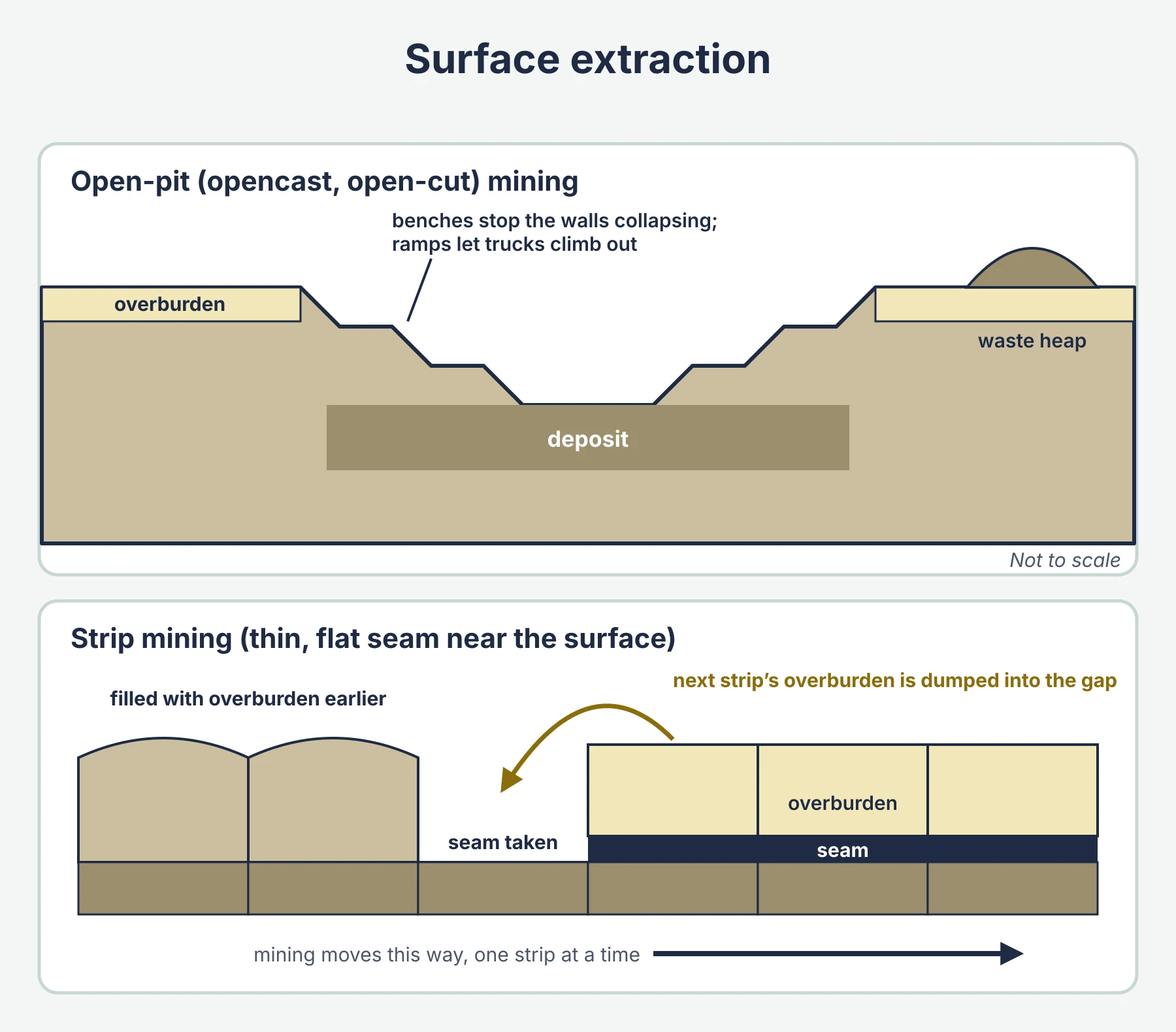
Surface methods remove the soil and rock lying over a deposit, called overburden, and dig the deposit out from above. They suit deposits that lie fairly close to the surface.
- Opencast, open-pit and open-cut mining are closely related terms for digging a large, deep hole down to the deposit. The sides are cut into steps (benches) so that the walls do not collapse and so that trucks can climb out on ramps. Rock is broken up by blasting and loaded by large machines.
- Strip mining is used where a deposit, such as a coal seam, lies in a thin, flat layer near the surface. The overburden is removed in long strips; once the deposit in one strip has been taken, the overburden from the next strip is dumped into the gap left behind.
Surface methods are usually cheaper and safer for workers than underground mining and recover most of the deposit, but they disturb a very large area and create large heaps of waste.
Subsurface extraction
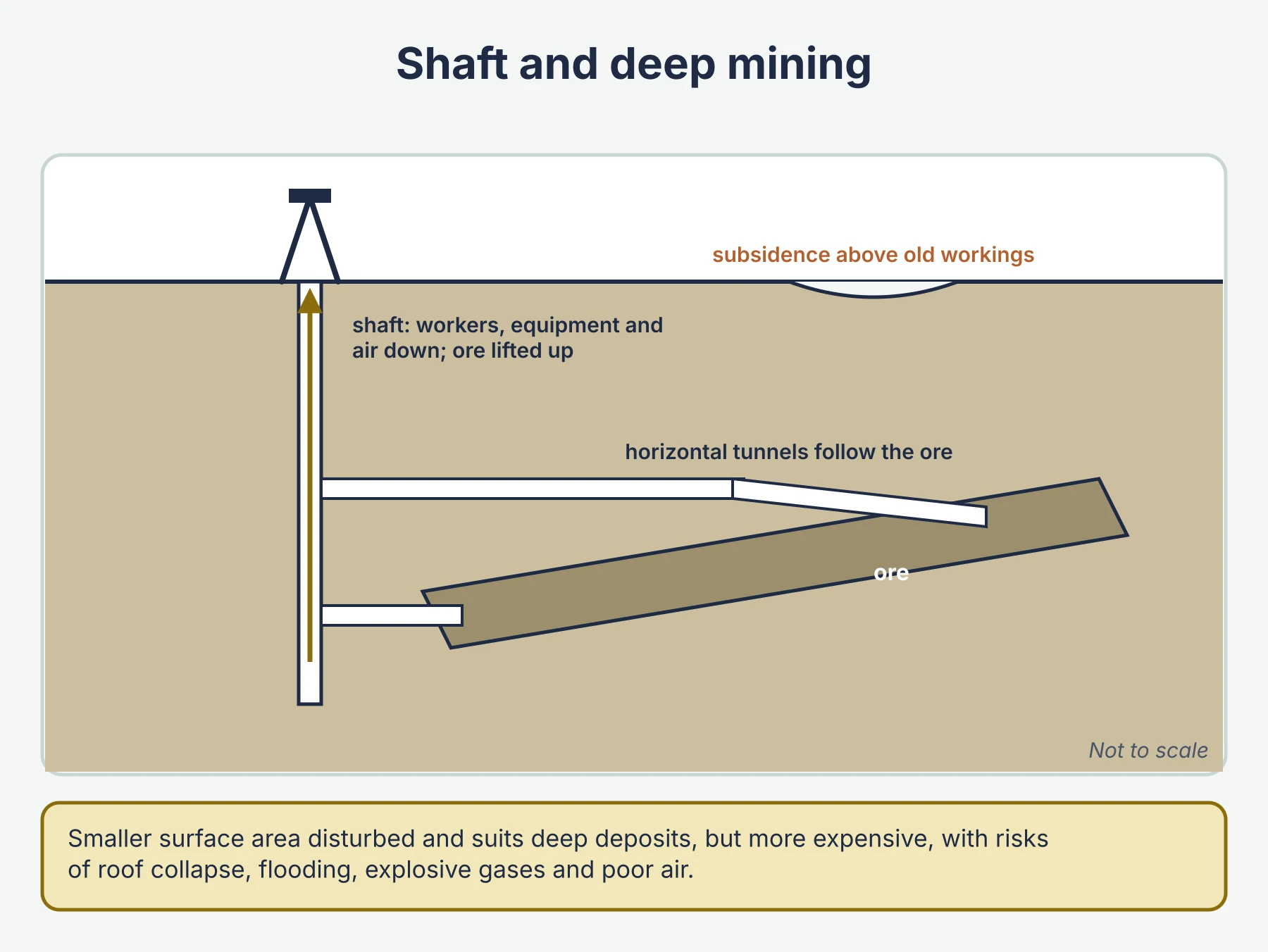
- Shaft mining sinks a vertical shaft from the surface down to the deposit. Workers, equipment and air go down the shaft, and ore is lifted up it.
- Deep mining reaches deposits far below the surface through shafts and a network of horizontal tunnels that follow the ore.
Underground methods disturb a smaller surface area and suit deep deposits, but they are more expensive and carry risks for miners such as roof collapse, flooding, explosive gases and poor air. The ground above old workings can sink (subsidence).
Biological extraction
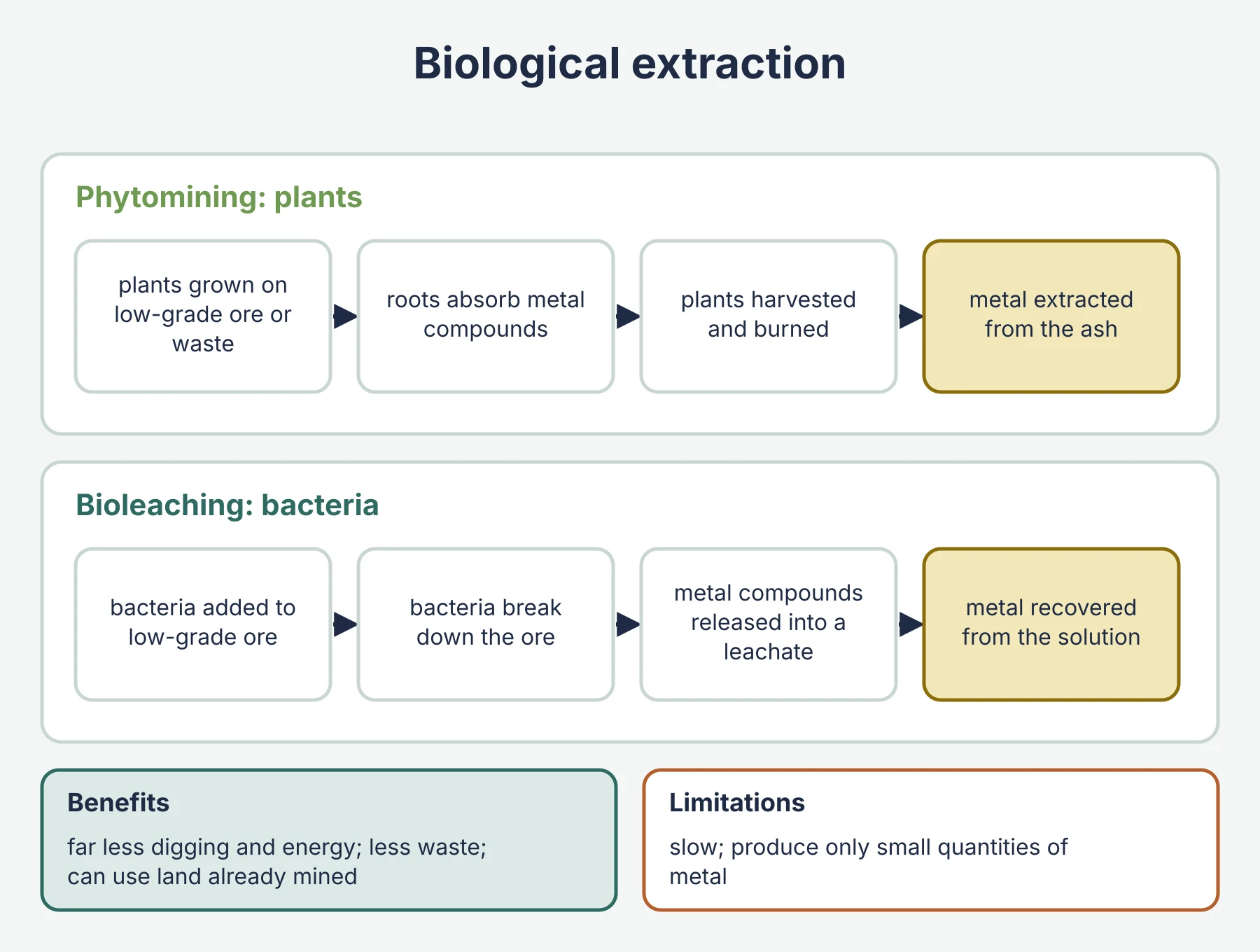
Biological methods use living organisms to recover metals from low-grade ore or mine waste that would be too expensive to process conventionally.
- Phytomining: plants that absorb metal compounds through their roots are grown on low-grade ore or waste. The plants are harvested and burned, and the metal is extracted from the ash.
- Bioleaching: bacteria break down the ore and release metal compounds into a solution (the leachate), from which the metal is recovered.
Both are slow and produce small quantities, but they need far less digging and energy, produce less waste, and can recover metal from land that has already been mined.
Factors in the decision to extract
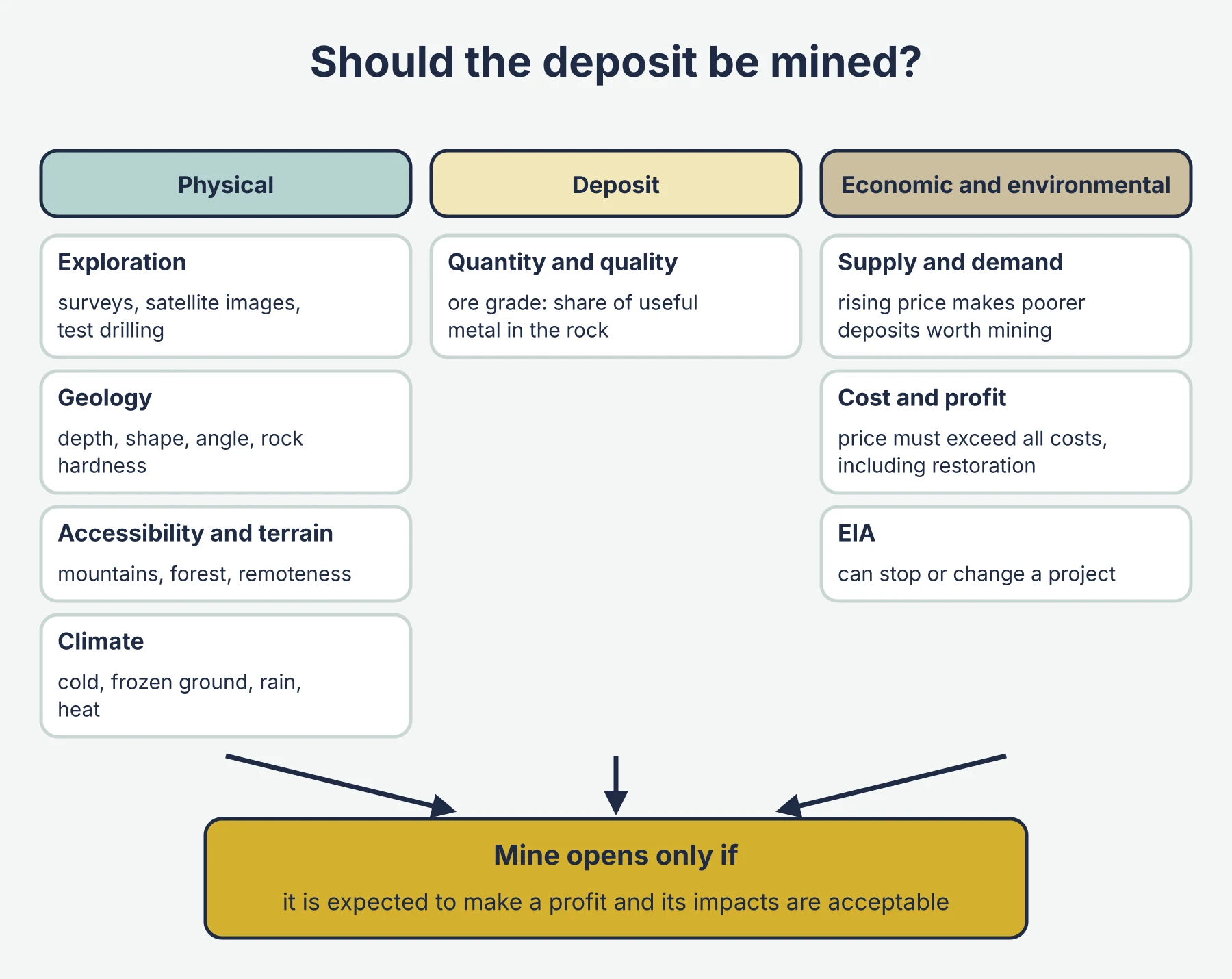
A mine opens only if it is expected to make a profit and its impacts are acceptable. The eight factors fit three groups.
Physical factors
- Exploration: geological surveys, satellite images and test drilling show where a deposit is and how large it is. Without exploration there is no evidence on which to base a decision.
- Geology: the depth, shape and angle of the deposit and the hardness of the surrounding rock decide which method is possible and how costly it will be.
- Accessibility and terrain: steep mountains, dense forest or remote locations make it expensive to bring in machinery and take the ore out.
- Climate: extreme cold, frozen ground, heavy rainfall or extreme heat slow work, damage equipment and limit the working season.
Deposit factors
- Quantity and quality of deposit (ore grade): ore grade is the proportion of the useful metal or mineral in the rock. A large deposit with a high grade means less rock must be dug and processed for each tonne of metal.
Economic and environmental factors
- Supply and demand: when demand rises faster than supply, the price rises and lower-grade or less accessible deposits become worth mining.
- Cost and profit: the expected selling price must exceed the costs of exploration, extraction, processing, transport, wages and restoration.
- Environmental impact assessment (EIA): a study, carried out before permission is granted, of the likely effects of the project on the environment and people, with proposals to reduce them. An unfavourable EIA can stop or change a project.
Impacts of extraction
Learn the impacts in three columns so that an extended answer can balance them.
| Environmental | Economic | Social |
|---|---|---|
| Loss of habitat and biodiversity as vegetation and soil are cleared | Creates jobs in mining and supporting businesses | New roads, power and water supplies can serve local communities |
| Dust and exhaust fumes (air pollution); spoil heaps (land pollution) | Taxes and export earnings for the national economy | Noise from blasting and trucks; visual impact of pits and heaps |
| Run-off of sediment and toxic chemicals into rivers (water pollution) | Local businesses gain customers | Jobs may go to skilled workers from outside the area |
| Large water usage for processing and dust control, competing with farms and homes | Income may fall sharply when the mine closes | Communities may be relocated; health problems from dust or polluted water |
| Waste rock and tailings must be stored safely; failures can release pollution | Prices for metals can rise and fall, making jobs insecure | Loss of farmland or traditional land use |
Waste management deserves its own line in an answer. Most of the rock dug from a low-grade mine is waste. Tailings, the fine waste left after processing, may contain toxic substances and are often stored behind dams. A failed tailings dam can release mud and contaminated water into rivers downstream.
Managing damaged landscapes
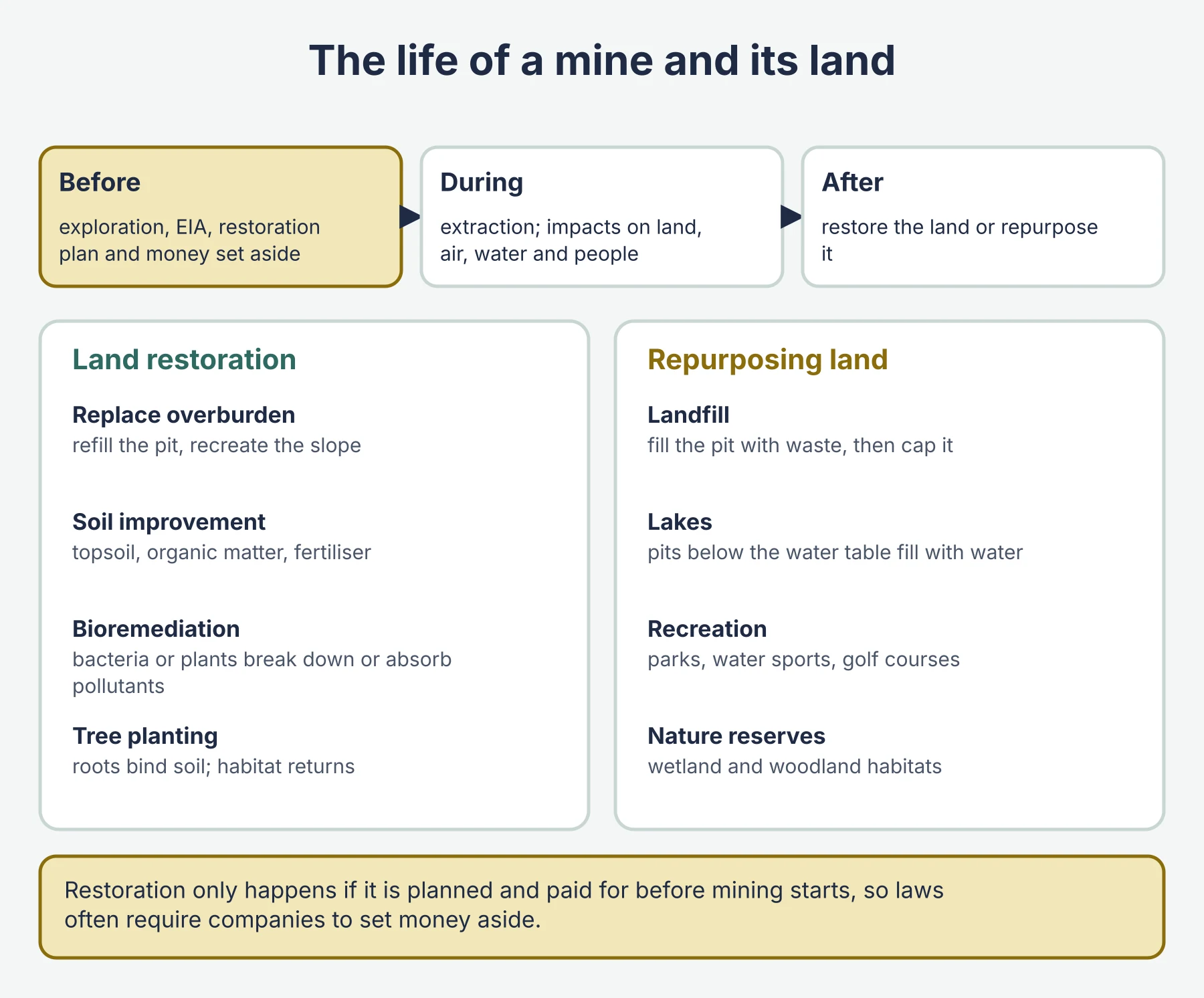
Land restoration
- Replacement of overburden: the soil and rock removed at the start is stored and put back to refill the pit and recreate the original slope.
- Soil improvement: adding topsoil, organic matter and fertiliser so that plants can grow on the restored land.
- Bioremediation: using organisms, such as bacteria or plants, to break down or absorb pollutants in the soil and water.
- Tree planting: re-establishes vegetation, binds the soil with roots, reduces erosion and provides habitat.
Repurposing land
- Landfill: an empty pit is used to dispose of waste, then capped and landscaped.
- Lakes: pits below the water table fill naturally with water and can be used for water storage or fishing.
- Recreation: lakes and landscaped areas become parks, water sports centres or golf courses.
- Nature reserves: wetlands and new woodland create habitats and may attract wildlife and visitors.
Benefits and limitations (1.2.6)
| Strategy | Benefits | Limitations |
|---|---|---|
| Replacing overburden | Returns land to something like its original shape | Costly; the original ecosystem may take decades to return |
| Soil improvement and tree planting | Reduces erosion; restores habitat and appearance | Trees grow slowly; polluted ground may stop plants growing |
| Bioremediation | Cleans pollution without digging the soil away | Slow; works only for some pollutants |
| Landfill | Fills the hole and earns income | Risk of leachate and methane; may still be unsightly |
| Lakes, recreation and nature reserves | New jobs, tourism and habitats | Steep pit sides can be dangerous; water may be polluted |
The best answers make the point that restoration only happens if it is planned and paid for before mining starts. That is why laws often require companies to set money aside for restoration.
Worked example 1: ore grade calculation
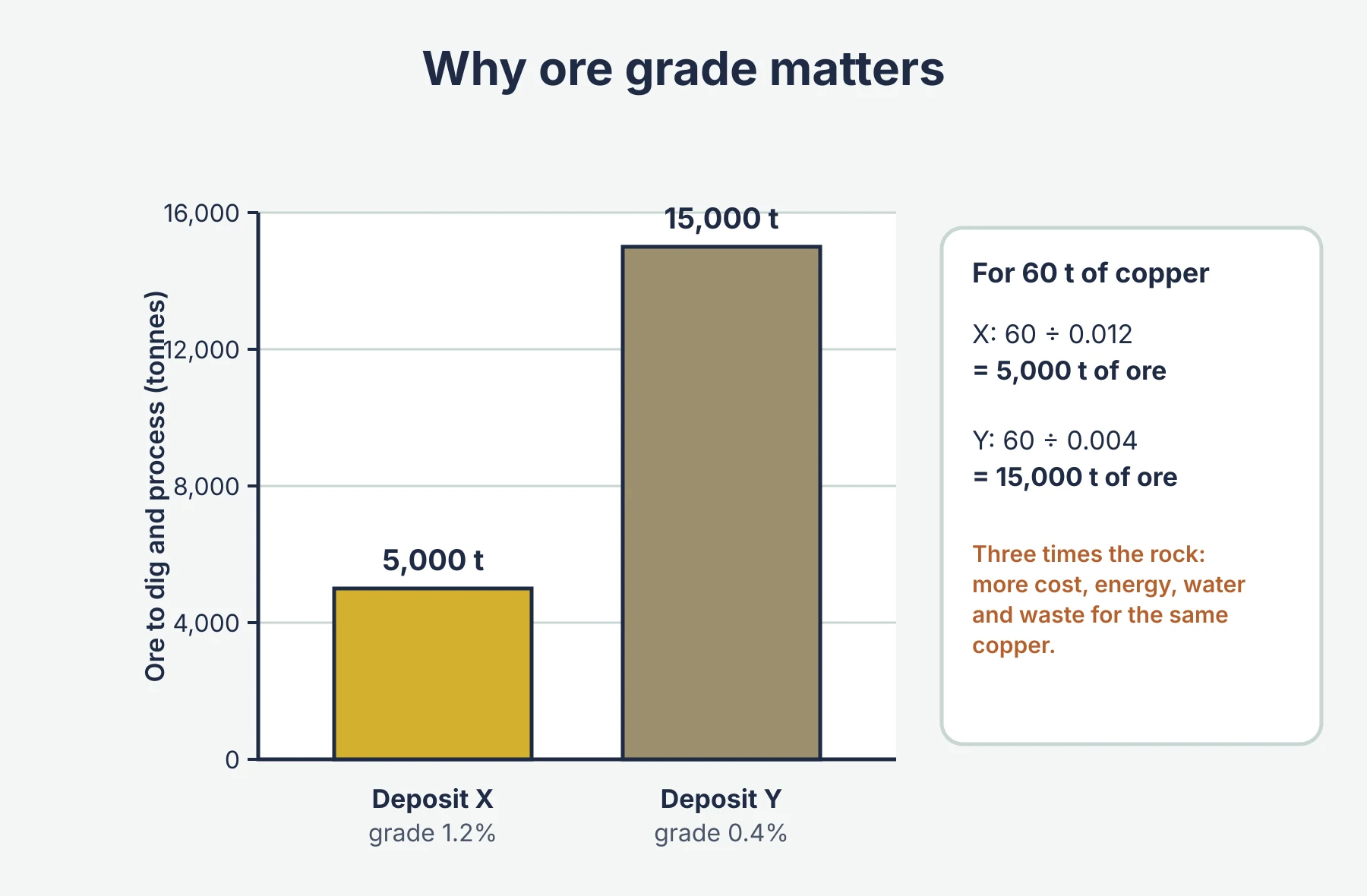
A company needs 60 tonnes of copper. Deposit X has an ore grade of 1.2% copper; deposit Y has 0.4%.
- Deposit X: 60 ÷ 0.012 = 5,000 tonnes of ore.
- Deposit Y: 60 ÷ 0.004 = 15,000 tonnes of ore.
Deposit Y requires three times as much rock to be dug, moved and processed, so it costs more, uses more energy and water, and creates more waste for the same copper. This is why ore grade is a key factor, and why low-grade deposits are candidates for bioleaching.
Worked example 2: a “discuss” answer
Question: A company proposes an open-pit mine in a forested valley near a village. Discuss the impacts of the proposal.
Annotated model answer (outline):
- Environmental: clearing the forest destroys habitat and reduces biodiversity; sediment run-off pollutes the river the village uses. (Two impacts, each explained.)
- Economic: jobs for villagers and income for local shops; taxes for the government. (Positive impacts balance the answer.)
- Social: blasting noise and dust affect health; a new road may give the village access to a hospital. (Uses the scenario.)
- Judgement: the mine could be acceptable if the EIA leads to controls such as dust suppression and a restoration plan, but the village’s water supply is the greatest risk. (Reaches a reasoned conclusion.)
Common mistakes
- Defining an ore as “a rock with metal in it that is profitable to mine”: use the syllabus wording.
- Mixing up the two biological methods: phytomining uses plants; bioleaching uses bacteria.
- Calling strip mining an underground method.
- Listing impacts without saying whether they are environmental, economic or social.
- Treating an EIA as the same as restoration. The EIA happens before extraction.
Exam technique
Describe questions on methods want the sequence of what happens. Explain questions on factors want the link: “high ore grade, so less rock is processed per tonne of metal, so costs are lower”. For discuss, give benefits and limitations, refer to the source, and finish with a judgement.
Condense the content with the Extraction of rocks, ores and minerals revision notes and test it with the Extraction of rocks, ores and minerals practice questions. Then see how finite minerals can be conserved in the Sustainable management of rocks, ores and minerals study guide.
Related resources
-
Revision notes
Cambridge IGCSE Environmental Management: Land — Revision Notes
Recall notes on soils and crop growth, food production and soil erosion for Topic 2 Land of Cambridge IGCSE Environmental Management 0680, 2027-2029 series.
Environmental Management · Cambridge · IGCSE
Revise topic -
Practice questions
Cambridge IGCSE Environmental Management (0680): Extraction of rocks, ores and minerals – Practice Questions
Original practice questions with full answers on mining methods, ore grade, extraction decisions, impacts and land restoration for Cambridge IGCSE 0680.
Environmental Management · Cambridge · IGCSE
Try questions -
Revision notes
Cambridge IGCSE Environmental Management (0680): Extraction of rocks, ores and minerals – Revision Notes
Recall notes on mining methods, extraction factors, impacts and land restoration for 1.2 Extraction of rocks, ores and minerals, Cambridge IGCSE 0680.
Environmental Management · Cambridge · IGCSE
Revise topic
Get free revision emails (optional)
Occasional emails with practice questions, worked explanations and links to free resources for the qualification and subjects you choose. No spam, and you can unsubscribe from any email. The free tools on this site never need an email.