
Revision Notes
Cambridge IGCSE Environmental Management (0680): Marine aquaculture – Revision Notes
Recall notes on overfishing, bycatch, the eight impacts of marine aquaculture and nine harvest management strategies for Cambridge IGCSE 0680.
- Subject
- Environmental Management
- Level
- IGCSE
- Topic
- Topic 3 – Water
- Author
- Marlbridge Academic Team
- Updated
- Reviewed by
- Azam Siddique (what this means)
Aligned to Cambridge IGCSE Environmental Management (0680), 2027-2029. Official specification .
Syllabus page (what it covers and how it is assessed): Cambridge IGCSE Environmental Management.
Syllabus points this page covers
0680
- 3.4 Marine aquaculture
Found an error? Report a correction.
Need help with this topic? Request a free trial class for IGCSE Environmental Management (0680).
Condensed notes for sub-topic 3.4 of Cambridge IGCSE Environmental Management (0680). The marine aquaculture study guide has the full explanations and two worked examples.
How the sub-topic fits together
Exploitation of wild species (3.4.1) → aquaculture as one response (3.4.2, 3.4.3) → managing the wild harvest (3.4.4) → evaluating that management (3.4.5). A long answer often travels the whole chain.
3.4.1 Impacts of exploitation
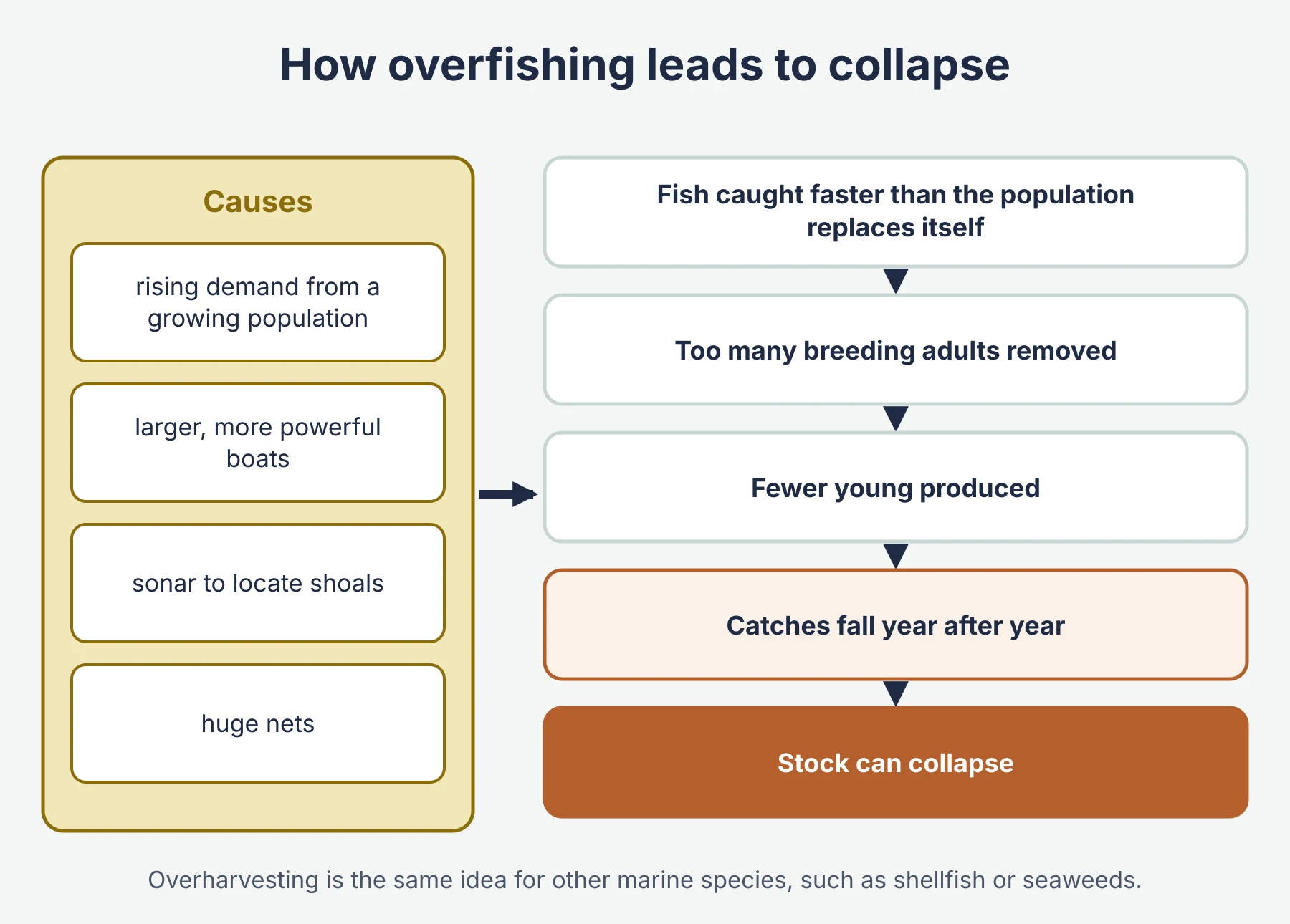
- Overfishing and overharvesting: species removed faster than they reproduce and grow; breeding stock shrinks; catches fall; stocks can collapse.
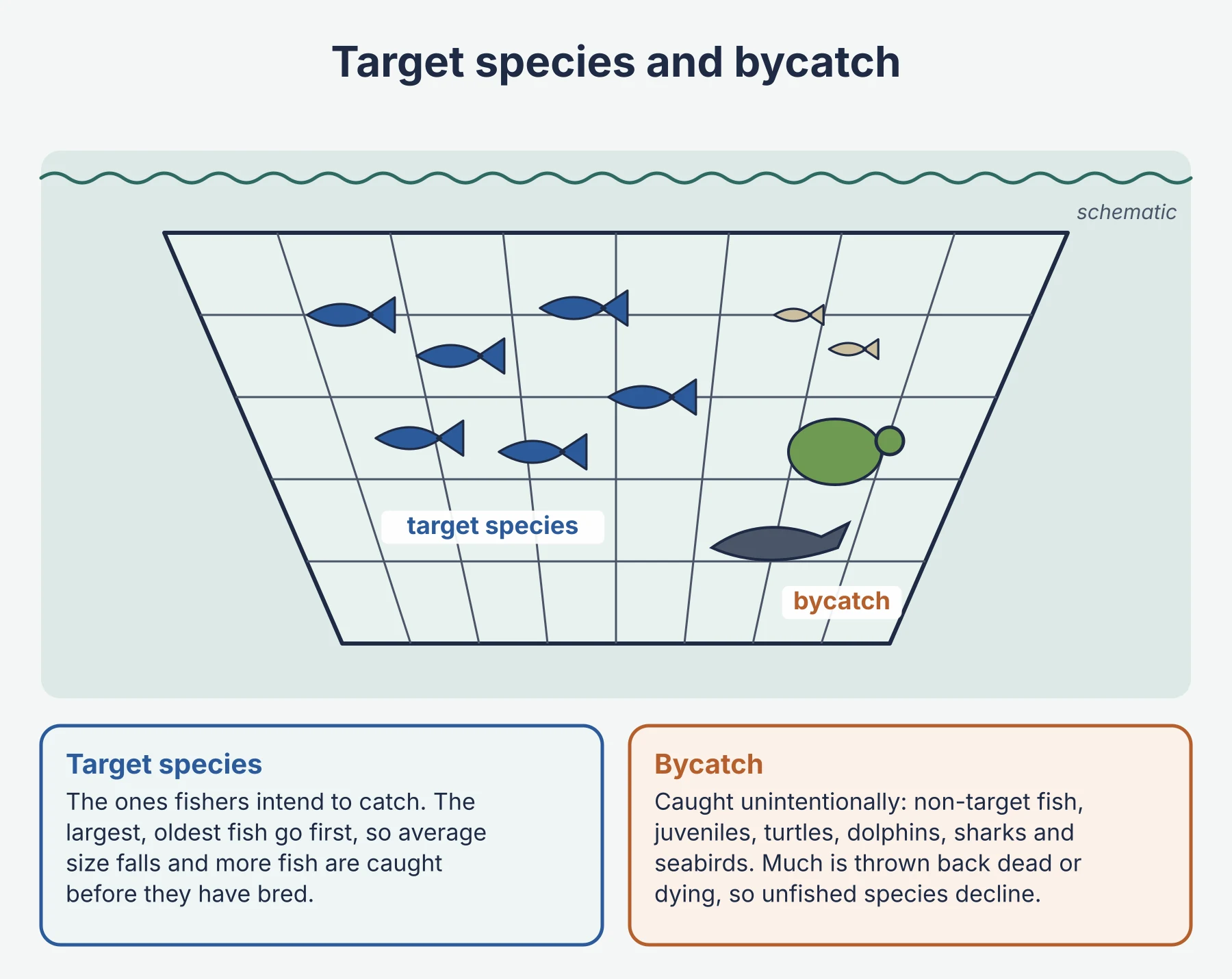
- Target species: the largest, oldest fish go first; average size falls; many fish caught before breeding.
- Bycatch species: non-target fish, juveniles, turtles, dolphins, sharks, seabirds caught and often discarded dead.
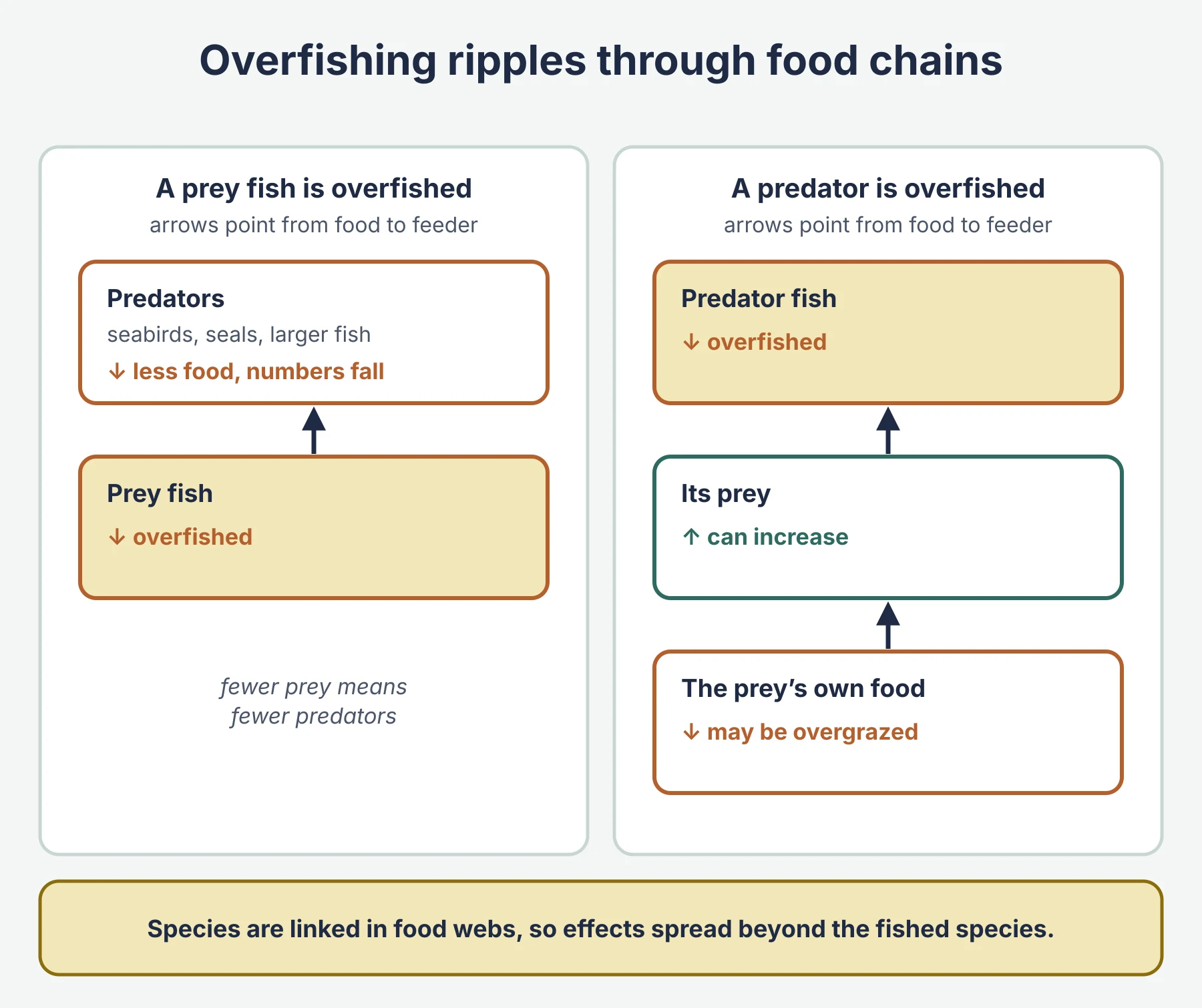
- Food chains: prey removed → predators starve and decline; predator removed → prey increase and may overgraze their food.
3.4.2 Definition
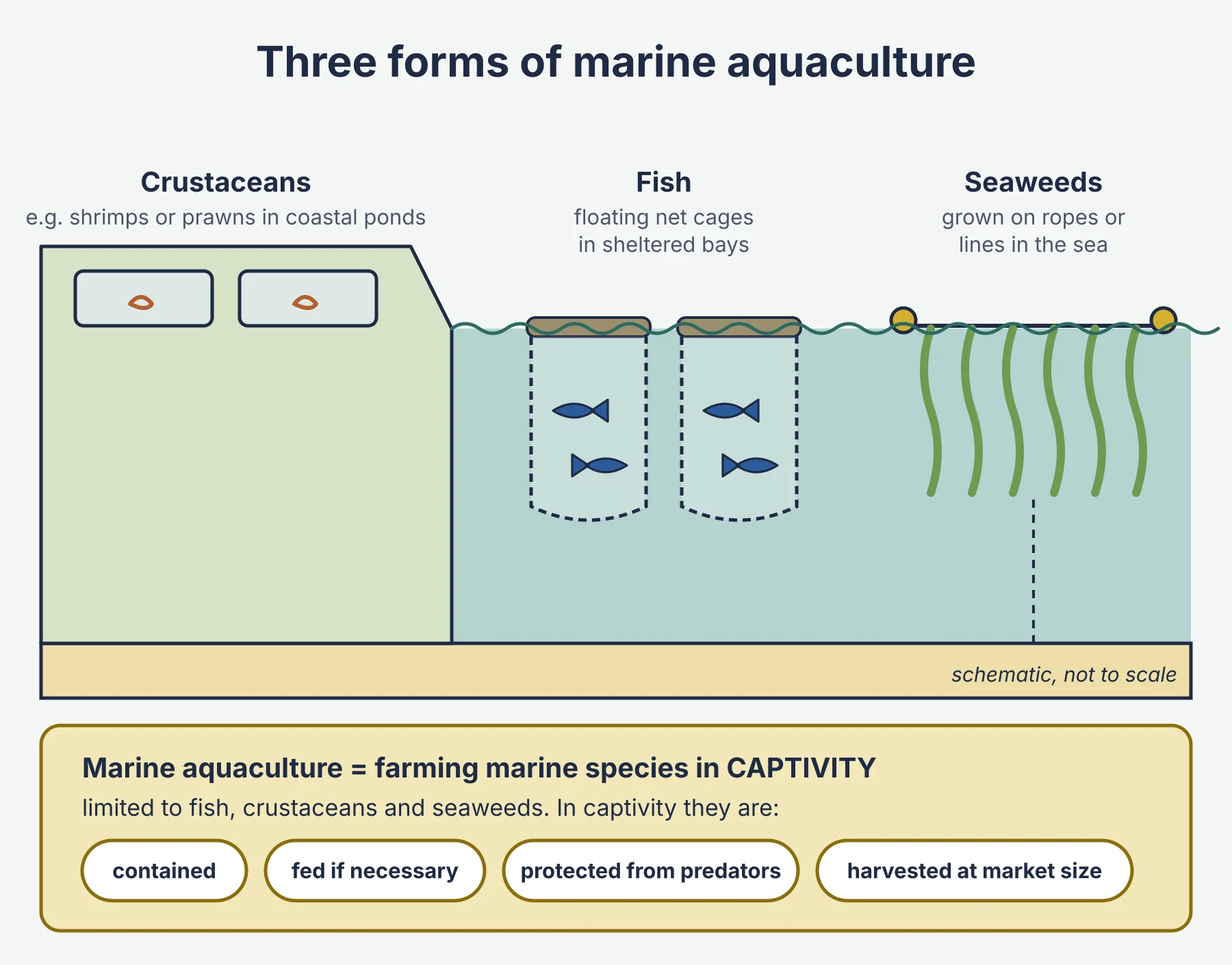
Marine aquaculture: the farming of marine species in captivity, limited to fish, crustaceans and seaweeds. No specific species needed.
Typical systems: fish in floating net cages; crustaceans in coastal ponds; seaweeds on ropes or lines.
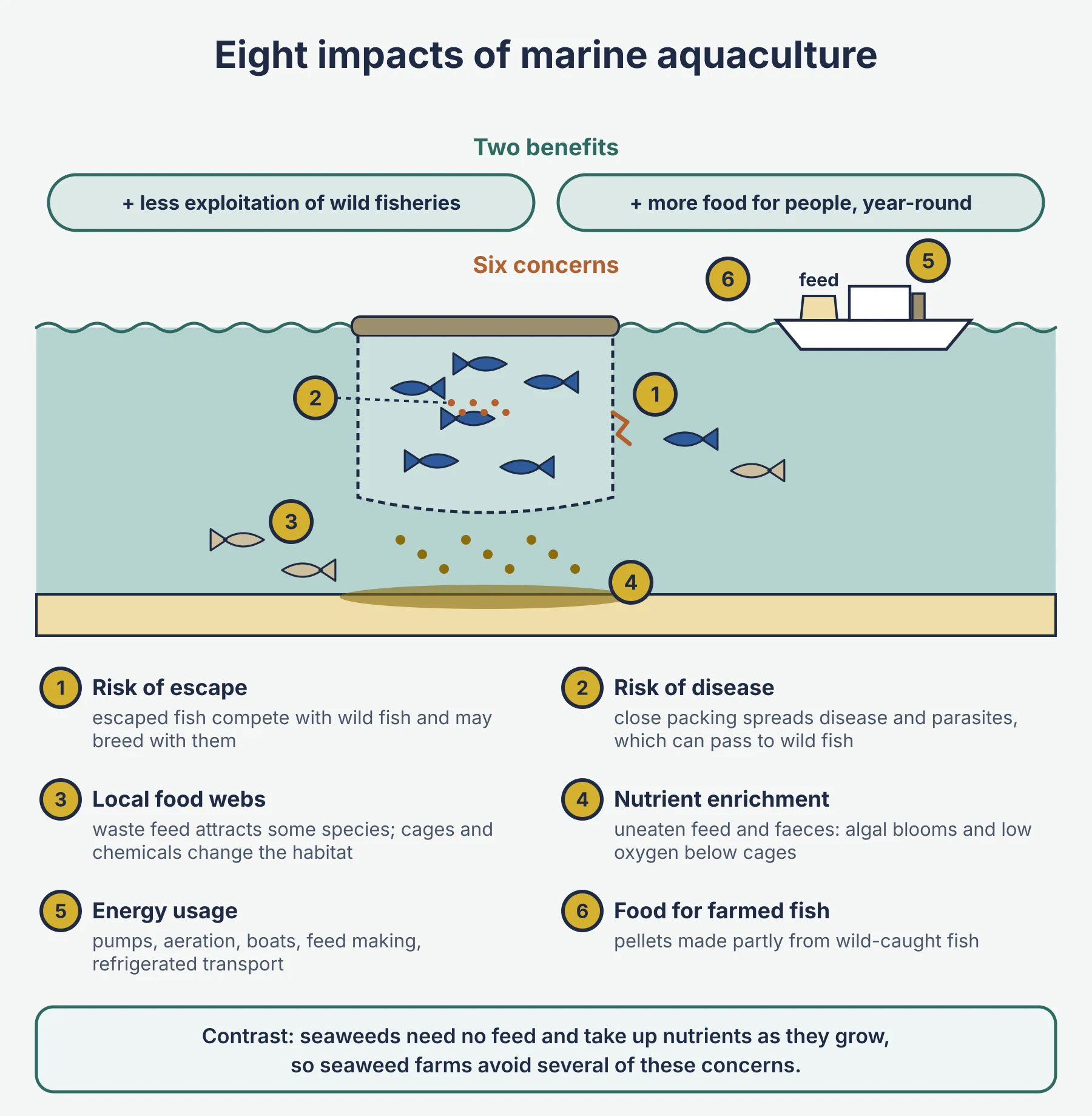
3.4.3 The eight impacts
Positive
- Reduced exploitation of natural fisheries.
- Increased food supply for humans.
Negative
- Risk of escape: competition and interbreeding with wild stock.
- Risk of disease: crowding spreads disease and parasites, which can reach wild populations.
- Local food webs: habitat change and waste feed alter the species around farms.
- Nutrient enrichment from waste: uneaten feed and faeces → algal blooms, low oxygen.
- Energy usage: pumps, aeration, boats, feed manufacture, refrigeration.
- Source of food for farmed species: fishmeal from wild-caught fish keeps wild fishing going.
Seaweed contrast: no feed, absorbs nutrients from water.
3.4.4 Nine harvest strategies
| Strategy | What it controls | Limitation to quote |
|---|---|---|
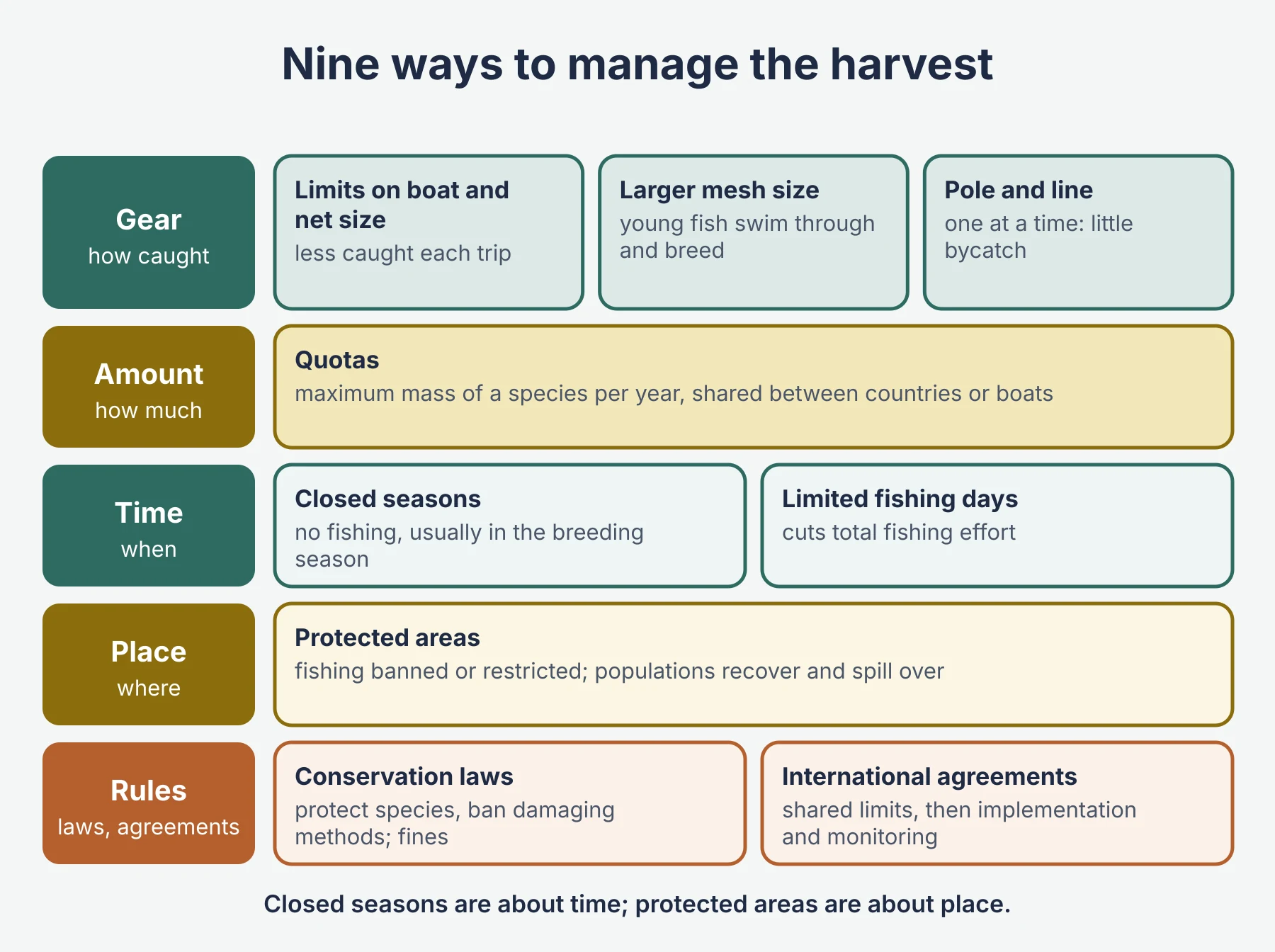
| Limits on boat and net size | Amount caught per trip | Fleets may add more boats |
| Larger mesh size | Age and size of fish caught | Does not limit total catch |
| Pole and line | Bycatch | Lower catch, so less income per trip |
| Quotas | Total mass caught | Hard to check at sea; discards |
| Closed seasons | When fishing happens | Effort concentrated into open season |
| Limited fishing days | Total effort | More intensive fishing on allowed days |
| Protected areas | Where fishing happens | Need patrols; fishing moves to edges |
| Conservation laws | Protected species and banned methods | Only as strong as enforcement |
| International agreements | Shared stocks across borders | Need implementation and monitoring; some countries may not sign |
Key terms
| Term | Meaning |
|---|---|
| Overfishing | Catching fish faster than the population can be replaced |
| Target species | The species fishers intend to catch |
| Bycatch | Organisms caught unintentionally |
| Marine aquaculture | Farming of marine species in captivity |
| Crustaceans | Shellfish with hard external skeletons, such as shrimps, prawns, crabs |
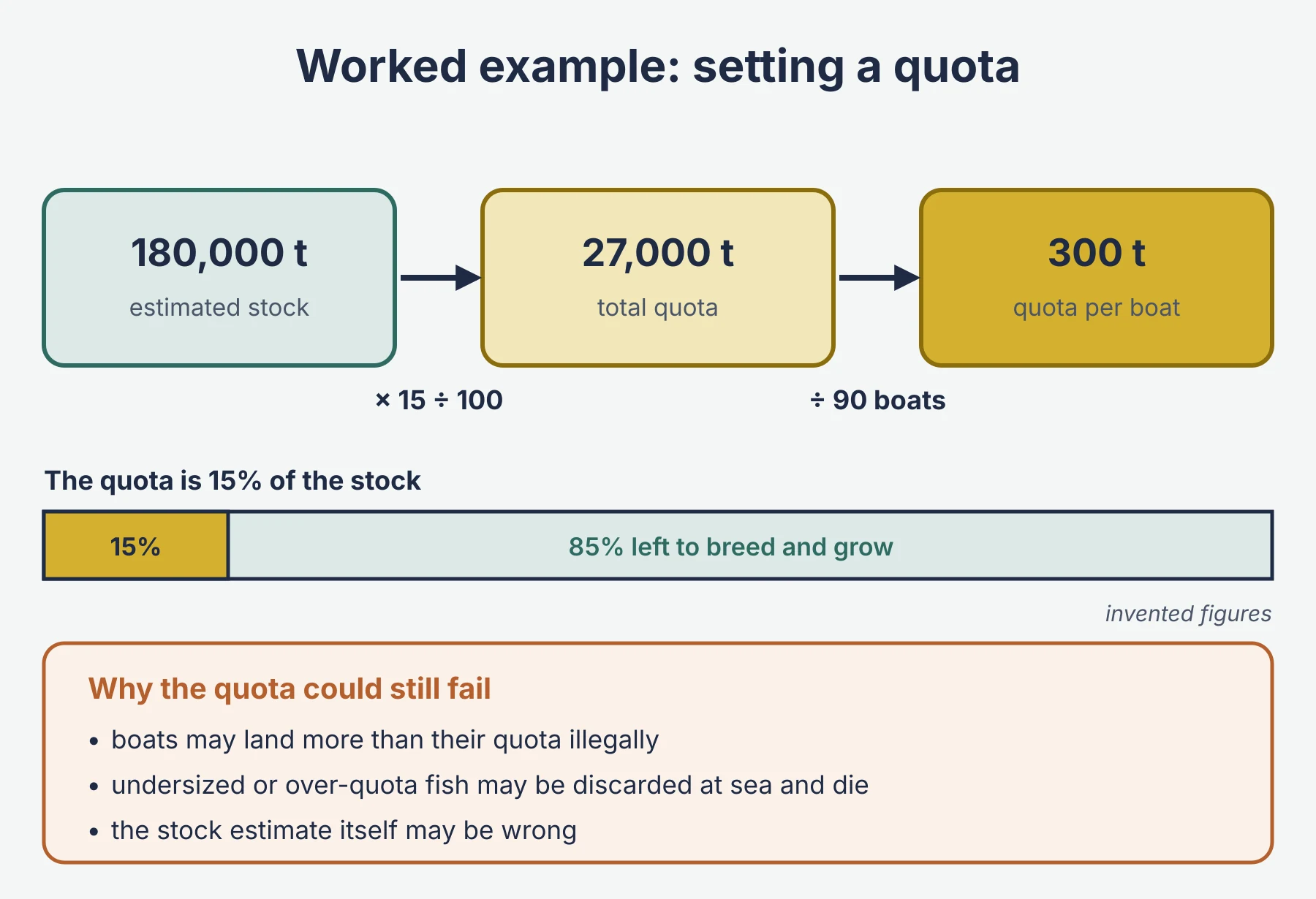
| Quota | Maximum mass of a species allowed to be caught in a period |
| Closed season | Period, often the breeding season, when fishing is banned |
| Mesh size | Size of the holes in a net |
| Protected area | A zone where fishing is banned or restricted |
| Fishmeal | Feed made from ground-up fish, used for farmed fish |
Calculation patterns
- Quota from stock: stock × allowed percentage / 100. With invented figures, 50,000 tonnes × 12 / 100 = 6,000 tonnes.
- Percentage change in catch: (new − old) / old × 100. A fall from 40,000 to 26,000 tonnes is −14,000 / 40,000 × 100 = −35%.
- Feed ratio: if 3 kg of wild fish in feed produces 1 kg of farmed fish, the farm uses more wild fish than it produces, so it does not reduce exploitation.
Exam traps
- Writing “fish farming” as the definition. Use the full syllabus wording, including crustaceans and seaweeds.
- Treating aquaculture as wholly positive or wholly negative. The syllabus has two benefits and six concerns; balance them.
- Saying a bigger mesh size catches more fish. It lets juveniles escape so they can breed.
- Forgetting that bycatch includes juveniles of the target species.
- Leaving out “implementation and monitoring” when describing international agreements.
- Mixing up closed seasons (time) and protected areas (place).
Self-test
- Define overfishing.
- What is bycatch? Give two examples.
- How can overfishing a prey species affect seabirds?
- Define marine aquaculture using the syllabus wording.
- State the three groups of organisms the syllabus includes in marine aquaculture.
- Give the two benefits of marine aquaculture named in the syllabus.
- Explain how fish-farm waste causes nutrient enrichment.
- Why might a farm raising carnivorous fish not reduce pressure on wild fisheries?
- How does increasing mesh size help fish stocks?
- Why is pole and line described as sustainable?
- What is the difference between a closed season and a protected area?
- A stock of 240,000 tonnes has an allowed catch of 10%. What is the quota?
Answers
- Catching fish faster than the population can replace itself by reproduction.
- Organisms caught unintentionally; any two of turtles, dolphins, sharks, seabirds, non-target fish, juveniles.
- Seabirds that feed on the prey have less food, so their breeding success and numbers fall.
- The farming of marine species in captivity.
- Fish, crustaceans and seaweeds.
- Reduced exploitation of natural fisheries; increased food supply for humans.
- Uneaten feed and faeces add nutrients and organic matter to the water, leading to algal growth and low oxygen.
- Its feed is made partly from wild-caught fish, so wild fishing continues to supply it.
- Young fish escape through the holes, survive to breed and replace the population.
- Fish are caught one at a time, so bycatch is very low and unwanted fish can be released alive.
- A closed season bans fishing at a certain time; a protected area bans or limits fishing in a certain place.
- 240,000 × 10 / 100 = 24,000 tonnes.
Linked pages
Test yourself with the marine aquaculture practice questions, and link nutrient enrichment to the water pollution revision notes.
Related resources
-
Revision notes
Cambridge IGCSE Environmental Management: Land — Revision Notes
Recall notes on soils and crop growth, food production and soil erosion for Topic 2 Land of Cambridge IGCSE Environmental Management 0680, 2027-2029 series.
Environmental Management · Cambridge · IGCSE
Revise topic -
Study guides
Cambridge IGCSE Environmental Management (0680): Oil pollution
Causes and impacts of marine oil pollution, MARPOL, double hulls and clean-up methods with their limitations for Cambridge IGCSE Environmental Management 0680.
Environmental Management · Cambridge · IGCSE
Read guide -
Practice questions
Cambridge IGCSE Environmental Management (0680): Oil pollution – Practice Questions
Original practice questions with mark-scheme answers on oil pollution causes, impacts, prevention and clean-up for Cambridge IGCSE 0680.
Environmental Management · Cambridge · IGCSE
Try questions
Get free revision emails (optional)
Occasional emails with practice questions, worked explanations and links to free resources for the qualification and subjects you choose. No spam, and you can unsubscribe from any email. The free tools on this site never need an email.