
Study Guides
Cambridge IGCSE Environmental Management (0680): Oil pollution
Causes and impacts of marine oil pollution, MARPOL, double hulls and clean-up methods with their limitations for Cambridge IGCSE Environmental Management 0680.
- Subject
- Environmental Management
- Level
- IGCSE
- Topic
- Topic 3 – Water
- Author
- Marlbridge Academic Team
- Updated
- Reviewed by
- Azam Siddique (what this means)
Aligned to Cambridge IGCSE Environmental Management (0680), 2027-2029. Official specification .
Syllabus page (what it covers and how it is assessed): Cambridge IGCSE Environmental Management.
Syllabus points this page covers
0680
- 3.5 Oil pollution
Found an error? Report a correction.
Need help with this topic? Request a free trial class for IGCSE Environmental Management (0680).
Sub-topic 3.5 of Cambridge IGCSE Environmental Management (0680) follows a clear sequence: the causes of oil pollution in marine and coastal ecosystems, its impacts on seven named groups, the strategies that prevent spills, and the strategies that minimise the damage once a spill has happened. Every list in the syllabus is closed (“limited to”), so the aim is to know each named item well enough to explain how it works and where it falls short. For the wider topic, see the Water study guide.
Why oil behaves as it does
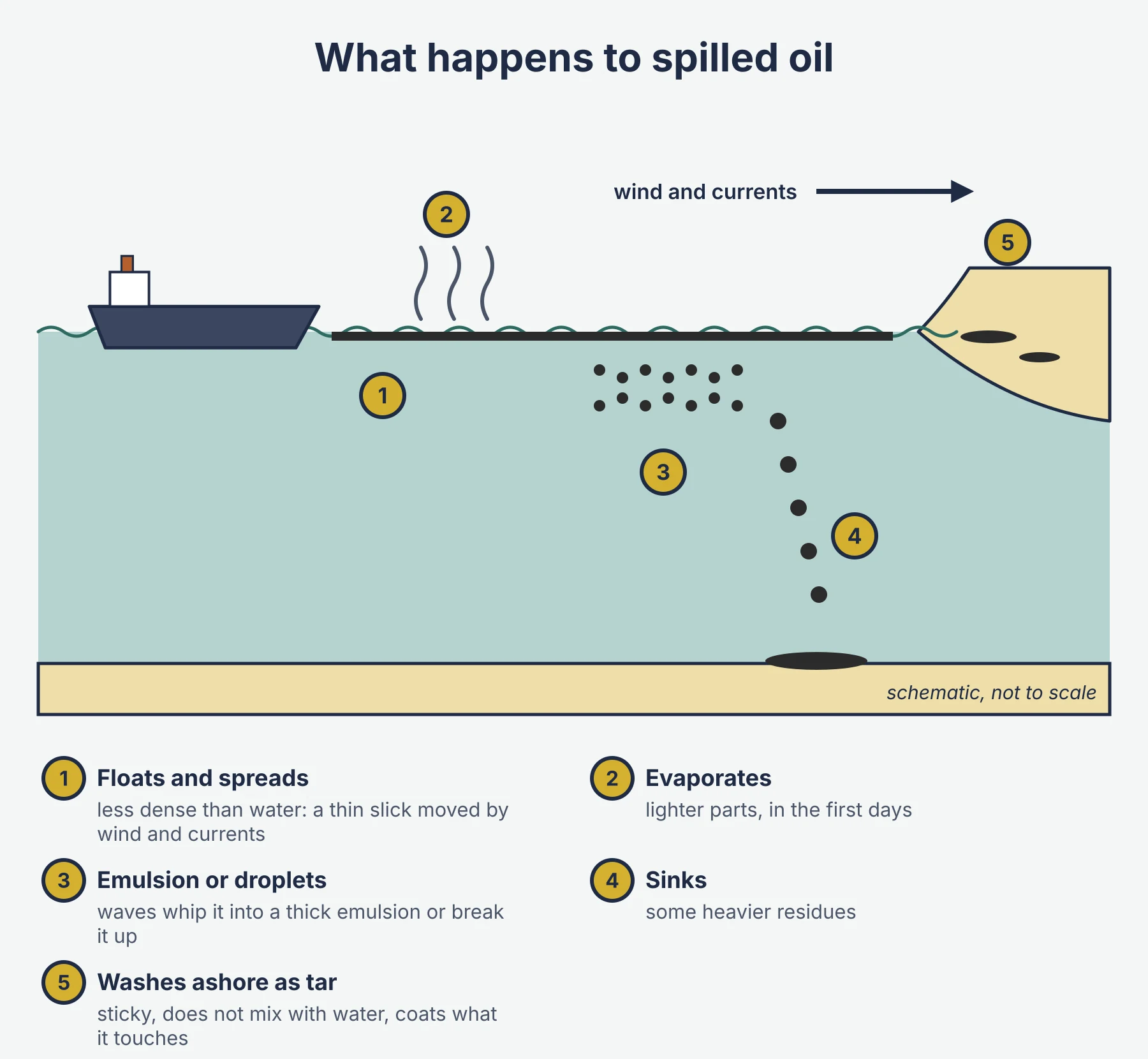
Two properties explain most impacts and most clean-up methods. Crude oil is less dense than water, so most of it floats and spreads into a thin slick driven by wind and currents. It is also sticky and does not mix with water, so it coats anything it touches. Some lighter parts evaporate in the first days, and waves can whip the rest into a thick emulsion or break it into droplets. Heavier residues may sink or wash ashore as tar.
Causes (3.5.1)
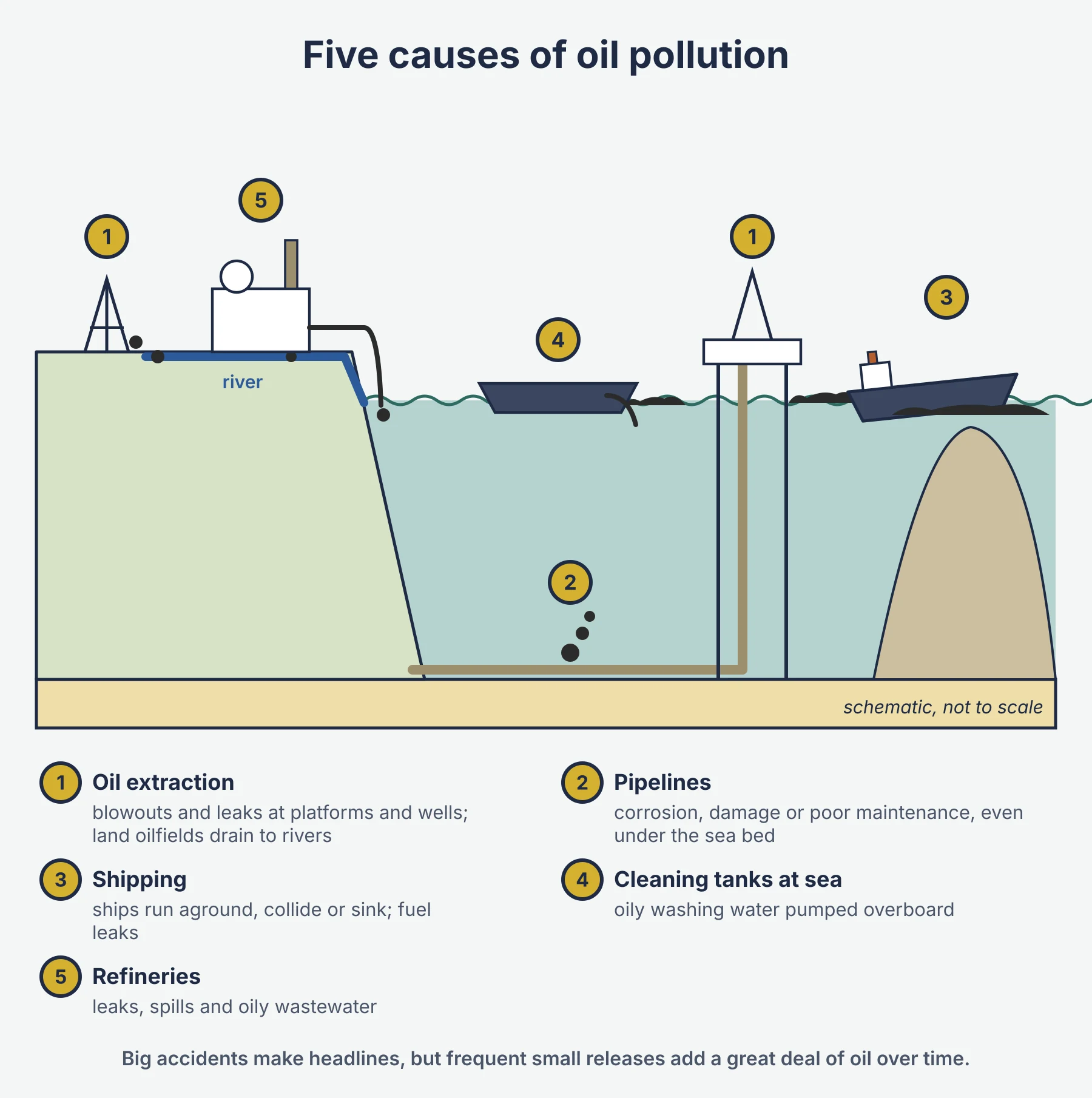
| Cause | How oil escapes |
|---|---|
| Off-shore and on-shore oil extraction | Blowouts and leaks at drilling platforms and wells; spills at land-based oilfields that drain into rivers and the sea |
| Pipelines | Corrosion, damage or poor maintenance lets oil leak along the route, including under the sea bed |
| Shipping | Tankers and other ships run aground, collide or sink; fuel leaks from all kinds of vessels |
| Cleaning of tanks at sea | Oily washing water from tanker cargo tanks is pumped overboard instead of being kept for disposal in port |
| Refineries | Leaks, spills and oily wastewater from coastal refineries reach the sea |
Large tanker accidents and platform blowouts make headlines, but frequent smaller releases from shipping, tank cleaning and land-based sources also add a great deal of oil over time.
Impacts (3.5.2)
The syllabus limits impacts to effects on seven groups. Knowledge of specific species is not required.
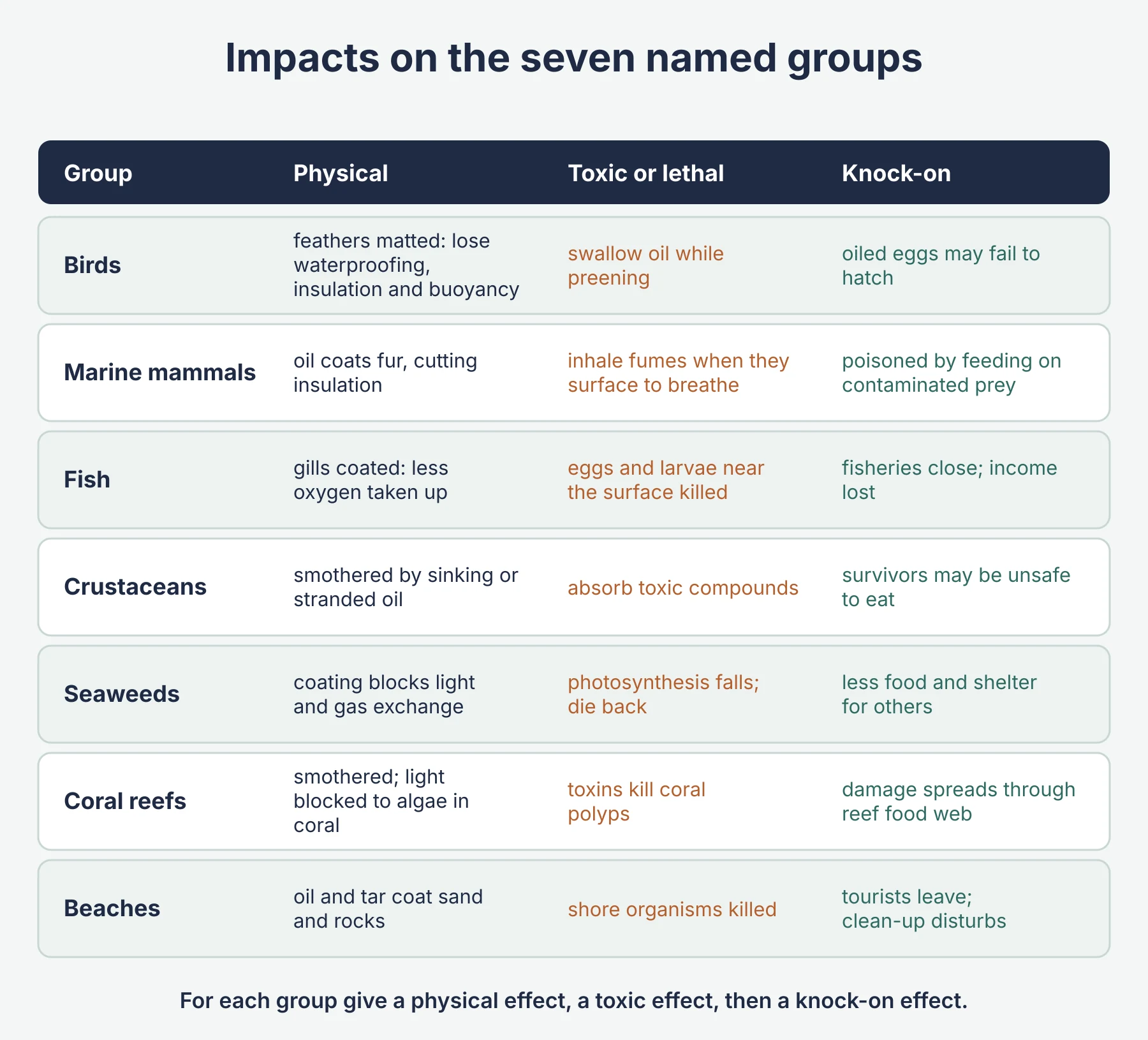
- Birds: oil mats feathers, so they lose waterproofing and insulation; birds become cold, lose buoyancy and may drown. Swallowing oil while preening poisons them. Oiled eggs may fail to hatch.
- Marine mammals: oil coats fur, reducing insulation, which matters most for mammals that rely on fur rather than fat. Animals that surface to breathe inhale fumes; feeding on contaminated prey poisons them.
- Fish: oil can coat gills and reduce oxygen uptake; eggs and larvae near the surface are especially easily killed. Contaminated fish may be unsafe to eat, so fisheries close and fishing communities lose income.
- Crustaceans: crabs, shrimps and lobsters on the shore and sea bed are smothered by sinking or stranded oil, and they absorb toxic compounds. Those that survive may be unsafe to eat.
- Seaweeds: a coating of oil blocks light and gas exchange, so photosynthesis falls and seaweeds die back, removing food and shelter for other organisms.
- Coral reefs: oil smothers coral, blocking light to the algae living in coral tissue, and its toxins kill coral polyps. Because reefs support very high biodiversity, damage spreads through the reef food web.
- Beaches: oil and tar coat sand and rocks, killing shore organisms. The visual pollution and smell drive away tourists, and clean-up can itself disturb the beach.
A useful exam habit: for each group, give the physical effect (coating, smothering) and the toxic effect (poisoning, contamination), then a knock-on effect on food chains or people.
Prevention strategies (3.5.3)
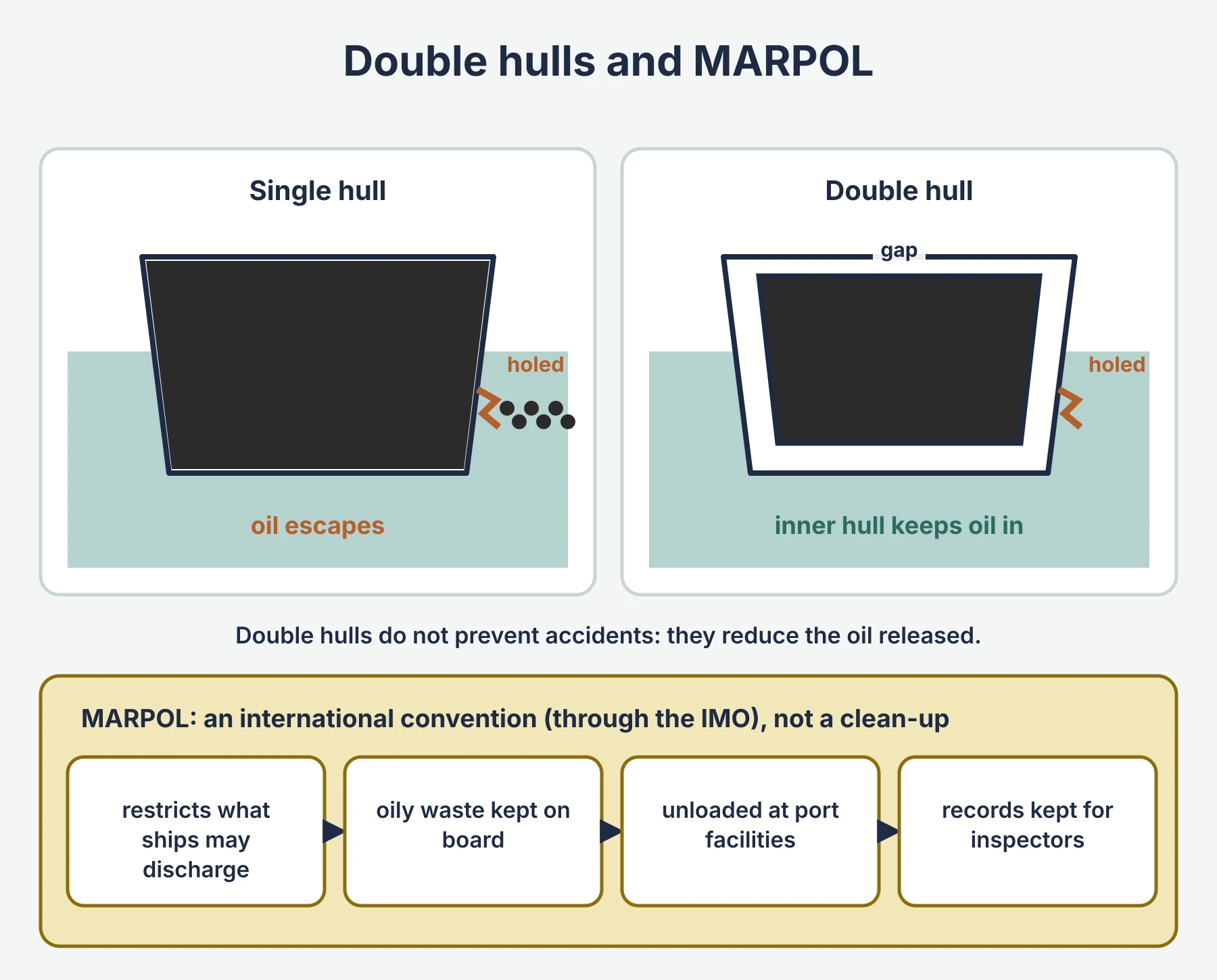
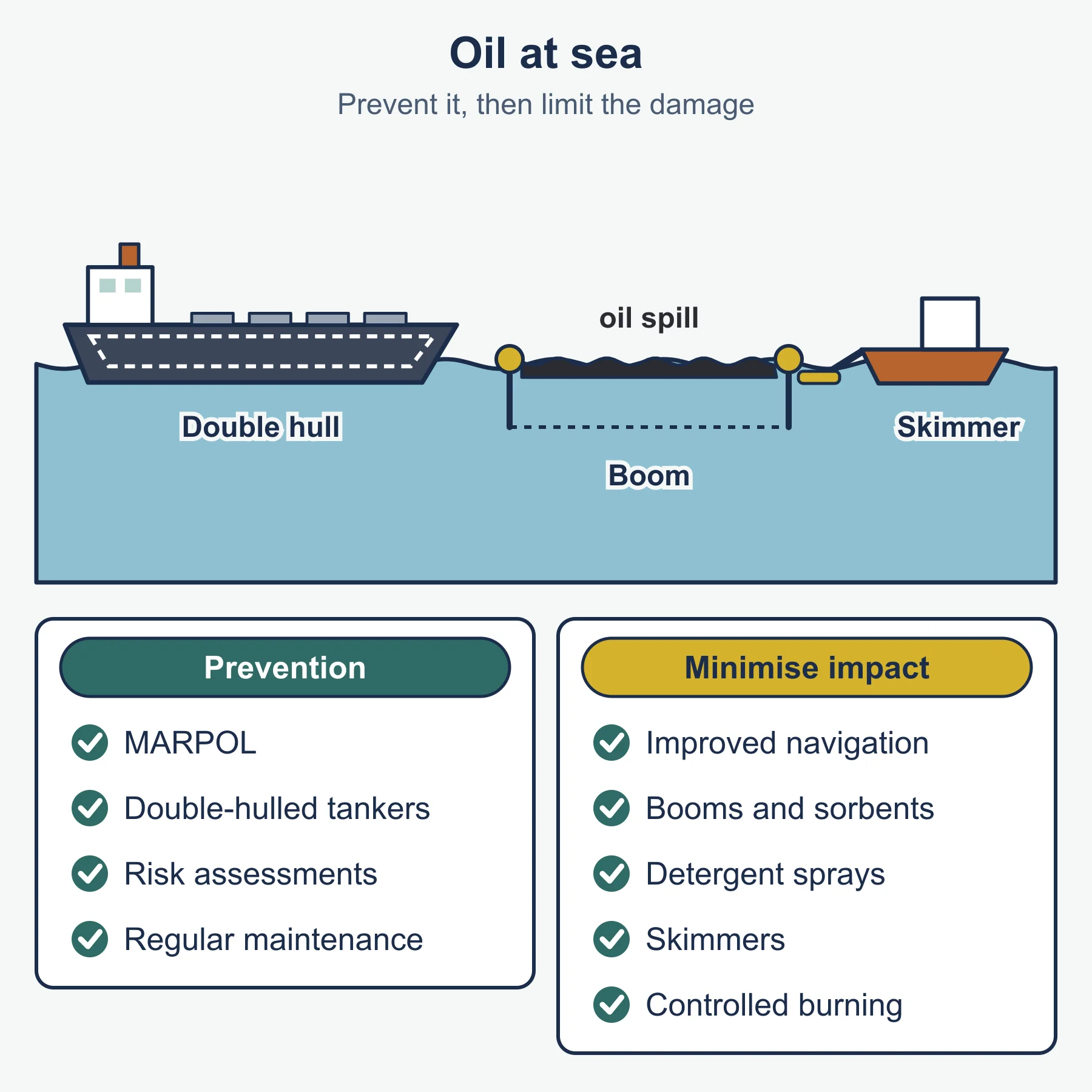
- MARPOL (International Convention for the Prevention of Pollution from Ships): an international agreement, made through the International Maritime Organization, that sets rules on what ships may discharge at sea. For oil it restricts discharges, requires oily waste to be kept on board and unloaded at port facilities, and requires records to be kept so inspectors can check.
- Double-hulled oil tankers: a second, inner hull with a gap between it and the outer hull. If the outer hull is holed in a collision or grounding, the inner hull keeps the oil contained.
- Risk assessments: identifying what could go wrong, how likely it is and how serious it would be, before drilling, building a pipeline or planning a shipping route, so precautions are put in place.
- Regular maintenance: inspecting and repairing pipelines, platforms, valves and ships so corrosion and equipment failure are caught before they cause leaks.
Strategies to minimise impacts (3.5.4)
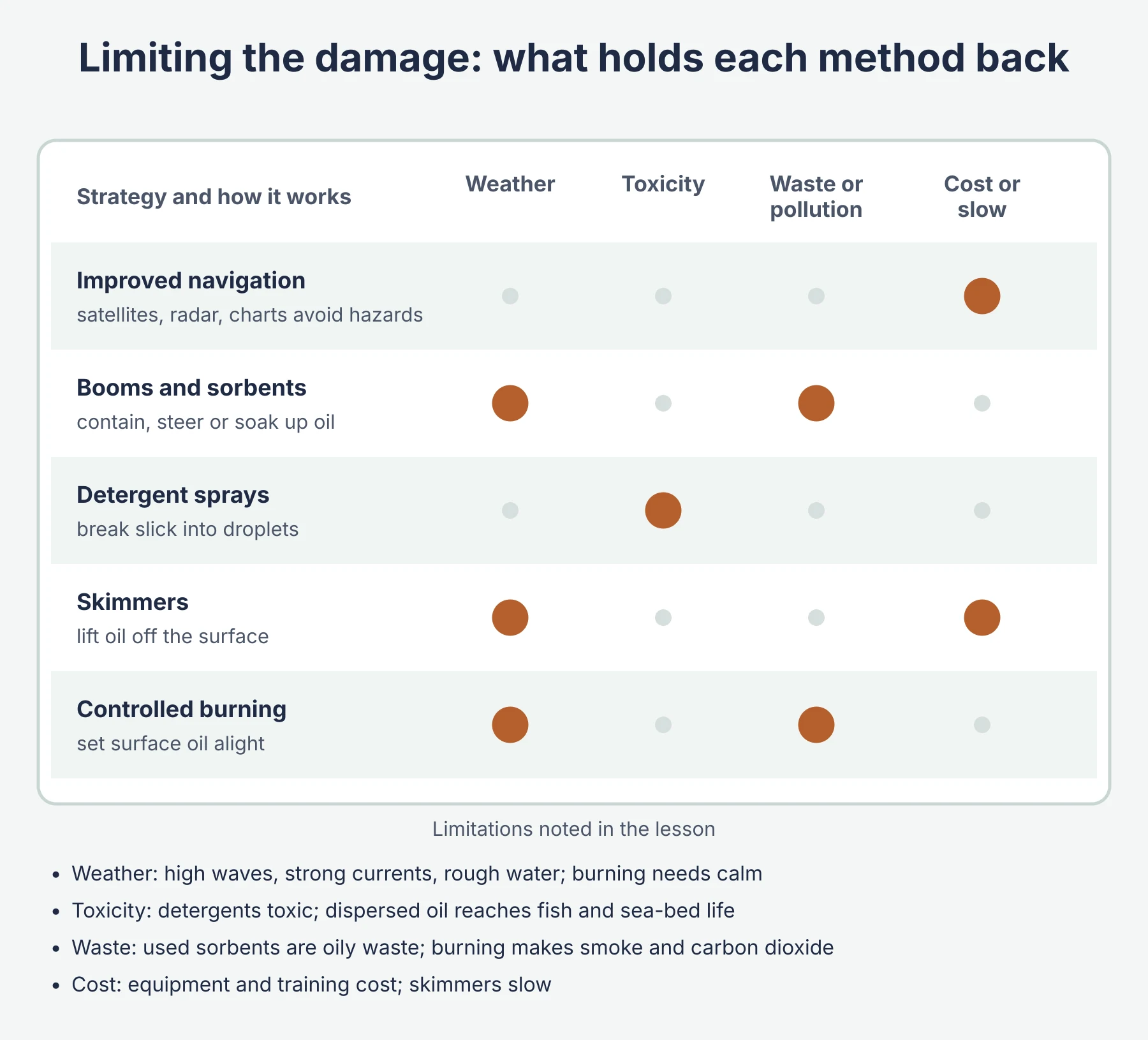
| Strategy | How it works | Limitation |
|---|---|---|
| Improved navigation systems for ships | Satellite positioning, radar and electronic charts help ships avoid rocks, shallows and collisions | Cost of equipment and training; human error can still occur |
| Booms and sorbents | Booms are floating barriers that contain oil or steer it away from sensitive coasts; sorbents are materials that soak oil up | Booms fail in high waves and strong currents; used sorbents become oily waste |
| Detergent sprays | Break the slick into small droplets that disperse into the water | The detergents are themselves toxic, and dispersed oil reaches fish and sea-bed life |
| Skimmers | Remove oil from the surface into storage tanks | Slow; work poorly in rough water or with very thick oil |
| Controlled burning | Oil on the surface, often held in fire-resistant booms, is set alight | Smoke and carbon dioxide pollute the air; works only on fresh, thick oil in calm conditions |
Notice that three issues recur in the limitations column: weather, toxicity and waste. They give you ready-made limitations for a “discuss” question.
Worked example: matching a strategy to a scenario
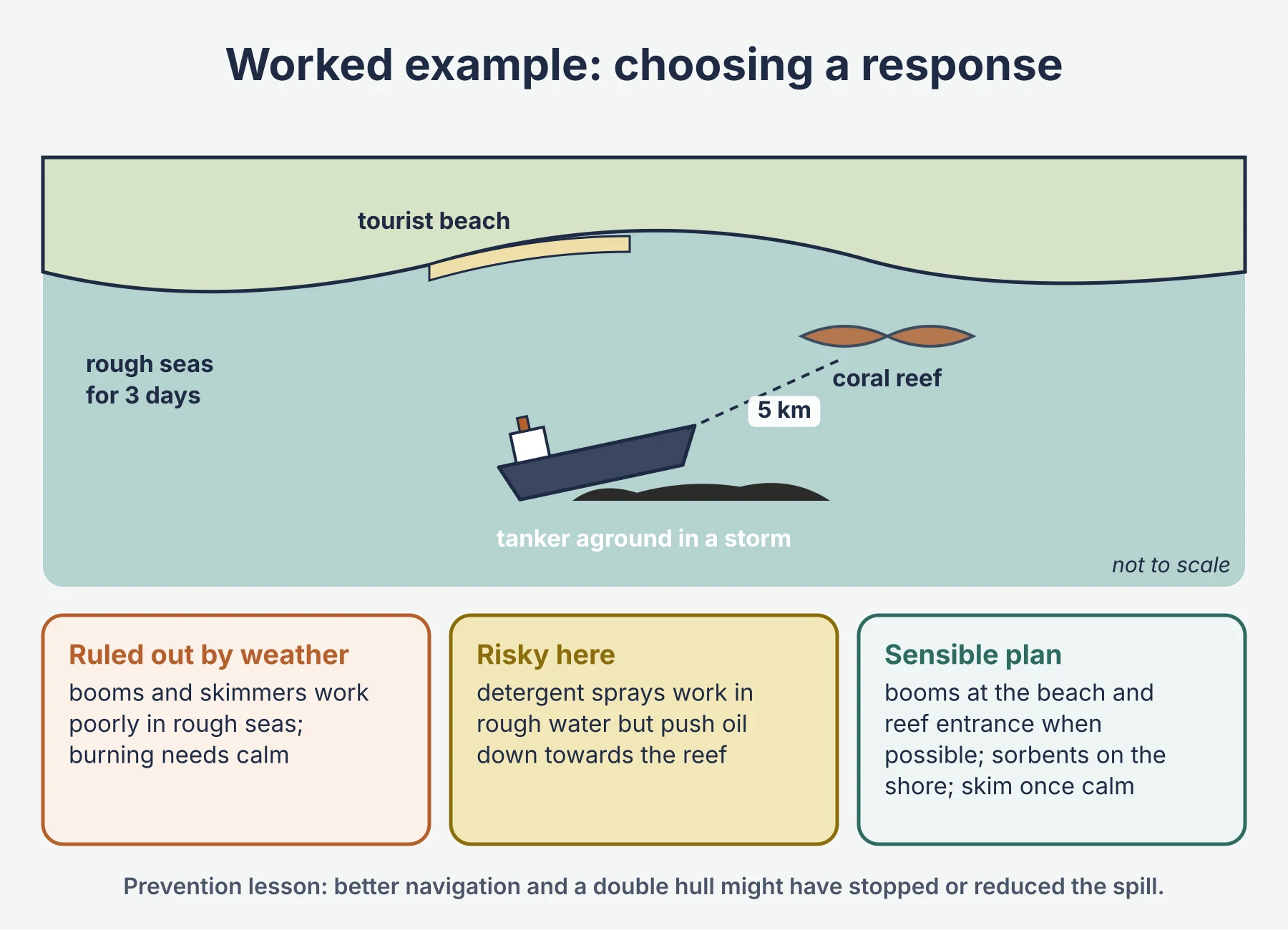
Scenario: a tanker runs aground in a storm 5 km from a coral reef and a tourist beach. Rough seas are expected for three days.
- Weather rules out some options: booms and skimmers work poorly in rough seas, and controlled burning needs calm conditions.
- Detergent sprays can be used in rougher water, but they would push dispersed oil down towards the reef, so they are risky close to coral.
- A sensible plan: deploy booms to protect the beach and reef entrance as soon as conditions allow, use sorbents along the shoreline, and skim once the sea calms. Prevention lesson: better navigation and a double hull might have stopped the spill or reduced its size.
An answer like this scores because each choice is justified by the conditions given in the question.
Worked example: a short calculation
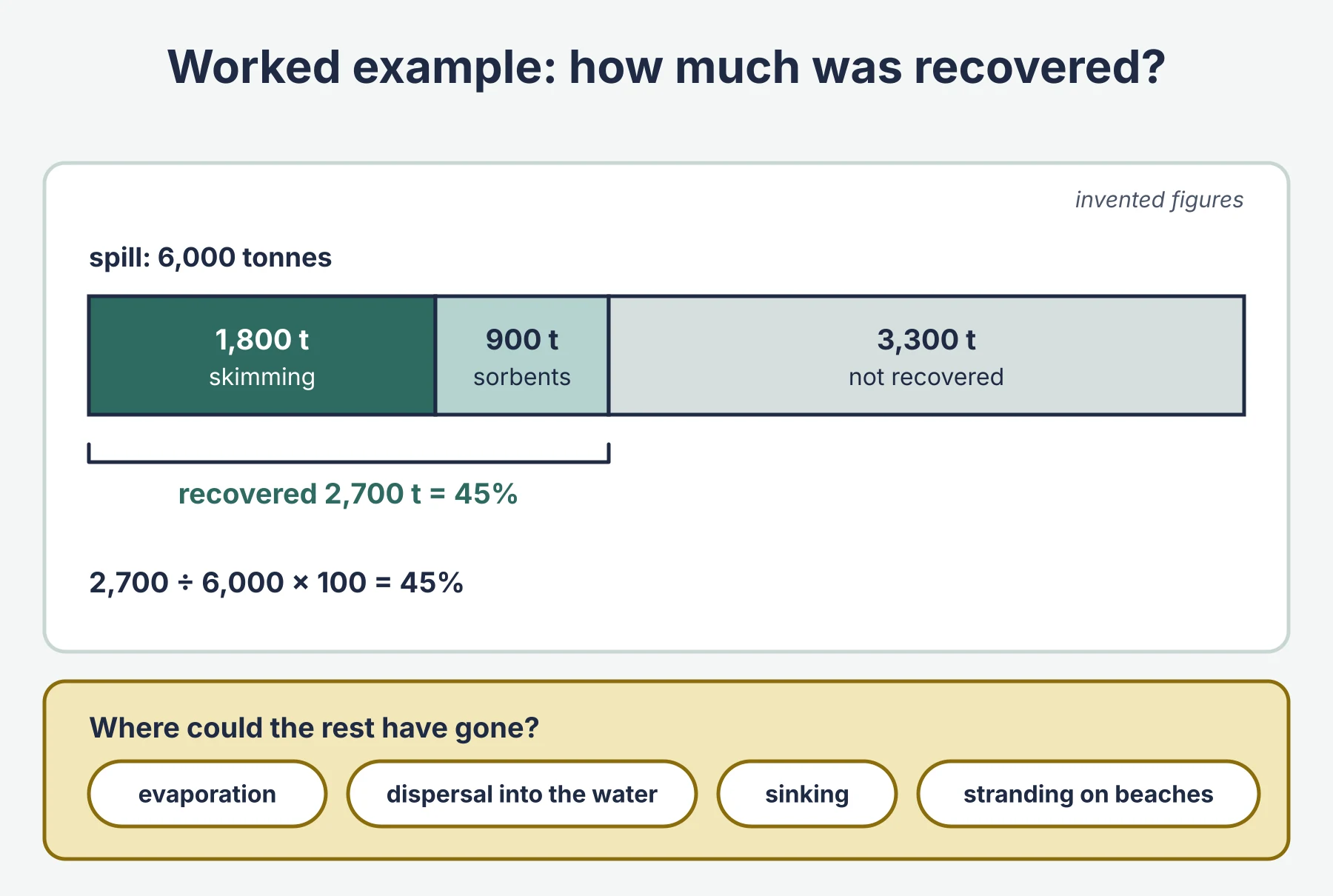
The figures are invented for practice. A clean-up removes 1,800 tonnes of a 6,000-tonne spill by skimming and 900 tonnes by sorbents. What percentage was recovered?
- Total recovered = 1,800 + 900 = 2,700 tonnes.
- Percentage = 2,700 / 6,000 × 100 = 45%.
A follow-up “suggest” question might ask where the rest went: evaporation, dispersal into the water, sinking, and stranding on beaches.
Common mistakes
- Writing that oil sinks and smothers everything on the sea floor. Most crude oil floats at first; some residues sink later.
- Describing MARPOL as a company or a ship. It is an international convention.
- Saying double hulls prevent accidents. They reduce the oil released when an accident happens.
- Treating detergent sprays as harmless “cleaning”. They disperse oil into the water column and are toxic.
- Mixing prevention (3.5.3) with minimising impacts (3.5.4). Read which the question asks for.
Exam technique
Describe questions on impacts reward the effect on the named group plus a reason. Describe strategies questions want the strategy and how it works. If a question gives weather or location details, use them: they are there to test whether you can choose an appropriate response. Use the correct terms: slick, boom, sorbent, skimmer, dispersal.
Revise with the oil pollution revision notes and test yourself with the oil pollution practice questions. For mixed oil and plastic questions, try the oil and plastic pollution practice questions.
Related resources
-
Revision notes
Cambridge IGCSE Environmental Management: Land — Revision Notes
Recall notes on soils and crop growth, food production and soil erosion for Topic 2 Land of Cambridge IGCSE Environmental Management 0680, 2027-2029 series.
Environmental Management · Cambridge · IGCSE
Revise topic -
Practice questions
Cambridge IGCSE Environmental Management (0680): Oil pollution – Practice Questions
Original practice questions with mark-scheme answers on oil pollution causes, impacts, prevention and clean-up for Cambridge IGCSE 0680.
Environmental Management · Cambridge · IGCSE
Try questions -
Revision notes
Cambridge IGCSE Environmental Management (0680): Oil pollution – Revision Notes
Recall notes on causes and impacts of oil pollution, spill prevention and clean-up strategies, key terms and a self-test for Cambridge IGCSE 0680.
Environmental Management · Cambridge · IGCSE
Revise topic
Get free revision emails (optional)
Occasional emails with practice questions, worked explanations and links to free resources for the qualification and subjects you choose. No spam, and you can unsubscribe from any email. The free tools on this site never need an email.