
Revision Notes
Cambridge IGCSE Environmental Management (0680): Oil pollution – Revision Notes
Recall notes on causes and impacts of oil pollution, spill prevention and clean-up strategies, key terms and a self-test for Cambridge IGCSE 0680.
- Subject
- Environmental Management
- Level
- IGCSE
- Topic
- Topic 3 – Water
- Author
- Marlbridge Academic Team
- Updated
- Reviewed by
- Azam Siddique (what this means)
Aligned to Cambridge IGCSE Environmental Management (0680), 2027-2029. Official specification .
Syllabus page (what it covers and how it is assessed): Cambridge IGCSE Environmental Management.
Syllabus points this page covers
0680
- 3.5 Oil pollution
Found an error? Report a correction.
Need help with this topic? Request a free trial class for IGCSE Environmental Management (0680).
Condensed notes for sub-topic 3.5 of Cambridge IGCSE Environmental Management (0680). The oil pollution study guide explains each point in full, with a scenario-based worked example.
The four parts of 3.5
- Causes (3.5.1): five named sources.
- Impacts (3.5.2): seven named groups.
- Prevention (3.5.3): four named strategies.
- Minimising impacts (3.5.4): five named strategies.
Read every question stem for which part it targets. “Prevent” and “reduce the impact of” are different questions.
Properties to quote
- Less dense than water, so it floats and spreads as a slick.
- Does not mix with water and is sticky, so it coats surfaces.
- Contains toxic compounds that poison organisms.
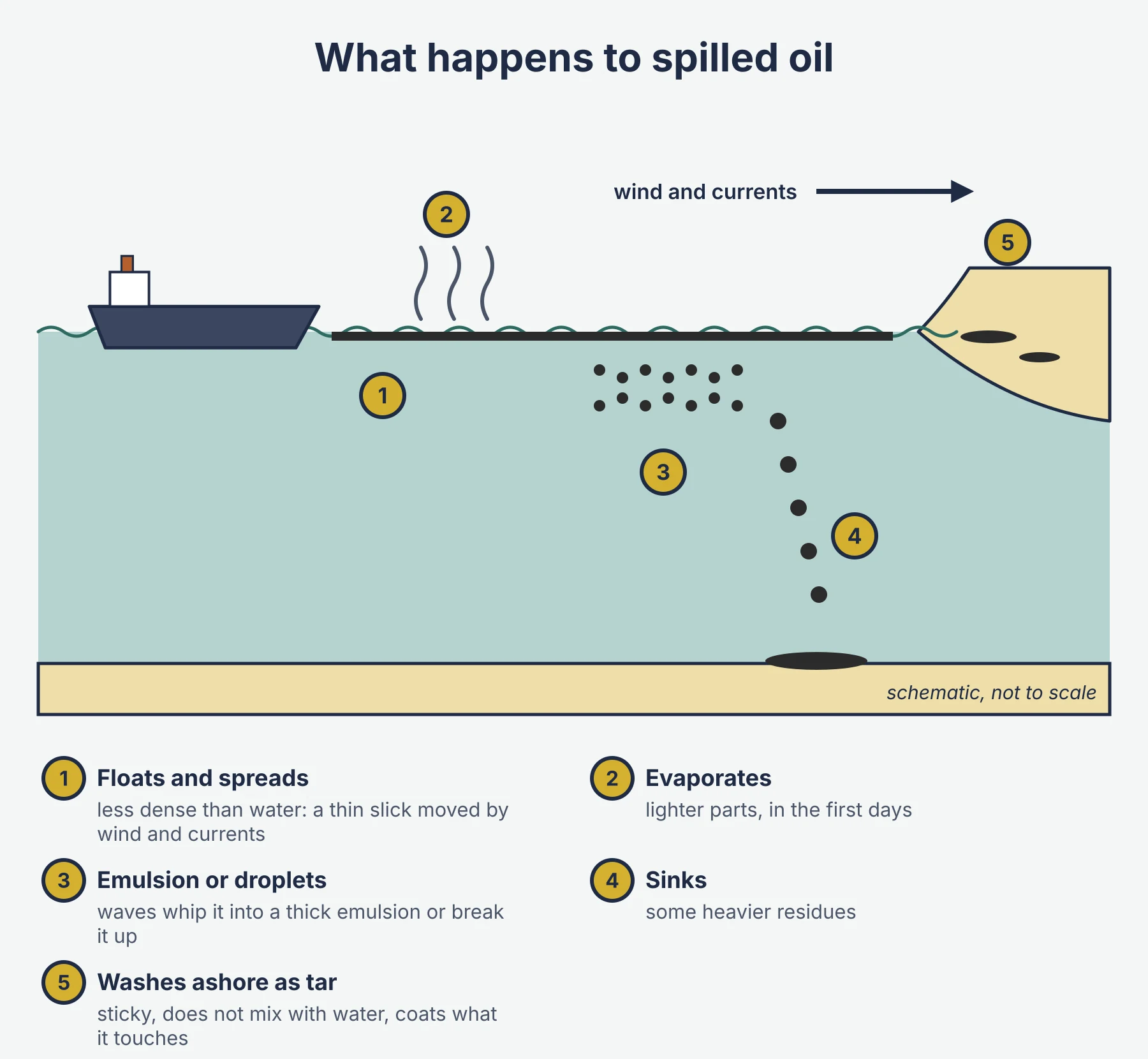
- Lighter parts evaporate; waves form emulsions or droplets; heavy residues sink or strand as tar.
Causes (3.5.1)
| Cause | Typical event |
|---|---|
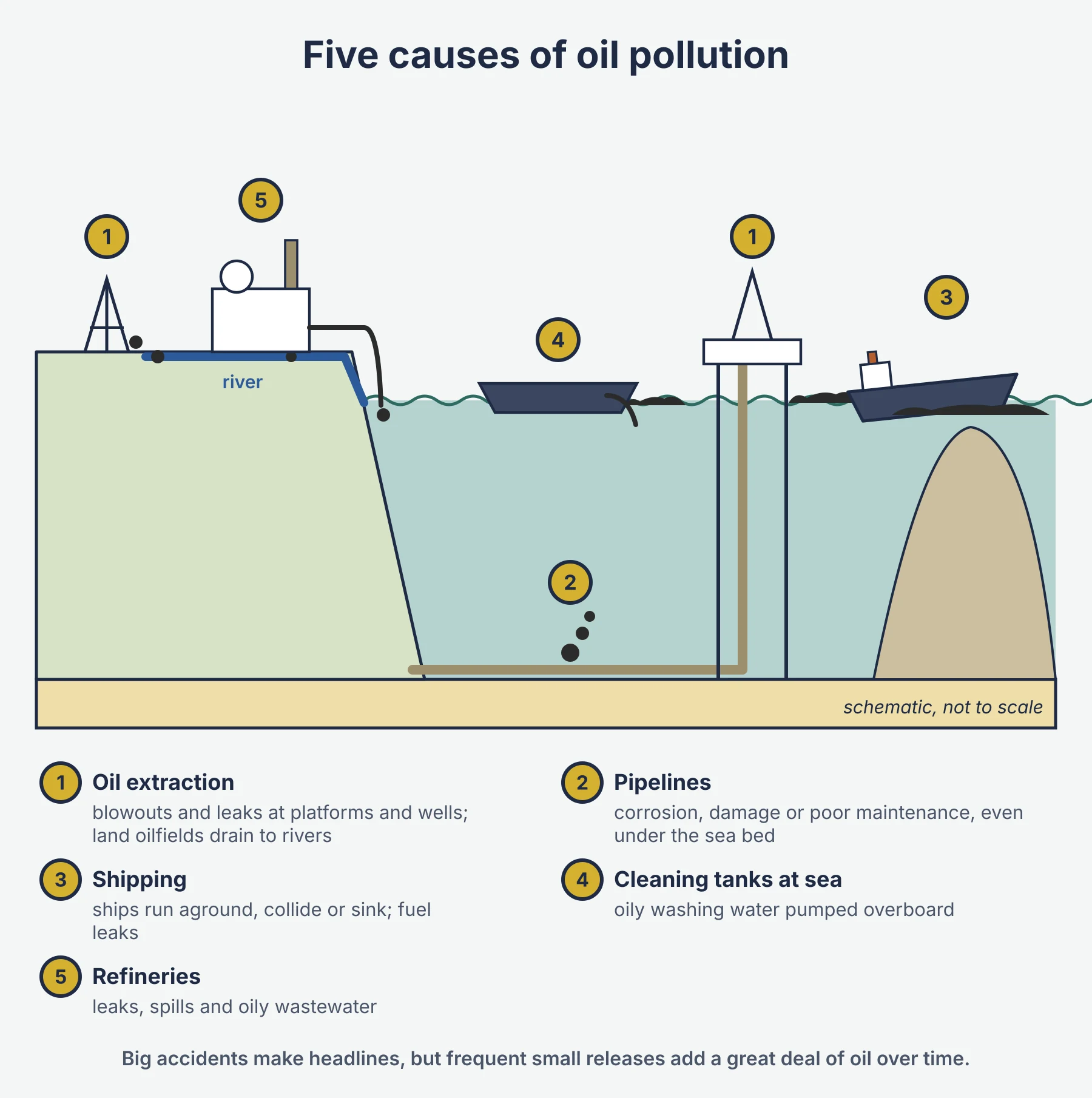
| Off-shore and on-shore extraction | Platform blowout, well leak, oilfield spill |
| Pipelines | Corrosion, damage, poor maintenance |
| Shipping | Grounding, collision, sinking, fuel leaks |
| Cleaning of tanks at sea | Oily wash water pumped overboard |
| Refineries | Leaks and oily wastewater on the coast |
Impacts (3.5.2): coat, poison, knock-on
| Group | Coating or smothering | Poisoning | Knock-on |
|---|---|---|---|
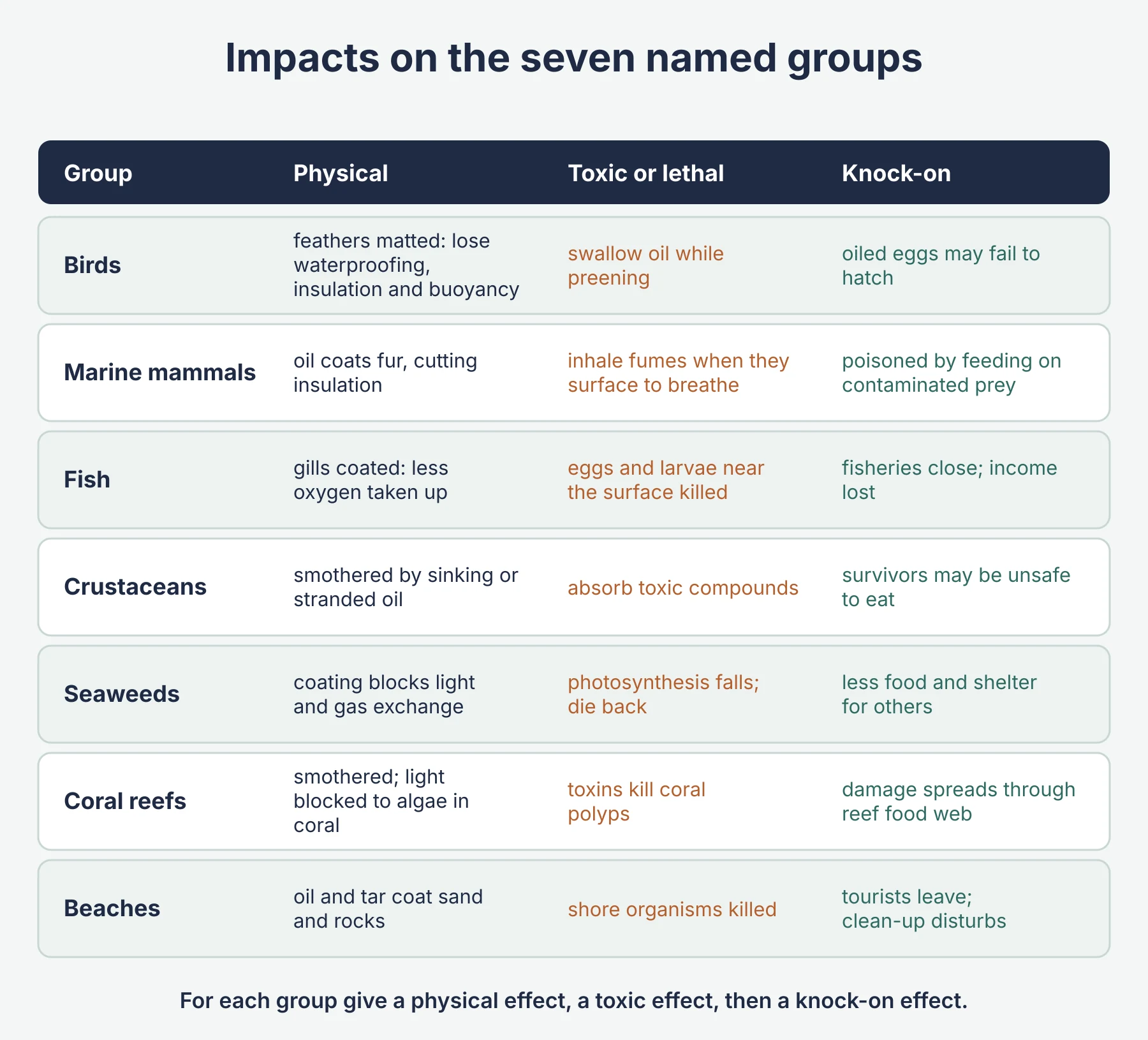
| Birds | Feathers lose waterproofing and insulation; birds chill, sink, drown | Oil swallowed while preening | Breeding fails; eggs oiled |
| Marine mammals | Fur loses insulation | Fumes inhaled; contaminated prey eaten | Predators of contaminated prey affected |
| Fish | Gills coated | Eggs and larvae killed; flesh contaminated | Fisheries close; income lost |
| Crustaceans | Smothered on shore and sea bed | Absorb toxins | Unsafe to eat; food web loses prey |
| Seaweeds | Light and gas exchange blocked | Toxic damage | Less food and shelter for other species |
| Coral reefs | Smothered; light to algae blocked | Polyps killed | High-biodiversity food web disrupted |
| Beaches | Sand and rocks coated | Shore organisms killed | Tourism and income lost |
Prevention (3.5.3)
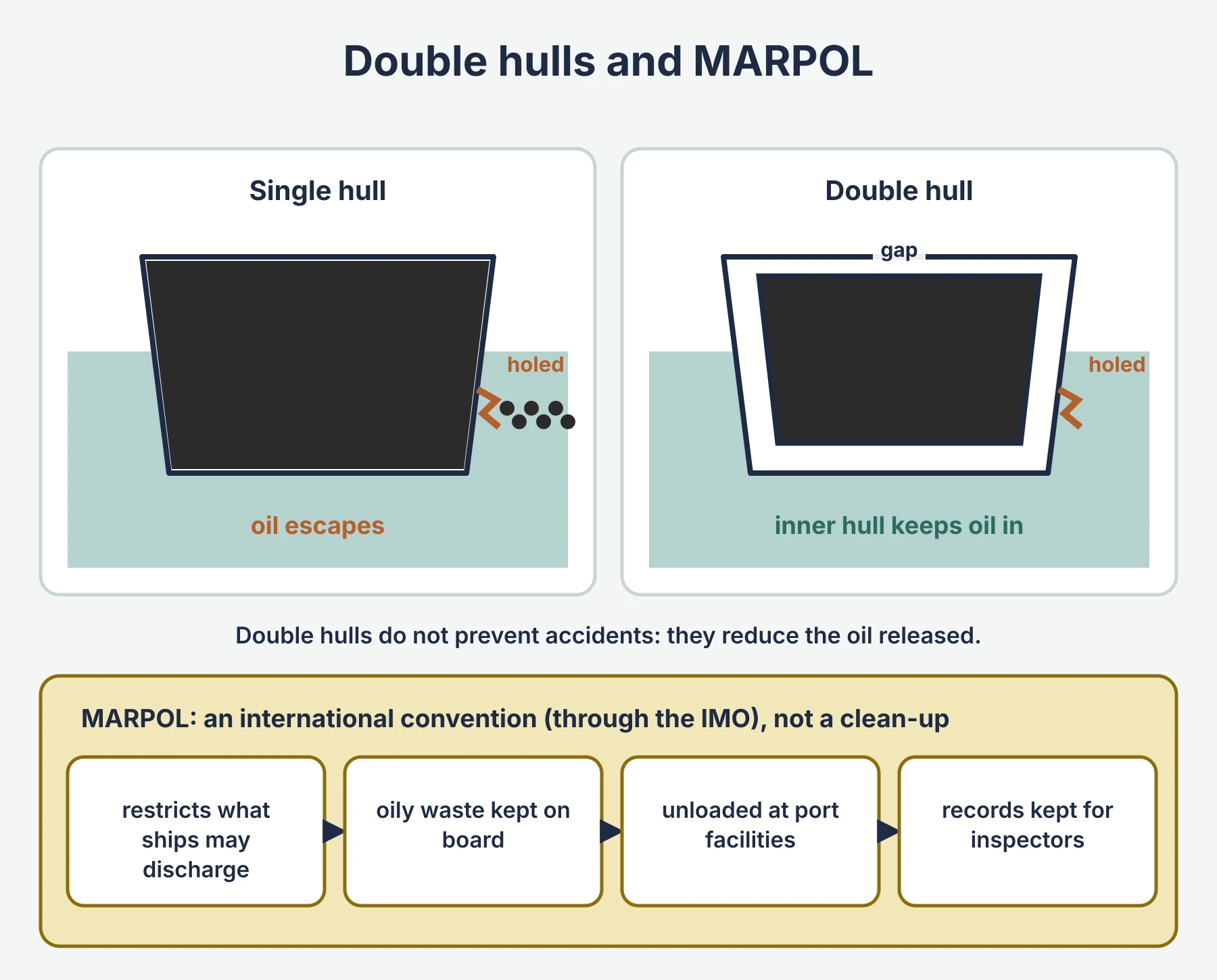
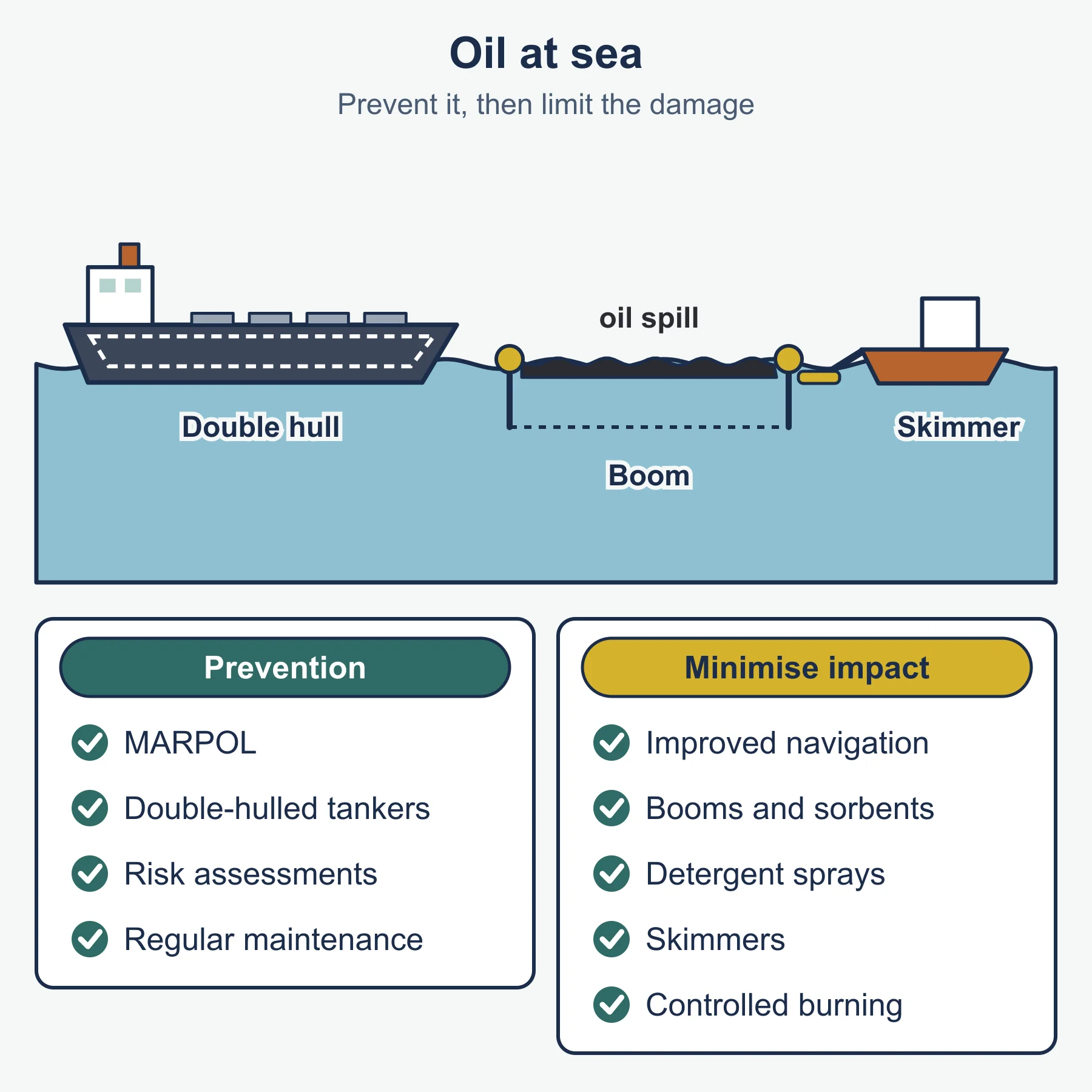
- MARPOL: International Convention for the Prevention of Pollution from Ships; limits discharges, oily waste kept for port disposal, records kept for inspection.
- Double-hulled tankers: inner hull contains oil if the outer hull is breached.
- Risk assessments: identify hazards and likelihood before drilling, pipeline building or routing.
- Regular maintenance: inspect and repair ships, pipelines and platforms.
Minimising impacts (3.5.4)
| Strategy | Works by | Main limitation |
|---|---|---|
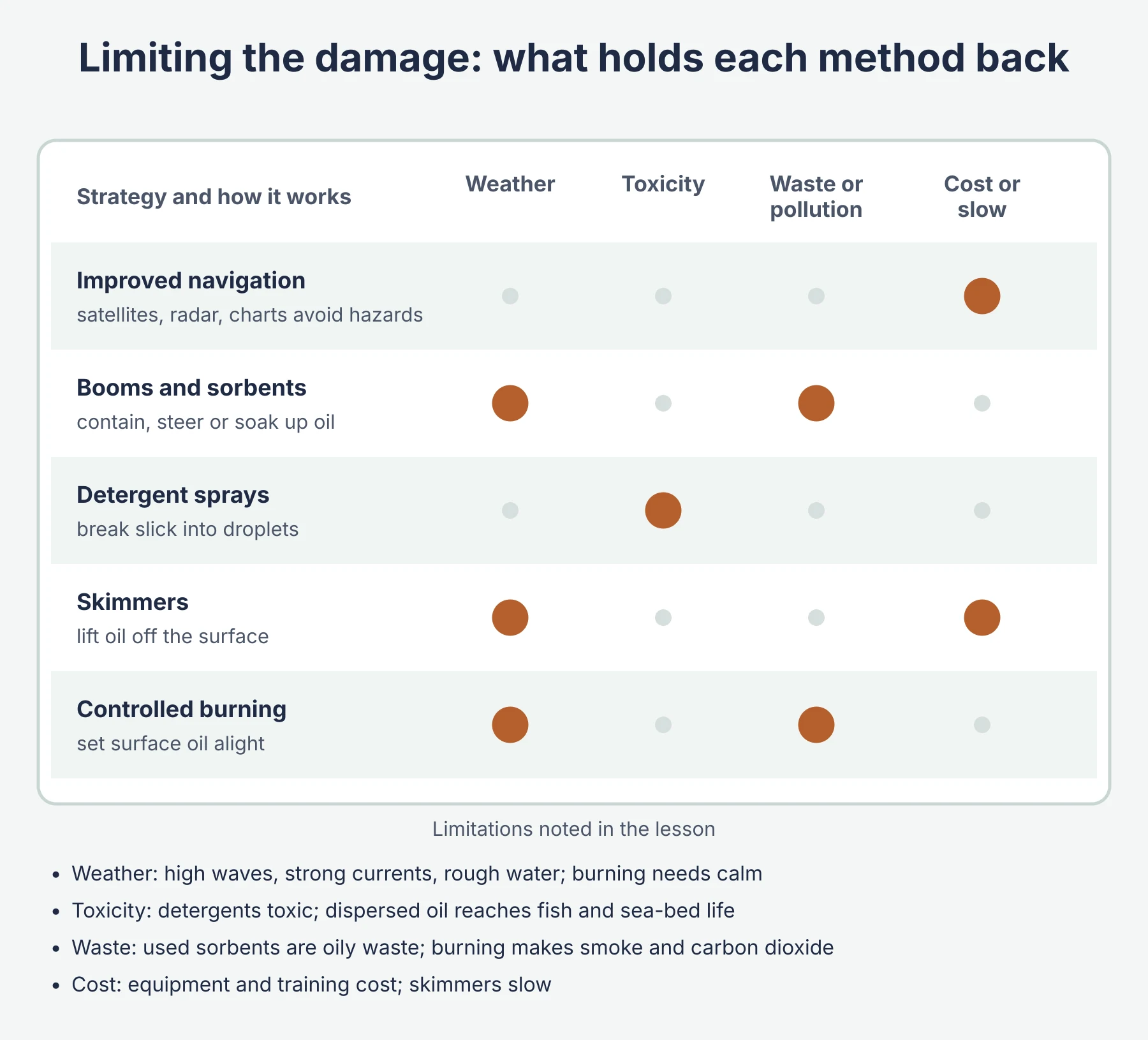
| Improved navigation systems | Avoiding groundings and collisions | Cost; human error remains |
| Booms | Containing or diverting the slick | Fail in high waves and strong currents |
| Sorbents | Soaking up oil | Become oily waste |
| Detergent sprays | Breaking oil into dispersing droplets | Toxic; oil spread into water column |
| Skimmers | Lifting oil off the surface | Slow; poor in rough seas |
| Controlled burning | Burning surface oil | Air pollution; needs fresh, thick oil and calm conditions |
Note: improved navigation is listed in the syllabus under minimising impacts, although it works by stopping the accident happening.
Key terms
| Term | Meaning |
|---|---|
| Oil slick | A layer of oil spreading over the water surface |
| Blowout | Uncontrolled release of oil from a well |
| MARPOL | The international convention preventing pollution from ships |
| Double hull | Two hull layers with a gap between them |
| Risk assessment | Identifying hazards, their likelihood and seriousness, and the precautions needed |
| Boom | A floating barrier that contains or diverts oil |
| Sorbent | A material that soaks up oil |
| Dispersant (detergent spray) | A chemical that breaks oil into small droplets |
| Skimmer | A device that removes oil from the surface |
| Controlled burning | Deliberately burning oil on the sea surface |
Exam traps
- Saying double hulls stop accidents. They reduce the spill when an accident happens.
- Calling MARPOL an organisation. It is a convention (an international agreement).
- Calling detergents a clean-up that removes oil. They disperse it; the oil is still in the sea.
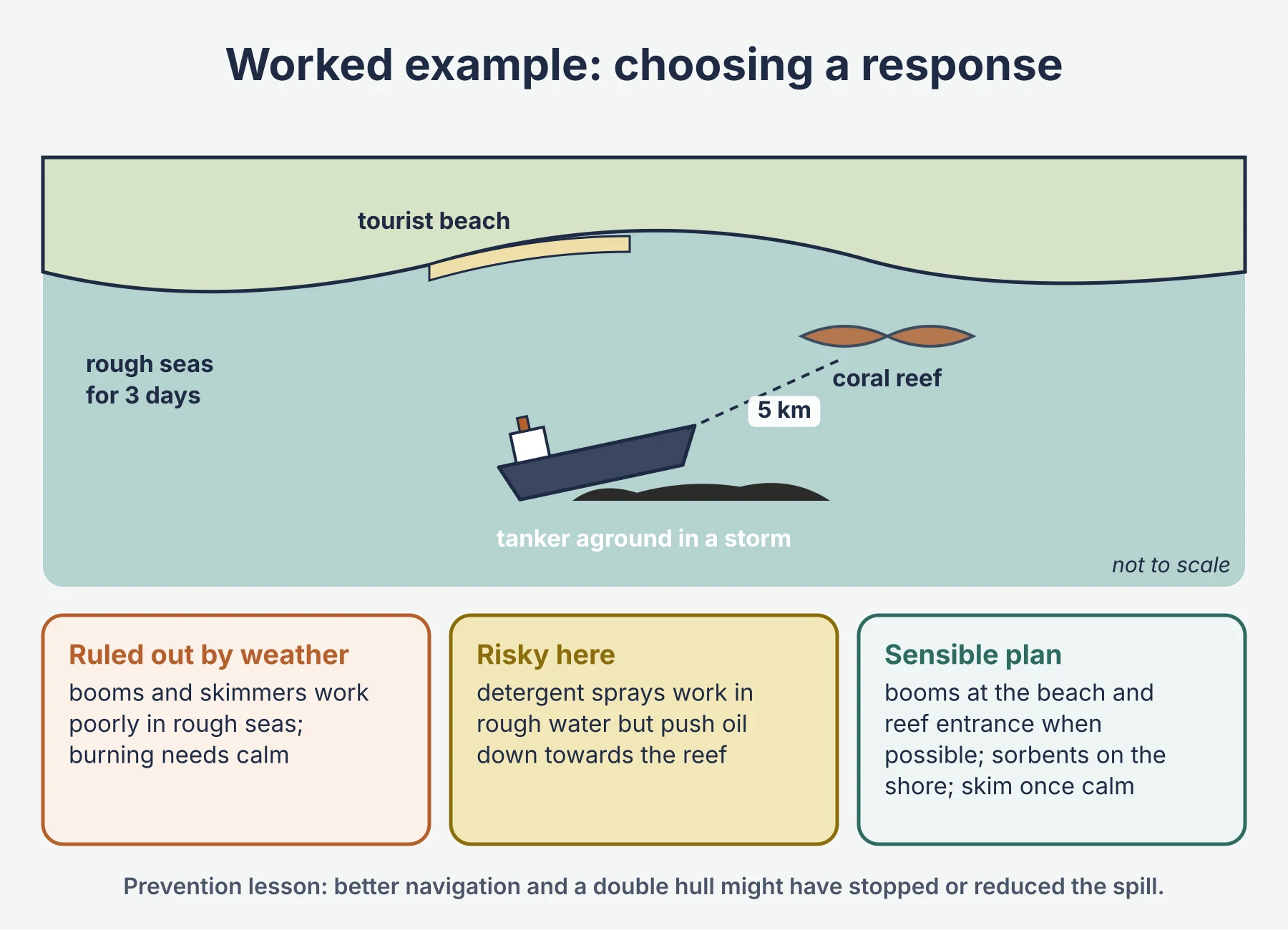
- Choosing booms or burning in a storm scenario. Match the method to the conditions given.
- Writing “oil kills birds” without the mechanism: insulation, buoyancy, poisoning.
- Naming specific species. The syllabus does not require them; describe the group.
Self-test
- State the five causes of oil pollution named in the syllabus.
- Why does oil spread over the surface of the sea?
- Explain two ways oil harms seabirds.
- Why are fish eggs and larvae especially at risk?
- How does oil affect seaweeds?
- What does MARPOL stand for?
- How does a double hull reduce oil pollution?
- What is the purpose of a risk assessment before building a pipeline?
- Give one advantage and one limitation of booms.
- Why can detergent sprays harm marine life?
- Give two conditions needed for controlled burning to work.
- A spill of 4,000 tonnes has 1,000 tonnes recovered. What percentage remains in the environment?
Answers
- Off-shore and on-shore oil extraction; pipelines; shipping; cleaning of tanks at sea; refineries.
- Oil is less dense than water, so it floats, and it is spread by wind and currents.
- Oil mats feathers so birds lose insulation and buoyancy, becoming cold or drowning; birds swallow oil while preening and are poisoned.
- Many float near the surface where the oil is, and they are small and easily poisoned.
- A coating blocks light and gas exchange, so photosynthesis falls and seaweeds die back.
- The International Convention for the Prevention of Pollution from Ships.
- If the outer hull is breached, the inner hull keeps the oil contained.
- To identify what could go wrong and how likely and serious it would be, so precautions are taken in advance.
- Advantage: contain oil or keep it away from sensitive coasts. Limitation: fail in high waves or strong currents.
- The detergents are toxic and the dispersed oil droplets spread into the water, reaching fish and sea-bed organisms.
- Fresh, thick oil and calm conditions (low wind and waves).
- 4,000 − 1,000 = 3,000 tonnes; 3,000 / 4,000 × 100 = 75%.
Linked pages
Practise with the oil pollution practice questions. For the other sub-topics of Topic 3, use the Water revision notes.
Related resources
-
Revision notes
Cambridge IGCSE Environmental Management: Land — Revision Notes
Recall notes on soils and crop growth, food production and soil erosion for Topic 2 Land of Cambridge IGCSE Environmental Management 0680, 2027-2029 series.
Environmental Management · Cambridge · IGCSE
Revise topic -
Study guides
Cambridge IGCSE Environmental Management (0680): Plastic pollution
Types of plastic, microplastics, marine impacts and strategies for managing plastic pollution, with worked examples, for Cambridge IGCSE 0680.
Environmental Management · Cambridge · IGCSE
Read guide -
Practice questions
Cambridge IGCSE Environmental Management (0680): Plastic pollution – Practice Questions
Original practice questions with answers on plastic types, microplastics, marine impacts and plastic management strategies for Cambridge IGCSE 0680.
Environmental Management · Cambridge · IGCSE
Try questions
Get free revision emails (optional)
Occasional emails with practice questions, worked explanations and links to free resources for the qualification and subjects you choose. No spam, and you can unsubscribe from any email. The free tools on this site never need an email.