
Study Guides
Cambridge IGCSE Environmental Management (0680): Plastic pollution
Types of plastic, microplastics, marine impacts and strategies for managing plastic pollution, with worked examples, for Cambridge IGCSE 0680.
- Subject
- Environmental Management
- Level
- IGCSE
- Topic
- Topic 3 – Water
- Author
- Marlbridge Academic Team
- Updated
- Reviewed by
- Azam Siddique (what this means)
Aligned to Cambridge IGCSE Environmental Management (0680), 2027-2029. Official specification .
Syllabus page (what it covers and how it is assessed): Cambridge IGCSE Environmental Management.
Syllabus points this page covers
0680
- 3.6 Plastic pollution
Found an error? Report a correction.
Need help with this topic? Request a free trial class for IGCSE Environmental Management (0680).
Sub-topic 3.6 of Cambridge IGCSE Environmental Management (0680) is new for the 2027-2029 syllabus. It has three parts: precise descriptions of five kinds of plastic (3.6.1 to 3.6.5), the impacts of plastic pollution on marine ecosystems (3.6.6), and strategies for managing those impacts (3.6.7). The definitions are where marks are most often lost, because the terms overlap in ways that are easy to blur. The Water study guide gives the topic overview.
The five descriptions
| Term | Syllabus description |
|---|---|
| Conventional plastics | Made from fossil fuels and generally non-biodegradable |
| Bioplastics | Fully or partly made from biological raw materials rather than fossil fuels; can be biodegradable or non-biodegradable |
| Biodegradable plastics | Designed to decompose in water or soil; decomposed by bacteria and fungi into water, biomass and gases (carbon dioxide and methane); decompose at different rates depending on biotic and abiotic factors |
| Non-biodegradable plastics | Break down over a long period of time |
| Microplastics | Less than 5 mm in length; formed when larger plastics break down; used in commercial products |
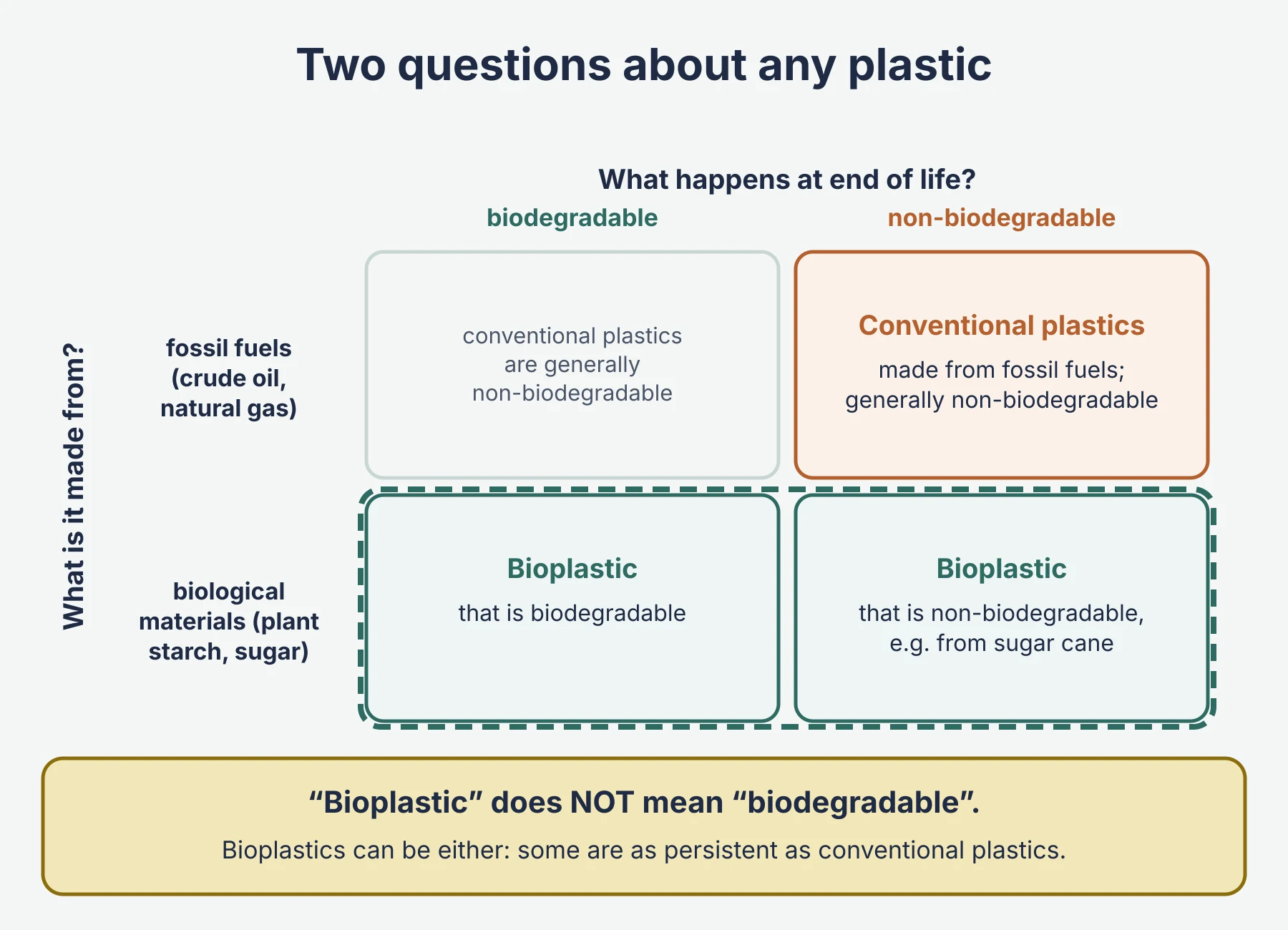
Two separate questions: what is it made from, and what happens to it?
The clearest way to keep these straight is to see that they answer two different questions.
- Raw material: conventional plastics come from fossil fuels (crude oil and natural gas); bioplastics come fully or partly from biological materials such as plant starch or sugar.
- End of life: biodegradable plastics are broken down by decomposers; non-biodegradable plastics only break into smaller and smaller pieces over a long time.
So “bioplastic” does not mean “biodegradable”. A bioplastic made from sugar cane can be chemically identical to a conventional plastic and just as persistent. The syllabus wording “can be biodegradable or non-biodegradable” is there to test exactly this.
Biodegradable plastics in more detail
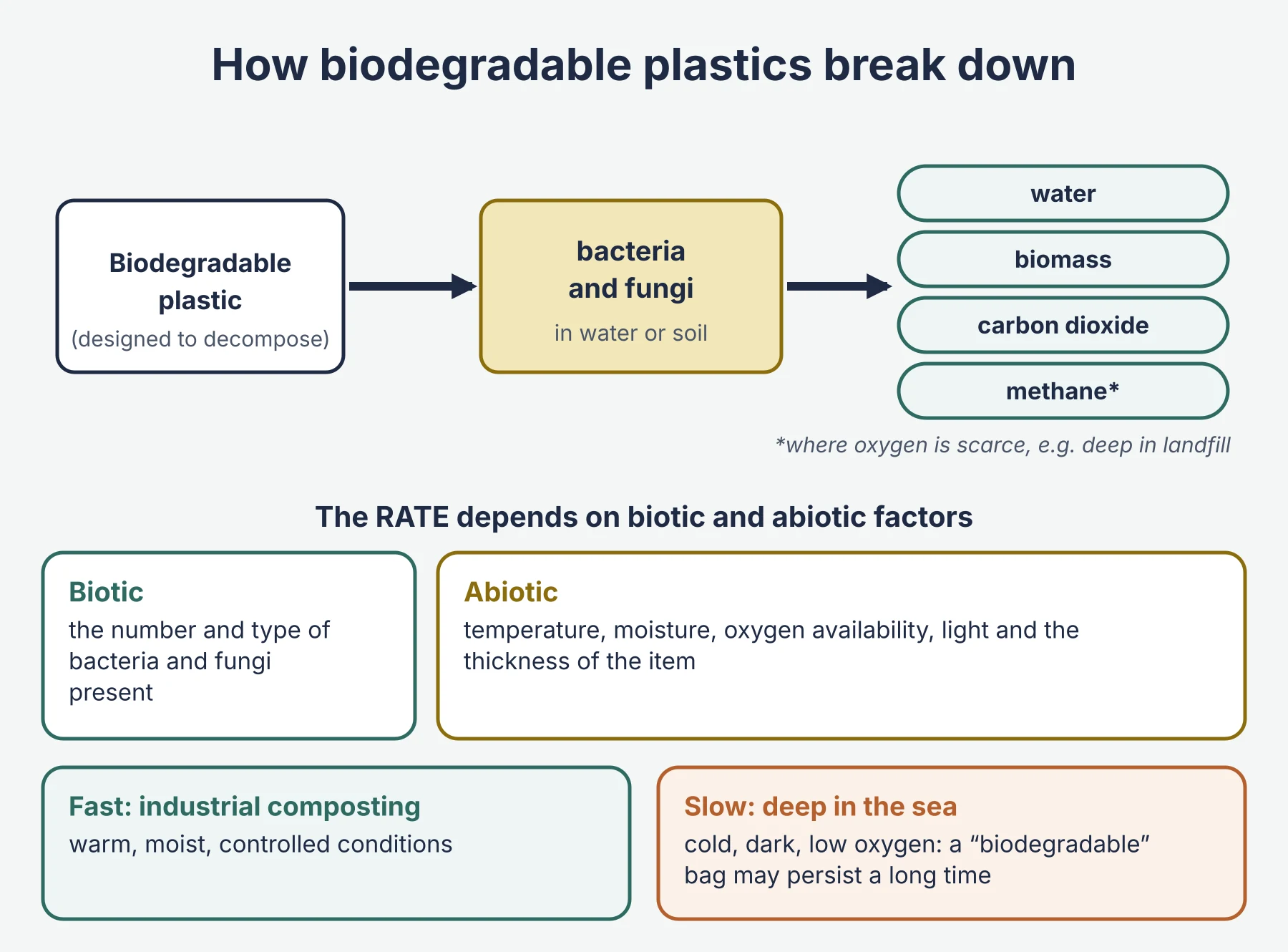
The syllabus gives three features. First, they are designed to decompose in water or soil: decomposition is a property built in by the manufacturer. Second, the decomposers are bacteria and fungi, and the products are water, biomass and gases (carbon dioxide and methane). Methane forms where oxygen is scarce, for example deep in landfill. Third, the rate varies with biotic and abiotic factors:
- Biotic: the number and type of bacteria and fungi present.
- Abiotic: temperature, moisture, oxygen availability, light and the thickness of the item.
Cold, dark, low-oxygen water at depth slows decomposition. Many biodegradable items break down well only in the warm, moist, controlled conditions of industrial composting, so a “biodegradable” bag may persist for a long time in the sea.
Non-biodegradable plastics and microplastics
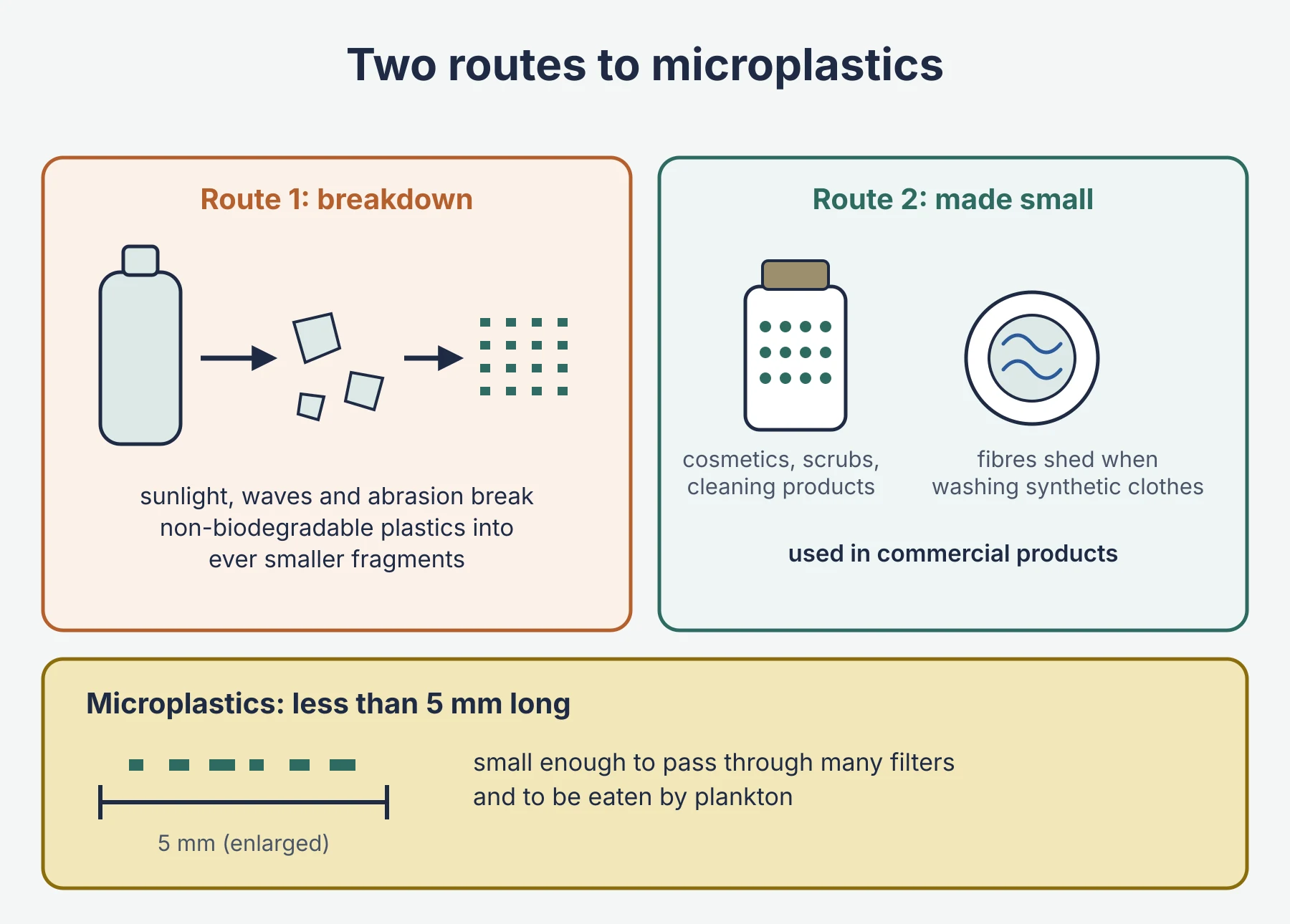
Non-biodegradable plastics are not digested by decomposers. Sunlight, waves and abrasion break them into fragments, so they “disappear” from view without leaving the ecosystem. That process is one of the two sources of microplastics. The other is deliberate manufacture: tiny plastic particles are used in commercial products such as some cosmetics, scrubs and cleaning products, and fibres are also shed when synthetic clothing is washed. Microplastics are less than 5 mm long, small enough to pass through many filters and to be eaten by plankton.
Impacts on marine ecosystems (3.6.6)
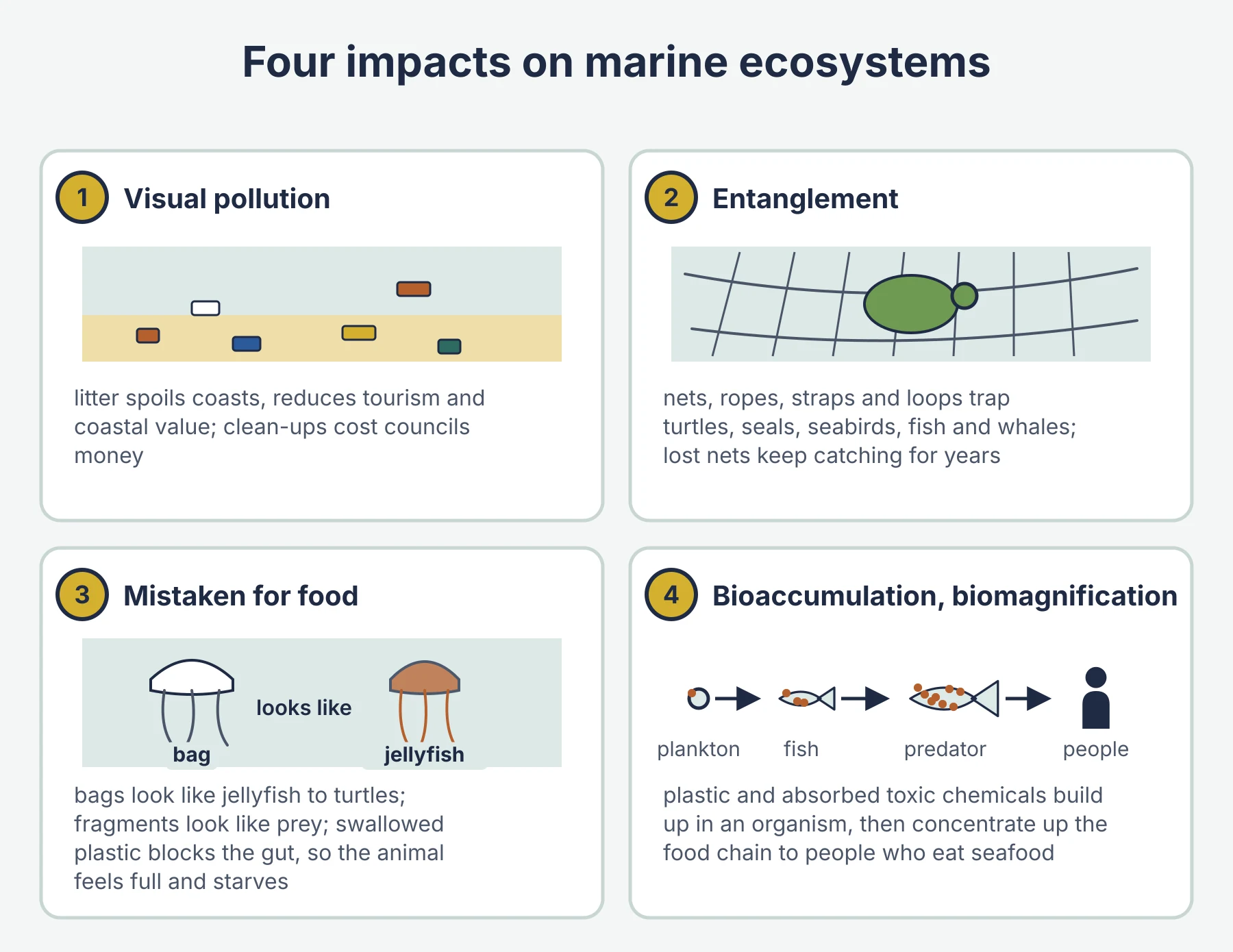
Visual pollution. Litter on beaches and floating rubbish spoil the appearance of coasts, reduce tourism and lower the value of coastal areas. Clean-ups cost money for local councils.
Entanglement. Discarded fishing nets, ropes, packing straps and loops of plastic trap turtles, seals, seabirds, fish and whales. Animals may drown, be unable to feed, or suffer wounds as they grow inside a tight loop. Lost nets can keep catching animals for years.
Risk of being mistaken for food. Floating bags can look like jellyfish to turtles; fragments look like prey to seabirds and fish. Swallowed plastic can block the gut or fill the stomach, so the animal feels full and starves. Seabirds can pass fragments to their chicks.
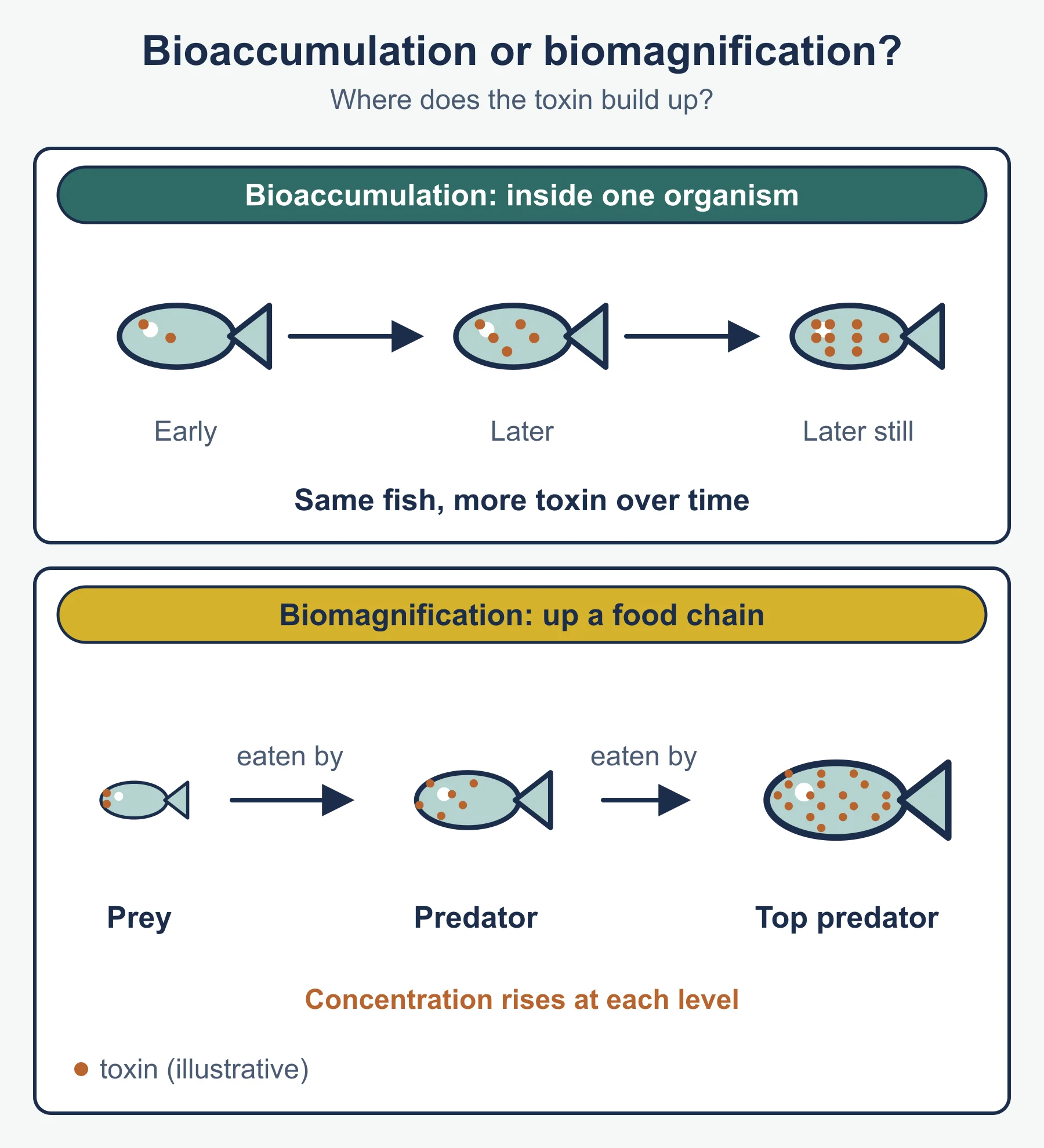
Bioaccumulation and biomagnification. Microplastics are eaten by plankton and filter feeders such as shellfish. Plastics contain additives and can absorb toxic chemicals from seawater, so the plastic and its chemicals build up in an organism over time (bioaccumulation). Predators eat many contaminated prey, so concentrations rise up the food chain (biomagnification), and people who eat seafood are at the end of that chain.
Strategies for managing the impacts (3.6.7)
| Strategy | How it reduces the impact | Limitation |
|---|---|---|
| Alternative packaging | Paper, card, glass, metal or reusable containers replace plastic | Alternatives may be heavier, more costly or use more energy to make and transport |
| Avoiding single-use plastics | Charges or bans on bags, straws, cutlery and cups cut the amount used once and thrown away | Needs behaviour change; substitutes may still be single-use |
| Safe disposal | Bins, regular collection, managed landfill and nets on drains stop plastic reaching rivers and the sea | Needs funding and infrastructure, often lacking where waste reaches the sea fastest |
| Recycling | Waste plastic is collected, sorted and made into new products | Many plastics are hard to recycle; contamination and mixed types; quality falls each time |
| Legislation and enforcement | Laws banning microbeads in products, dumping at sea or littering, with fines | Only works if it is policed; plastic crosses borders on ocean currents |
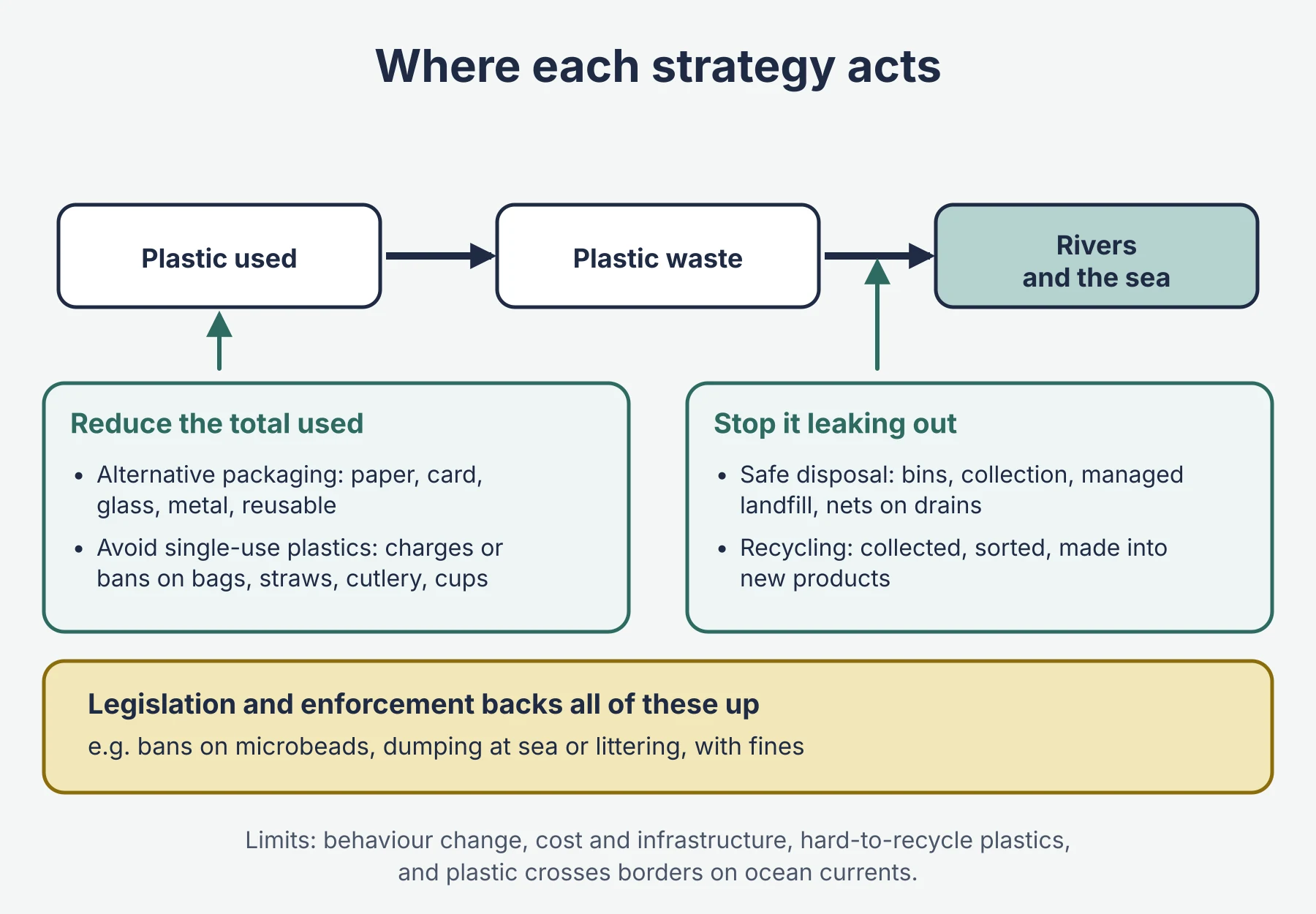
Strong answers connect strategies to the impacts they tackle. Avoiding single-use plastics and alternative packaging reduce the total entering the sea; safe disposal and recycling stop what is used from leaking out; legislation backs all of these up.
Worked example 1: decomposition data
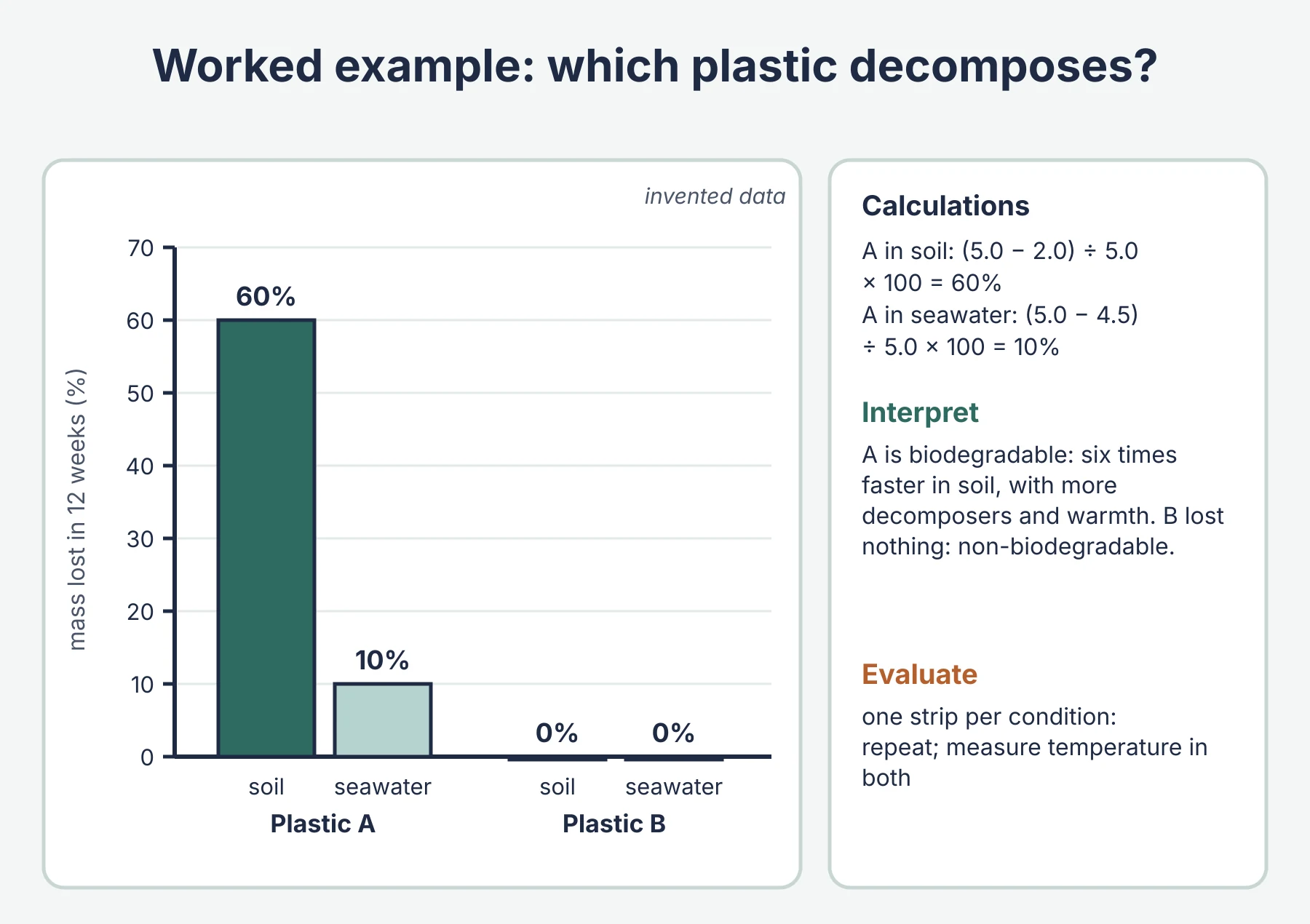
The data are invented for practice. A student buries strips of two plastics, A and B, in moist soil and hangs identical strips in a tank of cold seawater. After 12 weeks the mass of each is measured.
| Plastic | Starting mass (g) | Mass after 12 weeks in soil (g) | Mass after 12 weeks in seawater (g) |
|---|---|---|---|
| A | 5.0 | 2.0 | 4.5 |
| B | 5.0 | 5.0 | 5.0 |
- Percentage mass loss of A in soil = (5.0 − 2.0) / 5.0 × 100 = 60%.
- Percentage mass loss of A in seawater = (5.0 − 4.5) / 5.0 × 100 = 10%.
- Interpretation: A behaves as a biodegradable plastic; it decomposed six times faster in soil, where there are more decomposers and a warmer temperature, than in cold seawater. B lost no mass in either and behaves as a non-biodegradable plastic.
- Evaluation: one strip per condition is not enough, so repeats are needed; temperature should be measured in both.
Worked example 2: an annotated model answer
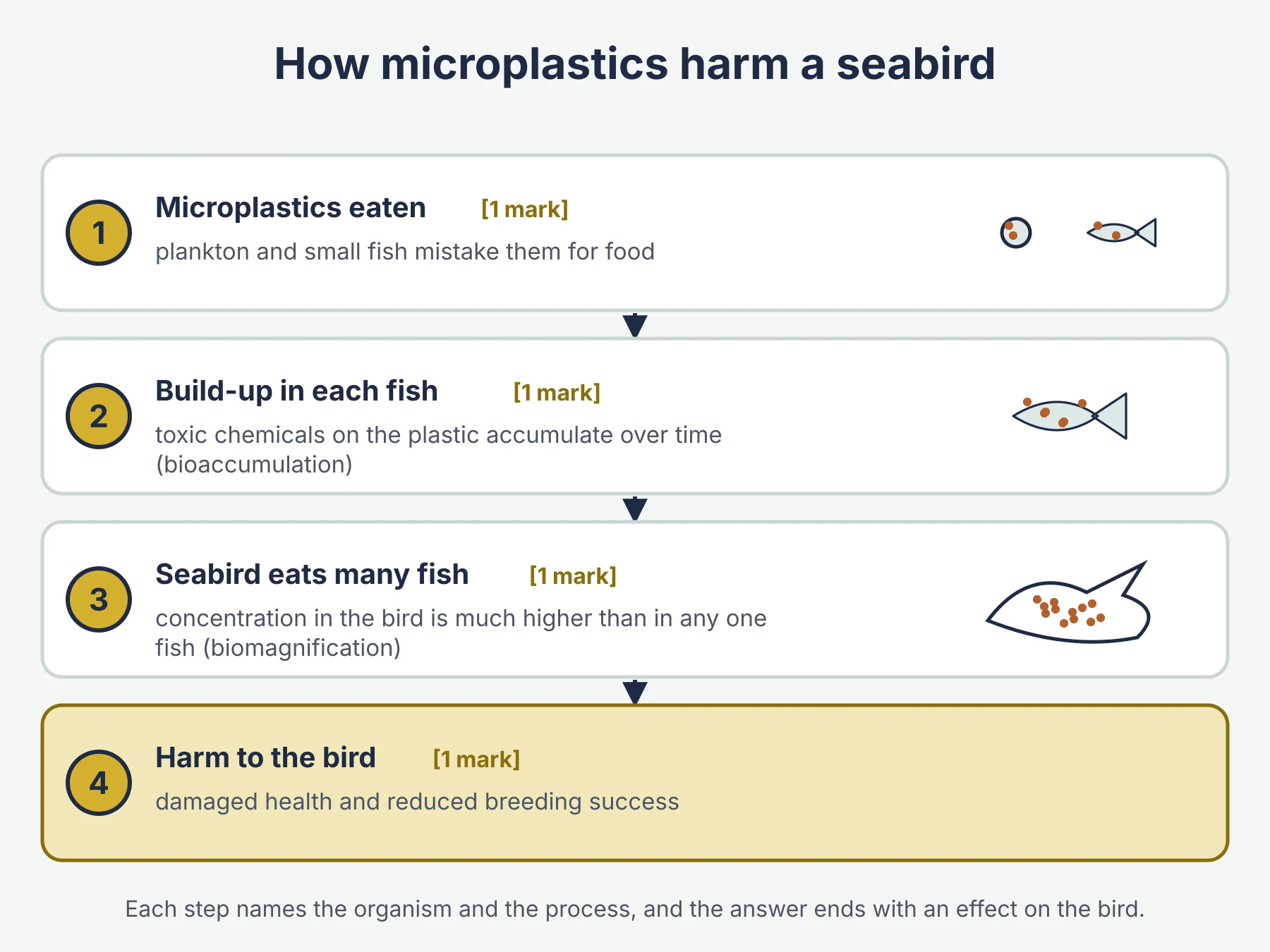
Question: explain how microplastics can harm a fish-eating seabird. [4]
Model answer: Microplastics are eaten by plankton and small fish, which mistake them for food (1). Toxic chemicals absorbed onto the plastic build up in each fish’s body over time (1). The seabird eats many contaminated fish, so the concentration in the bird is much higher than in any single fish (1). This can damage its health and reduce breeding success (1).
Why it scores: each step names the organism and the process, and the answer ends with an effect on the bird.
Common mistakes
- Saying bioplastics are always biodegradable.
- Writing “microplastics are small pieces of plastic” without the 5 mm limit.
- Saying non-biodegradable plastics never break down. They break into smaller pieces over a long period.
- Forgetting methane as a product of decomposition, or listing only carbon dioxide.
- Recommending recycling for every problem; it does nothing for plastic already in the sea and works for only some plastic types.
Exam technique
Describe questions on the five plastic types are point-for-point recall: use the syllabus phrases. Describe and explain questions on impacts need the impact plus how it harms the organism or people. For strategies, say how each one reduces plastic reaching the sea or its harm, then give a limitation if asked to evaluate. In data questions, calculate percentage change from the starting value and refer to biotic and abiotic factors when explaining different rates.
Condense this with the plastic pollution revision notes and practise with the plastic pollution practice questions. Bioaccumulation and biomagnification are also covered in the water pollution study guide.
Related resources
-
Revision notes
Cambridge IGCSE Environmental Management: Land — Revision Notes
Recall notes on soils and crop growth, food production and soil erosion for Topic 2 Land of Cambridge IGCSE Environmental Management 0680, 2027-2029 series.
Environmental Management · Cambridge · IGCSE
Revise topic -
Practice questions
Cambridge IGCSE Environmental Management (0680): Plastic pollution – Practice Questions
Original practice questions with answers on plastic types, microplastics, marine impacts and plastic management strategies for Cambridge IGCSE 0680.
Environmental Management · Cambridge · IGCSE
Try questions -
Revision notes
Cambridge IGCSE Environmental Management (0680): Plastic pollution – Revision Notes
Recall notes on conventional, bio, biodegradable and microplastics, marine impacts and management strategies, with a self-test, for Cambridge IGCSE 0680.
Environmental Management · Cambridge · IGCSE
Revise topic
Get free revision emails (optional)
Occasional emails with practice questions, worked explanations and links to free resources for the qualification and subjects you choose. No spam, and you can unsubscribe from any email. The free tools on this site never need an email.