
Study Guides
Cambridge IGCSE Environmental Management (0680): Marine aquaculture
Overfishing, bycatch, marine aquaculture impacts and strategies for managing the harvest of marine species for Cambridge IGCSE Environmental Management 0680.
- Subject
- Environmental Management
- Level
- IGCSE
- Topic
- Topic 3 – Water
- Author
- Marlbridge Academic Team
- Updated
- Reviewed by
- Azam Siddique (what this means)
Aligned to Cambridge IGCSE Environmental Management (0680), 2027-2029. Official specification .
Syllabus page (what it covers and how it is assessed): Cambridge IGCSE Environmental Management.
Syllabus points this page covers
0680
- 3.4 Marine aquaculture
Found an error? Report a correction.
Need help with this topic? Request a free trial class for IGCSE Environmental Management (0680).
Sub-topic 3.4 of Cambridge IGCSE Environmental Management (0680) is broader than its title suggests. It starts with the impacts of exploiting wild marine species, then defines marine aquaculture and its impacts, and ends with the strategies used to manage the harvest of marine species and a “discuss the benefits and limitations” point. Expect questions that link the three: overfishing creates the demand for aquaculture, and aquaculture does not remove the need to manage wild fisheries. The Water study guide places this within Topic 3.
Exploitation of marine species (3.4.1)
Overfishing and overharvesting
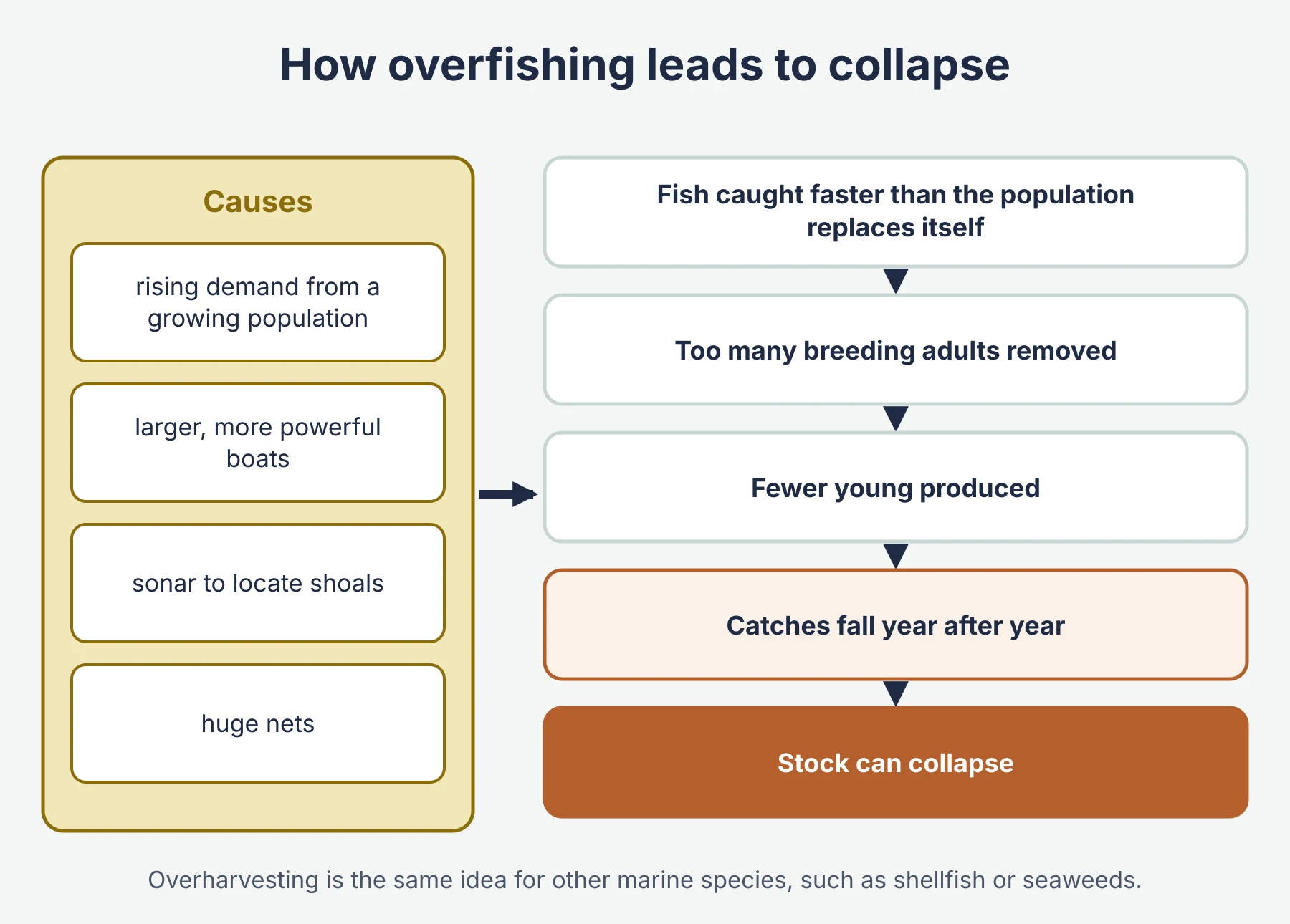
Overfishing means catching fish faster than the population can replace itself by reproduction and growth. Overharvesting is the same idea applied to other marine species, such as shellfish or seaweeds. Causes include rising demand from a growing population, larger and more powerful boats, sonar to locate shoals, and huge nets. When too many breeding adults are removed, fewer young are produced, catches fall year after year and a stock can collapse.
Effect on target and bycatch species
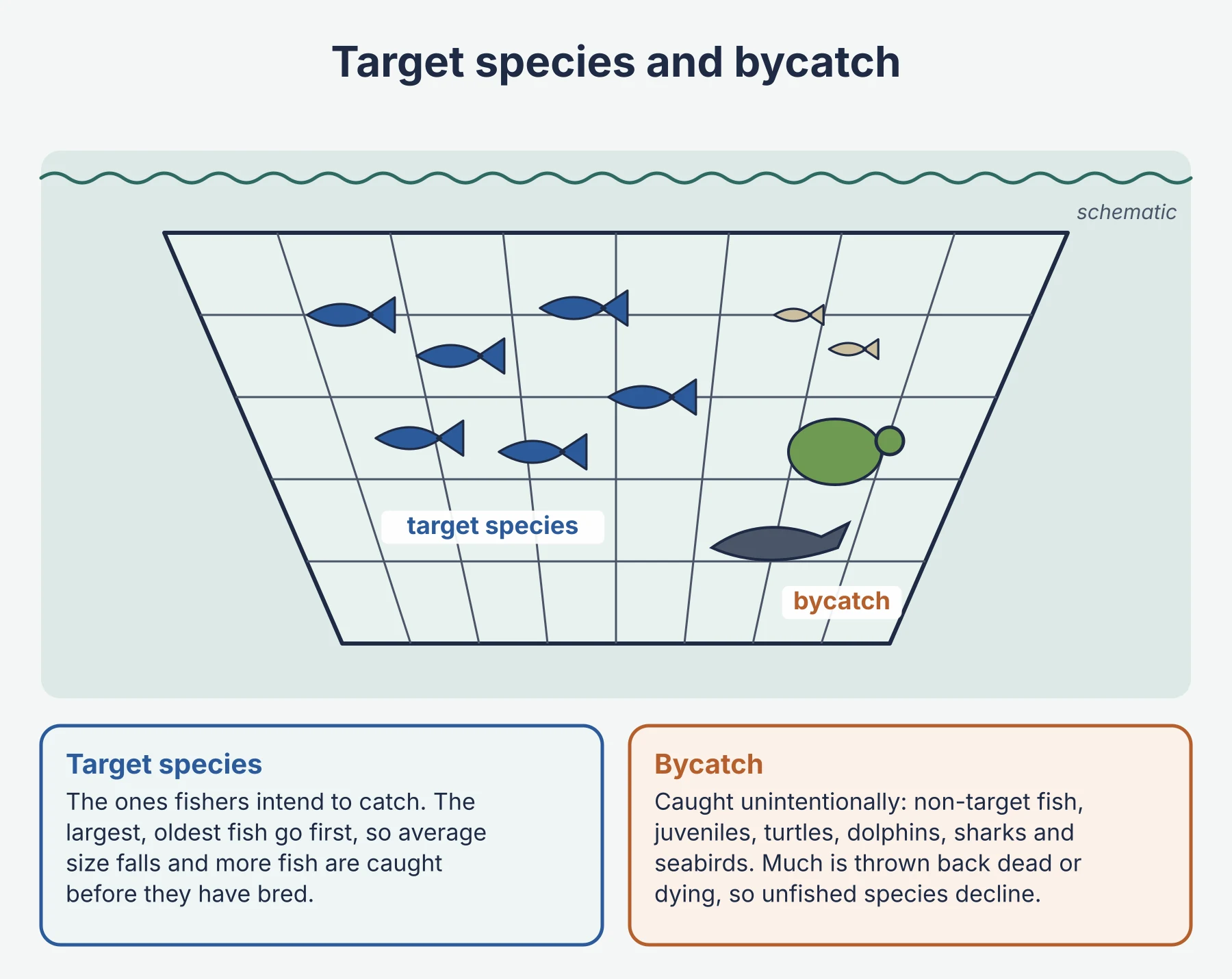
- Target species are the ones the fishers intend to catch. Heavy fishing removes the largest, oldest fish first, so the average size falls and more fish are caught before they have bred.
- Bycatch is everything caught unintentionally: non-target fish, juveniles of the target species, turtles, dolphins, sharks and seabirds. Much bycatch is thrown back dead or dying, so species that are not even being fished for decline.
Effect on food chains
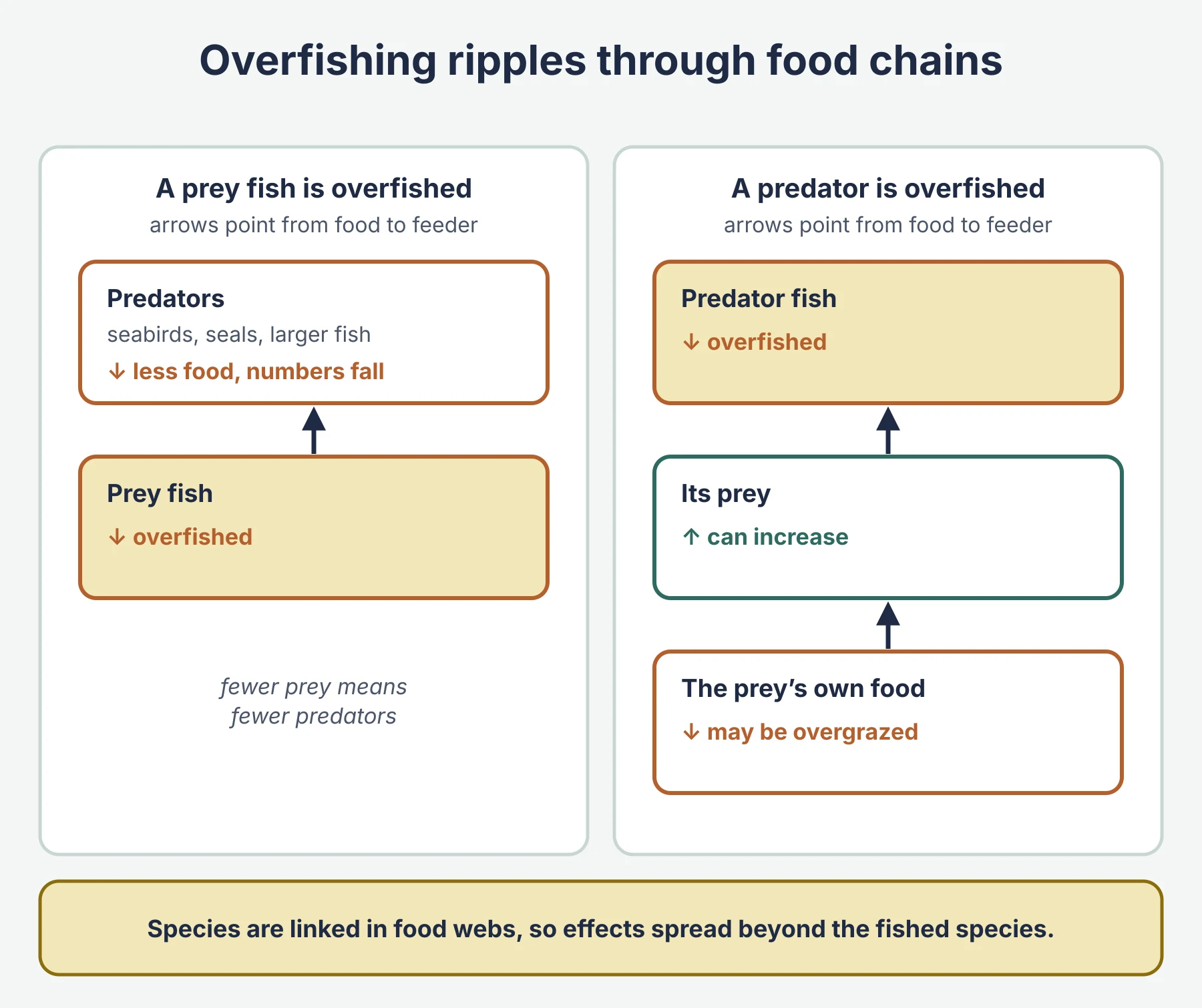
Removing a species changes the food chain around it. If a prey fish is overfished, its predators, such as seabirds, seals and larger fish, have less food and their numbers fall. If a predator is overfished, its prey can increase, which may then overgraze their own food. Because many marine species are linked in food webs, the effects spread well beyond the fished species.
Defining marine aquaculture (3.4.2)
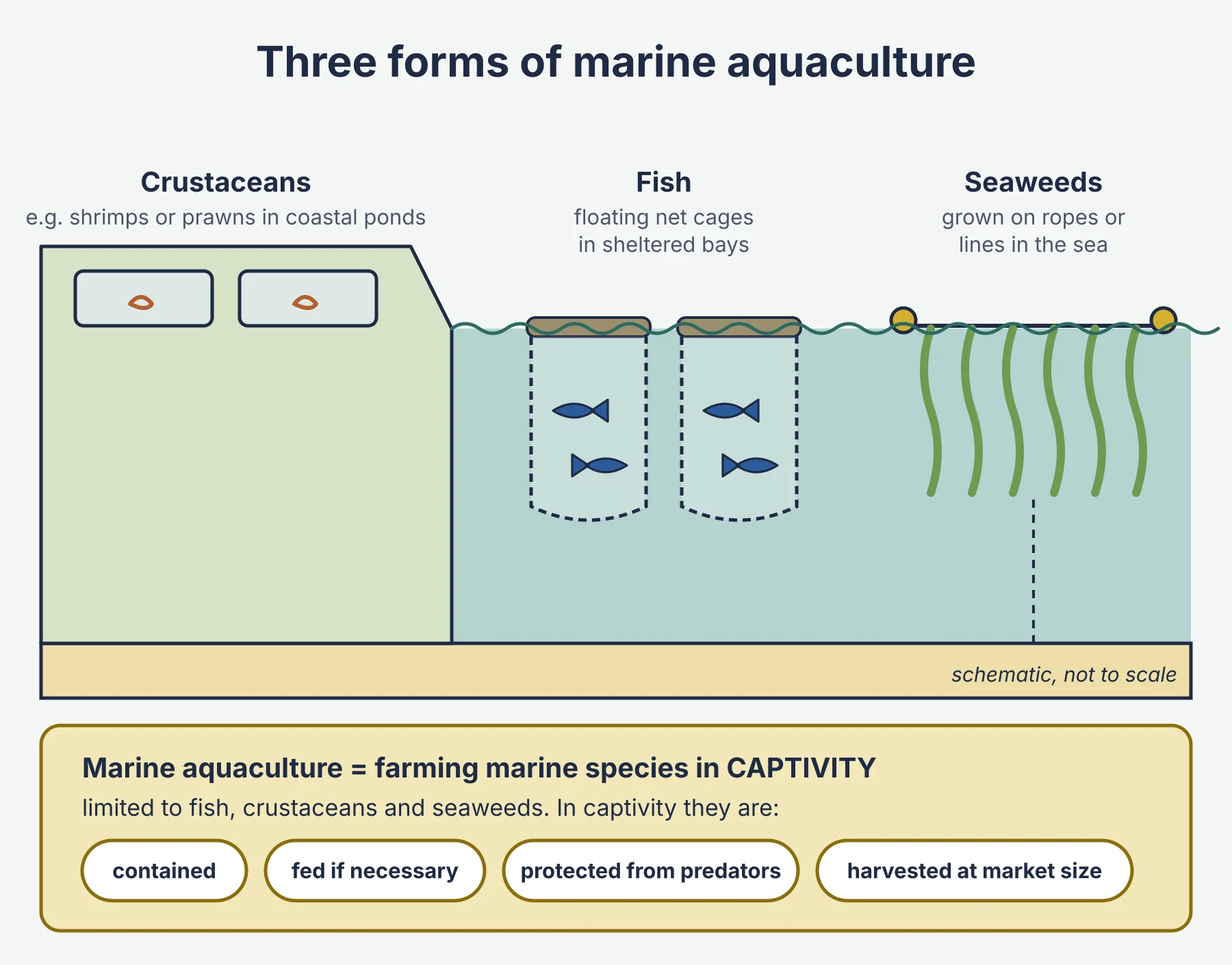
The syllabus defines marine aquaculture as the farming of marine species in captivity, limited to fish, crustaceans and seaweeds. Knowledge of specific species is not required, so describe groups: farmed fish kept in floating net cages in sheltered bays, crustaceans such as shrimps or prawns raised in coastal ponds, and seaweeds grown on ropes or lines in the sea.
The key word is captivity: the organisms are contained and managed, fed if necessary, protected from predators and harvested when they reach market size.
Impacts of marine aquaculture (3.4.3)
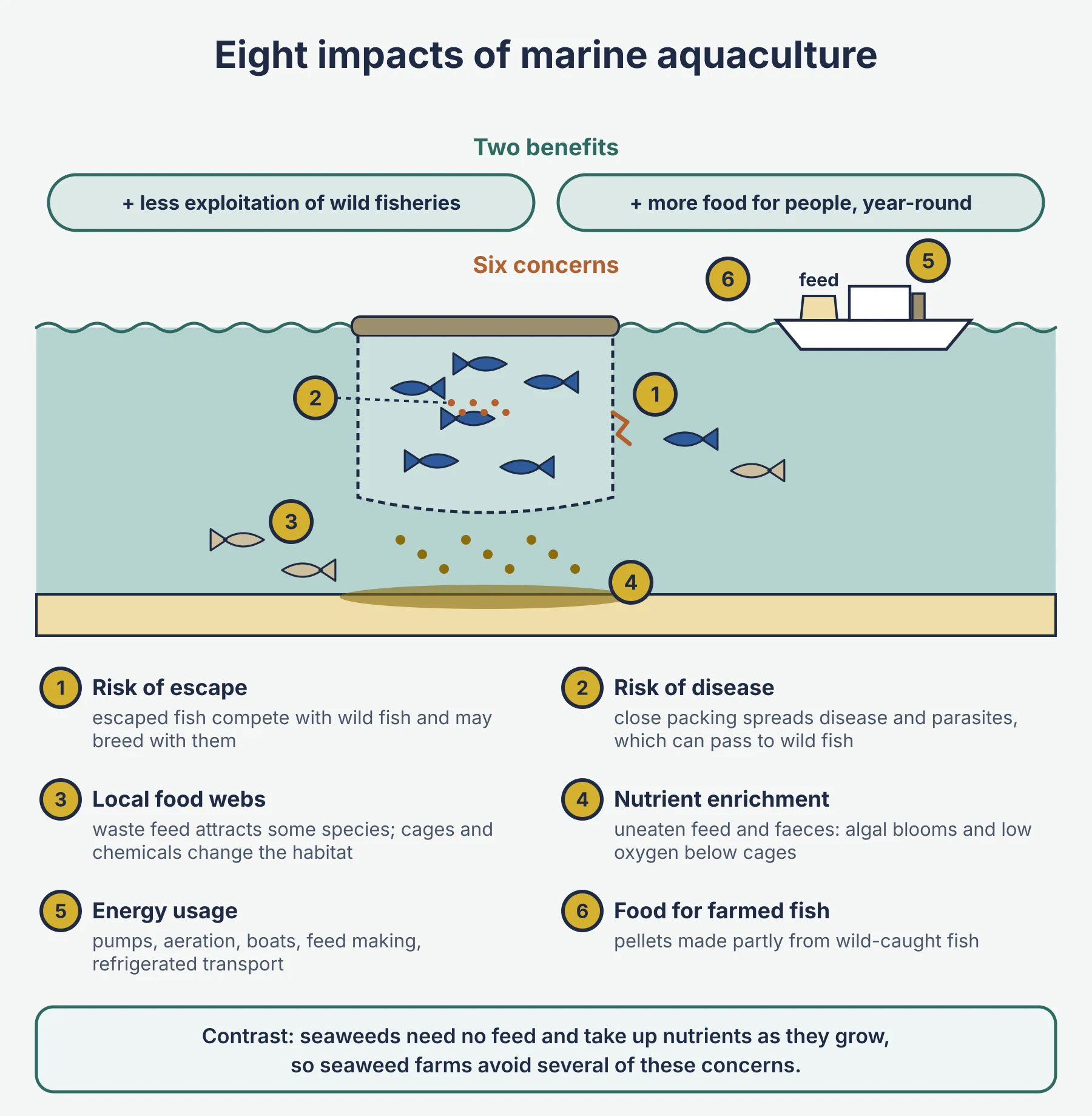
The syllabus lists eight impacts. Learn them as two benefits and six concerns.
| Impact | Explanation |
|---|---|
| Reduced exploitation of natural fisheries | Farmed products replace some wild catch, so pressure on wild stocks can fall |
| Increased food supply for humans | A reliable, year-round supply of protein that can grow with demand |
| Risk of escape | Farmed fish escape from damaged cages, compete with wild fish for food and space, and may breed with them |
| Risk of disease | Animals packed closely together spread disease and parasites quickly, which can pass to wild populations nearby |
| Local food webs | Waste feed attracts some species; cages, ponds and chemicals change the habitat and the organisms living around the farm |
| Nutrient enrichment from waste | Uneaten feed and faeces add nutrients and organic matter to the water, which can cause algal blooms and low oxygen below cages |
| Energy usage | Pumps, aeration, lighting, boats, feed manufacture and refrigerated transport all use energy, often from fossil fuels |
| Source of food for farmed species | Many farmed fish are fed pellets made partly from wild-caught fish, so wild fishing continues to supply the farm |
Seaweed farming is a useful contrast in answers: seaweeds need no feed and take up nutrients from the water as they grow, so they avoid several of the concerns in the table.
Managing the harvest of marine species (3.4.4)
| Strategy | How it works |
|---|---|
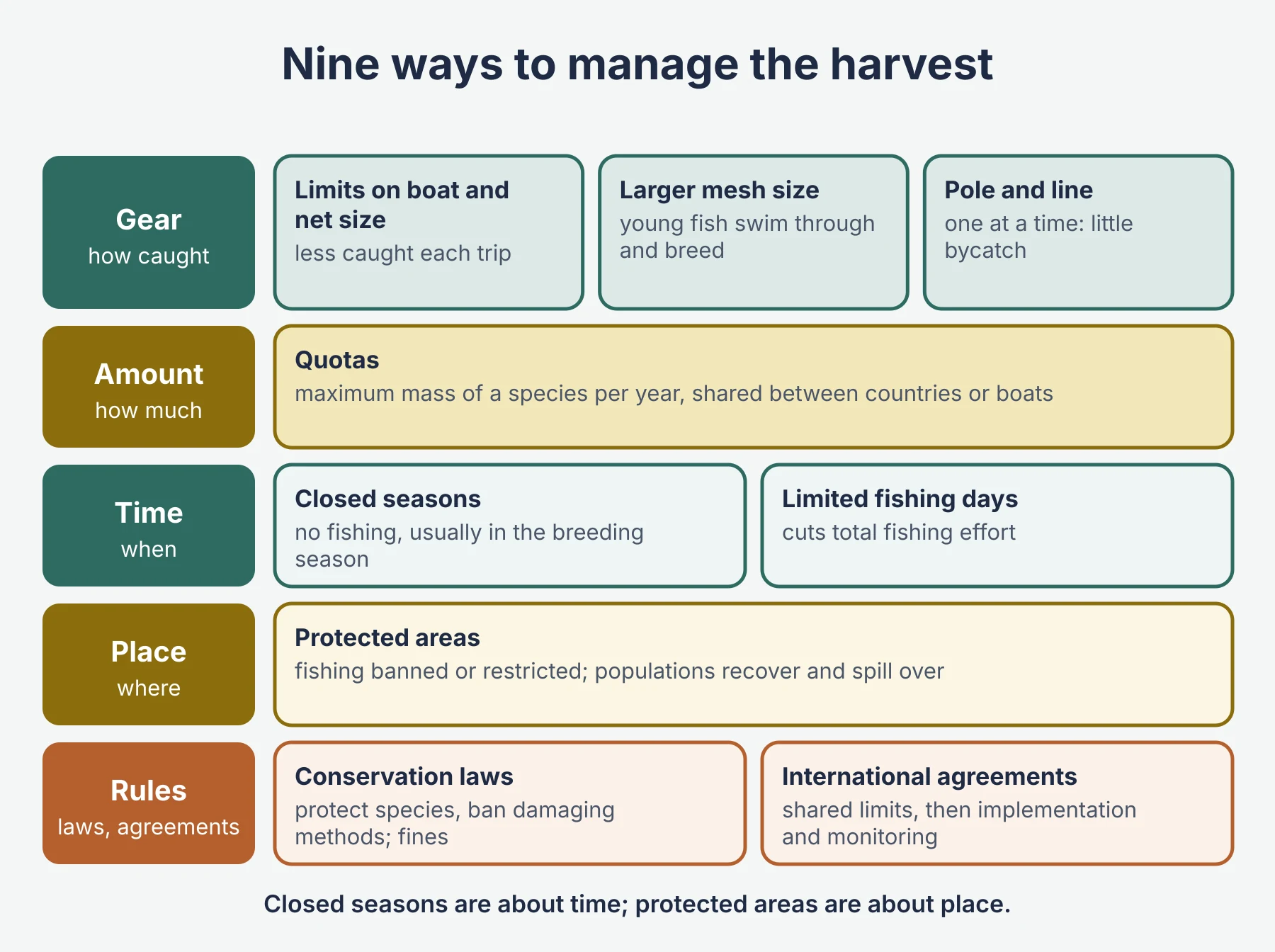
| Limits on size of boat and overall net size | Smaller boats and nets catch less in each trip, so total catch is lower |
| Increased mesh size of nets | Young, small fish swim through the holes, survive and breed before they are caught |
| Sustainable methods: pole and line | Fish are caught one at a time, so there is little bycatch and unwanted fish can be released alive |
| Quotas | A maximum mass of a species that may be caught in a year, often divided between countries or boats |
| Closed seasons | Fishing is banned at certain times, usually the breeding season, so fish can spawn |
| Limited number of fishing days | Boats may fish only on a set number of days, cutting total effort |
| Protected areas | Zones where fishing is banned or restricted, letting populations recover and spill over into nearby waters |
| Conservation laws | Laws protecting endangered species or banning damaging methods, enforced with fines |
| International agreements: implementation and monitoring | Fish move across borders, so countries agree shared limits and then check that they are followed, for example by inspections and vessel tracking |
Worked example: a quota calculation
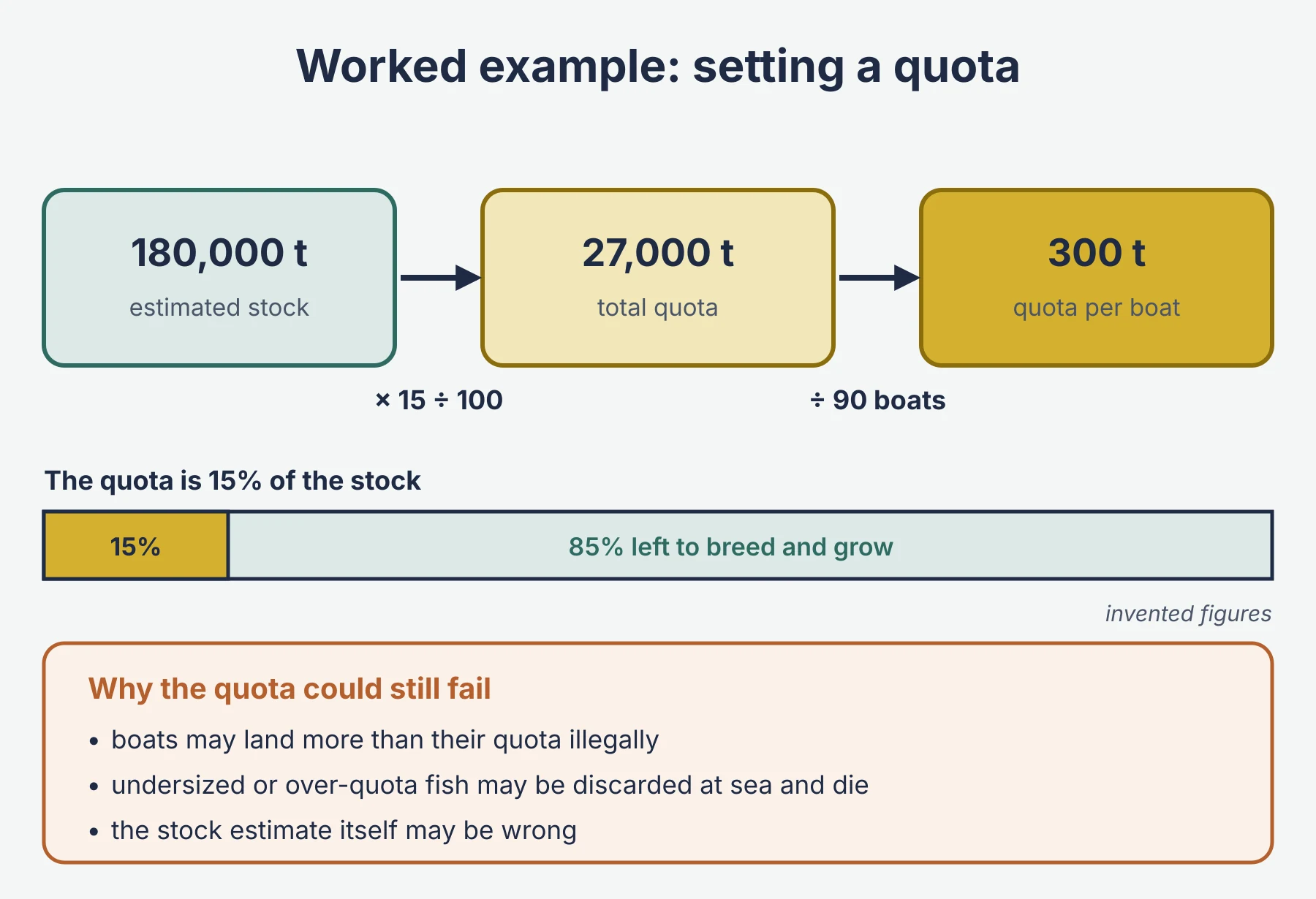
The figures are invented for practice. Scientists estimate that a fish stock contains 180,000 tonnes. They advise that no more than 15% of the stock is caught each year. The quota is shared equally between 90 licensed boats.
- Total quota = 180,000 × 15 / 100 = 27,000 tonnes.
- Quota per boat = 27,000 / 90 = 300 tonnes.
A follow-up question might ask why the quota could still fail. Strong answers mention that boats may land more than their quota illegally, that undersized or over-quota fish may be discarded at sea and die, and that the stock estimate itself may be wrong.
Worked example: an annotated “discuss” answer
Question: discuss the benefits and limitations of quotas and protected areas for managing a fishery. [6]
Quotas set a limit on the total mass caught, so fewer fish are removed than the stock can replace (benefit). They can be adjusted each year as new survey data arrive (benefit). However, quotas are hard to check at sea, and fishers may throw back over-quota fish dead, so the real catch is higher than recorded (limitation).
Protected areas let fish breed and grow without disturbance, and adults spill over into fished waters nearby (benefit). But they only work if patrolled, and fishing effort may simply move to the edge of the protected area (limitation).
A combination works best: quotas control the amount taken overall, while protected areas safeguard breeding grounds, provided both are monitored (judgement).
Why it scores: two benefits and one limitation for quotas, one of each for protected areas, a reasoned judgement, and every point says how the strategy affects the fish population.
Common mistakes
- Defining aquaculture as “fish farming”. The syllabus definition is the farming of marine species in captivity: fish, crustaceans and seaweeds.
- Claiming aquaculture always reduces pressure on wild stocks. Many farmed fish are fed on wild-caught fish.
- Saying a bigger mesh “catches more fish”. It lets juveniles escape.
- Confusing closed seasons with protected areas: one is about time, the other about place.
- Naming international agreements without mentioning implementation and monitoring, which the syllabus wording includes.
Exam technique
Describe and explain questions on impacts want the impact plus its cause: “escaped farmed fish compete with wild fish for food” rather than “escape”. For strategy questions, say how the strategy changes the number or size of fish caught. In discuss questions, give both sides for each named strategy, link to the scenario’s details, such as a fishery shared by several countries, and finish with a judgement.
Condense this content with the marine aquaculture revision notes, then try the marine aquaculture practice questions. Nutrient enrichment from fish-farm waste links to eutrophication in the water pollution study guide.
Related resources
-
Revision notes
Cambridge IGCSE Environmental Management: Land — Revision Notes
Recall notes on soils and crop growth, food production and soil erosion for Topic 2 Land of Cambridge IGCSE Environmental Management 0680, 2027-2029 series.
Environmental Management · Cambridge · IGCSE
Revise topic -
Practice questions
Cambridge IGCSE Environmental Management (0680): Marine aquaculture – Practice Questions
Original practice questions with answers on overfishing, bycatch, marine aquaculture impacts and fishery management for Cambridge IGCSE 0680.
Environmental Management · Cambridge · IGCSE
Try questions -
Revision notes
Cambridge IGCSE Environmental Management (0680): Marine aquaculture – Revision Notes
Recall notes on overfishing, bycatch, the eight impacts of marine aquaculture and nine harvest management strategies for Cambridge IGCSE 0680.
Environmental Management · Cambridge · IGCSE
Revise topic
Get free revision emails (optional)
Occasional emails with practice questions, worked explanations and links to free resources for the qualification and subjects you choose. No spam, and you can unsubscribe from any email. The free tools on this site never need an email.