
Study Guides
Cambridge IGCSE Environmental Management (0680): Soil erosion
Causes of soil erosion by wind and water, its impacts on land and people, and strategies such as terracing and wind breaks, for Cambridge IGCSE 0680.
- Subject
- Environmental Management
- Level
- IGCSE
- Topic
- Topic 2 – Land
- Author
- Marlbridge Academic Team
- Updated
- Reviewed by
- Azam Siddique (what this means)
Aligned to Cambridge IGCSE Environmental Management (0680), 2027-2029. Official specification .
Syllabus page (what it covers and how it is assessed): Cambridge IGCSE Environmental Management.
Syllabus points this page covers
0680
- 2.3 Soil erosion
Found an error? Report a correction.
Need help with this topic? Request a free trial class for IGCSE Environmental Management (0680).
Soil forms very slowly, from weathered rock and decomposed organic matter, but it can be stripped away in a single storm. Sub-topic 2.3 asks why that happens, what it does to land and people, and how farmers can prevent it. The syllabus gives the mechanism for each prevention strategy, so this is one area where learning the exact wording pays directly in marks. The topic also closes the loop of Topic 2: poor soil management (2.1) and unsustainable farming (2.2) are the main causes of erosion.
What the syllabus asks you to do
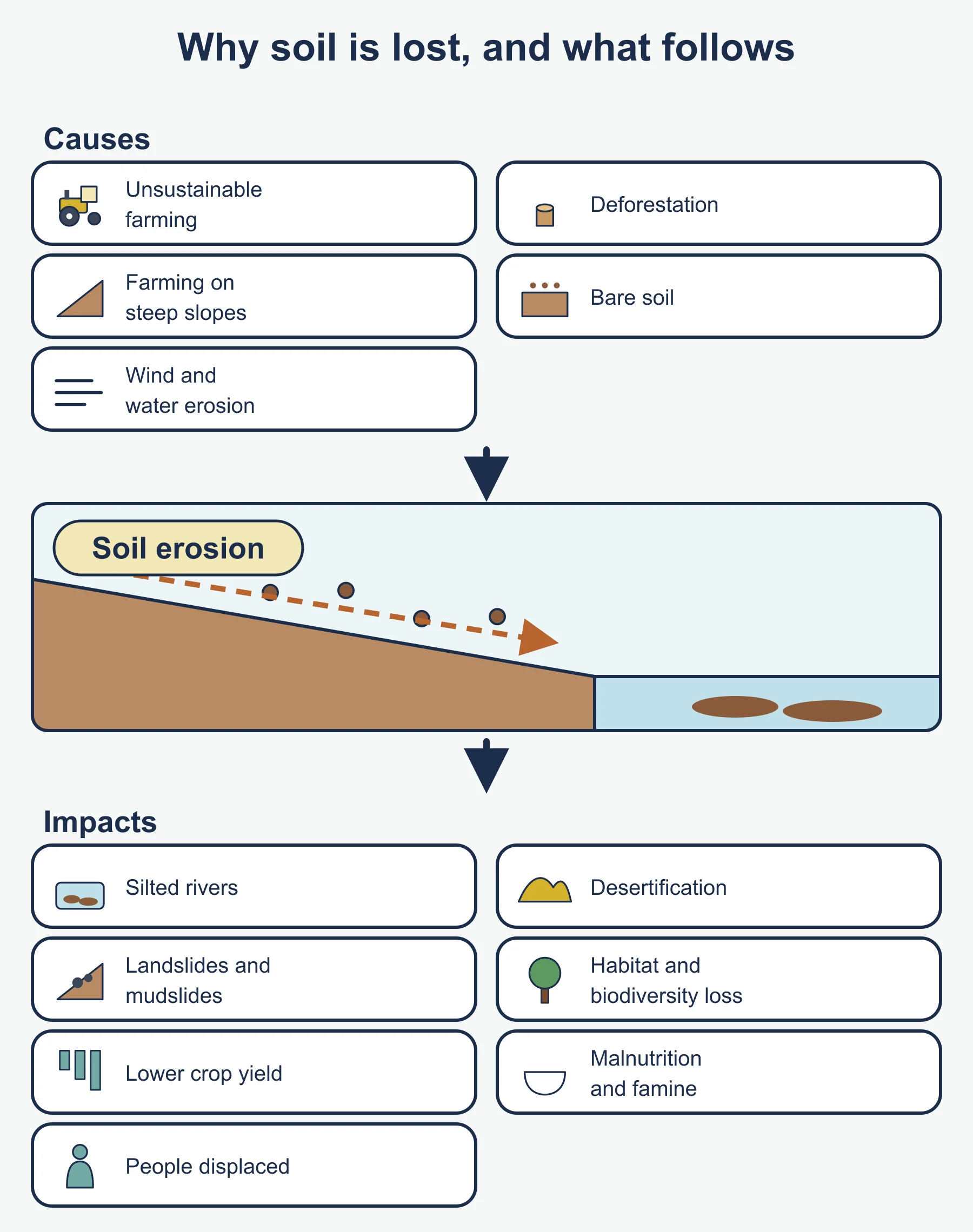
- 2.3.1 Describe the causes of soil erosion: unsustainable agricultural practices; deforestation; farming on steep slopes; bare soil; wind and water erosion.
- 2.3.2 Describe the impacts of soil erosion: silting of rivers; desertification; mass movement (landslides, rockslides and mudslides); loss of habitats and biodiversity; reduction in crop yield; malnutrition and famine; displacement of people.
- 2.3.3 Describe and explain strategies to reduce soil erosion: terracing; contour ploughing; bunds; wind breaks; maintaining vegetation cover; addition of organic matter.
What soil erosion is
Soil erosion is the removal of soil, especially the fertile topsoil, by water or wind faster than new soil forms. Topsoil matters most because it contains most of the organic matter, nutrients and soil organisms that crops depend on.
How water and wind remove soil
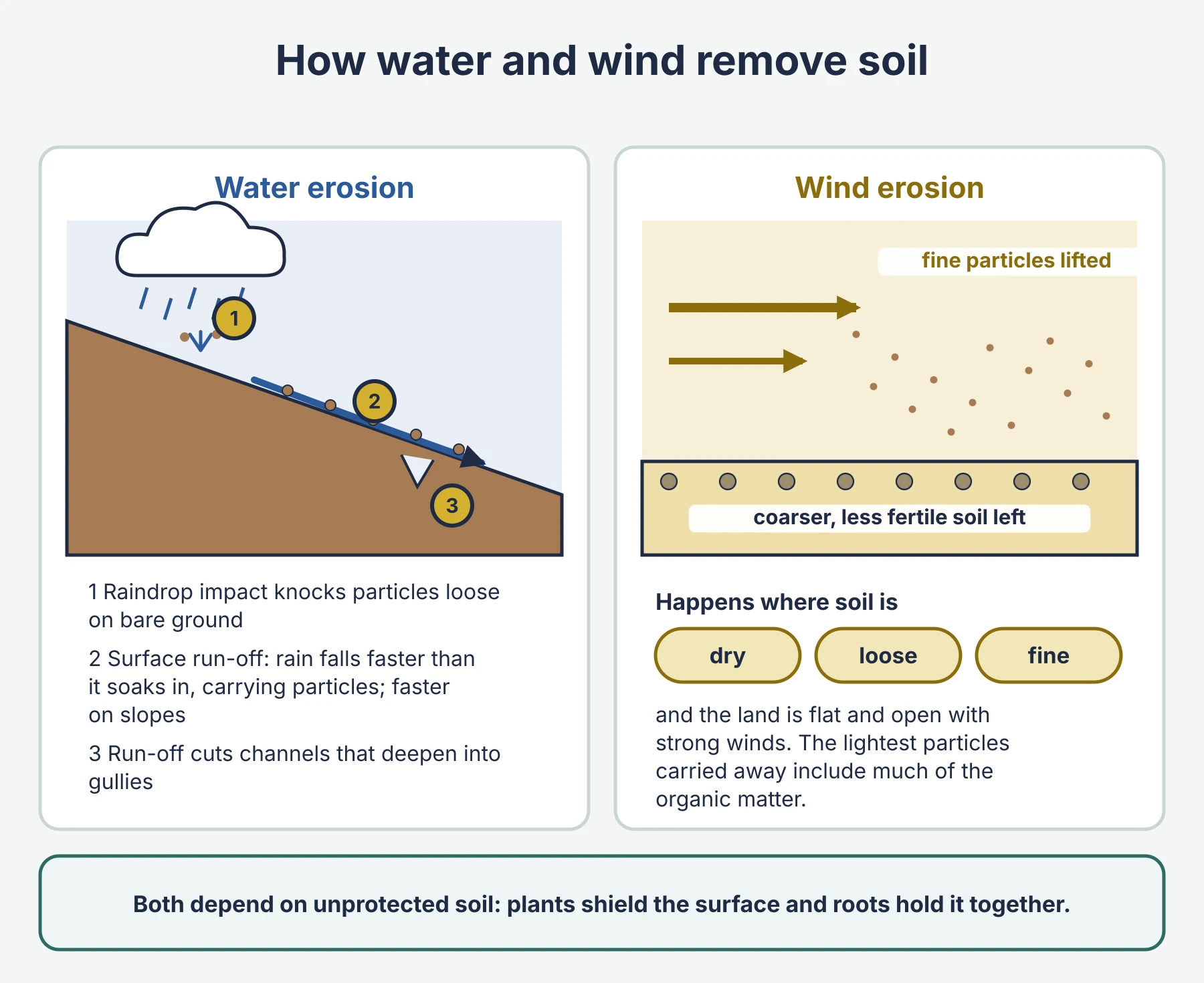
Water erosion
- Raindrop impact: heavy rain falling on bare ground knocks soil particles loose.
- Surface run-off: when rain falls faster than it can soak in, water flows over the surface, carrying loosened particles with it. On slopes it speeds up and carries more.
- As run-off concentrates, it cuts small channels, which can deepen into gullies that make land impossible to farm.
Wind erosion
- Happens where soil is dry, loose and fine, the land is flat and open, and winds are strong.
- Wind lifts and carries the smallest, lightest particles, which include much of the organic matter, leaving coarser, less fertile soil behind.
Both processes depend on the soil being unprotected. Vegetation shields the surface from rain and wind, and roots hold the soil together.
Causes of soil erosion (2.3.1)
| Cause | How it leads to erosion |
|---|---|
| Unsustainable agricultural practices | Overgrazing removes grass cover; overcultivation and monoculture exhaust organic matter, weakening soil structure; ploughing up and down slopes creates channels for run-off; mismanaged irrigation causes run-off |
| Deforestation | Removes the canopy that intercepts rain and the roots that bind soil; more rain reaches the ground and runs off |
| Farming on steep slopes | Gravity speeds up run-off, giving water more energy to carry soil downhill |
| Bare soil | Nothing protects the surface from raindrop impact or wind; common after harvest, ploughing or clearance |
| Wind and water erosion | The processes that remove the loosened soil, made worse by all of the above |
Causes rarely act alone. A cleared hillside, ploughed and left bare between crops, combines deforestation, a steep slope, bare soil and an unsustainable practice.
Impacts of soil erosion (2.3.2)
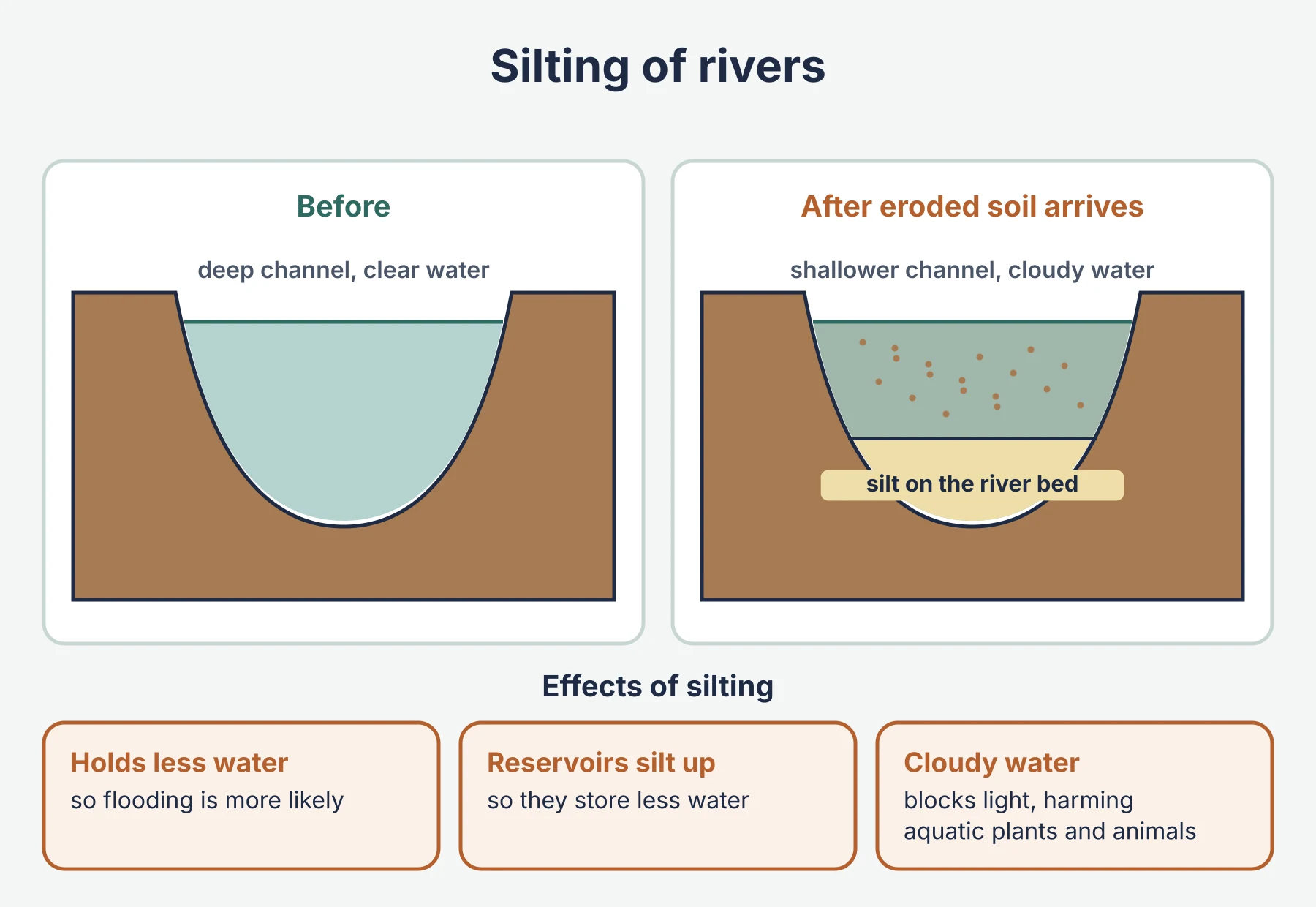
Silting of rivers. Eroded soil is carried into rivers and deposited on the river bed and in reservoirs. The channel becomes shallower and holds less water, so flooding becomes more likely; reservoirs store less water; cloudy water blocks light, harming aquatic plants and animals.
Desertification. In dry areas, the loss of topsoil and vegetation leaves land that can no longer support plants, so it becomes increasingly desert-like.
Mass movement. On slopes, soil and rock that are no longer held by roots can move downhill suddenly as landslides, rockslides or, when saturated with water, mudslides, burying land, roads and homes.
Loss of habitats and biodiversity. Organisms that live in or depend on the soil lose their habitat; silt damages river ecosystems.
Reduction in crop yield. The remaining soil holds fewer nutrients and less water, so crops grow less.
Malnutrition and famine. Where people depend on local harvests, falling yields mean too little food; severe and widespread shortages can lead to famine.
Displacement of people. When land can no longer feed a family, or has been destroyed by mass movement, people are forced to move, often to towns or to other farmland, spreading pressure elsewhere.
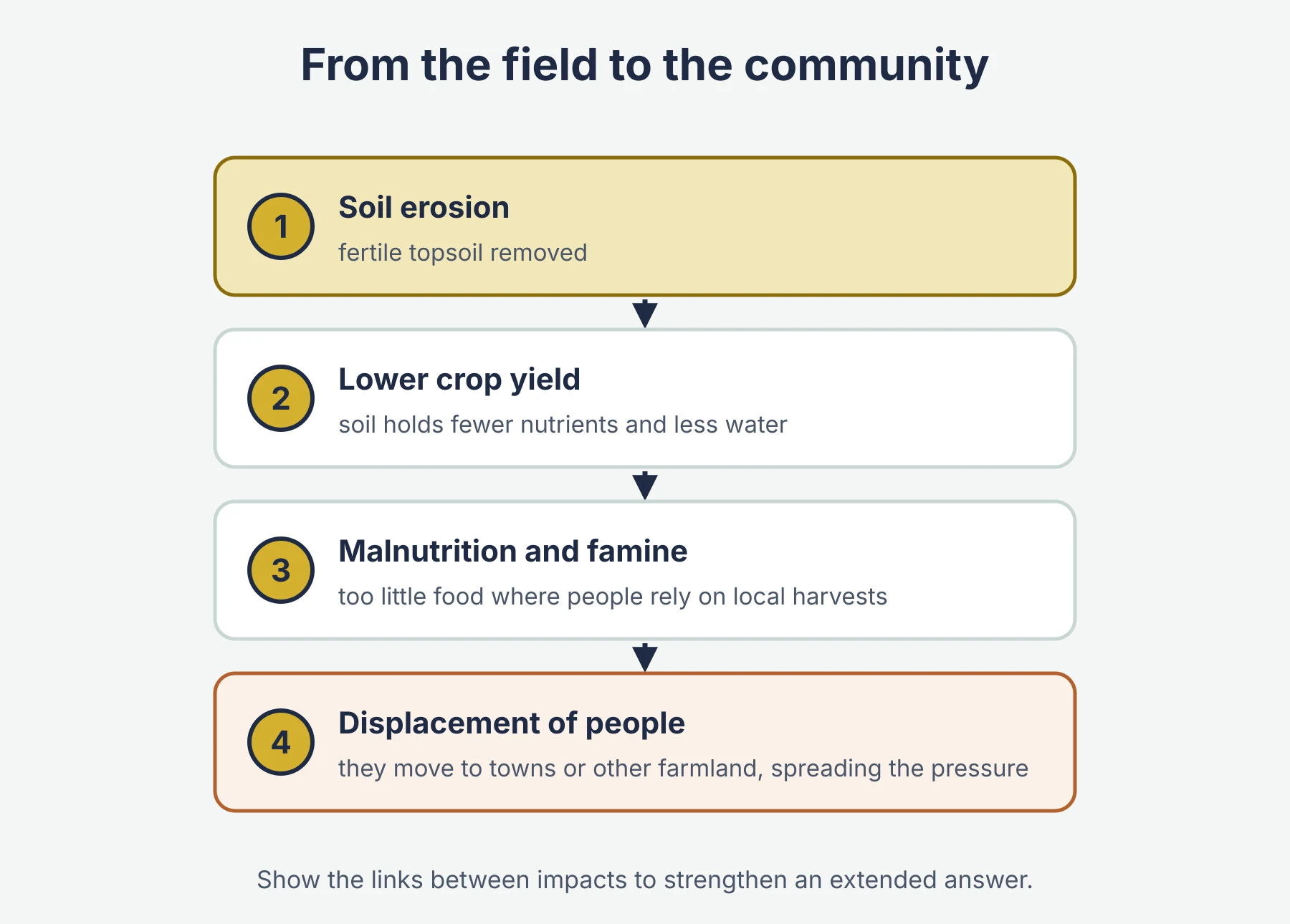
These impacts form a chain from the field to the community: erosion → lower yield → malnutrition → displacement. Showing the links between them strengthens an extended answer.
Strategies to reduce soil erosion (2.3.3)
| Strategy | What it is | How it works (syllabus mechanism) |
|---|---|---|
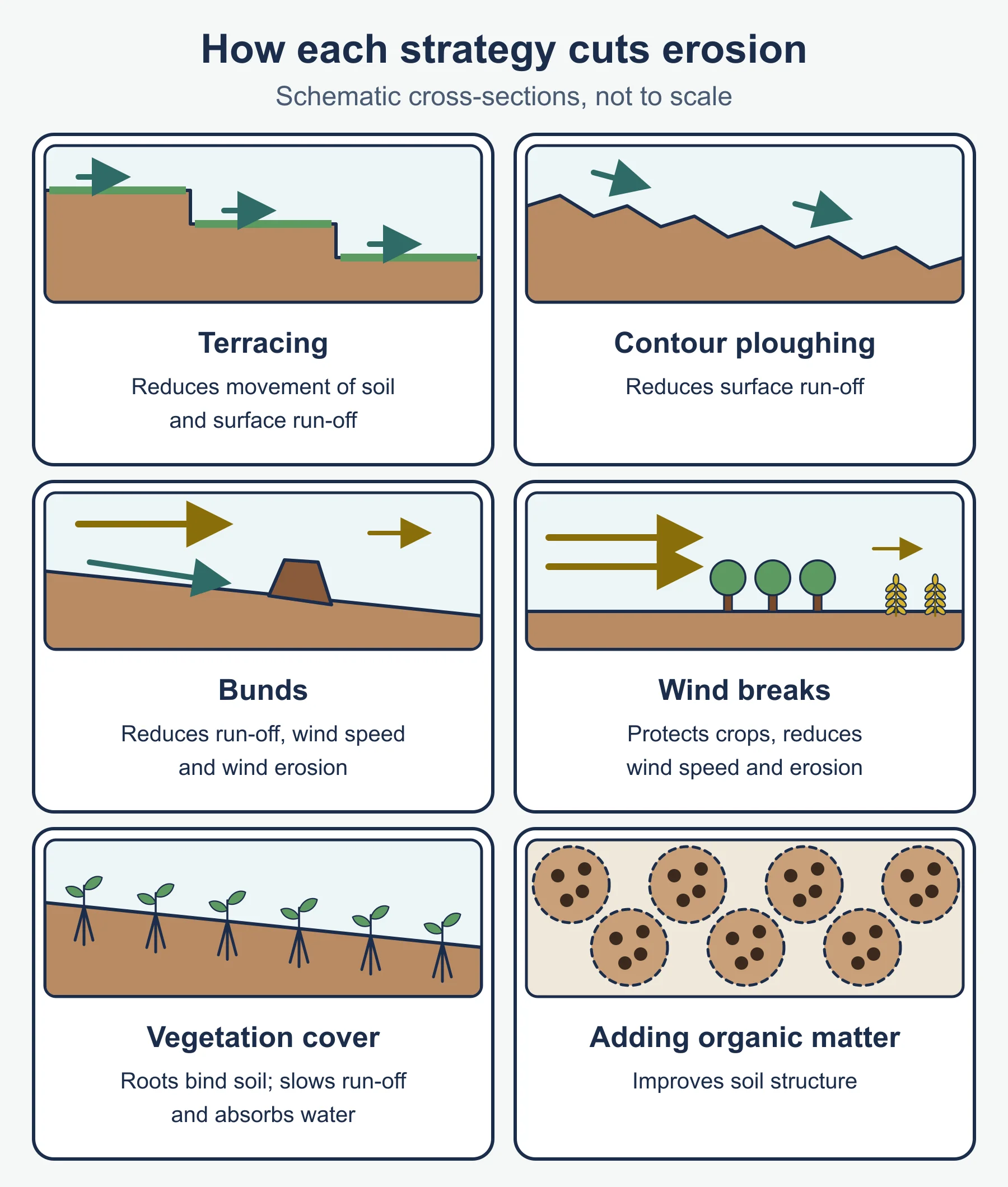
| Terracing | Cutting a slope into a series of flat steps, often with walls | Reduces movement of soil and surface run-off |
| Contour ploughing | Ploughing across a slope, following lines of equal height, not up and down it | Reduces surface run-off: each furrow catches water |
| Bunds | Low banks of earth or stones built along the contours or around fields | Reduce surface run-off, reduce wind speed and wind erosion |
| Wind breaks | Lines of trees, hedges or fences across the prevailing wind | Protect crops, reduce wind speed and wind erosion |
| Maintaining vegetation cover | Keeping plants on the soil, such as cover crops after harvest or leaving grass strips | Roots bind the soil; vegetation reduces surface run-off and absorbs water |
| Addition of organic matter | Adding manure, compost or crop residue | Improves soil structure, so particles stick together and resist erosion |
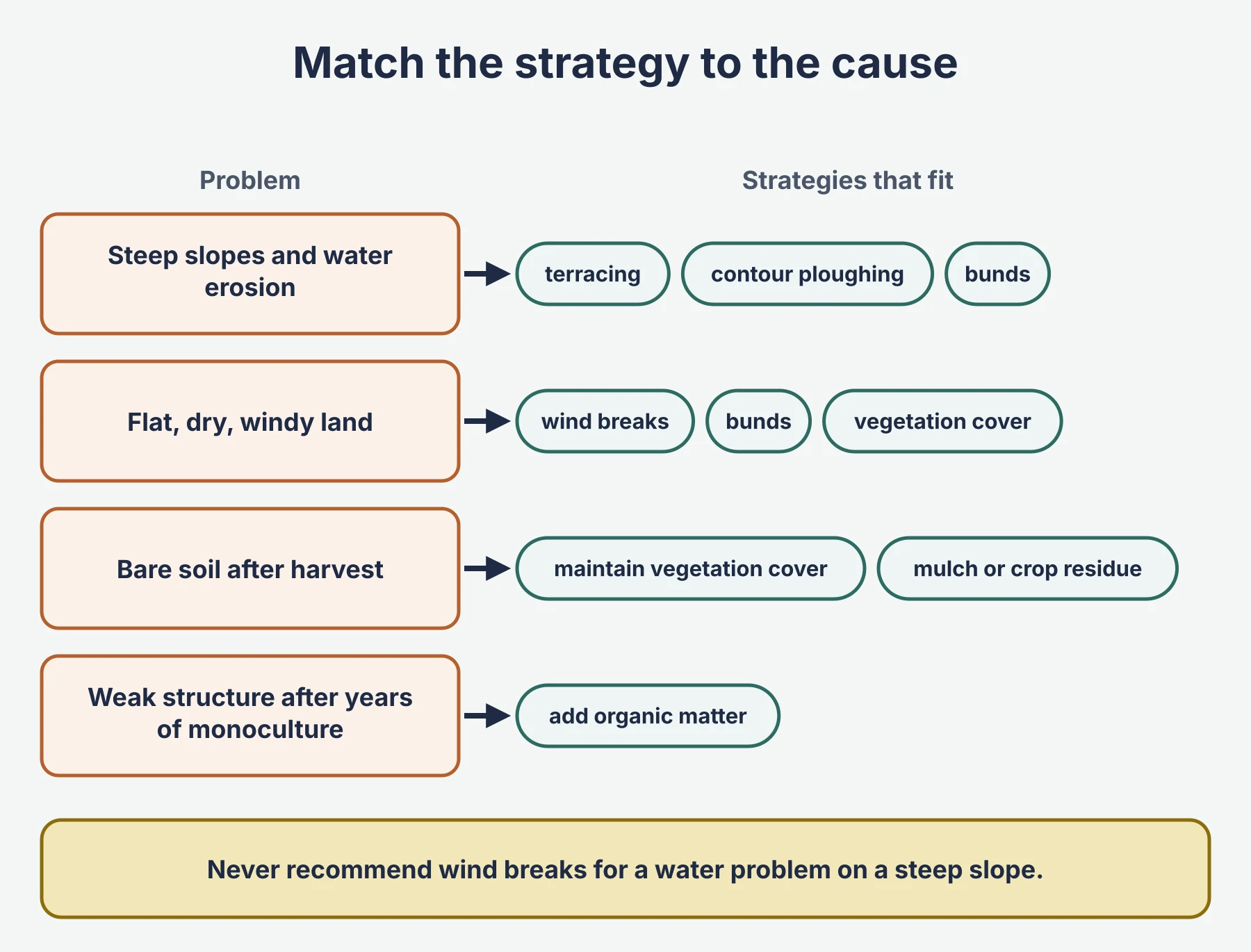
Matching strategy to cause is the key exam skill:
- Steep slopes and water erosion → terracing, contour ploughing, bunds.
- Flat, dry, windy land → wind breaks, bunds, vegetation cover.
- Bare soil after harvest → maintaining vegetation cover, mulch or crop residue.
- Weak soil structure after years of monoculture → organic matter.
Benefits and limitations to weigh
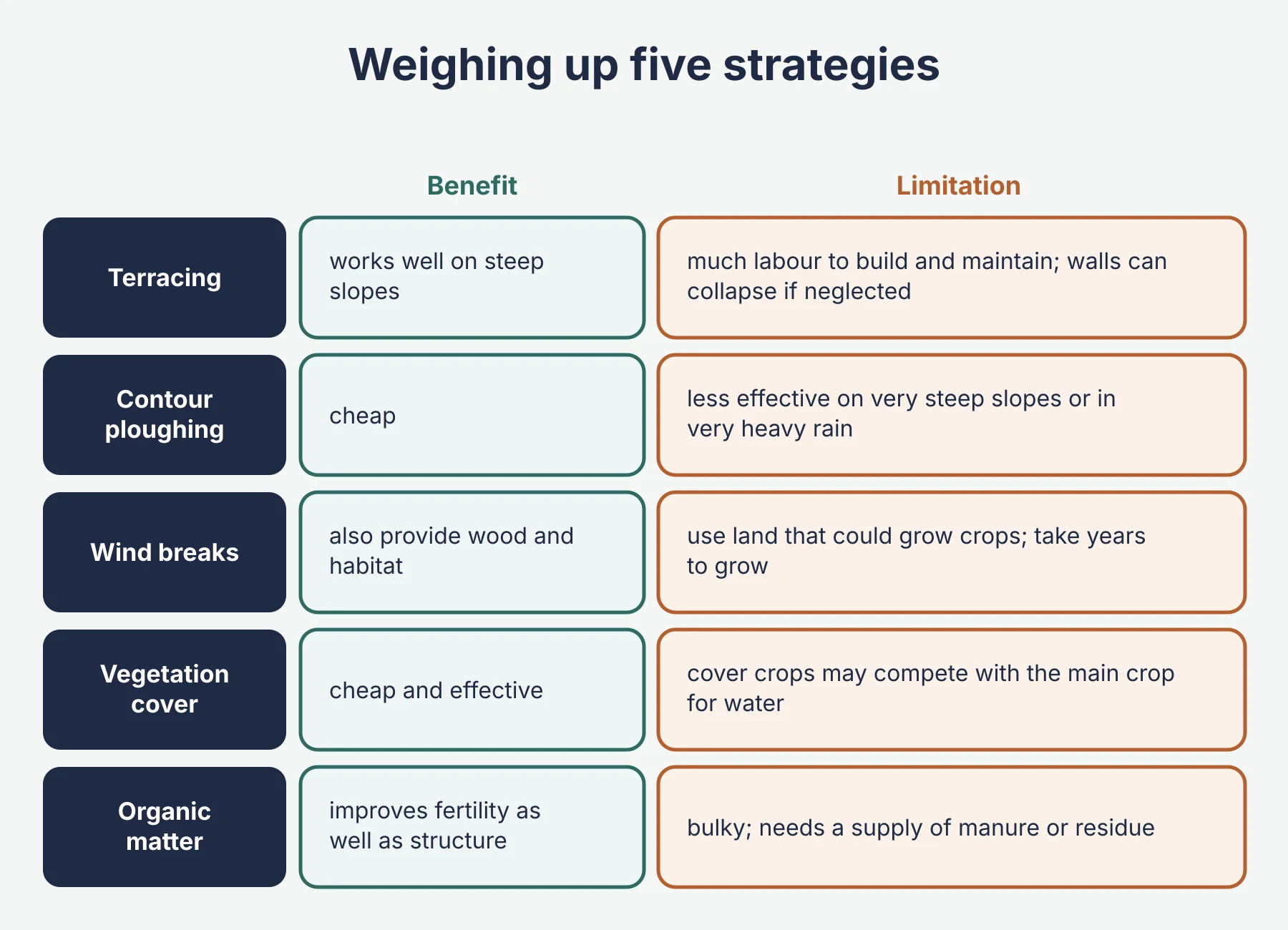
- Terracing works well on steep slopes but takes a great deal of labour to build and maintain, and walls can collapse if neglected.
- Contour ploughing is cheap, but less effective on very steep slopes or in very heavy rain.
- Wind breaks use land that could grow crops and take years to grow, but they also provide wood and habitat.
- Vegetation cover is cheap and effective, but cover crops may compete with the main crop for water.
- Organic matter improves fertility as well as structure, but is bulky and needs a supply of manure or residue.
Worked example 1: interpreting erosion plot data
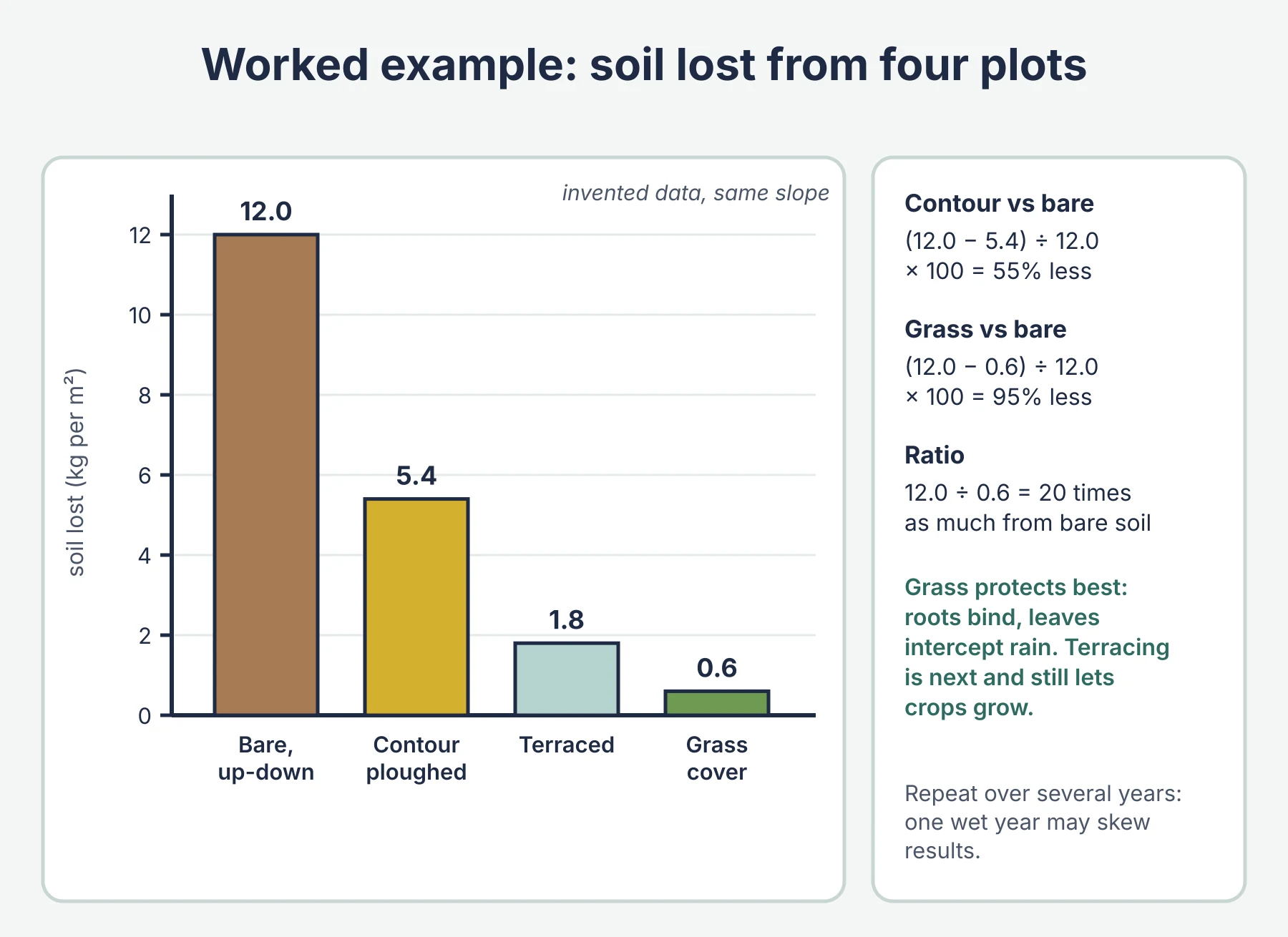
A study measured soil lost from four plots on the same slope over one year. (Data invented for practice.)
| Plot | Treatment | Soil lost (kg per m²) |
|---|---|---|
| 1 | Bare soil, ploughed up and down slope | 12.0 |
| 2 | Contour ploughed | 5.4 |
| 3 | Terraced | 1.8 |
| 4 | Permanent grass cover | 0.6 |
- Percentage reduction by contour ploughing compared with bare soil: (12.0 − 5.4) ÷ 12.0 × 100 = 55%.
- Percentage reduction by grass cover: (12.0 − 0.6) ÷ 12.0 × 100 = 95%.
- The bare plot lost 12.0 ÷ 0.6 = 20 times as much soil as the grass plot.
Interpretation: permanent vegetation is the most effective because roots bind the soil and leaves intercept rain. Terracing is next best and, unlike permanent grass, still allows crops to be grown. All plots were on the same slope, so slope was controlled; repeating the study over several years would show whether one unusually wet year affected the results.
Worked example 2: an annotated describe-and-explain answer
Question: A farmer grows maize on a steep hillside in a region with heavy seasonal rain. Suggest and explain two strategies to reduce soil erosion.
Model answer: The farmer could build terraces, cutting the slope into flat steps. Each step slows the water and traps soil, which reduces the movement of soil and surface run-off down the hill (strategy + mechanism + link to slope). The farmer could also maintain vegetation cover by planting a cover crop after the maize harvest, so that the soil is not bare when the heavy rains arrive; roots bind the soil and plants absorb water, reducing run-off (strategy + mechanism + link to rainfall).
Common mistakes
- Defining soil erosion as “soil being damaged”; it is soil being removed.
- Describing contour ploughing as ploughing “around the hill” without saying it reduces run-off.
- Recommending wind breaks for a problem caused by water on a steep slope.
- Listing impacts without explaining them, such as writing “silting” without the effect on rivers.
- Forgetting the human impacts: malnutrition, famine and displacement.
Exam technique
Describe a cause or impact: state it and add one detail. Describe and explain a strategy: what it is, then how it works, using the syllabus mechanism. In source-based questions, match strategies to the conditions given: slope, rainfall, wind, vegetation.
Revise with the Soil erosion revision notes and practise with the Soil erosion practice questions. To see how the three sub-topics of Topic 2 connect, use the Land revision notes.
Related resources
-
Revision notes
Cambridge IGCSE Environmental Management: Land — Revision Notes
Recall notes on soils and crop growth, food production and soil erosion for Topic 2 Land of Cambridge IGCSE Environmental Management 0680, 2027-2029 series.
Environmental Management · Cambridge · IGCSE
Revise topic -
Practice questions
Cambridge IGCSE Environmental Management (0680): Soil erosion – Practice Questions
Original questions with mark-scheme answers on the causes, impacts and prevention of soil erosion, including slope data, for Cambridge IGCSE 0680.
Environmental Management · Cambridge · IGCSE
Try questions -
Revision notes
Cambridge IGCSE Environmental Management (0680): Soil erosion – Revision Notes
Recall notes on the causes, impacts and prevention of soil erosion, with each strategy's mechanism and a self-test, for Cambridge IGCSE 0680 sub-topic 2.3.
Environmental Management · Cambridge · IGCSE
Revise topic
Get free revision emails (optional)
Occasional emails with practice questions, worked explanations and links to free resources for the qualification and subjects you choose. No spam, and you can unsubscribe from any email. The free tools on this site never need an email.