
Revision Notes
Cambridge IGCSE Environmental Management (0680): Food production and crop yield – Revision Notes
Recall notes on farming types, sustainable food production, yield strategies and the impacts of unsustainable agriculture for Cambridge IGCSE 0680.
- Subject
- Environmental Management
- Level
- IGCSE
- Topic
- Topic 2 – Land
- Author
- Marlbridge Academic Team
- Updated
- Reviewed by
- Azam Siddique (what this means)
Aligned to Cambridge IGCSE Environmental Management (0680), 2027-2029. Official specification .
Syllabus page (what it covers and how it is assessed): Cambridge IGCSE Environmental Management.
Syllabus points this page covers
0680
- 2.2 Food production and crop yield
Found an error? Report a correction.
Need help with this topic? Request a free trial class for IGCSE Environmental Management (0680).
Condensed notes for sub-topic 2.2. For the mechanism behind every strategy and impact, a yield calculation and an annotated answer, use the Food production and crop yield study guide.
Types of agriculture (2.2.1)
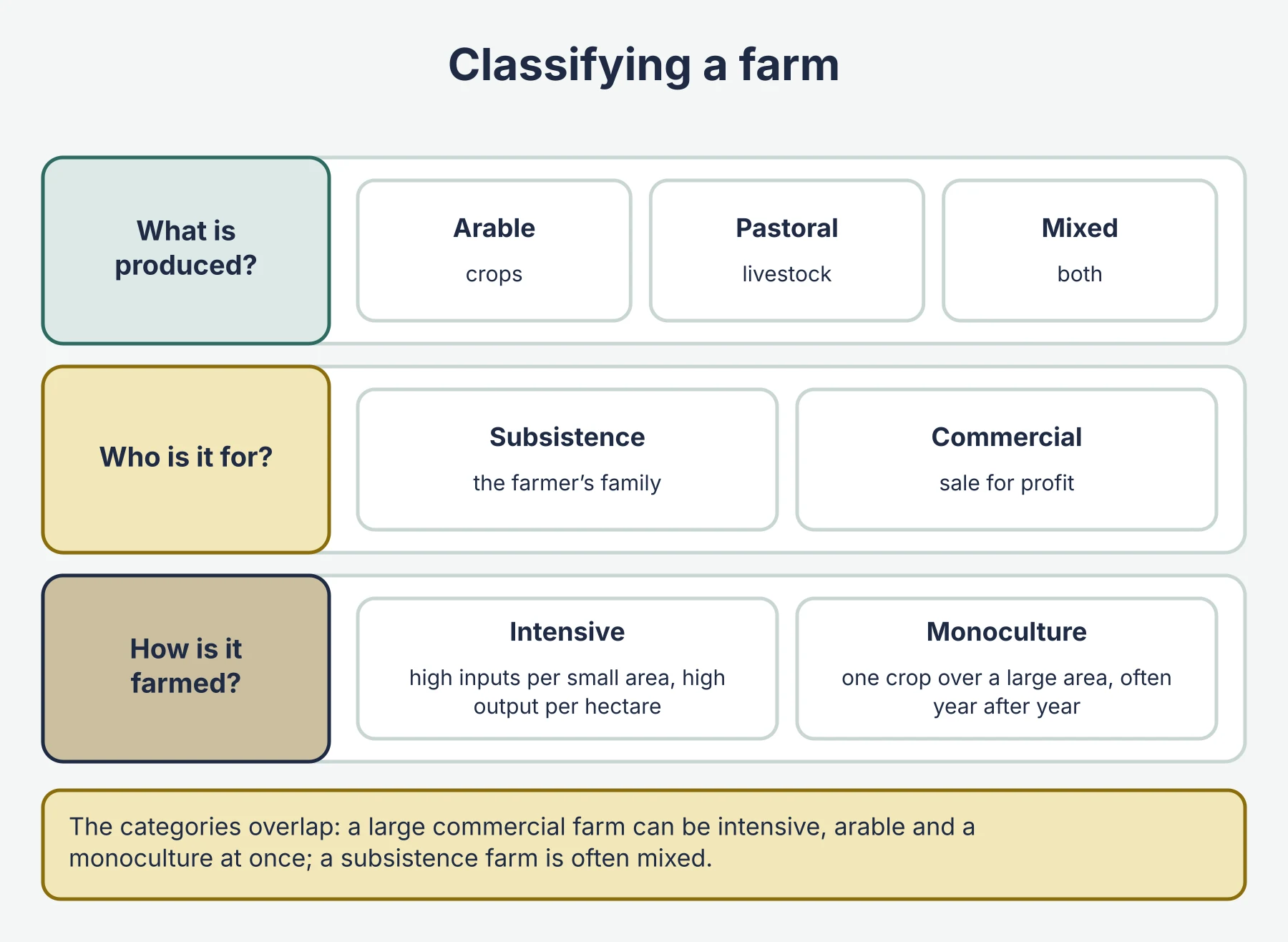
- Arable: crops. Pastoral: livestock. Mixed: both.
- Subsistence: food mainly for the farmer’s family. Commercial: for sale and profit.
- Intensive: high inputs (labour, money, machinery, chemicals) per hectare for high output.
- Monoculture: one crop over a large area.
A single farm can fit several labels at once.
Definition (2.2.2)
Sustainable food production: the production of sufficient food for the present generation using methods that ensure future generations can grow food from the same land.
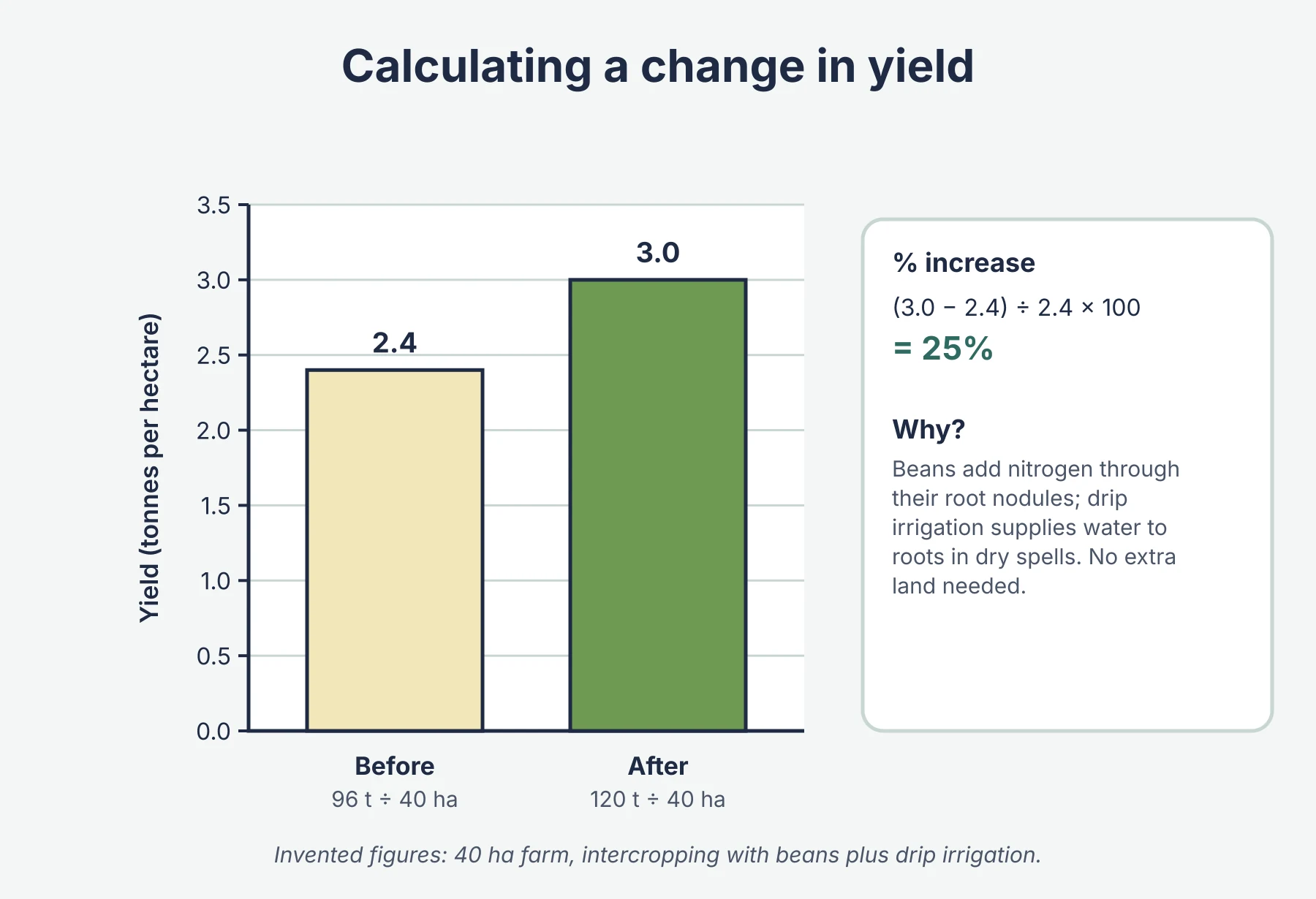
Crop yield = mass of crop ÷ area (usually tonnes per hectare).
Twelve strategies (2.2.3): what and how
| Strategy | How it raises yield or production |
|---|---|
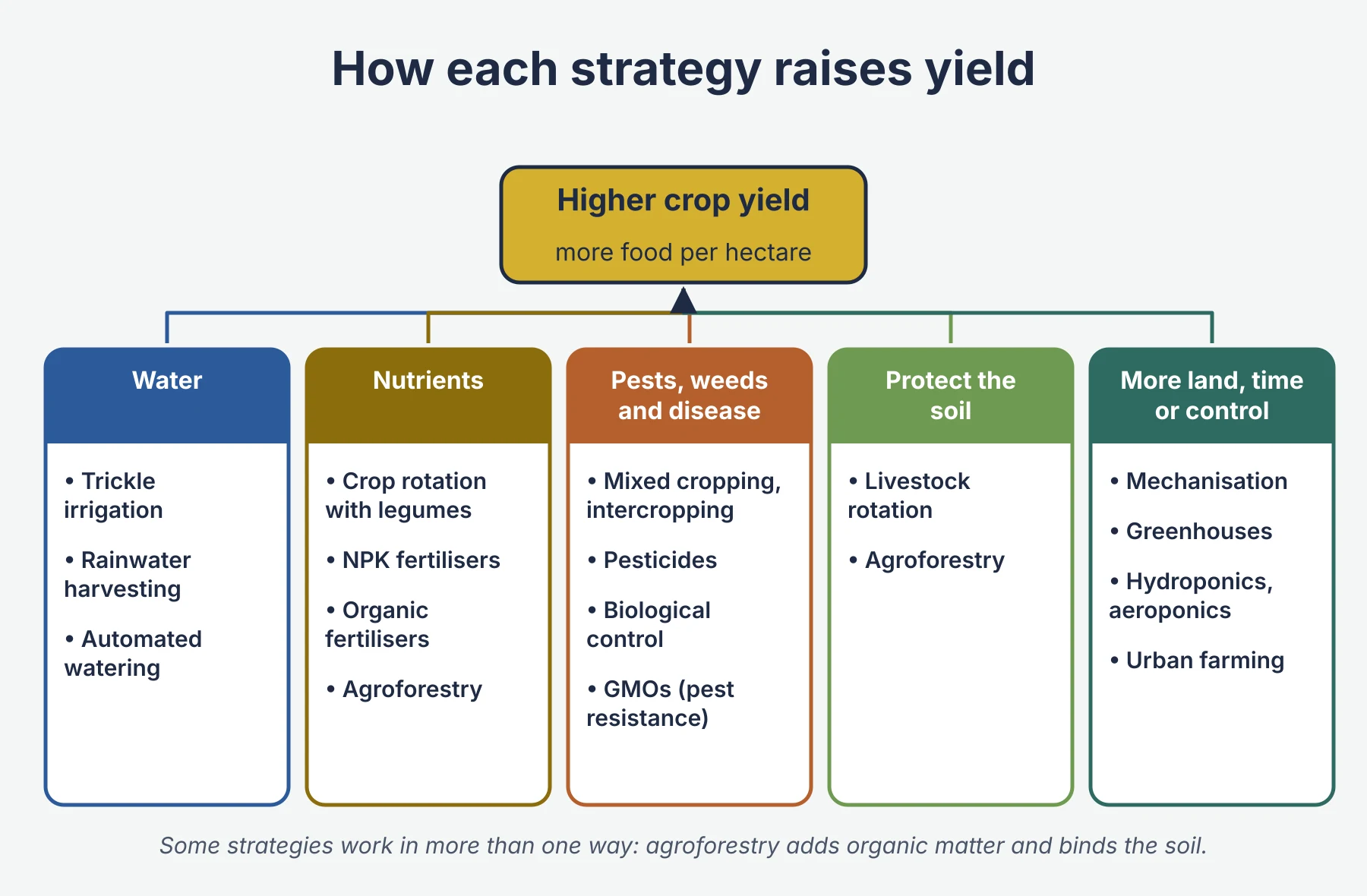
| Mixed cropping, intercropping, crop rotation | Crops use different nutrients and depths; pests do not build up; legumes add nitrogen |
| Trickle/drip irrigation | Water straight to roots; little evaporation or run-off |
| Rainwater harvesting | Stores rain for dry periods |
| Automated watering | Water only when sensors or timers show it is needed |
| Mechanisation | Larger areas cultivated and harvested quickly and on time |
| GMOs | Genes removed, changed or inserted for pest resistance, drought tolerance or nutrition |
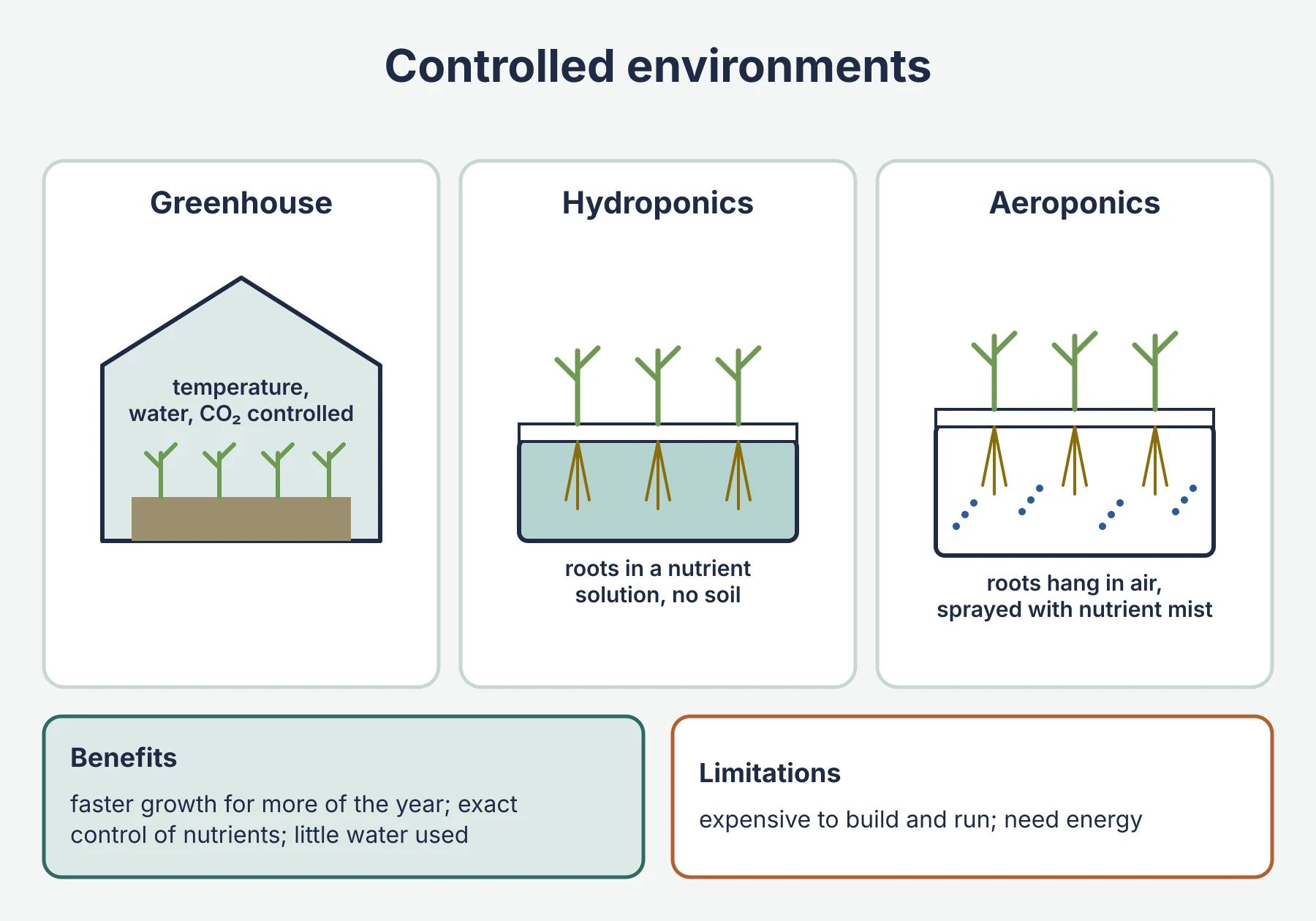
| Greenhouses | Control temperature, water, carbon dioxide; exclude pests; longer season |
| Hydroponics | Roots in nutrient solution; exact nutrient control; no soil |
| Aeroponics | Roots in air, sprayed with nutrient mist; very little water |
| Managed grazing (livestock rotation) | Grass recovers between grazing; avoids overgrazing |
| Urban farming | Uses rooftops, gardens and buildings in cities |
| Agroforestry | Trees bind soil, add organic matter, give shade, shelter and extra products |
| Inorganic NPK fertilisers | Fast, measured supply of nitrogen, phosphorus, potassium |
| Organic fertilisers (crop residue, manure, mulch) | Slow nutrient release; better soil structure and water retention |
| Pesticides (insecticide, herbicide, fungicide) | Kill insects, weeds and fungi that reduce yield |
| Biological control | Natural predator or parasite reduces pest; no chemicals |
One limitation each to have ready: drip systems cost money to install; mechanisation is expensive and compacts soil; GMO seed is costly; controlled environments need energy; NPK can be overused; organic fertiliser is bulky; pesticides harm other organisms; biological control is slow.
Nine impacts of unsustainable practice (2.2.4)
- Overproduction → food wastage.
- Cash crops (coffee, cotton, soya beans, palm oil) and biofuel crops replacing food crops → food shortages.
- Mismanaged irrigation → soil erosion, salinisation, water logging.
- Overuse of pesticides → pesticide resistance, pest resurgence, harm to pollinators.
- Overuse of fertilisers → leaching into water sources, nutrient enrichment, eutrophication.
- Exhaustion of nutrients → loss of organic content and inorganic ions; falling yields.
- Removal of natural vegetation → deforestation, overcultivation, overgrazing.
- Monoculture and intensification → soil and water pollution; loss of biodiversity.
- Soil erosion → loss of topsoil and nutrients.
Chains to learn
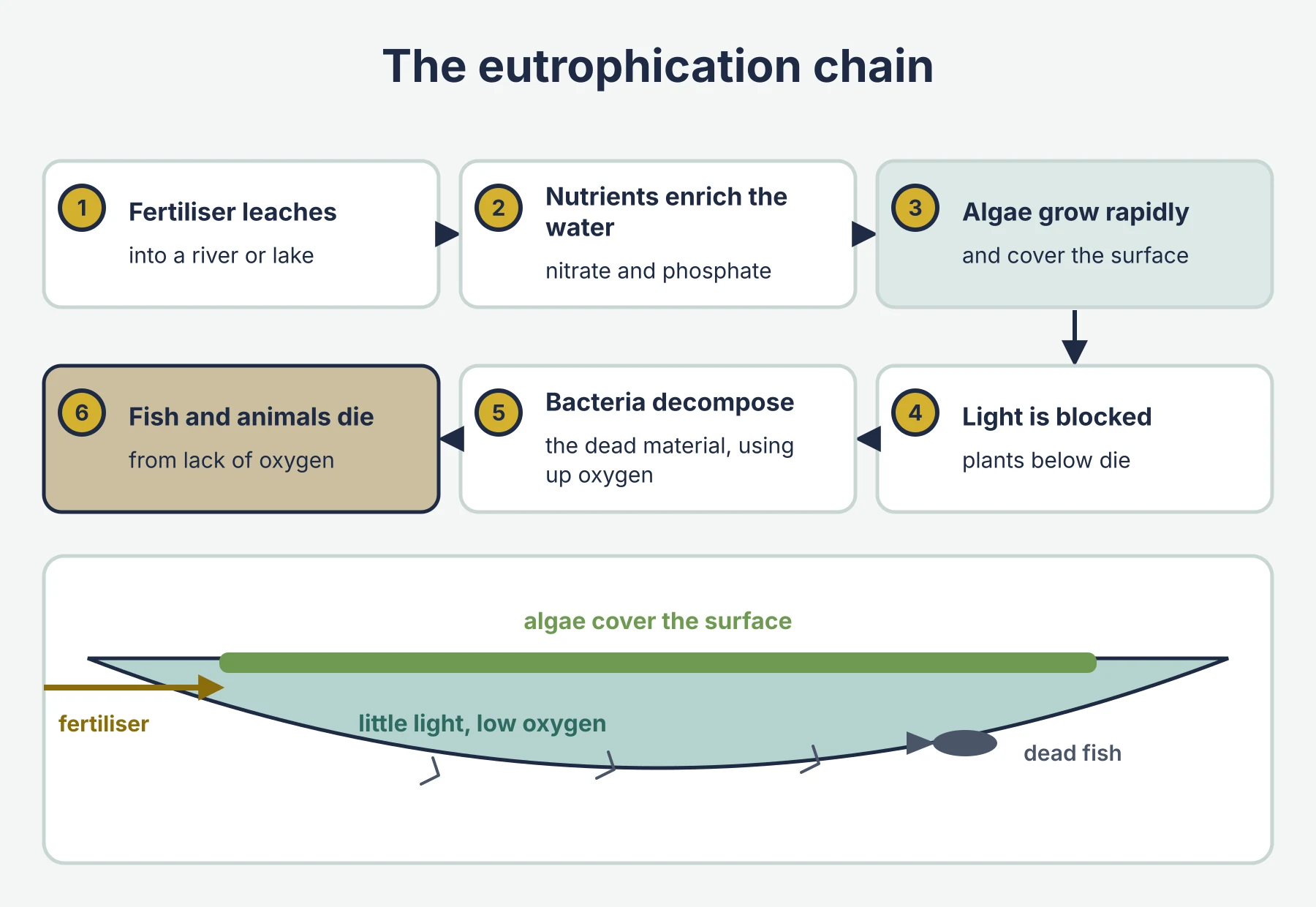
Eutrophication: fertiliser leaches → nutrient enrichment → algal bloom → light blocked, plants die → bacteria decompose them using oxygen → fish die.
Salinisation: irrigation water contains dissolved salts → in hot conditions water evaporates → salts left behind build up in topsoil → crops cannot grow well.
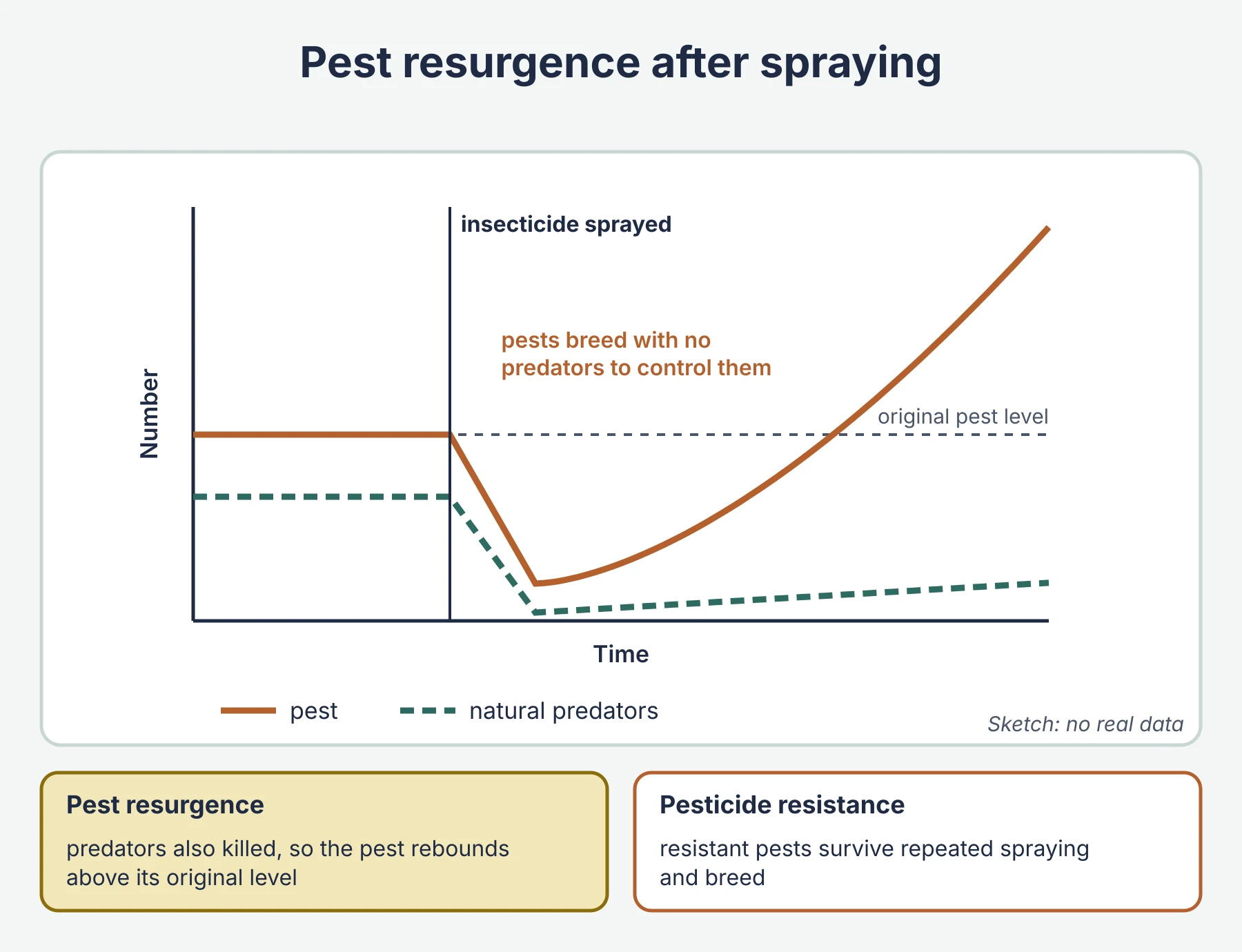
Pesticide resistance: spraying kills most pests → resistant individuals survive → they breed → the population becomes resistant.
Pest resurgence: pesticide also kills predators → pest population recovers with nothing to control it → numbers exceed the original level.
Matching strategy to problem
| Problem in a source | Strategy to suggest |
|---|---|
| Dry climate, water shortage | Drip irrigation; rainwater harvesting; mulch |
| Pests resistant to chemicals | Biological control; crop rotation |
| Nutrient-poor soil | Crop rotation with legumes; manure; agroforestry |
| Overgrazed land | Livestock rotation |
| Little farmland near a city | Urban farming; hydroponics |
| Eutrophication downstream | Organic fertilisers; measured NPK use |
Key terms
| Term | Meaning |
|---|---|
| Crop yield | Mass of crop produced per unit area |
| Legume | Plant such as beans or peas whose root nodules contain bacteria that fix nitrogen |
| Cash crop | Crop grown to sell rather than to eat |
| Salinisation | Build-up of salts in soil |
| Pollinator | Animal, such as a bee, that transfers pollen between flowers |
| Leaching | Nutrients washed out of soil by draining water |
Exam traps
- Intensive means high inputs per hectare, not a large farm.
- Mixed cropping is not mixed farming.
- Resistance and resurgence are different processes.
- Name the steps of eutrophication; “pollutes the water” is not enough.
- The definition needs “present generation”, “future generations” and “the same land”.
Self-test
- Define sustainable food production.
- What is the difference between subsistence and commercial agriculture?
- What is intensive agriculture?
- How does crop rotation with legumes improve soil?
- Why does drip irrigation waste less water than flooding a field?
- What is the difference between hydroponics and aeroponics?
- Name the three types of pesticide in the syllabus and what each controls.
- Give one benefit of biological control over chemical control.
- Name the four cash crops listed in the syllabus.
- Describe how mismanaged irrigation causes salinisation.
- Explain pest resurgence.
- A 25 ha field produces 70 tonnes of wheat. What is the yield?
Answers
- The production of sufficient food for the present generation using methods that ensure future generations can grow food from the same land.
- Subsistence produces food mainly for the farmer’s family; commercial produces for sale and profit.
- Farming with high inputs of labour, money, machinery or chemicals per unit area to get high output.
- Bacteria in legume root nodules add nitrogen compounds to the soil for the next crop.
- Water goes straight to the roots, so less evaporates or runs off.
- Hydroponics grows roots in a nutrient solution; aeroponics hangs roots in air and sprays them with nutrient mist.
- Insecticide (insects), herbicide (weeds), fungicide (fungi).
- Any one: no chemical pollution; pests unlikely to become resistant; does not harm pollinators.
- Coffee, cotton, soya beans and palm oil.
- Irrigation water containing dissolved salts evaporates in hot conditions, leaving salts that build up in the soil.
- A pesticide kills the pest’s predators as well, so the pest population recovers without control and rises above its original level.
- 70 ÷ 25 = 2.8 tonnes per hectare.
Where to go next
Practise with the Food production and crop yield practice questions, then revise the Soil erosion revision notes.
Related resources
-
Revision notes
Cambridge IGCSE Environmental Management: Land — Revision Notes
Recall notes on soils and crop growth, food production and soil erosion for Topic 2 Land of Cambridge IGCSE Environmental Management 0680, 2027-2029 series.
Environmental Management · Cambridge · IGCSE
Revise topic -
Study guides
Cambridge IGCSE Environmental Management (0680): Soil erosion
Causes of soil erosion by wind and water, its impacts on land and people, and strategies such as terracing and wind breaks, for Cambridge IGCSE 0680.
Environmental Management · Cambridge · IGCSE
Read guide -
Practice questions
Cambridge IGCSE Environmental Management (0680): Soil erosion – Practice Questions
Original questions with mark-scheme answers on the causes, impacts and prevention of soil erosion, including slope data, for Cambridge IGCSE 0680.
Environmental Management · Cambridge · IGCSE
Try questions
Get free revision emails (optional)
Occasional emails with practice questions, worked explanations and links to free resources for the qualification and subjects you choose. No spam, and you can unsubscribe from any email. The free tools on this site never need an email.