
Study Guides
Cambridge IGCSE Environmental Management (0680): Food production and crop yield
Types of agriculture, sustainable food production, twelve strategies to raise crop yield and the impacts of unsustainable farming, for Cambridge IGCSE 0680.
- Subject
- Environmental Management
- Level
- IGCSE
- Topic
- Topic 2 – Land
- Author
- Marlbridge Academic Team
- Updated
- Reviewed by
- Azam Siddique (what this means)
Aligned to Cambridge IGCSE Environmental Management (0680), 2027-2029. Official specification .
Syllabus page (what it covers and how it is assessed): Cambridge IGCSE Environmental Management.
Syllabus points this page covers
0680
- 2.2 Food production and crop yield
Found an error? Report a correction.
Need help with this topic? Request a free trial class for IGCSE Environmental Management (0680).
Sub-topic 2.2 is the largest in Topic 2. It asks how farming is organised, how farmers can grow more food on the same land, and what goes wrong when farming is unsustainable. The two long lists, twelve strategies and nine impacts, are where most marks are lost: candidates name a strategy but cannot say how it raises yield, or name an impact but cannot trace the chain of cause and effect. This page explains the mechanism behind each.
What the syllabus asks you to do
- 2.2.1 Describe types of agriculture: arable, pastoral and mixed; subsistence and commercial; intensive; monoculture.
- 2.2.2 Define sustainable food production as the production of sufficient food for the present generation using methods that ensure future generations can grow food from the same land.
- 2.2.3 Describe and explain strategies to increase food production and crop yield (twelve, listed below).
- 2.2.4 Describe and explain the impacts of unsustainable agricultural practices on the environment and people (nine, listed below).
Types of agriculture
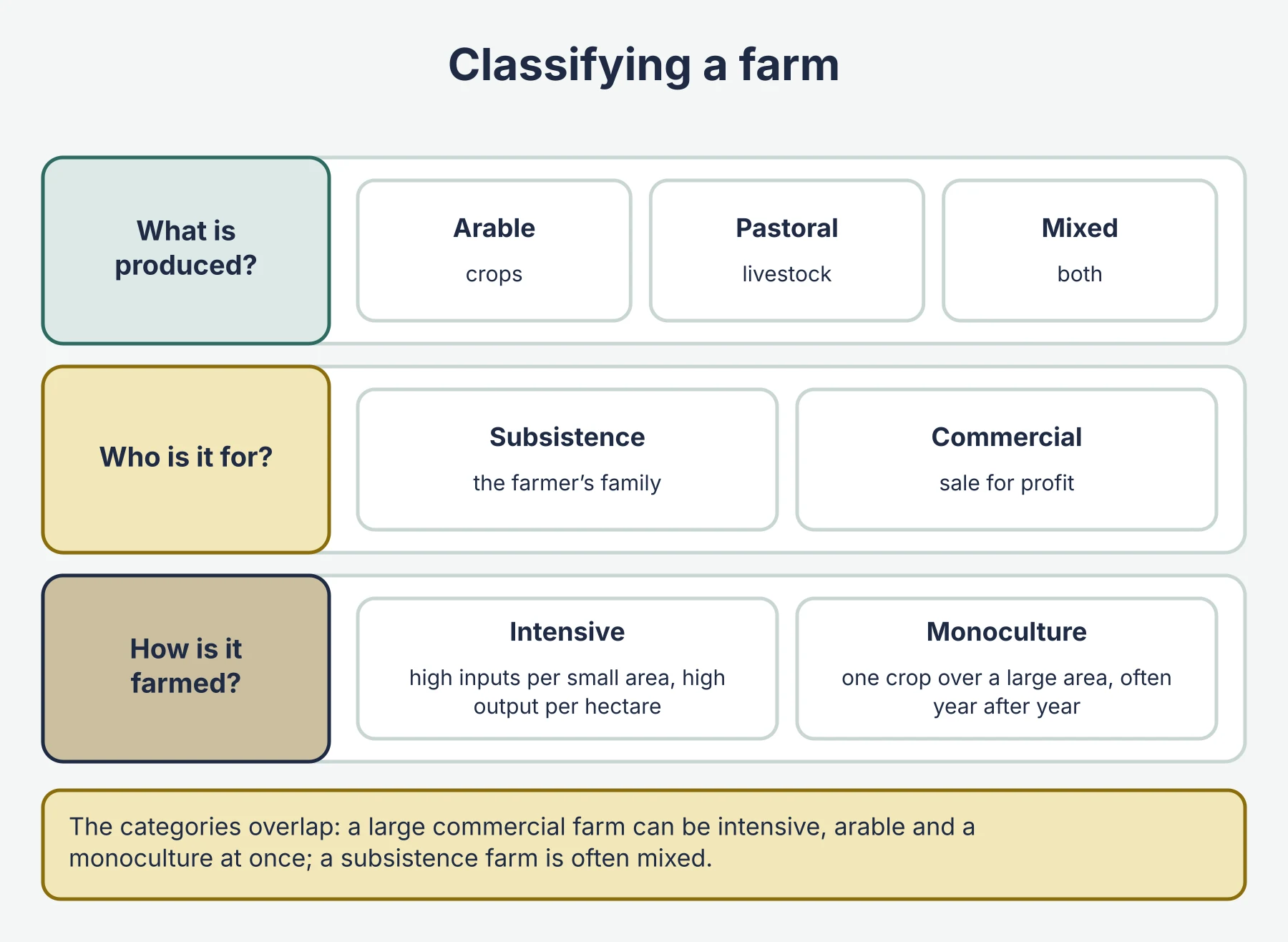
| Type | Meaning |
|---|---|
| Arable | Growing crops |
| Pastoral | Rearing livestock |
| Mixed | Both crops and livestock on the same farm |
| Subsistence | Producing food mainly for the farmer’s family, with little to sell |
| Commercial | Producing crops or livestock to sell for profit |
| Intensive | High inputs of labour, money, machinery or chemicals on a relatively small area to get high output per hectare |
| Monoculture | Growing a single crop over a large area, often year after year |
These are not exclusive categories. A large commercial farm can be intensive, arable and a monoculture all at once; a subsistence farm is often mixed.
Crop yield is the amount of crop produced per unit area, usually in tonnes per hectare. Raising yield means more food from the same land, which is central to the definition of sustainable food production.
Strategies to increase food production and crop yield
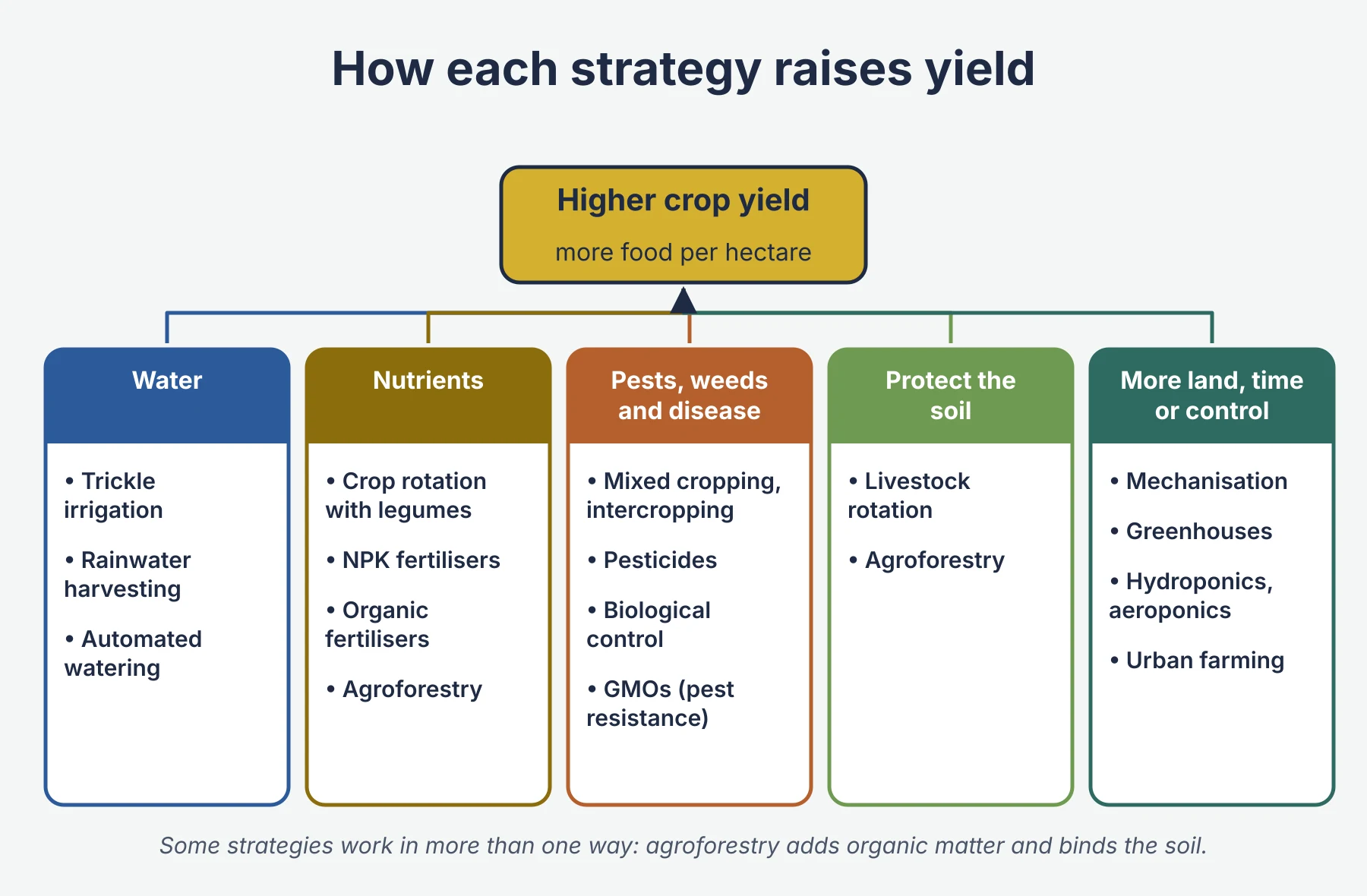
(a) Mixed cropping, intercropping and crop rotation. Mixed cropping grows two or more crops together on the same land; intercropping grows them in alternating rows. Different crops use different nutrients and have roots at different depths, and a pest of one crop may not attack another. Crop rotation changes the crop grown in a field each year, so nutrients are not exhausted and pests and diseases specific to one crop do not build up. Including legumes, such as beans or peas, adds nitrogen, because bacteria in their root nodules convert nitrogen from the air into compounds plants can use.
(b) Improved methods of irrigation. Trickle (drip) irrigation delivers water through pipes with small holes directly to each plant’s roots, so little is lost to evaporation or run-off. Rainwater harvesting collects and stores rain for use in dry periods. Automated watering systems use timers or soil moisture sensors to water only when needed. All three supply enough water for growth while wasting less.
(c) Mechanisation. Tractors, ploughs, seed drills and combine harvesters let a farmer cultivate and harvest larger areas quickly and at the right time. Limitations: high cost, fuel use, fewer jobs and compaction of soil by heavy machines.
(d) Genetically modified organisms (GMOs). Changing the genetic material of an organism by removing, changing or inserting individual genes to give favourable characteristics, such as resistance to pests, tolerance of drought, or a higher nutrient content. Limitations: seed is often expensive and must be bought each year, and some people are concerned about effects on wild plants and on biodiversity.
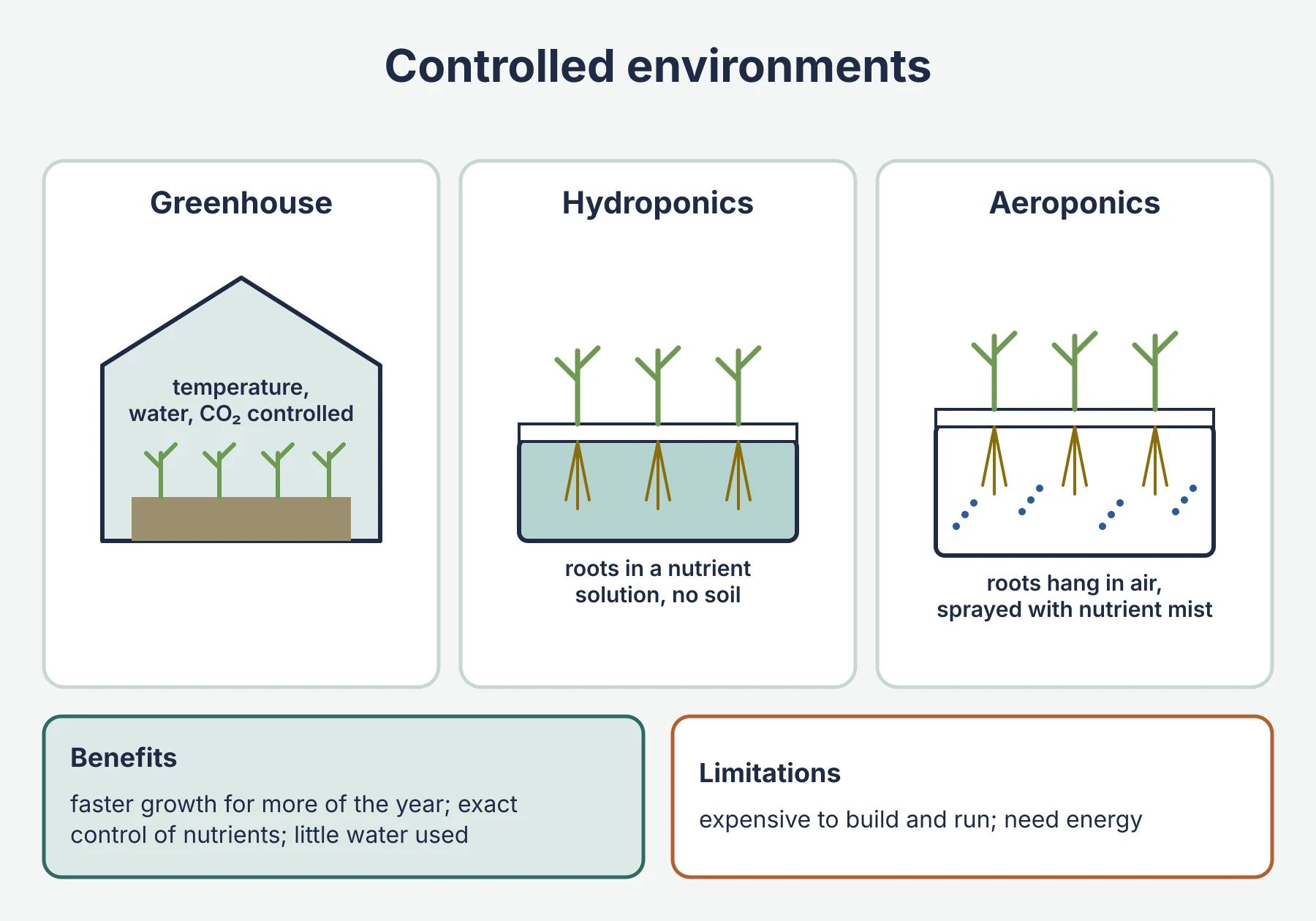
(e) Controlled environments. In greenhouses, temperature, water and sometimes carbon dioxide are controlled and pests excluded, so crops grow faster and for more of the year. In hydroponics, plants grow with their roots in a nutrient solution instead of soil. In aeroponics, roots hang in the air and are sprayed with a nutrient mist. Both soil-free methods give exact control of nutrients and use little water, but they are expensive and need energy.
(f) Managed grazing: livestock rotation. Animals are moved between fields (paddocks) so that each area of grass has time to regrow. This prevents overgrazing and keeps more vegetation cover protecting the soil.
(g) Urban farming. Growing food in towns and cities, on rooftops, in gardens, allotments or vertical farms in buildings. It uses land that would otherwise produce nothing and brings food close to consumers.
(h) Agroforestry. Growing trees alongside crops or livestock. Tree roots bind the soil, leaves add organic matter as they fall, trees give shade and shelter from wind, and some trees fix nitrogen or provide fruit and timber as extra products.
(i) Inorganic NPK fertilisers. Manufactured fertilisers supplying nitrogen, phosphorus and potassium in known amounts. They act quickly and raise yields sharply, but are costly and can be overused (see impacts below).
(j) Organic fertilisers. Crop residue (stalks and leaves left after harvest), manure from animals and mulch (a layer of organic material spread over the soil). They release nutrients slowly, add organic matter that improves soil structure and water retention, and mulch also reduces evaporation and weeds. They are cheaper but less concentrated, and bulky to move.
(k) Chemical control of pests (pesticides). Insecticides kill insects, herbicides kill weeds that compete with the crop for light, water and nutrients, and fungicides kill fungi that cause disease. They protect yields but can harm other organisms.
(l) Biological control of pests. Using a natural predator, parasite or disease of the pest to reduce its numbers, for example ladybirds that eat aphids. It avoids chemicals and the pest is unlikely to become resistant, but it is slower and the control organism must not become a pest itself.
Impacts of unsustainable agricultural practices
Each impact is best written as a chain: practice → process → consequence.
| Practice | Process | Consequence for environment and people |
|---|---|---|
| (a) Overproduction of food | More food is produced than can be sold or eaten | Food wastage; wasted water, energy and land |
| (b) Food shortages from cash and biofuel crops | Land is used for coffee, cotton, soya beans, palm oil or biofuel crops instead of food | Less food grown locally; higher food prices; hunger |
| (c) Mismanagement of irrigation | Too much water, or poor drainage | Soil erosion by run-off; water logging; salinisation as water evaporates and leaves salts behind |
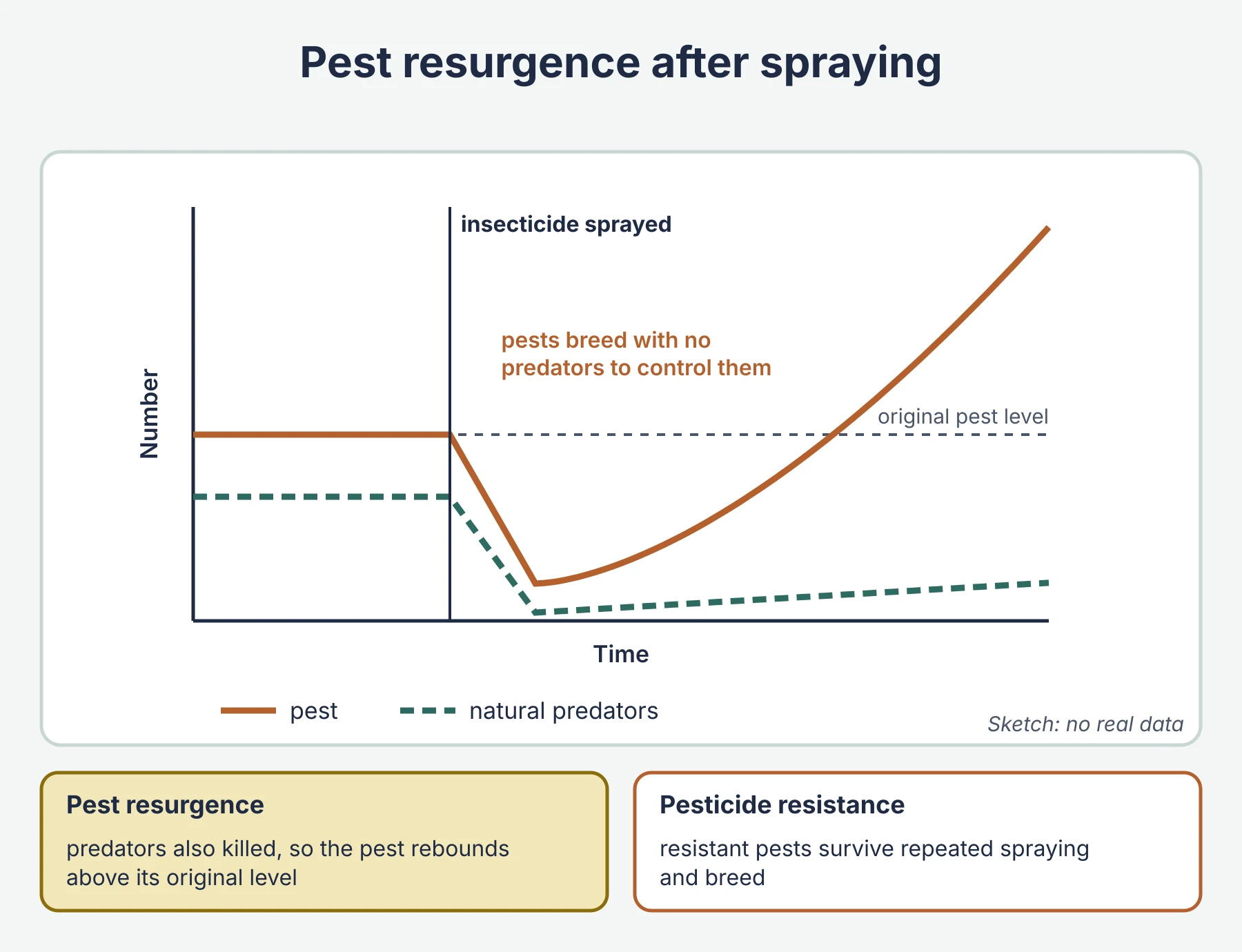
| (d) Overuse of pesticides | Repeated spraying kills susceptible pests but resistant ones survive and breed | Pesticide resistance; pest resurgence when predators are also killed and the pest rebounds; harm to pollinators such as bees |
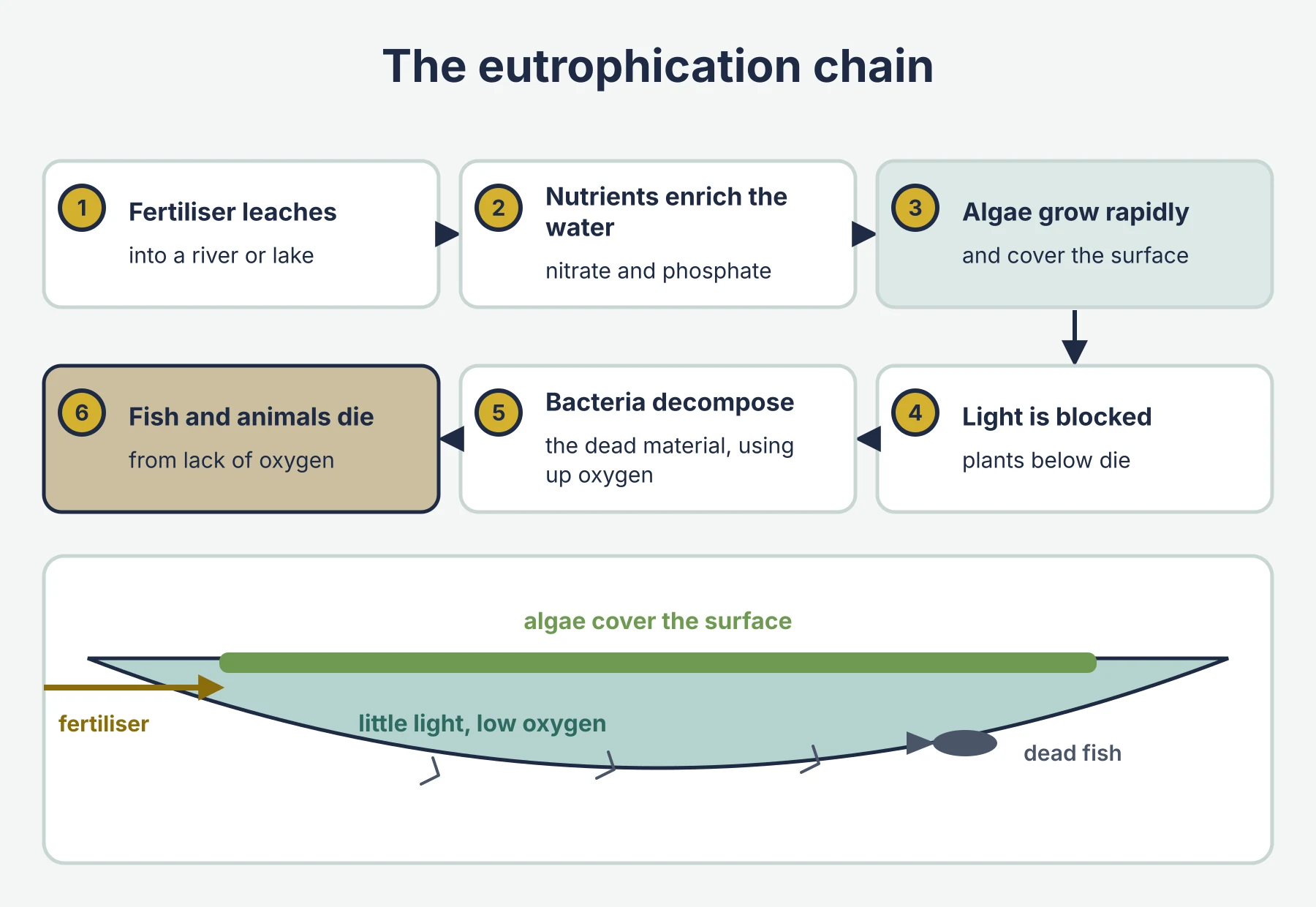
| (e) Overuse of fertilisers | Excess nutrients dissolve and drain away | Leaching into water sources, nutrient enrichment and eutrophication |
| (f) Exhaustion of nutrients in soils | Crops remove nutrients and nothing is returned | Loss of organic content and inorganic ions; falling yields |
| (g) Removal of natural vegetation | Deforestation, overcultivation and overgrazing | Bare soil exposed to wind and rain; loss of habitat |
| (h) Monoculture and intensification | One crop and heavy inputs over large areas | Soil and water pollution; loss of biodiversity |
| (i) Soil erosion | Topsoil removed by wind and water | Loss of topsoil and nutrients; lower yields (see 2.3) |
The eutrophication chain is often tested in full: fertiliser leaches into a river or lake → nutrients (nitrate and phosphate) enrich the water → algae grow rapidly and cover the surface → light is blocked and plants below die → bacteria decompose the dead material, using up oxygen → fish and other animals die from lack of oxygen.
The pest resurgence chain: insecticide kills the pest and its natural predators → surviving or incoming pests breed quickly with no predators to control them → pest numbers rise above their original level.
Worked example 1: calculating a change in yield
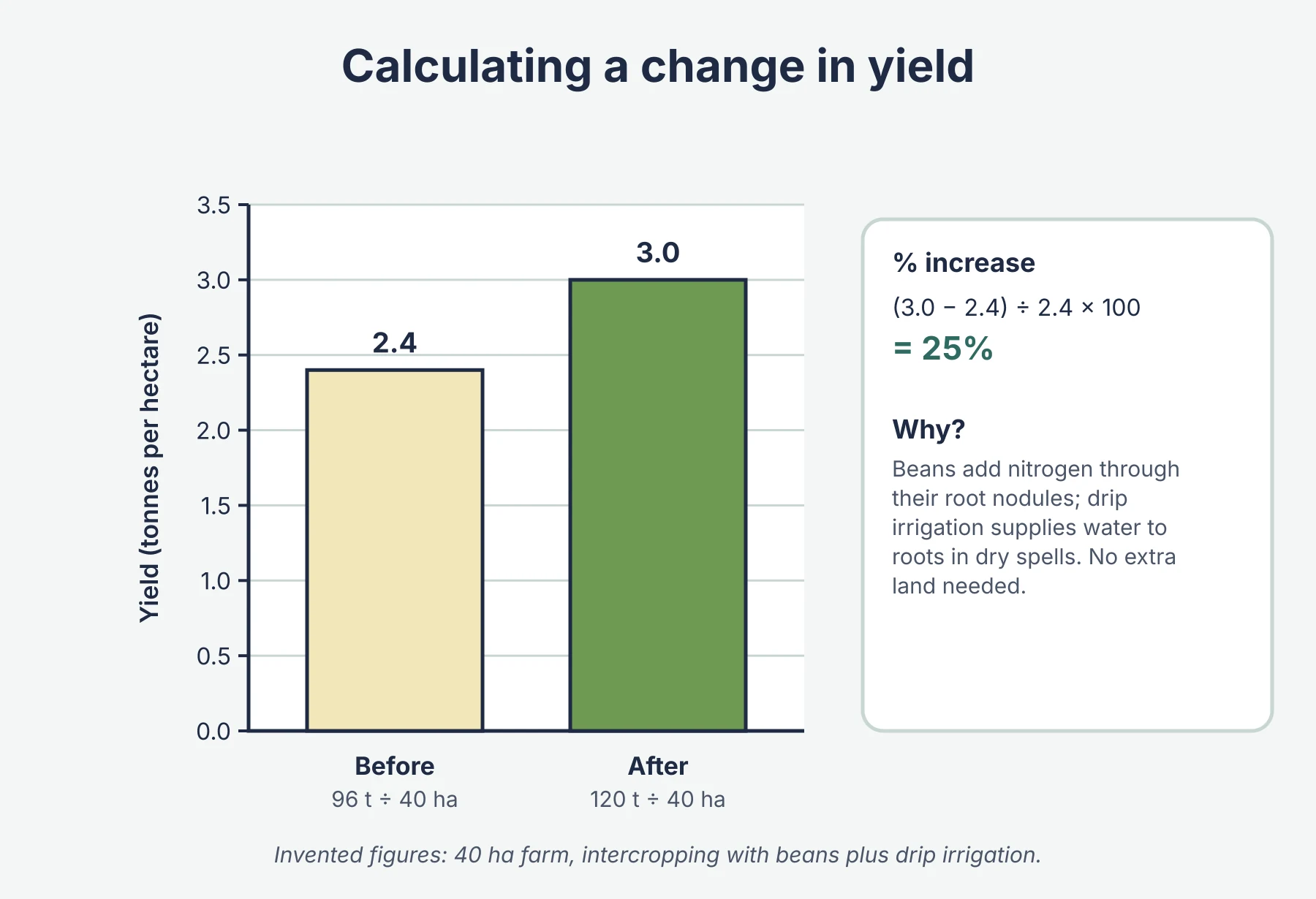
A farm of 40 hectares produced 96 tonnes of maize. After introducing intercropping with beans and drip irrigation, it produced 120 tonnes from the same area. (Figures invented for practice.)
- Yield before: 96 ÷ 40 = 2.4 tonnes per hectare.
- Yield after: 120 ÷ 40 = 3.0 tonnes per hectare.
- Percentage increase: (3.0 − 2.4) ÷ 2.4 × 100 = 25%.
Explanation: beans add nitrogen to the soil through their root nodules; drip irrigation supplies water directly to roots in dry spells. Both raise yield without needing more land.
Worked example 2: an annotated explain answer
Question: Explain how overgrazing can lead to reduced crop yield and food shortages.
Model answer: Too many animals on the land eat the grass faster than it can regrow (practice). The soil is left bare, so roots no longer bind it and rain and wind remove the topsoil (process). The topsoil holds most of the organic matter and nutrients, so the land becomes less fertile, yields fall and less food is available for people who depend on it (consequence). Livestock rotation would allow grass to recover (link to a strategy).
Common mistakes
- Defining intensive farming as “a big farm”; it means high inputs per unit area.
- Confusing mixed cropping (several crops together) with mixed farming (crops and livestock).
- Writing “fertilisers pollute water” without the leaching and eutrophication steps.
- Treating pesticide resistance and pest resurgence as the same thing.
- Giving the sustainable food production definition without “future generations” and “the same land”.
Exam technique
For describe and explain a strategy, say what it is and how it raises yield. For impacts, write the three-step chain. For suggest, choose a strategy that fits the problem in the source, such as drip irrigation for a dry area or biological control where pests are resistant.
Revise with the Food production and crop yield revision notes, practise with the Food production and crop yield practice questions, then continue to the Soil erosion study guide.
Related resources
-
Revision notes
Cambridge IGCSE Environmental Management: Land — Revision Notes
Recall notes on soils and crop growth, food production and soil erosion for Topic 2 Land of Cambridge IGCSE Environmental Management 0680, 2027-2029 series.
Environmental Management · Cambridge · IGCSE
Revise topic -
Practice questions
Cambridge IGCSE Environmental Management (0680): Food production and crop yield – Practice Questions
Original questions with answers on farming types, yield calculations, yield strategies and the impacts of unsustainable farming for Cambridge IGCSE 0680.
Environmental Management · Cambridge · IGCSE
Try questions -
Revision notes
Cambridge IGCSE Environmental Management (0680): Food production and crop yield – Revision Notes
Recall notes on farming types, sustainable food production, yield strategies and the impacts of unsustainable agriculture for Cambridge IGCSE 0680.
Environmental Management · Cambridge · IGCSE
Revise topic
Get free revision emails (optional)
Occasional emails with practice questions, worked explanations and links to free resources for the qualification and subjects you choose. No spam, and you can unsubscribe from any email. The free tools on this site never need an email.