
Revision Notes
Cambridge IGCSE Environmental Management (0680): Soils and crop growth – Revision Notes
Condensed notes on soil composition, nutrient ions, pH, drainage, loam, weather and conditions for photosynthesis for 2.1 Soils and crop growth, IGCSE 0680.
- Subject
- Environmental Management
- Level
- IGCSE
- Topic
- Topic 2 – Land
- Author
- Marlbridge Academic Team
- Updated
- Reviewed by
- Azam Siddique (what this means)
Aligned to Cambridge IGCSE Environmental Management (0680), 2027-2029. Official specification .
Syllabus page (what it covers and how it is assessed): Cambridge IGCSE Environmental Management.
Syllabus points this page covers
0680
- 2.1 Soils and crop growth
Found an error? Report a correction.
Need help with this topic? Request a free trial class for IGCSE Environmental Management (0680).
Condensed notes for sub-topic 2.1. For full explanations and two worked examples, use the Soils and crop growth study guide.
Soil composition (2.1.1): four components
- Mineral particles: sand, silt and clay, from weathered rock.
- Organic content: living organisms (plants, animals, fungi, bacteria) and organic matter from decomposition (humus).
- Gases: air in pore spaces, including oxygen and carbon dioxide.
- Water: in pore spaces and as films around particles, carrying dissolved ions.
Percentage composition is not required.
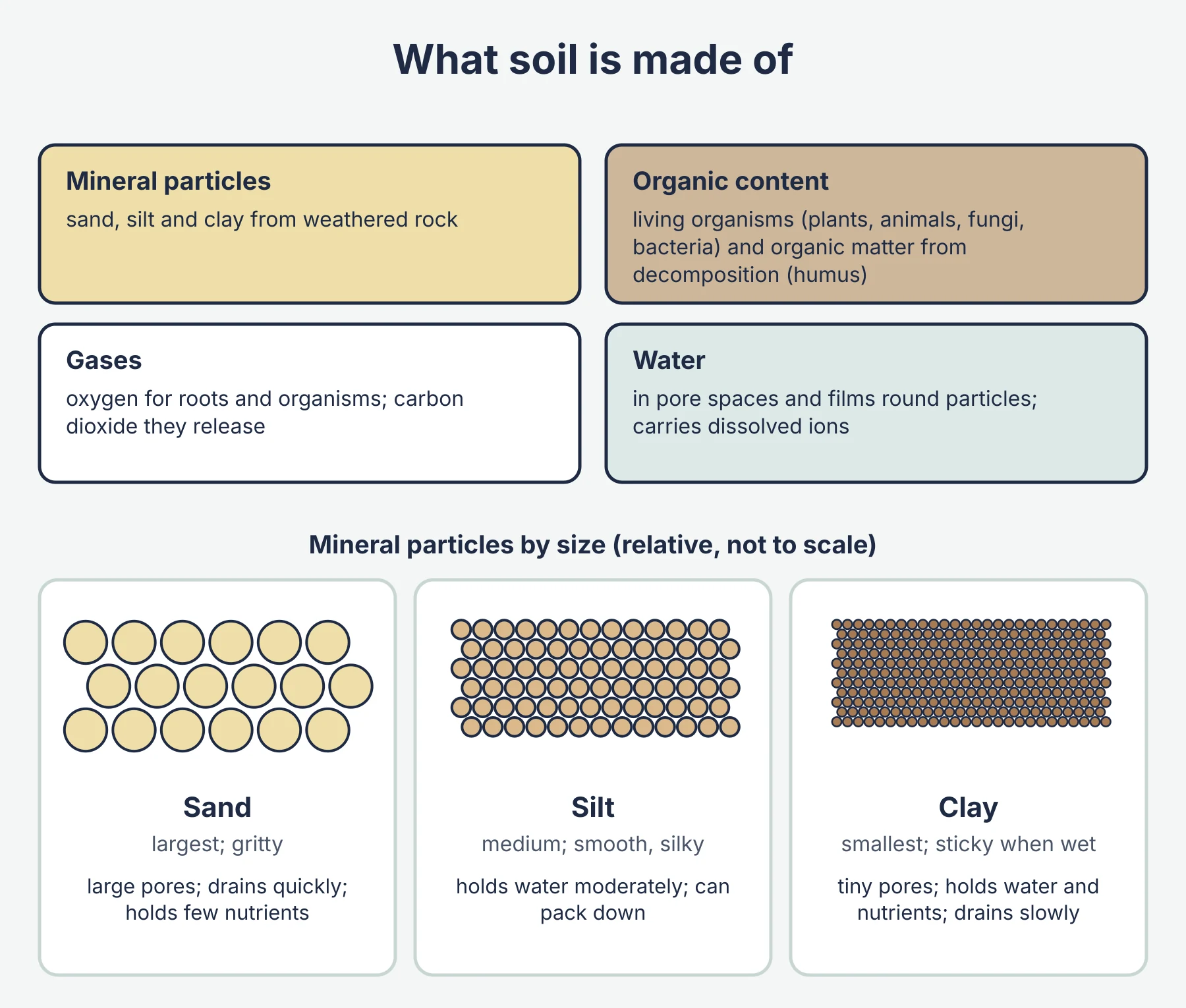
Sand, silt and clay compared
| Sand | Silt | Clay | |
|---|---|---|---|
| Particle size | Largest | Medium | Smallest |
| Feel | Gritty | Smooth | Sticky |
| Pore spaces | Large | Medium | Tiny |
| Drainage | Fast | Moderate | Slow |
| Water retention | Low | Moderate | High |
| Nutrient retention | Low (leaching) | Moderate | High |
| Cultivation | Easy, light | Can compact | Heavy when wet, hard when dry |
| Main risk | Drying out, nutrient loss | Packing down | Waterlogging |
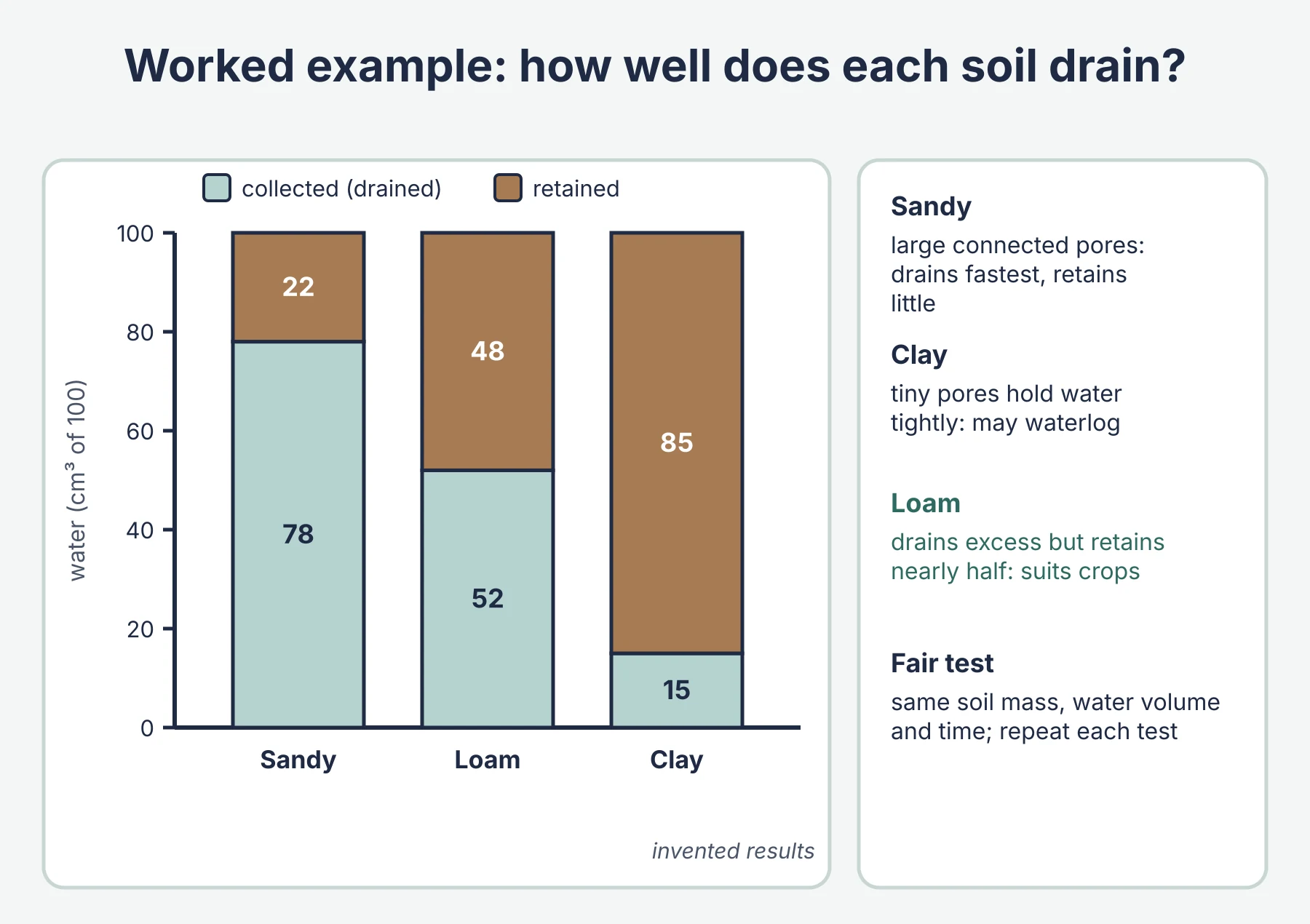
Why composition matters (2.1.2)
- Mineral particles: control drainage, water and nutrient retention.
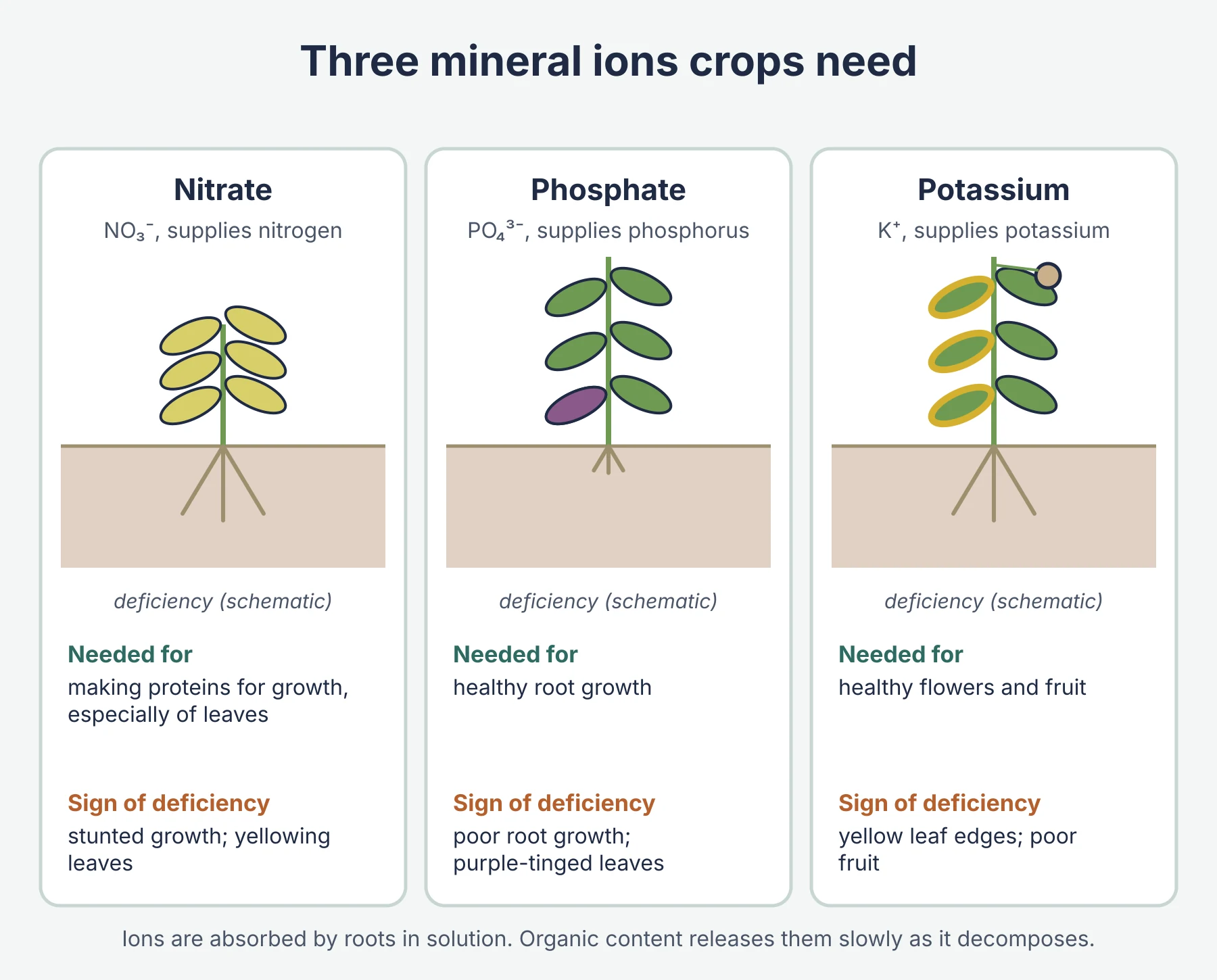
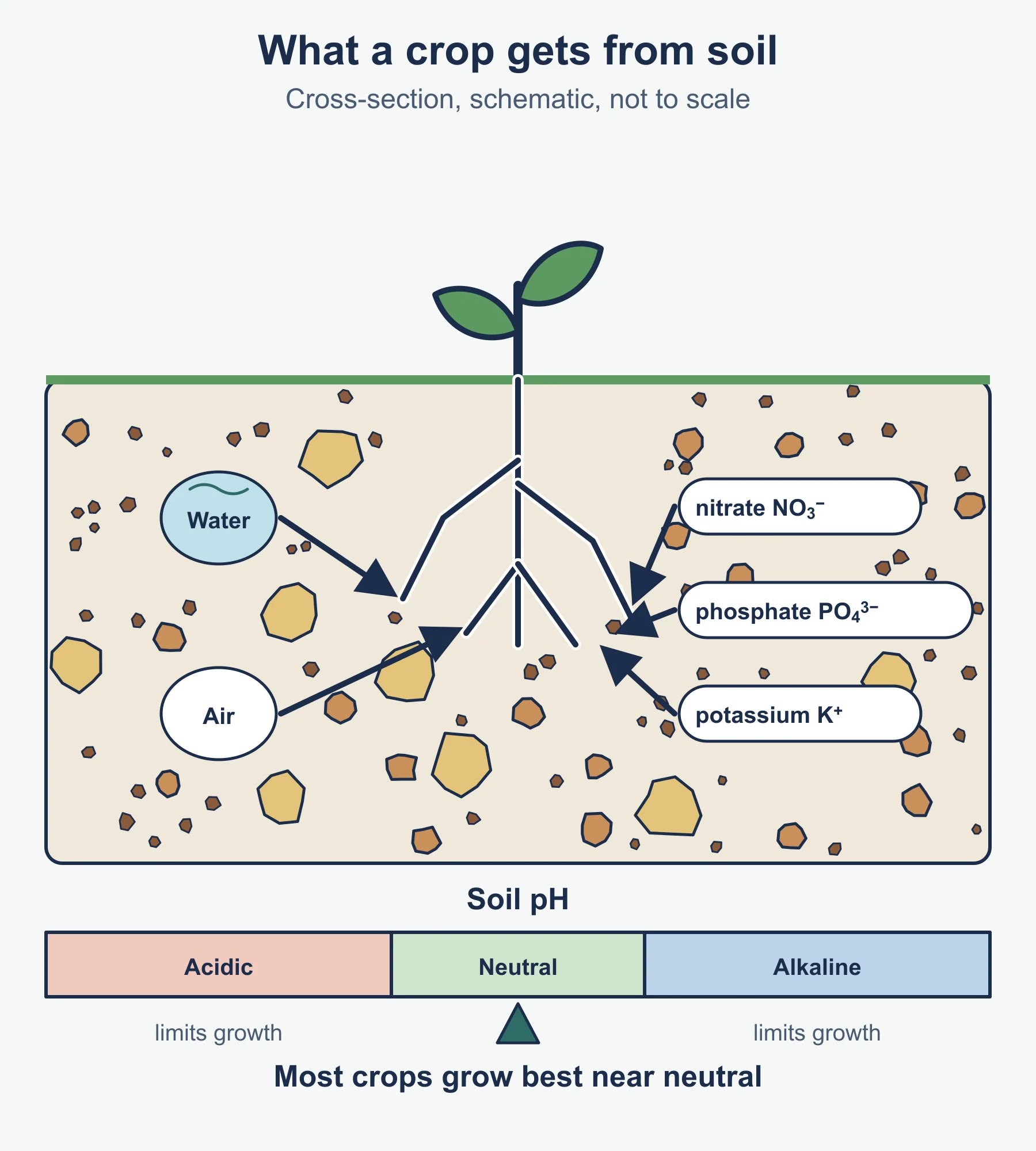
- Nutrient content: organic content releases ions as it decomposes; inorganic ions:
- Nitrate (NO₃⁻): nitrogen for proteins and leaf growth; lack gives stunted growth and yellow leaves.
- Phosphate (PO₄³⁻): phosphorus for root growth; lack gives poor roots and purple-tinged leaves.
- Potassium (K⁺): for flowers and fruit; lack gives yellow leaf edges and poor fruit.
- pH: acidic (below 7), neutral (7), alkaline (above 7). Most crops prefer near neutral; extremes make some nutrients less available.
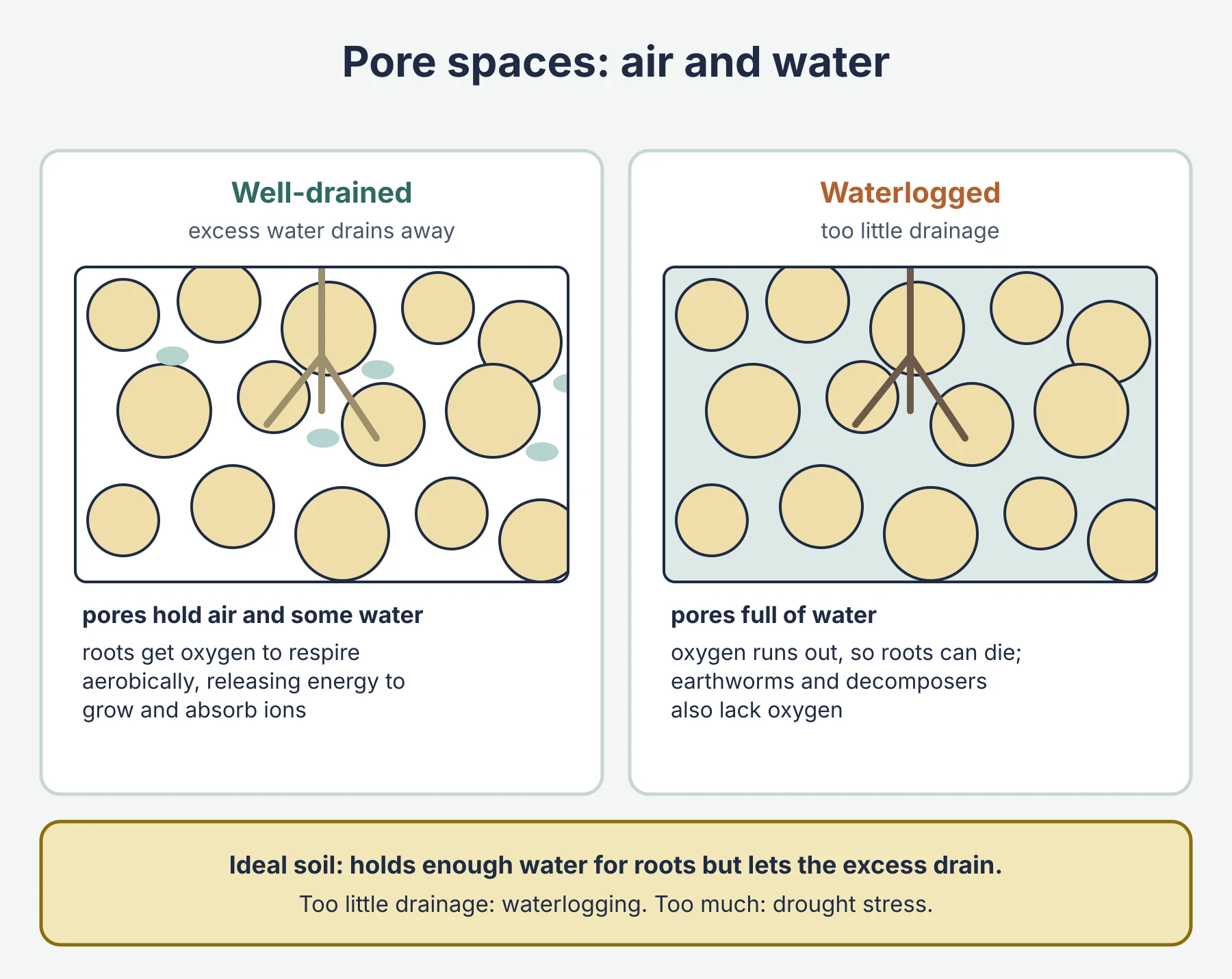
- Pore spaces: hold air and water; room for roots.
- Gas content: oxygen for aerobic respiration of roots and soil organisms.
- Water content and drainage: water for photosynthesis and ion transport; excess must drain to avoid waterlogging.
- Ease of cultivation: how easily soil can be ploughed and planted.
Loam (2.1.3): five reasons, each with its benefit
| Reason | Benefit to the crop |
|---|---|
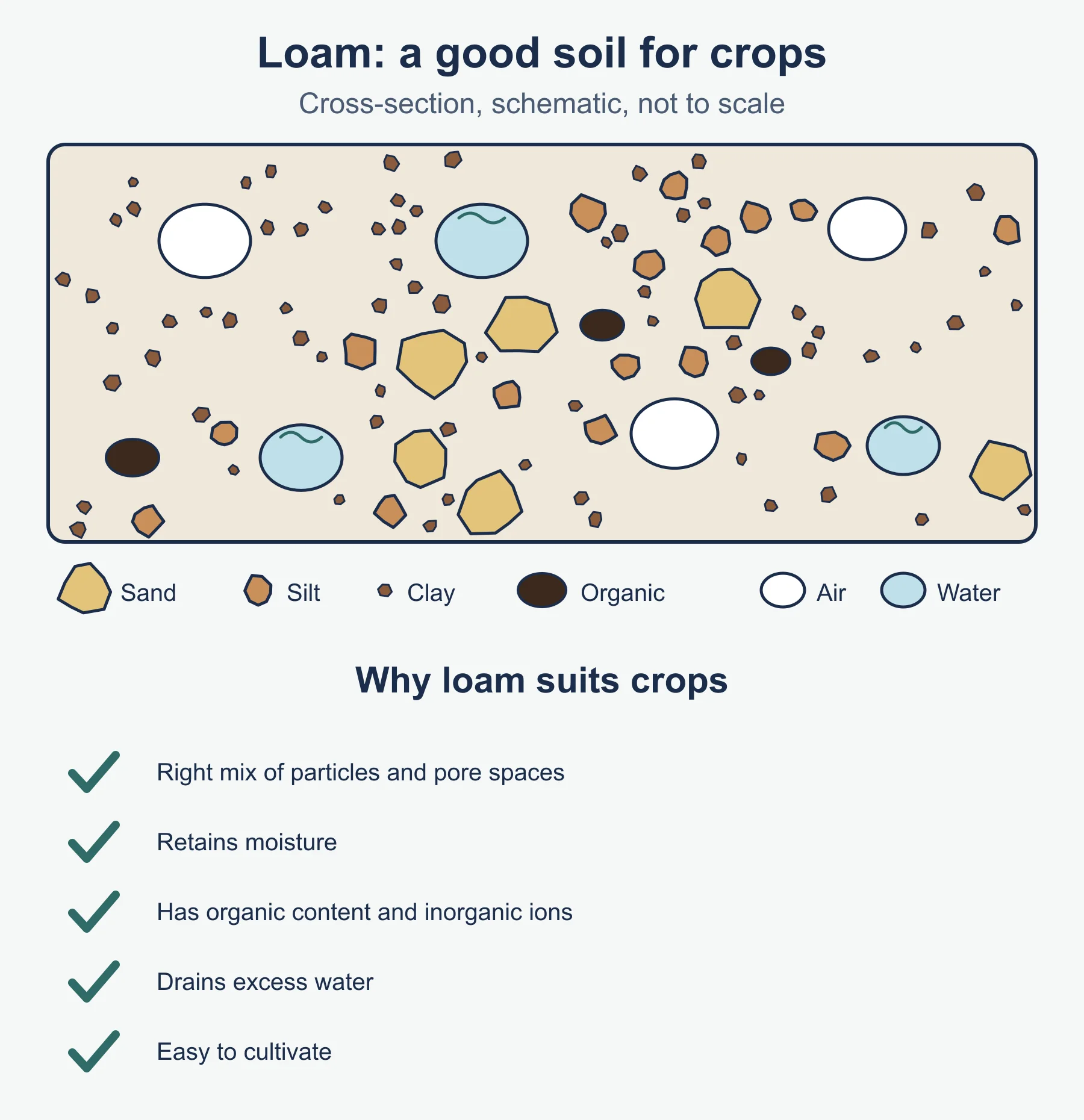
| Ideal combination of mineral particles and pore spaces | Both air and water available to roots |
| Retains moisture | Water between rainfall or irrigation |
| Contains organic content and inorganic ions | Supply of nitrate, phosphate and potassium |
| Allows excess water to drain | No waterlogging; roots get oxygen |
| Easy to cultivate | Less time, fuel and labour to plough and plant |
Weather and seasons (2.1.4 and 2.1.5)
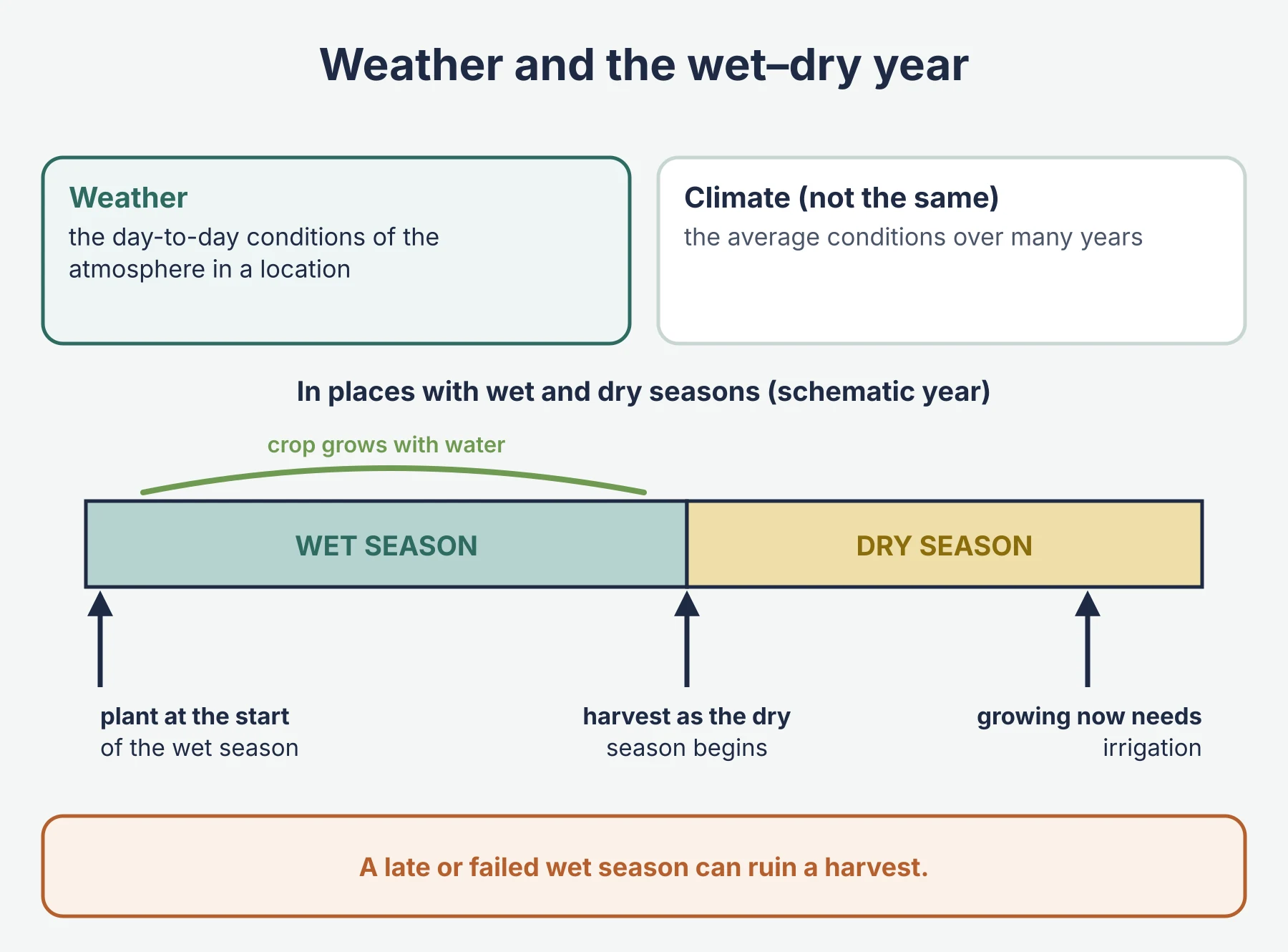
- Weather: the day-to-day conditions of the atmosphere in a location. (Climate is the long-term average.)
- Wet and dry seasons: some areas have them; crops are planted at the start of the wet season; dry-season growing needs irrigation; a failed wet season reduces harvests.
Optimum photosynthesis and crop growth (2.1.6)
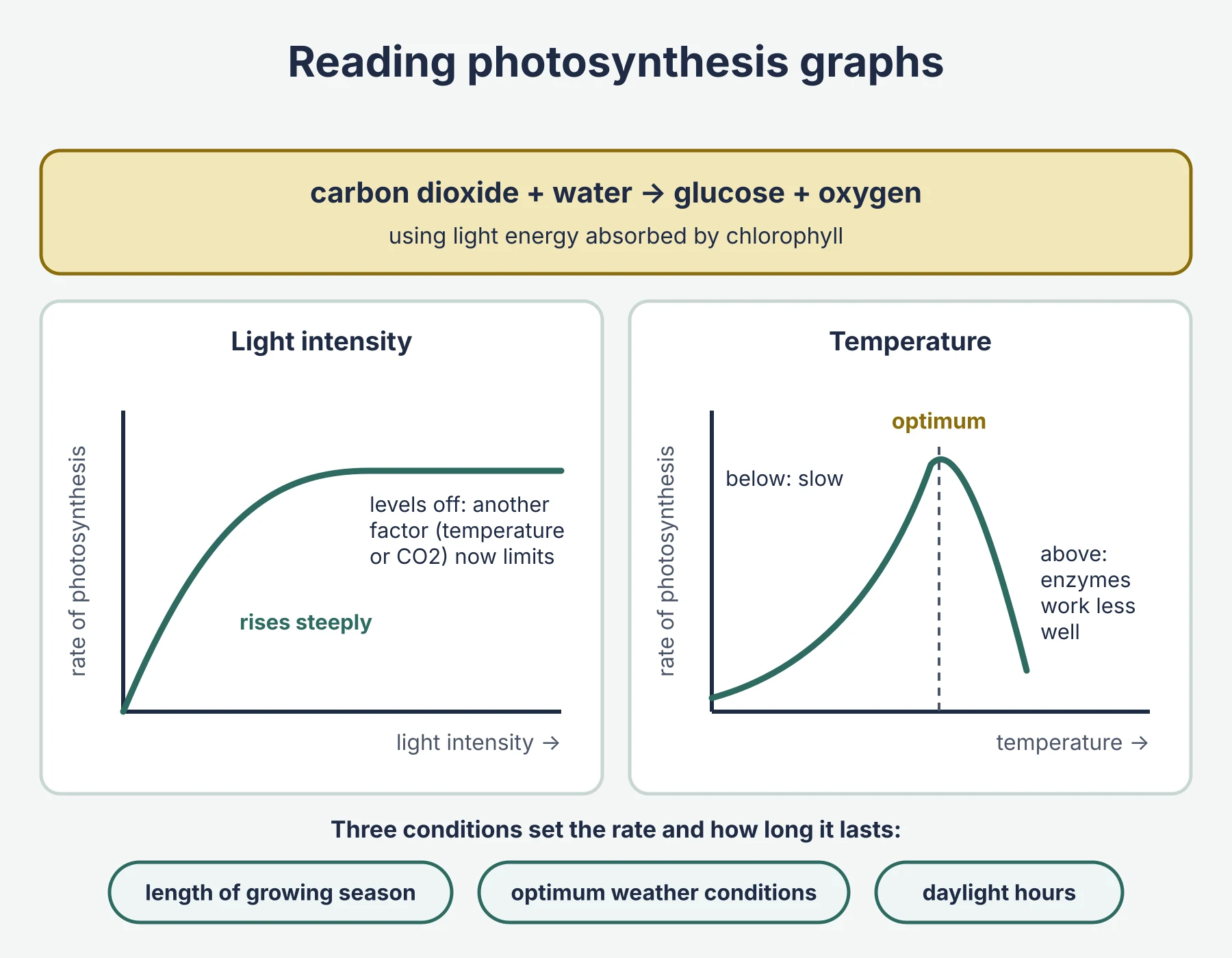
Word equation: carbon dioxide + water → glucose + oxygen (light energy, chlorophyll).
- Length of growing season: more days warm and wet enough → slower crops can mature, or more harvests.
- Optimum weather conditions: warm but not extreme heat, enough rain, sunshine, no frost.
- Daylight hours: longer days → more hours of photosynthesis per day.
Reading graphs
- Rate against light intensity: rises, then levels off (another factor now limiting).
- Rate against temperature: rises to an optimum, then falls (enzymes work less well).
Key terms
| Term | Meaning |
|---|---|
| Humus | Dark organic matter from decomposition |
| Leaching | Nutrients washed down out of reach of roots by draining water |
| Waterlogging | Pore spaces filled with water, leaving little oxygen |
| Loam | Soil with a balanced mix of sand, silt and clay plus organic matter |
| Growing season | Period of the year when conditions allow crops to grow |
| Limiting factor | The condition in shortest supply that holds back the rate of photosynthesis |
Exam traps
- Organic content has two parts: living organisms and decomposed matter.
- Clay is not simply “good”: it holds water and nutrients but drains poorly.
- Sand is not simply “bad”: it drains well but loses water and nutrients.
- Nitrate = nitrogen; phosphate = phosphorus; potassium ions = potassium.
- Weather is day to day, not the average over years.
- More heat does not always mean faster growth.
- For loam, explain what each property does for the crop.
Self-test
- Name the four components of soil.
- Which mineral particle is the smallest?
- Name the two parts of soil organic content.
- Which ion supplies nitrogen to plants?
- What is the main use of phosphate in plants?
- Why do roots need oxygen from the soil?
- Why can a clay soil become waterlogged?
- Why does a sandy soil often lack nutrients?
- Give three reasons why loam is a good medium for crop growth.
- Define weather.
- Why are crops in areas with wet and dry seasons usually planted at the start of the wet season?
- On a graph of photosynthesis rate against light intensity, why does the line level off?
Answers
- Mineral particles, organic content, gases and water.
- Clay.
- Living organisms (plants, animals, fungi, bacteria) and organic matter from decomposition.
- Nitrate (NO₃⁻).
- Healthy root growth.
- For aerobic respiration, which releases energy for growth and for absorbing mineral ions.
- Its tiny pore spaces drain slowly, so they fill with water.
- Water drains quickly through large pores and washes nutrients down (leaching).
- Any three: ideal mix of particles and pore spaces; retains moisture; contains organic content and inorganic ions; allows excess water to drain; easy to cultivate.
- The day-to-day conditions of the atmosphere in a location.
- So that the crop has water while it grows, and can be harvested as the dry season starts.
- Another factor, such as temperature or carbon dioxide, has become the limiting factor.
Where to go next
Practise with the Soils and crop growth practice questions, then revise the Food production and crop yield revision notes. For all of Topic 2 on one page, see the Land revision notes.
Related resources
-
Revision notes
Cambridge IGCSE Environmental Management: Land — Revision Notes
Recall notes on soils and crop growth, food production and soil erosion for Topic 2 Land of Cambridge IGCSE Environmental Management 0680, 2027-2029 series.
Environmental Management · Cambridge · IGCSE
Revise topic -
Study guides
Cambridge IGCSE Environmental Management: Land (0680)
Soils and crop growth, food production and crop yield, and soil erosion – Topic 2 of Cambridge IGCSE Environmental Management (0680), the 2027-2029 series.
Environmental Management · Cambridge · IGCSE
Read guide -
Practice questions
Cambridge IGCSE Environmental Management: Land — Practice Questions (0680)
Original practice questions with worked answers on soils, crop growth, food production and soil erosion for Cambridge IGCSE Environmental Management 0680.
Environmental Management · Cambridge · IGCSE
Try questions
Get free revision emails (optional)
Occasional emails with practice questions, worked explanations and links to free resources for the qualification and subjects you choose. No spam, and you can unsubscribe from any email. The free tools on this site never need an email.