
Study Guides
Cambridge IGCSE Environmental Management (0680): Soils and crop growth
Soil composition, why particles, nutrients, pH, pore spaces and drainage matter, why loam suits crops, and growing conditions, for Cambridge IGCSE 0680.
- Subject
- Environmental Management
- Level
- IGCSE
- Topic
- Topic 2 – Land
- Author
- Marlbridge Academic Team
- Updated
- Reviewed by
- Azam Siddique (what this means)
Aligned to Cambridge IGCSE Environmental Management (0680), 2027-2029. Official specification .
Syllabus page (what it covers and how it is assessed): Cambridge IGCSE Environmental Management.
Syllabus points this page covers
0680
- 2.1 Soils and crop growth
Found an error? Report a correction.
Need help with this topic? Request a free trial class for IGCSE Environmental Management (0680).
Sub-topic 2.1 explains what soil is made of and why that matters to a farmer. It links the physical make-up of soil to the needs of a growing plant, then widens out to the weather and seasons that set how fast crops can grow. Everything in 2.2 (how to raise yields) and 2.3 (how soil is lost) depends on the ideas here, so it is worth learning the reasons, not just the lists.
What the syllabus asks you to do
- 2.1.1 Describe the composition of soils: mineral particles (sand, silt and clay); organic content (living organisms, namely plants, animals, fungi and bacteria, and organic matter from decomposition); gases; water. Percentage composition is not required.
- 2.1.2 Describe how composition is important for crop growth: mineral particles; nutrient content (organic content and inorganic ions: nitrogen as nitrate ions NO₃⁻, phosphorus as phosphate ions PO₄³⁻, potassium as potassium ions K⁺); pH (acidic, neutral, alkaline); pore spaces; gas content; water content and drainage; ease of cultivation.
- 2.1.3 Explain why loam soils are a good medium for crop growth.
- 2.1.4 Define weather as the day-to-day conditions of the atmosphere in a location.
- 2.1.5 State that some areas experience wet and dry seasons that affect crop growth.
- 2.1.6 Describe and interpret conditions for the optimum rate of photosynthesis and crop growth: length of growing season, optimum weather conditions, daylight hours.
What soil is made of
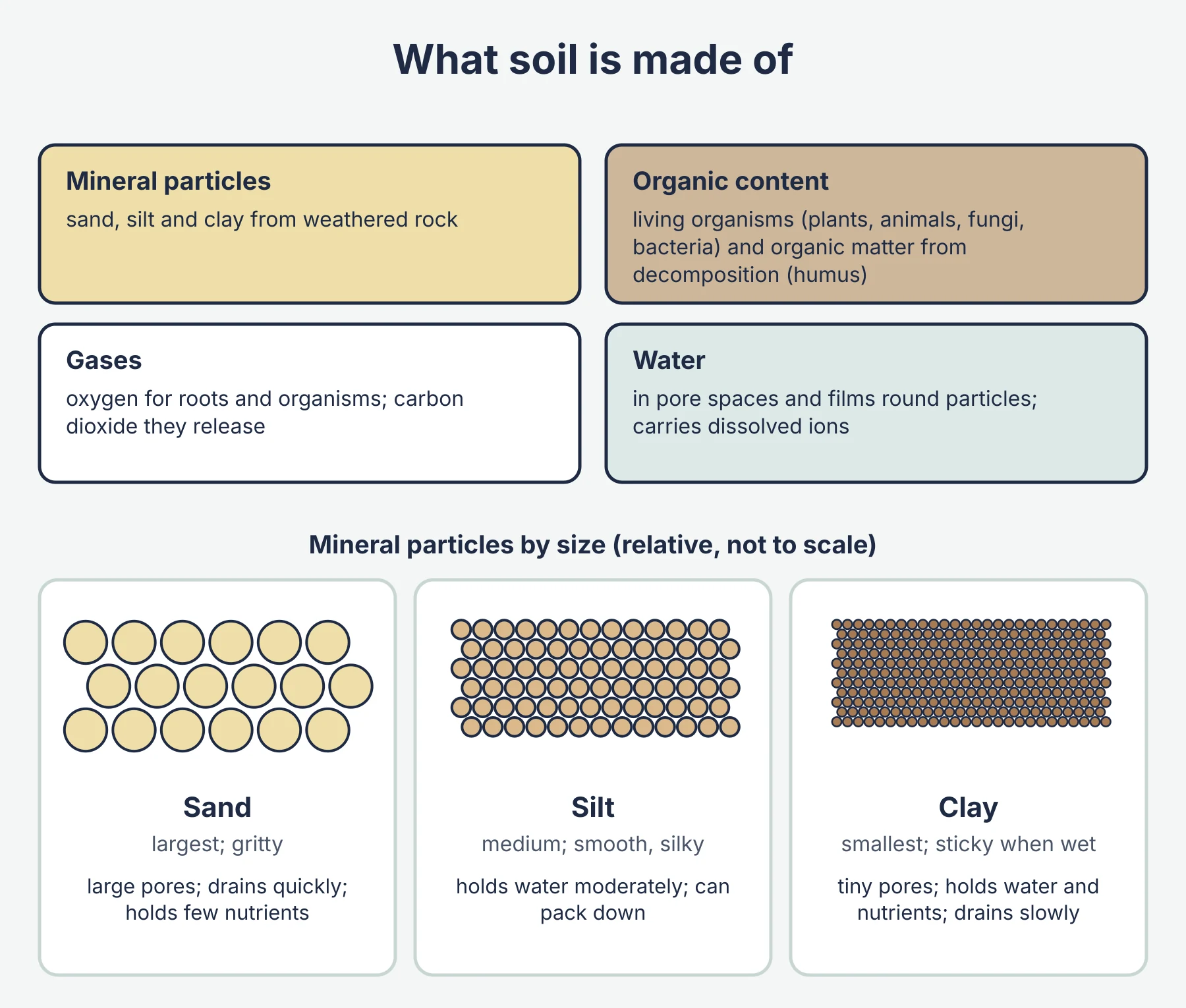
Mineral particles come from weathered rock (1.1) and form most of the soil’s solid material. They are classified by size:
| Particle | Relative size | Feel | Effect on soil |
|---|---|---|---|
| Sand | Largest | Gritty | Large pore spaces; drains quickly; holds few nutrients |
| Silt | Medium | Smooth, silky | Holds water moderately; can pack down |
| Clay | Smallest | Sticky when wet | Tiny pore spaces; holds water and nutrients; drains slowly |
Organic content has two parts. Living organisms include plant roots, animals such as earthworms and insects, and fungi and bacteria. Organic matter from decomposition is the dark, partly broken-down remains of dead organisms and waste, often called humus. Decomposers break this material down and release nutrients.
Gases fill the pore spaces that are not filled with water. Soil air contains oxygen that roots and soil organisms need, and carbon dioxide that they release.
Water is held in the pore spaces and as thin films around particles. It carries dissolved mineral ions to plant roots.
Why composition matters for crops
Mineral particles. The mix of sand, silt and clay controls how much water the soil holds, how quickly it drains and how many nutrients it keeps. A very sandy soil dries out and loses nutrients as water drains through it (leaching). A heavy clay soil holds water and nutrients well but can become waterlogged.
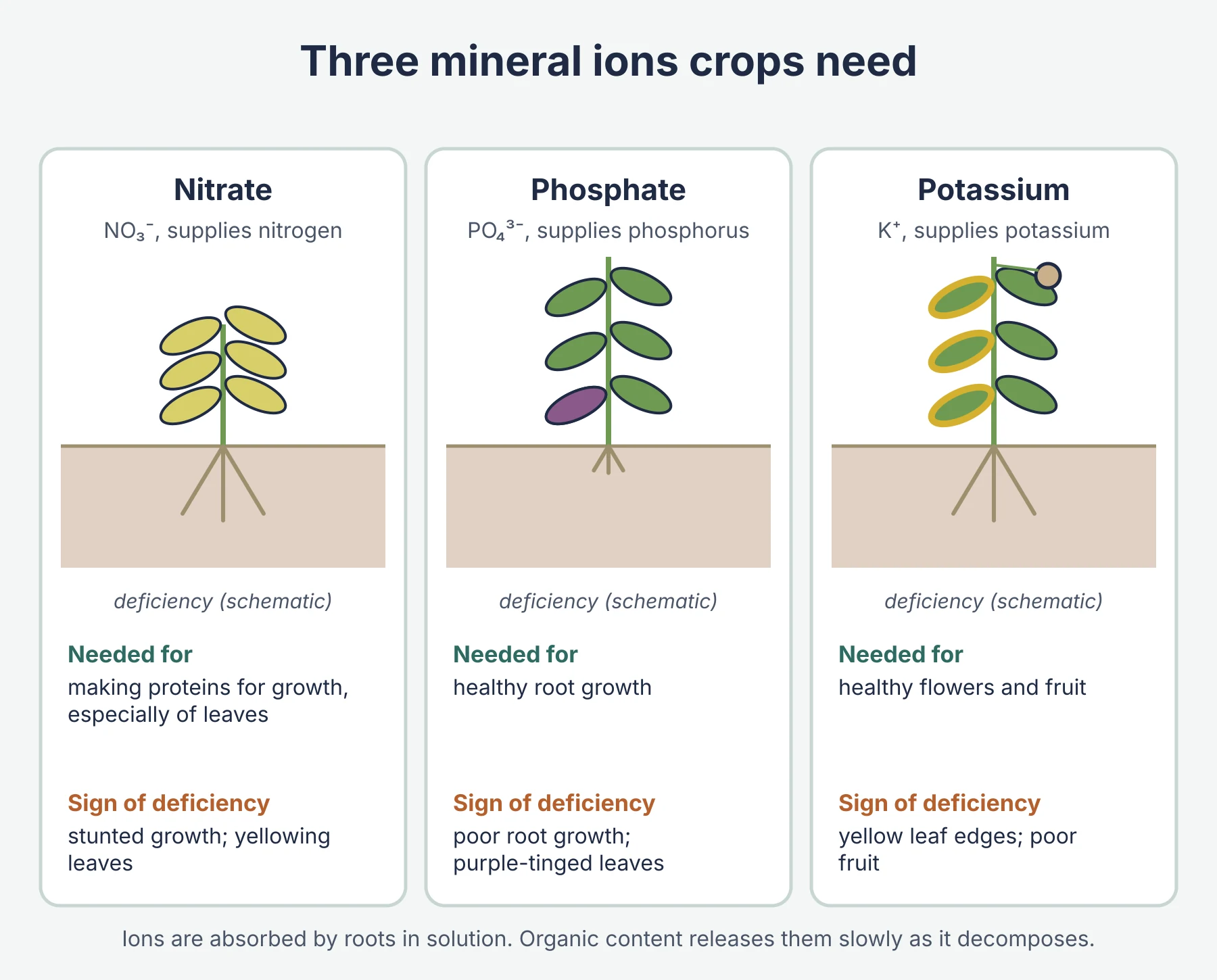
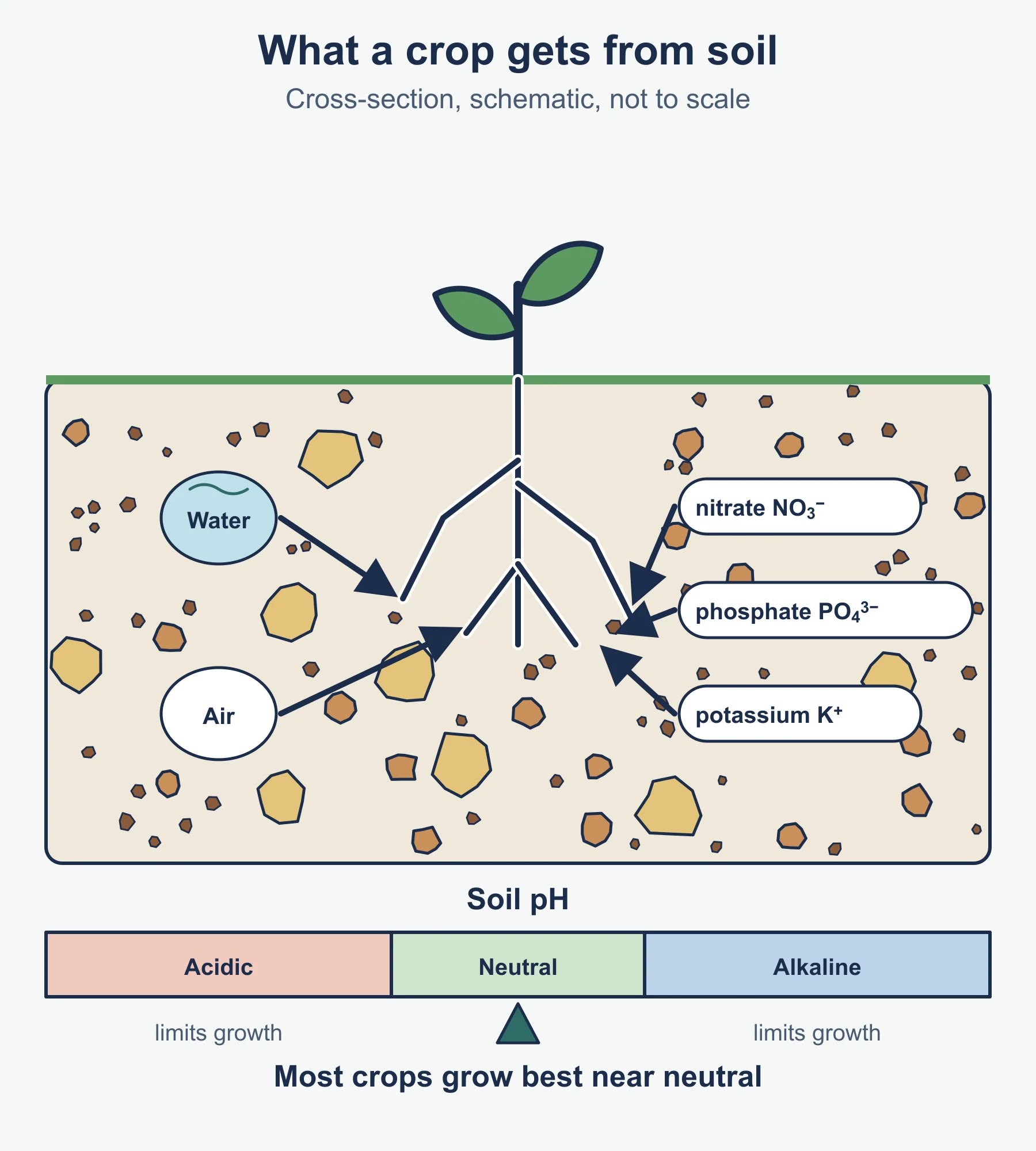
Nutrient content. Plants need mineral ions, absorbed through their roots in solution.
| Ion | Needed for | Sign of deficiency |
|---|---|---|
| Nitrate (NO₃⁻), supplying nitrogen | Making proteins for growth, especially of leaves | Stunted growth; yellowing leaves |
| Phosphate (PO₄³⁻), supplying phosphorus | Healthy root growth | Poor root growth; purple-tinged leaves |
| Potassium (K⁺) | Healthy flowers and fruit | Yellow leaf edges; poor fruit |
Organic content supplies these ions slowly as it decomposes; inorganic ions may also come from weathered rock or from fertilisers (2.2).
pH. Soils are acidic (pH below 7), neutral (pH 7) or alkaline (above 7). Most crops grow best in soils close to neutral. In strongly acidic or alkaline soils, some nutrients become less available to roots, so growth slows even if the nutrients are present.
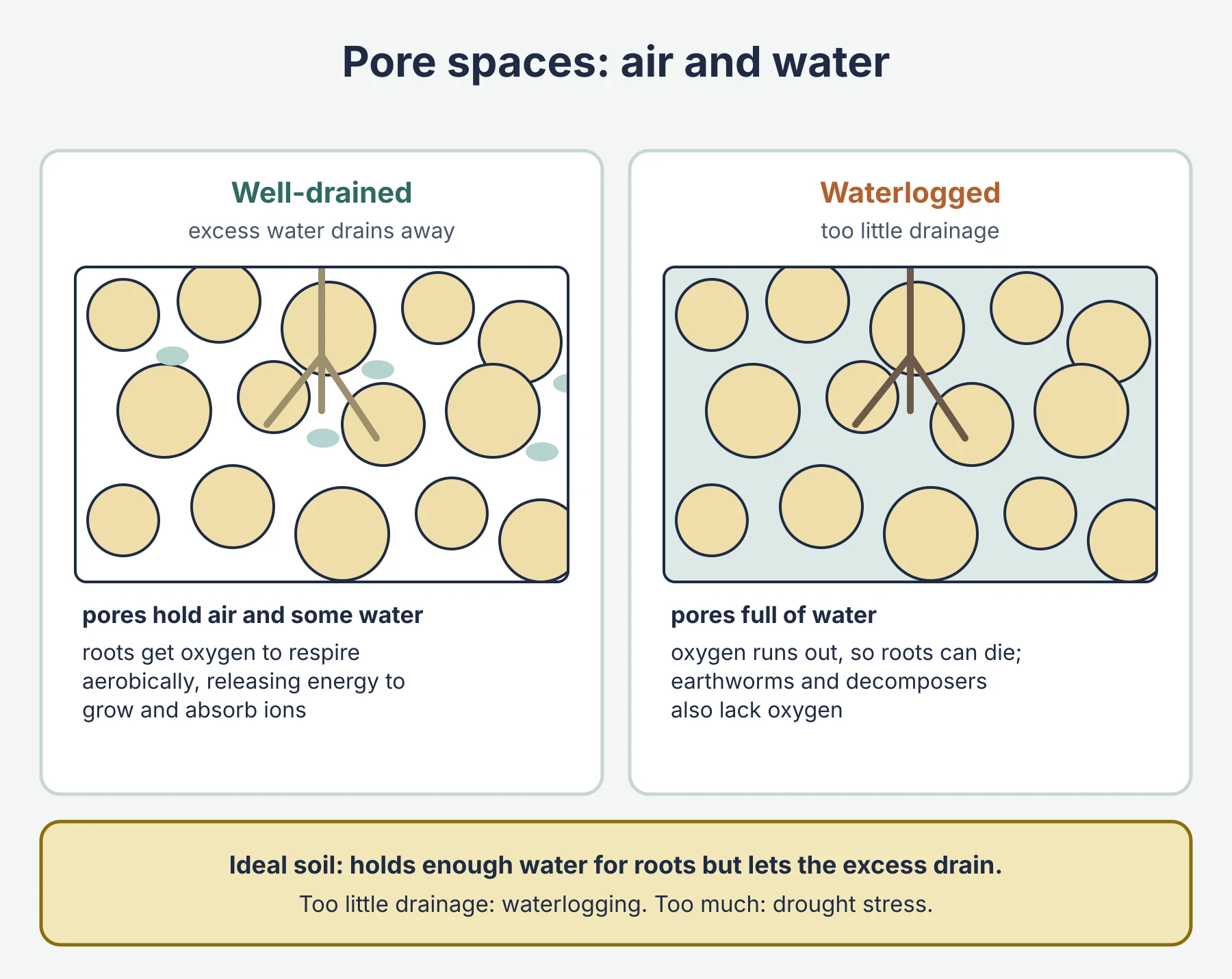
Pore spaces. Gaps between particles hold the air and water that roots need, and give roots room to grow and spread.
Gas content. Roots respire aerobically, using oxygen to release the energy they need to grow and to absorb mineral ions. If pore spaces fill with water, oxygen runs out and roots can die. Soil organisms such as earthworms and decomposers also need oxygen.
Water content and drainage. Plants need water for photosynthesis, to carry dissolved ions and to stay firm (turgid). The ideal soil holds enough water for roots but lets the excess drain away. Too little drainage causes waterlogging; too much causes drought stress.
Ease of cultivation. Farmers must plough, dig and plant. Clay is heavy and sticky when wet and sets hard when dry. Sandy soil is light and easy to work. A soil that is easy to cultivate saves time, fuel and labour.
Why loam is a good medium for crop growth
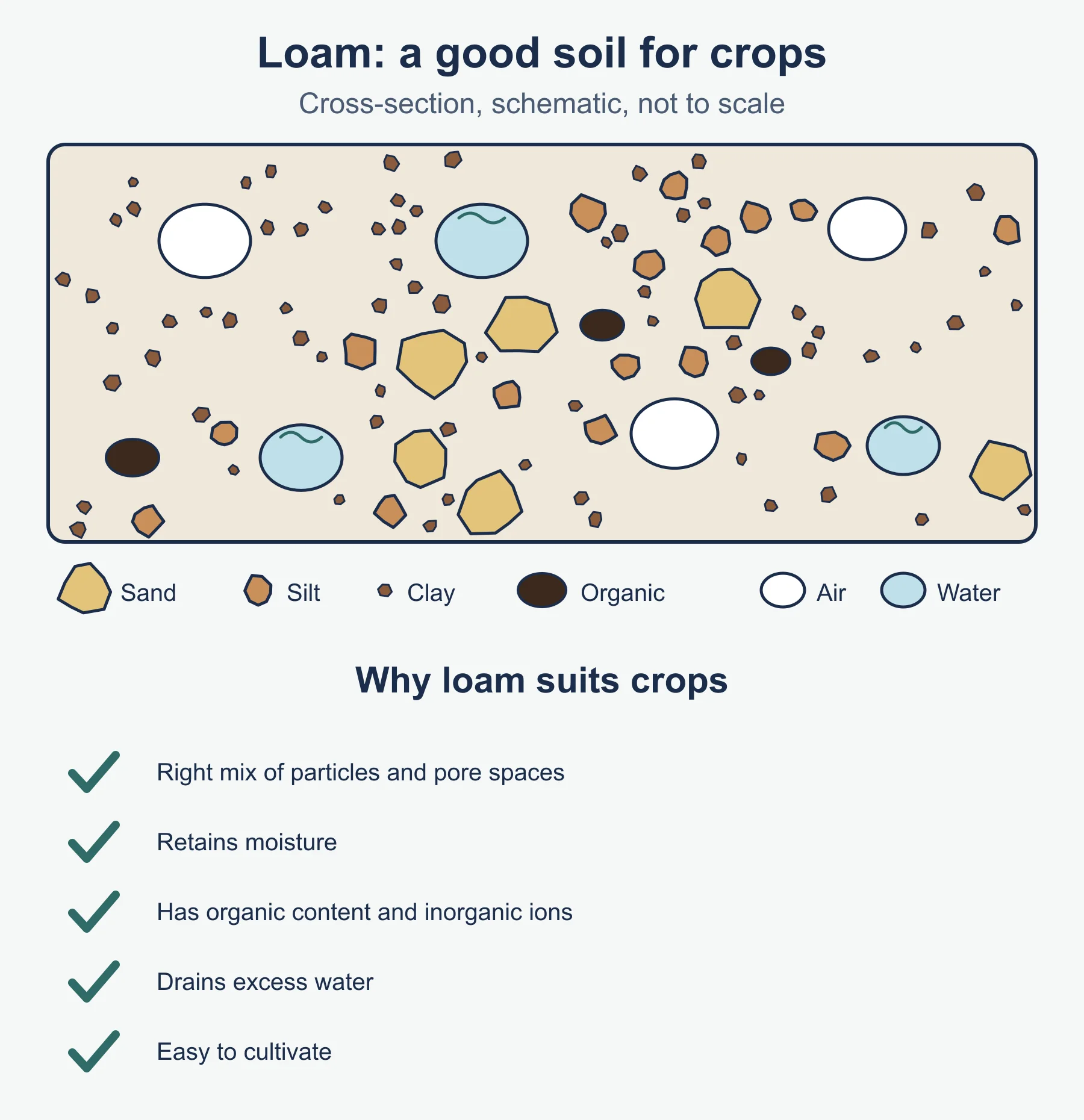
Loam is a mixture of sand, silt and clay with plenty of organic matter. The syllabus gives five reasons it suits crops; each one links to a point above:
- Ideal combination of mineral particles and pore spaces: enough large pores for air and drainage, enough small pores to hold water.
- Retains moisture: the clay, silt and organic matter hold water for roots between rainfall or irrigation.
- Contains organic content and inorganic ions: a supply of nitrate, phosphate and potassium ions, and humus that holds them.
- Allows excess water to drain: the sand prevents waterlogging, so roots get oxygen.
- Easy to cultivate: crumbly texture makes ploughing and planting easier.
A strong answer avoids simply repeating “it has a good mix”; it says what each component contributes.
Weather, seasons and crop growth
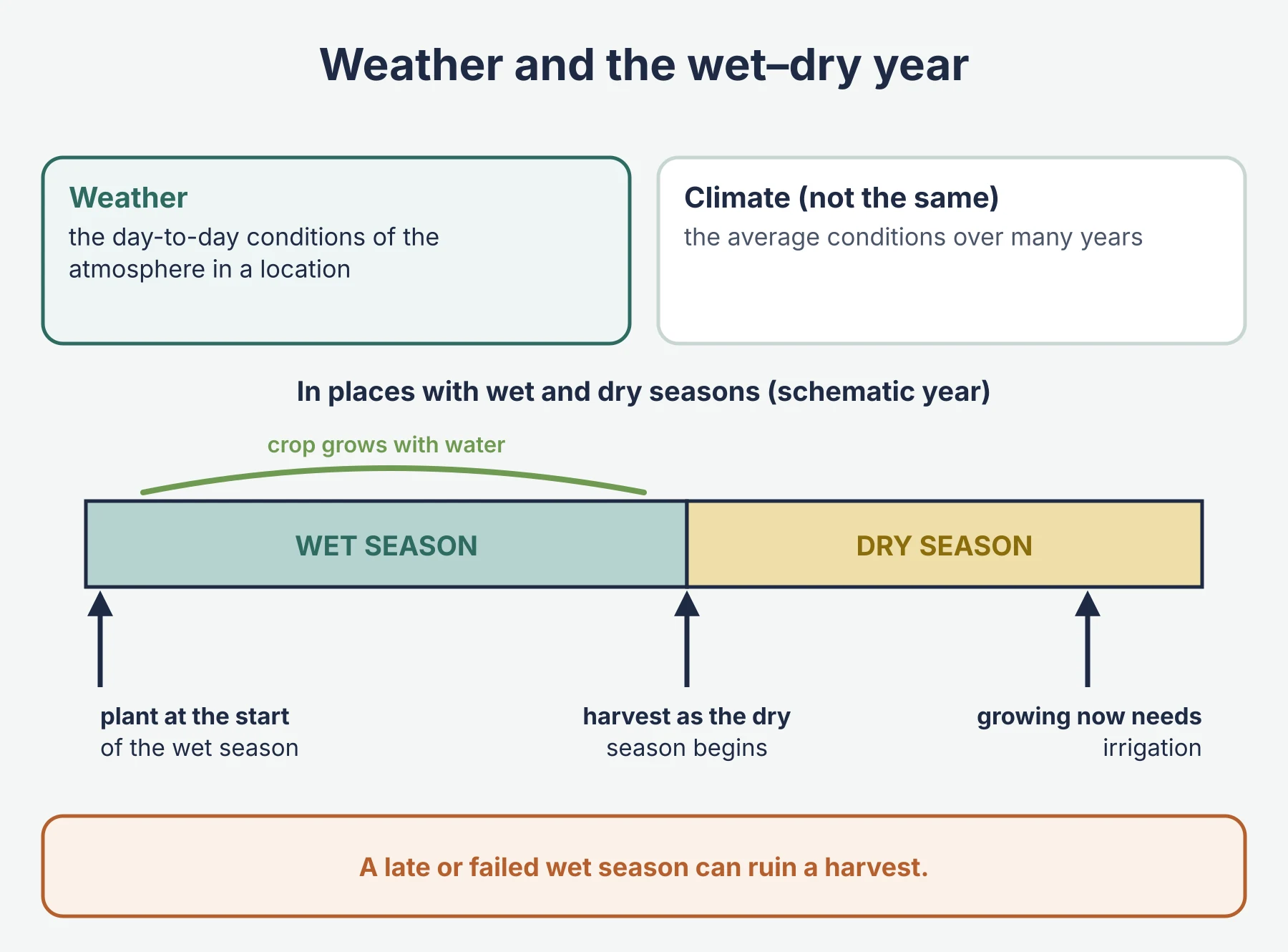
Weather is the day-to-day conditions of the atmosphere in a location: temperature, rainfall, sunshine, wind and humidity on a given day. It is different from climate, which describes the average conditions over many years.
Some areas of the world have wet seasons and dry seasons. In these places, crops are usually planted at the start of the wet season so that they have water while growing, and harvested as the dry season begins. A late or failed wet season can ruin a harvest, and growing crops in the dry season needs irrigation.
Conditions for the optimum rate of photosynthesis and crop growth
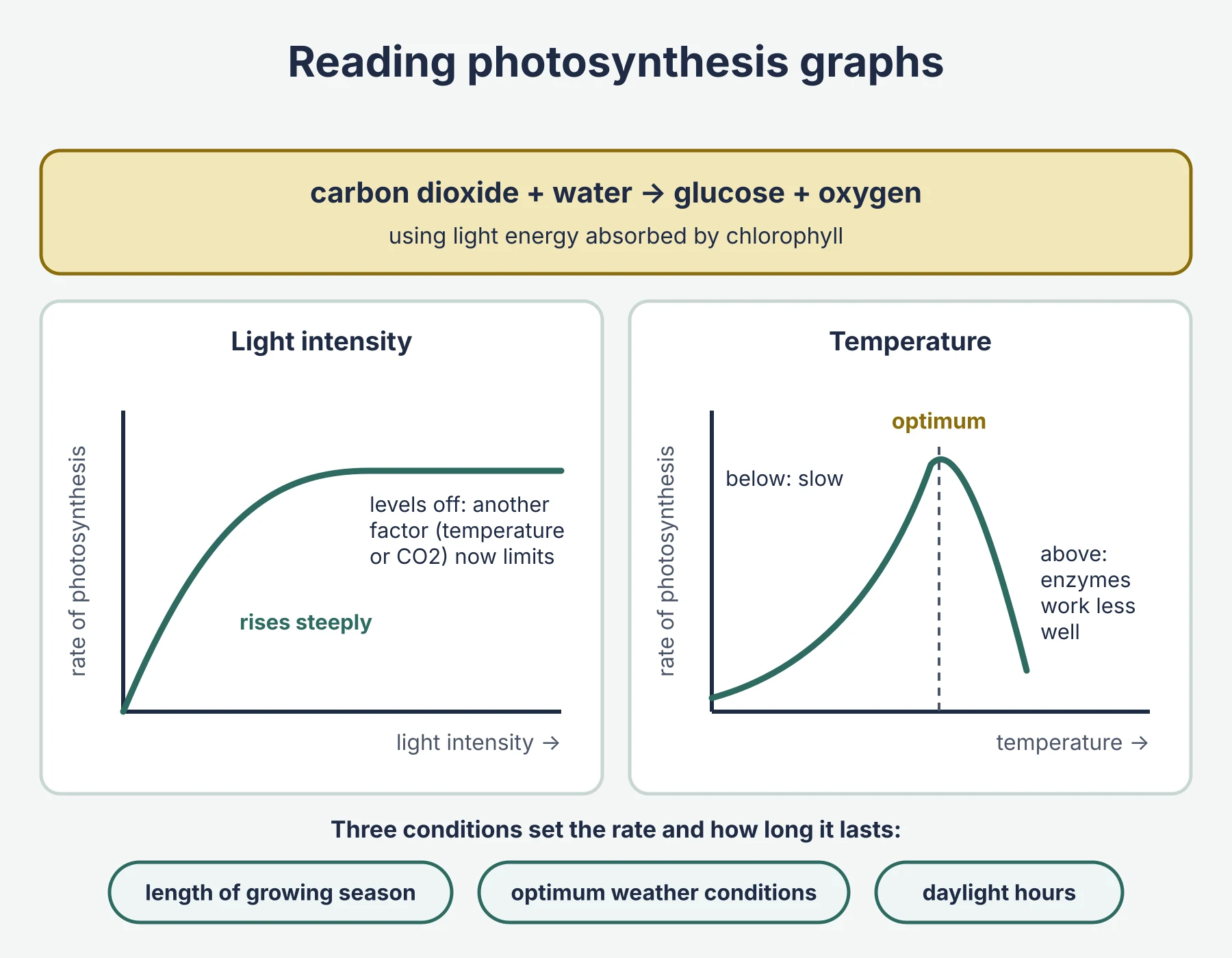
Crops grow by photosynthesis:
carbon dioxide + water → glucose + oxygen (using light energy absorbed by chlorophyll)
Three conditions in the syllabus control how fast this happens and for how long:
- Length of growing season: the number of days in the year when conditions are warm and wet enough for growth. A longer season allows slower crops to mature, or more than one harvest a year.
- Optimum weather conditions: warm (but not extremely hot) temperatures, sufficient rainfall, plenty of sunshine and no frost. Below the optimum temperature, photosynthesis is slow; well above it, the plant’s enzymes stop working well and growth falls.
- Daylight hours: photosynthesis needs light, so longer days allow more photosynthesis each day.
Interpreting graphs. On a graph of photosynthesis rate against light intensity, the rate rises steeply at first and then levels off. The levelling shows that something else, such as temperature or carbon dioxide, is now limiting the rate. On a graph against temperature, the rate rises to a peak at the optimum and then falls.
Worked example 1: a drainage experiment
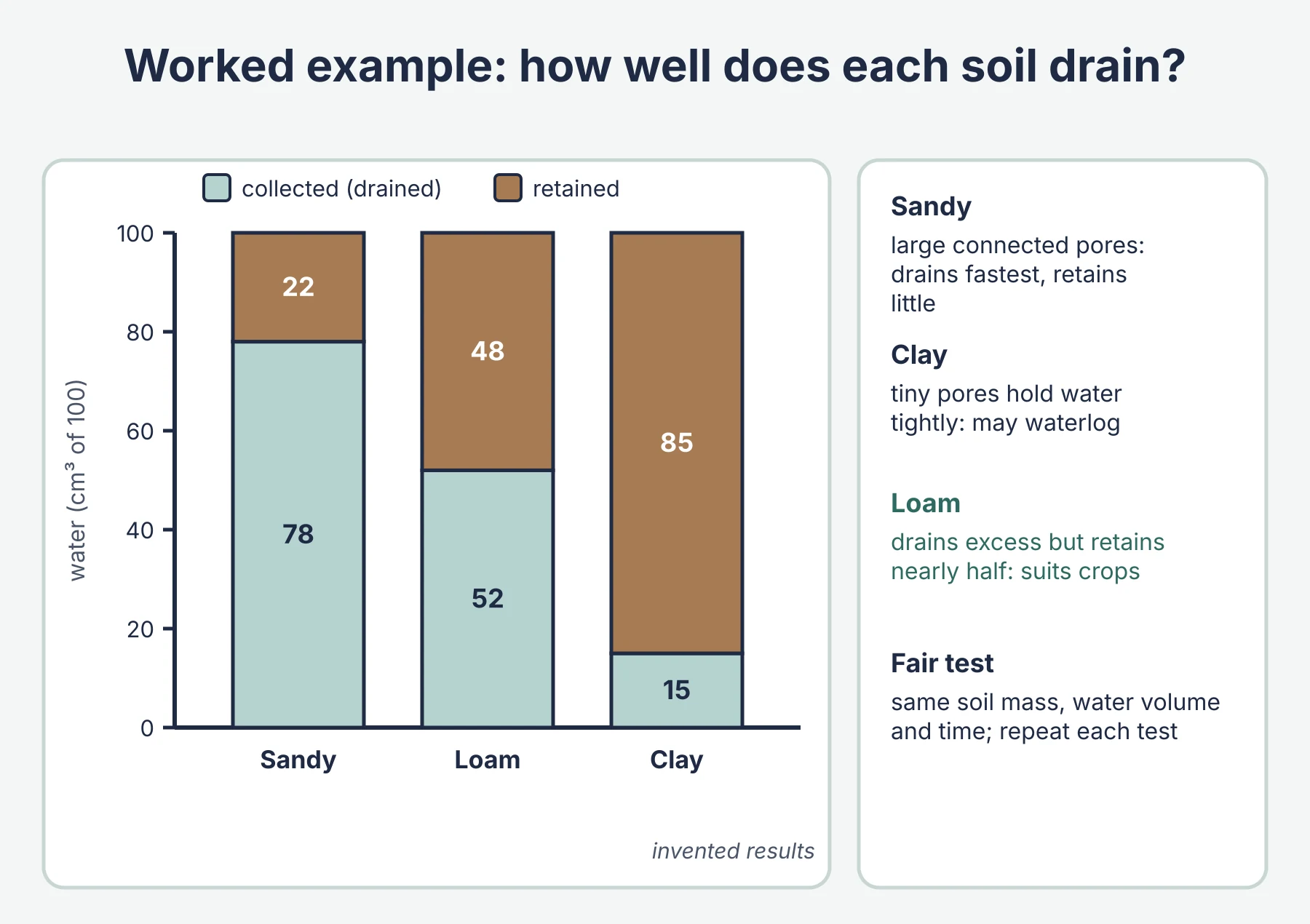
A student pours 100 cm³ of water through 100 g of each soil in a funnel and measures the water collected after 10 minutes. (Results invented for practice.)
| Soil | Water collected (cm³) | Water retained (cm³) |
|---|---|---|
| Sandy | 78 | 100 − 78 = 22 |
| Loam | 52 | 100 − 52 = 48 |
| Clay | 15 | 100 − 15 = 85 |
Interpretation: sandy soil drains fastest because its large particles leave large, connected pore spaces; it retains little water, so crops may suffer in dry weather. Clay retains most water because its tiny pores hold water tightly, so it may become waterlogged. Loam lies in between: it drains excess water but retains nearly half, which is why it suits crops. For a fair test, the same mass of soil, the same volume of water and the same time must be used; repeating each test improves reliability.
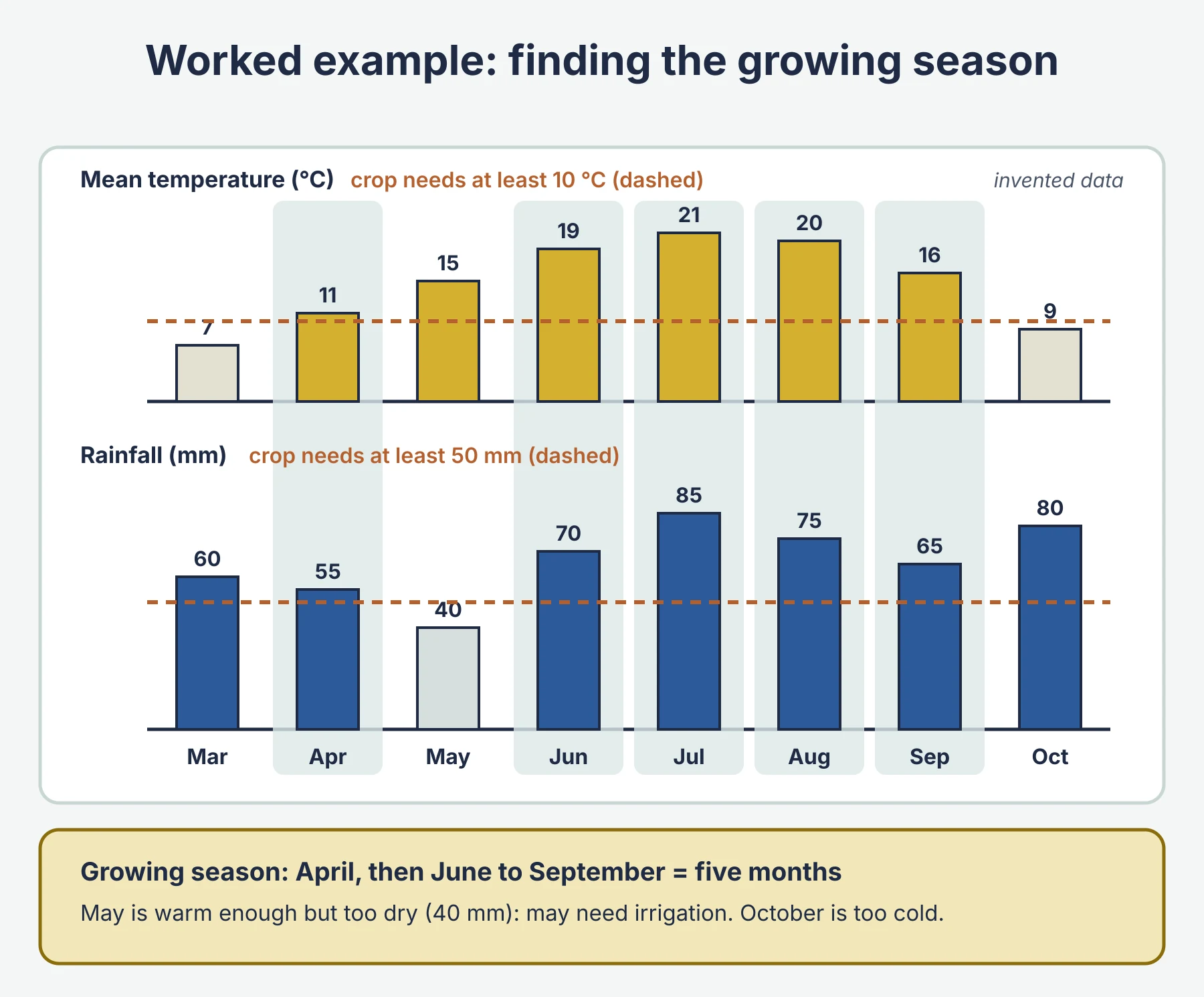
Worked example 2: finding the growing season
A crop needs a mean monthly temperature of at least 10 °C and at least 50 mm of rain in a month. (Data invented for practice.)
| Month | Mar | Apr | May | Jun | Jul | Aug | Sep | Oct |
|---|---|---|---|---|---|---|---|---|
| Mean temperature (°C) | 7 | 11 | 15 | 19 | 21 | 20 | 16 | 9 |
| Rainfall (mm) | 60 | 55 | 40 | 70 | 85 | 75 | 65 | 80 |
April meets both conditions; May is warm enough but too dry (40 mm); June to September meet both; October is too cold. The growing season is therefore April, then June to September: five months, with May a dry month in which the crop may need irrigation.
Common mistakes
- Listing soil components without the organic content’s two parts (living organisms and decomposed matter).
- Saying clay is good because it “holds water” without noting the waterlogging risk.
- Mixing up the ions: nitrate supplies nitrogen, phosphate supplies phosphorus.
- Giving a definition of climate when asked for weather.
- Stating that more heat always increases photosynthesis.
Exam technique
Describe composition: name all four components. Explain why loam is good: give the reason and its benefit to the crop. Interpret graphs or tables: quote figures and identify where a rate changes or levels off. Define weather using the syllabus wording.
Revise with the Soils and crop growth revision notes, practise with the Soils and crop growth practice questions, then continue to the Food production and crop yield study guide.
Related resources
-
Revision notes
Cambridge IGCSE Environmental Management: Land — Revision Notes
Recall notes on soils and crop growth, food production and soil erosion for Topic 2 Land of Cambridge IGCSE Environmental Management 0680, 2027-2029 series.
Environmental Management · Cambridge · IGCSE
Revise topic -
Practice questions
Cambridge IGCSE Environmental Management (0680): Soils and crop growth – Practice Questions
Original questions with answers on soil composition, nutrient ions, drainage data, waterlogging, seasons and photosynthesis graphs for Cambridge IGCSE 0680.
Environmental Management · Cambridge · IGCSE
Try questions -
Revision notes
Cambridge IGCSE Environmental Management (0680): Soils and crop growth – Revision Notes
Condensed notes on soil composition, nutrient ions, pH, drainage, loam, weather and conditions for photosynthesis for 2.1 Soils and crop growth, IGCSE 0680.
Environmental Management · Cambridge · IGCSE
Revise topic
Get free revision emails (optional)
Occasional emails with practice questions, worked explanations and links to free resources for the qualification and subjects you choose. No spam, and you can unsubscribe from any email. The free tools on this site never need an email.