
Revision Notes
Cambridge IGCSE Environmental Management (0680): Soil erosion – Revision Notes
Recall notes on the causes, impacts and prevention of soil erosion, with each strategy's mechanism and a self-test, for Cambridge IGCSE 0680 sub-topic 2.3.
- Subject
- Environmental Management
- Level
- IGCSE
- Topic
- Topic 2 – Land
- Author
- Marlbridge Academic Team
- Updated
- Reviewed by
- Azam Siddique (what this means)
Aligned to Cambridge IGCSE Environmental Management (0680), 2027-2029. Official specification .
Syllabus page (what it covers and how it is assessed): Cambridge IGCSE Environmental Management.
Syllabus points this page covers
0680
- 2.3 Soil erosion
Found an error? Report a correction.
Need help with this topic? Request a free trial class for IGCSE Environmental Management (0680).
Condensed notes for sub-topic 2.3. Full explanations, an erosion plot data example and an annotated answer are in the Soil erosion study guide.
Definition to use
Soil erosion: the removal of soil, especially fertile topsoil, by water or wind faster than new soil forms.
Topsoil holds most of the organic matter, nutrients and soil organisms, so losing it hits crop growth hardest.
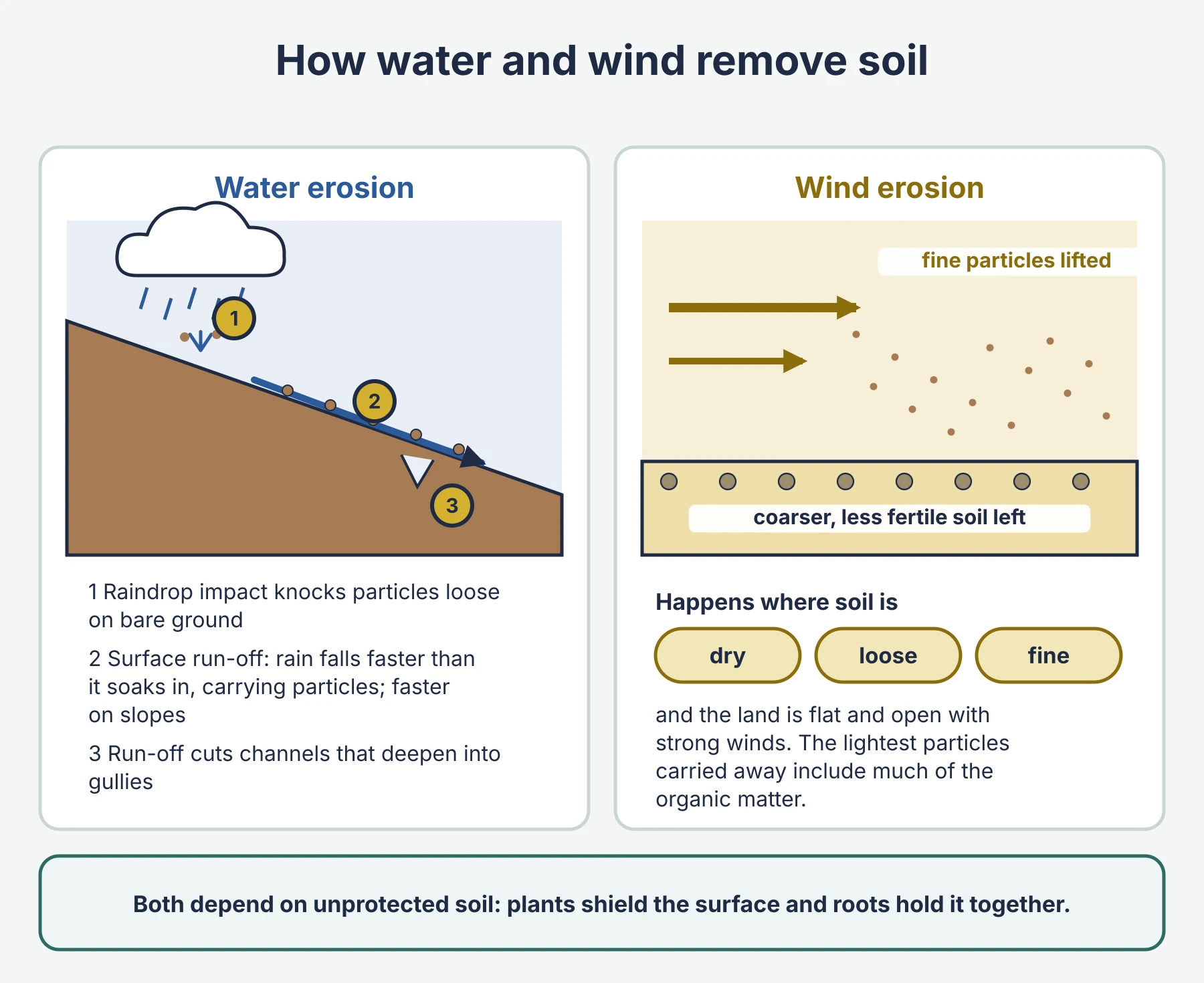
The two processes
Water erosion
- Raindrops hit bare soil and knock particles loose.
- Rain falls faster than it can soak in, so surface run-off forms.
- Run-off carries particles downhill, faster on steep slopes.
- Concentrated run-off cuts channels and gullies.
Wind erosion
- Soil is dry, loose and fine.
- Land is flat, open and unprotected.
- Strong winds lift the lightest particles, including organic matter.
- Coarse, less fertile soil is left behind.
Common condition: soil without vegetation to shield the surface and roots to bind it.
Causes (2.3.1)
| Cause | Key link |
|---|---|
| Unsustainable agricultural practices | Overgrazing, overcultivation, monoculture, ploughing up and down slopes, poor irrigation |
| Deforestation | No canopy to intercept rain; no roots to bind soil |
| Farming on steep slopes | Gravity speeds run-off |
| Bare soil | No protection from raindrops or wind |
| Wind and water erosion | The processes that remove loosened soil |
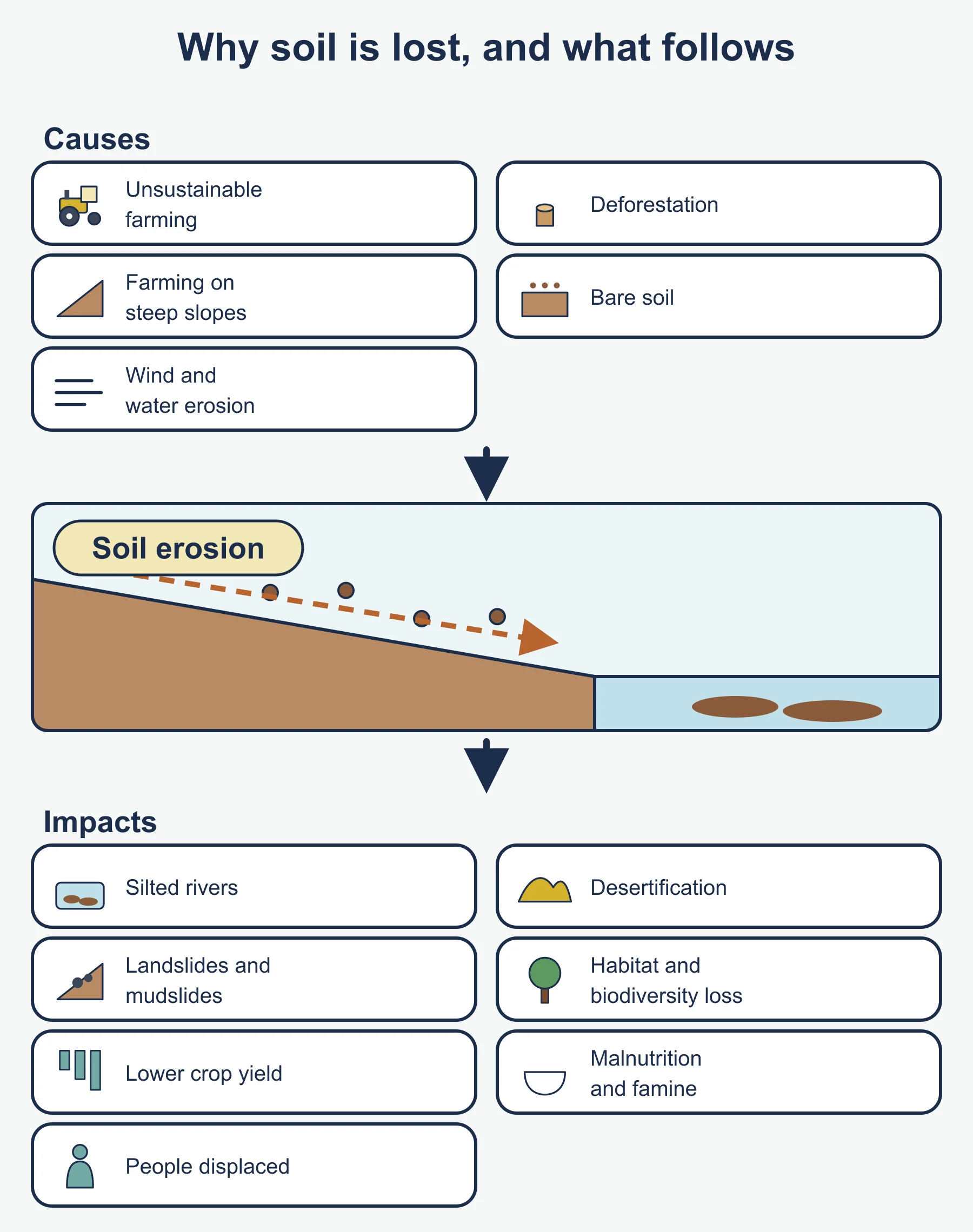
Impacts (2.3.2)
| Impact | What happens |
|---|---|
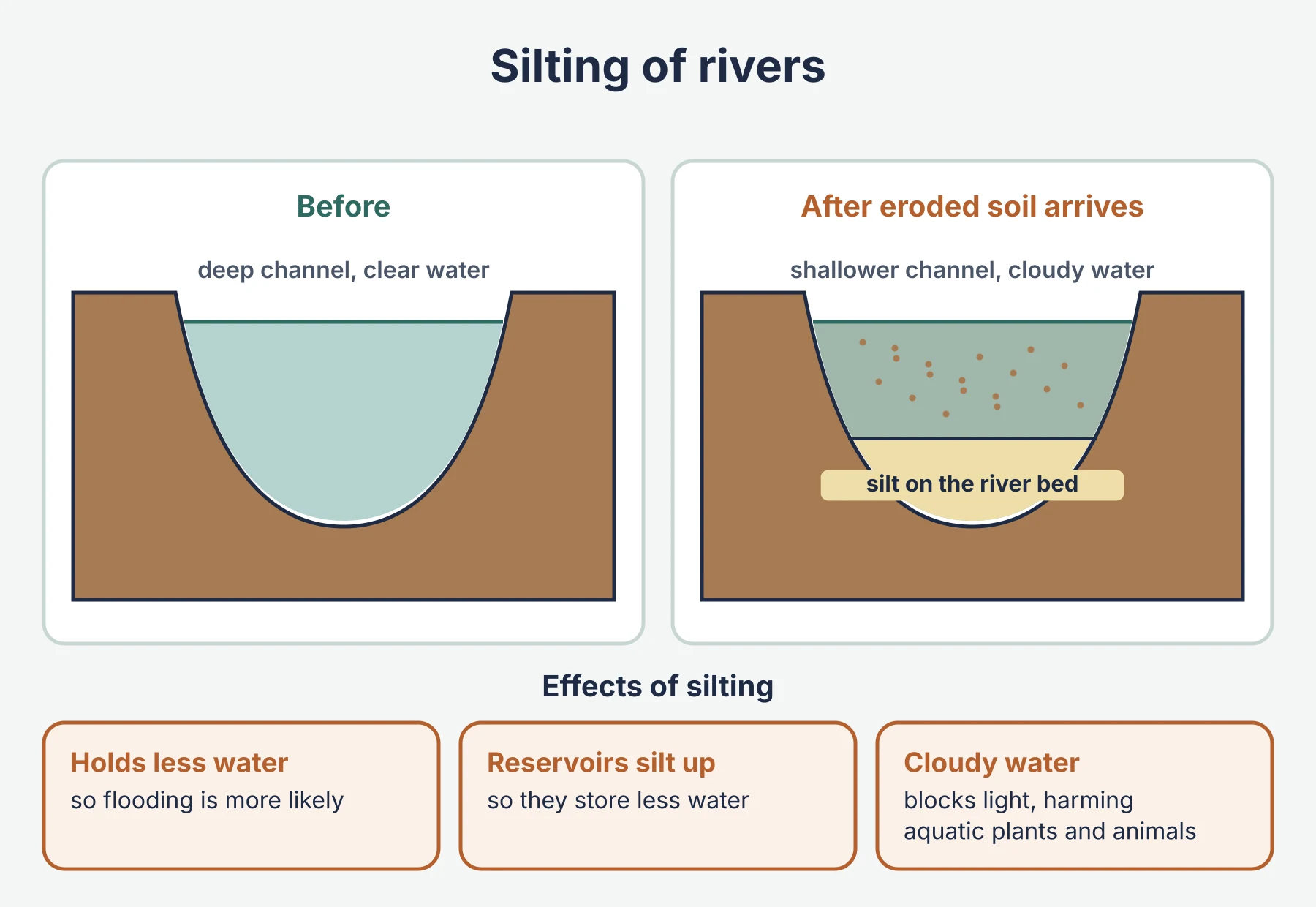
| Silting of rivers | Soil deposited in channels and reservoirs; shallower rivers flood; cloudy water harms aquatic life |
| Desertification | Dry land loses topsoil and vegetation and becomes desert-like |
| Mass movement | Landslides, rockslides, mudslides on slopes with no roots to hold them |
| Loss of habitats and biodiversity | Soil organisms and river ecosystems lose habitat |
| Reduction in crop yield | Fewer nutrients and less water held in the remaining soil |
| Malnutrition and famine | Too little food where people rely on local harvests |
| Displacement of people | Families forced to leave land that can no longer feed them |
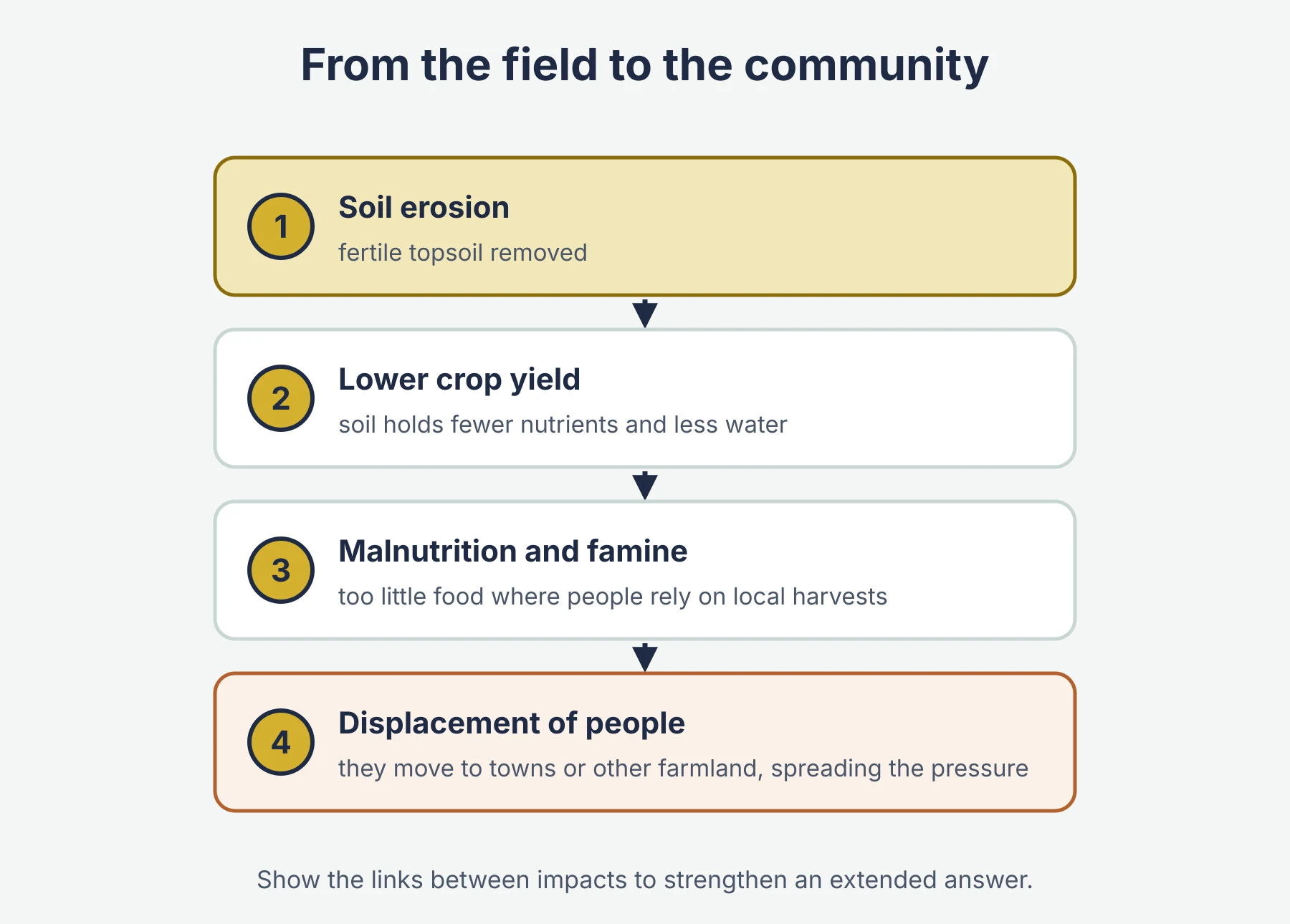
Human chain: erosion → lower yield → malnutrition or famine → displacement.
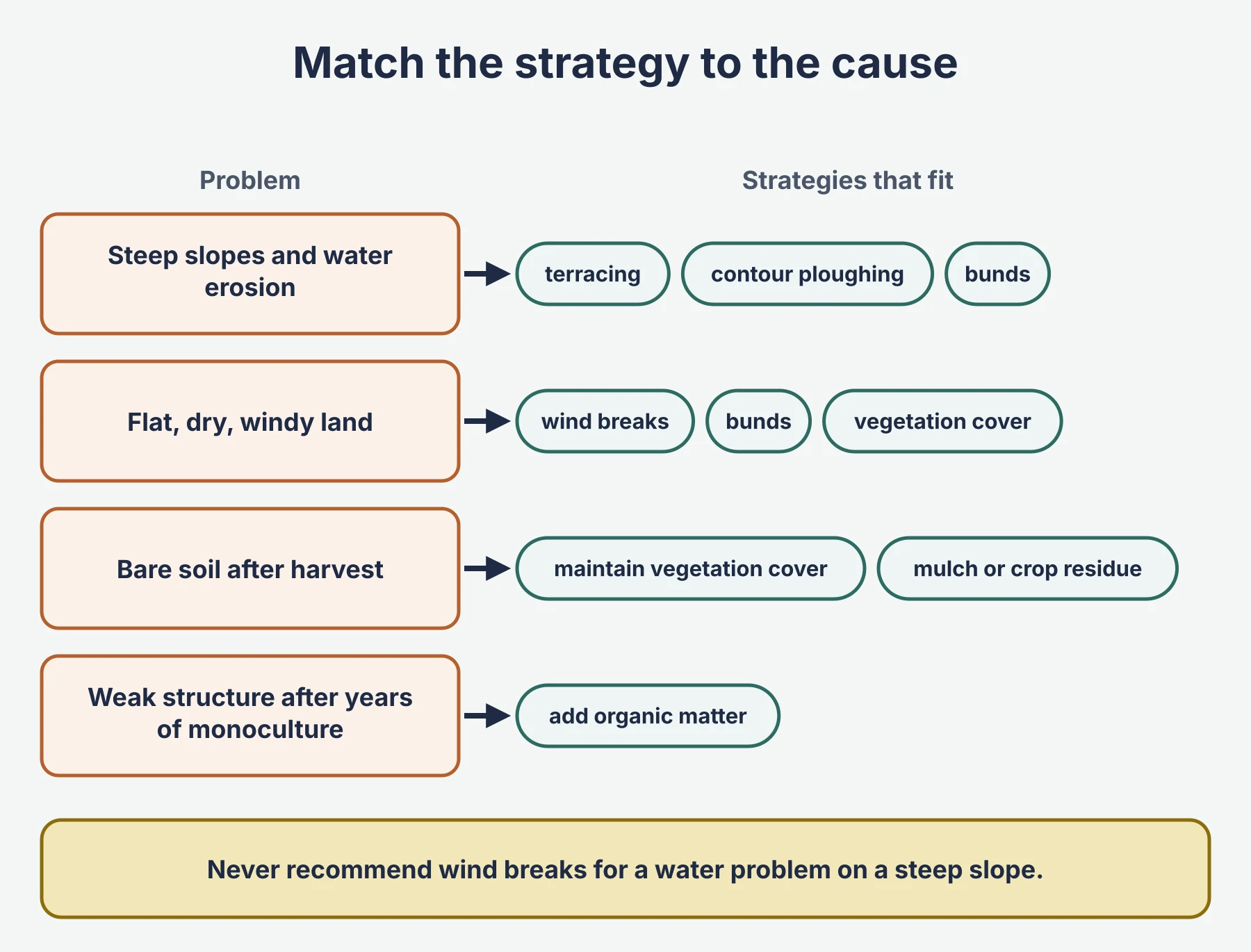
Strategies (2.3.3): learn the mechanism wording
| Strategy | Syllabus mechanism | Best for |
|---|---|---|
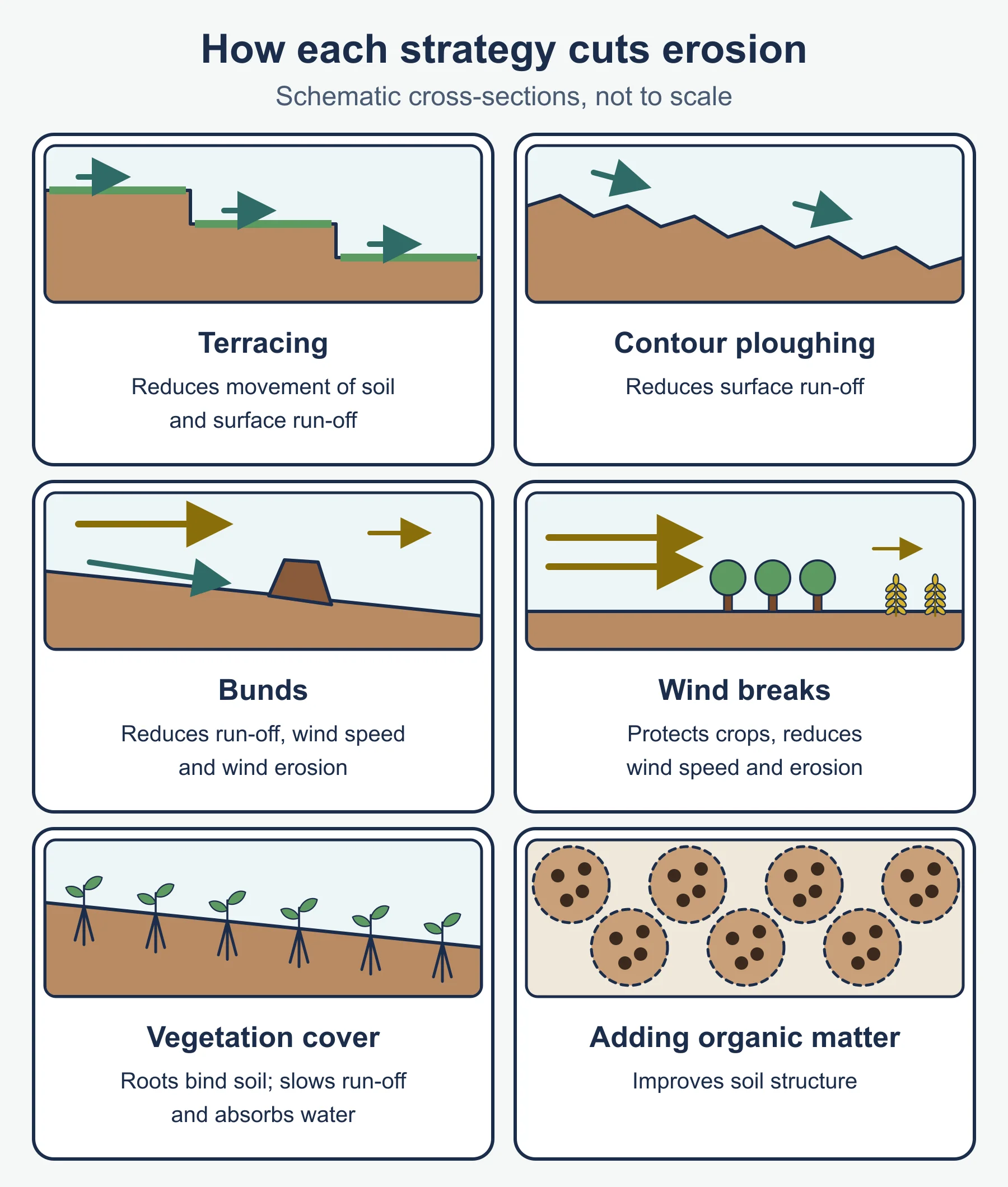
| Terracing | Reduces movement of soil and surface run-off | Steep slopes |
| Contour ploughing | Reduces surface run-off | Gentle to moderate slopes |
| Bunds | Reduce surface run-off; reduce wind speed and wind erosion | Slopes and dry, windy land |
| Wind breaks | Protect crops; reduce wind speed and wind erosion | Flat, open, windy land |
| Maintaining vegetation cover | Roots bind the soil; vegetation reduces surface run-off and absorbs water | Anywhere, especially after harvest |
| Addition of organic matter | Improves soil structure | Soils weakened by monoculture or overcultivation |
One limitation each
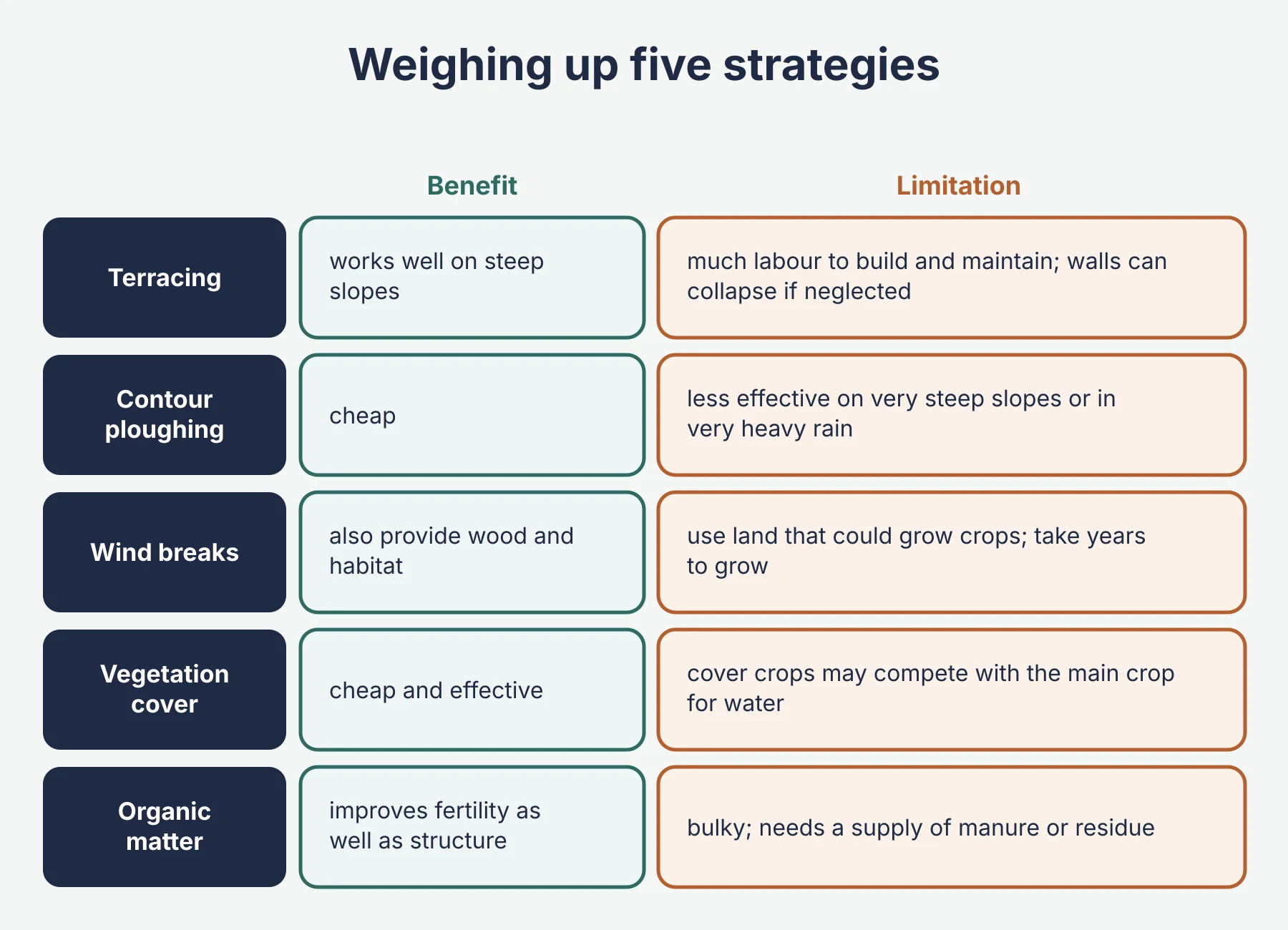
- Terracing: heavy labour to build and maintain; walls can collapse.
- Contour ploughing: less effective on very steep slopes or in very heavy rain.
- Bunds: take labour to build; can be breached in storms.
- Wind breaks: take up crop land; take years to grow.
- Vegetation cover: cover crops may compete with the main crop for water.
- Organic matter: bulky; needs a supply of manure, compost or residue.
Data skills
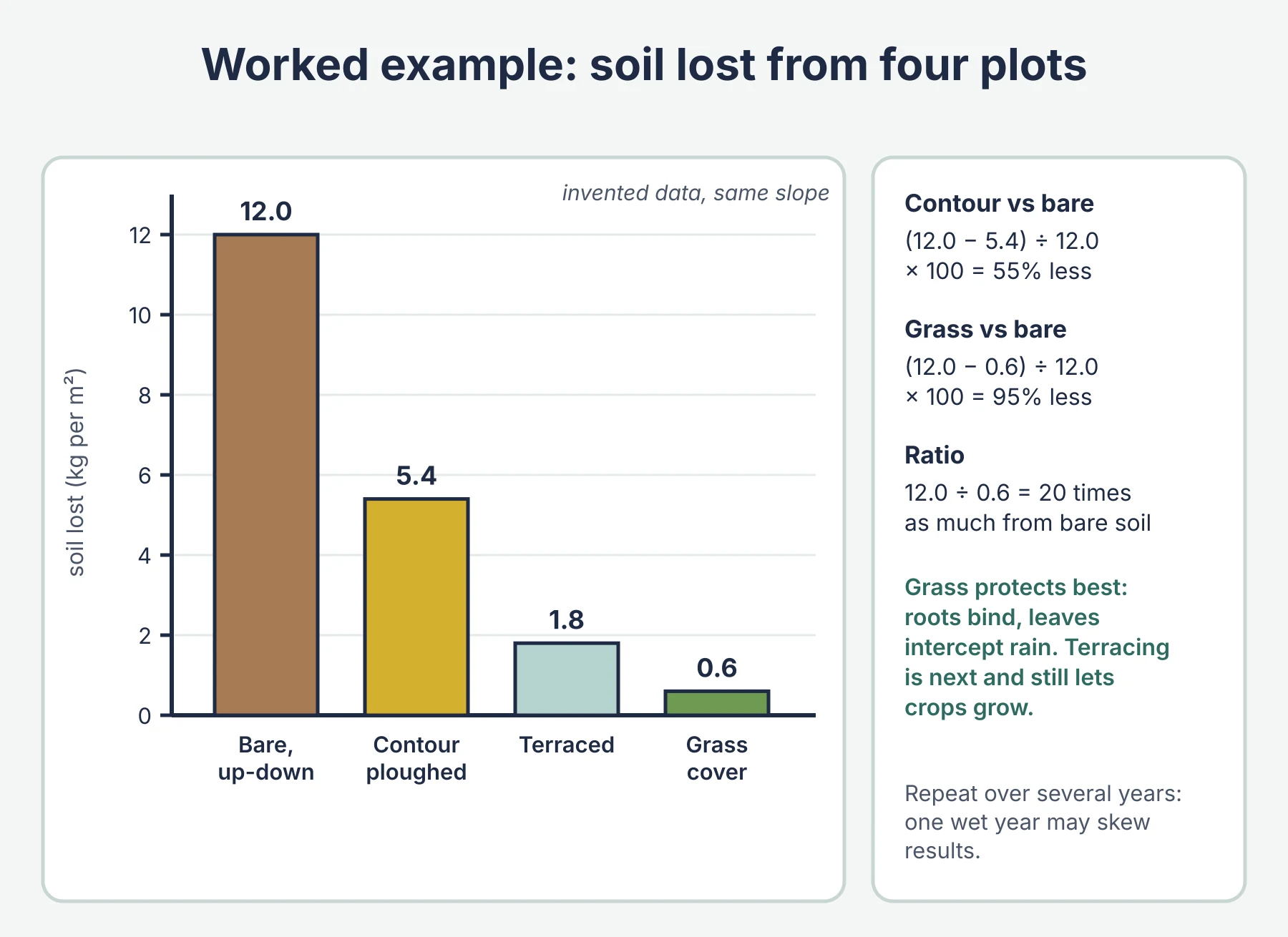
- Percentage reduction = (original − new) ÷ original × 100.
- How many times greater = larger ÷ smaller.
- Quick check: soil loss falls from 8.0 to 2.0 kg per m² → (8.0 − 2.0) ÷ 8.0 × 100 = 75% reduction; 8.0 ÷ 2.0 = 4 times less.
Key terms
| Term | Meaning |
|---|---|
| Topsoil | Upper layer of soil, richest in organic matter and nutrients |
| Surface run-off | Water flowing over the ground surface |
| Gully | Deep channel cut by concentrated run-off |
| Silting | Build-up of eroded sediment in rivers or reservoirs |
| Desertification | Land in dry areas becoming desert-like |
| Mass movement | Downhill movement of soil and rock under gravity |
| Contour | Line joining points of equal height |
Exam traps
- Erosion means removal, not damage.
- Contour ploughing goes across the slope, along contours.
- Wind breaks solve wind problems; terraces solve slope and water problems.
- Use the syllabus mechanism: “reduces surface run-off” earns the mark that “stops erosion” does not.
- Include human impacts: malnutrition, famine, displacement.
- Bunds work against both water and wind; wind breaks only against wind.
Self-test
- Define soil erosion.
- Why is losing topsoil so damaging?
- Describe how raindrops and run-off erode soil.
- What conditions favour wind erosion?
- Explain how deforestation causes soil erosion.
- How does soil erosion lead to flooding downstream?
- Name three types of mass movement in the syllabus.
- How does terracing reduce soil erosion?
- What is contour ploughing?
- Which strategy protects crops and reduces wind speed?
- How does adding organic matter reduce erosion?
- Soil loss on a plot falls from 15 to 3 kg per m² after vegetation is planted. Calculate the percentage reduction.
Answers
- The removal of soil, especially topsoil, by water or wind faster than new soil forms.
- It contains most of the organic matter, nutrients and soil organisms crops need.
- Raindrops knock particles loose; when rain cannot soak in, run-off flows over the surface and carries them away.
- Dry, loose, fine soil on flat, open land with strong winds and no vegetation.
- Without the canopy, more rain hits the ground and runs off; without roots, soil is not held together.
- Eroded soil is deposited in rivers, making channels shallower so they hold less water and overflow.
- Landslides, rockslides and mudslides.
- Flat steps reduce the movement of soil and surface run-off down the slope.
- Ploughing across a slope along lines of equal height, so furrows catch water and reduce run-off.
- Wind breaks.
- It improves soil structure, so particles stick together and resist being carried away.
- (15 − 3) ÷ 15 × 100 = 80%.
Where to go next
Practise with the Soil erosion practice questions, then review how erosion links to farming in the Food production and crop yield revision notes.
Related resources
-
Revision notes
Cambridge IGCSE Environmental Management: Land — Revision Notes
Recall notes on soils and crop growth, food production and soil erosion for Topic 2 Land of Cambridge IGCSE Environmental Management 0680, 2027-2029 series.
Environmental Management · Cambridge · IGCSE
Revise topic -
Study guides
Cambridge IGCSE Environmental Management (0680): Soils and crop growth
Soil composition, why particles, nutrients, pH, pore spaces and drainage matter, why loam suits crops, and growing conditions, for Cambridge IGCSE 0680.
Environmental Management · Cambridge · IGCSE
Read guide -
Practice questions
Cambridge IGCSE Environmental Management (0680): Soils and crop growth – Practice Questions
Original questions with answers on soil composition, nutrient ions, drainage data, waterlogging, seasons and photosynthesis graphs for Cambridge IGCSE 0680.
Environmental Management · Cambridge · IGCSE
Try questions
Get free revision emails (optional)
Occasional emails with practice questions, worked explanations and links to free resources for the qualification and subjects you choose. No spam, and you can unsubscribe from any email. The free tools on this site never need an email.