
Revision Notes
Cambridge IGCSE Physics (0625): Kinetic particle model of matter – Revision Notes
Revision notes for Cambridge IGCSE Physics 0625 section 2.1: states of matter, particles, Brownian motion, gas pressure, kelvin, pV = constant and a self-test.
- Subject
- Physics
- Level
- IGCSE
- Topic
- Thermal physics
- Author
- Marlbridge Academic Team
- Updated
- Reviewed by
- Iftikhar Azeemi (what this means)
Aligned to Cambridge IGCSE Physics (0625), For examination in 2026, 2027 and 2028. Official specification .
Syllabus page (what it covers and how it is assessed): Cambridge IGCSE Physics.
Syllabus points this page covers, with Core and Extended
0625
- 2.1 Kinetic particle model of matter · Core and Extended
"Core and Extended" means part of that syllabus point is Extended only. The page's own tier notes say which part.
Found an error? Report a correction.
Need help with this topic? Request a free trial class for IGCSE Physics (0625).
These notes condense section 2.1, Kinetic particle model of matter (2.1.1 to 2.1.3), of the Cambridge IGCSE Physics 0625 syllabus for examination in 2026, 2027 and 2028. Supplement content, marked Extended only, is examined on Papers 2 and 4. Full explanations and worked examples are in the study guide on the kinetic particle model of matter; the Thermal physics revision notes cover the whole of Topic 2.
States of matter
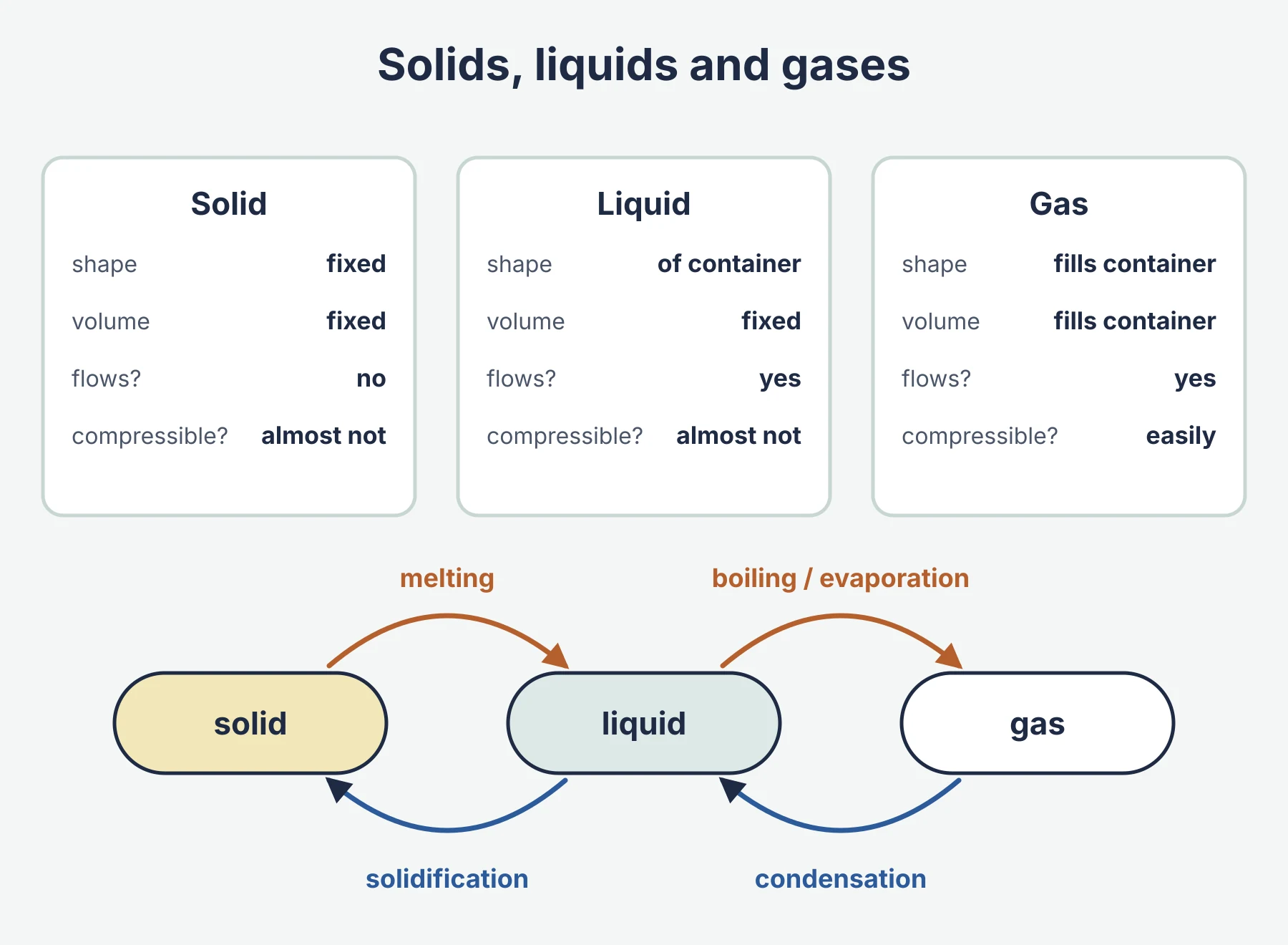
| Solid | Liquid | Gas | |
|---|---|---|---|
| Shape | fixed | shape of container | fills container |
| Volume | fixed | fixed | fills container |
| Flows? | no | yes | yes |
| Compresses? | hardly | hardly | easily |
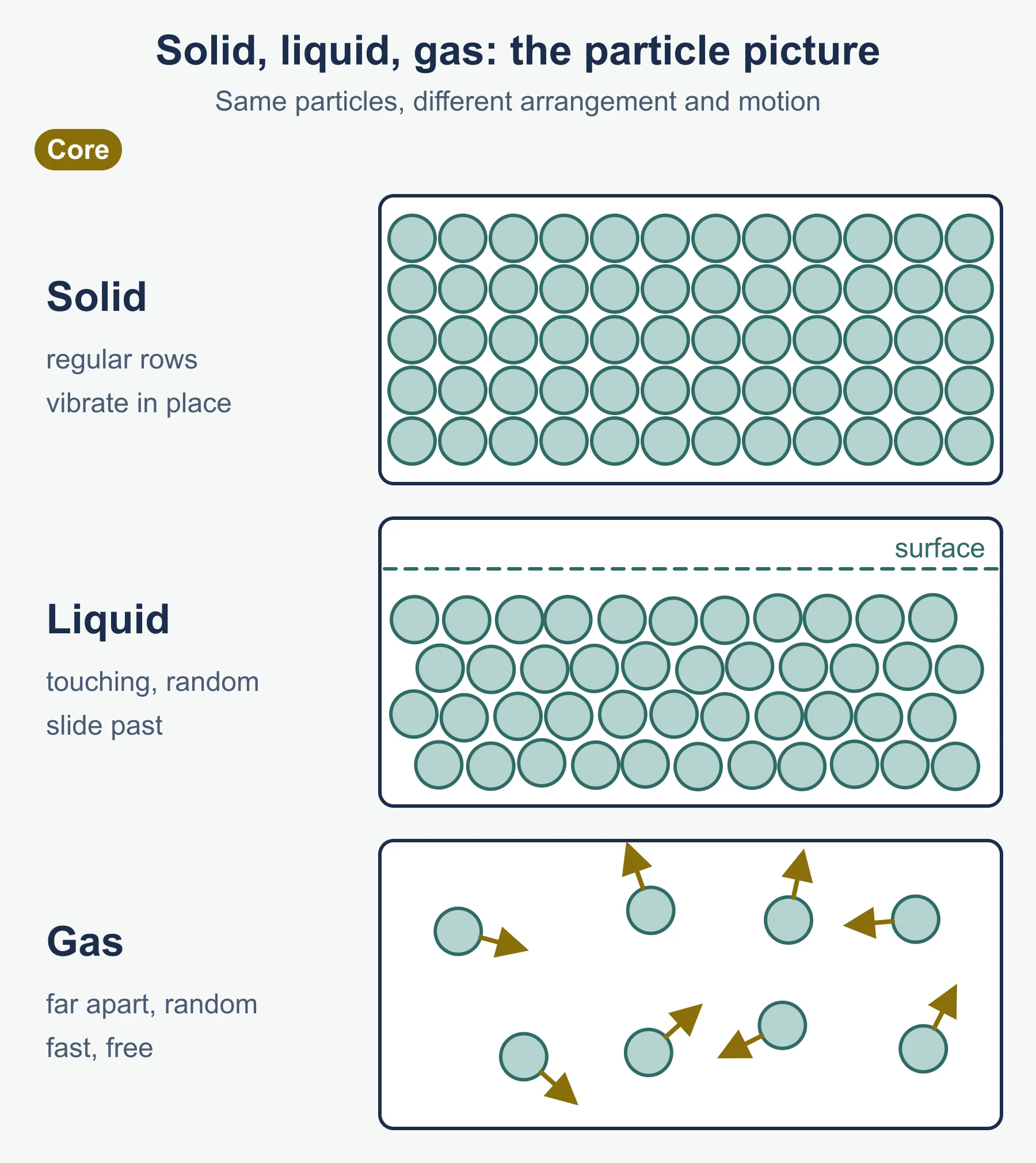
| Arrangement | regular | irregular | random |
| Separation | very close | close | far apart |
| Motion | vibrate about fixed positions | slide past each other | fast, random, straight lines between collisions |
Changes of state: melting (s → l); solidification or freezing (l → s); boiling and evaporation (l → g); condensation (g → l).
Temperature
- Higher temperature → particles move faster on average.
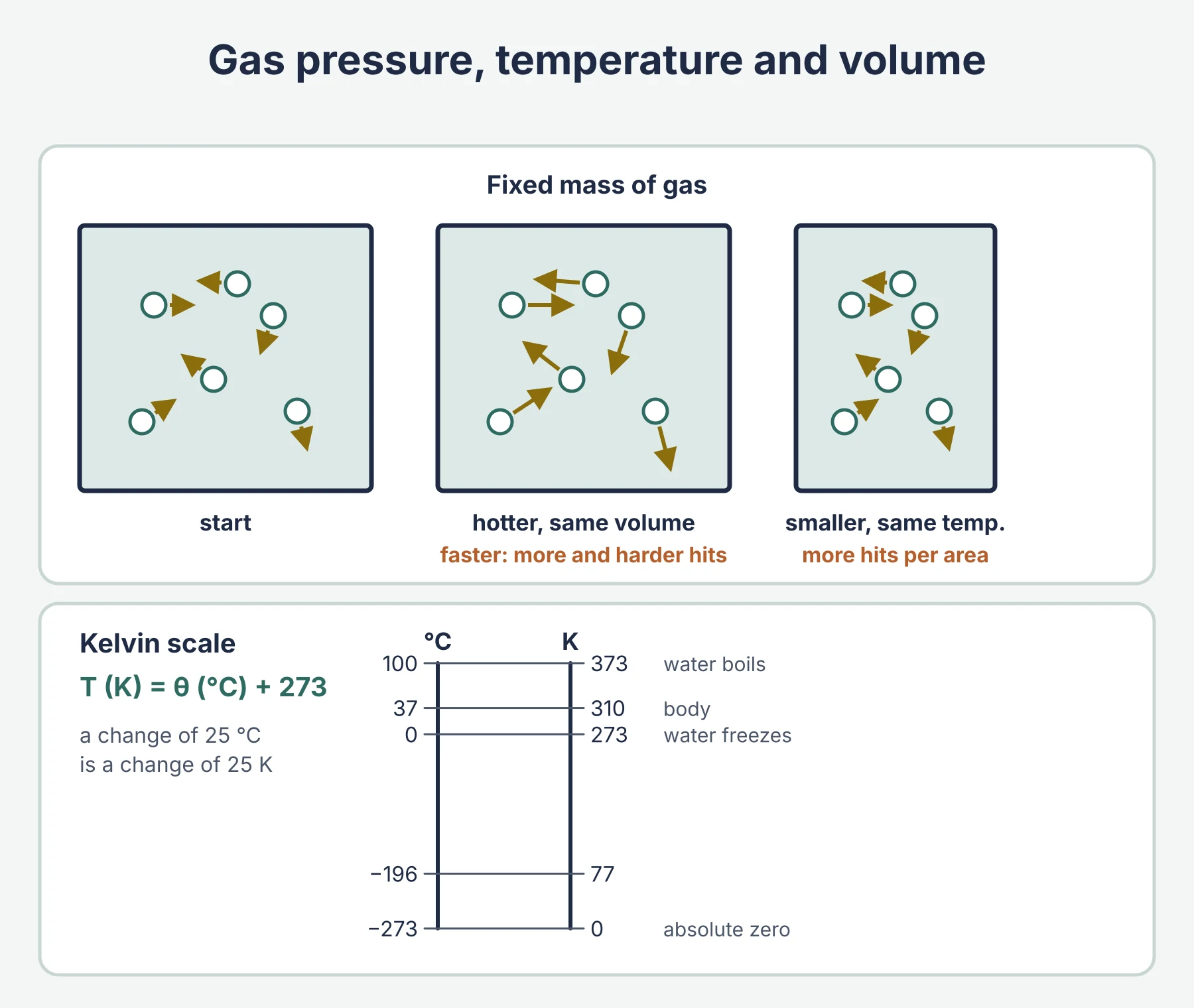
- Absolute zero = −273 °C = 0 K: particles have the least kinetic energy.
- T (K) = θ (°C) + 273.
- A change of 1 °C = a change of 1 K.
Forces between particles (Extended only)
- Particles (atoms, molecules, ions, electrons) attract strongly when close.
- Solid: strong forces, fixed positions.
- Liquid: forces keep particles close but cannot hold them in place.
- Gas: particles far apart, forces very weak; particles move freely.
Gas pressure
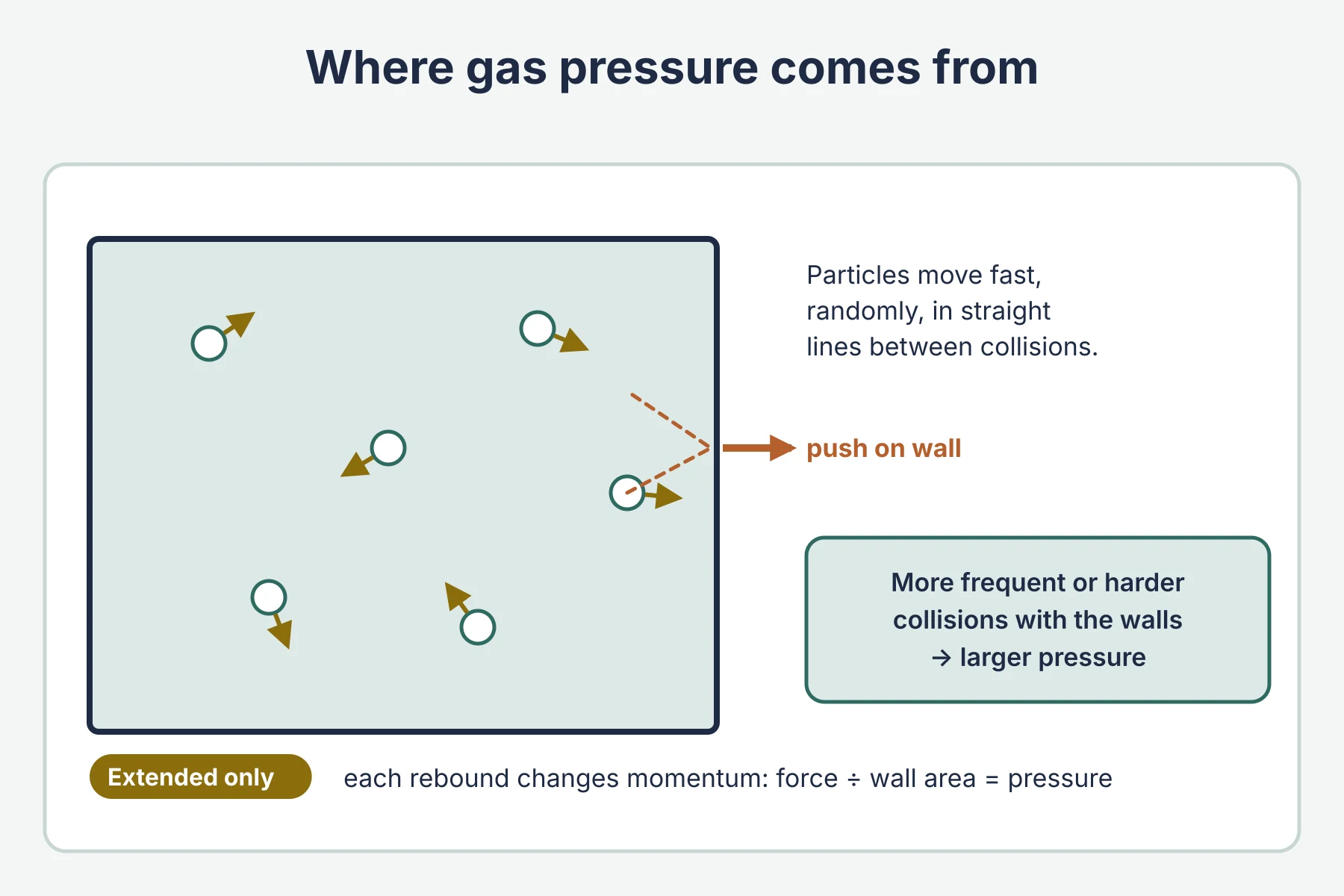
- Core: gas particles collide with the container walls; the collisions cause the pressure.
- Extended only: each collision exerts a force on the wall; pressure = total force ÷ area of wall (force per unit area).
| Change (fixed mass of gas) | Particle explanation | Pressure |
|---|---|---|
| temperature up, volume constant | faster particles; more frequent, harder collisions | increases |
| temperature down, volume constant | slower particles; fewer, gentler collisions | decreases |
| volume down, temperature constant | same speeds, less space; more collisions per unit area per second | increases |
| volume up, temperature constant | fewer collisions per unit area per second | decreases |
Brownian motion
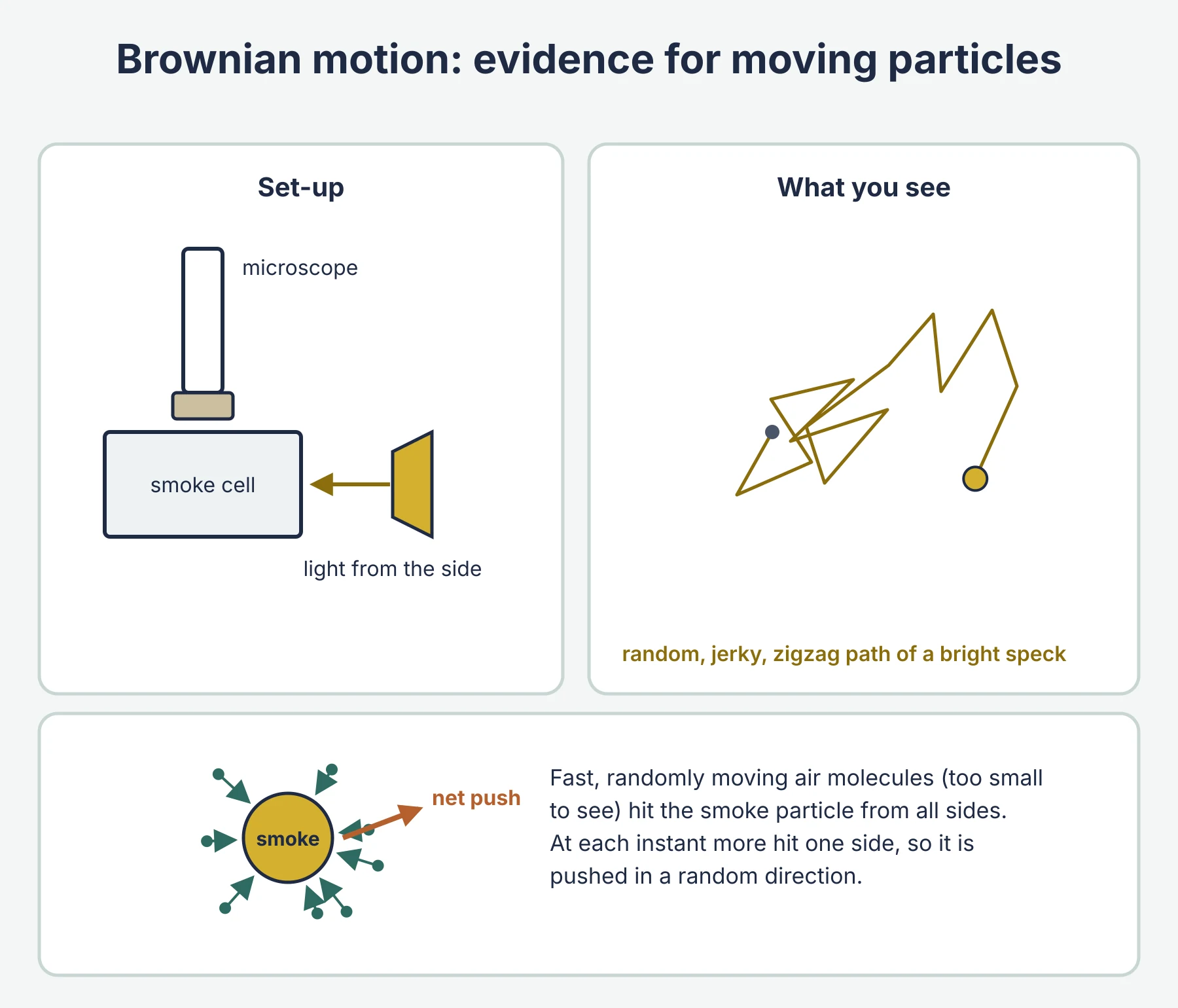
- Seen: smoke particles in air (lit, viewed with a microscope) move randomly and jerkily, in a zigzag.
- Cause: random collisions with fast-moving air molecules, unequal from different sides.
- Shows: evidence for the kinetic particle model (the air is made of moving particles).
- (Extended only) Smoke specks are microscopic particles; air consists of molecules. Light, fast molecules can move a much more massive particle.
pV = constant (Extended only)
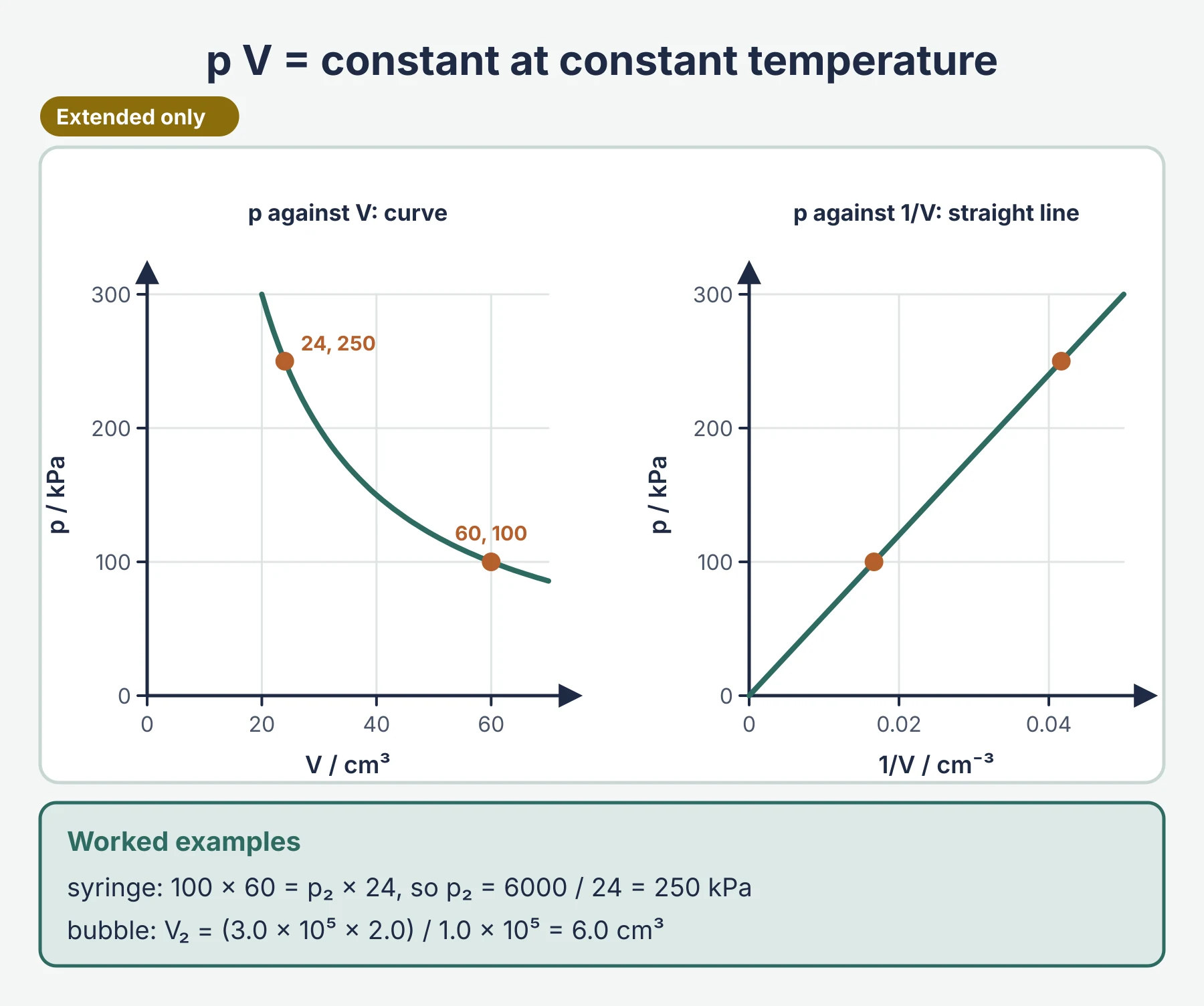
- Fixed mass of gas, constant temperature.
- p₁V₁ = p₂V₂.
- Halve the volume → double the pressure.
- p against V: curve (falling, flattening). p against 1/V: straight line through the origin.
- Check data: p × V should be the same for every pair.
Key terms
| Term | Meaning |
|---|---|
| Kinetic particle model | Matter is made of tiny particles in constant motion |
| Absolute zero | −273 °C (0 K), lowest possible temperature, particles have least kinetic energy |
| Kelvin (K) | Unit of the absolute temperature scale |
| Brownian motion | Random motion of microscopic particles in a liquid or gas |
| Suspension | Microscopic particles spread through a liquid or gas |
| Gas pressure | Force per unit area from particles colliding with a surface |
| Condensation | Gas to liquid |
| Solidification | Liquid to solid |
Exam traps
- Particles do not expand, melt or get hot themselves; they move faster.
- Gas pressure comes from collisions with the walls, not with each other.
- Kelvin to Celsius: subtract 273.
- Particle diagrams: same-size particles; liquid particles mostly touching.
- “Smoke particles move because they are hot” or “because of convection”: wrong.
- (Extended) pV = constant only at constant temperature.
- (Extended) “Smoke molecules”: they are microscopic particles.
Quick self-test
- Give two properties of a gas that a liquid does not have.
- Describe the motion of particles in a solid.
- State what happens to the motion of particles when a gas is heated.
- State the value of absolute zero in °C.
- Convert 27 °C into kelvin.
- Convert 250 K into °C.
- Explain, in terms of particles, how a gas exerts a pressure.
- In a smoke cell, what is seen through the microscope?
- Explain why a sealed can of gas bursts if it is heated strongly.
- (Extended) A gas at 120 kPa has a volume of 300 cm³. It is compressed at constant temperature to 200 cm³. Find the new pressure.
- (Extended) Explain why tiny air molecules can move a much larger smoke particle.
- (Extended) Describe the graph of p against 1/V for a fixed mass of gas at constant temperature.
Answers
- Any two: it fills its container; it has no fixed volume; it is easily compressed.
- They vibrate about fixed positions.
- The particles move faster (more kinetic energy).
- −273 °C.
- 27 + 273 = 300 K.
- 250 − 273 = −23 °C.
- Particles collide with the walls; each collision pushes on the wall; many collisions per second give the pressure.
- Small bright specks moving randomly and jerkily.
- Particles move faster, hit the walls more often and harder, so the pressure rises until the can bursts.
- 120 × 300 = p₂ × 200, so p₂ = 180 kPa.
- The air molecules are light but move very fast, and many hit the particle; unequal numbers of collisions on different sides push it.
- A straight line through the origin.
Where to go next
Try the practice questions on the kinetic particle model of matter, then continue with the revision notes on thermal properties and temperature.
Related resources
-
Study guides
Cambridge IGCSE Physics (0625): Thermal properties and temperature
Study guide to Cambridge IGCSE Physics 0625 section 2.2: thermal expansion, specific heat capacity, melting, boiling and evaporation, with worked examples.
Physics · Cambridge · IGCSE
Read guide -
Practice questions
Cambridge IGCSE Physics (0625): Thermal properties and temperature – Practice Questions
Twelve original Cambridge IGCSE Physics 0625 questions on thermal expansion, specific heat capacity, melting, boiling and evaporation, with full answers.
Physics · Cambridge · IGCSE
Try questions -
Revision notes
Cambridge IGCSE Physics (0625): Thermal properties and temperature – Revision Notes
Revision notes for Cambridge IGCSE Physics 0625 section 2.2: thermal expansion, specific heat capacity, melting, boiling and evaporation, with a self-test.
Physics · Cambridge · IGCSE
Revise topic
Related articles
Get free revision emails (optional)
Occasional emails with practice questions, worked explanations and links to free resources for the qualification and subjects you choose. No spam, and you can unsubscribe from any email. The free tools on this site never need an email.