
Revision Notes
Cambridge IGCSE Physics (0625): Thermal properties and temperature – Revision Notes
Revision notes for Cambridge IGCSE Physics 0625 section 2.2: thermal expansion, specific heat capacity, melting, boiling and evaporation, with a self-test.
- Subject
- Physics
- Level
- IGCSE
- Topic
- Thermal physics
- Author
- Marlbridge Academic Team
- Updated
- Reviewed by
- Iftikhar Azeemi (what this means)
Aligned to Cambridge IGCSE Physics (0625), For examination in 2026, 2027 and 2028. Official specification .
Syllabus page (what it covers and how it is assessed): Cambridge IGCSE Physics.
Syllabus points this page covers, with Core and Extended
0625
- 2.2 Thermal properties and temperature · Core and Extended
"Core and Extended" means part of that syllabus point is Extended only. The page's own tier notes say which part.
Found an error? Report a correction.
Need help with this topic? Request a free trial class for IGCSE Physics (0625).
These notes condense section 2.2, Thermal properties and temperature (2.2.1 to 2.2.3), of the Cambridge IGCSE Physics 0625 syllabus for examination in 2026, 2027 and 2028. Supplement content, marked Extended only, is examined on Papers 2 and 4. Explanations, the liquid experiment and worked examples are in the study guide on thermal properties and temperature; the Thermal physics revision notes cover the whole of Topic 2.
Thermal expansion (2.2.1)
- Heating at constant pressure → expansion; cooling → contraction.
- Mass unchanged, volume up → density down.
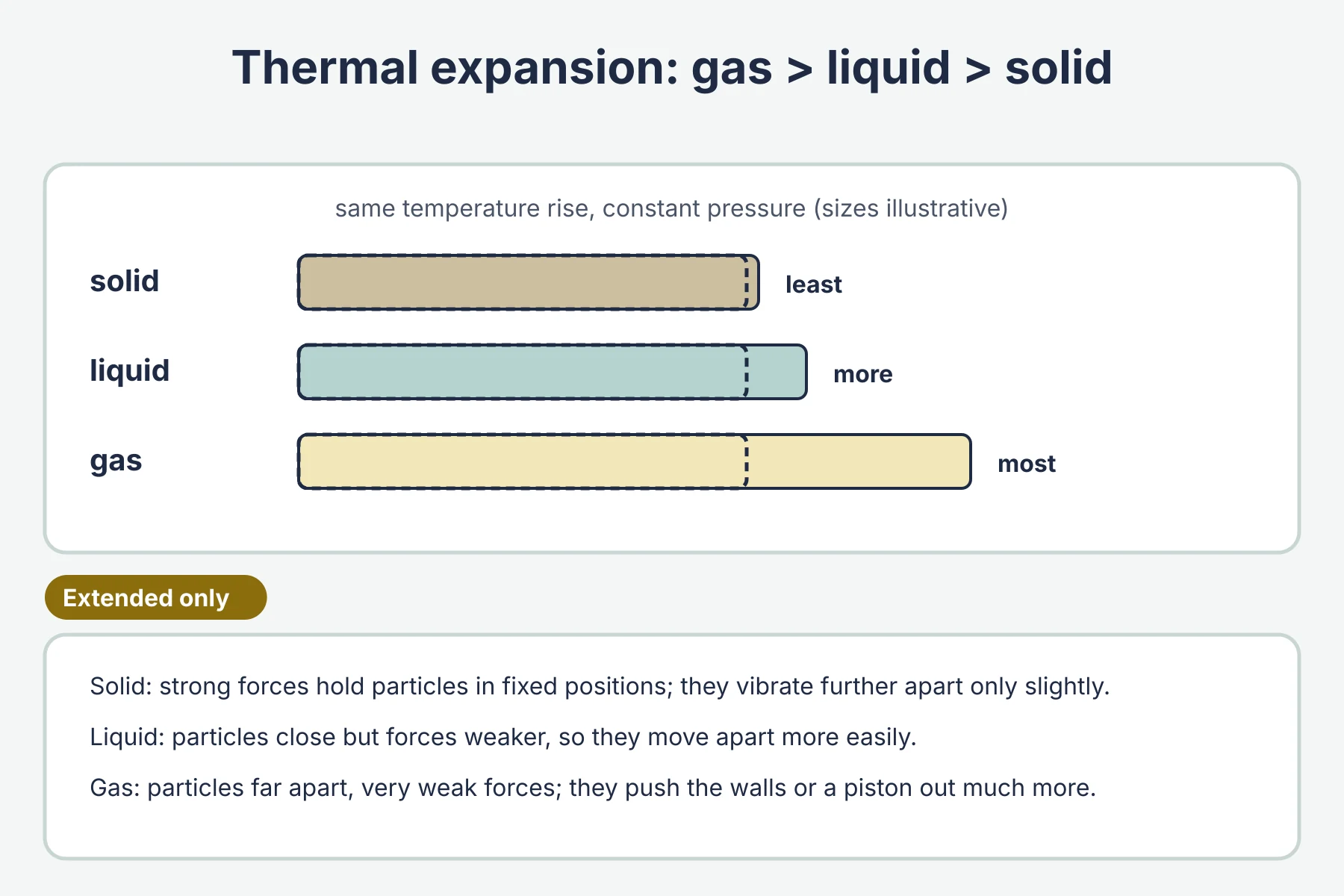
- Order for the same temperature rise: gas > liquid > solid.
(Extended only) Why that order
| State | Forces between particles | Effect of heating | Expansion |
|---|---|---|---|
| solid | strong; fixed positions | larger vibrations, slightly further apart | smallest |
| liquid | weaker; particles close but mobile | particles move apart more easily | medium |
| gas | very weak; particles far apart | faster particles push the boundary outwards | largest |
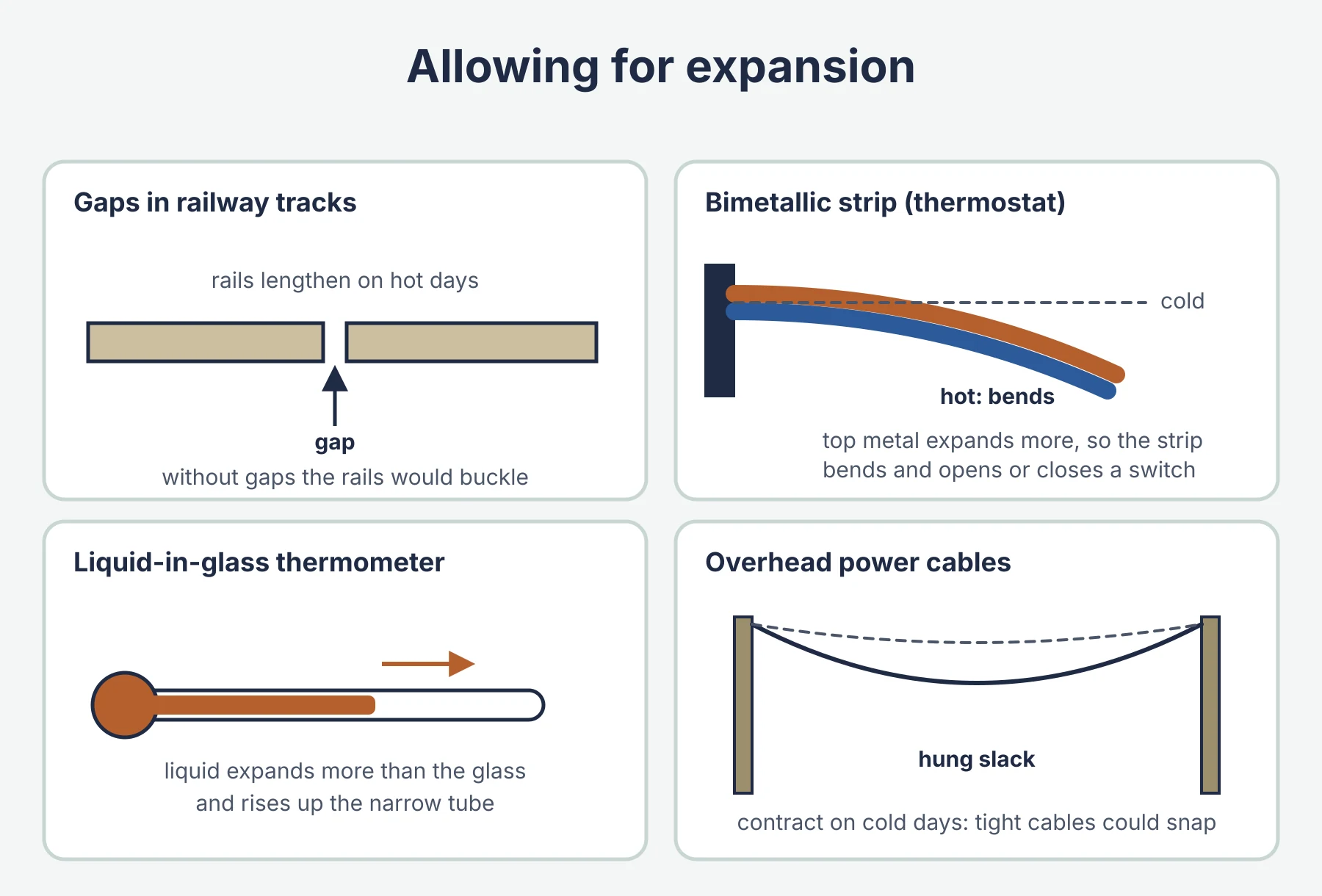
Applications and consequences: liquid-in-glass thermometers; gaps in railway lines; expansion joints in bridges; slack overhead cables; bimetallic strips in thermostats; loosening metal lids with hot water; thick glass cracking when hot liquid is poured in.
Specific heat capacity (2.2.2)
- Core: temperature rise → internal energy increases.
- (Extended only) Temperature rise = increase in the average kinetic energy of all the particles.
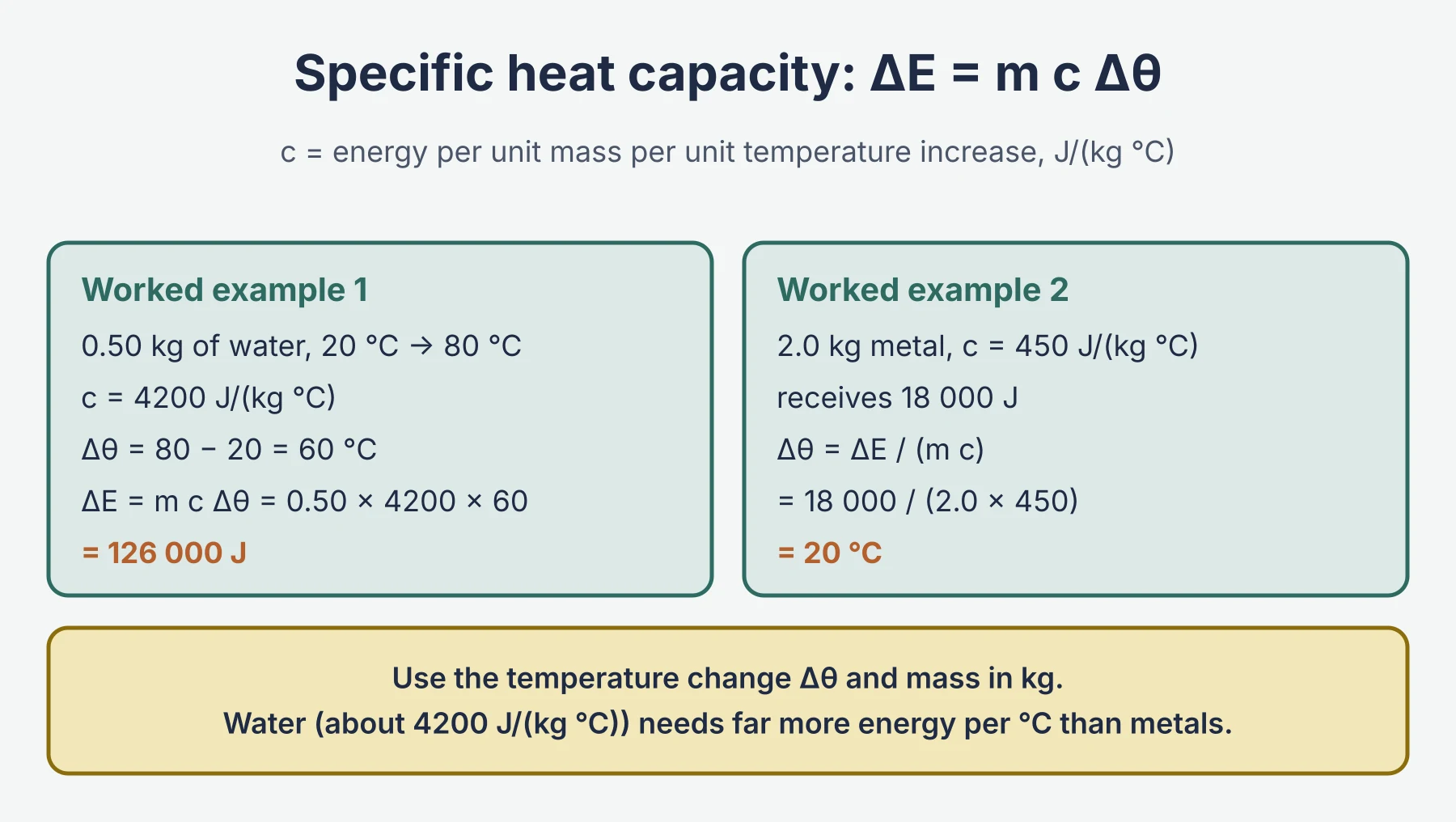
- (Extended only) Specific heat capacity: energy required per unit mass per unit temperature increase.
| Equation (Extended only) | Units |
|---|---|
| c = ΔE / (m Δθ) | J/(kg °C) |
| ΔE = m c Δθ | J |
| Δθ = ΔE / (m c) | °C |
- Water: c ≈ 4200 J/(kg °C), high, so it warms and cools slowly.
- Metals: much lower c, so they heat up quickly.
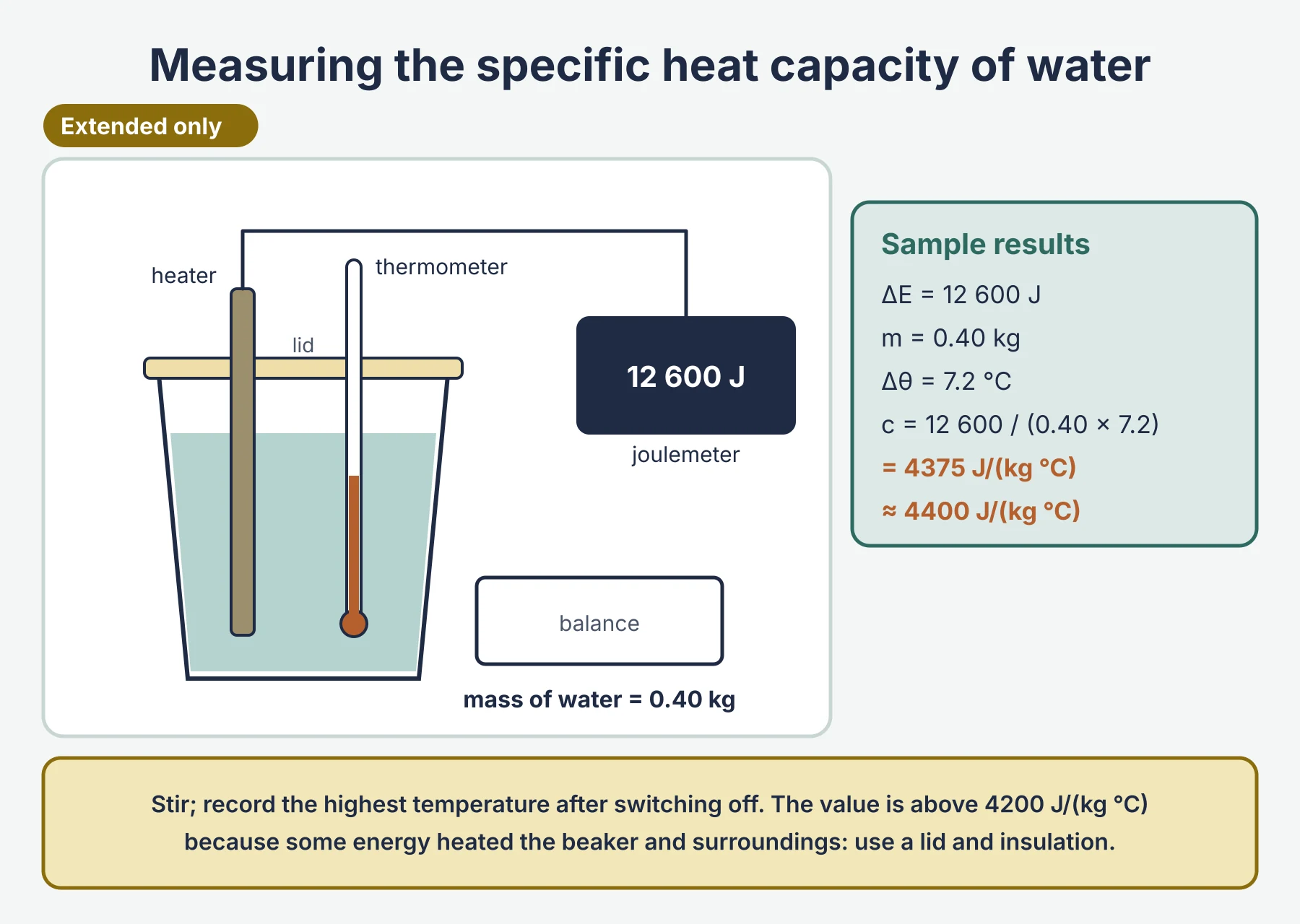
(Extended only) Experiment checklist
- Mass by balance (subtract the container for a liquid).
- Energy by joulemeter, or E = IVt (ammeter, voltmeter, stopwatch).
- Starting temperature, then the highest temperature after switching off.
- Insulate; use a lid; stir liquids; oil in the thermometer hole of a solid block.
- Measured c is usually too high, because energy is lost to the surroundings and the container.
Melting, boiling and evaporation (2.2.3)
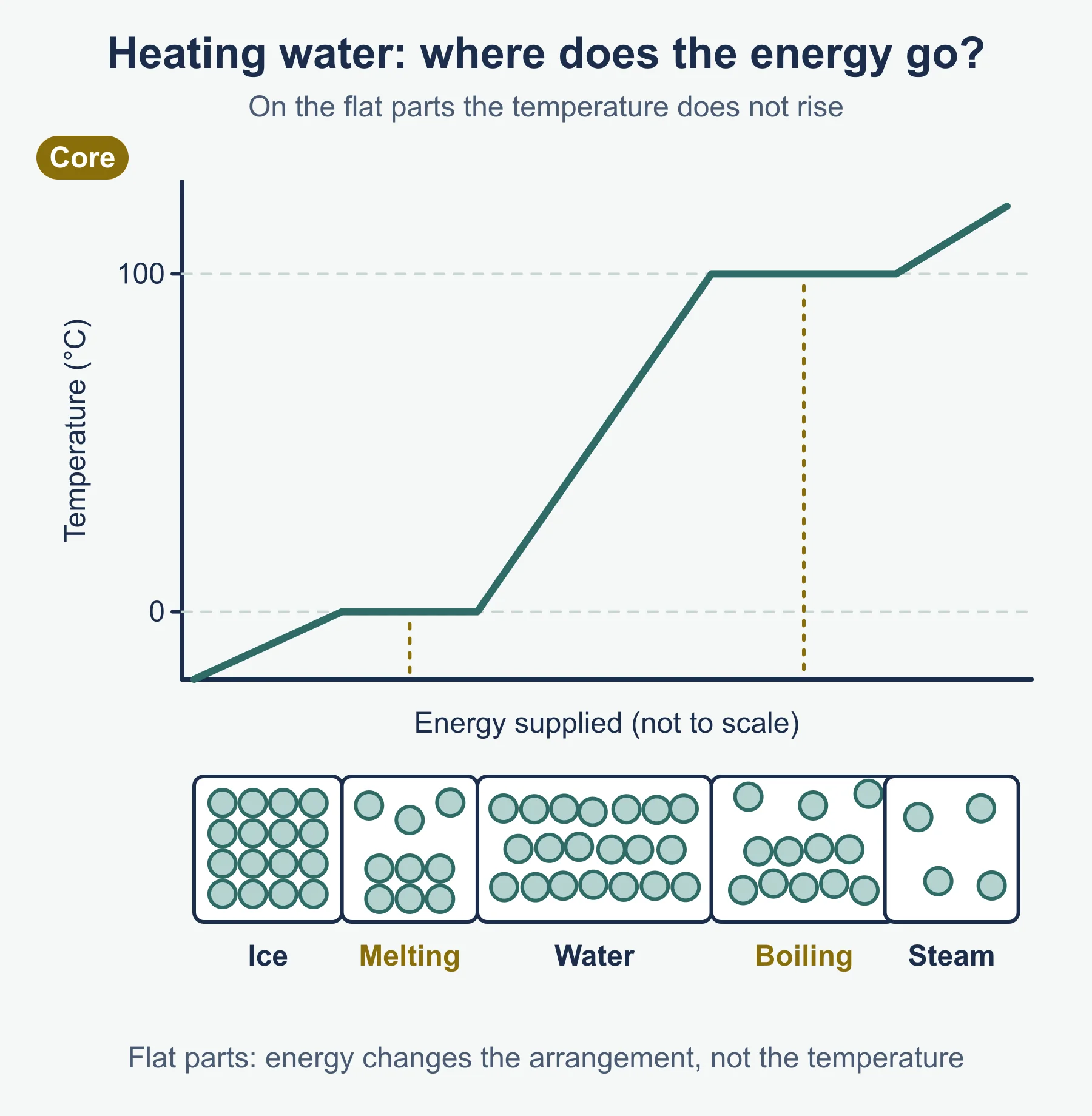
- Melting and boiling: energy supplied, temperature constant until the change is complete.
- Water at standard atmospheric pressure: melts at 0 °C, boils at 100 °C.
- Condensation: gas particles slow and come together to form a liquid. Solidification: liquid particles settle into fixed positions.
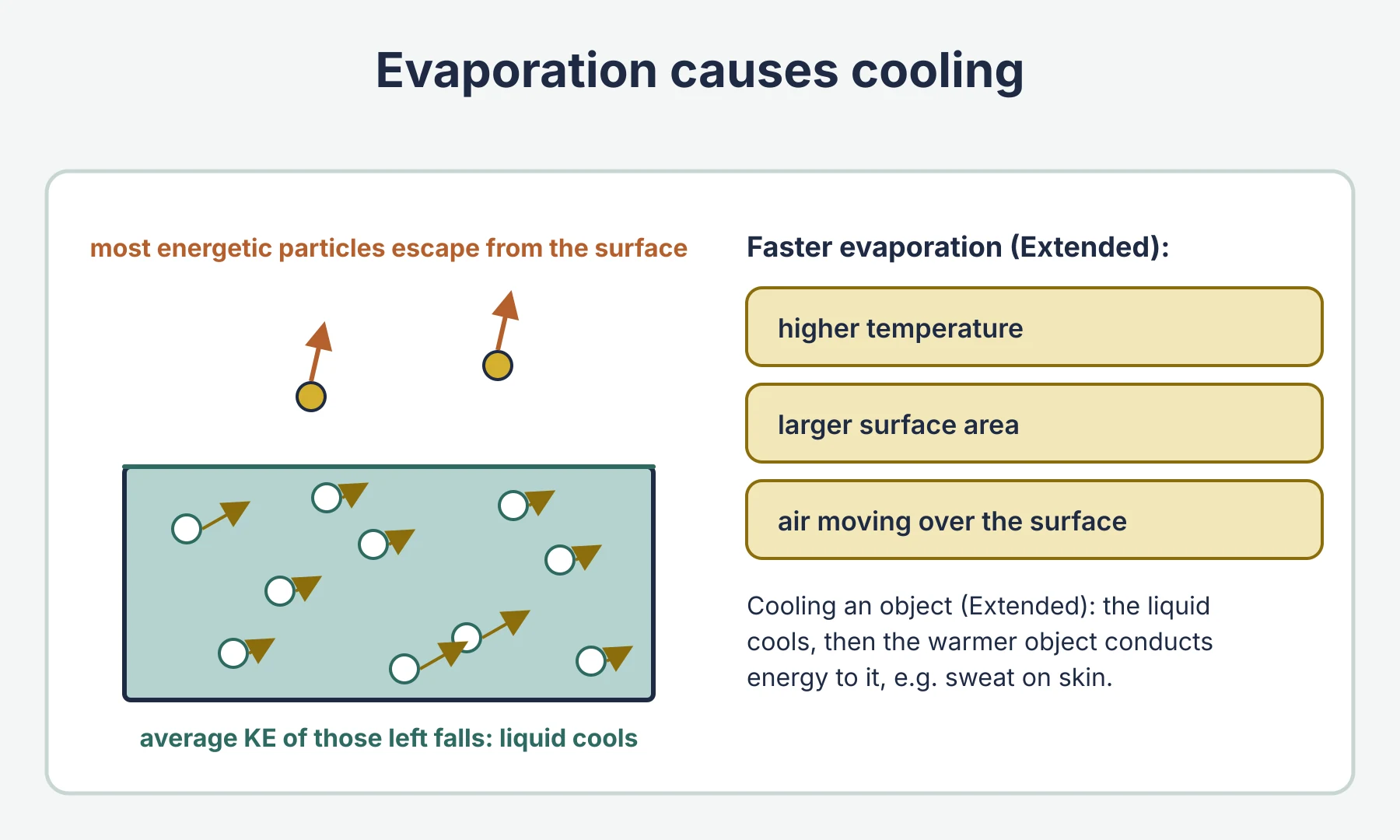
- Evaporation: more-energetic particles escape from the surface of a liquid.
- Evaporation causes cooling: the average kinetic energy of the remaining particles falls.
(Extended only) Boiling vs evaporation
| Evaporation | Boiling | |
|---|---|---|
| where | surface only | throughout, with bubbles |
| temperature | any | boiling point only |
| energy | from the liquid (it cools) | supplied by heating |
(Extended only) Faster evaporation: higher temperature; larger surface area; more air movement.
(Extended only) Cooling by contact: the evaporating liquid cools, then energy flows from the warmer object into the liquid, so the object cools (sweating, wet cloth on a bottle).
Key terms
| Term | Meaning |
|---|---|
| Thermal expansion | Increase in size of a substance when its temperature rises |
| Internal energy | Total energy of the particles of an object |
| Specific heat capacity (Extended) | Energy required per unit mass per unit temperature increase |
| Melting point | Temperature at which a solid melts (0 °C for water) |
| Boiling point | Temperature at which a liquid boils (100 °C for water) |
| Evaporation | Escape of more-energetic particles from the surface of a liquid |
| Bimetallic strip | Two metals bonded together that bend when heated because they expand by different amounts |
Exam traps
- Particles do not expand; the gaps between them grow.
- Δθ is a temperature change; subtract first.
- Masses in kg in ΔE = mcΔθ (250 g = 0.250 kg).
- The temperature does not rise during melting or boiling.
- Evaporation happens at any temperature, not only at the boiling point.
- “Evaporation cools because the liquid loses heat”: say the most energetic particles escape, so the average kinetic energy of those left falls.
- (Extended) A measured c above the true value is due to energy losses, not “human error”.
Quick self-test
- Which expands most for the same temperature rise: a solid, a liquid or a gas?
- Why are gaps left between sections of railway track?
- Explain how a liquid-in-glass thermometer works.
- State what happens to the internal energy of an object when its temperature rises.
- State the melting and boiling points of water at standard atmospheric pressure.
- What happens to the temperature of water while it is boiling?
- Explain why evaporation cools a liquid.
- (Extended) Define specific heat capacity.
- (Extended) Find the energy needed to raise the temperature of 2.0 kg of water by 15 °C (c = 4200 J/(kg °C)).
- (Extended) 9000 J raises the temperature of 0.50 kg of a metal by 40 °C. Find c.
- (Extended) Give two differences between boiling and evaporation.
- (Extended) Give three ways to make a puddle evaporate faster.
Answers
- A gas.
- The rails expand on hot days; the gaps stop them buckling.
- The liquid expands more than the glass when heated, so it rises up the narrow tube; the length of liquid shows the temperature.
- It increases.
- 0 °C and 100 °C.
- It stays constant (100 °C) while energy is supplied.
- The more-energetic particles escape, so the average kinetic energy of the remaining particles falls.
- The energy required per unit mass per unit temperature increase.
- 2.0 × 4200 × 15 = 126 000 J.
- 9000 ÷ (0.50 × 40) = 450 J/(kg °C).
- Any two: evaporation at the surface, boiling throughout; evaporation at any temperature, boiling only at the boiling point; evaporation cools the liquid, boiling needs energy supplied.
- Warm it, spread it out (larger surface area), and blow air over it.
Where to go next
Try the practice questions on thermal properties and temperature, then move on to the revision notes on transfer of thermal energy.
Related resources
-
Study guides
Cambridge IGCSE Physics (0625): Transfer of thermal energy
Study guide to Cambridge IGCSE Physics 0625 section 2.3: conduction, convection and infrared radiation, their experiments, radiation balance and applications.
Physics · Cambridge · IGCSE
Read guide -
Practice questions
Cambridge IGCSE Physics (0625): Transfer of thermal energy – Practice Questions
Twelve original Cambridge IGCSE Physics 0625 questions on conduction, convection, infrared radiation, energy balance and applications, with full answers.
Physics · Cambridge · IGCSE
Try questions -
Revision notes
Cambridge IGCSE Physics (0625): Transfer of thermal energy – Revision Notes
Revision notes for Cambridge IGCSE Physics 0625 section 2.3: conduction, convection, infrared radiation, energy balance and applications, with a self-test.
Physics · Cambridge · IGCSE
Revise topic
Related articles
Get free revision emails (optional)
Occasional emails with practice questions, worked explanations and links to free resources for the qualification and subjects you choose. No spam, and you can unsubscribe from any email. The free tools on this site never need an email.