
Study Guides
Cambridge IGCSE Physics (0625): Transfer of thermal energy
Study guide to Cambridge IGCSE Physics 0625 section 2.3: conduction, convection and infrared radiation, their experiments, radiation balance and applications.
- Subject
- Physics
- Level
- IGCSE
- Topic
- Thermal physics
- Author
- Marlbridge Academic Team
- Updated
- Reviewed by
- Iftikhar Azeemi (what this means)
Aligned to Cambridge IGCSE Physics (0625), For examination in 2026, 2027 and 2028. Official specification .
Syllabus page (what it covers and how it is assessed): Cambridge IGCSE Physics.
Syllabus points this page covers, with Core and Extended
0625
- 2.3 Transfer of thermal energy · Core and Extended
"Core and Extended" means part of that syllabus point is Extended only. The page's own tier notes say which part.
Found an error? Report a correction.
Need help with this topic? Request a free trial class for IGCSE Physics (0625).
This guide teaches section 2.3, Transfer of thermal energy, of the Cambridge IGCSE Physics 0625 syllabus for examination in 2026, 2027 and 2028, in its four parts: 2.3.1 Conduction, 2.3.2 Convection, 2.3.3 Radiation and 2.3.4 Consequences of thermal energy transfer. Supplement content is examined only on Papers 2 and 4 and is labelled Extended only. The Thermal physics study guide already describes the rods-and-wax conduction test, the coloured-crystal convection test, the emitter and absorber experiments, the Earth’s radiation balance, a fire and a car radiator. This page gives different experiments for the same ideas, the particle explanations and model answers.
What the syllabus asks for
| Part | Core | Extended only |
|---|---|---|
| 2.3.1 Conduction | Experiments showing good and bad thermal conductors (insulators) | Lattice vibrations in all solids; free (delocalised) electrons in metals; why conduction is bad in gases and most liquids; many solids lie between good conductors and insulators |
| 2.3.2 Convection | Convection is important in liquids and gases; explain it by density changes; describe experiments | – |
| 2.3.3 Radiation | Thermal radiation is infrared; all objects emit it; no medium needed; effect of colour (black or white) and texture (dull or shiny) on emission, absorption and reflection | Constant temperature needs equal rates in and out; what happens if they differ; the Earth’s temperature; experiments on emitters and absorbers; rate of emission depends on surface temperature and area |
| 2.3.4 Consequences | Everyday applications, including heating pans and heating a room by convection | Complex applications with more than one transfer, including a fire and a car radiator |
Conduction (2.3.1)
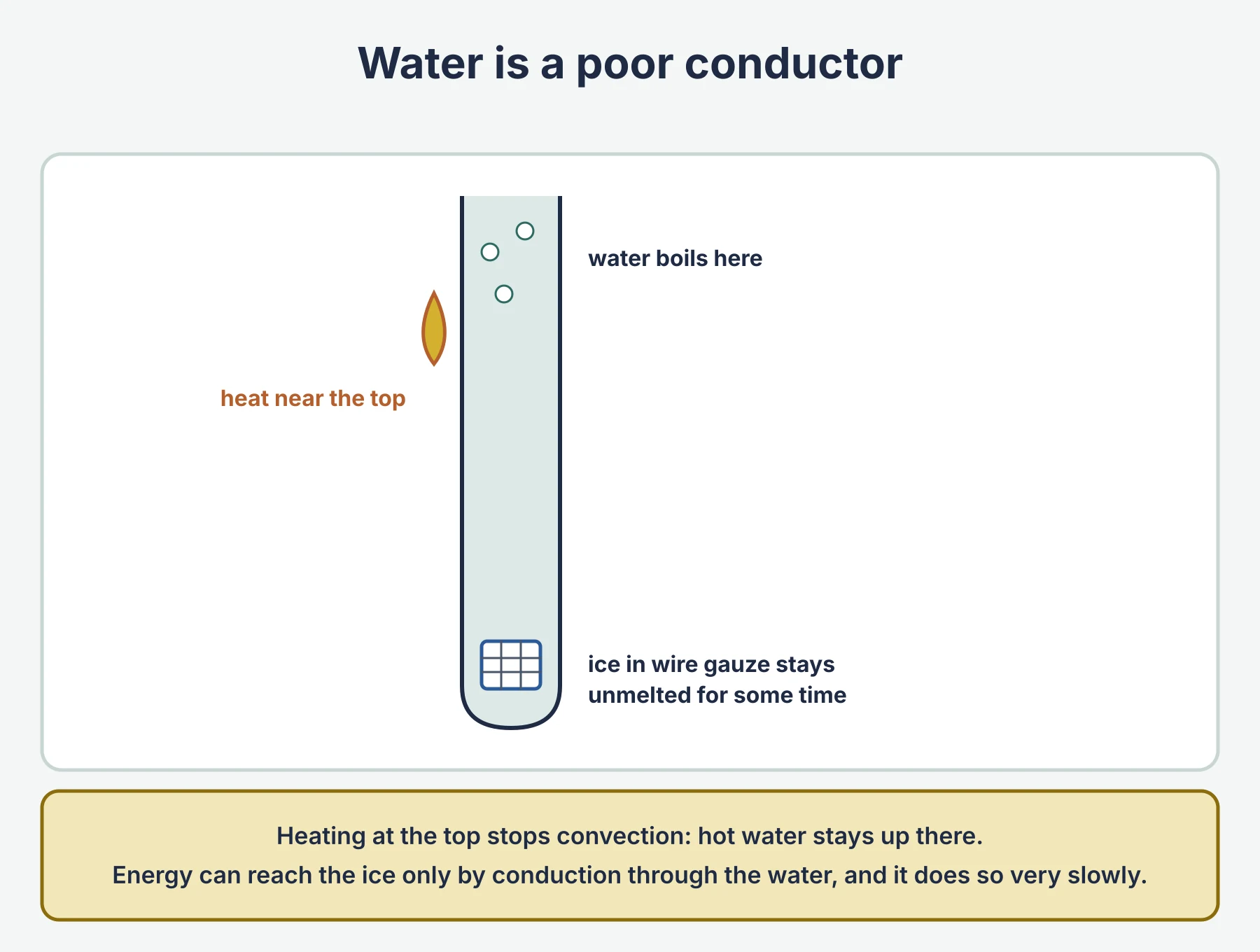
Core experiment: water is a poor conductor. Wrap a small piece of ice in wire gauze so it sinks, and drop it to the bottom of a test tube of cold water. Heat the tube gently near the top. The water at the top boils while the ice at the bottom stays unmelted for some time. Heating at the top prevents convection (hot water stays at the top), so the only way energy could reach the ice is by conduction through the water, and it does so very slowly.
Core experiment: paper and two metals. Wrap a strip of paper tightly round a rod made half of wood and half of brass, joined end to end, and pass it briefly through a flame. The paper over the wood scorches; the paper over the brass does not. The brass conducts energy away from the paper quickly, so the paper there stays below the temperature at which it burns.
Good thermal conductors: metals (copper, aluminium, iron). Bad conductors (thermal insulators): plastic, wood, wool, air, water.
The particle explanation (Extended only)
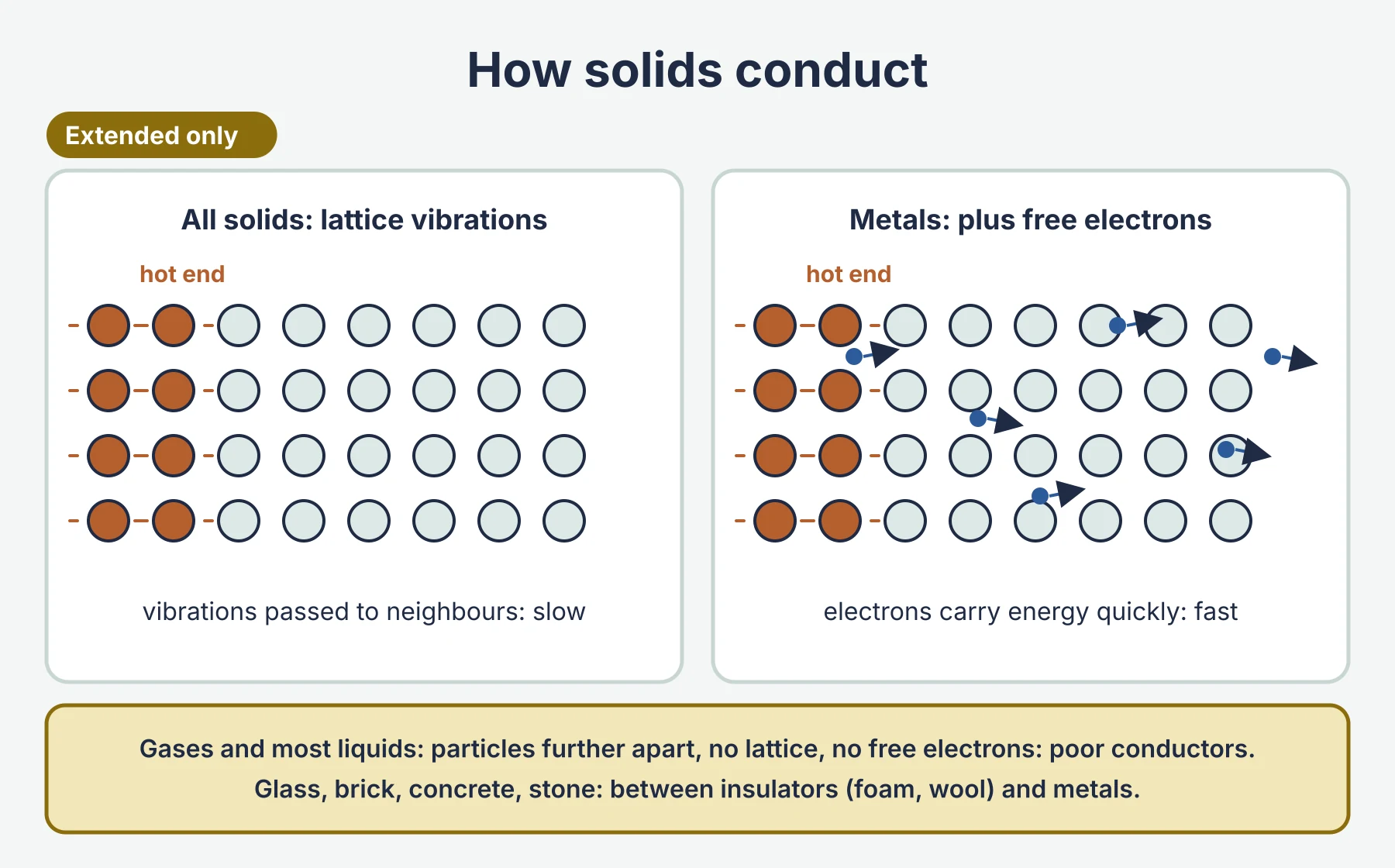
- All solids: when one end is heated, its particles vibrate with more energy. Because the particles are bonded in a lattice, they pass the vibrations on to their neighbours, and energy moves along: lattice vibrations. This is slow.
- Metals: in addition, metals have free (delocalised) electrons that move through the whole lattice. Electrons in the hot region gain kinetic energy, travel quickly to colder regions and transfer energy in collisions there. This is much faster, which is why metals are the best conductors (and also conduct electricity).
- Gases and most liquids: the particles are further apart (very far apart in a gas), so energy is passed on only when particles happen to collide, and there is no lattice and no free electrons. Conduction is therefore bad.
- In between: many solids, such as glass, brick, concrete and stone, conduct better than thermal insulators like foam and wool but much less well than metals.
Convection (2.3.2)
Convection is the main way thermal energy moves through liquids and gases. It cannot happen in solids, because the particles cannot move from place to place.
Explanation by density changes.
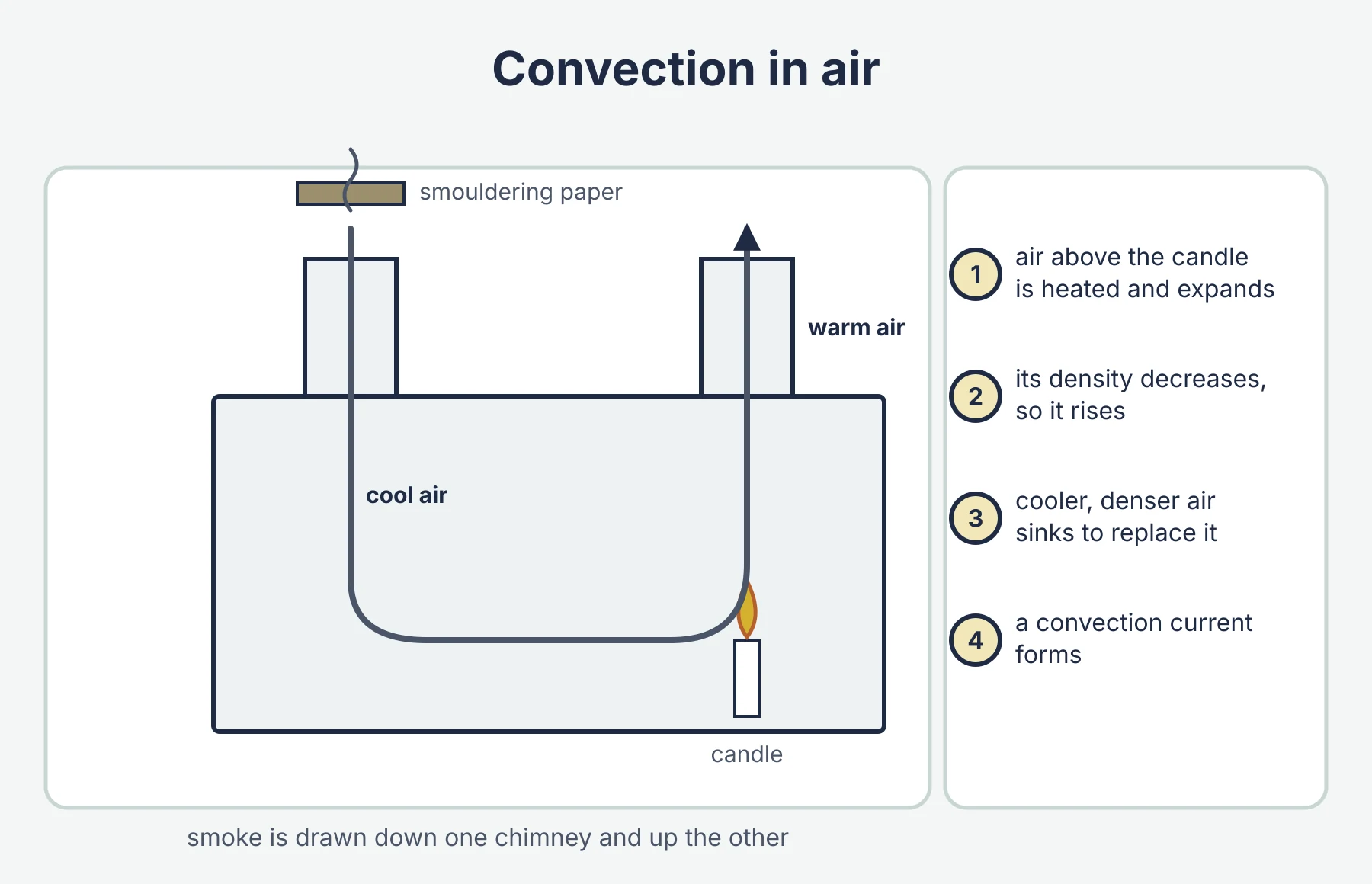
- Fluid near the heat source is heated and expands.
- Its density decreases, so it rises.
- Cooler, denser fluid sinks to take its place.
- That fluid is heated in turn, so a continuous circulation, a convection current, forms.
Experiment: convection in air. A box has a glass front and two chimneys on top. A lit candle stands under one chimney. Hold smouldering paper (or a smoke source) over the other chimney. The smoke is drawn down that chimney, across the box and up the chimney above the candle. Air above the candle is heated, becomes less dense and rises; cooler air is drawn in to replace it.
A paper spiral hung above a heater turns as the warm air rising past it pushes it round.
Radiation (2.3.3)
Thermal radiation is infrared radiation, part of the electromagnetic spectrum. All objects emit it, whatever their temperature, and hotter objects emit more. It does not need a medium: it travels through a vacuum, which is how energy from the Sun reaches the Earth through space.
| Surface | Absorbing infrared | Emitting infrared | Reflecting infrared |
|---|---|---|---|
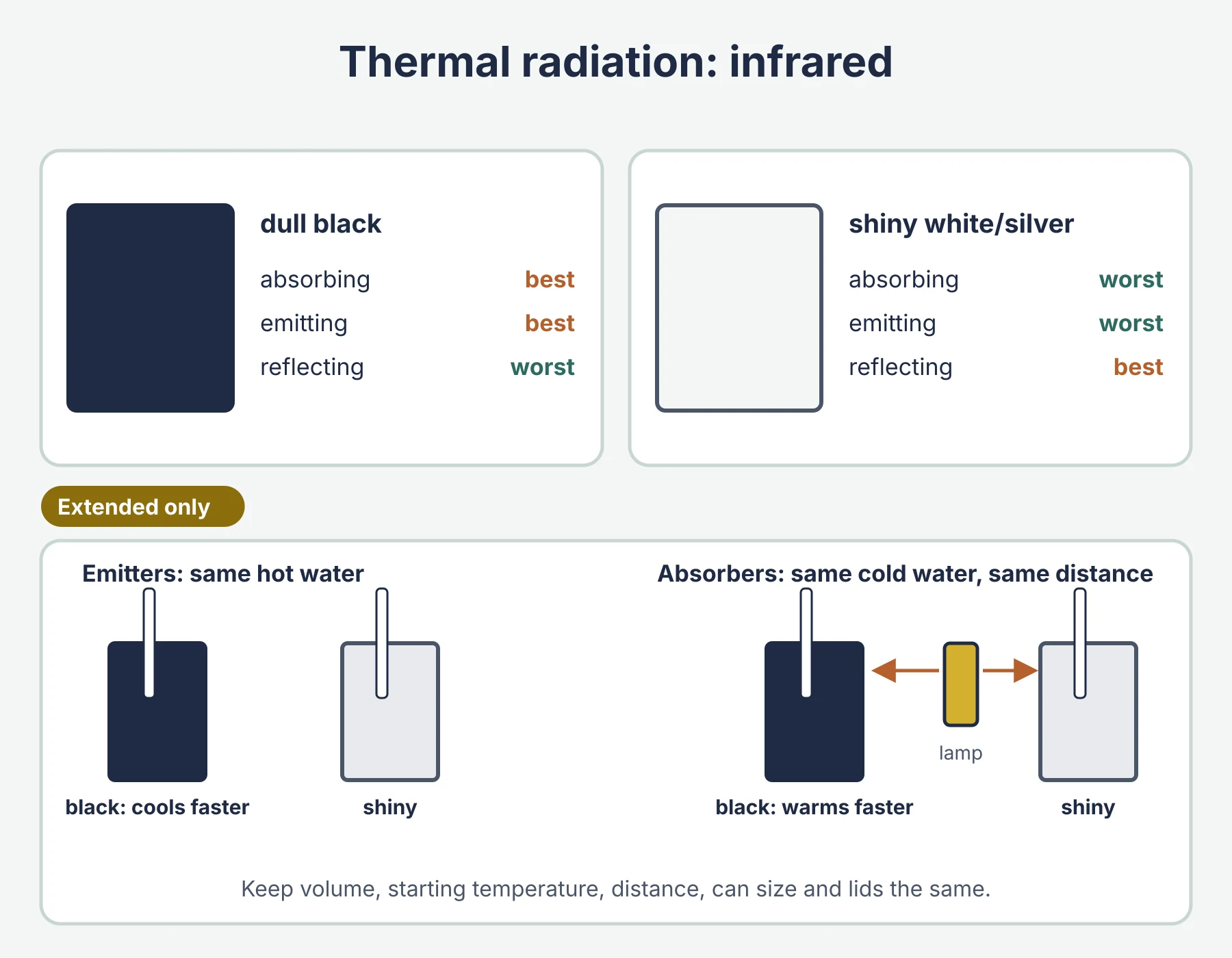
| dull black | best | best | worst |
| shiny white or silver | worst | worst | best |
A dull surface absorbs and emits better than a shiny one of the same colour; a black surface better than a white one of the same texture.
Examples: solar water-heating panels are painted dull black; buildings in hot countries are painted white; emergency blankets are shiny; cooling fins on the back of a refrigerator are dull black so they emit well.
Energy balance (Extended only)
- An object stays at a constant temperature when it transfers energy away at the same rate as it receives energy.
- If it receives energy faster than it transfers it away, its temperature rises; if it loses energy faster, its temperature falls. A hotter object emits faster, so it settles at a new temperature where the rates are equal again.
- The rate of emission increases with the surface temperature and the surface area.
The Earth. Its temperature depends on the balance between incoming radiation from the Sun and infrared radiation emitted from its surface. Factors that change this balance include the amount of greenhouse gas in the atmosphere (which absorbs some of the emitted infrared and sends some back towards the surface), cloud cover, and how much of the surface is reflective ice and snow compared with darker land and sea.
Different experiments for emitters and absorbers (Extended only)
- Emitters: fill two identical cans, one dull black and one shiny silver, with the same volume of water at the same high temperature. Place a thermometer in each and record the temperature every minute. The black can cools faster: it is the better emitter.
- Absorbers: fill the same two cans with equal volumes of cold water and place them the same distance from an infrared lamp. The water in the black can warms faster: it is the better absorber.
Keep everything else the same: volume, starting temperature, distance, size of can, lids on.
Consequences and applications (2.3.4)
Core: a saucepan. The base is metal (a good conductor) so energy passes quickly from the hob to the food. The handle is plastic or wood (an insulator) so it stays cool to hold. The base may be thick copper or aluminium to spread energy evenly.
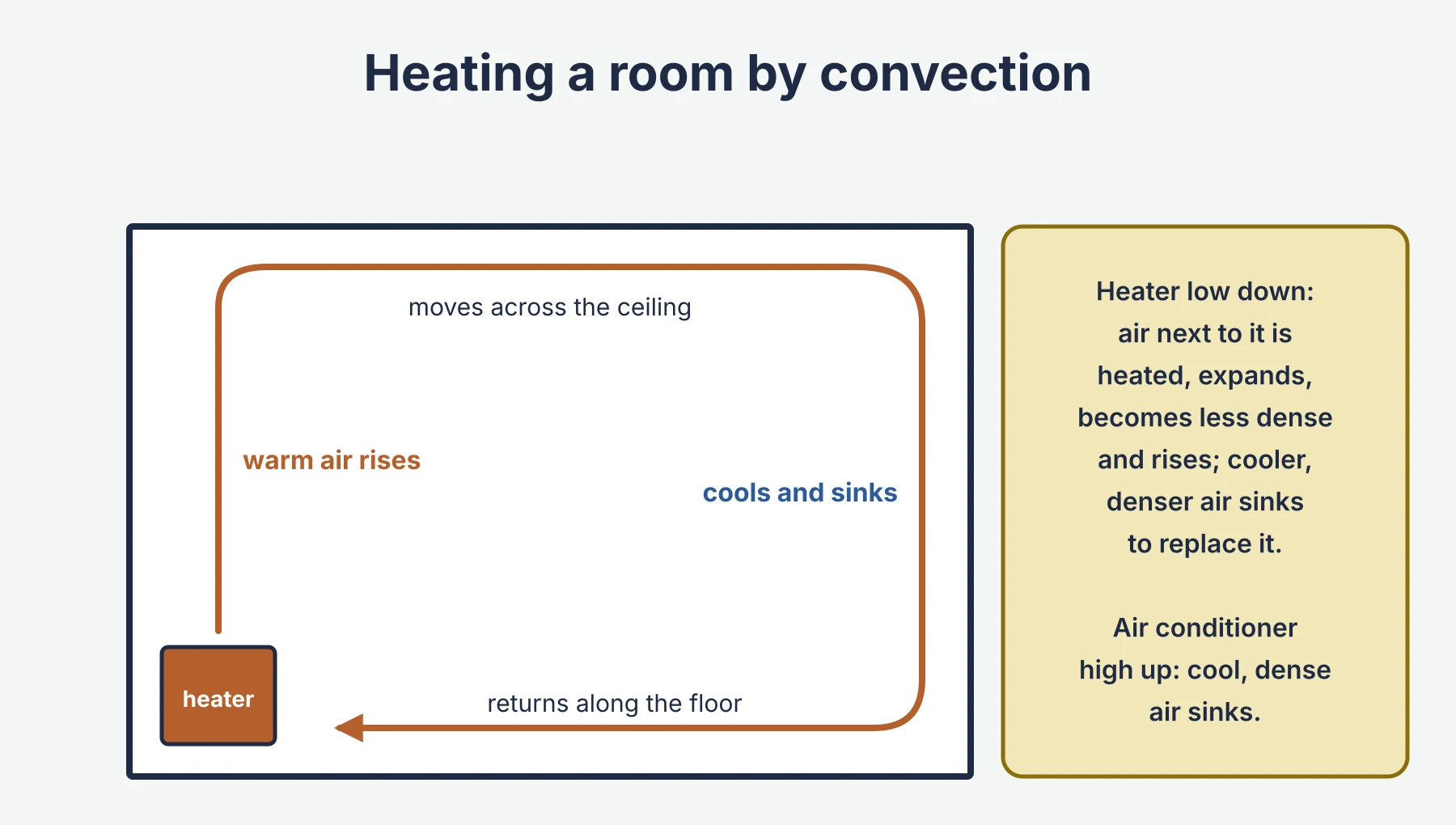
Core: heating a room. A heater placed low down warms the air next to it; this air expands, becomes less dense and rises to the ceiling, moves across, cools and sinks on the far side, and returns along the floor. The whole room is heated by the convection current. (An air conditioner is placed high up for the opposite reason: cool, dense air sinks.)
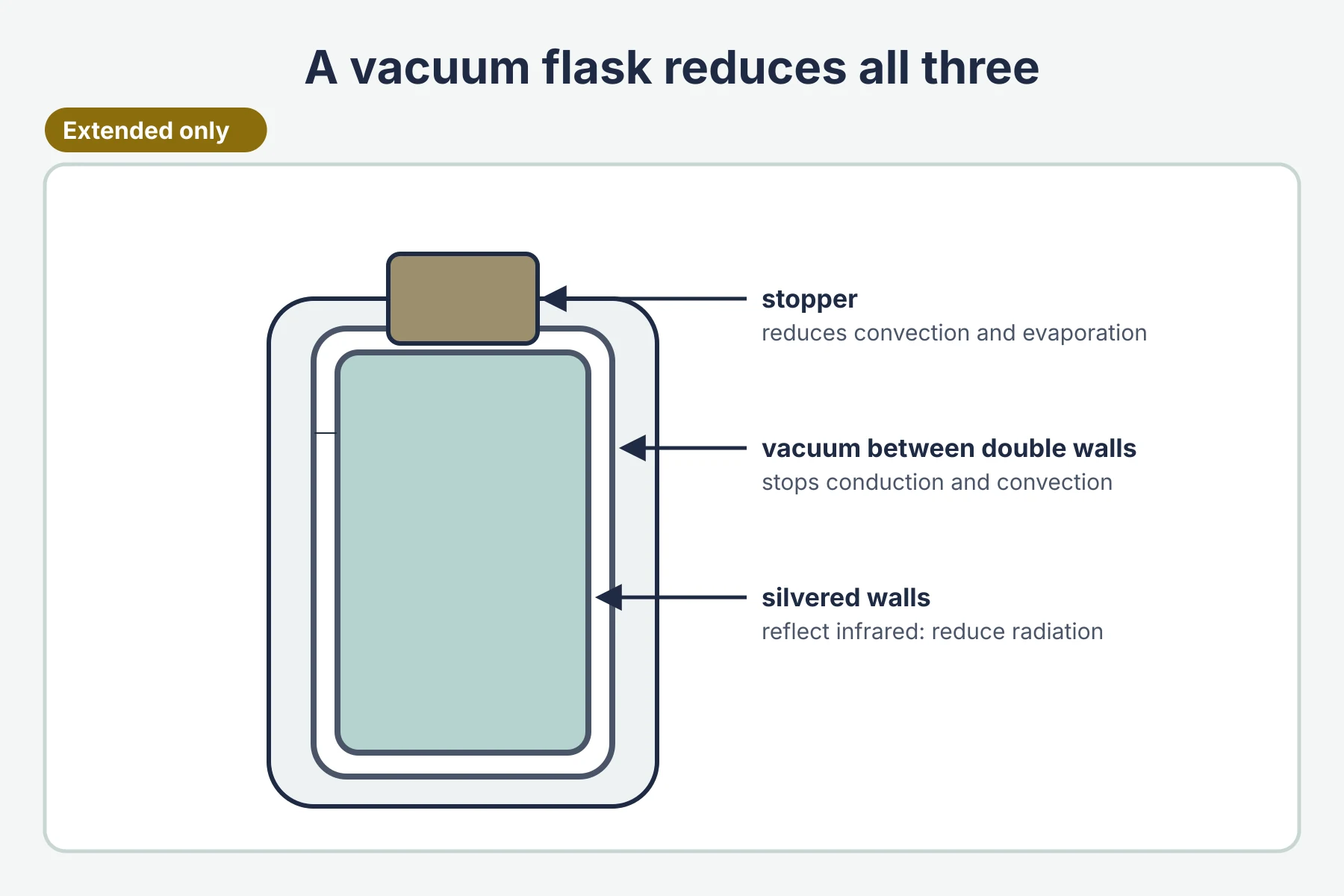
Extended only: more than one process. In a vacuum flask, the vacuum between the double walls stops conduction and convection; the silvered walls reduce radiation by reflecting infrared back; the stopper reduces convection and evaporation from the top. In a fire, radiation from the glowing fuel warms the room, convection carries hot gases up the chimney, and conduction heats the grate. In a car radiator, conduction through the metal and convection by moving air carry energy away from the coolant.
Model answer
Question: Explain why a room is heated by a heater placed near the floor. [3]
The air next to the heater is heated, expands and becomes less dense [1]. This warm air rises and cooler, denser air sinks to replace it [1]. A convection current forms that circulates warm air through the room [1].
Each mark needs a cause and its effect; “hot air rises” alone earns at most one.
Common mistakes
- Saying “heat rises”: warm, less dense fluid rises.
- Saying particles get less dense: the fluid gets less dense because it expands.
- Saying convection or conduction happens in a vacuum.
- Mixing up good emitters and good reflectors.
- (Extended) Saying free electrons are present in all solids; only metals have them.
- (Extended) Explaining a constant temperature as “no energy transfer”: energy flows in and out at equal rates.
Exam technique: command words
- Describe an experiment: what you set up, what you keep the same, what you observe and what it shows.
- Explain convection: expansion → lower density → rises → cooler fluid sinks → current.
- State which surface is the best emitter or absorber: “dull black”. Use both words.
- Explain (Extended) conduction in metals: name both lattice vibrations and free electrons.
- Explain an application: name each process and say how the design increases or reduces it.
Revise with the revision notes on transfer of thermal energy and test yourself with the practice questions on transfer of thermal energy. Density changes in fluids rely on the study guide on thermal properties and temperature, and infrared as a wave links to the study guide on general properties of waves.
Related resources
-
Practice questions
Cambridge IGCSE Physics (0625): Transfer of thermal energy – Practice Questions
Twelve original Cambridge IGCSE Physics 0625 questions on conduction, convection, infrared radiation, energy balance and applications, with full answers.
Physics · Cambridge · IGCSE
Try questions -
Revision notes
Cambridge IGCSE Physics (0625): Transfer of thermal energy – Revision Notes
Revision notes for Cambridge IGCSE Physics 0625 section 2.3: conduction, convection, infrared radiation, energy balance and applications, with a self-test.
Physics · Cambridge · IGCSE
Revise topic -
Study guides
IGCSE Physics: Thermal Physics (Cambridge 0625)
Cambridge IGCSE Physics 0625 Topic 2 thermal physics guide for 2026-2028: particle model, gas pressure, kelvin scale, specific heat capacity and heat transfer.
Physics · Cambridge · IGCSE
Read guide
Related articles
Get free revision emails (optional)
Occasional emails with practice questions, worked explanations and links to free resources for the qualification and subjects you choose. No spam, and you can unsubscribe from any email. The free tools on this site never need an email.