
Study Guides
Cambridge IGCSE Physics (0625): Thermal properties and temperature
Study guide to Cambridge IGCSE Physics 0625 section 2.2: thermal expansion, specific heat capacity, melting, boiling and evaporation, with worked examples.
- Subject
- Physics
- Level
- IGCSE
- Topic
- Thermal physics
- Author
- Marlbridge Academic Team
- Updated
- Reviewed by
- Iftikhar Azeemi (what this means)
Aligned to Cambridge IGCSE Physics (0625), For examination in 2026, 2027 and 2028. Official specification .
Syllabus page (what it covers and how it is assessed): Cambridge IGCSE Physics.
Syllabus points this page covers, with Core and Extended
0625
- 2.2 Thermal properties and temperature · Core and Extended
"Core and Extended" means part of that syllabus point is Extended only. The page's own tier notes say which part.
Found an error? Report a correction.
Need help with this topic? Request a free trial class for IGCSE Physics (0625).
This guide teaches section 2.2, Thermal properties and temperature, of the Cambridge IGCSE Physics 0625 syllabus for examination in 2026, 2027 and 2028, in its three parts: 2.2.1 Thermal expansion of solids, liquids and gases, 2.2.2 Specific heat capacity and 2.2.3 Melting, boiling and evaporation. Supplement content is examined only on Papers 2 and 4 and is labelled Extended only. The Thermal physics study guide describes a metal-block heat capacity experiment and condensation and solidification in terms of particles; this page adds expansion, the liquid experiment, calculations and evaporation in depth.
What the syllabus asks for
| Part | Core | Extended only |
|---|---|---|
| 2.2.1 | Qualitative thermal expansion of solids, liquids and gases at constant pressure; everyday applications and consequences | Explain the relative order of magnitude of expansion of solids, liquids and gases, using particles |
| 2.2.2 | A rise in temperature increases an object’s internal energy | Temperature rise as an increase in the average kinetic energy of the particles; define specific heat capacity; c = ΔE/(mΔθ); experiments for a solid and a liquid |
| 2.2.3 | Melting and boiling with energy input but no temperature change; melting and boiling points of water; condensation and solidification in terms of particles; evaporation as escape of more-energetic particles; evaporation causes cooling | Differences between boiling and evaporation; effect of temperature, surface area and air movement on evaporation; cooling of an object in contact with an evaporating liquid |
Thermal expansion (2.2.1)
When solids, liquids and gases are heated at constant pressure, they expand: their volume increases (and for a solid, its length too). When they cool they contract. The mass does not change, so the density decreases on heating.
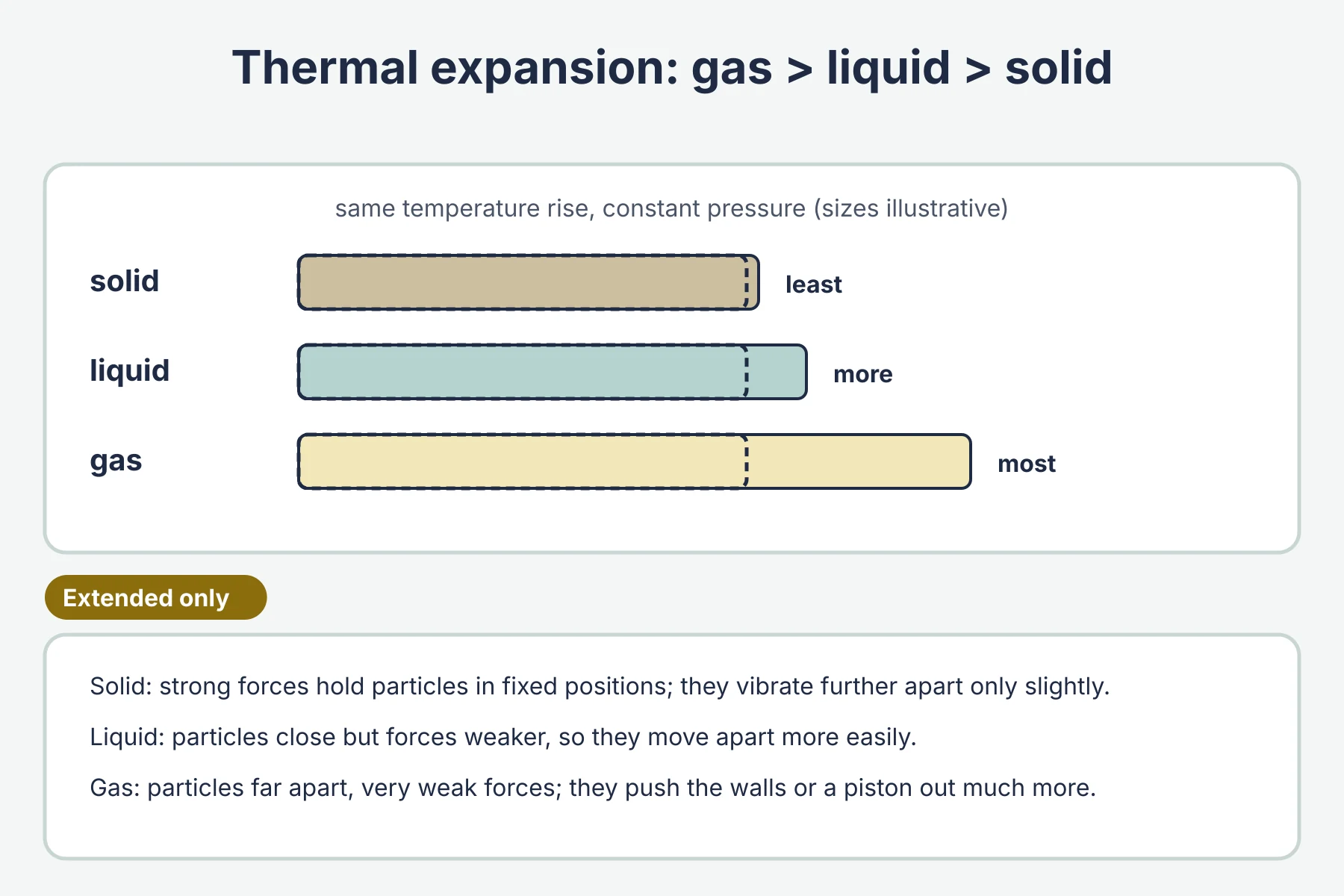
For the same temperature rise, gases expand most, liquids less and solids least.
Explaining the order (Extended only)
- Solids: the particles are held in fixed positions by strong forces. Heating makes them vibrate with larger amplitude, pushing them slightly further apart: a small expansion.
- Liquids: the particles are close together but the forces between them are weaker than in a solid, so their faster motion moves them apart more easily: more expansion.
- Gases: the particles are far apart with very weak forces between them; at constant pressure the faster particles push the container walls (or a piston) outwards much more: by far the largest expansion.
Applications and consequences
| Example | What happens | Why it matters |
|---|---|---|
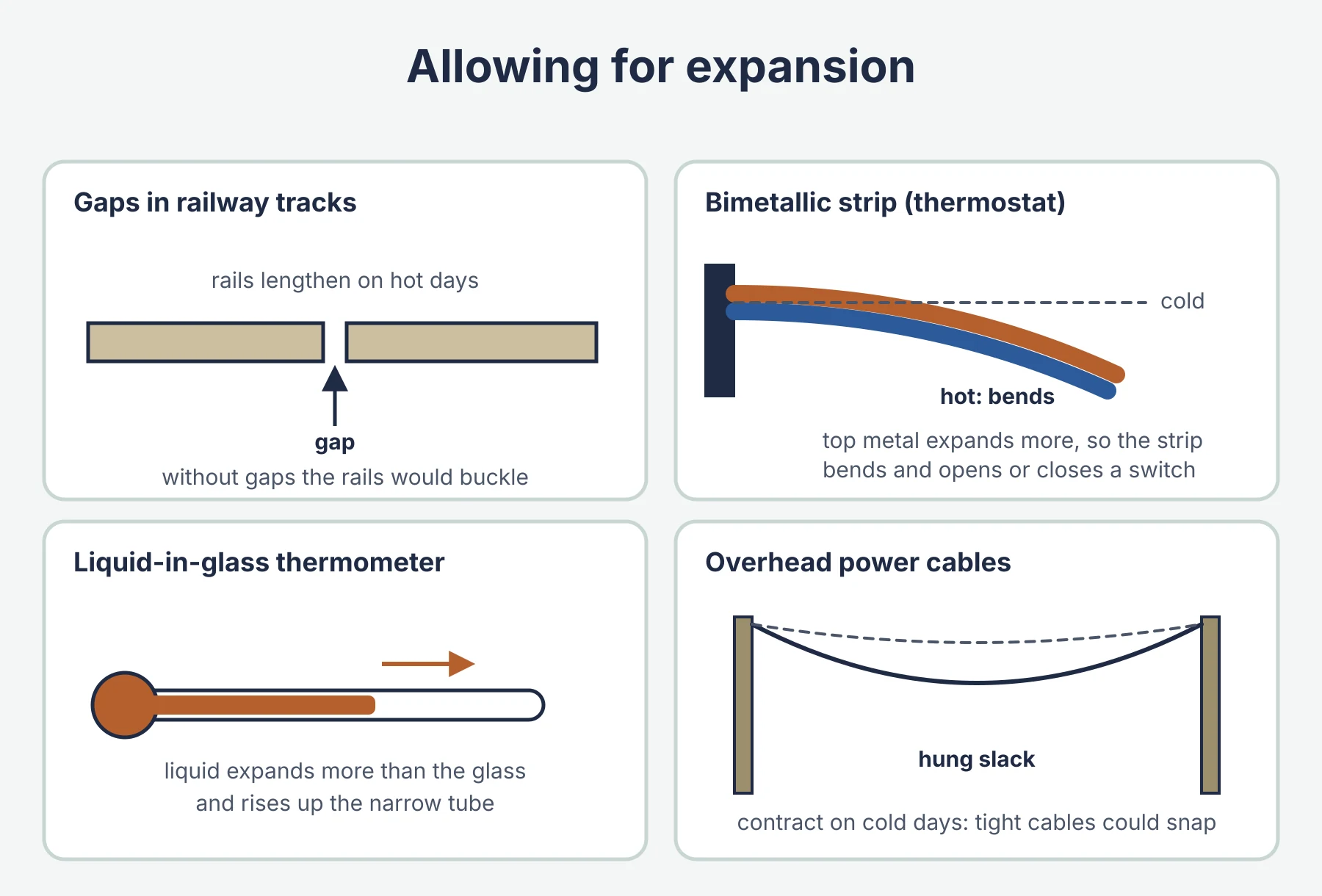
| liquid-in-glass thermometer | liquid expands more than the glass and rises up the narrow tube | the length of the liquid column measures temperature |
| gaps in railway tracks and expansion joints in bridges | rails and bridge sections lengthen on hot days | without gaps the metal would buckle |
| overhead power cables | hung slack so they can contract on cold days | tight cables could snap in winter |
| bimetallic strip (in thermostats) | two metals bonded together expand by different amounts, so the strip bends when heated | the bending opens or closes a switch |
| tight metal lid on a glass jar | running hot water over the lid makes the metal expand more than the glass | the lid becomes easier to unscrew |
| thick glass cracking with hot water | the inside surface expands before the outside | uneven expansion causes stress and cracks |
Specific heat capacity (2.2.2)
Core. A rise in the temperature of an object increases its internal energy.
Extended only. A rise in temperature is an increase in the average kinetic energy of all the particles in the object. Different materials need different amounts of energy for the same temperature rise of the same mass.
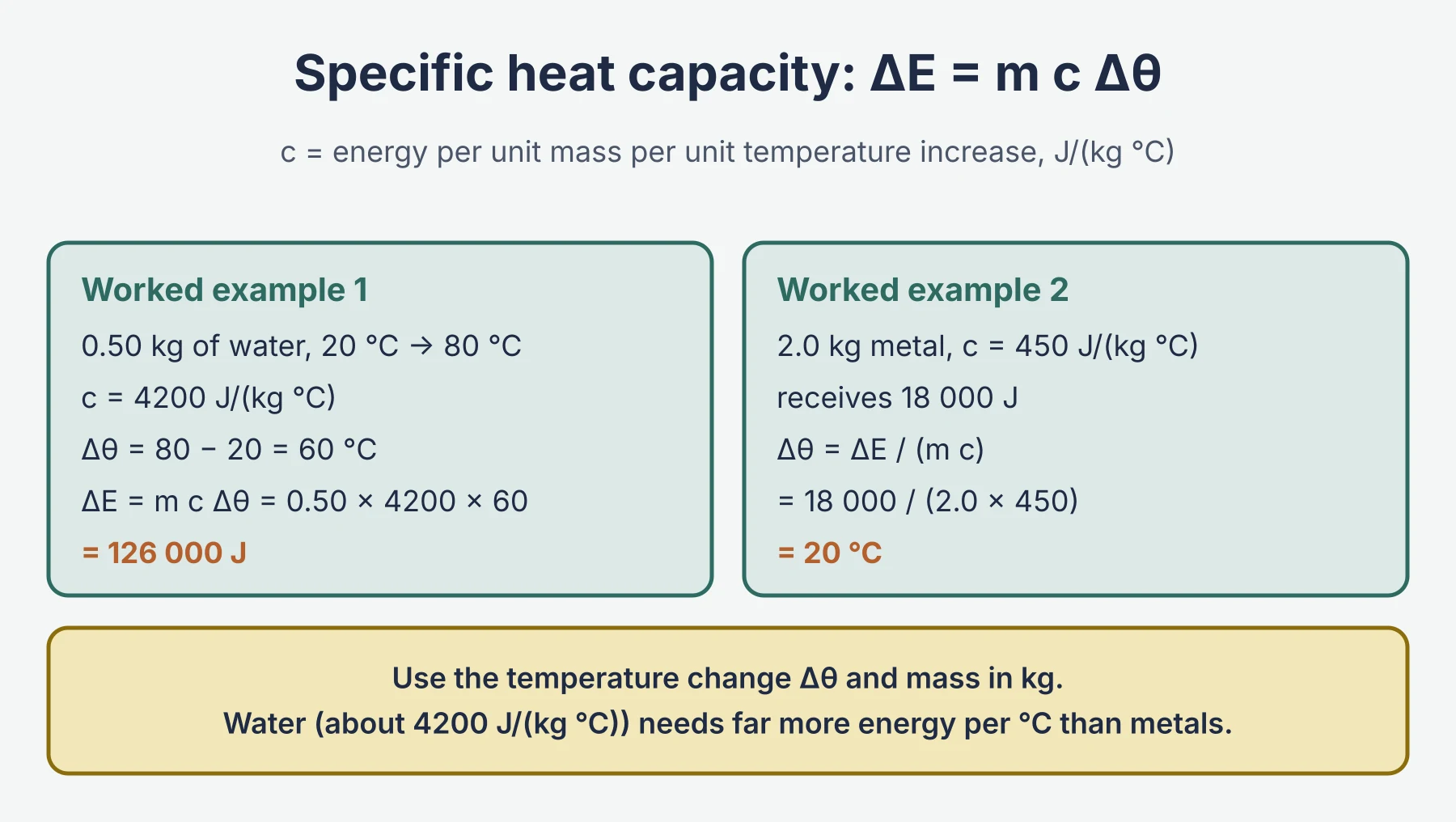
Specific heat capacity is the energy required per unit mass per unit temperature increase:
c = ΔE / (m Δθ)          ΔE = m c Δθ
c in J/(kg °C),  ΔE in J,  m in kg,  Δθ (temperature change) in °C
Water has a high specific heat capacity, about 4200 J/(kg °C): each kilogram needs 4200 J to warm by 1 °C. Metals have much lower values, so a metal pan warms up far faster than the water in it.
Worked example 1. Find the energy needed to warm 0.50 kg of water from 20 °C to 80 °C (c = 4200 J/(kg °C)).
Δθ = 80 − 20 = 60 °C
ΔE = m c Δθ = 0.50 × 4200 × 60 = 126 000 J
Worked example 2 (finding a temperature rise). A 2.0 kg block of a metal with c = 450 J/(kg °C) receives 18 000 J.
Δθ = ΔE / (m c) = 18 000 / (2.0 × 450) = 20 °CExperiment for a liquid (Extended only)
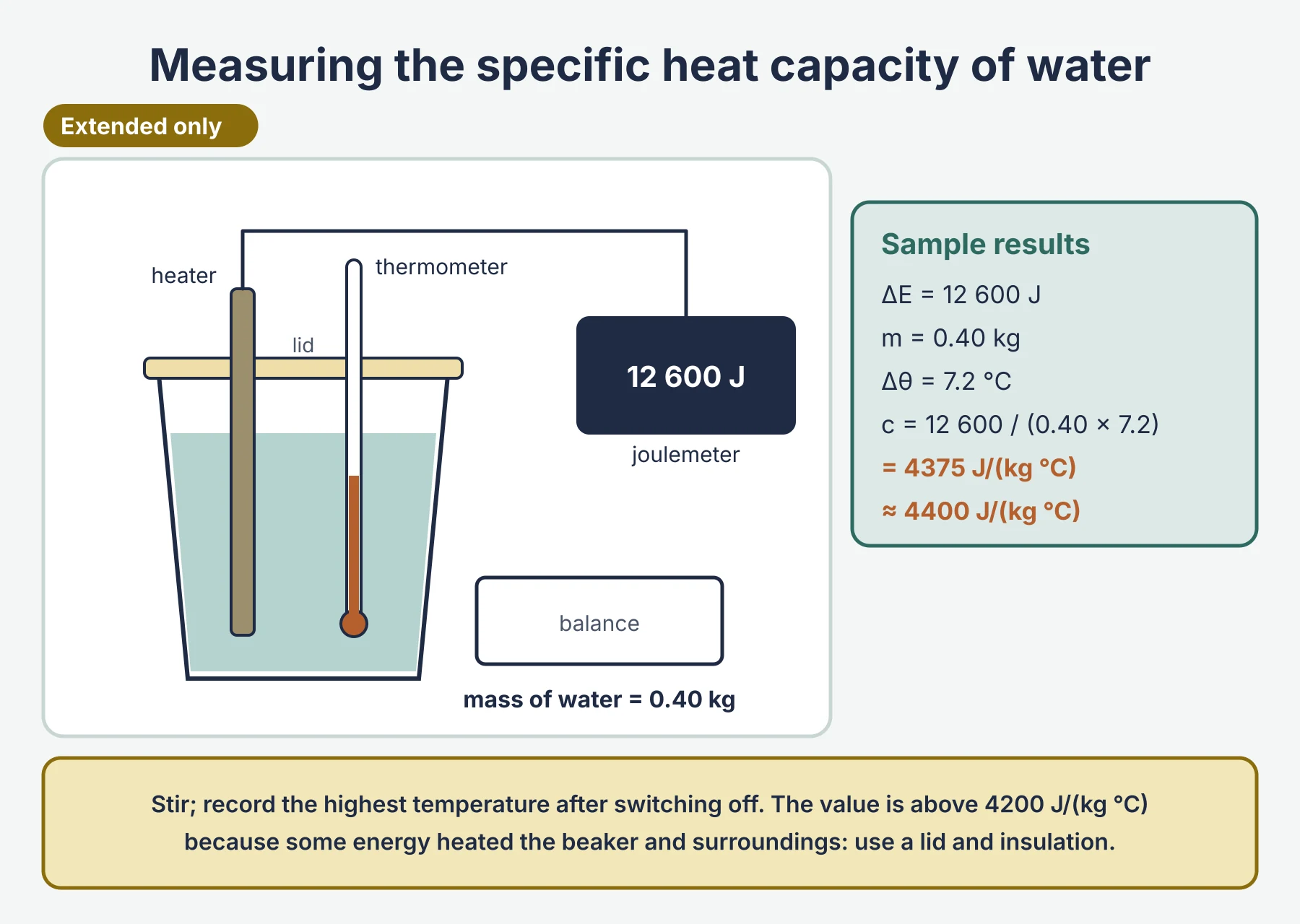
- Measure the mass of an empty, insulated beaker (or a polystyrene cup); add water and measure again; the difference is the water’s mass.
- Place an immersion heater and a thermometer in the water. Connect the heater to a joulemeter (or use an ammeter, a voltmeter and a stopwatch, so that E = IVt).
- Record the starting temperature. Switch on, stir gently, and after several minutes switch off.
- Keep stirring and record the highest temperature reached (the heater is still hotter than the water just after switching off).
- Calculate c = ΔE / (m Δθ).
Sample results. Mass of water 0.40 kg; joulemeter reading 12 600 J; temperature rise 7.2 °C.
c = 12 600 / (0.40 × 7.2) = 4375 J/(kg °C) ≈ 4400 J/(kg °C)The value is higher than 4200 J/(kg °C) because some of the energy supplied heated the beaker and the surroundings rather than the water, so the measured temperature rise was too small. A lid and insulation reduce this.
For a solid, use a metal block with holes for the heater and thermometer, a few drops of oil in the thermometer hole for good contact, and insulation round the block; the calculation is the same.
Melting, boiling and evaporation (2.2.3)
Melting and boiling
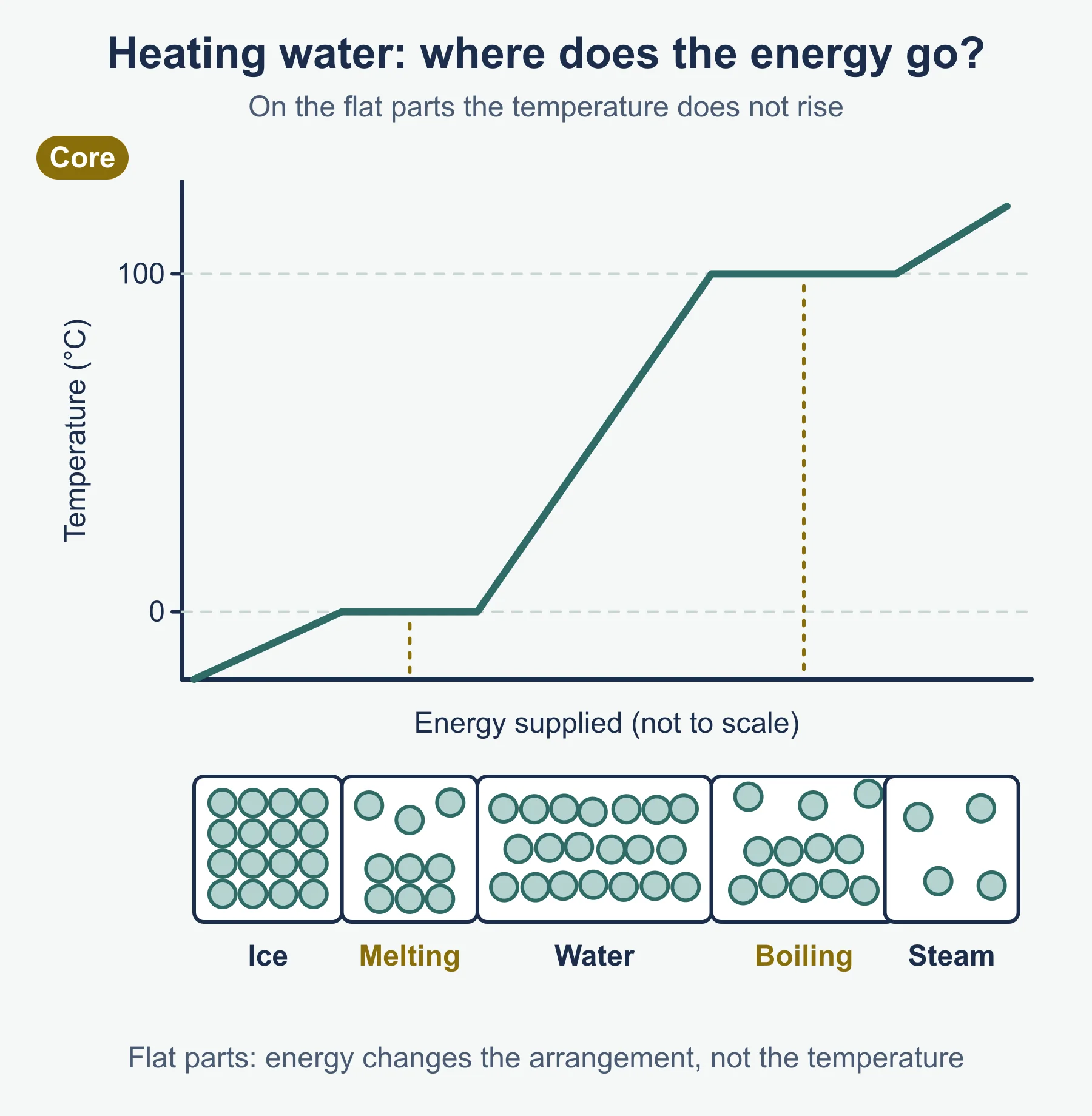
During melting and boiling, energy is supplied but the temperature stays constant until the change of state is complete. The energy is used to separate the particles (overcoming the forces between them), not to increase their kinetic energy. For water at standard atmospheric pressure, the melting point is 0 °C and the boiling point is 100 °C.
Evaporation
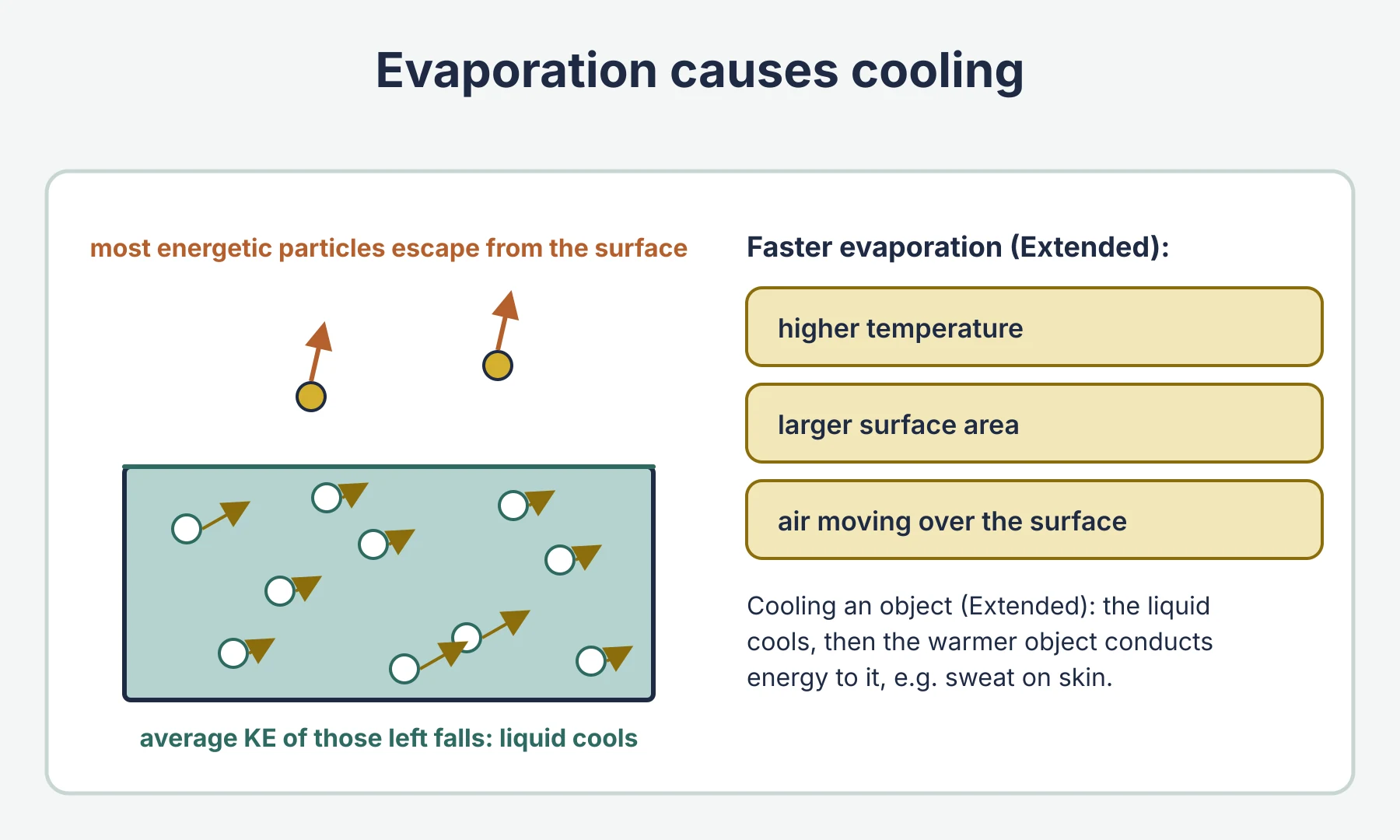
Evaporation is the escape of more-energetic particles from the surface of a liquid. Particles in a liquid move with a range of speeds; only those near the surface with enough energy to overcome the attraction of the others can leave.
Evaporation causes cooling: the particles that escape are the most energetic ones, so the average kinetic energy of those left behind falls, and the liquid’s temperature falls.
Boiling compared with evaporation (Extended only)
| Evaporation | Boiling | |
|---|---|---|
| Where | at the surface only | throughout the liquid (bubbles form inside) |
| Temperature | at any temperature | only at the boiling point |
| Energy | energy comes from the liquid itself (it cools) | energy must be supplied by heating |
| Rate | usually slow | rapid |
What affects the rate of evaporation (Extended only)
- Higher temperature: more particles have enough energy to escape.
- Larger surface area: more particles are at the surface.
- Air movement over the surface: removes escaped particles before they can return to the liquid.
Wet washing dries fastest on a warm, windy day when it is spread out.
Cooling an object in contact with an evaporating liquid (Extended only)
When a liquid evaporates from an object, the liquid cools; energy is then transferred by conduction from the warmer object to the cooler liquid, so the object cools too. Examples: sweat evaporating from skin; a wet cloth wrapped round a water bottle; a drop of alcohol on the back of the hand feels cold.
Common mistakes
- Saying the particles themselves expand when a substance is heated.
- Using a temperature instead of a temperature change in ΔE = mcΔθ.
- Using grams in ΔE = mcΔθ.
- Saying the temperature rises while ice melts.
- Explaining evaporative cooling as “the liquid takes away heat” without the most energetic particles escaping.
- (Extended) Saying evaporation happens only at the boiling point, or boiling happens at the surface only.
Exam technique: command words
- Describe an application of expansion: say what expands, and what that does.
- Explain (Extended): link the order of expansion to the forces and distances between particles.
- Define specific heat capacity: “energy required per unit mass per unit temperature increase”.
- Describe an experiment (Extended): apparatus, measurements (mass, energy, temperature change), precautions, and the equation.
- Explain evaporative cooling: more-energetic particles escape → average kinetic energy of those left falls → temperature falls.
Revise with the revision notes on thermal properties and temperature and test yourself with the practice questions on thermal properties and temperature. The particle ideas are introduced in the study guide on the kinetic particle model of matter, and how thermal energy moves is in the study guide on transfer of thermal energy.
Related resources
-
Practice questions
Cambridge IGCSE Physics (0625): Thermal properties and temperature – Practice Questions
Twelve original Cambridge IGCSE Physics 0625 questions on thermal expansion, specific heat capacity, melting, boiling and evaporation, with full answers.
Physics · Cambridge · IGCSE
Try questions -
Revision notes
Cambridge IGCSE Physics (0625): Thermal properties and temperature – Revision Notes
Revision notes for Cambridge IGCSE Physics 0625 section 2.2: thermal expansion, specific heat capacity, melting, boiling and evaporation, with a self-test.
Physics · Cambridge · IGCSE
Revise topic -
Study guides
Cambridge IGCSE Physics (0625): Transfer of thermal energy
Study guide to Cambridge IGCSE Physics 0625 section 2.3: conduction, convection and infrared radiation, their experiments, radiation balance and applications.
Physics · Cambridge · IGCSE
Read guide
Related articles
Get free revision emails (optional)
Occasional emails with practice questions, worked explanations and links to free resources for the qualification and subjects you choose. No spam, and you can unsubscribe from any email. The free tools on this site never need an email.