
Study Guides
Cambridge IGCSE Sociology (0495): Research methods – How do sociologists investigate society?
Cambridge IGCSE Sociology 0495 key question 1.3: research design, sampling, interviews, observation, question types and ethics and a model plan.
- Subject
- Sociology
- Level
- IGCSE
- Topic
- Paper 1 – Research Methods, Identity and Inequality
- Author
- Marlbridge Academic Team
- Updated
- Reviewed by
- Naqiya Yousaf (what this means)
Aligned to Cambridge IGCSE Sociology (0495), 2025-2027. Official specification .
Syllabus page (what it covers and how it is assessed): Cambridge IGCSE Sociology.
Syllabus points this page covers
0495
- 1.3 Research methods – How do sociologists investigate society?
Found an error? Report a correction.
Need help with this topic? Request a free trial class for IGCSE Sociology (0495).
Key question 1.3 of Cambridge IGCSE Sociology (0495) asks How do sociologists investigate society? It is the practical side of research: how a study is designed, who is studied and how they are chosen, which primary methods are used, how questions are written, and which theoretical, practical and ethical issues shape every decision. It is tested throughout Paper 1 Question 1 and is the core of part (e), where you must plan research on a topic you are given.
For a one-page overview of all of topic 1, see the research approaches, data and investigation guide.
Syllabus coverage
Cambridge IGCSE Sociology 0495, syllabus for 2025, 2026 and 2027, 1.3 How do sociologists investigate society?
- 1.3.1 The stages in research design — selection of topic; aims; hypothesis; target population; methods; operationalisation; pilot studies.
- 1.3.2 Sampling — sampling frames; random, systematic, stratified, snowball and quota techniques; strengths and limitations of each.
- 1.3.3 Quantitative and qualitative primary research methods — surveys; questionnaires; interviews (structured, semi-structured, unstructured, group); observations (participant, non-participant, covert, overt); strengths and limitations of each.
- 1.3.4 Types of question — open; closed; multiple choice; scaled.
- 1.3.5 Theoretical and practical issues — researcher perspective (positivist/interpretivist); access to sample; response rate; funding/cost; time.
- 1.3.6 Ethical issues — informed consent; privacy/confidentiality; deception; prevention of harm; legality.
Research design as a chain of decisions (1.3.1)
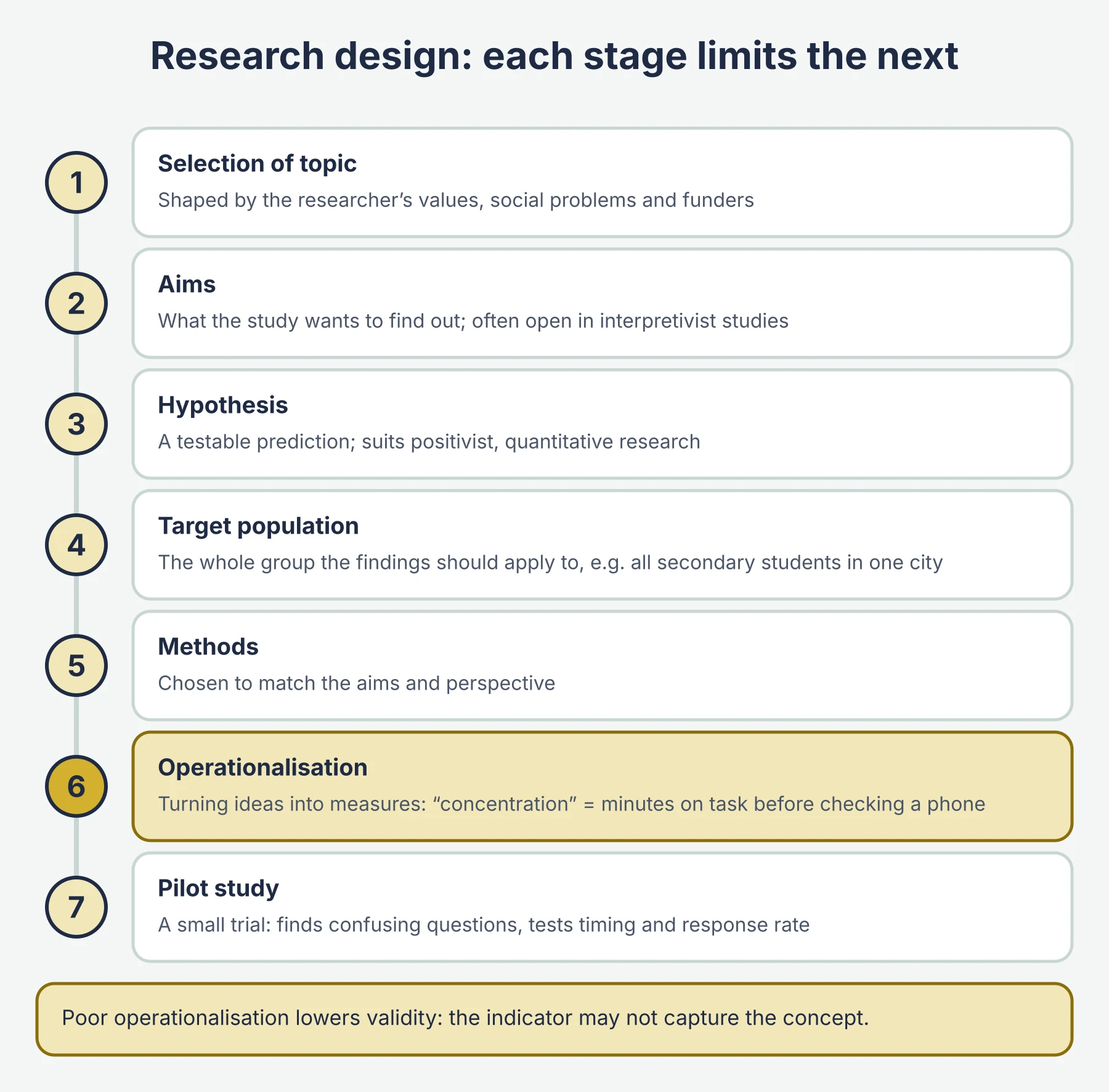
Each stage limits the next, so explain the links rather than listing stages.
- Selection of topic is shaped by the researcher’s values, social problems and funders.
- Aims state what the study wants to find out (“to discover how students experience online learning”). Interpretivist studies often have open aims instead of a hypothesis.
- A hypothesis is a testable prediction (“students from homes without a quiet study space will report lower concentration in online lessons”). It suits positivist, quantitative research.
- The target population is the whole group the findings are meant to apply to — for example, all secondary students in one city.
- Methods are chosen to match the aims and perspective.
- Operationalisation turns abstract ideas into things that can be measured. “Concentration” might be measured by asking how many minutes students stay on a task before checking their phone. Poor operationalisation lowers validity: the indicator may not capture the concept.
- A pilot study is a small trial run on a few people like the target population. It finds confusing questions, tests how long the research takes and checks the response rate, saving money before the full study.
Sampling (1.3.2)
A sample is the smaller group actually studied. A sampling frame is the list from which it is drawn — a school roll, a membership list, an electoral register. If no frame exists (there is no list of people who have committed a crime but not been caught), random methods are impossible.
Worked example: drawing a stratified sample
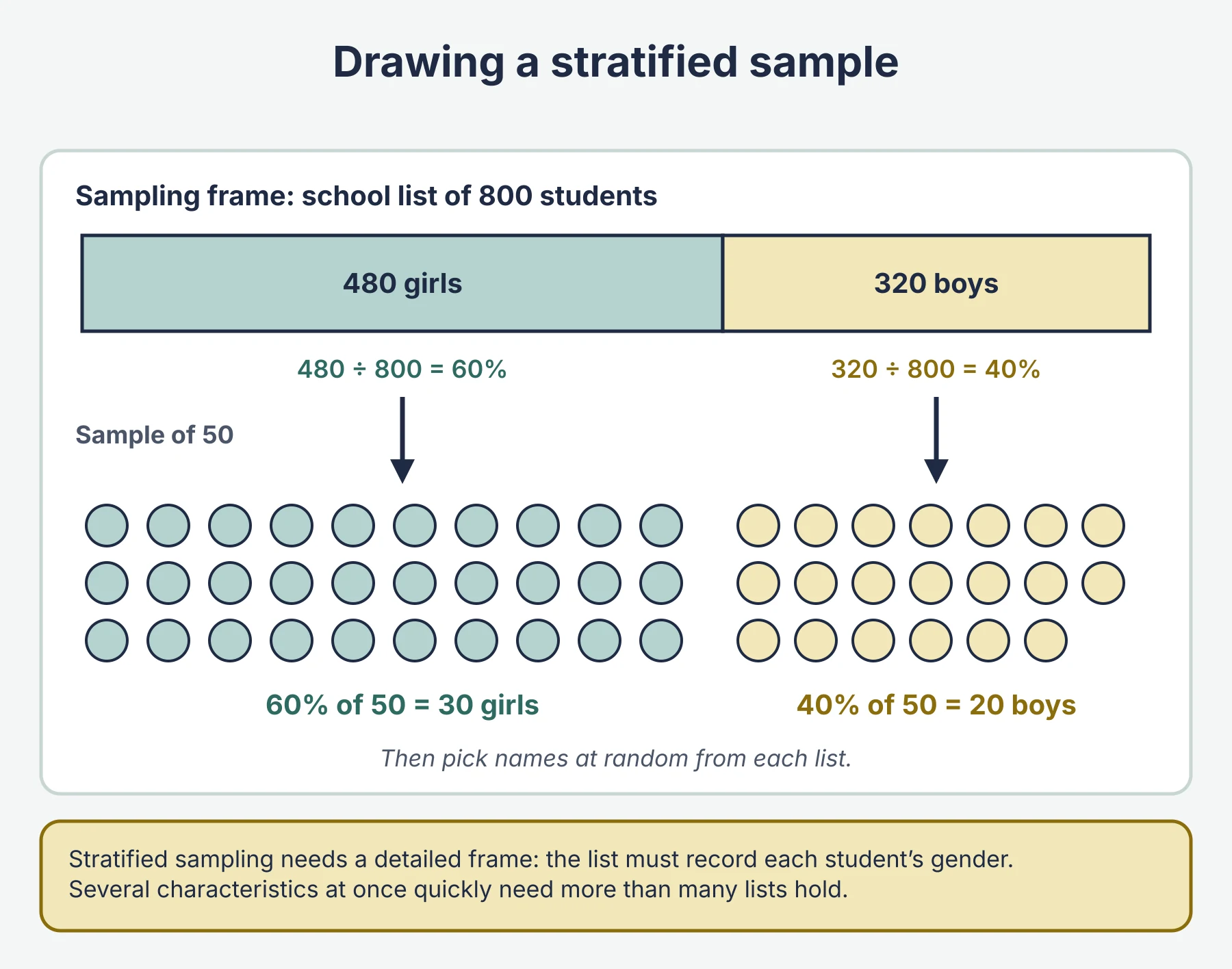
A school has 800 students: 480 girls and 320 boys. A researcher wants a sample of 50 that mirrors the school by gender.
- Girls are 480 ÷ 800 = 60% of the school, so 60% of 50 = 30 girls.
- Boys are 320 ÷ 800 = 40%, so 40% of 50 = 20 boys.
- The researcher then picks 30 names at random from the list of girls and 20 from the list of boys.
This shows why stratified sampling needs a detailed frame: the list must record each student’s gender. Stratifying by several characteristics at once (gender and year group and ethnicity) quickly needs more information than many lists hold.
Choosing a technique
| Situation | Suitable technique | Reason |
|---|---|---|
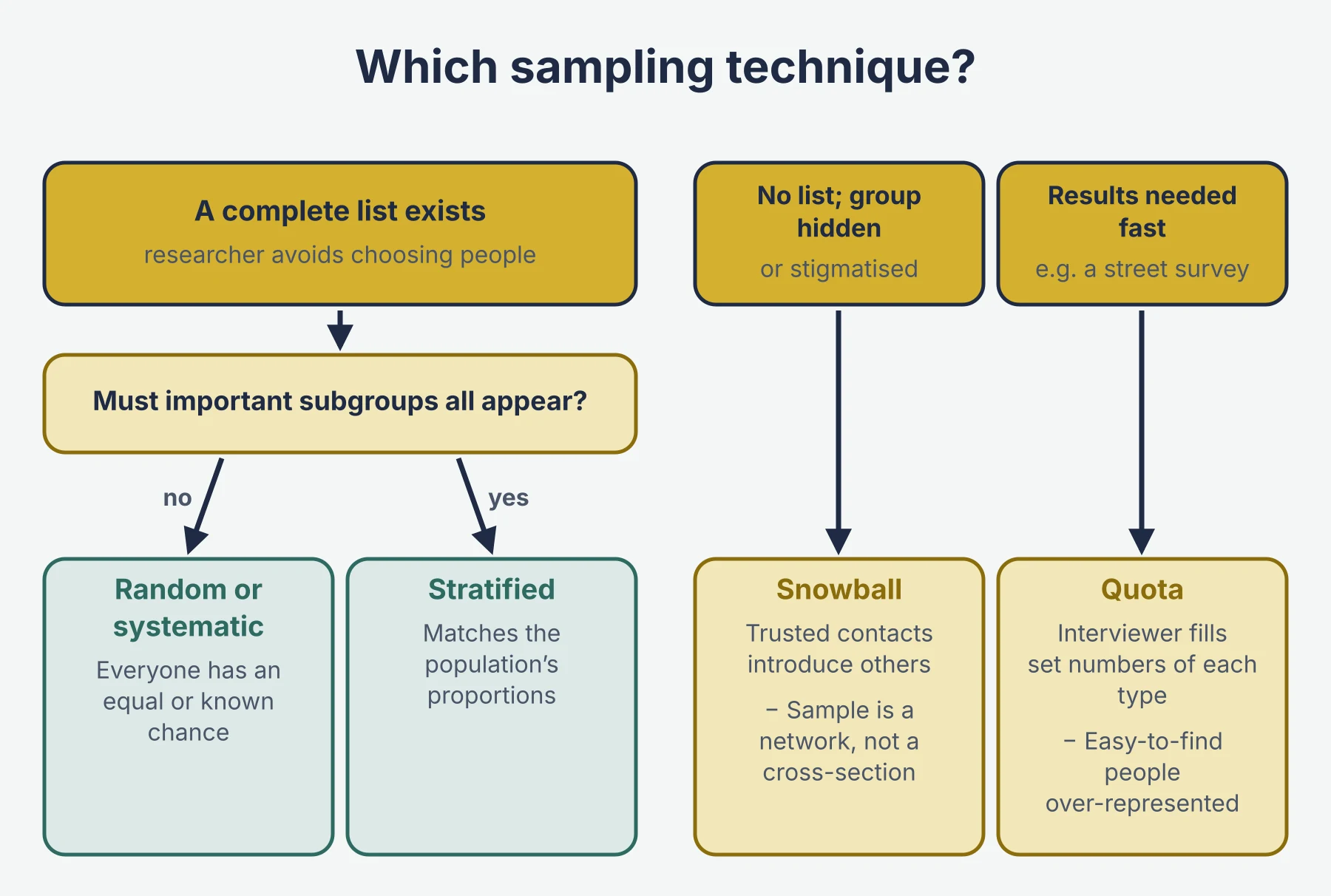
| A complete list exists and the researcher wants to avoid choosing people themselves | Random or systematic | Everyone has an equal or known chance of selection |
| The population has important subgroups that must all appear | Stratified | Sample matches the population’s proportions |
| No list exists and the group is hidden or stigmatised | Snowball | Trusted contacts introduce the researcher to others |
| Results are needed quickly, for example in a street survey | Quota | Interviewer fills set numbers of each type |
The weakness of quota sampling is that the interviewer picks who fills each quota, so people who are easy to find — at home in daytime, willing to stop — are over-represented. The weakness of snowball sampling is that each person recommends people like themselves, so the sample is a network, not a cross-section.
Primary methods (1.3.3)
A survey is a study that collects the same information from many people, usually through a questionnaire or structured interview. A questionnaire is the written list of questions, which may be self-completed by post, online or in person.
Interviews
| Type | Features | Best for |
|---|---|---|
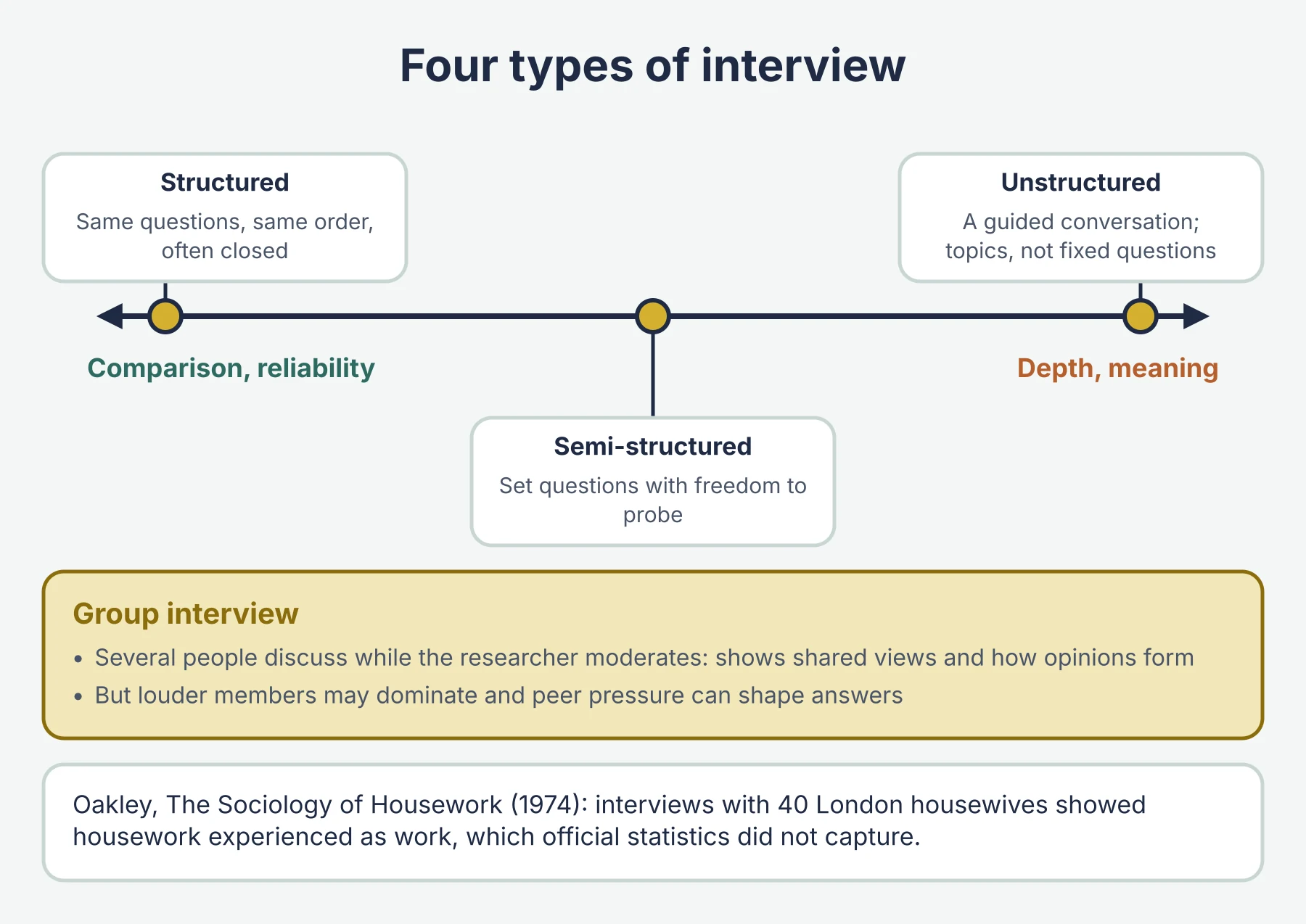
| Structured | Same questions, same order, often closed; interviewer reads them out | Comparing many people reliably |
| Semi-structured | Set questions with freedom to probe and follow up | Balance of comparison and depth |
| Unstructured | A guided conversation; topics rather than fixed questions | Meanings, sensitive experiences, verstehen |
| Group | Several people discuss together; the researcher moderates | Shared views, how opinions form; but louder members may dominate and peer pressure can shape answers |
Ann Oakley’s The Sociology of Housework (1974) used interviews with 40 London housewives to show how women experienced housework as work, a topic official statistics did not capture.
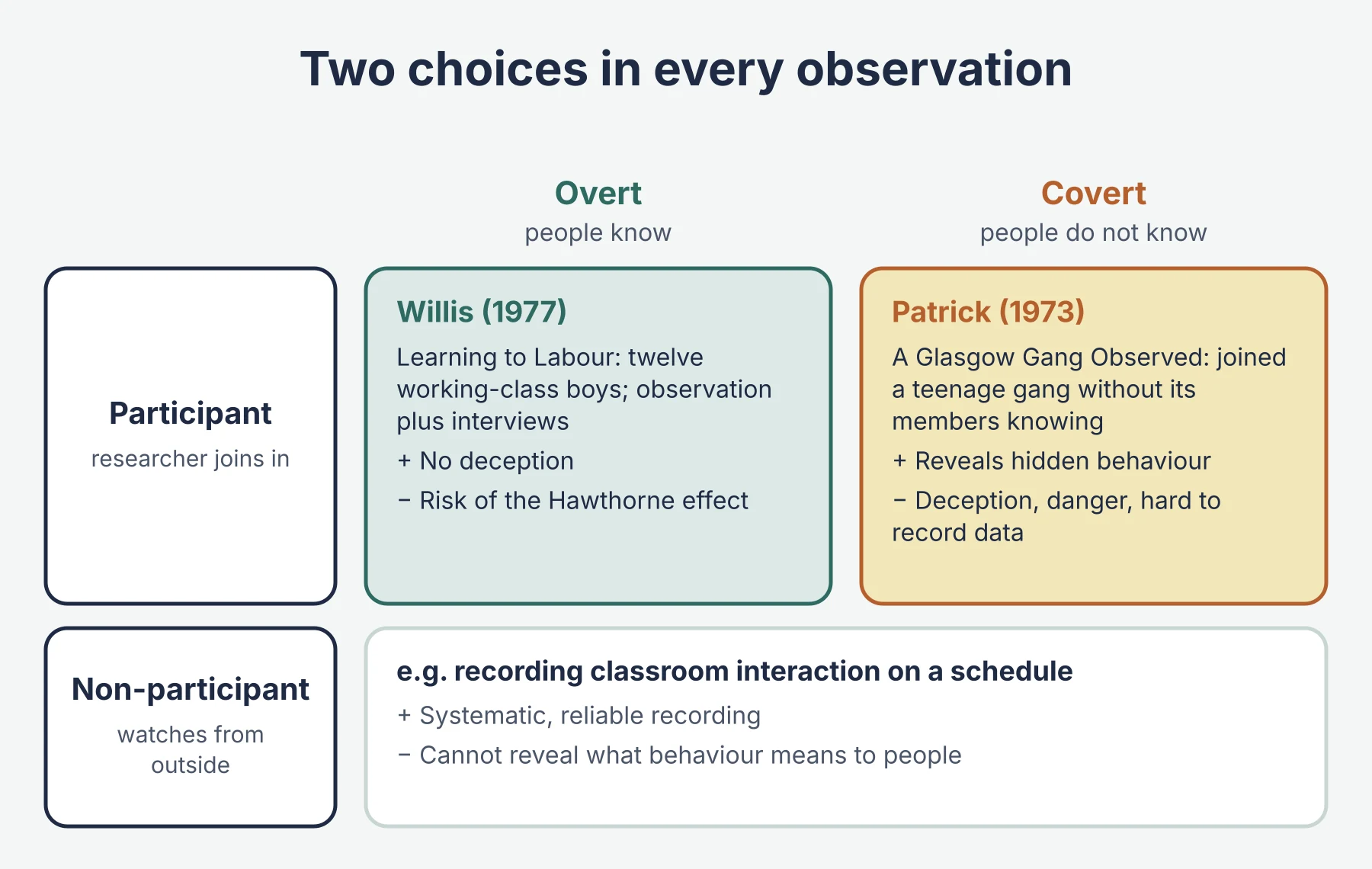
Observation combines two choices: whether the researcher joins in (participant) or watches from outside (non-participant), and whether people know they are being studied (overt) or not (covert).
- Covert participant observation can reveal behaviour people would hide, as in James Patrick’s A Glasgow Gang Observed (1973), for which he joined a teenage gang without its members knowing. But it involves deception, danger, and difficulty recording data; Patrick wrote under a pseudonym and left when violence escalated.
- Overt participant observation avoids deception but risks the Hawthorne effect. Paul Willis’s Learning to Labour (1977) studied twelve working-class boys at a school in the English Midlands, combining observation with interviews to understand their anti-school culture.
- Non-participant observation — such as recording classroom interaction on a schedule — allows systematic, reliable recording but cannot reveal what behaviour means to people.
Types of question (1.3.4)
| Type | Example | Strength | Limitation |
|---|---|---|---|
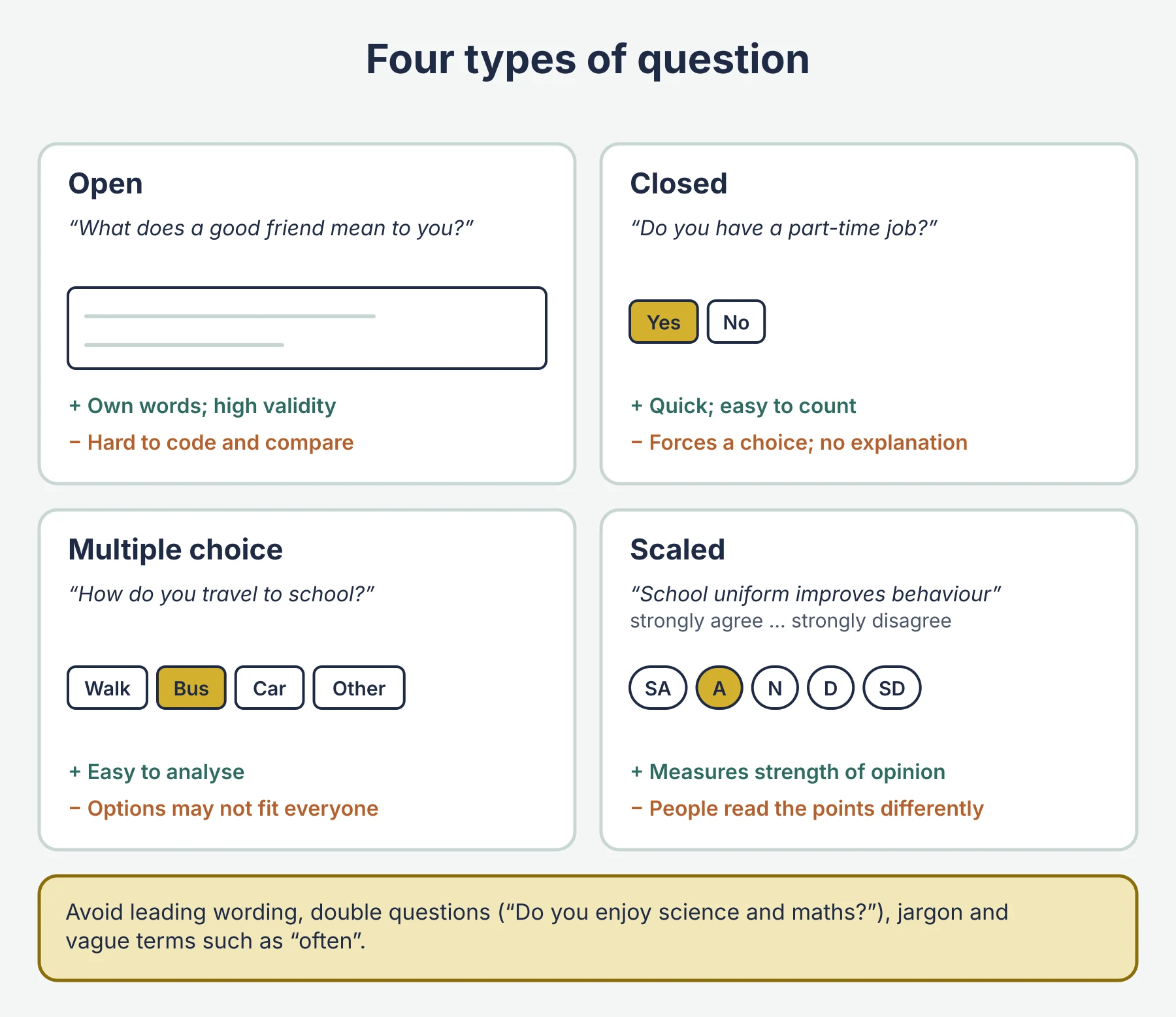
| Open | “What does a good friend mean to you?” | Respondent’s own words; high validity | Hard to code and compare |
| Closed | “Do you have a part-time job? Yes / No” | Quick; easy to count | Forces a choice; no explanation |
| Multiple choice | “How do you travel to school? Walk / Bus / Car / Other” | Easy to analyse; covers set options | Options may not fit everyone |
| Scaled | “School uniform improves behaviour: strongly agree / agree / neutral / disagree / strongly disagree” | Measures strength of opinion | People interpret the points differently |
Good questions avoid leading wording, double questions (“Do you enjoy science and maths?”), jargon and vague terms such as “often”.
Theoretical, practical and ethical issues (1.3.5 and 1.3.6)
Theoretical: a positivist will prefer standardised methods and large samples; an interpretivist will prefer unstructured interviews and participant observation.
Practical:
- Access to sample — gatekeepers such as head teachers or employers may refuse; hidden groups are hard to find.
- Response rate — the proportion of people who take part. Postal and online questionnaires often have low response rates, and those who reply may differ from those who do not.
- Funding/cost — large surveys and long observations are expensive; funders may influence the topic.
- Time — participant observation can take months or years.
Ethical (the British Sociological Association publishes a statement of ethical practice for its members):
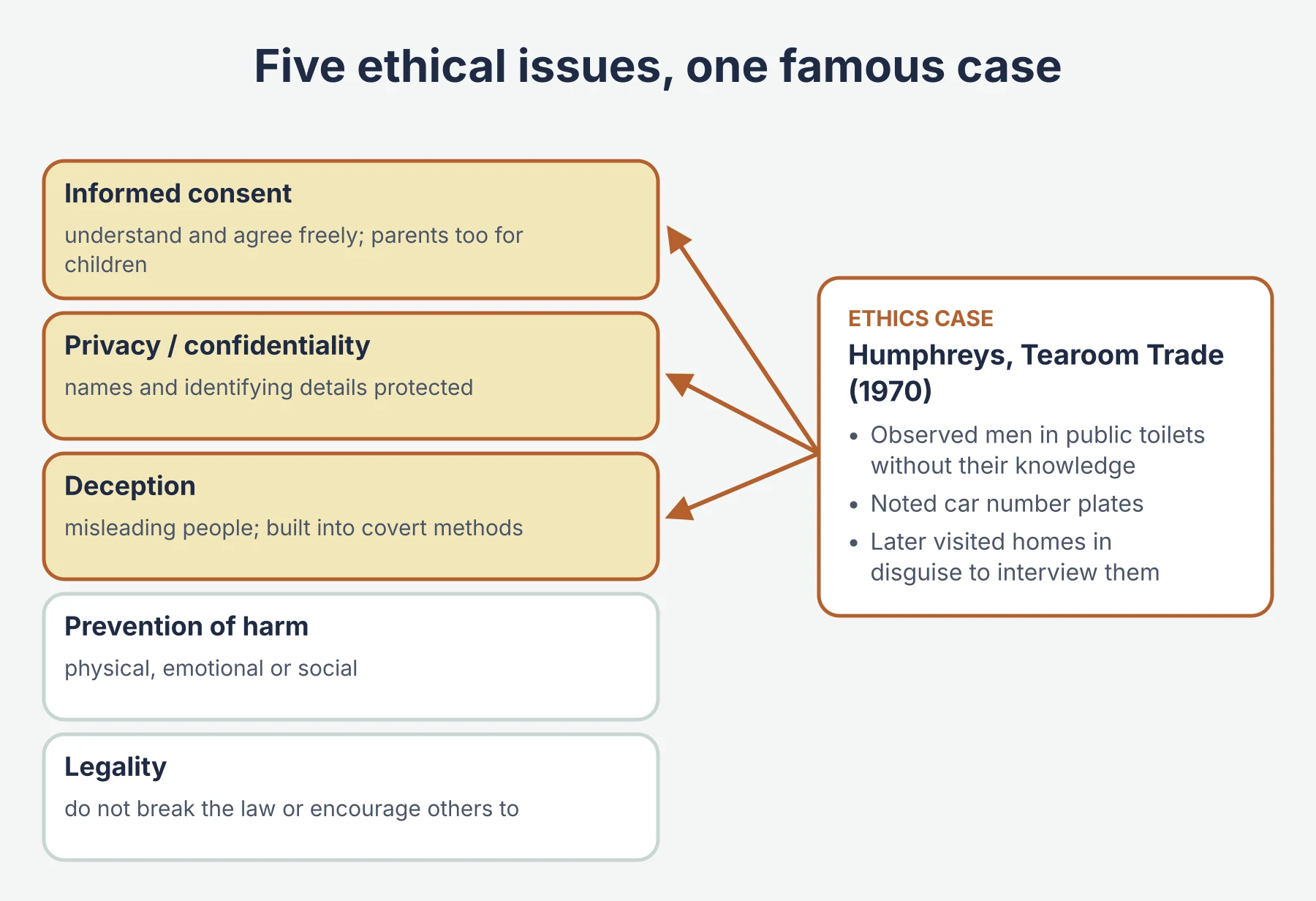
- Informed consent — participants understand the research and agree freely; for children, parents or guardians consent too.
- Privacy/confidentiality — names and identifying details are protected.
- Deception — misleading people about the research; built into covert methods.
- Prevention of harm — physical, emotional or social harm, including distress from sensitive questions.
- Legality — the researcher must not break the law or encourage others to.
Laud Humphreys’ Tearoom Trade (1970) is widely discussed as an ethics case: he observed men in public toilets without their knowledge, noted their car number plates, and later visited their homes in disguise to interview them — raising deception, consent and privacy concerns.
Model answer: Question 1(e)-style plan
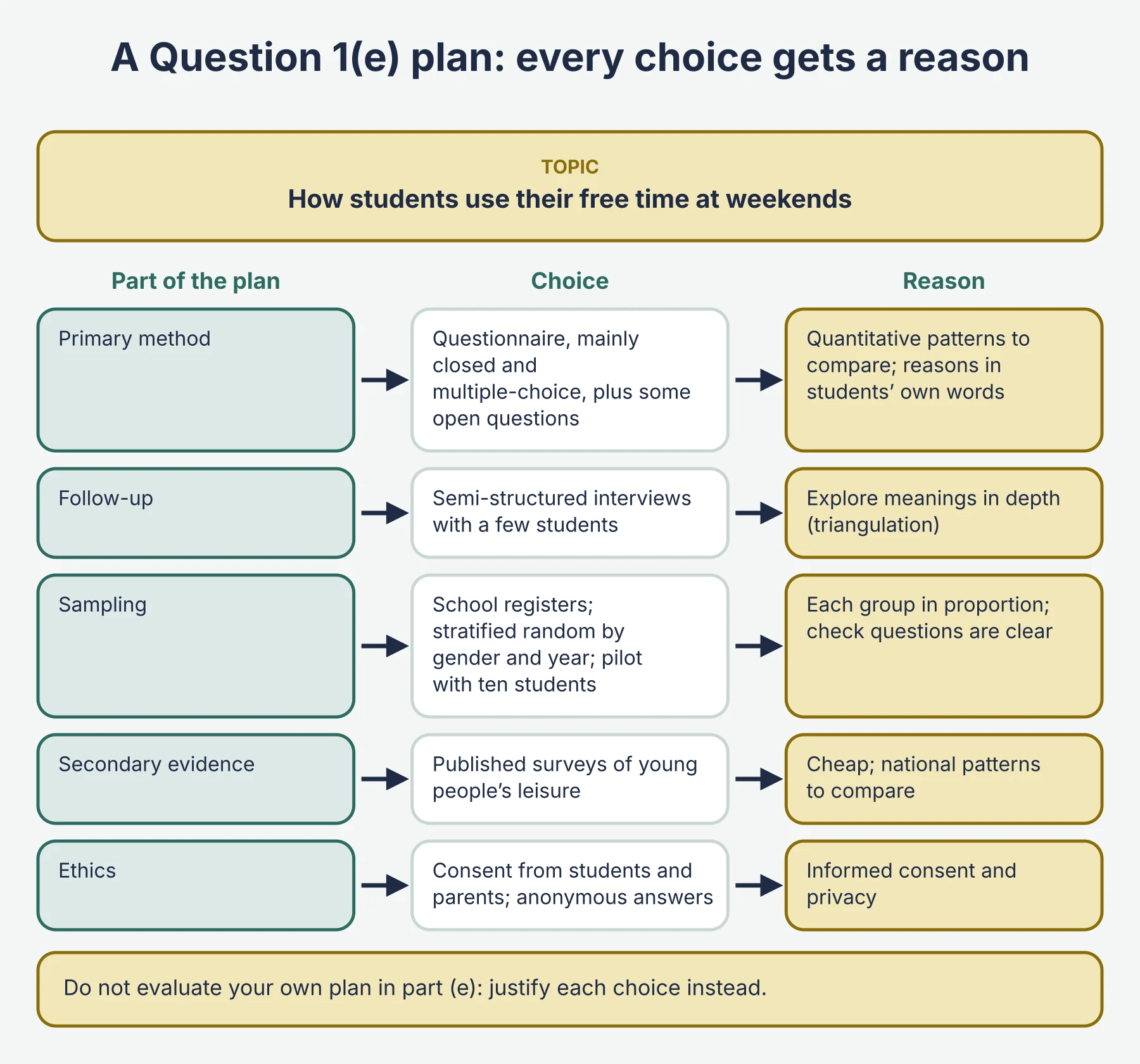
Investigate how students use their free time at weekends.
Primary method. I would use a self-completion questionnaire with mainly closed and multiple- choice questions, such as “How many hours did you spend on sport last weekend?”, because this produces quantitative data on patterns that can be compared between groups. I would add some open questions, such as “Why do you choose these activities?”, to collect reasons in students’ own words. I would follow this with semi-structured interviews with a small number of students to explore meanings in more depth, which is triangulation.
Sampling. My target population is students aged 14–16 in one town. I would use school registers as a sampling frame, after gaining head teachers’ permission, and take a stratified random sample by gender and year group so that each group appears in proportion. I would run a pilot study with ten students to check the questions are clear.
Secondary evidence. I would use published surveys of young people’s leisure, because they are cheap and show national patterns to compare with my local results.
Ethics. I would obtain informed consent from students and their parents and keep answers anonymous.
Every choice is followed by a reason, and the plan is not evaluated, as the syllabus asks.
Common mistakes
- Confusing sampling frame (the list) with sample (the people chosen).
- Calling a questionnaire “unreliable because people lie”. Lying affects validity, not reliability.
- Choosing covert observation for school students without discussing consent.
- Writing “random sampling” when you mean asking whoever is nearby — that is an opportunity sample, not random.
- In part (e), giving a list of methods with no reasons, or spending time on weaknesses.
Exam technique
- Explain a strength or limitation: state it, give the reason, apply it to the topic in the question.
- For evaluate questions on a method, use 1.1 concepts — validity, reliability, representativeness — plus practical and ethical issues, and reach a judgement.
Revise with the how sociologists investigate society revision notes and practise with the investigating society practice questions.
Related resources
-
Practice questions
Cambridge IGCSE Sociology (0495): Research methods – How do sociologists investigate society? – Practice Questions
Original Cambridge IGCSE Sociology 0495 practice on key question 1.3: sampling, interviews, observation, question types and ethics, with mark-scheme answers.
Sociology · Cambridge · IGCSE
Try questions -
Revision notes
Cambridge IGCSE Sociology (0495): Research methods – How do sociologists investigate society? – Revision Notes
Revision notes for Cambridge IGCSE Sociology 0495 key question 1.3: research design, sampling techniques, primary methods, question types and ethics.
Sociology · Cambridge · IGCSE
Revise topic -
Study guides
Cambridge IGCSE Sociology (0495): Identity: self and society – How do we learn our identity?
Cambridge IGCSE Sociology 0495 key question 2.1: social construction, nature and nurture, agencies and processes, and theories of socialisation.
Sociology · Cambridge · IGCSE
Read guide
Related articles
Get free revision emails (optional)
Occasional emails with practice questions, worked explanations and links to free resources for the qualification and subjects you choose. No spam, and you can unsubscribe from any email. The free tools on this site never need an email.