
Study Guides
Cambridge IGCSE Sociology (0495): Identity: self and society – How do we learn our identity?
Cambridge IGCSE Sociology 0495 key question 2.1: social construction, nature and nurture, agencies and processes, and theories of socialisation.
- Subject
- Sociology
- Level
- IGCSE
- Topic
- Paper 1 – Research Methods, Identity and Inequality
- Author
- Marlbridge Academic Team
- Updated
- Reviewed by
- Naqiya Yousaf (what this means)
Aligned to Cambridge IGCSE Sociology (0495), 2025-2027. Official specification .
Syllabus page (what it covers and how it is assessed): Cambridge IGCSE Sociology.
Syllabus points this page covers
0495
- 2.1 Identity: self and society – How do we learn our identity?
Found an error? Report a correction.
Need help with this topic? Request a free trial class for IGCSE Sociology (0495).
Key question 2.1 of Cambridge IGCSE Sociology (0495) asks How do we learn our identity? The sociological answer is that identity is not simply inborn: it is learned through socialisation, the lifelong process by which people learn the culture of their society. To answer exam questions you need the building-block concepts of culture, the nature–nurture debate, the agencies and processes of socialisation, and the competing functionalist, Marxist and feminist interpretations of what socialisation does.
For a short overview of all of Paper 1, see the research methods, identity and inequality guide.
Syllabus coverage
Cambridge IGCSE Sociology 0495, syllabus for 2025, 2026 and 2027, 2.1 How do we learn our identity?
- 2.1.1 (a) Society as a product of social construction: culture, norms, values, customs, roles, status (achieved/ascribed), stereotypes; (b) how these concepts influence individual behaviour and social identity.
- 2.1.2 The social construction of our identity: the nature–nurture debate; the relativity of culture; socialisation; norms and values.
- 2.1.3 Primary and secondary socialisation: key agencies (family, education, peer group, media, religion, workplace); the effectiveness of each agency.
- 2.1.4 Processes used by agencies, e.g. canalisation, hidden curriculum, media representations, peer pressure, religious teachings, role modelling, workplace training.
- 2.1.5 The debate between perspectives: consensus and conflict; functionalist ideas (inadequate socialisation, social cohesion/value consensus); Marxist ideas (socialisation into capitalist ideology, reproduction of social class); feminist ideas (gender role socialisation into masculinity/femininity).
The building blocks of culture (2.1.1)
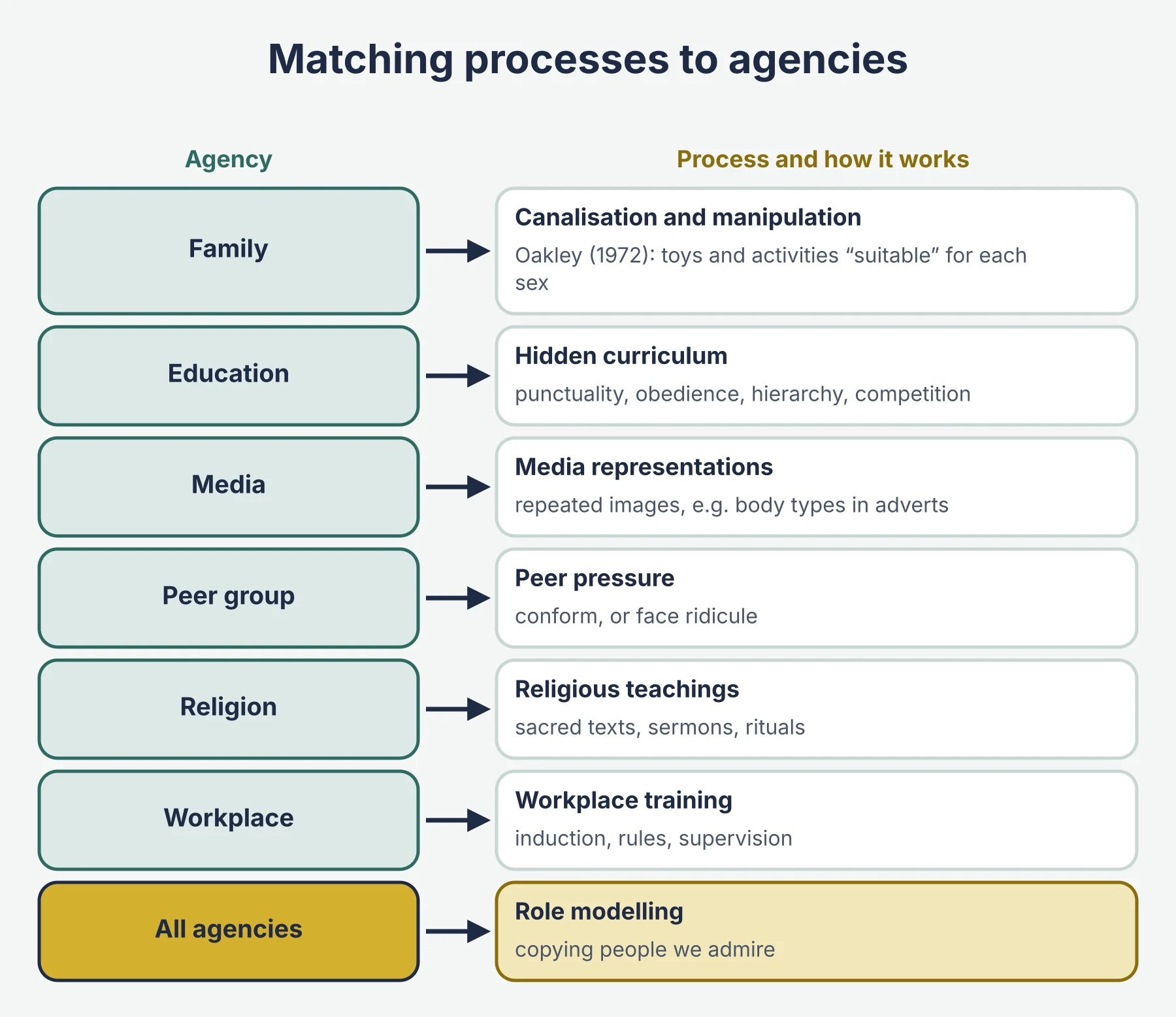
Social construction means that something is created by people in society rather than fixed by nature. Seven concepts describe what is constructed.
| Concept | Meaning | Example of influence on behaviour and identity |
|---|---|---|
| Culture | The whole way of life of a group: language, beliefs, knowledge, customs, food, dress | Gives people a sense of who “we” are |
| Values | Broad beliefs about what is good and important | A value placed on education leads families to invest in tutoring |
| Norms | Specific rules of expected behaviour, usually based on values | Queuing; removing shoes before entering a home |
| Customs | Traditional, long-established practices passed between generations | Wedding rituals; festival foods |
| Roles | Expected patterns of behaviour attached to a position | A “good student” is expected to arrive on time and listen |
| Status | A position in society and the prestige attached to it — ascribed (given at birth) or achieved (earned) | A royal title is ascribed; a doctor’s status is achieved |
| Stereotypes | Fixed, oversimplified generalisations about a group | Assuming boys are naturally bad at caring roles can steer career choices |
The link between them matters: values underpin norms; norms define roles; roles attach to statuses; and stereotypes can push people into roles regardless of their own abilities. Together they shape how people behave and how they see themselves.
Nature or nurture? (2.1.2)
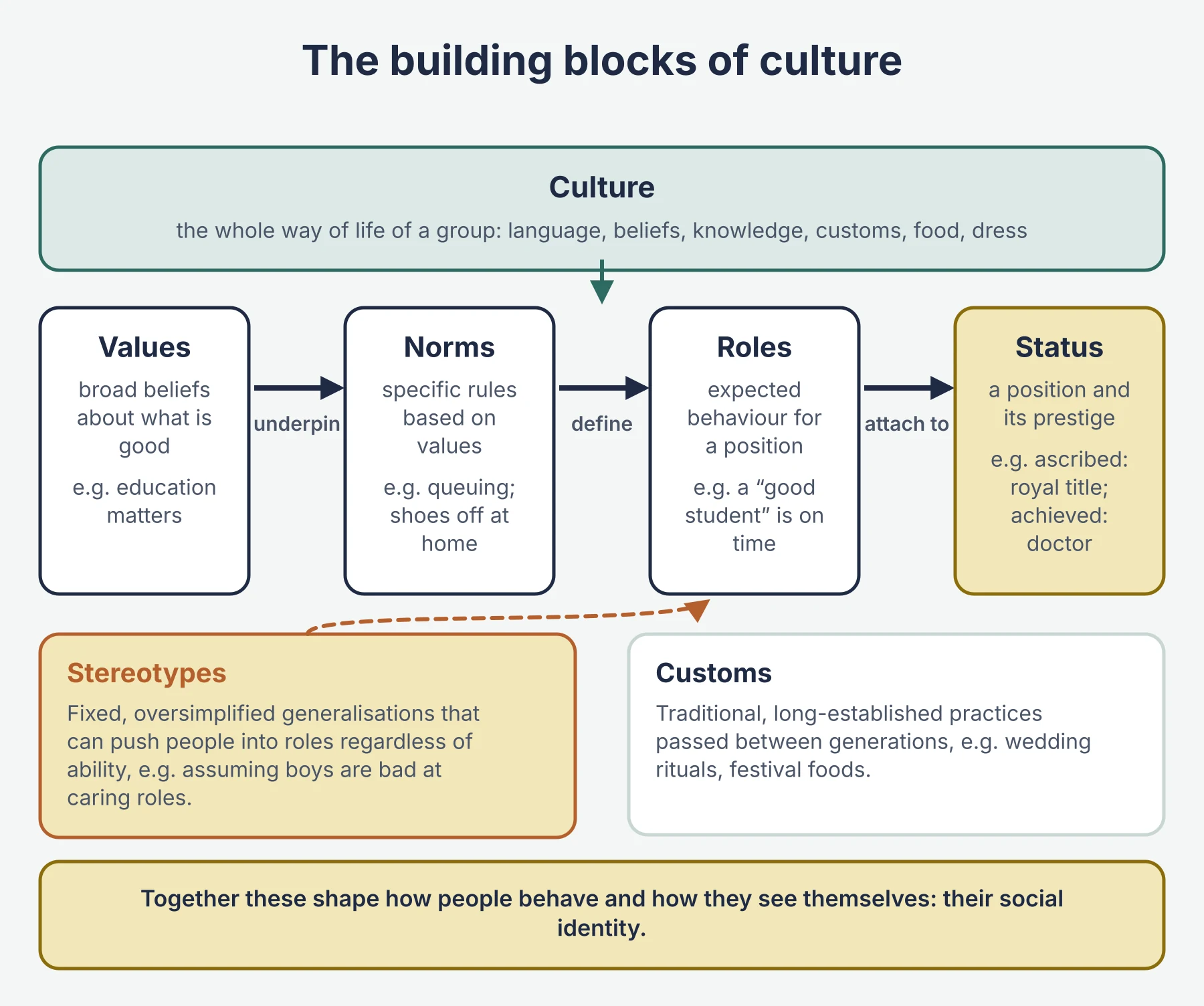
The nature view says behaviour is mainly inborn — genes, instincts, hormones. The nurture view, which sociologists emphasise, says behaviour is mainly learned through socialisation. Three kinds of evidence support nurture.
- Feral and isolated children. “Genie”, discovered in Los Angeles in 1970 at the age of 13 after being kept in severe isolation, could not speak and had great difficulty learning language and social behaviour afterwards. Such cases suggest that without early socialisation humans do not develop normal language or social skills. However, cases are rare, and some children may have had disabilities from birth, so the evidence must be treated with care.
- The relativity of culture. Norms and values differ between societies and over time, which would not happen if behaviour were fixed by biology. Margaret Mead’s Sex and Temperament in Three Primitive Societies (1935) described three groups in New Guinea — the Arapesh, Mundugumor and Tchambuli — with very different expectations of how men and women should behave. Mead’s fieldwork has since been questioned, but the wider point that gender norms vary is well supported.
- Change within one society. Expectations about women’s paid work or men’s role in childcare have changed within a few generations, far too fast for genetic change.
A balanced answer accepts that biology sets some limits (for example, physical maturation) but argues that the meaning attached to biology is learned.
Primary and secondary socialisation (2.1.3)
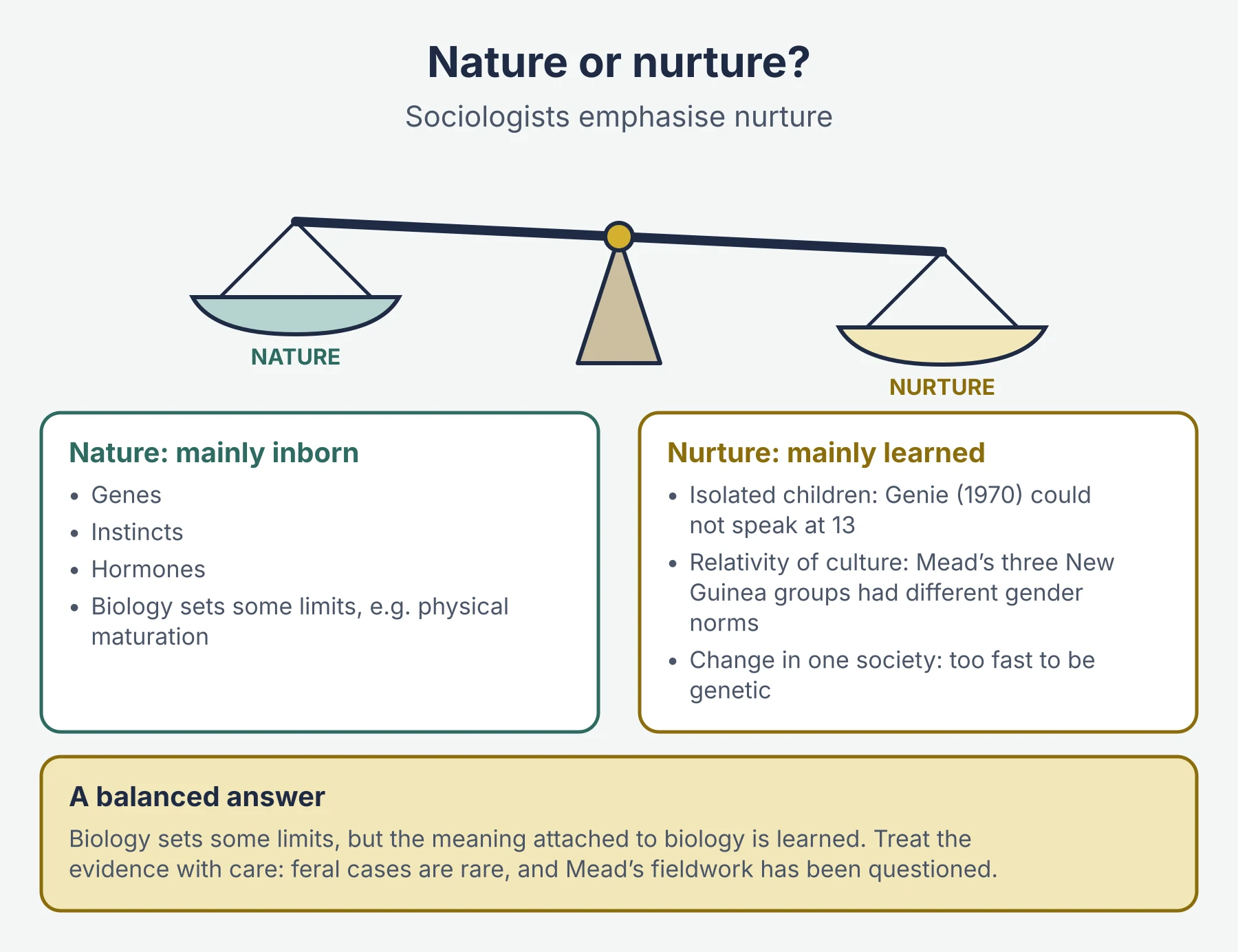
Primary socialisation takes place in early childhood, mainly within the family, and teaches language, basic norms, emotional ties and early gender identity. Secondary socialisation continues through later childhood and adult life through education, the peer group, the media, religion and the workplace.
How effective is each agency?
| Agency | Why it can be effective | Limits on its effectiveness |
|---|---|---|
| Family | Earliest and most emotionally powerful; constant contact | Families differ; some fail to socialise children adequately; influence weakens in adolescence |
| Education | Many years of daily attendance; formal and hidden curricula | Anti-school subcultures reject school values (Willis, 1977) |
| Peer group | Strong in adolescence; acceptance matters greatly | Peer groups vary; individuals belong to several |
| Media | Constant exposure; reaches across the world; role models and representations | Audiences interpret and reject messages actively |
| Religion | Moral rules backed by belief and community | Influence varies greatly between and within societies |
| Workplace | Teaches occupational norms, time discipline, professional identity | Only affects adults in work; people may comply without accepting values |
Effectiveness is always relative: an agency may be strong for one group or at one life stage and weak for another.
How do agencies socialise us? (2.1.4)
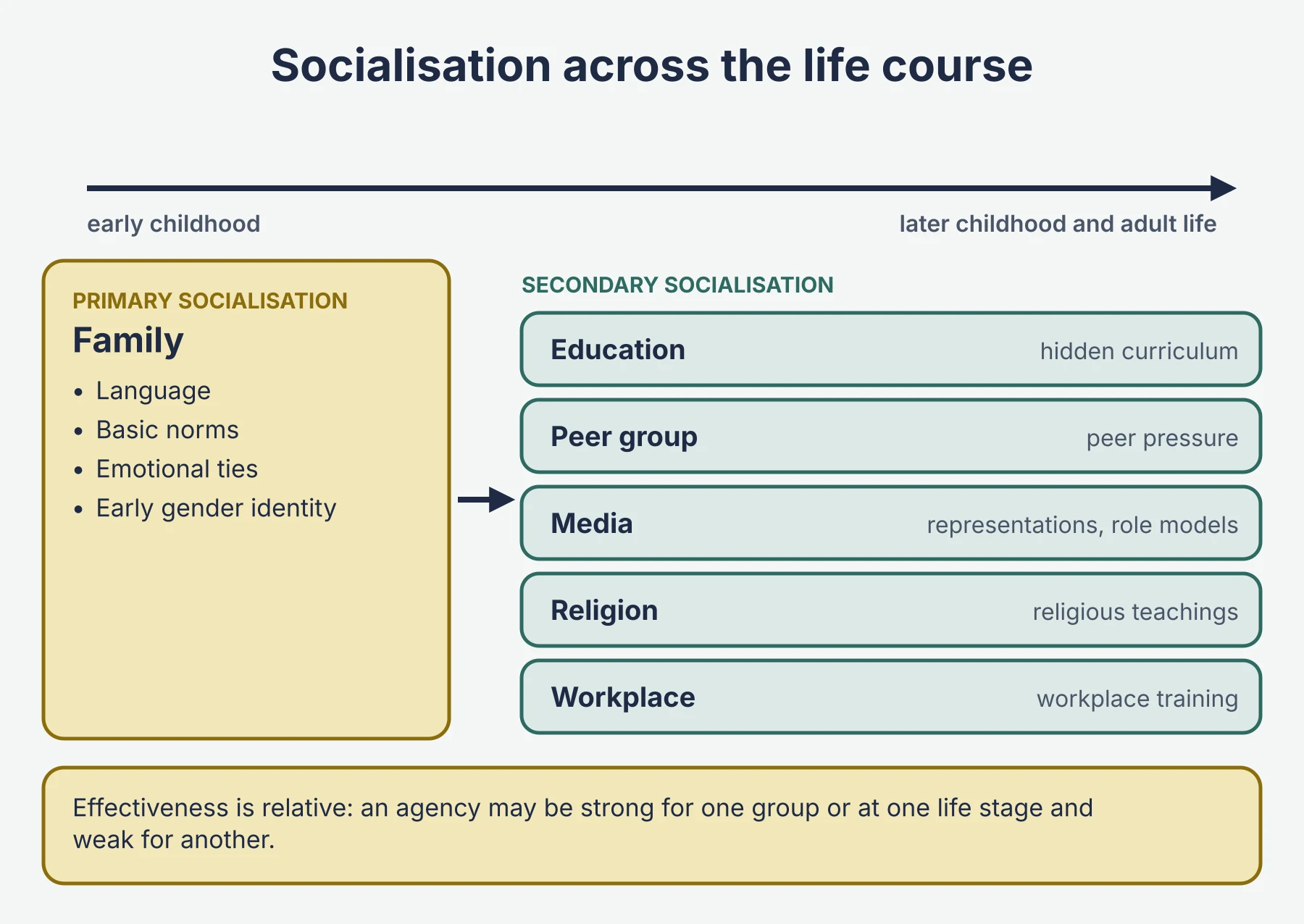
The syllabus gives examples of processes. Learn to match each process to an agency and explain how it works.
- Canalisation (family) — Ann Oakley (Sex, Gender and Society, 1972) described how parents channel children’s interests towards toys and activities seen as suitable for their sex, such as dolls for girls and construction toys for boys. Oakley also identified manipulation — encouraging behaviour seen as appropriate for the child’s sex and discouraging other behaviour.
- Hidden curriculum (education) — the lessons taught by the way school is organised rather than by the timetable: punctuality, obedience, accepting hierarchy, competition.
- Media representations (media) — repeated images of groups, such as particular body types in advertising, shape what audiences see as normal or desirable.
- Peer pressure (peer group) — the pressure to conform to friends’ norms, backed by acceptance or ridicule.
- Religious teachings (religion) — sacred texts, sermons and rituals teach moral codes, for example about honesty or family duty.
- Role modelling (all agencies) — learning by copying people we admire, such as parents, teachers, celebrities or older siblings.
- Workplace training (workplace) — induction, rules and supervision teach the norms of a job, from dress codes to customer manners.
Theories of socialisation (2.1.5)
Consensus theories see socialisation as creating shared values that benefit everyone; conflict theories see it as serving powerful groups.
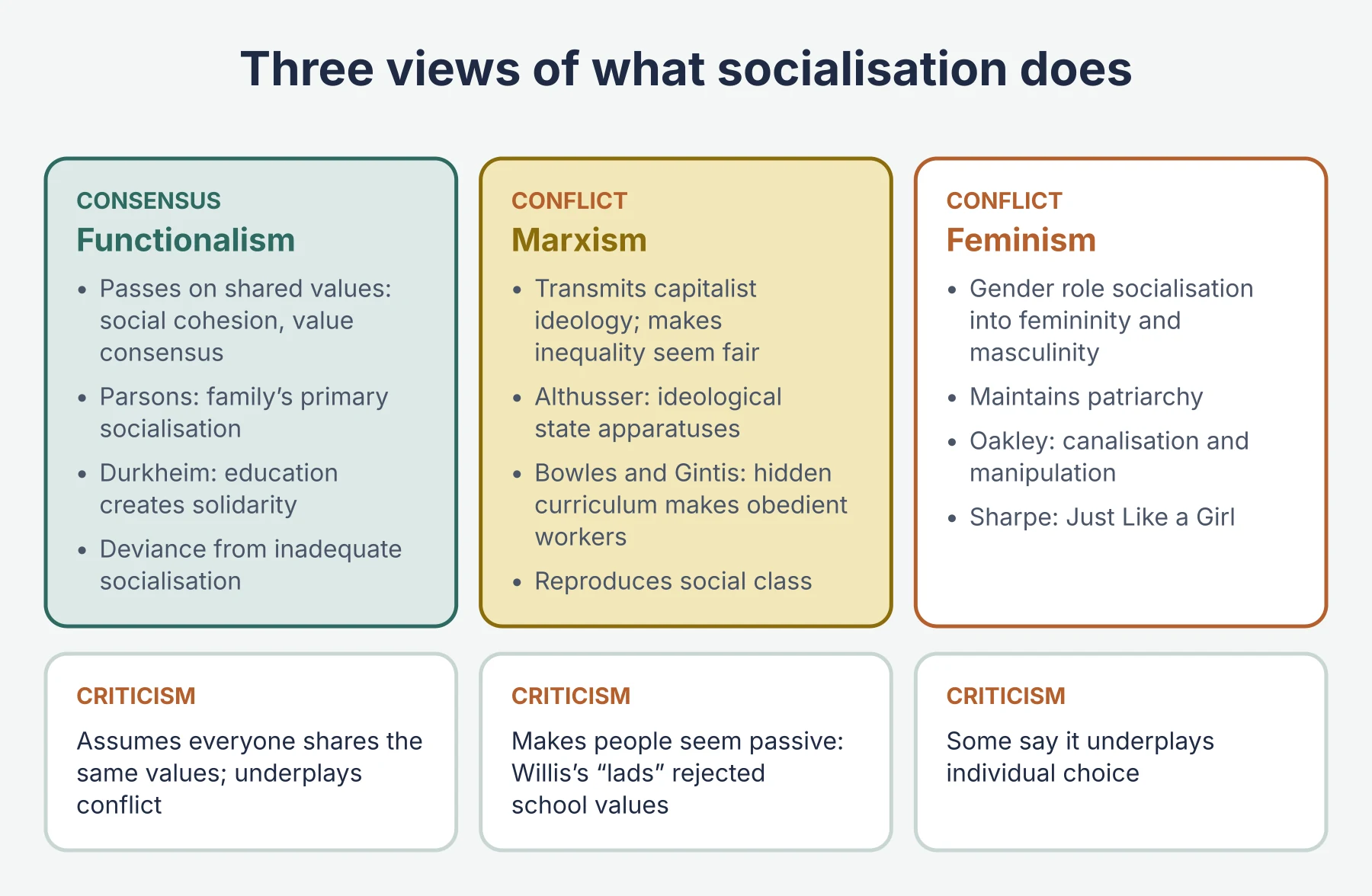
Functionalism (consensus). Talcott Parsons argued that the family’s basic functions include the primary socialisation of children, so that they internalise society’s values. Émile Durkheim saw education as passing on shared values and creating social cohesion (solidarity). Functionalists explain deviance partly through inadequate socialisation — if families or schools fail to pass on values, individuals may not conform.
Marxism (conflict). Marxists argue socialisation transmits capitalist ideology — ideas that make inequality seem fair, such as the belief that success depends only on effort. Louis Althusser (1971) called institutions such as schools, religion and the media “ideological state apparatuses”. Samuel Bowles and Herbert Gintis (Schooling in Capitalist America, 1976) argued that the hidden curriculum prepares working-class students to be obedient workers, so schooling reproduces social class rather than overcoming it.
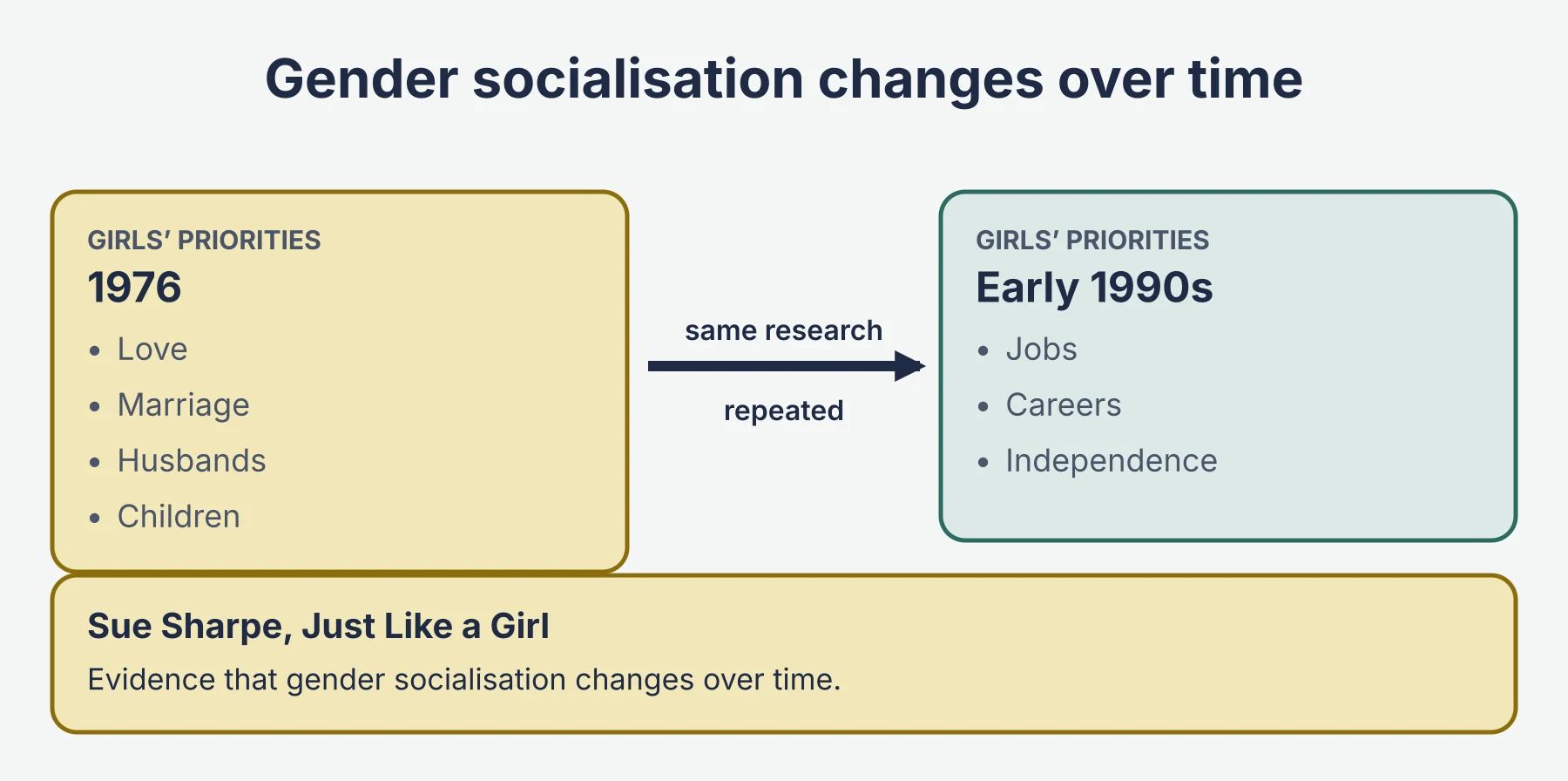
Feminism (conflict). Feminists argue that gender role socialisation teaches girls femininity (caring, appearance, domestic roles) and boys masculinity (toughness, competition), maintaining patriarchy. Oakley’s canalisation and manipulation are examples. Sue Sharpe’s study Just Like a Girl (1976) found that girls’ priorities were love, marriage, husbands and children; when she repeated the research in the early 1990s, girls’ priorities had shifted towards jobs, careers and independence — evidence that gender socialisation changes over time.
Evaluation points. Functionalism assumes everyone shares the same values and underplays conflict. Marxism can make people seem passive — Willis’s “lads” rejected school values rather than absorbing them. Feminism has shown that gender socialisation changes, as Sharpe’s repeat study suggests, and some critics say it underplays individual choice.
Worked example: a Question 2(e)-style “discuss”
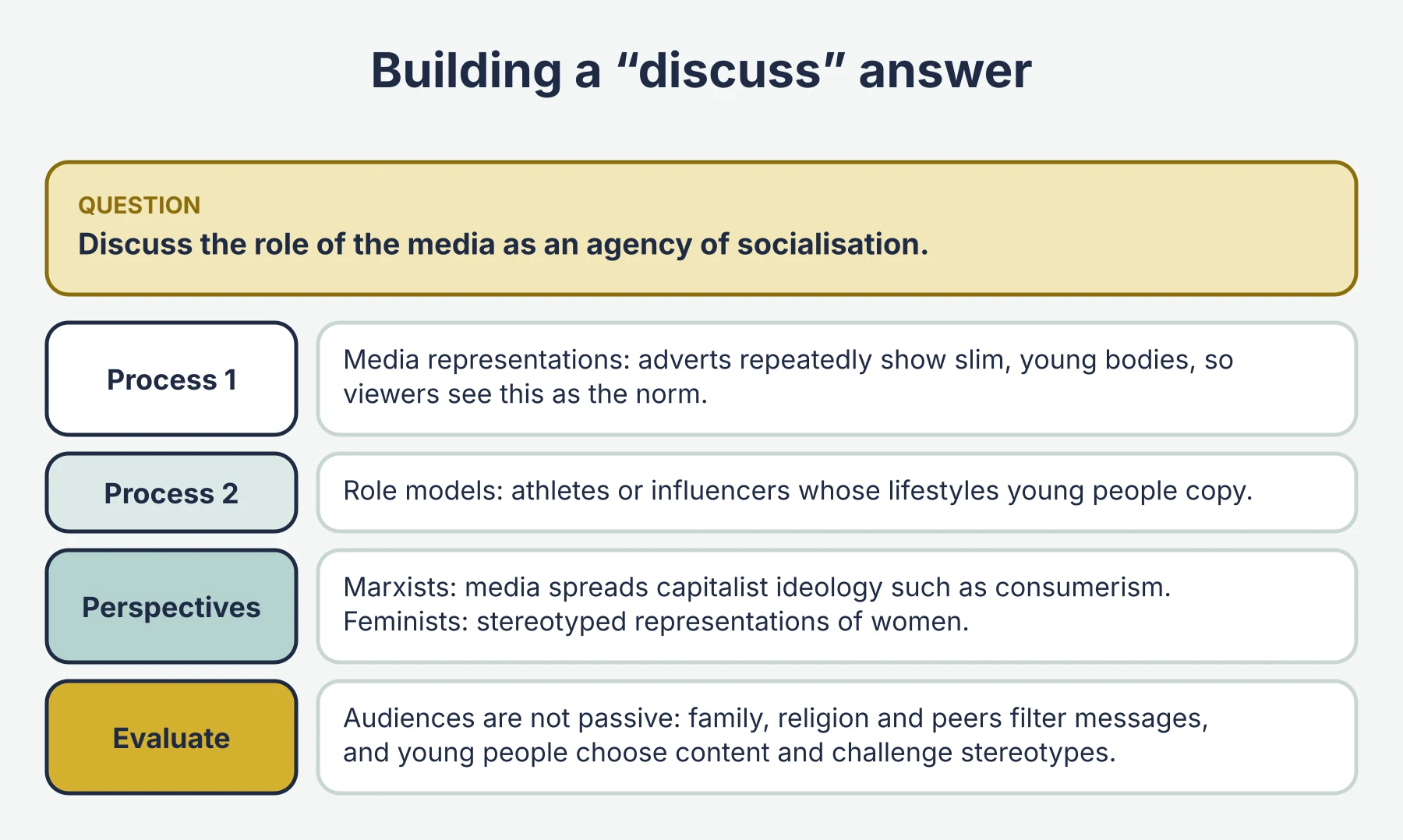
Discuss the role of the media as an agency of socialisation.
The media is an important agency of secondary socialisation because people of all ages spend many hours each day watching, reading and scrolling. It works through media representations: when advertisements repeatedly show slim, young bodies as attractive, viewers may come to see this as the norm and judge themselves against it. It also provides role models, such as athletes or influencers whose lifestyles young people copy.
Marxists argue the media spreads capitalist ideology, for example by encouraging consumerism. Feminists point to stereotyped representations of women.
However, audiences are not passive. People interpret messages differently according to their family, religion and peer group, and many young people now choose the content they consume and challenge stereotypes online. The media’s influence is therefore strong but filtered through other agencies.
Why it works: it names processes from the syllabus, applies two perspectives, and evaluates.
Common mistakes
- Defining norms and values the same way. Values are broad ideals; norms are specific rules.
- Saying ascribed status is “what others think of you”. It is status given at birth.
- Listing agencies without explaining processes or effectiveness.
- Treating feral children as proof that biology plays no role.
- Forgetting that Marxists and feminists are both conflict theories.
Exam technique
- Define (precise meaning) — one sentence plus a short example.
- Explain (reasons, how or why, with evidence) — process, how it works, an example.
- Discuss — several developed points, ideally including perspectives, in paragraphs.
- Evaluate — for example “Evaluate the view that the family is the most important agency of socialisation”: arguments for, arguments against (other agencies, adolescence, media), and a judgement.
Revise with the learning our identity revision notes and test yourself with the learning our identity practice questions. Social control follows in the study guide for key question 2.2.
Related resources
-
Practice questions
Cambridge IGCSE Sociology (0495): Identity: self and society – How do we learn our identity? – Practice Questions
Original Cambridge IGCSE Sociology 0495 practice on key question 2.1: culture, nature and nurture, and the agencies and theories of socialisation.
Sociology · Cambridge · IGCSE
Try questions -
Revision notes
Cambridge IGCSE Sociology (0495): Identity: self and society – How do we learn our identity? – Revision Notes
Revision notes for Cambridge IGCSE Sociology 0495 key question 2.1: culture and status, nature and nurture, agencies and processes of socialisation, theories.
Sociology · Cambridge · IGCSE
Revise topic -
Study guides
Cambridge IGCSE Sociology (0495): Identity: self and society – How does society control us?
Cambridge IGCSE Sociology 0495 key question 2.2: formal and informal control, sanctions, consensus and conflict views, agencies, surveillance and resistance.
Sociology · Cambridge · IGCSE
Read guide
Related articles
Get free revision emails (optional)
Occasional emails with practice questions, worked explanations and links to free resources for the qualification and subjects you choose. No spam, and you can unsubscribe from any email. The free tools on this site never need an email.