
Revision Notes
Cambridge IGCSE Sociology (0495): Identity: self and society – How do we learn our identity? – Revision Notes
Revision notes for Cambridge IGCSE Sociology 0495 key question 2.1: culture and status, nature and nurture, agencies and processes of socialisation, theories.
- Subject
- Sociology
- Level
- IGCSE
- Topic
- Paper 1 – Research Methods, Identity and Inequality
- Author
- Marlbridge Academic Team
- Updated
- Reviewed by
- Naqiya Yousaf (what this means)
Aligned to Cambridge IGCSE Sociology (0495), 2025-2027. Official specification .
Syllabus page (what it covers and how it is assessed): Cambridge IGCSE Sociology.
Syllabus points this page covers
0495
- 2.1 Identity: self and society – How do we learn our identity?
Found an error? Report a correction.
Need help with this topic? Request a free trial class for IGCSE Sociology (0495).
Key question 2.1 of Cambridge IGCSE Sociology (0495) asks How do we learn our identity? In short: identity is socially constructed. We learn culture — values, norms, customs, roles and statuses — through primary socialisation in the family and secondary socialisation through education, peers, media, religion and work. Evidence from isolated children and cultural variation supports nurture over nature. Functionalists see socialisation as building consensus; Marxists and feminists see it as reproducing class and gender inequality.
Full explanations are in the learning our identity study guide.
Syllabus coverage
0495 syllabus 2025–2027, 2.1:
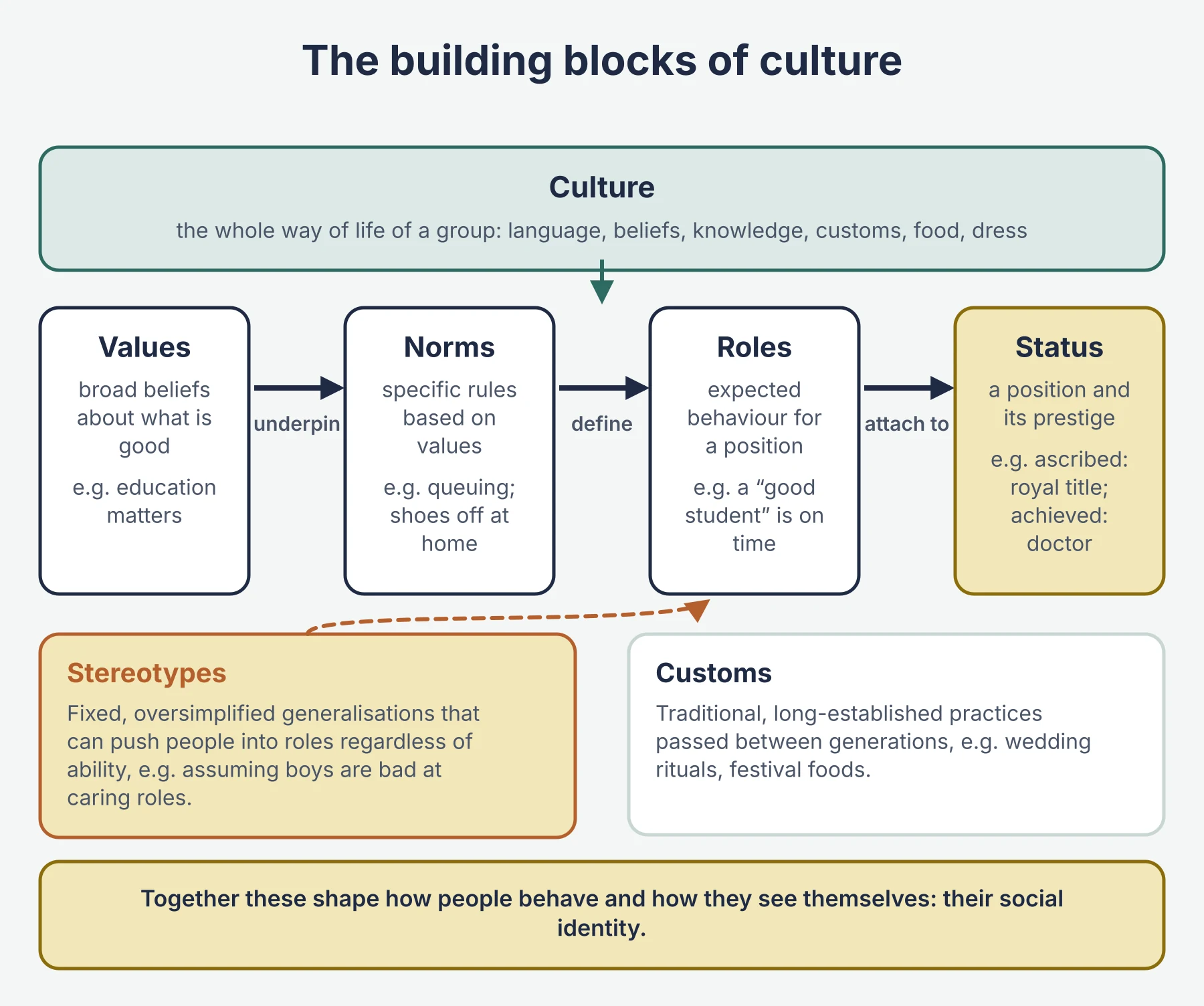
- 2.1.1 Culture, norms, values, customs, roles, status (achieved/ascribed), stereotypes, and how they influence behaviour and identity.
- 2.1.2 Nature–nurture debate; relativity of culture; socialisation; norms and values.
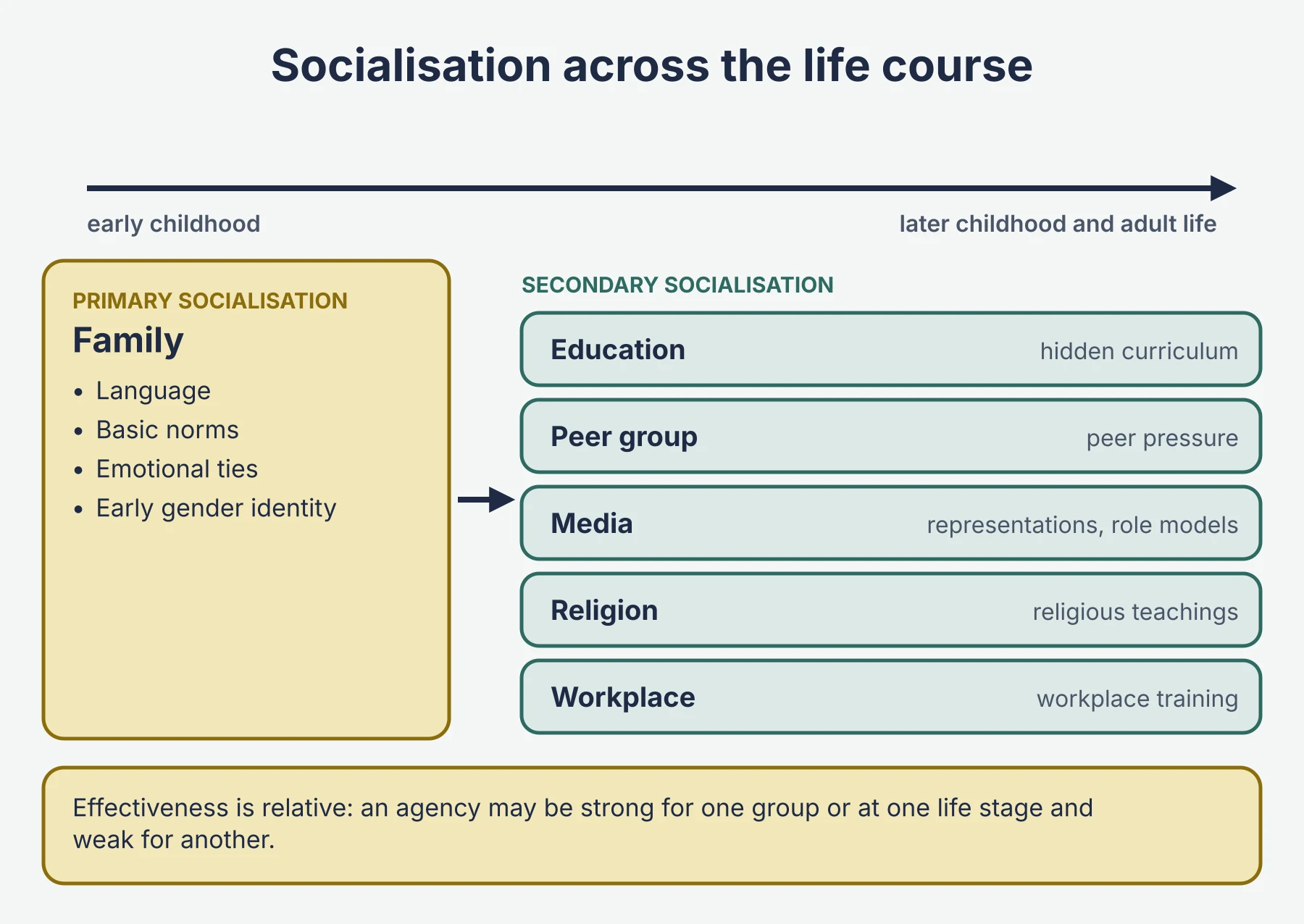
- 2.1.3 Primary and secondary socialisation; family, education, peer group, media, religion, workplace; effectiveness of each.
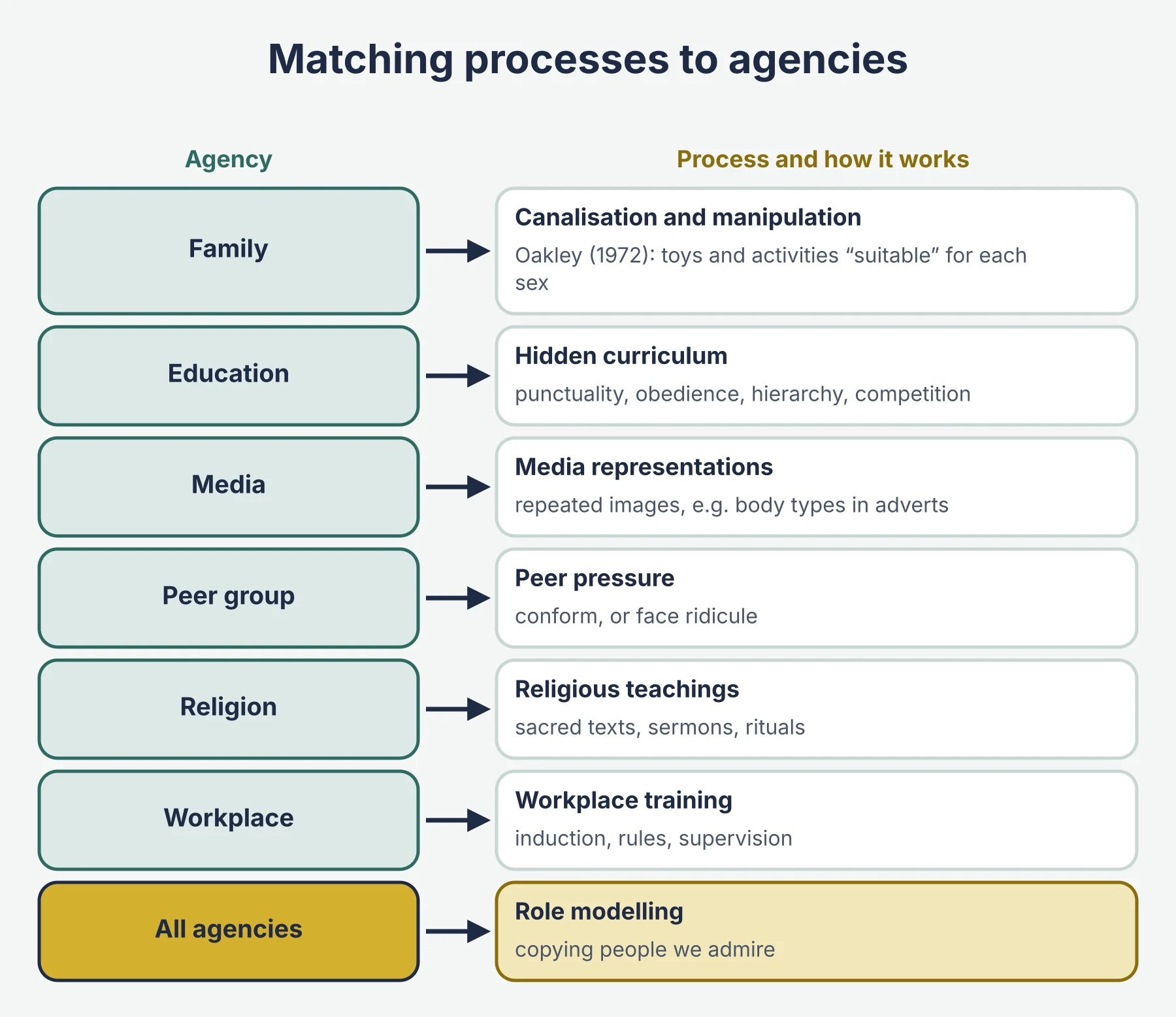
- 2.1.4 Processes, e.g. canalisation, hidden curriculum, media representations, peer pressure, religious teachings, role modelling, workplace training.
- 2.1.5 Consensus and conflict; functionalist, Marxist and feminist ideas on socialisation.
Key terms
| Term | Definition |
|---|---|
| Social construction | Something created and given meaning by society rather than fixed by nature |
| Culture | The shared way of life of a group |
| Values | General beliefs about what is good and worthwhile |
| Norms | Specific expected rules of behaviour |
| Customs | Long-established traditional practices |
| Role | Behaviour expected of someone in a particular position |
| Ascribed status | Position given at birth, e.g. caste, royal title |
| Achieved status | Position earned through effort or ability, e.g. a qualification |
| Stereotype | Oversimplified, fixed generalisation about a group |
| Socialisation | Lifelong process of learning a society’s culture |
| Cultural relativity | Norms and values vary between societies and over time |
| Canalisation | Channelling children towards gender-typed toys and activities |
| Hidden curriculum | What school teaches through its organisation, not lessons |
| Ideology | Ideas that justify the interests of a powerful group |
Nature versus nurture
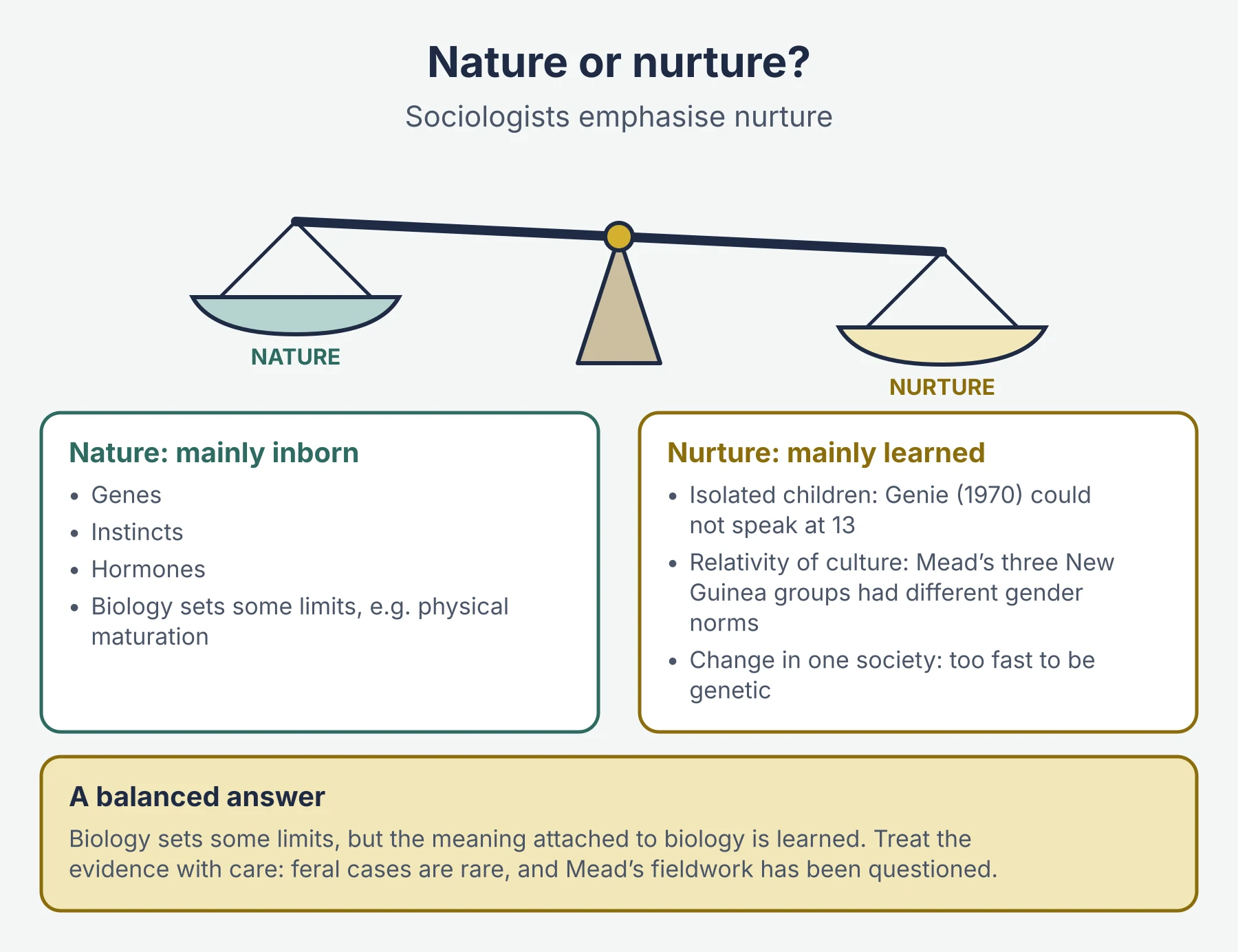
- Nature: behaviour inborn — genes, instincts.
- Nurture: behaviour learned through socialisation (sociologists’ emphasis).
- Evidence for nurture: isolated children such as “Genie” (found in 1970 aged 13, unable to speak); cultural variation, e.g. Mead (1935) on gender in three New Guinea societies; rapid change in norms within one society.
- Caution: feral cases are few and may involve other factors; Mead’s fieldwork has been questioned.
Agencies, processes and effectiveness
| Agency | Type | Key process | Effectiveness point |
|---|---|---|---|
| Family | Primary | Canalisation, manipulation, role modelling | Strongest early, weaker in adolescence |
| Education | Secondary | Hidden curriculum, rewards and punishments | Resisted by anti-school subcultures |
| Peer group | Secondary | Peer pressure | Very strong for teenagers |
| Media | Secondary | Media representations, role models | Audiences interpret actively |
| Religion | Secondary | Religious teachings, rituals | Varies by society and individual |
| Workplace | Secondary | Workplace training, induction | Adults may comply without believing |
Perspectives
| Perspective | Type | Key ideas | Names |
|---|---|---|---|
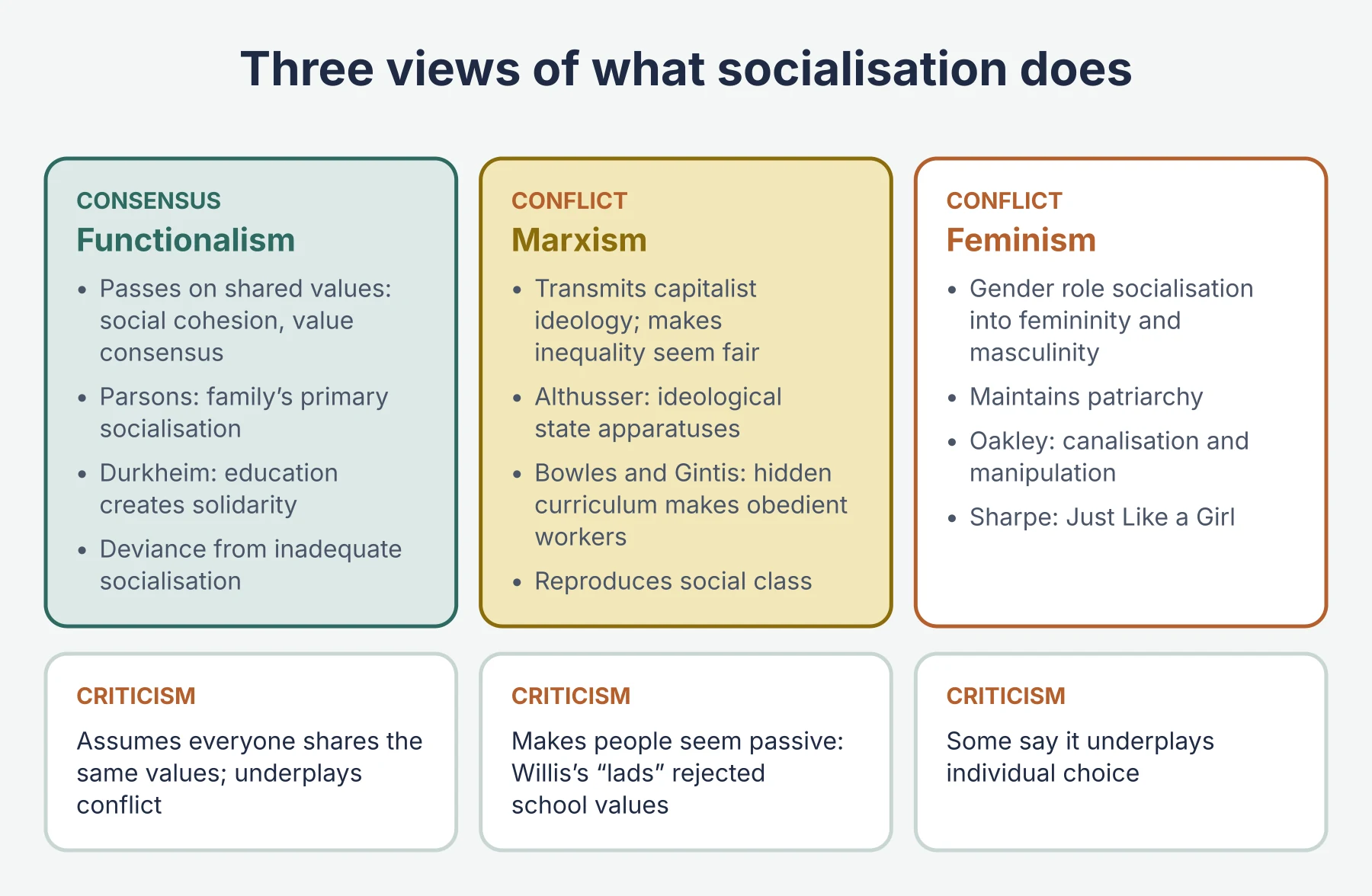
| Functionalism | Consensus | Shared values; social cohesion; inadequate socialisation explains deviance | Parsons; Durkheim |
| Marxism | Conflict | Socialisation into capitalist ideology; reproduction of social class | Althusser (1971); Bowles and Gintis (1976) |
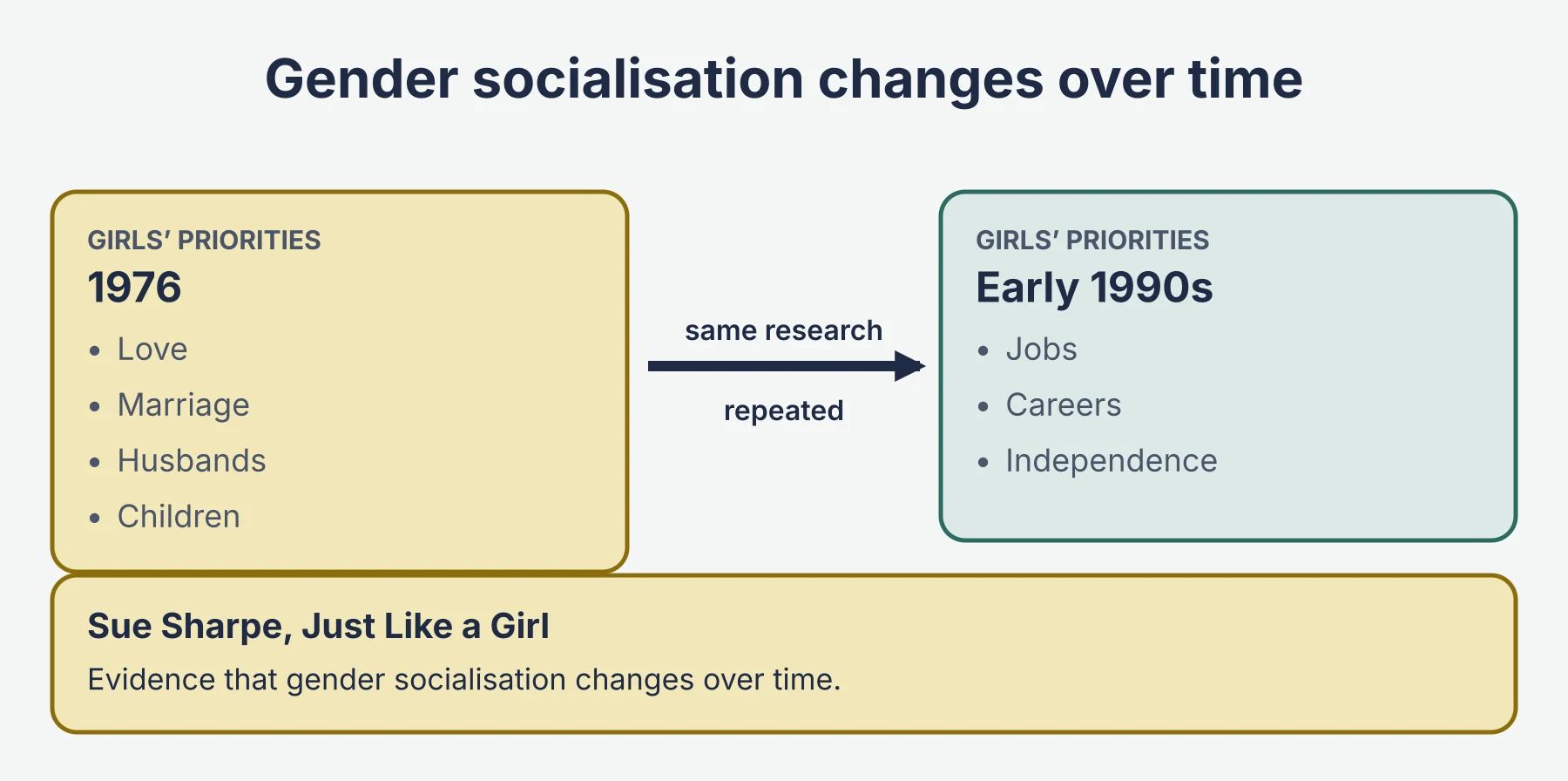
| Feminism | Conflict | Gender role socialisation into masculinity and femininity maintains patriarchy | Oakley (1972); Sharpe (1976, repeated early 1990s) |
Criticisms: functionalism ignores conflict and assumes shared values; Marxism treats people as passive (Willis’s lads resisted); feminism may underplay change and individual choice.
Exam traps
- Values and norms are not the same — give one of each in definitions.
- Ascribed ≠ “given by others”; it means given at birth.
- An agency is who socialises; a process is how. Questions on “processes” need the how.
- Peer pressure can encourage conformity to deviant norms as well as mainstream ones.
- Do not claim feral children “prove” nature plays no part.
Worked example: a 6-mark “explain” answer
Explain three ways the workplace socialises adults. (practice)
- Workplace training — induction courses teach rules, dress codes and how to treat customers, so new employees learn occupational norms.
- Role modelling — new workers copy experienced colleagues, learning informal norms such as how hard to work and how to speak to managers.
- Sanctions — promotion, praise or warnings reward or punish behaviour, so workers internalise expectations such as punctuality.
Self-test
- Define norms.
- Give one example of ascribed status and one of achieved status.
- What does “cultural relativity” mean?
- How does the case of “Genie” support the nurture view?
- What is the difference between primary and secondary socialisation?
- Explain canalisation with an example.
- What is the hidden curriculum?
- Which agency is most associated with peer pressure?
- What do functionalists mean by inadequate socialisation?
- What did Bowles and Gintis argue about schooling?
- What change did Sharpe find when she repeated her study of girls?
- Name two conflict perspectives on socialisation.
Answers
- Specific rules or expectations about how to behave in a situation.
- Ascribed: sex, caste, royal title. Achieved: a degree, a job as a lawyer.
- That norms and values differ between societies and over time, so no single culture is “natural”.
- Without early socialisation she could not speak or behave normally, suggesting such skills are learned.
- Primary happens in early childhood, mainly in the family; secondary continues through life through other agencies.
- Parents channel children towards gender-typed toys or activities, e.g. dolls for girls, toy cars for boys.
- Lessons learned from the way school is organised, such as obedience and punctuality, not taught formally.
- The peer group.
- When families or other agencies fail to pass on society’s values, individuals may not conform.
- The hidden curriculum prepares working-class students to be obedient workers, reproducing class inequality.
- Girls’ priorities had shifted from love and marriage towards jobs, careers and independence.
- Marxism and feminism.
Related pages: learning our identity practice questions | Paper 1 revision notes
Related resources
-
Study guides
Cambridge IGCSE Sociology (0495): Identity: self and society – How does society control us?
Cambridge IGCSE Sociology 0495 key question 2.2: formal and informal control, sanctions, consensus and conflict views, agencies, surveillance and resistance.
Sociology · Cambridge · IGCSE
Read guide -
Practice questions
Cambridge IGCSE Sociology (0495): Identity: self and society – How does society control us? – Practice Questions
Original Cambridge IGCSE Sociology 0495 practice on key question 2.2: sanctions, police, surveillance, theories of control and sub-cultures, with full answers.
Sociology · Cambridge · IGCSE
Try questions -
Revision notes
Cambridge IGCSE Sociology (0495): Identity: self and society – How does society control us? – Revision Notes
Revision notes for Cambridge IGCSE Sociology 0495 key question 2.2: sanctions, formal and informal agencies, surveillance, theories of control and resistance.
Sociology · Cambridge · IGCSE
Revise topic
Related articles
Get free revision emails (optional)
Occasional emails with practice questions, worked explanations and links to free resources for the qualification and subjects you choose. No spam, and you can unsubscribe from any email. The free tools on this site never need an email.