
Revision Notes
Cambridge IGCSE Sociology (0495): Identity: self and society – How does society control us? – Revision Notes
Revision notes for Cambridge IGCSE Sociology 0495 key question 2.2: sanctions, formal and informal agencies, surveillance, theories of control and resistance.
- Subject
- Sociology
- Level
- IGCSE
- Topic
- Paper 1 – Research Methods, Identity and Inequality
- Author
- Marlbridge Academic Team
- Updated
- Reviewed by
- Naqiya Yousaf (what this means)
Aligned to Cambridge IGCSE Sociology (0495), 2025-2027. Official specification .
Syllabus page (what it covers and how it is assessed): Cambridge IGCSE Sociology.
Syllabus points this page covers
0495
- 2.2 Identity: self and society – How does society control us?
Found an error? Report a correction.
Need help with this topic? Request a free trial class for IGCSE Sociology (0495).
Key question 2.2 of Cambridge IGCSE Sociology (0495) asks How does society control us? In short: societies produce conformity through formal control (written laws enforced by state agencies) and informal control (unwritten norms enforced by family, school, peers, media, religion and work), both using positive and negative sanctions. Functionalists see control as protecting shared values; Marxists and feminists see it as protecting class and male power. Some people resist through protest groups and sub-cultures.
The full explanation is in the study guide for key question 2.2.
Syllabus coverage
0495 syllabus 2025–2027, 2.2:
- 2.2.1 Formal and informal control; positive and negative sanctions; their effectiveness.
- 2.2.2 Consensus and conflict views: functionalism, Marxism, feminism.
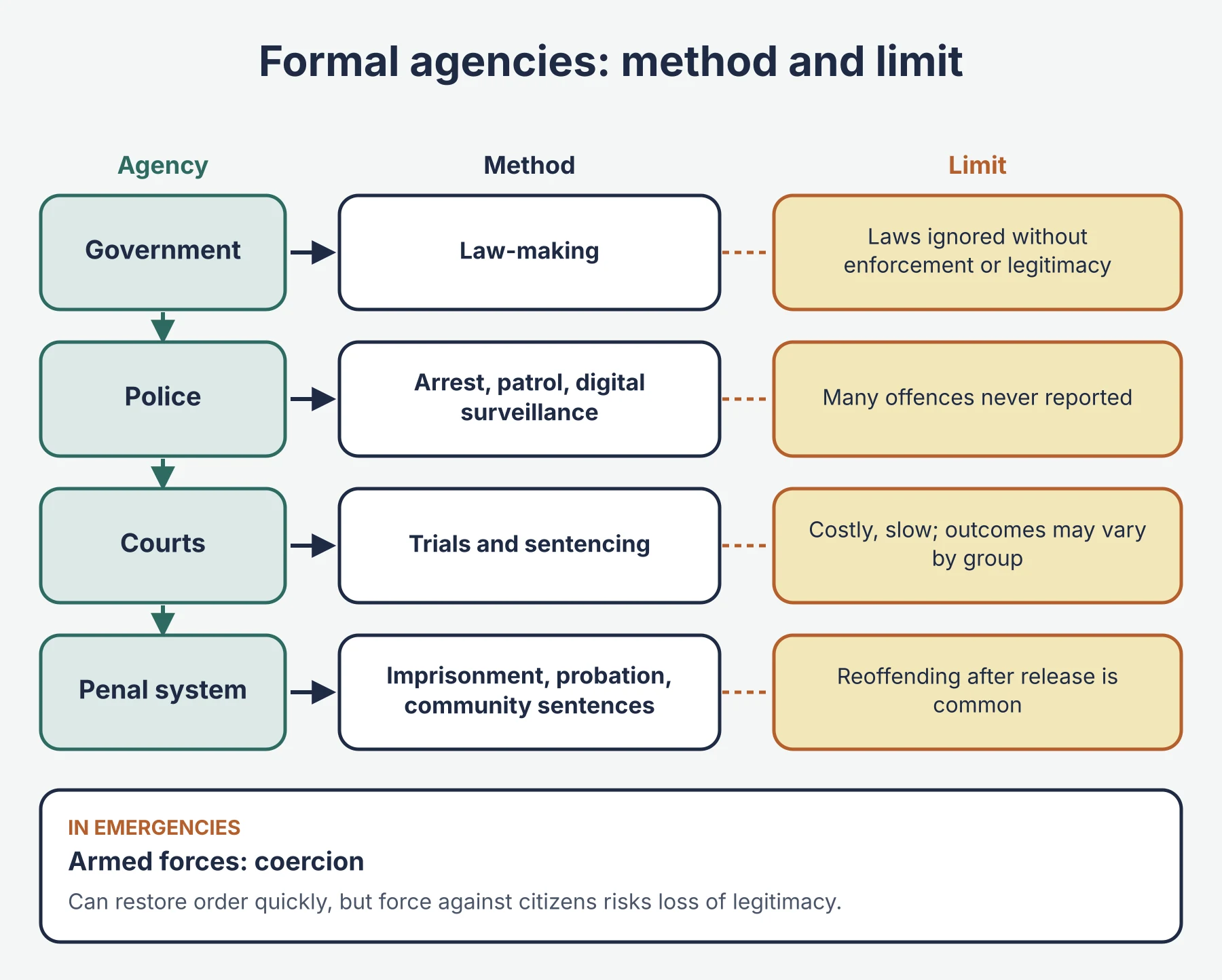
- 2.2.3 Effectiveness of government, police, courts, penal system, armed forces.
- 2.2.4 Law-making, coercion, digital surveillance, arrest, sentencing, imprisonment.
- 2.2.5 Effectiveness of family, education, peer group, media, religion, workplace.
- 2.2.6 Sanctions, e.g. ostracism, parental rewards, social media “likes”, religious rewards/sanctions, school punishments, dismissal from a job.
- 2.2.7 Protest groups and sub-cultures: why people join; deviant and non-conformist behaviour; protest, online, youth and religious examples.
Key terms
| Term | Definition |
|---|---|
| Social conformity | Behaving in line with society’s norms and laws |
| Sanction | A reward or punishment that encourages conformity |
| Legitimacy | Acceptance that a rule or authority is rightful and fair |
| Law-making | Government creating written rules backed by penalties |
| Repressive state apparatus | Agencies that control by force — police, courts, prisons, army (Althusser) |
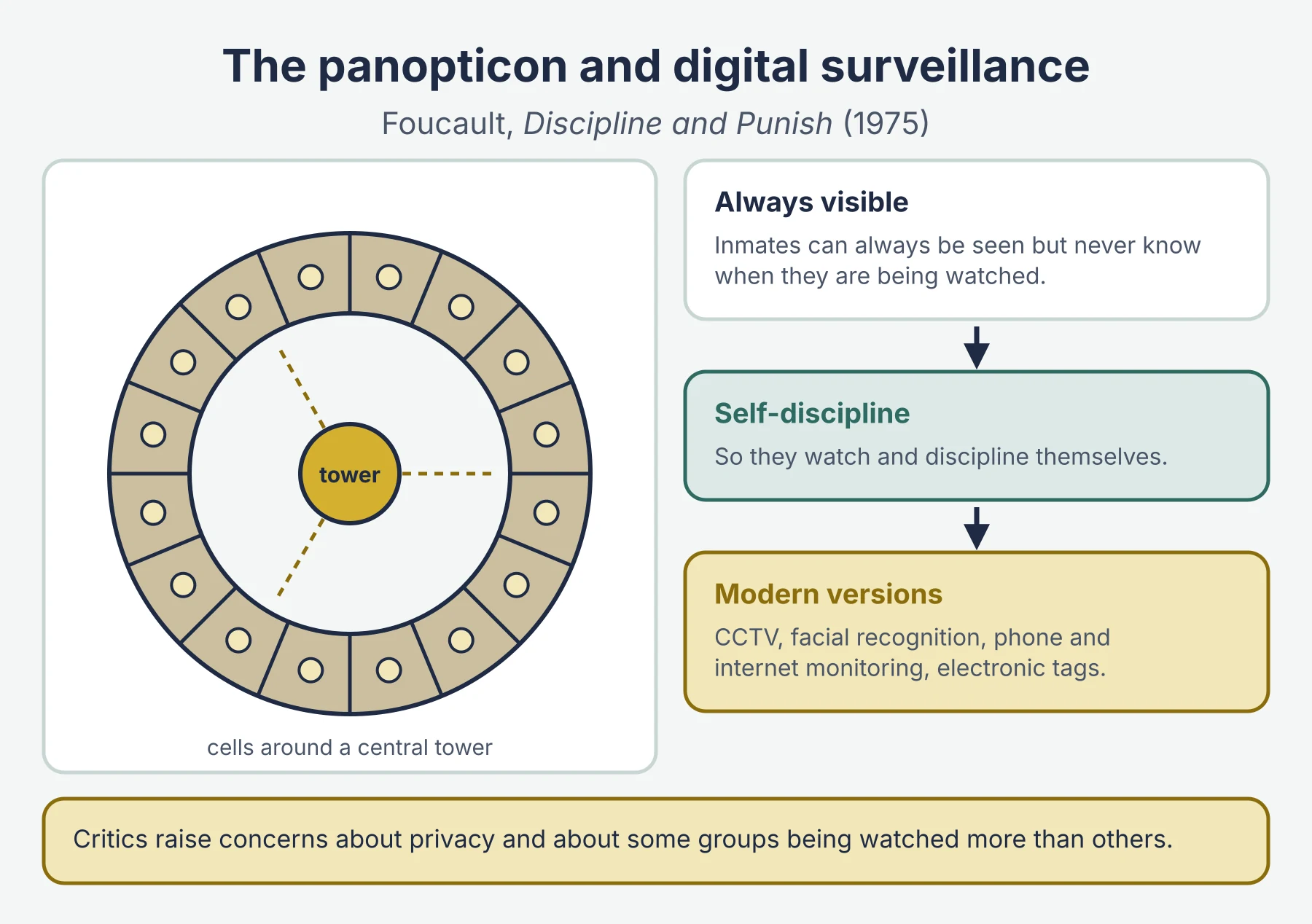
| Panopticon | Prison design where inmates may always be watched; Foucault’s image of self-discipline under surveillance |
| Penal system | Prisons, probation and other means of punishing offenders |
| Martial law | Temporary rule by the armed forces in an emergency |
| Deviant behaviour | Behaviour that breaks norms and attracts negative sanctions |
| Non-conformist behaviour | Rejecting mainstream expectations without necessarily breaking rules |
| Moral panic | Exaggerated public fear about a group seen as a threat (Cohen, 1972) |
| Sub-culture | A group with norms and values that differ from the mainstream |
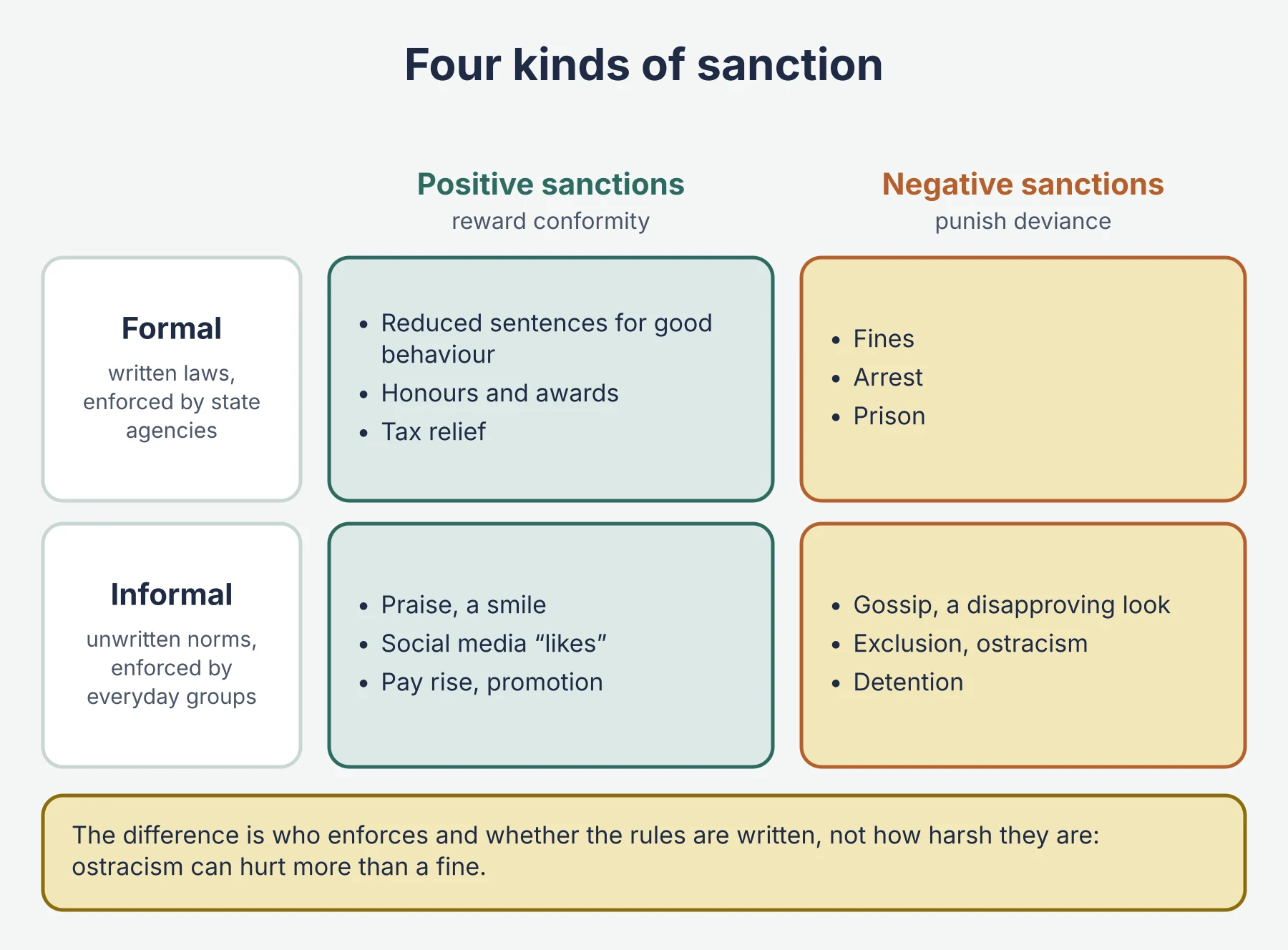
Formal versus informal: four differences
- Rules: written laws versus unwritten norms.
- Enforcers: paid state officials versus family, friends, colleagues.
- Sanctions: fixed legal penalties versus flexible everyday reactions.
- Reach: everyone in a territory versus members of a group.
Remember: both use positive as well as negative sanctions (honours and reduced sentences are formal positive sanctions).
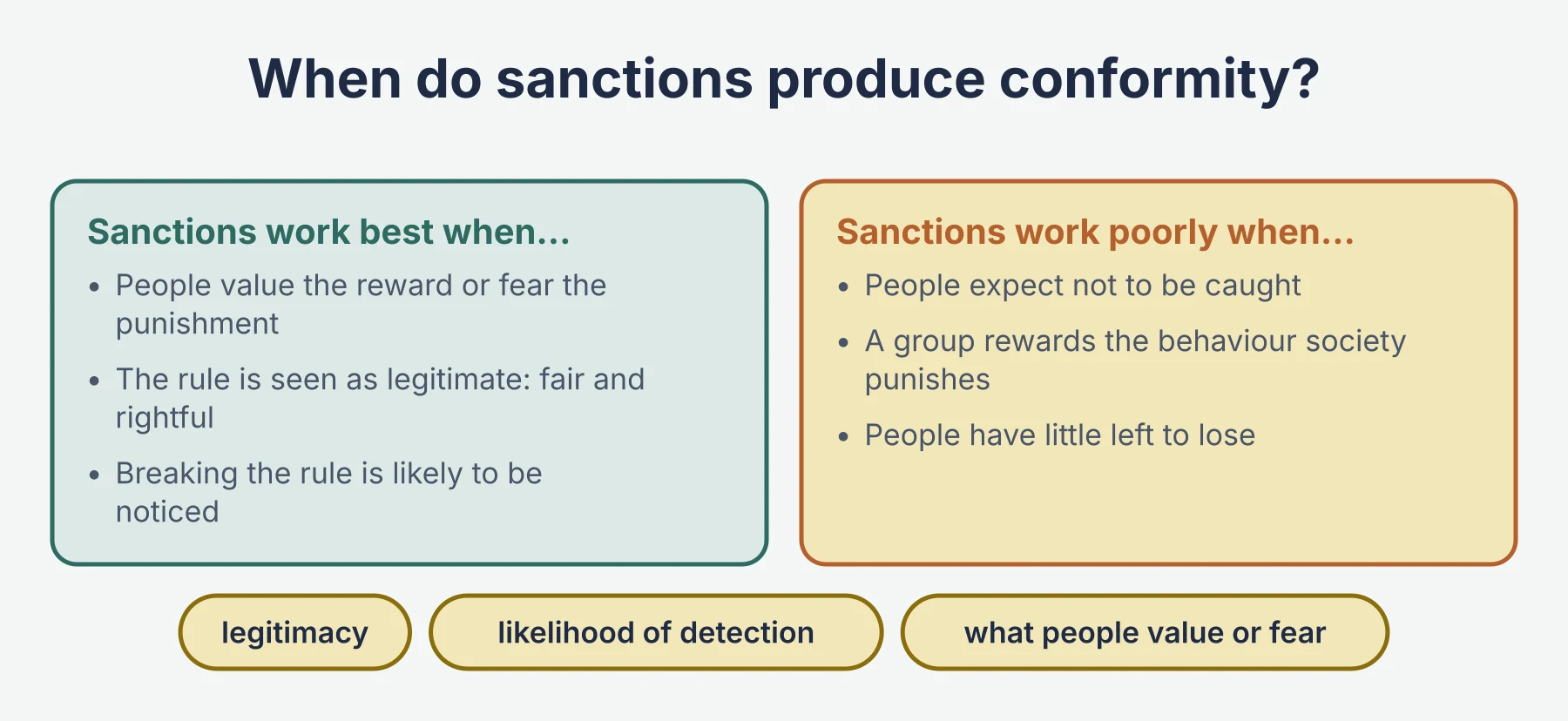
What makes control effective?
- The rule is seen as legitimate.
- Breaking it is likely to be detected.
- The reward is valued or the punishment feared.
- Informal and formal agencies send the same message.
Control fails when detection is unlikely, a group rewards deviance, or people feel they have nothing to lose.
Perspectives recall
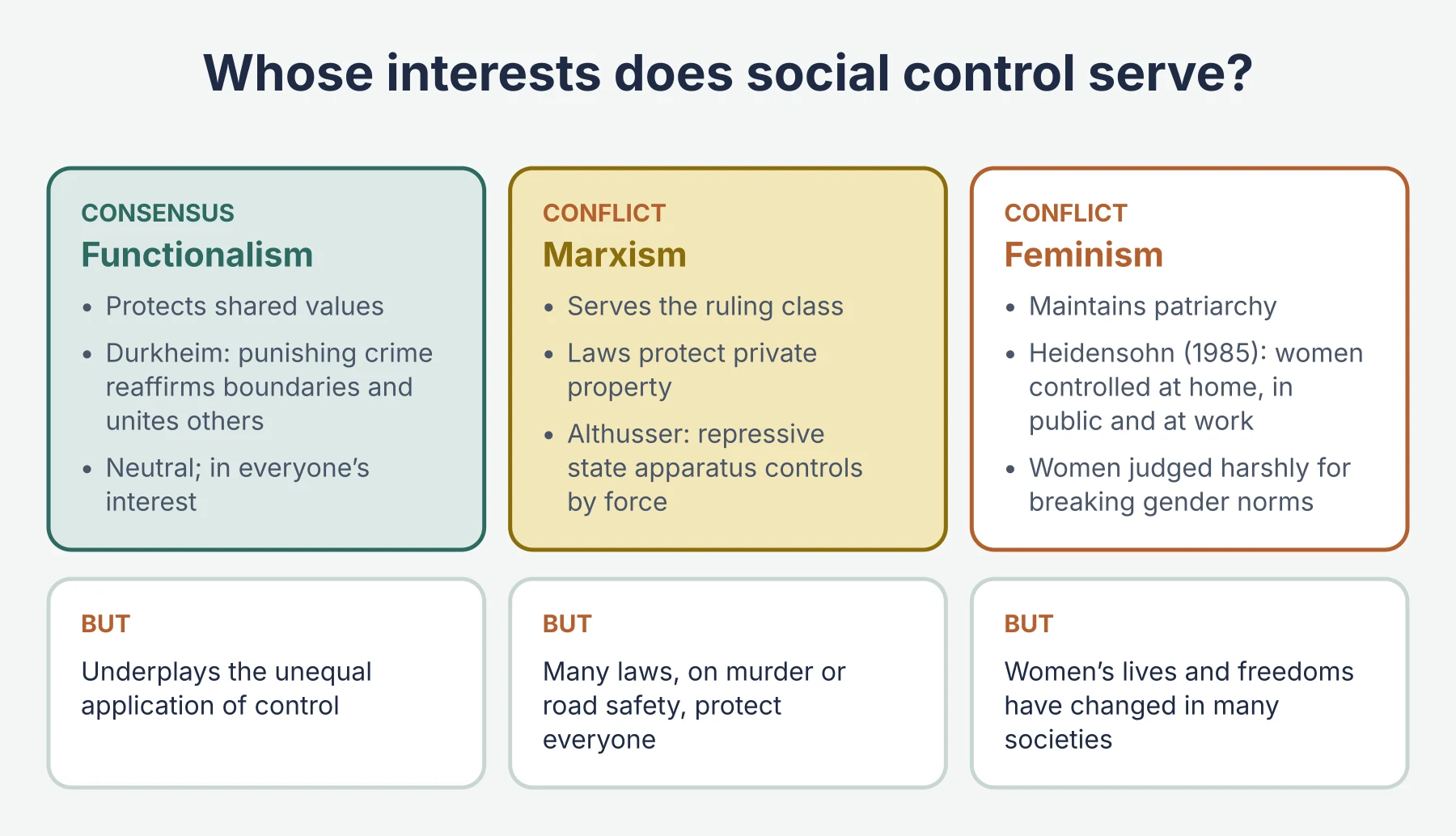
| Functionalism | Marxism | Feminism | |
|---|---|---|---|
| Type | Consensus | Conflict | Conflict |
| Purpose of control | Protect shared values and order | Protect ruling-class power and property | Maintain patriarchy |
| Key idea | Punishment reaffirms boundaries (Durkheim) | Repressive and ideological apparatuses (Althusser) | Women controlled at home, in public and at work (Heidensohn, 1985) |
| Criticism | Ignores unequal enforcement | Many laws protect everyone | Women’s freedoms have expanded |
Resistance recall
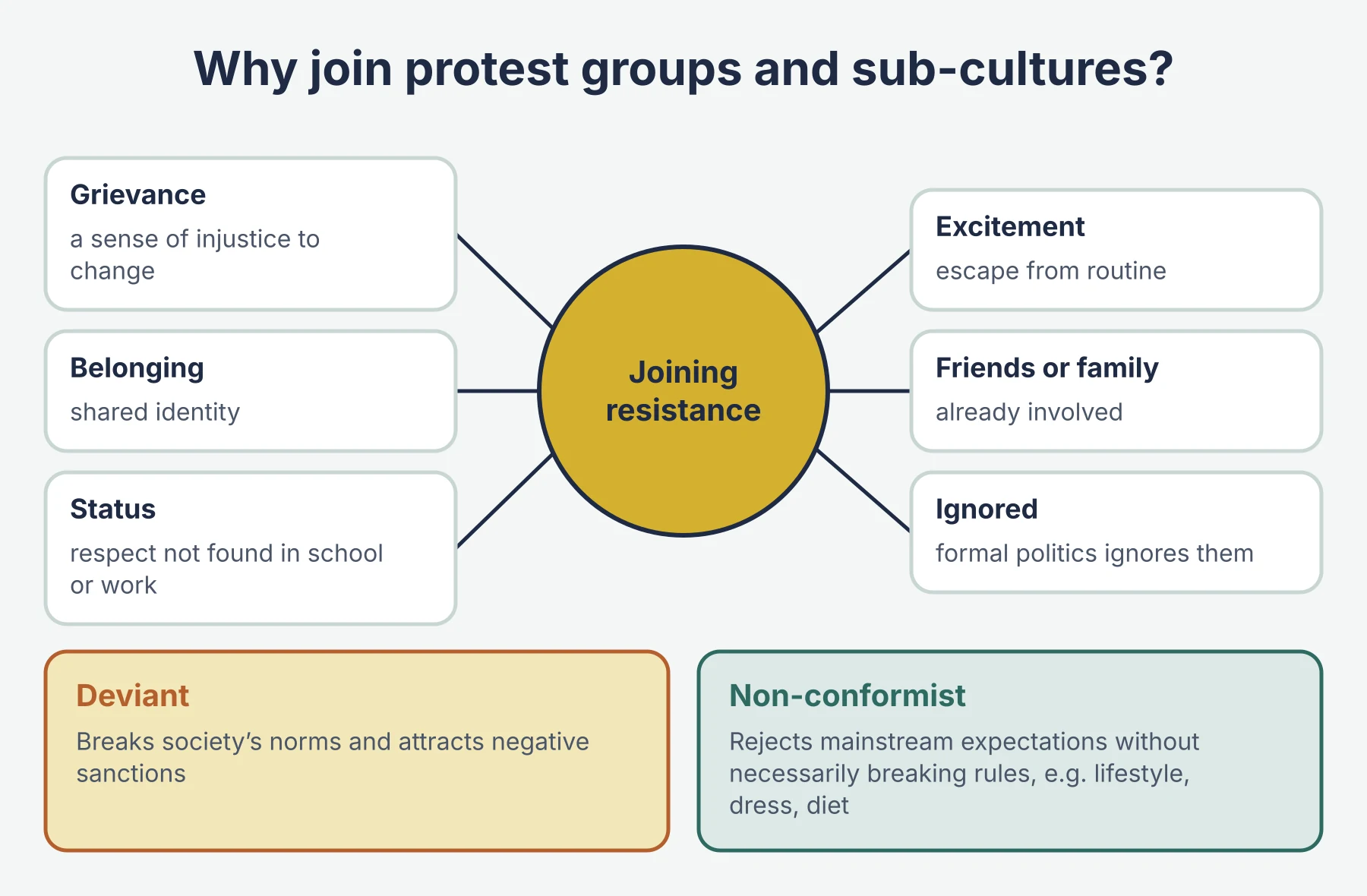
- Why join: grievance, belonging, identity, status, excitement, friends involved, distrust of formal politics.
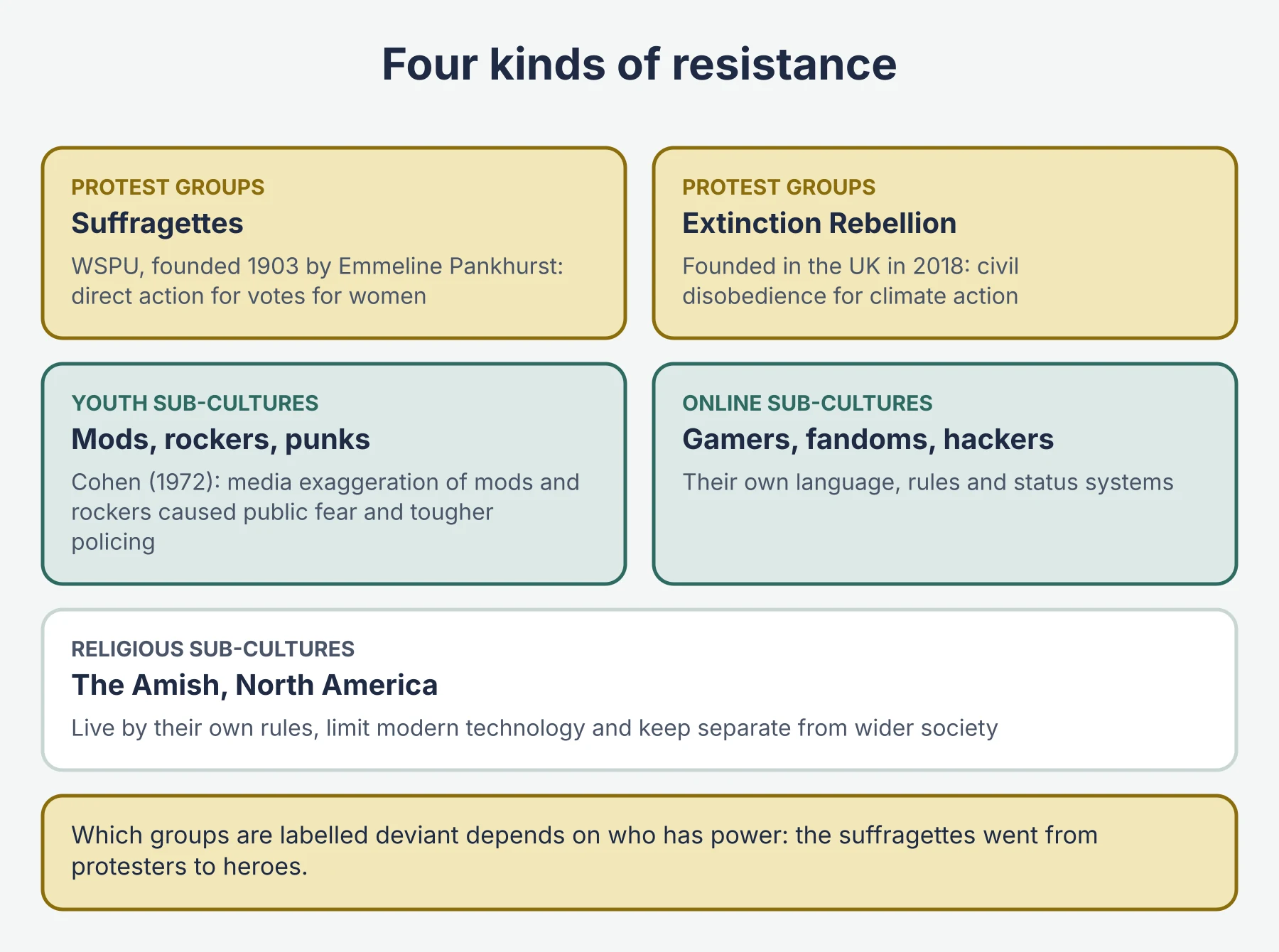
- Protest groups: suffragettes (WSPU, 1903); Extinction Rebellion (2018).
- Youth: mods and rockers (1960s) and Cohen’s moral panic; punks (1970s).
- Online: gaming communities, fandoms, hacker groups.
- Religious: the Amish, who limit modern technology and live apart.
Exam traps
- Formal ≠ harsh; informal ≠ mild. The difference is who enforces and whether rules are written.
- Do not say surveillance “stops crime” — explain deterrence, detection and self-discipline, and note privacy concerns.
- Subcultures are not always deviant; many are non-conformist.
- Name feminism as well as Marxism when asked for conflict views.
- “Effectiveness” questions need a judgement, not just description.
Worked example: a 6-mark “explain” answer
Explain three reasons why imprisonment may not be effective in producing conformity. (practice)
- Reoffending — many prisoners commit further crimes after release, so prison has not changed their behaviour.
- Criminal contacts — prisoners may learn new techniques and make contacts with other offenders, which encourages further crime.
- Labelling and exclusion — a criminal record makes finding legal work difficult, so former prisoners may return to crime to survive.
Self-test
- Define social control.
- Give one formal positive sanction.
- Name the five formal agencies listed in the syllabus.
- What is meant by legitimacy?
- What did Foucault mean by the panopticon?
- Give two informal negative sanctions used in schools or by peers.
- Give one reason why informal control may be more effective than formal control.
- What did Heidensohn argue about the control of women?
- What is the difference between deviant and non-conformist behaviour?
- Give two reasons why people join protest groups.
- What is a moral panic?
- Give one example of a religious sub-culture.
Answers
- The ways society makes people conform to its norms and laws.
- A reduced sentence for good behaviour, an award or honour, a tax relief.
- Government, police, courts, penal system, armed forces.
- Acceptance that a rule or authority is fair and rightful.
- A design in which people may always be watched, so they discipline themselves; modern surveillance works similarly.
- Detention, exclusion, ostracism, ridicule, gossip.
- It is constant and comes from people we care about, such as family and friends.
- That women are controlled at home, in public and at work, which helps explain lower female crime.
- Deviant behaviour breaks norms and is punished; non-conformist behaviour rejects mainstream expectations without necessarily breaking rules.
- Any two: grievance, belonging, identity, excitement, friends involved, distrust of politics.
- Exaggerated public concern about a group portrayed as a threat, often fuelled by the media.
- The Amish.
Related pages: social control practice questions for key question 2.2 | Paper 1 revision notes
Related resources
-
Practice questions
Cambridge IGCSE Sociology (0495): Identity: self and society – What influences our social identity? – Practice Questions
Original Cambridge IGCSE Sociology 0495 practice on key question 2.3: age, gender, digital identity, globalisation and postmodern choice, with full answers.
Sociology · Cambridge · IGCSE
Try questions -
Revision notes
Cambridge IGCSE Sociology (0495): Identity: self and society – What influences our social identity? – Revision Notes
Revision notes for Cambridge IGCSE Sociology 0495 key question 2.3: age, gender, ethnicity and class, the digital self, globalisation and postmodern choice.
Sociology · Cambridge · IGCSE
Revise topic -
Study guides
Cambridge IGCSE Sociology (0495): Social stratification and inequality – What is social stratification?
Cambridge IGCSE Sociology 0495 key question 3.1: open and closed societies, caste, slavery, mobility, life chances, intersectionality, labelling and Marxism.
Sociology · Cambridge · IGCSE
Read guide
Related articles
Get free revision emails (optional)
Occasional emails with practice questions, worked explanations and links to free resources for the qualification and subjects you choose. No spam, and you can unsubscribe from any email. The free tools on this site never need an email.