
Study Guides
Cambridge IGCSE Sociology (0495): Identity: self and society – How does society control us?
Cambridge IGCSE Sociology 0495 key question 2.2: formal and informal control, sanctions, consensus and conflict views, agencies, surveillance and resistance.
- Subject
- Sociology
- Level
- IGCSE
- Topic
- Paper 1 – Research Methods, Identity and Inequality
- Author
- Marlbridge Academic Team
- Updated
- Reviewed by
- Naqiya Yousaf (what this means)
Aligned to Cambridge IGCSE Sociology (0495), 2025-2027. Official specification .
Syllabus page (what it covers and how it is assessed): Cambridge IGCSE Sociology.
Syllabus points this page covers
0495
- 2.2 Identity: self and society – How does society control us?
Found an error? Report a correction.
Need help with this topic? Request a free trial class for IGCSE Sociology (0495).
Key question 2.2 of Cambridge IGCSE Sociology (0495) asks How does society control us? Socialisation (key question 2.1) teaches people what is expected; social control is the set of ways society makes sure they actually conform, and deals with them when they do not. The syllabus wants you to compare formal and informal control, judge how effective different agencies are, explain their methods, contrast consensus and conflict views, and explain why some people resist control through protest groups and subcultures.
This guide adds depth to the social control and social identity revision notes, which cover 2.2 and 2.3 together.
Syllabus coverage
Cambridge IGCSE Sociology 0495, syllabus for 2025, 2026 and 2027, 2.2 How does society control us?
- 2.2.1 Social control: difference between formal and informal types; positive and negative sanctions; effectiveness of these in producing social conformity.
- 2.2.2 The debate between consensus and conflict views of social control: functionalism, Marxism, feminism.
- 2.2.3 The effectiveness of agencies of formal social control: government, police, courts, penal system, armed forces.
- 2.2.4 Methods used by formal agencies, e.g. law-making, coercion, digital surveillance, arrest, sentencing, imprisonment.
- 2.2.5 The effectiveness of agencies of informal social control: family, education, peer group, media, religion, workplace.
- 2.2.6 Methods used by informal agencies: positive and negative sanctions, e.g. ostracism, parental rewards, social media “likes”, religious rewards/sanctions, school punishments, dismissal from a job.
- 2.2.7 Resistance through protest groups and sub-cultures: reasons why some people join them; deviant and non-conformist behaviour; examples of protest groups, online, youth and religious sub-cultures.
Formal and informal control (2.2.1)
| Formal social control | Informal social control | |
|---|---|---|
| Rules | Written laws and official regulations | Unwritten norms and expectations |
| Enforced by | State agencies employed for the purpose | Ordinary people in everyday groups |
| Sanctions | Fixed by law: fines, arrest, prison | Flexible: praise, gossip, exclusion |
| Reach | Applies to everyone in the territory | Depends on group membership |
| Example | A driver fined for speeding | A student teased for wearing the “wrong” trainers |
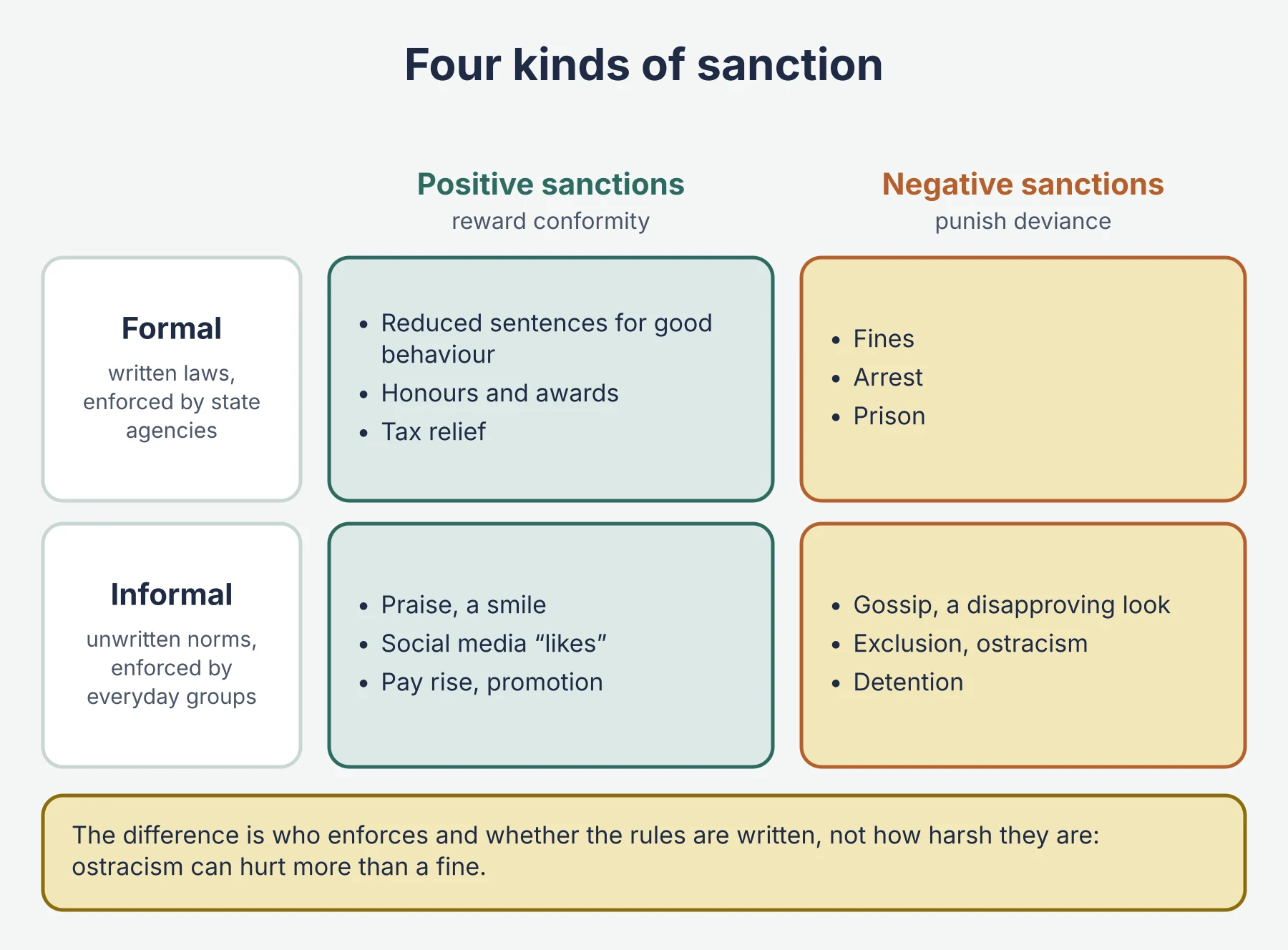
A sanction is a reaction that rewards or punishes behaviour. Positive sanctions reward conformity (a bonus, a medal, a smile, a “like”); negative sanctions punish deviance (a fine, detention, a disapproving look). Students often forget that formal control also uses positive sanctions: reduced sentences for good behaviour, honours and awards, tax relief for approved activities.
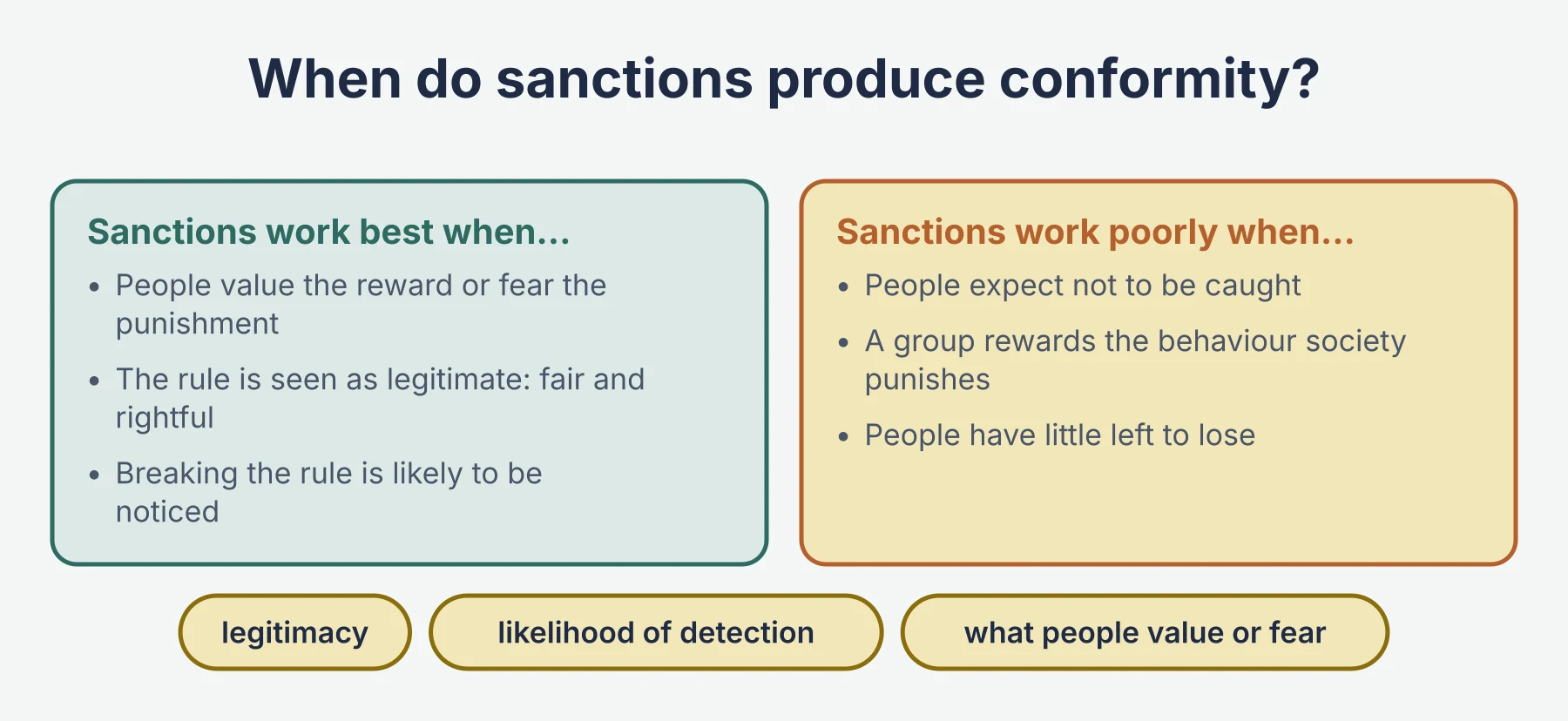
How effective are sanctions? They work best when people value what is offered or fear what is threatened, when the rule is seen as legitimate (fair and rightful), and when breaking it is likely to be noticed. They work poorly when people expect not to be caught, when a group rewards the very behaviour society punishes, or when people have little left to lose.
Consensus and conflict views (2.2.2)
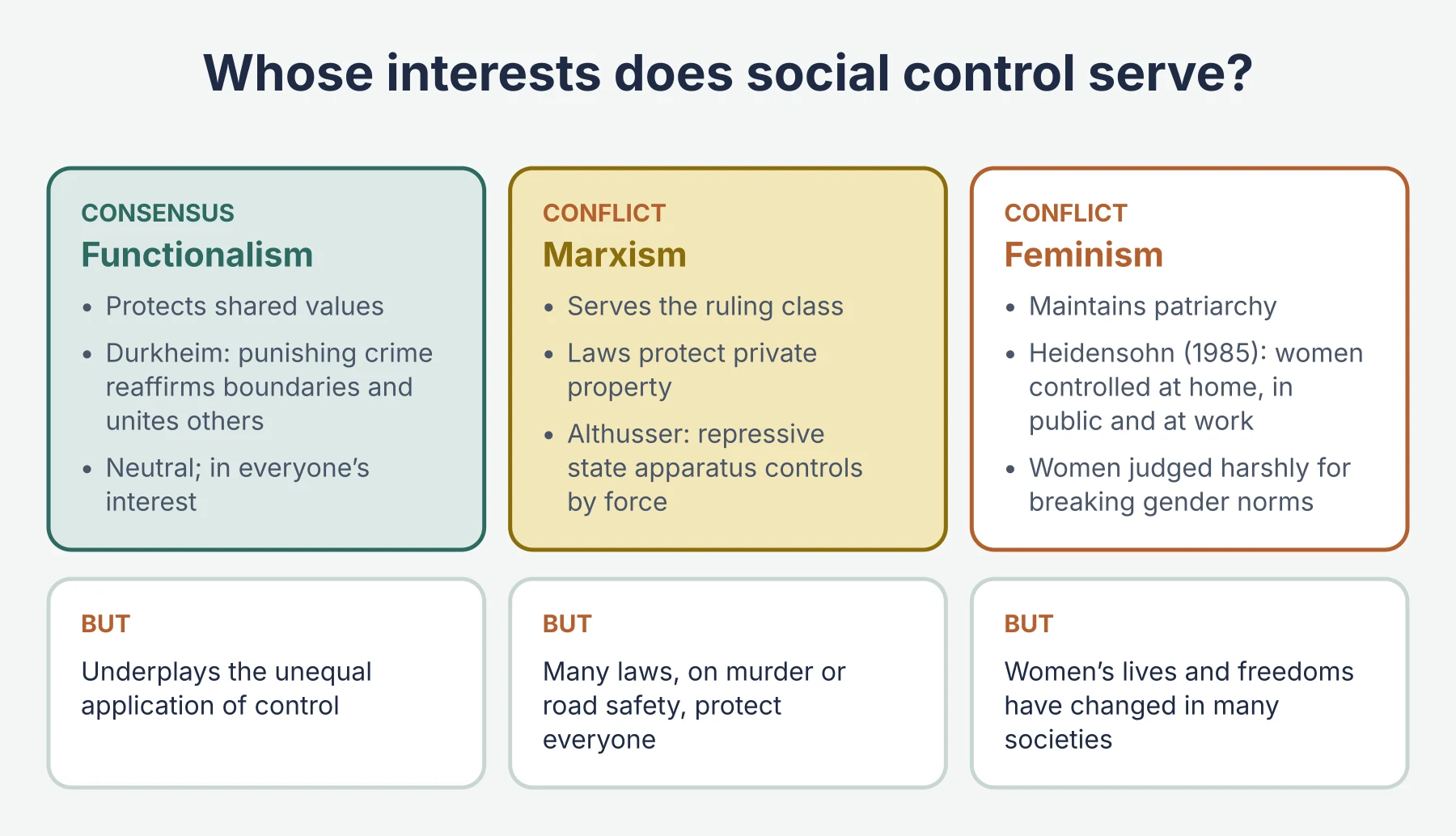
Functionalism (consensus). Social control protects the shared values that hold society together. Durkheim argued that punishing crime reaffirms the boundaries of acceptable behaviour: when an offender is punished publicly, others are reminded of the rules and feel united. Control is therefore neutral and in everyone’s interest.
Marxism (conflict). Control serves the ruling class. Laws protect private property and the capitalist system; the police watch working-class areas closely while white-collar and corporate offences are less often prosecuted. Louis Althusser distinguished the repressive state apparatus — police, courts, prisons and the army, which control through force — from ideological apparatuses that control through ideas.
Feminism (conflict). Control maintains patriarchy. Frances Heidensohn (Women and Crime, 1985) argued that women are controlled at home through domestic responsibilities, in public through fear of violence and concern for reputation, and at work through male supervisors and harassment. Feminists also note that women may be judged more harshly when they break gender norms.
Evaluation: functionalism underplays the unequal application of control; Marxism may overstate how much law serves only the powerful, since many laws (on murder or road safety) protect everyone; feminism shows that informal control is gendered but women’s lives and freedoms have changed in many societies.
Formal agencies and their methods (2.2.3 and 2.2.4)
| Agency | Methods | Signs of effectiveness | Limits |
|---|---|---|---|
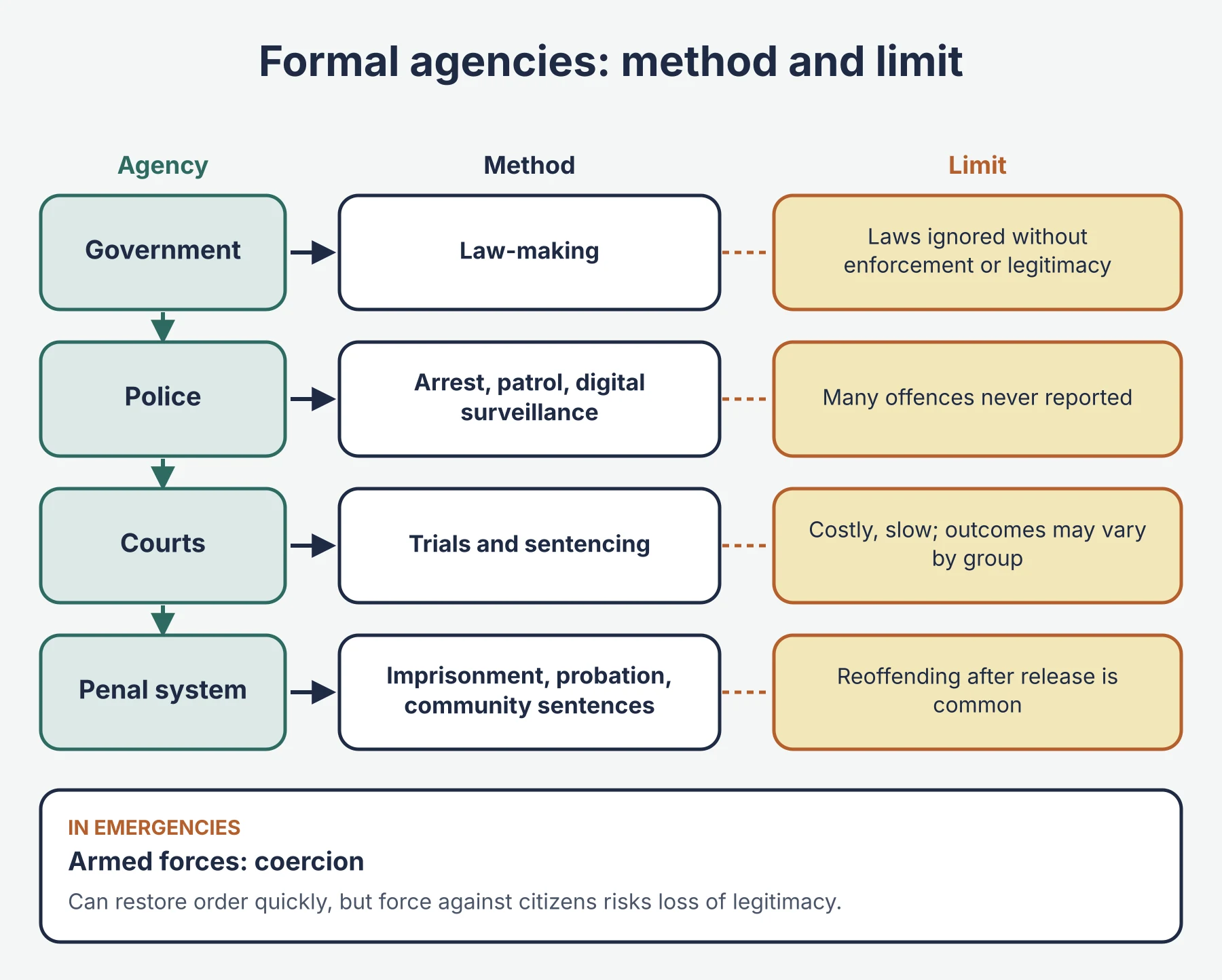
| Government | Law-making; setting policy; funding other agencies | Laws define acceptable behaviour for the whole society | Laws without enforcement or legitimacy are ignored |
| Police | Arrest, patrol, investigation, digital surveillance | Visible presence deters some crime | Many offences are never reported; relationships with communities may be poor |
| Courts | Trials and sentencing | Public punishment deters and reaffirms rules | Costly, slow; outcomes may vary for different social groups |
| Penal system | Imprisonment, probation, community sentences | Removes offenders from society; can offer rehabilitation | Reoffending after release is common in many countries |
| Armed forces | Coercion in emergencies, civil disorder or under martial law | Can restore order quickly | Use of force against citizens risks loss of legitimacy |
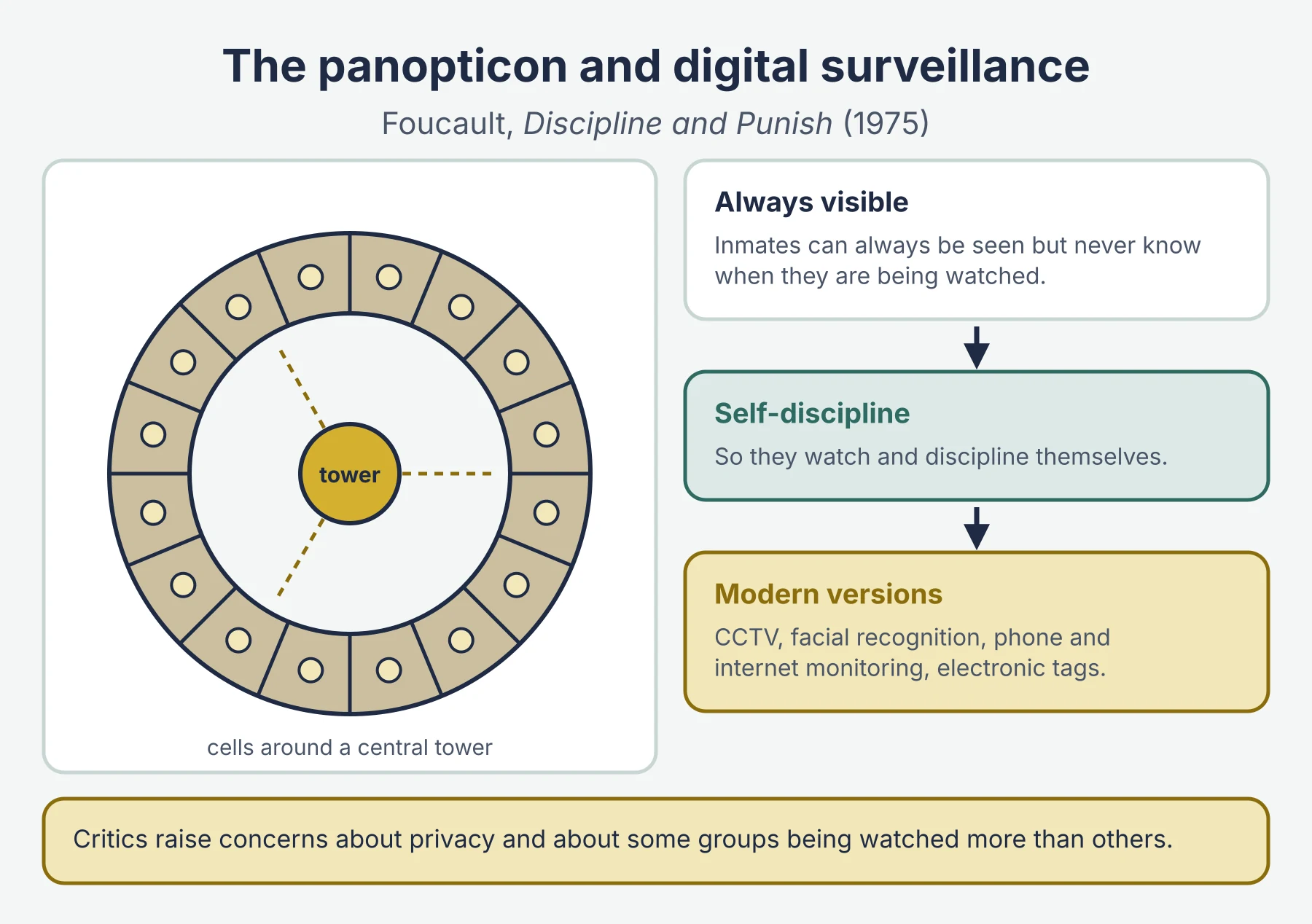
Digital surveillance includes CCTV, facial recognition, monitoring of phone and internet data and electronic tags. Michel Foucault (Discipline and Punish, 1975) used the image of the panopticon — a prison design in which inmates can always be seen but never know when they are being watched — to argue that modern control works by making people watch and discipline themselves. Surveillance cameras in streets and shops can be seen as a modern version. Critics raise concerns about privacy and about some groups being watched more than others.
Informal agencies and their sanctions (2.2.5 and 2.2.6)
| Agency | Positive sanctions | Negative sanctions | Effectiveness |
|---|---|---|---|
| Family | Parental rewards: praise, treats, privileges | Grounding, withdrawal of affection, removing phones | Powerful in childhood; weaker with older teenagers |
| Education | Merits, prizes, positions of responsibility | School punishments: detention, exclusion | Daily and long-term, but some students reject school values |
| Peer group | Acceptance, popularity | Ostracism, ridicule, gossip | Very strong for teenagers; can reward deviance |
| Media | Social media “likes”, shares, celebrity | Online shaming, negative comments | Fast and wide-reaching, but can encourage harmful trends |
| Religion | Religious rewards — community respect, promised spiritual reward | Religious sanctions — disapproval, exclusion from rituals | Strong where faith is central; weaker in more secular settings |
| Workplace | Pay rises, promotion | Warnings, dismissal from a job | Strong because income depends on it; limited to people in work |
Informal control is often more effective than formal control for everyday behaviour because it is constant and comes from people we care about. Formal control is needed where informal ties are weak — in large anonymous cities, for example — or for serious harm.
Resistance: protest groups and sub-cultures (2.2.7)
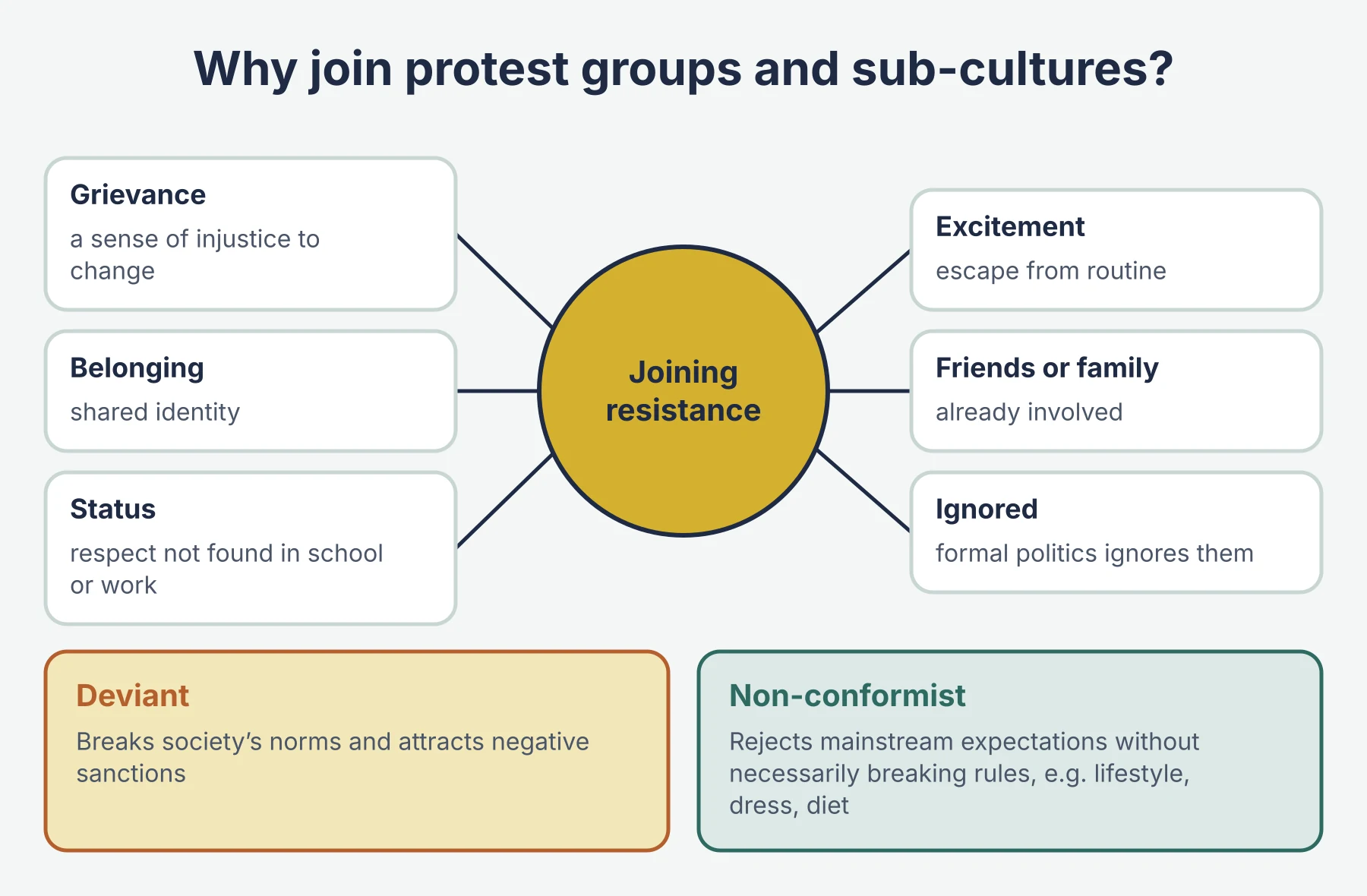
Deviant behaviour breaks a society’s norms and attracts negative sanctions. Non-conformist behaviour rejects mainstream expectations without necessarily breaking rules — choosing an alternative lifestyle, dress or diet, for example. Resistance may be either.
Reasons people join:
- a grievance or sense of injustice they want changed;
- a sense of belonging and shared identity;
- status and respect not available in school or work;
- excitement and escape from routine;
- friends or family already involved;
- feeling that formal politics ignores them.
Examples by type:
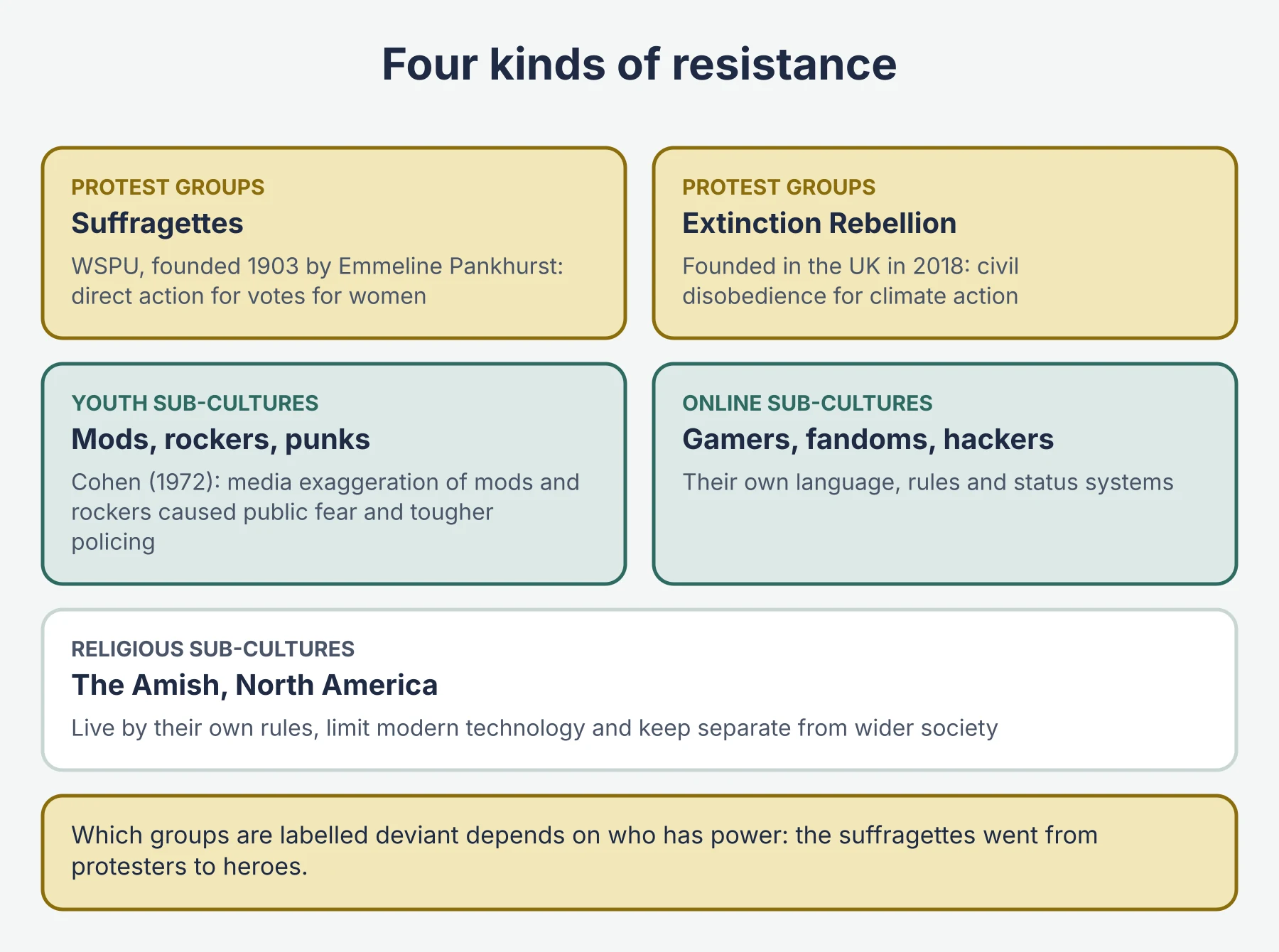
- Protest groups: the suffragettes of the Women’s Social and Political Union (founded in 1903 by Emmeline Pankhurst) used direct action to win votes for women; environmental groups such as Extinction Rebellion (founded in the UK in 2018) use civil disobedience to demand climate action.
- Youth sub-cultures: mods and rockers in 1960s Britain — Stanley Cohen’s Folk Devils and Moral Panics (1972) showed how media exaggeration of clashes between them provoked public fear and tougher policing; punks in the 1970s.
- Online sub-cultures: gaming communities, fandoms and hacker groups with their own language, rules and status systems.
- Religious sub-cultures: the Amish in North America live by their own rules, limiting the use of modern technology and keeping separate from wider society.
Resistance shows that control is never complete. Interactionists and conflict theorists add that which groups are labelled deviant depends on who has power — yesterday’s protesters can become today’s heroes, as the suffragettes did.
Worked example: Question 2(f)-style evaluation
Evaluate the view that formal agencies are more effective than informal agencies in producing conformity.
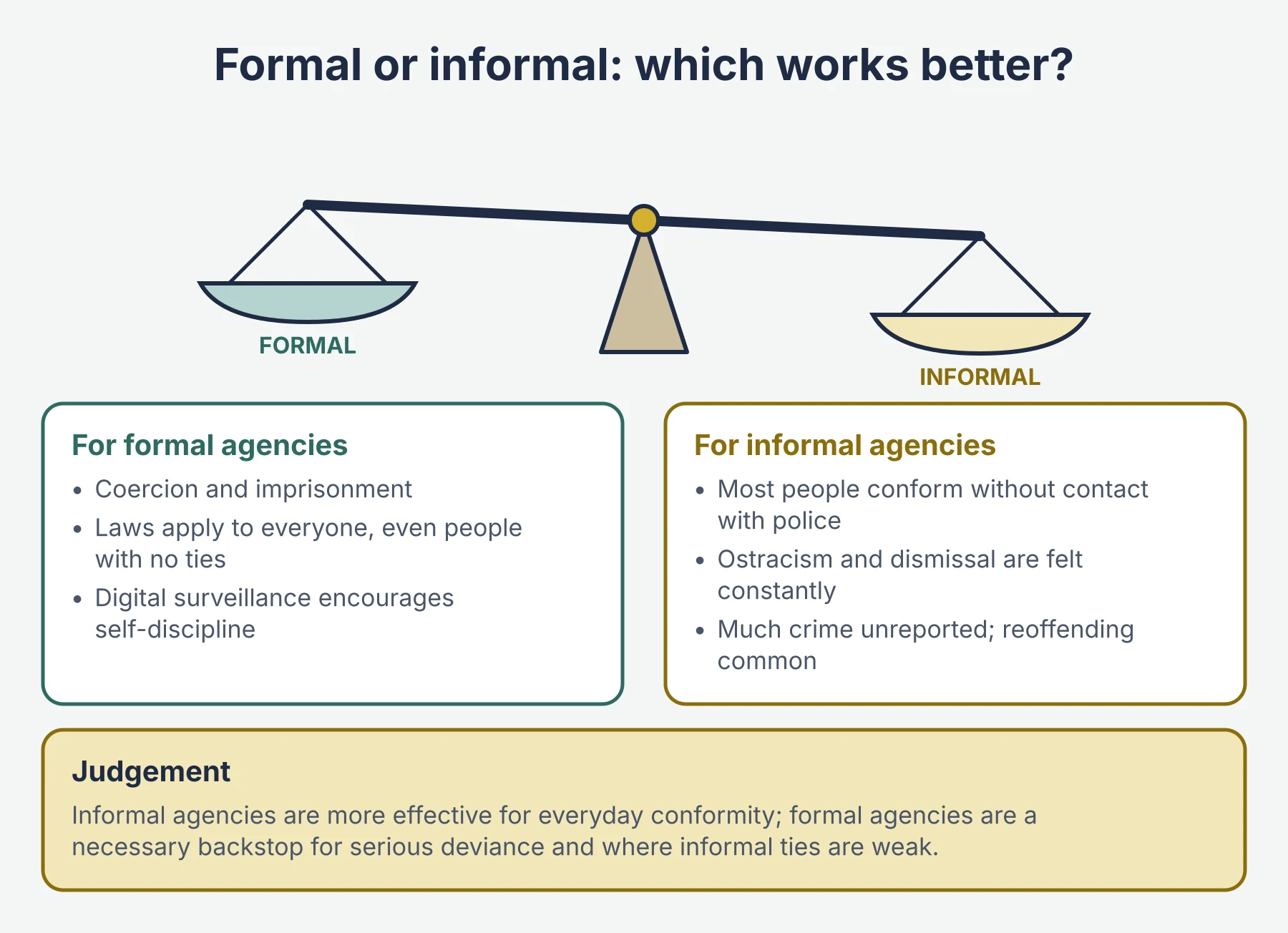
For: formal agencies can use coercion and legal penalties that informal agencies cannot, such as imprisonment; laws apply to everyone, including people with no family or community ties; and digital surveillance extends their reach, encouraging self-discipline as Foucault described.
Against: most people conform most of the time without any contact with the police, because of norms learned and enforced by family, peers and workplace; informal sanctions such as ostracism or dismissal from a job are felt constantly; and formal control often fails — much crime goes unreported and reoffending is common. Marxists add that formal control targets some groups more than others, reducing legitimacy.
Judgement: informal agencies are more effective for everyday conformity, while formal agencies are a necessary backstop for serious deviance and where informal ties are weak.
Common mistakes
- Treating “formal” as “strict” and “informal” as “gentle”. The difference is who enforces and whether rules are written, not severity — ostracism can hurt more than a fine.
- Listing agencies without the method and the effectiveness judgement the syllabus asks for.
- Assuming all subcultures are criminal; many are non-conformist rather than deviant.
- Writing about conflict views with only Marxism; feminism is also named in 2.2.2.
Exam technique
- Identify / Give — short, precise examples, such as “detention” for a school sanction.
- Explain — method + how it produces conformity + example.
- Discuss — developed paragraphs, including perspectives.
- Evaluate — both sides, effectiveness concepts (legitimacy, likelihood of detection), judgement.
Revise with the social control revision notes for key question 2.2 and practise with the social control practice questions for key question 2.2. How socialisation builds identity is covered in the study guide for key question 2.1.
Related resources
-
Practice questions
Cambridge IGCSE Sociology (0495): Identity: self and society – How does society control us? – Practice Questions
Original Cambridge IGCSE Sociology 0495 practice on key question 2.2: sanctions, police, surveillance, theories of control and sub-cultures, with full answers.
Sociology · Cambridge · IGCSE
Try questions -
Revision notes
Cambridge IGCSE Sociology (0495): Identity: self and society – How does society control us? – Revision Notes
Revision notes for Cambridge IGCSE Sociology 0495 key question 2.2: sanctions, formal and informal agencies, surveillance, theories of control and resistance.
Sociology · Cambridge · IGCSE
Revise topic -
Practice questions
Cambridge IGCSE Sociology (0495): Identity: self and society – What influences our social identity? – Practice Questions
Original Cambridge IGCSE Sociology 0495 practice on key question 2.3: age, gender, digital identity, globalisation and postmodern choice, with full answers.
Sociology · Cambridge · IGCSE
Try questions
Related articles
Get free revision emails (optional)
Occasional emails with practice questions, worked explanations and links to free resources for the qualification and subjects you choose. No spam, and you can unsubscribe from any email. The free tools on this site never need an email.