
Revision Notes
Cambridge IGCSE Sociology (0495): Research methods – How do sociologists investigate society? – Revision Notes
Revision notes for Cambridge IGCSE Sociology 0495 key question 1.3: research design, sampling techniques, primary methods, question types and ethics.
- Subject
- Sociology
- Level
- IGCSE
- Topic
- Paper 1 – Research Methods, Identity and Inequality
- Author
- Marlbridge Academic Team
- Updated
- Reviewed by
- Naqiya Yousaf (what this means)
Aligned to Cambridge IGCSE Sociology (0495), 2025-2027. Official specification .
Syllabus page (what it covers and how it is assessed): Cambridge IGCSE Sociology.
Syllabus points this page covers
0495
- 1.3 Research methods – How do sociologists investigate society?
Found an error? Report a correction.
Need help with this topic? Request a free trial class for IGCSE Sociology (0495).
Key question 1.3 of Cambridge IGCSE Sociology (0495) asks How do sociologists investigate society? In short: researchers move through set stages of research design, choose a sample from a sampling frame using one of five techniques, collect primary data through questionnaires, interviews or observation, write questions of four types, and take account of theoretical, practical and ethical issues. These notes are for fast recall; worked examples are in the how sociologists investigate society study guide.
Syllabus coverage
0495 syllabus 2025–2027, 1.3:
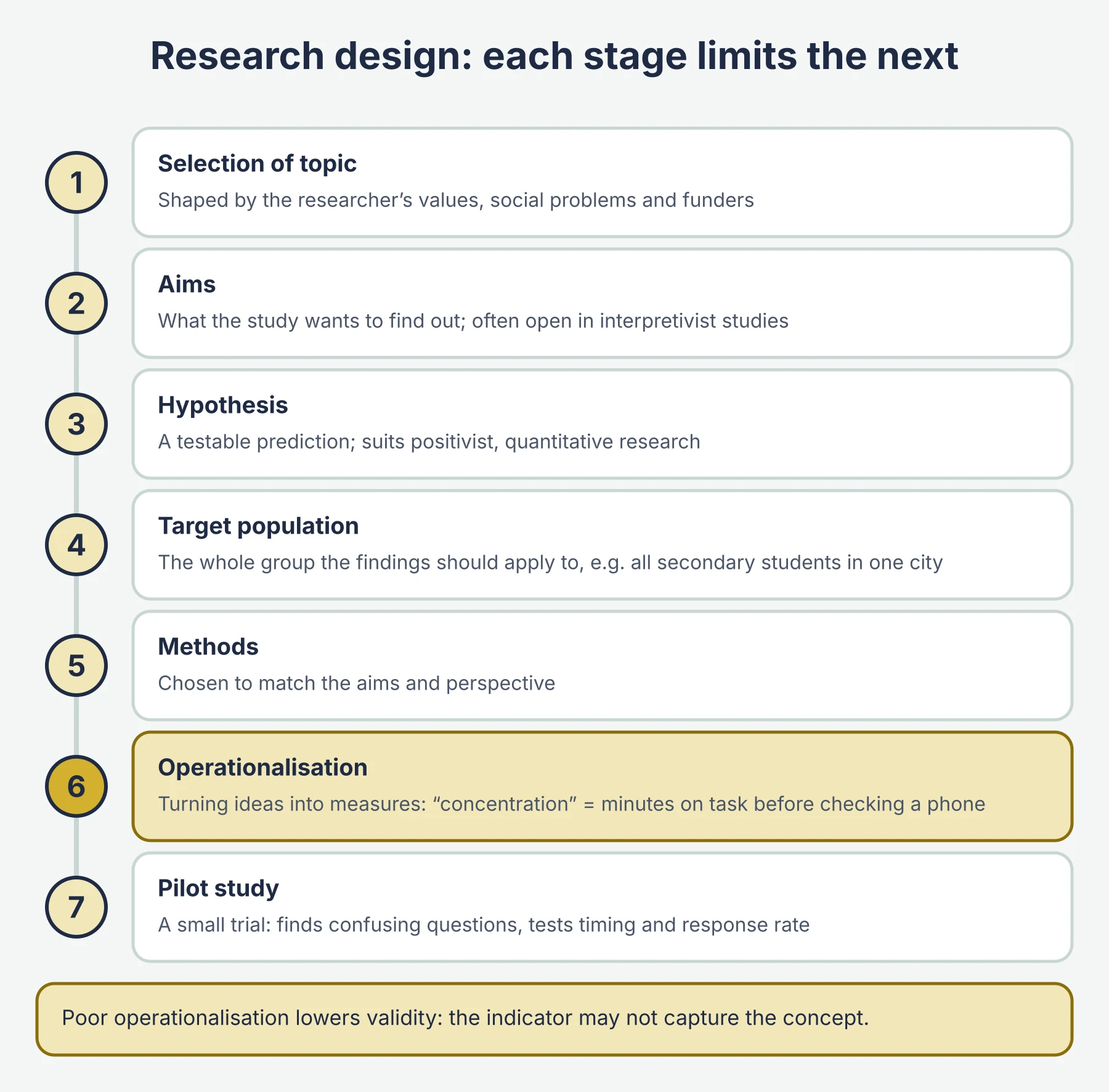
- 1.3.1 Stages in research design: selection of topic, aims, hypothesis, target population, methods, operationalisation, pilot studies.
- 1.3.2 Sampling frames; random, systematic, stratified, snowball, quota.
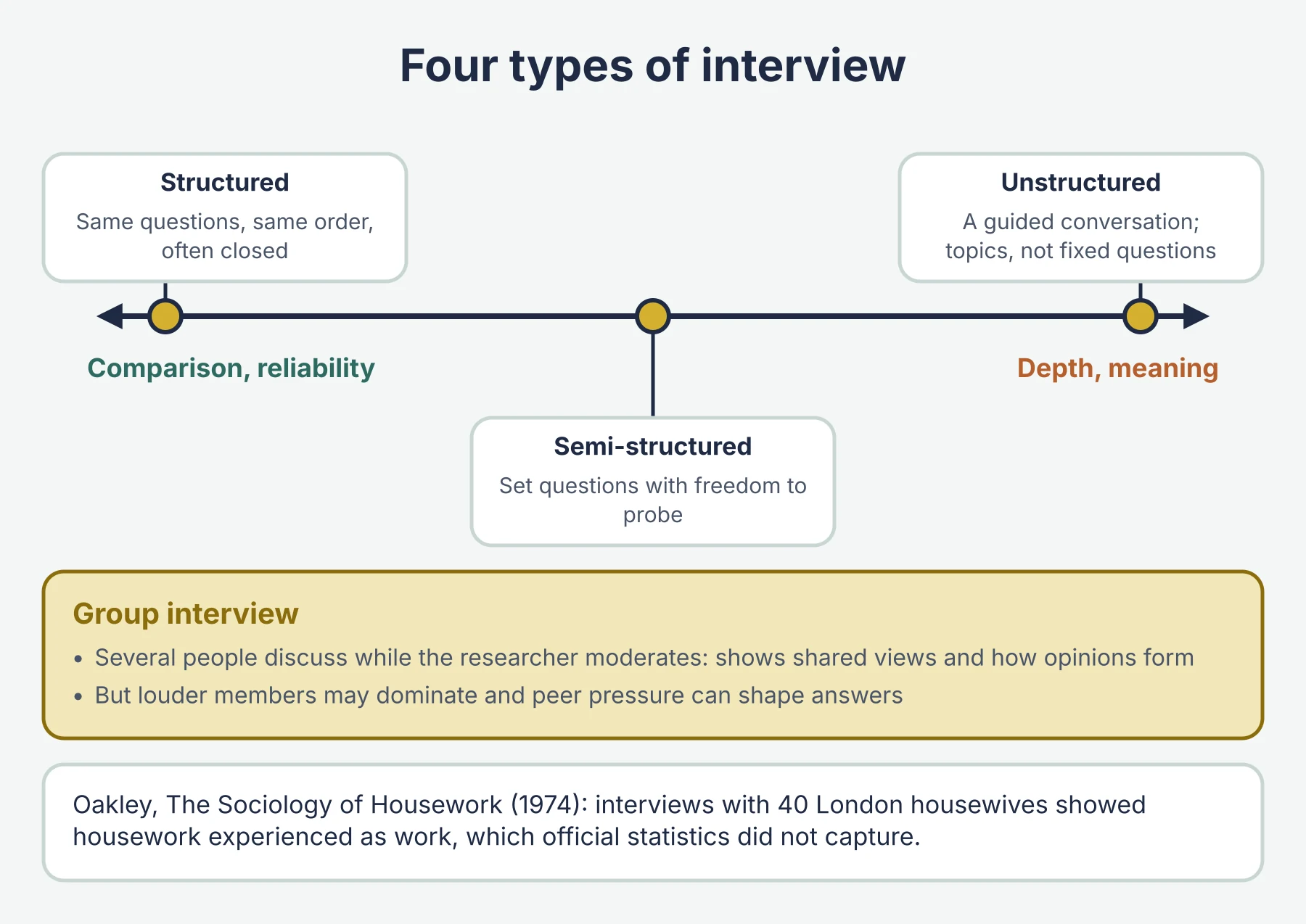
- 1.3.3 Surveys, questionnaires, interviews (structured, semi-structured, unstructured, group), observations (participant, non-participant, covert, overt).
- 1.3.4 Open, closed, multiple choice and scaled questions.
- 1.3.5 Researcher perspective, access to sample, response rate, funding/cost, time.
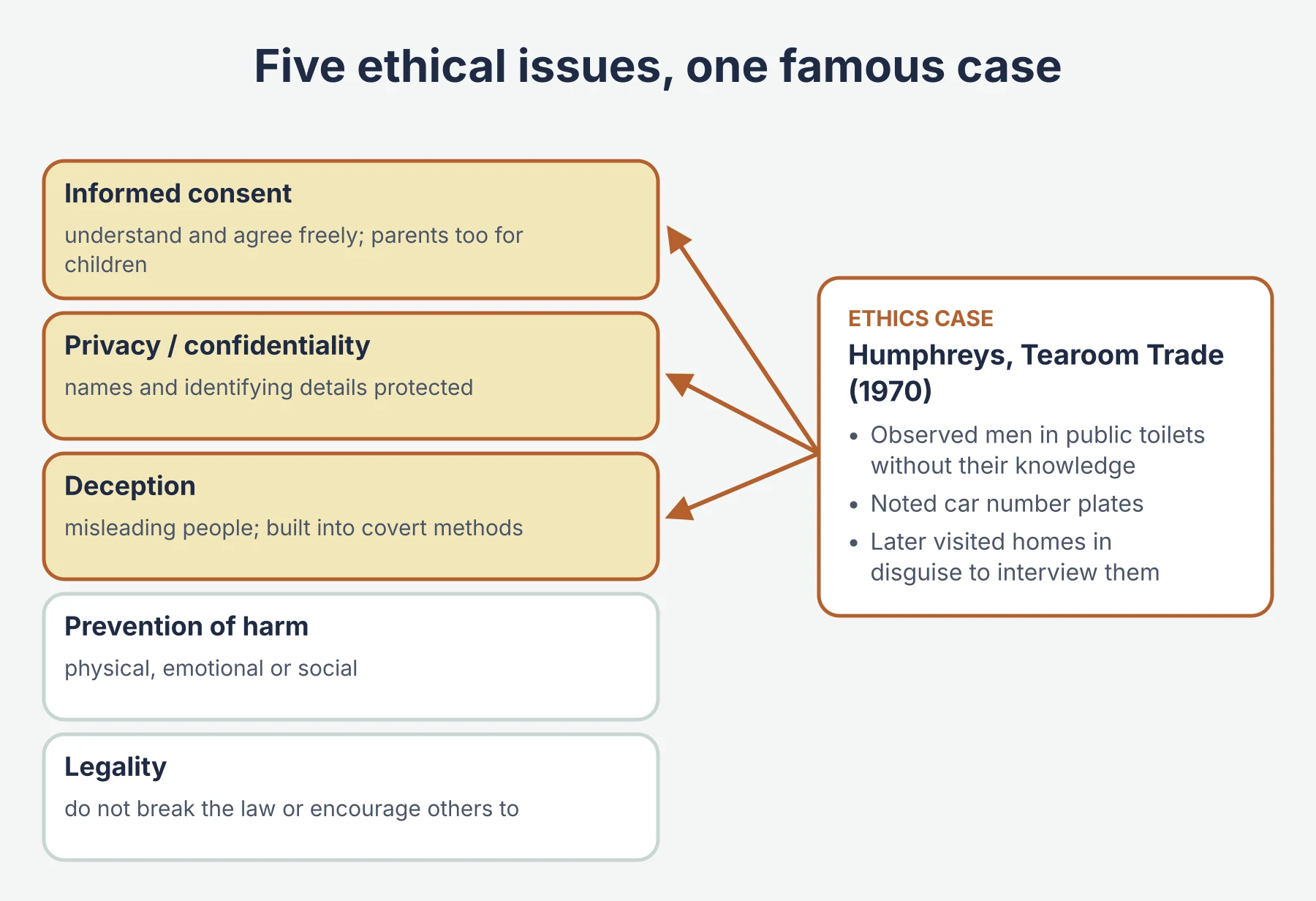
- 1.3.6 Informed consent, privacy/confidentiality, deception, prevention of harm, legality.
Key terms
| Term | Definition |
|---|---|
| Aim | A general statement of what the research wants to find out |
| Hypothesis | A testable prediction about a relationship between variables |
| Target population | The whole group the research is about |
| Operationalisation | Turning a concept into something measurable |
| Pilot study | A small trial run to test questions and procedures |
| Sampling frame | The list from which a sample is chosen |
| Response rate | The percentage of people asked who take part |
| Gatekeeper | Someone who controls access to a group, such as a head teacher |
| Survey | Collecting the same information from many people |
| Covert observation | Observation where people do not know they are studied |
| Overt observation | Observation where people know about the research |
| Informed consent | Agreement to take part based on full understanding of the research |
| Deception | Misleading participants about the research or researcher |
| Confidentiality | Keeping participants’ identities and data private |
Sampling at a glance
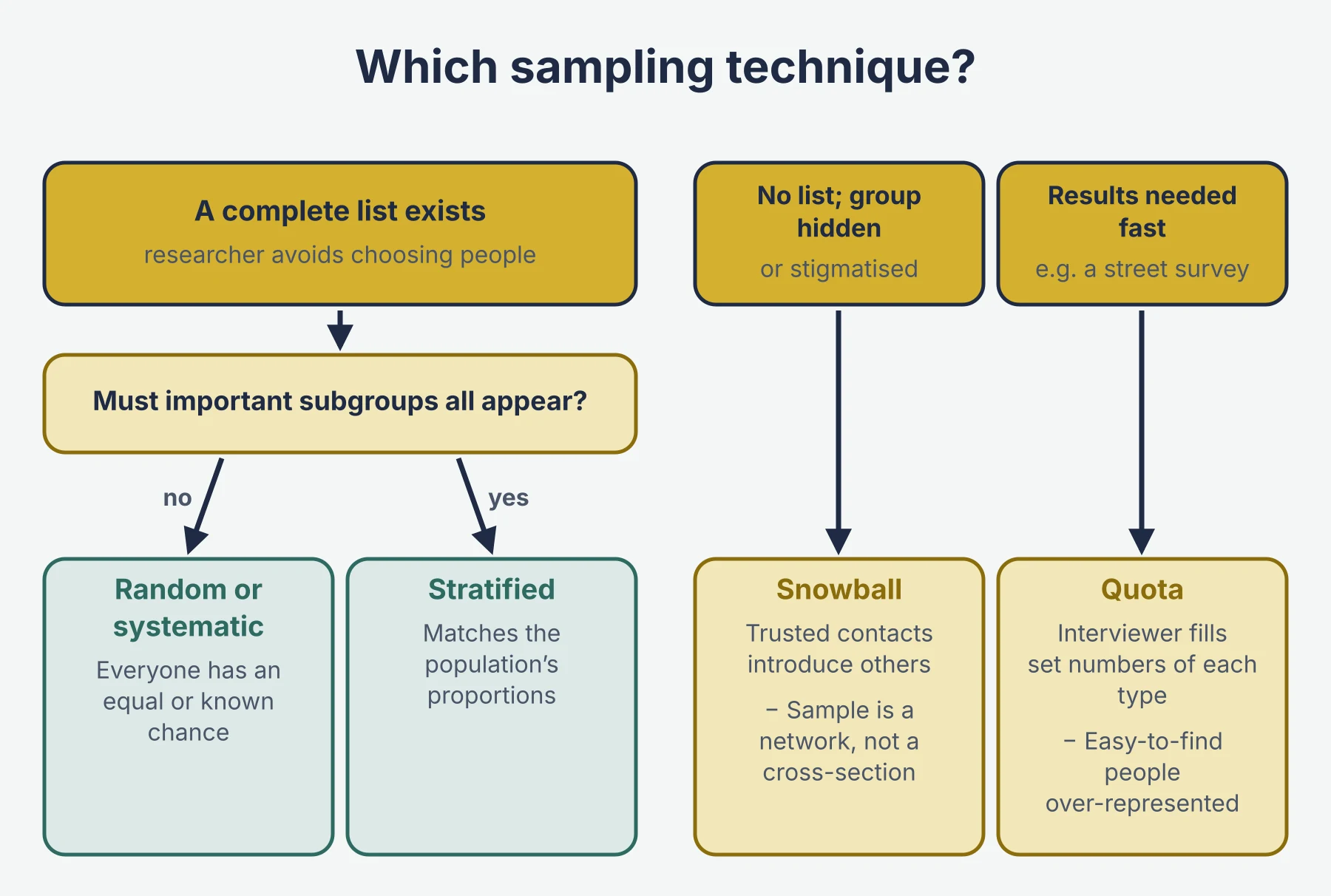
- Random: names drawn by chance from the frame → avoids researcher bias; may miss small groups.
- Systematic: every nth name → simple; a pattern in the list can distort it.
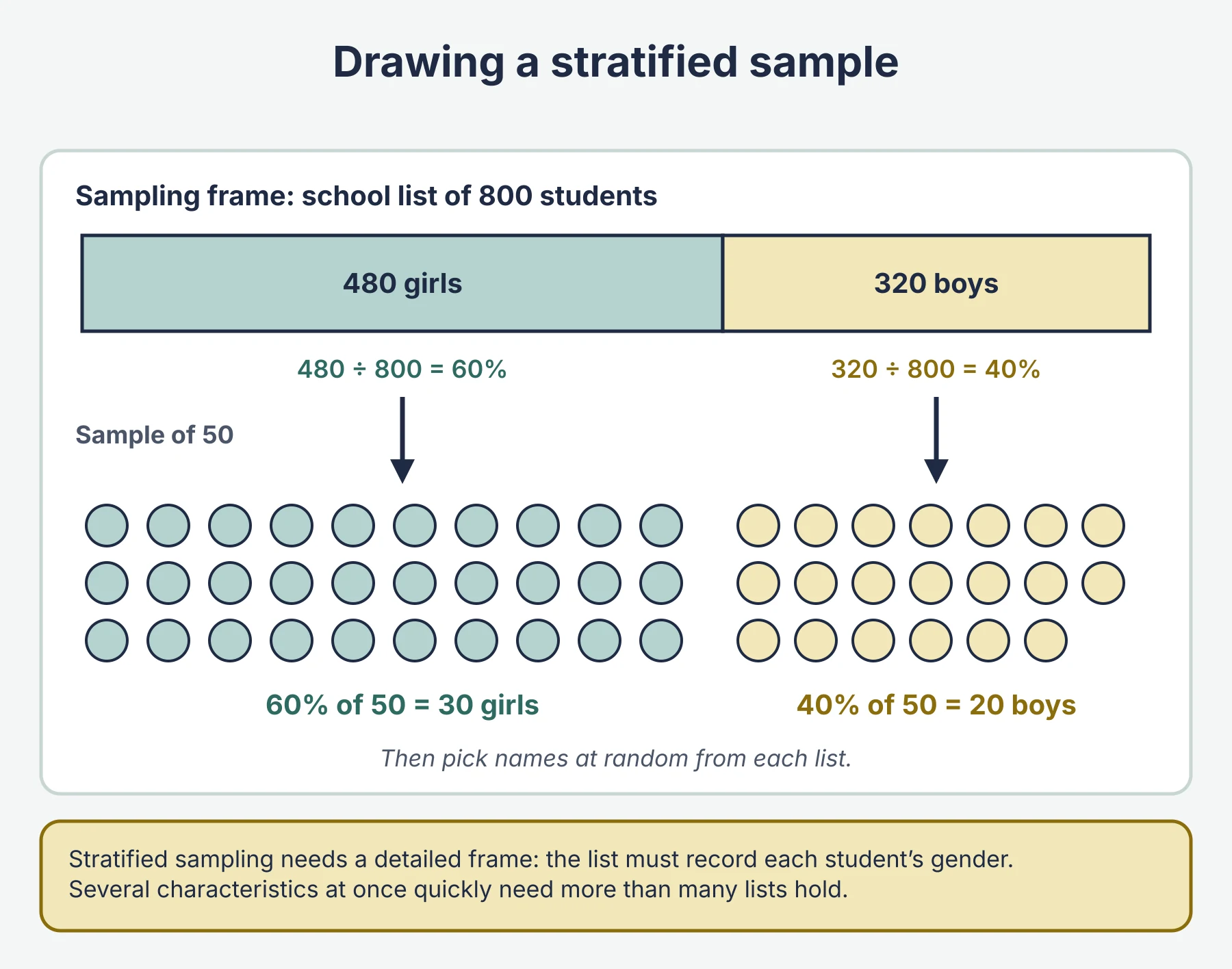
- Stratified: split the frame into groups, sample each in proportion → representative; needs a detailed frame. Example: 60% girls in the school → 30 girls in a sample of 50.
- Snowball: one participant introduces others → reaches hidden groups; a network, not a cross-section.
- Quota: fill set numbers of each type → quick, no frame needed; interviewer chooses, so bias.
Methods at a glance
| Method | Main strength | Main limitation | Perspective |
|---|---|---|---|
| Postal/online questionnaire | Reaches many people cheaply; reliable | Low response rate; no chance to explain questions | Positivist |
| Structured interview | Standardised; can clarify; higher response | Interviewer effect; little depth | Positivist |
| Semi-structured interview | Comparable and in depth | Takes longer to analyse | Both |
| Unstructured interview | High validity; rapport for sensitive topics | Small samples; hard to repeat | Interpretivist |
| Group interview | Shows how views form in discussion | Dominant voices; peer pressure | Interpretivist |
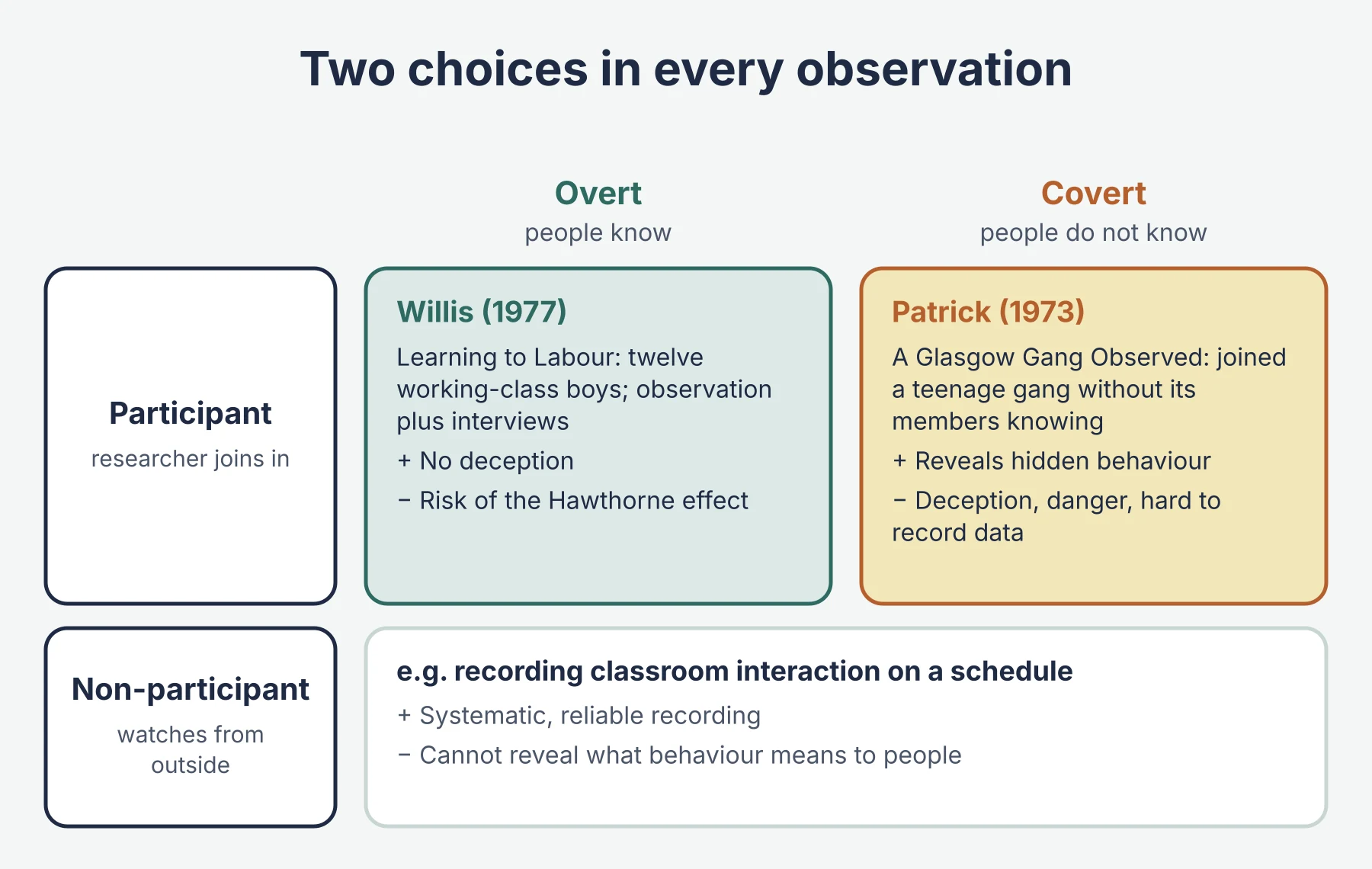
| Covert participant observation | Natural behaviour; no Hawthorne effect | Deception; danger; recording difficult | Interpretivist |
| Overt participant observation | Ethical; can ask questions | Hawthorne effect | Interpretivist |
| Non-participant observation | Systematic recording | Misses meanings; observer effect | Either |
Named studies
- Patrick (1973): covert participant observation of a Glasgow gang; deception and danger.
- Willis (1977): twelve working-class boys; observation and interviews; anti-school culture.
- Oakley (1974): interviews with 40 London housewives about housework.
- Humphreys (1970): covert observation and later disguised interviews; key ethics example.
Question types
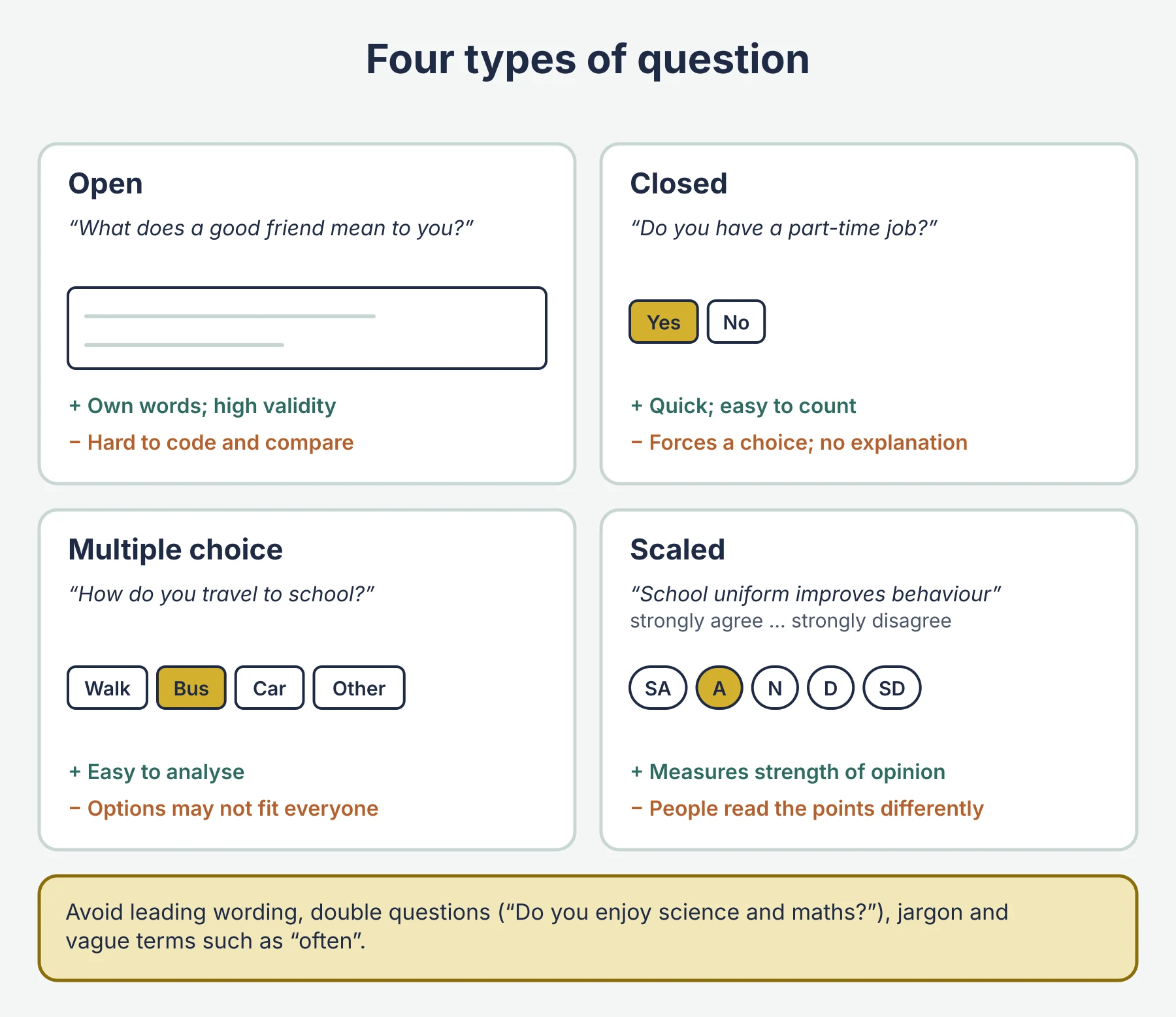
- Open — own words; valid; hard to code.
- Closed — yes/no; quick to count; no detail.
- Multiple choice — set options; options may not fit.
- Scaled — strength of opinion (strongly agree → strongly disagree); points interpreted differently.
Avoid leading, double, vague and jargon-filled questions.
Exam traps
- Sampling frame ≠ sample.
- Lying in answers is a validity problem; inconsistent procedures are a reliability problem.
- A large sample is not automatically representative if the method of choosing is biased.
- Covert research is not automatically unethical in every answer — explain which principles it breaks and why some researchers defend it when overt access is impossible.
- In Question 1(e), give reasons for every choice; do not evaluate your plan.
Worked example: a 6-mark “explain” answer
Explain three reasons why a postal questionnaire may have a low response rate. (practice)
- No personal contact — nobody is present to encourage people, so many forms are put aside and forgotten, especially if the topic seems irrelevant to them.
- Literacy and language — people who find reading difficult or do not read the language well may not complete it, which also makes the sample less representative.
- Length and effort — long questionnaires take time to complete and post back, so busy people such as shift workers or carers are less likely to reply.
Each reason is stated and then developed with its effect on the research.
Self-test
- What is operationalisation?
- Give one reason a hypothesis suits positivist research.
- Define sampling frame.
- A club has 200 members, 150 adults and 50 under-18s. How many under-18s should be in a stratified sample of 20?
- Why is snowball sampling useful for studying hidden groups?
- Give one weakness of quota sampling.
- State one difference between a structured and an unstructured interview.
- What is the difference between overt and covert observation?
- Give an example of a scaled question.
- Name two practical issues affecting research.
- Which ethical principles does covert observation usually break?
- What is a gatekeeper?
Answers
- Turning an abstract concept into measurable indicators.
- It is a testable prediction that can be checked with measurable, quantitative data.
- The list of the target population from which a sample is drawn.
- 50 ÷ 200 = 25%, and 25% of 20 = 5 under-18s.
- Trusted members introduce the researcher to others who would otherwise refuse or cannot be found.
- The interviewer chooses who fills the quota, so people who are easy to reach are over-represented.
- Structured uses fixed questions in a fixed order; unstructured is a flexible conversation.
- In overt observation people know they are studied; in covert they do not.
- “Homework helps me learn: strongly agree / agree / neutral / disagree / strongly disagree.”
- Any two: access to sample, response rate, funding/cost, time.
- Informed consent and deception (and possibly privacy).
- A person who controls access to a group, such as a head teacher or employer.
Related pages: investigating society practice questions | Paper 1 revision notes
Related resources
-
Study guides
Cambridge IGCSE Sociology (0495): Identity: self and society – How do we learn our identity?
Cambridge IGCSE Sociology 0495 key question 2.1: social construction, nature and nurture, agencies and processes, and theories of socialisation.
Sociology · Cambridge · IGCSE
Read guide -
Practice questions
Cambridge IGCSE Sociology (0495): Identity: self and society – How do we learn our identity? – Practice Questions
Original Cambridge IGCSE Sociology 0495 practice on key question 2.1: culture, nature and nurture, and the agencies and theories of socialisation.
Sociology · Cambridge · IGCSE
Try questions -
Revision notes
Cambridge IGCSE Sociology (0495): Identity: self and society – How do we learn our identity? – Revision Notes
Revision notes for Cambridge IGCSE Sociology 0495 key question 2.1: culture and status, nature and nurture, agencies and processes of socialisation, theories.
Sociology · Cambridge · IGCSE
Revise topic
Related articles
Get free revision emails (optional)
Occasional emails with practice questions, worked explanations and links to free resources for the qualification and subjects you choose. No spam, and you can unsubscribe from any email. The free tools on this site never need an email.