
Study Guides
Cambridge IGCSE Sociology (0495): Family – What are the different types of families?
Cambridge IGCSE Sociology 0495 key question 4.1: family structures, diversity by culture, class and ethnicity, alternatives to the family and types of marriage.
- Subject
- Sociology
- Level
- IGCSE
- Topic
- Paper 2 – Family, Education and Crime
- Author
- Marlbridge Academic Team
- Updated
- Reviewed by
- Naqiya Yousaf (what this means)
Aligned to Cambridge IGCSE Sociology (0495), 2025-2027. Official specification .
Syllabus page (what it covers and how it is assessed): Cambridge IGCSE Sociology.
Syllabus points this page covers
0495
- 4.1 Family – What are the different types of families?
Found an error? Report a correction.
Need help with this topic? Request a free trial class for IGCSE Sociology (0495).
This guide covers key question 4.1 What are the different types of families? in the Family topic of Cambridge IGCSE Sociology (0495) Paper 2, 2025–2027 syllabus. It goes deeper than the family, education and crime study guide, which surveys the whole paper. Key question 4.1 supplies the descriptive vocabulary that the rest of the Family topic depends on: you cannot discuss the role of the family (4.2) or how it is changing (4.3) without first being exact about which family you mean.
What key question 4.1 covers
The syllabus divides 4.1 into five parts:
- 4.1.1 Family structures: nuclear; extended (modified, horizontal, vertical/beanpole); reconstituted; lone parent; empty nest; childless; and the strengths and limitations of each.
- 4.1.2 Variations and diversity: cross-cultural, social class and ethnicity.
- 4.1.3 Sociological views on diversity: New Right views on diversity and “dysfunctional” families; postmodernist views on its positive aspects; the extent of diversity and the dominance of the nuclear family.
- 4.1.4 Alternatives to the family: single person households, shared households, friends as family.
- 4.1.5 Types of marriage: arranged, empty shell, love, monogamy, serial monogamy.
The syllabus also lists content that may be taught where local context and law allow, such as polygamous and same-sex families and marriages. It is not assessed, but you may use it to support an answer where it is relevant.
Family structures and their strengths and limitations
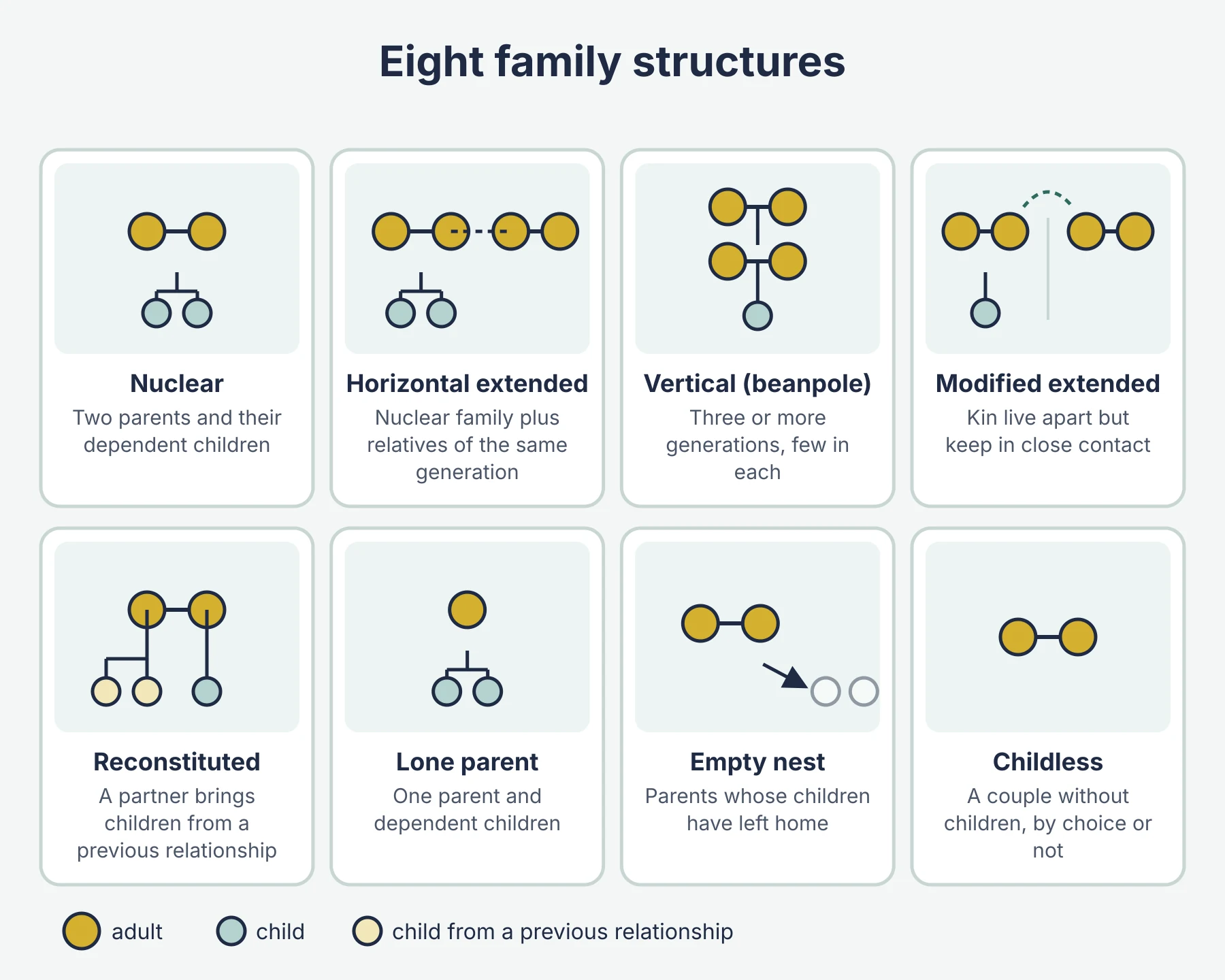
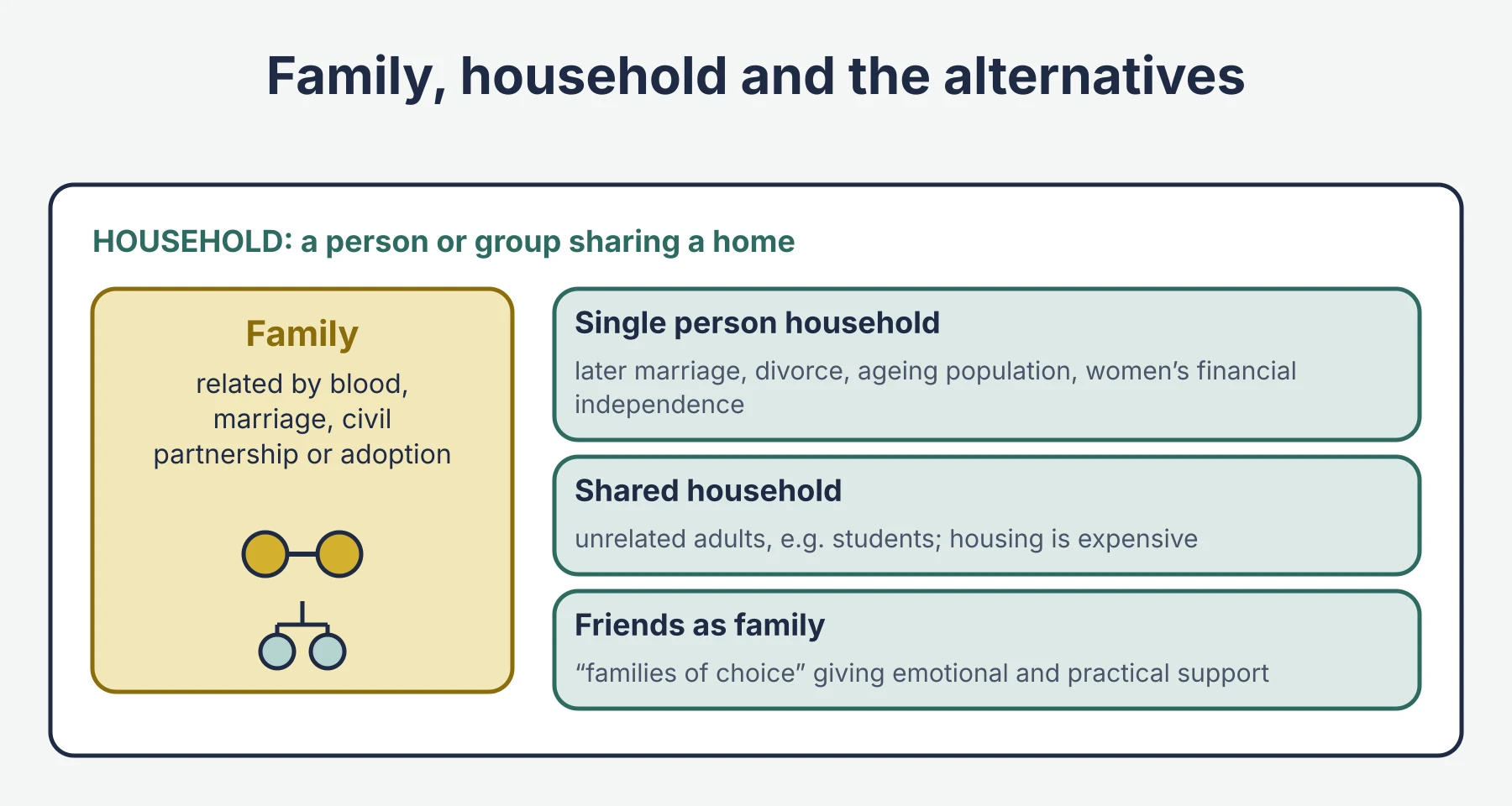
A family is a group related by blood, marriage, civil partnership or adoption; a household is a person or group sharing a home. Every family structure is a household arrangement with trade-offs, and the syllabus asks for those trade-offs explicitly, so learn one strength and one limitation for each.
| Structure | Definition | Strength | Limitation |
|---|---|---|---|
| Nuclear | Two parents and their dependent children | Geographically mobile; privacy and close emotional bonds | Isolated from kin support; pressure falls on two adults |
| Horizontal extended | Nuclear family plus relatives of the same generation, such as a parent’s brother and his wife | Shared income and childcare | Crowding; conflict over decisions |
| Vertical (beanpole) extended | Three or more generations, few members in each | Grandparents give care and advice; elders are cared for | Middle generation carries a heavy caring load |
| Modified extended | Kin live apart but keep in close contact by phone, visits and online | Support without loss of privacy or mobility | Practical help is limited by distance |
| Reconstituted | One or both partners bring children from a previous relationship | A second chance at stable family life; wider kin network | Loyalty conflicts; tension between step-relatives |
| Lone parent | One parent and dependent children | Can end a harmful relationship; close parent–child bond | Higher risk of poverty; one adult does paid and unpaid work |
| Empty nest | Parents whose children have left home | More time and income for the couple | Loneliness or loss of purpose |
| Childless | A couple without children, by choice or not | Freedom, income and time for careers | Possible social stigma; no children to care in old age |
Two points earn credit beyond the table. First, Julia Brannen used the term beanpole family for long, thin family trees produced by longer lives and fewer births, which links 4.1 directly to 4.3. Second, the modified extended family shows that extended kinship has not simply disappeared: it has changed form, which is useful evidence against the claim that the isolated nuclear family is universal.
Variations and diversity (4.1.2)
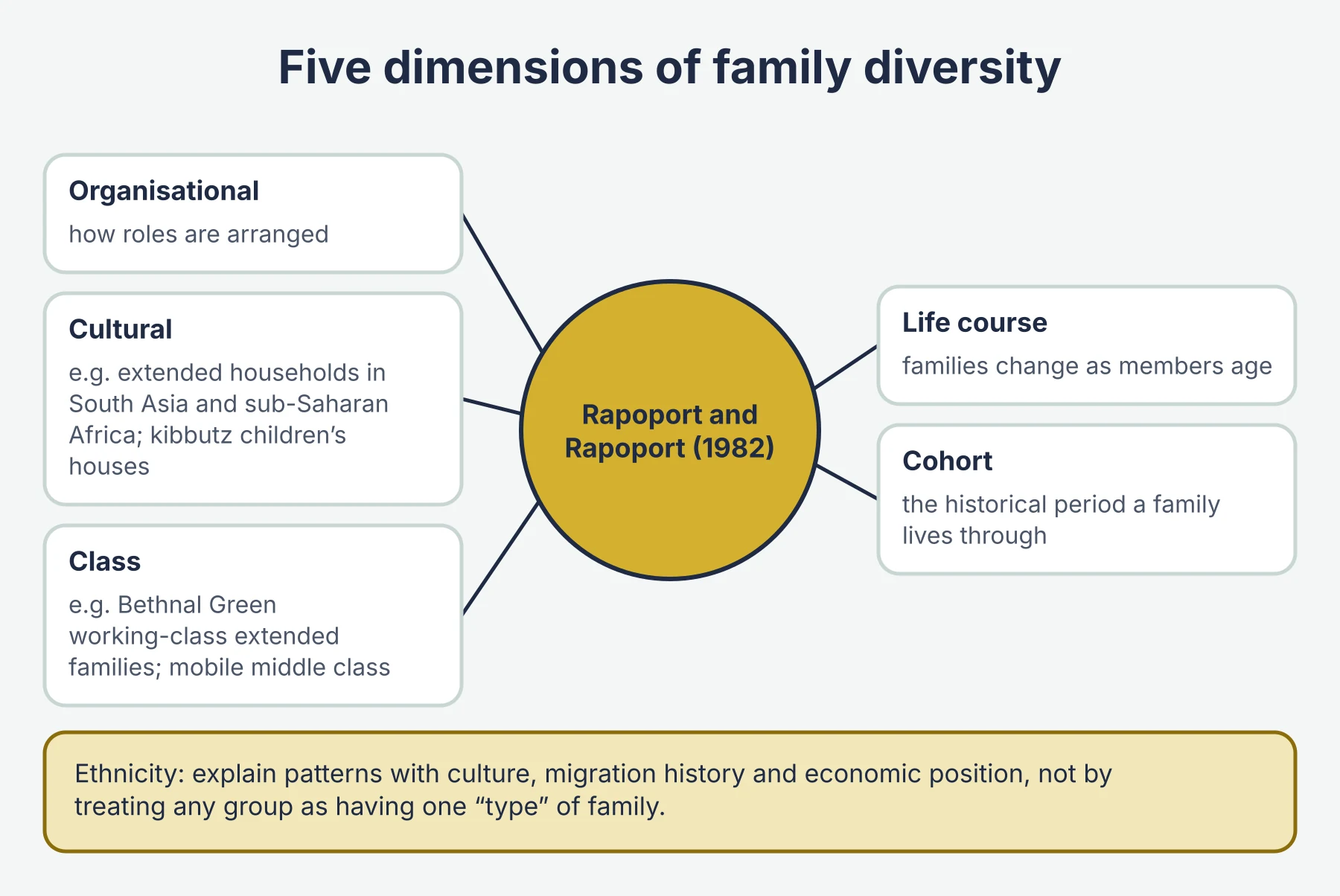
Cross-cultural. Family forms differ between societies. Extended households sharing a home and income remain common in many parts of South Asia and sub-Saharan Africa. In Israeli kibbutzim, children were historically raised partly in communal children’s houses rather than by parents alone, which challenges the claim that the nuclear family is found everywhere.
Social class. Young and Willmott’s study of Bethnal Green in East London in the 1950s found close-knit working-class extended families, with married daughters living near and seeing their mothers daily. Middle-class families have more often been geographically mobile for work, which favours the modified extended family. Class also shapes resources: wealthier families can buy childcare and space, while poorer families may rely more on kin.
Ethnicity. In Britain, sociologists have noted that households of South Asian heritage are more likely than average to include extended kin and to value family obligation, while families of Black Caribbean heritage include a higher proportion of lone-mother households. Explain these patterns with culture, migration history and economic position rather than treating any ethnic group as having one “type” of family.
Rhona and Robert Rapoport (1982) organised diversity into five types: organisational (how roles are arranged), cultural, class, life course (families change as members age) and cohort (the historical period a family lives through). Using their categories shows an examiner that diversity has more than one dimension.
Sociological views on diversity (4.1.3)
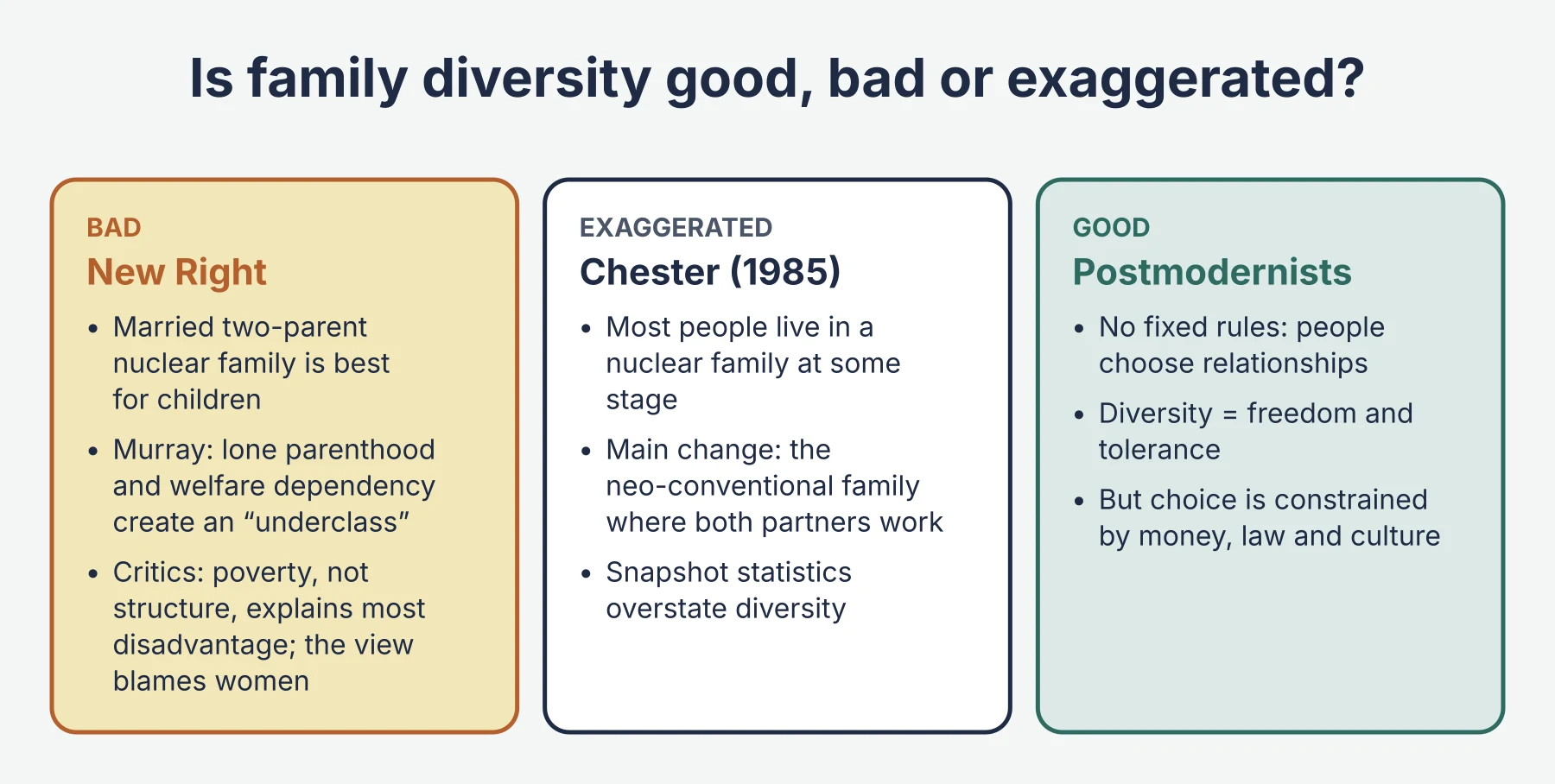
The New Right sees the married, two-parent nuclear family as the best setting for raising children. Growing numbers of lone-parent and reconstituted families are treated as signs of decline; Charles Murray linked lone parenthood and welfare dependency to an “underclass” whose children are inadequately socialised. Critics reply that poverty, not family structure, explains most of the disadvantage, and that the view blames women.
Postmodernists see diversity positively. Without fixed rules, individuals choose the relationships that suit them: cohabitation, living apart, friends as family. Diversity reflects freedom and tolerance rather than breakdown. The limitation is that choice is constrained by money, law and culture, so not everyone can “choose” freely.
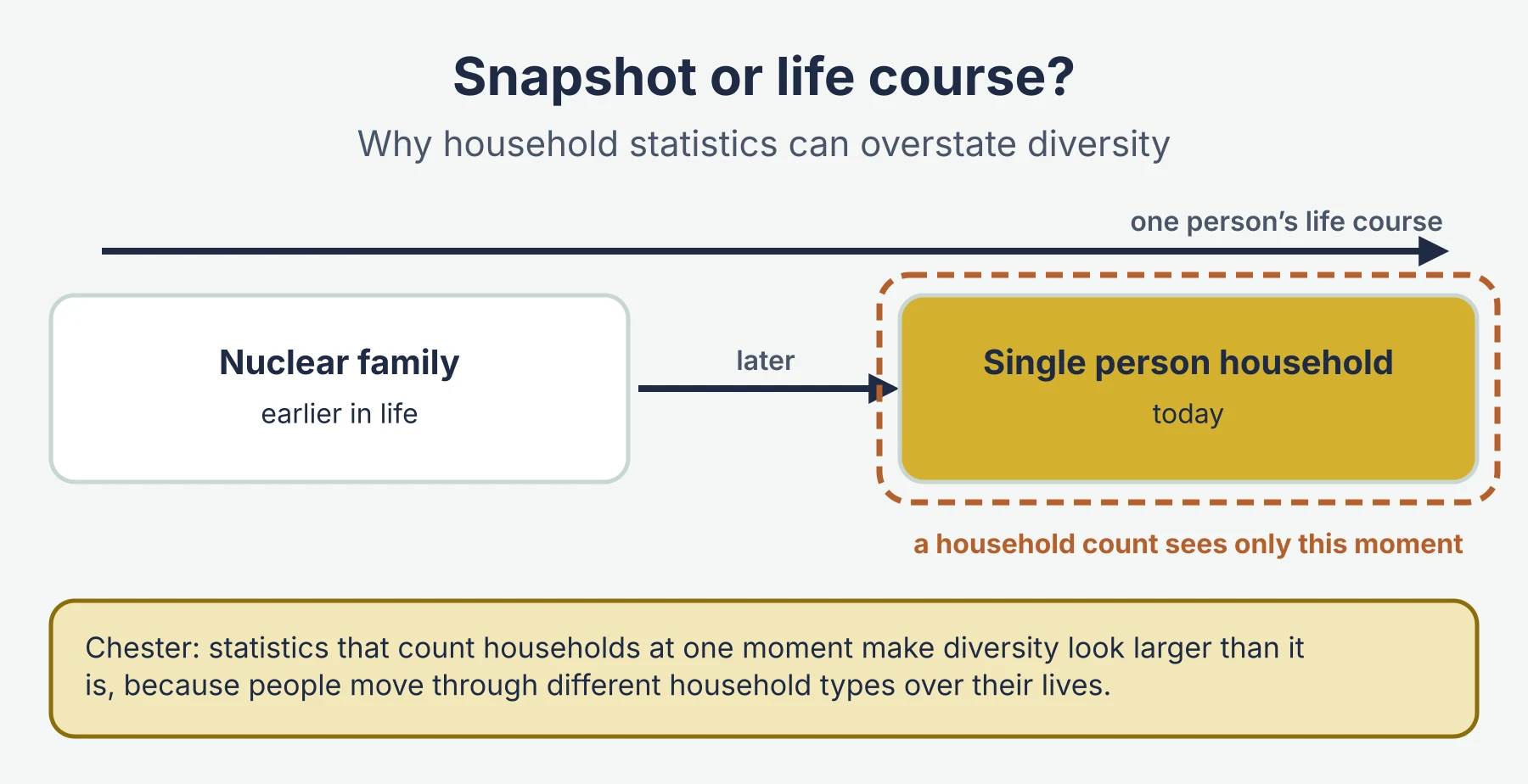
The extent of diversity. Robert Chester (1985) argued that the change has been exaggerated. Most people still live in a nuclear family at some stage of their lives, and the main change is the neo-conventional family, in which both partners work. Statistics that count households at one moment make diversity look larger than it is, because a person in a single-person household today may have lived in a nuclear family earlier in life.
Alternatives to the family (4.1.4)
- Single person households: people living alone, including young professionals, divorced people and widowed older people. Their growth reflects later marriage, divorce, an ageing population and the financial independence of women.
- Shared households: unrelated adults sharing a home, such as students or young workers, often because housing is expensive.
- Friends as family: close friends who provide the emotional and practical support usually expected of kin. The phrase “families of choice” is sometimes used for these networks.
These matter in exams because they test whether “family” and “household” are being used precisely.
Types of marriage (4.1.5)
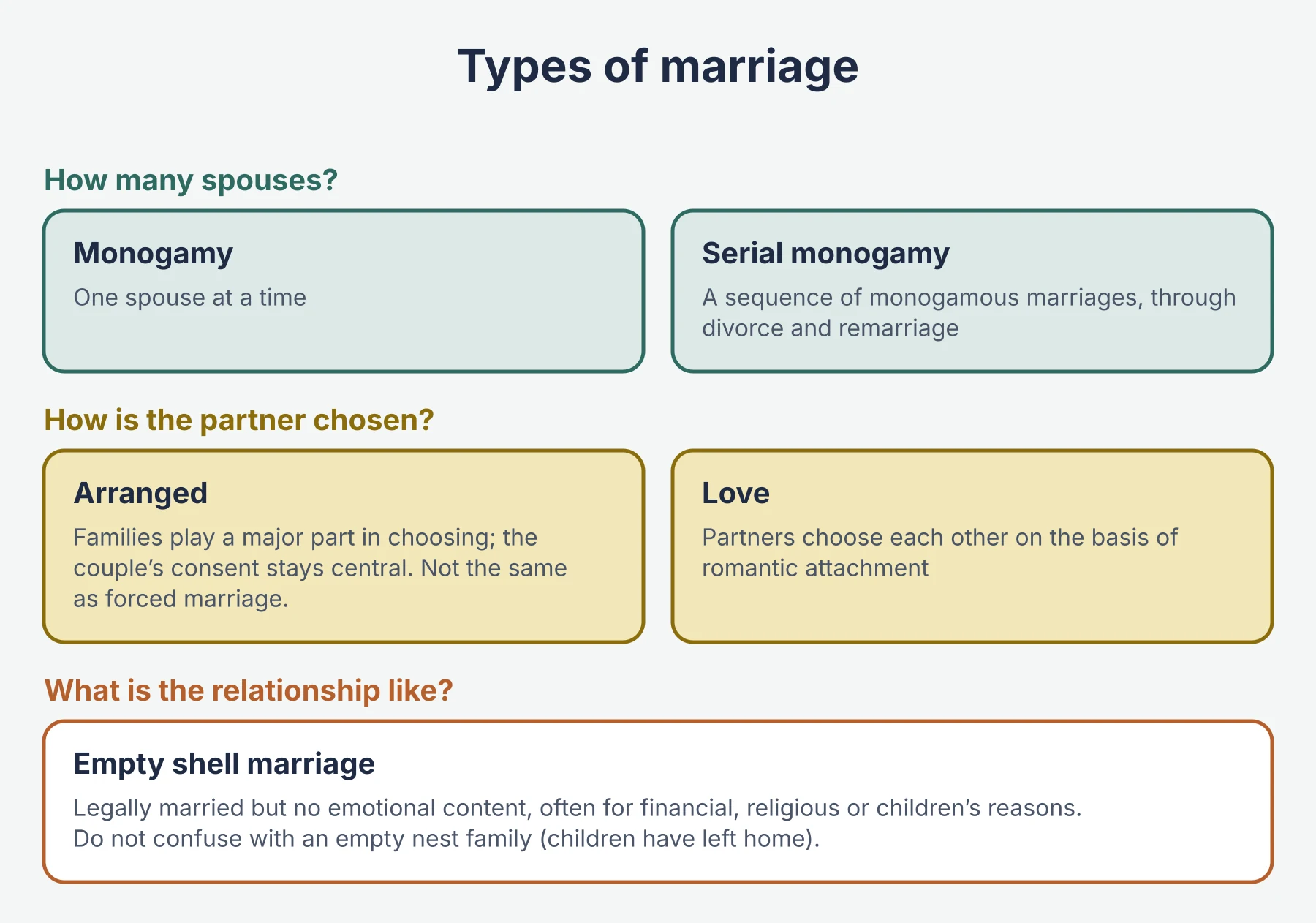
- Monogamy: one spouse at a time. Serial monogamy: a sequence of monogamous marriages, made possible by divorce and remarriage.
- Arranged marriage: families play a major part in choosing the partner; the couple’s consent remains central and it is different from forced marriage.
- Love marriage: partners choose each other on the basis of romantic attachment.
- Empty shell marriage: the couple stay legally married but the relationship has no emotional content, often for financial, religious or children’s reasons.
Worked example: planning a part (f) answer
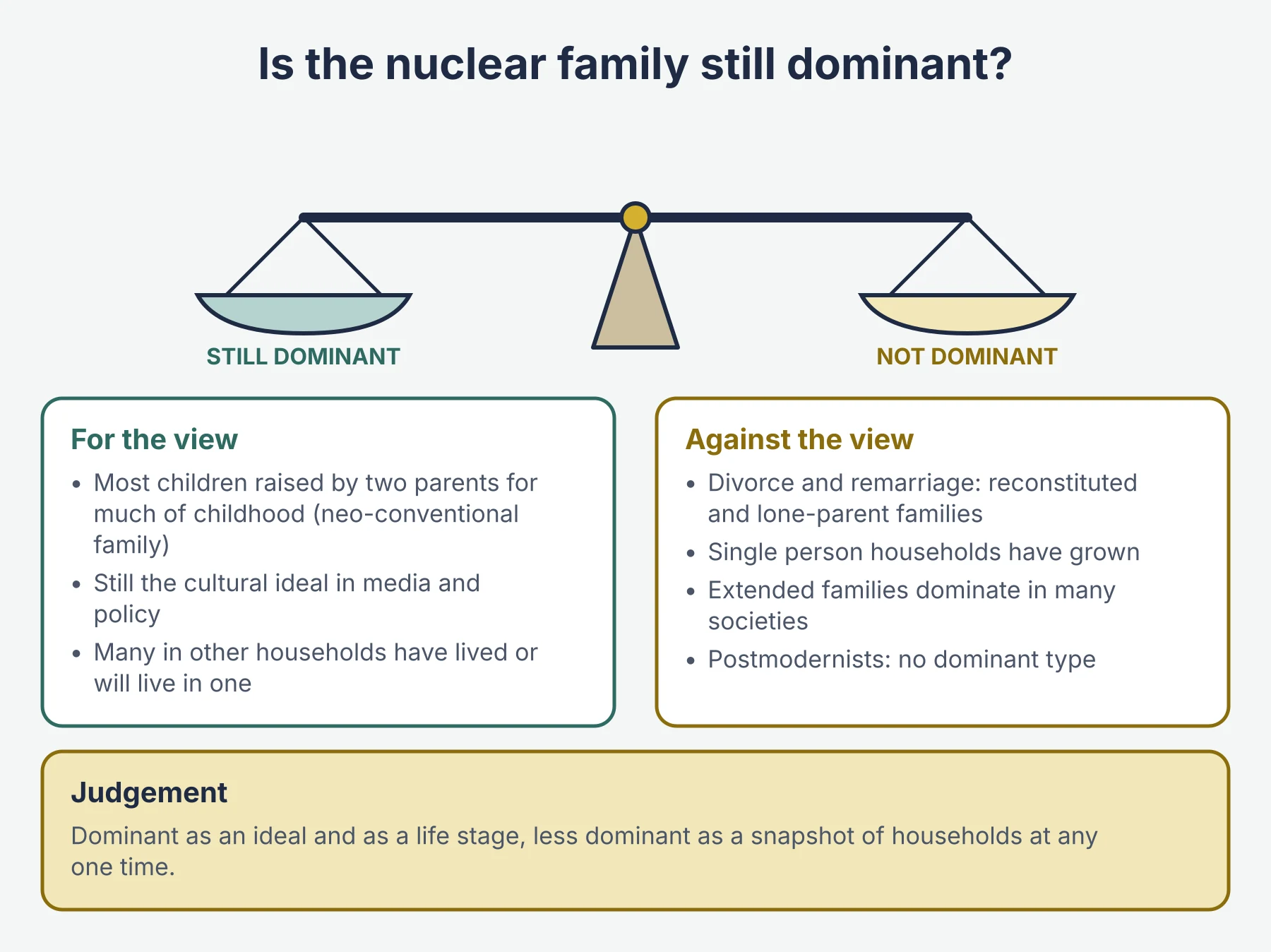
Evaluate the view that the nuclear family is still the dominant family type.
A plan that reaches the top level needs three developed arguments on each side and a judgement.
- For: most children are still raised by two parents for much of their childhood (Chester’s neo-conventional family); the nuclear family remains the cultural ideal promoted in media and policy; many people in other household types have lived, or will live, in a nuclear family over their life course.
- Against: rising divorce and remarriage produce reconstituted and lone-parent families; single person households have grown; cross-cultural evidence shows extended families dominate in many societies; postmodernists argue there is no longer any dominant type.
- Judgement: the nuclear family may be dominant as an ideal and as a life stage, while being less dominant as a snapshot of households at any one time.
Annotated sample paragraph (against): “Rising divorce rates have increased the number of reconstituted families [names a structure from 4.1.1], where children live with a step-parent and step-siblings. This weakens the claim that the nuclear family is dominant because the family is no longer a simple two-parent unit [explicit link to the view], although Chester would argue many reconstituted families still look nuclear in form [evaluation within the point].”
Common mistakes
- Using “family” and “household” as if they mean the same thing, which loses accuracy on alternatives to the family.
- Defining the beanpole family as “a big family”: it is long and thin, with many generations and few members in each.
- Confusing an empty nest family (children have left) with an empty shell marriage (no emotional content).
- Treating arranged marriage as forced marriage.
- Presenting the New Right view without a criticism, or giving postmodernism without mentioning constraints on choice.
Exam technique
- Define in part (a): one precise sentence plus a short example, such as “a reconstituted family, for example a mother, her two children and her new husband.”
- Give in part (b): two brief, separate points; development earns nothing extra.
- Explain in parts (c) and (d): identify each point, then develop it with a reason or example. Three points, each with its own paragraph.
- Discuss in part (e): three developed points with evidence, such as comparing New Right and postmodernist views.
- Evaluate in part (f): arguments on both sides and a conclusion; a one-sided answer is capped.
Condense this content with the key question 4.1 revision notes, then test yourself with the key question 4.1 practice questions. Continue with the role of the family (key question 4.2).
Related resources
-
Practice questions
Cambridge IGCSE Sociology (0495): Family – What are the different types of families? – Practice Questions
Original Cambridge IGCSE Sociology 0495 practice on key question 4.1: family structures, diversity, alternatives to the family and marriage, with full answers.
Sociology · Cambridge · IGCSE
Try questions -
Revision notes
Cambridge IGCSE Sociology (0495): Family – What are the different types of families? – Revision Notes
Revision notes for Cambridge IGCSE Sociology 0495 key question 4.1: family structures, diversity, New Right and postmodern views, alternatives, marriage.
Sociology · Cambridge · IGCSE
Revise topic -
Study guides
Cambridge IGCSE Sociology (0495): Family – What is the role of the family for the individual and society?
Cambridge IGCSE Sociology 0495 key question 4.2: functionalist, Marxist and feminist views of the family, their evaluation and whether family life is positive.
Sociology · Cambridge · IGCSE
Read guide
Related articles
Get free revision emails (optional)
Occasional emails with practice questions, worked explanations and links to free resources for the qualification and subjects you choose. No spam, and you can unsubscribe from any email. The free tools on this site never need an email.