
Revision Notes
Cambridge IGCSE Sociology (0495): Family – What are the different types of families? – Revision Notes
Revision notes for Cambridge IGCSE Sociology 0495 key question 4.1: family structures, diversity, New Right and postmodern views, alternatives, marriage.
- Subject
- Sociology
- Level
- IGCSE
- Topic
- Paper 2 – Family, Education and Crime
- Author
- Marlbridge Academic Team
- Updated
- Reviewed by
- Naqiya Yousaf (what this means)
Aligned to Cambridge IGCSE Sociology (0495), 2025-2027. Official specification .
Syllabus page (what it covers and how it is assessed): Cambridge IGCSE Sociology.
Syllabus points this page covers
0495
- 4.1 Family – What are the different types of families?
Found an error? Report a correction.
Need help with this topic? Request a free trial class for IGCSE Sociology (0495).
Condensed notes for key question 4.1 What are the different types of families? (Cambridge IGCSE Sociology 0495, Paper 2, Family). For full explanations and a worked part (f) plan, use the key question 4.1 study guide.
The five parts of 4.1 at a glance
| Syllabus point | What you must be able to do |
|---|---|
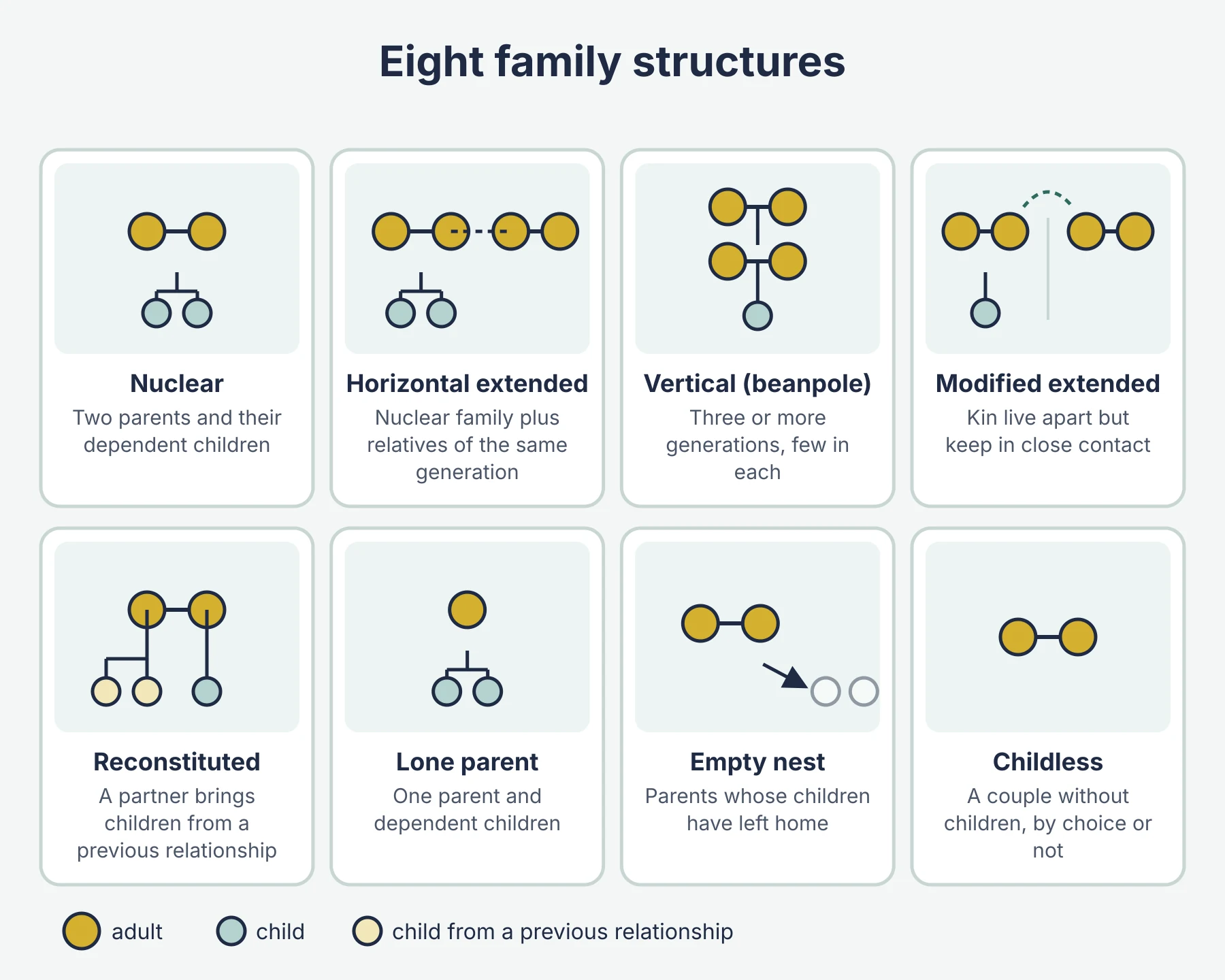
| 4.1.1 Family structures | Define seven structures (with three extended sub-types) and give a strength and a limitation of each |
| 4.1.2 Variations | Show how families differ across cultures, social classes and ethnic groups |
| 4.1.3 Views on diversity | Contrast New Right and postmodernist views; judge how dominant the nuclear family still is |
| 4.1.4 Alternatives | Explain single person households, shared households and friends as family |
| 4.1.5 Marriage | Distinguish arranged, empty shell, love, monogamy and serial monogamy |
Key terms
| Term | Meaning |
|---|---|
| Family | People related by blood, marriage, civil partnership or adoption |
| Household | One person, or a group, living at the same address and sharing facilities |
| Nuclear family | Two adults and their dependent children |
| Extended family | A family wider than the nucleus, such as grandparents, aunts or cousins |
| Horizontal extension | Adding relatives of the same generation, such as siblings and their spouses |
| Vertical extension | Adding generations, such as grandparents living with parents and children |
| Beanpole family | A vertically extended family with many generations but few members in each |
| Modified extended family | Relatives living apart who keep close contact and give support |
| Reconstituted family | A step-family formed when a partner brings children from an earlier relationship |
| Lone-parent family | One parent living with dependent children |
| Empty nest family | A couple whose children have grown up and left home |
| Serial monogamy | A series of marriages, one at a time, separated by divorce |
| Empty shell marriage | A marriage that continues legally without love or companionship |
| Neo-conventional family | Chester’s term for a nuclear family in which both partners work |
Structures: one strength, one limitation
- Nuclear: mobile and private / isolated, with no kin on hand.
- Extended (horizontal or vertical): pooled money and childcare / crowding and conflict.
- Modified extended: support at a distance / less day-to-day help.
- Reconstituted: a new stable home / step-relationship tensions.
- Lone parent: escape from conflict / risk of poverty and a single earner.
- Empty nest: freedom for the couple / loneliness.
- Childless: time and money for careers / stigma and no children to rely on later.
Memory hook: say who lives together, then who helps whom. Every strength and limitation comes back to support, resources or conflict.
Variations (4.1.2)
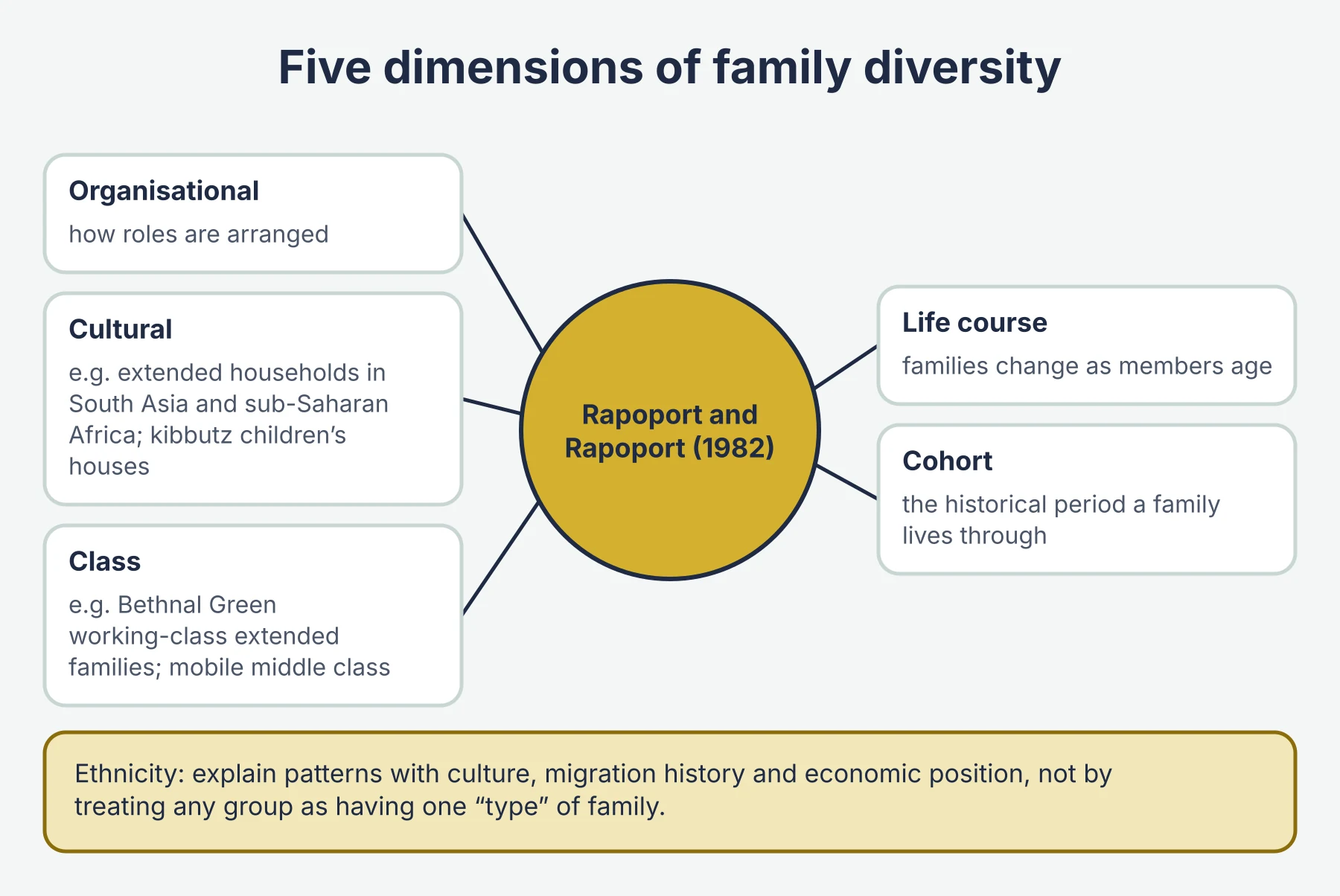
- Cross-cultural: extended households are common in many South Asian and African societies; Israeli kibbutzim historically used communal children’s houses.
- Class: Young and Willmott found close-knit extended kin among the working class of Bethnal Green in the 1950s; middle-class job mobility favours the modified extended family.
- Ethnicity: in Britain, South Asian heritage households more often include extended kin; Black Caribbean heritage families include a higher share of lone-mother households. Explain with culture, migration and economics, and avoid stereotyping.
- Rapoport and Rapoport (1982): diversity is organisational, cultural, class, life course and cohort.
Views on diversity (4.1.3)
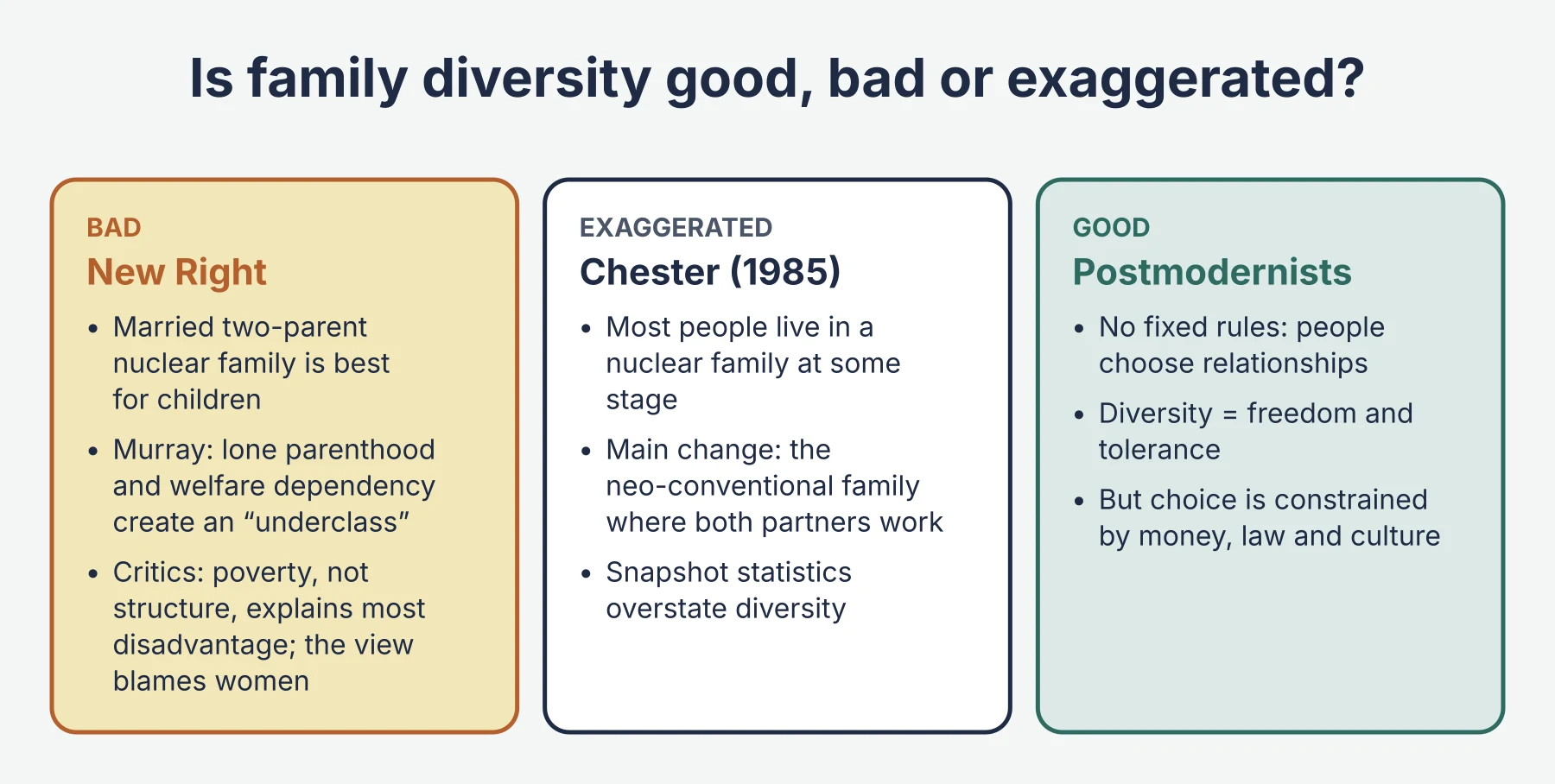
| New Right | Postmodernist | |
|---|---|---|
| Diversity is | A sign of decline | A sign of freedom and choice |
| Ideal family | Married two-parent nuclear family | No single ideal |
| Lone parents | Linked to inadequate socialisation (Murray’s underclass) | One legitimate choice among many |
| Main criticism | Blames individuals and women; ignores poverty | Overstates choice; money, law and culture constrain it |
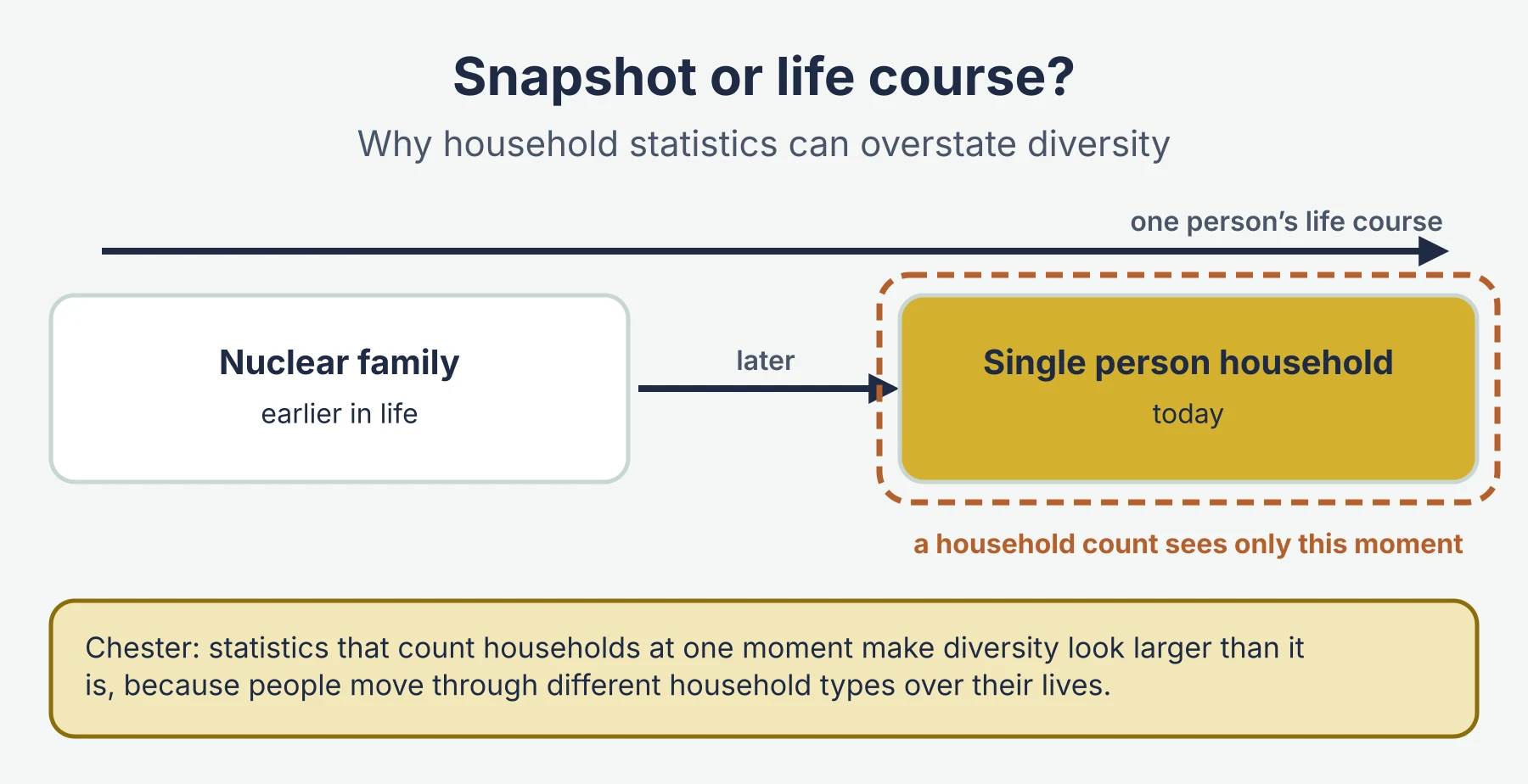
Extent of diversity: Chester (1985) argued most people still pass through a nuclear family at some point in their lives, so snapshots of households exaggerate diversity.
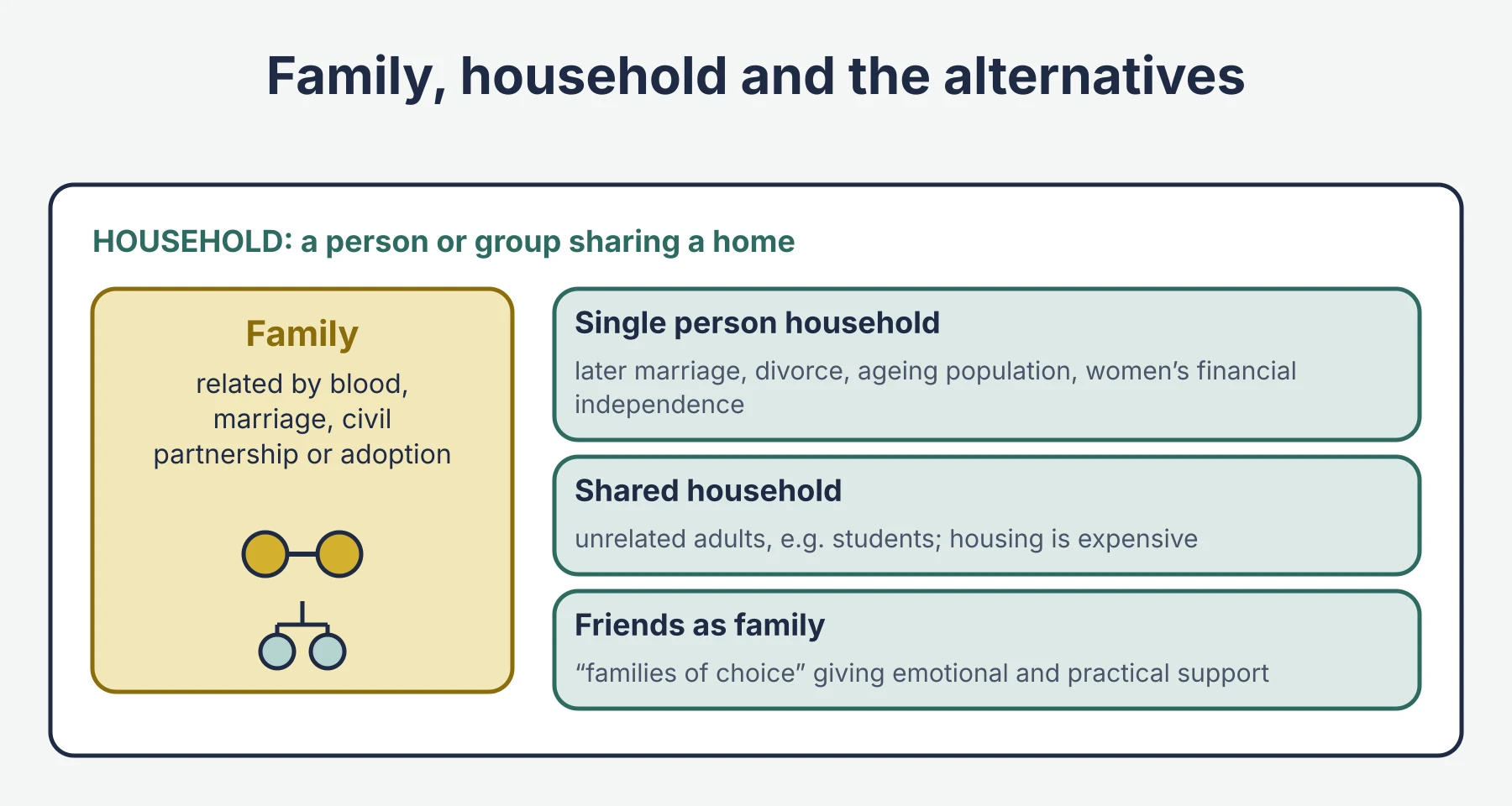
Alternatives to the family (4.1.4)
- Single person households: rising with later marriage, divorce, widowhood and women’s financial independence.
- Shared households: unrelated adults, often because of housing costs.
- Friends as family: friendship networks providing kin-like support, sometimes called families of choice.
Marriage types (4.1.5)
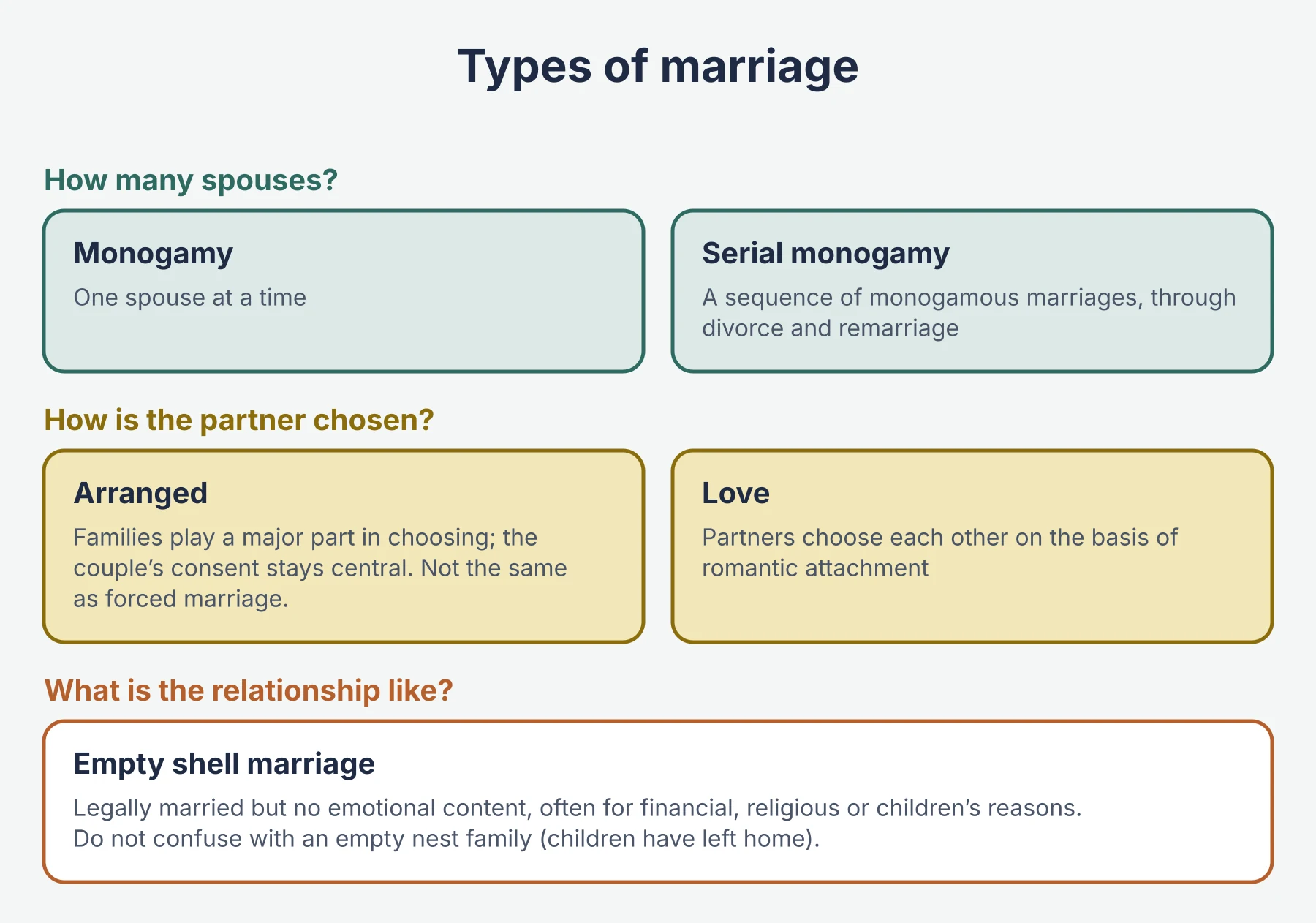
- Arranged: family-led choice of partner, with consent (not forced marriage).
- Love: chosen through romantic attachment.
- Monogamy and serial monogamy: one spouse at a time; repeated through divorce and remarriage.
- Empty shell: legally intact, emotionally empty.
Optional local-context content (for example polygamy or same-sex marriage) is not assessed but may support an answer.
Exam traps
- Empty nest vs empty shell: one is about children leaving; the other is about a loveless marriage.
- Beanpole means thin, not big. Say “many generations, few in each”.
- Family vs household: a shared student house is a household, not a family.
- Arranged vs forced: arranged marriage involves consent.
- One-sided diversity answers: always pair the New Right with a criticism, and postmodernism with the limits of choice.
- Snapshot statistics: households counted at one moment hide the life course, which is Chester’s key point.
Self-test
- What is the difference between a family and a household?
- Define a beanpole family.
- How does a horizontally extended family differ from a vertically extended one?
- Give one strength and one limitation of the lone-parent family.
- What is a modified extended family?
- What did Young and Willmott find in Bethnal Green in the 1950s?
- Name the five types of diversity identified by the Rapoports.
- Why does the New Right see family diversity as a problem?
- Why do postmodernists welcome diversity?
- What is the neo-conventional family?
- Give two reasons for the growth of single person households.
- What is the difference between serial monogamy and an empty shell marriage?
Answers: 1. A family is linked by kinship, marriage or adoption; a household is anyone sharing a home, related or not. 2. A family with several generations alive but few members in each generation, long and thin like a beanpole. 3. Horizontal extension adds relatives of the same generation; vertical extension adds generations such as grandparents. 4. Strength: can remove children from a conflict-ridden or abusive relationship; limitation: one income makes poverty more likely. 5. Relatives who live apart but keep regular contact and give support. 6. Close-knit working-class extended families, with mothers and married daughters in daily contact. 7. Organisational, cultural, class, life course and cohort. 8. It believes the two-parent married family socialises children best, so other types are linked to poor socialisation and dysfunction. 9. They see it as evidence that people can choose relationships that suit them. 10. Chester’s term for the nuclear family in which both partners do paid work. 11. Any two: later marriage, divorce, widowhood in an ageing population, women’s financial independence. 12. Serial monogamy is a sequence of marriages one at a time; an empty shell marriage continues without emotional content.
Apply these notes in the key question 4.1 practice questions, or revise the whole Paper 2 with the family, education and crime revision notes.
Related resources
-
Study guides
Cambridge IGCSE Sociology (0495): Family – What is the role of the family for the individual and society?
Cambridge IGCSE Sociology 0495 key question 4.2: functionalist, Marxist and feminist views of the family, their evaluation and whether family life is positive.
Sociology · Cambridge · IGCSE
Read guide -
Practice questions
Cambridge IGCSE Sociology (0495): Family – What is the role of the family for the individual and society? – Practice Questions
Original Cambridge IGCSE Sociology 0495 practice on key question 4.2: functionalist, Marxist and feminist views of the family's role, with full mark guidance.
Sociology · Cambridge · IGCSE
Try questions -
Revision notes
Cambridge IGCSE Sociology (0495): Family – What is the role of the family for the individual and society? – Revision Notes
Revision notes for Cambridge IGCSE Sociology 0495 key question 4.2: functionalist, Marxist and feminist roles of the family, with key terms and a self-test.
Sociology · Cambridge · IGCSE
Revise topic
Related articles
Get free revision emails (optional)
Occasional emails with practice questions, worked explanations and links to free resources for the qualification and subjects you choose. No spam, and you can unsubscribe from any email. The free tools on this site never need an email.