
Revision Notes
Cambridge IGCSE Sociology (0495): Family – What is the role of the family for the individual and society? – Revision Notes
Revision notes for Cambridge IGCSE Sociology 0495 key question 4.2: functionalist, Marxist and feminist roles of the family, with key terms and a self-test.
- Subject
- Sociology
- Level
- IGCSE
- Topic
- Paper 2 – Family, Education and Crime
- Author
- Marlbridge Academic Team
- Updated
- Reviewed by
- Naqiya Yousaf (what this means)
Aligned to Cambridge IGCSE Sociology (0495), 2025-2027. Official specification .
Syllabus page (what it covers and how it is assessed): Cambridge IGCSE Sociology.
Syllabus points this page covers
0495
- 4.2 Family – What is the role of the family for the individual and society?
Found an error? Report a correction.
Need help with this topic? Request a free trial class for IGCSE Sociology (0495).
Condensed notes for key question 4.2 What is the role of the family for the individual and society? (Cambridge IGCSE Sociology 0495, Paper 2). The key question 4.2 study guide explains each idea in full with an annotated answer.
The one-line summary
| Perspective | Who benefits? | Core mechanism |
|---|---|---|
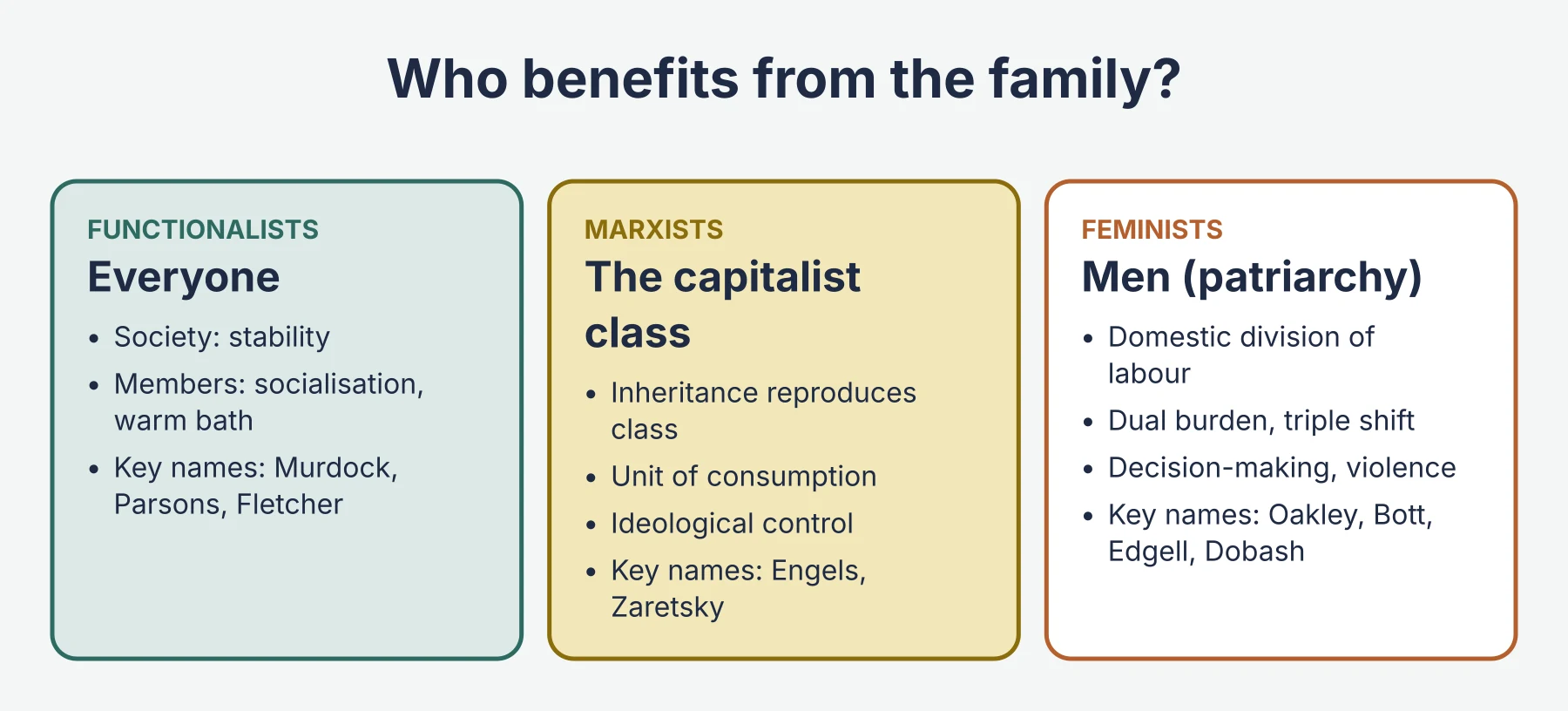
| Functionalism | Everyone: members and society | Essential functions; primary socialisation; stabilising adults |
| Marxism | The capitalist ruling class | Inheritance, consumption, ideological control, unpaid labour |
| Feminism | Men (patriarchy) | Unequal domestic labour, decision-making, violence, gendered socialisation |
Key terms
| Term | Meaning |
|---|---|
| Functions of the family | The jobs the family does for members and society |
| Primary socialisation | Learning basic norms, values and language in early childhood, mainly in the family |
| Warm bath theory | Parsons’ idea that family life relaxes and stabilises adult personalities |
| Loss of functions | The view that other institutions have taken over many family functions since industrialisation |
| Structural differentiation | Institutions becoming more specialised as society develops |
| Unit of consumption | The family as a buyer of goods and services that create profit |
| Ideological control | Teaching ideas that make inequality seem natural and acceptable |
| Patriarchy | A system of male power and dominance over women |
| Domestic division of labour | How housework and childcare are shared between partners |
| Segregated conjugal roles | Partners have separate tasks and separate leisure (Bott, 1957) |
| Joint conjugal roles | Partners share tasks, decisions and leisure |
| Dual burden | Doing paid work and most of the unpaid domestic work |
| Triple shift | Paid work, domestic work and emotion work (Duncombe and Marsden, 1995) |
| Canalisation | Channelling children towards gender-typed toys and activities (Oakley) |
Functionalism (4.2.1)
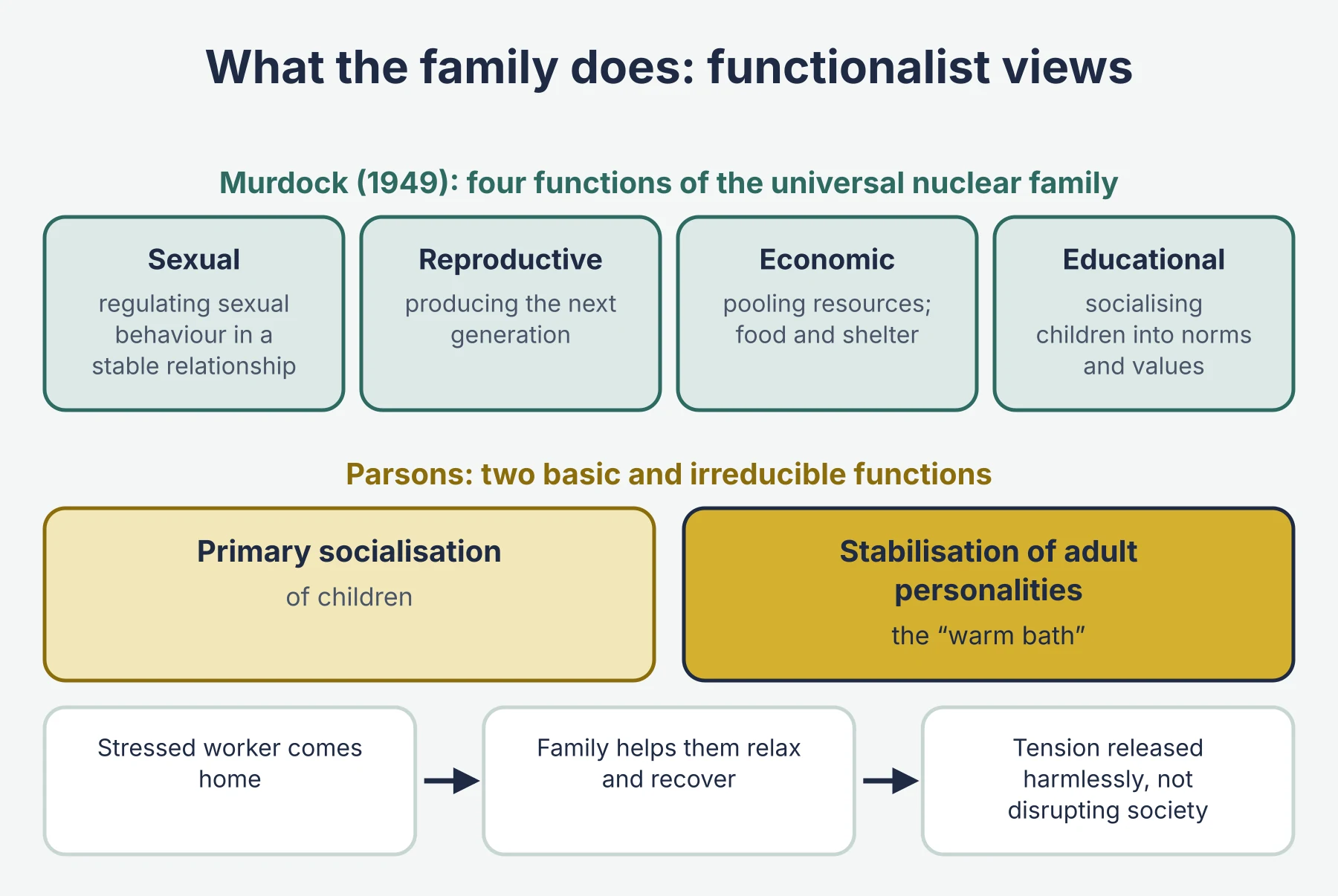
- Murdock (1949): four universal functions: sexual, reproductive, economic, educational.
- Parsons: two irreducible functions: primary socialisation and stabilisation of adult personalities (warm bath).
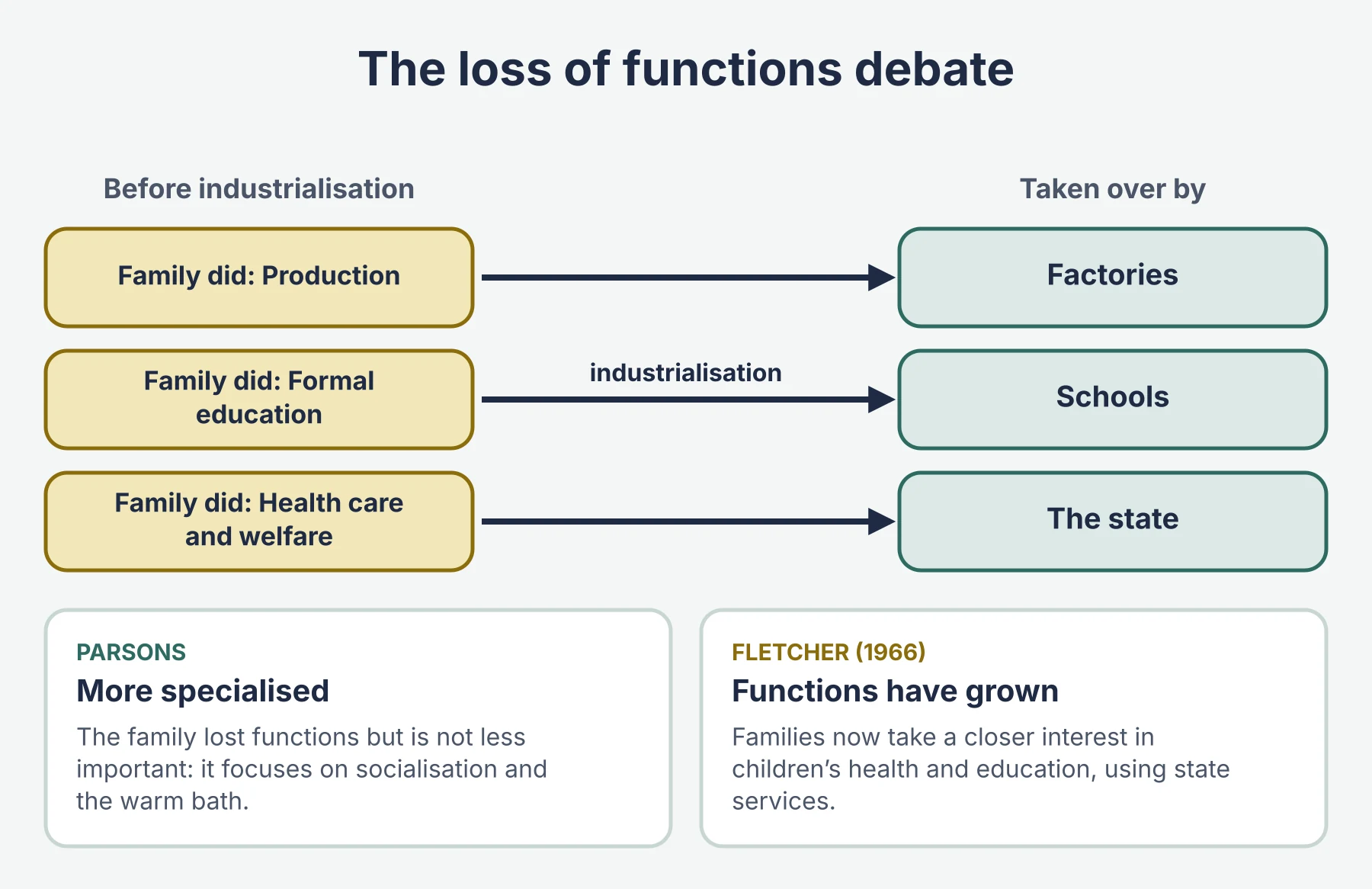
- Loss of functions: industrialisation passed production to factories, education to schools, welfare and health to the state; the family became specialised.
- Fletcher (1966): functions have grown in importance, not shrunk; families now take more interest in health and education.
- Nuclear family fits industry: small and geographically mobile; status achieved, not inherited.
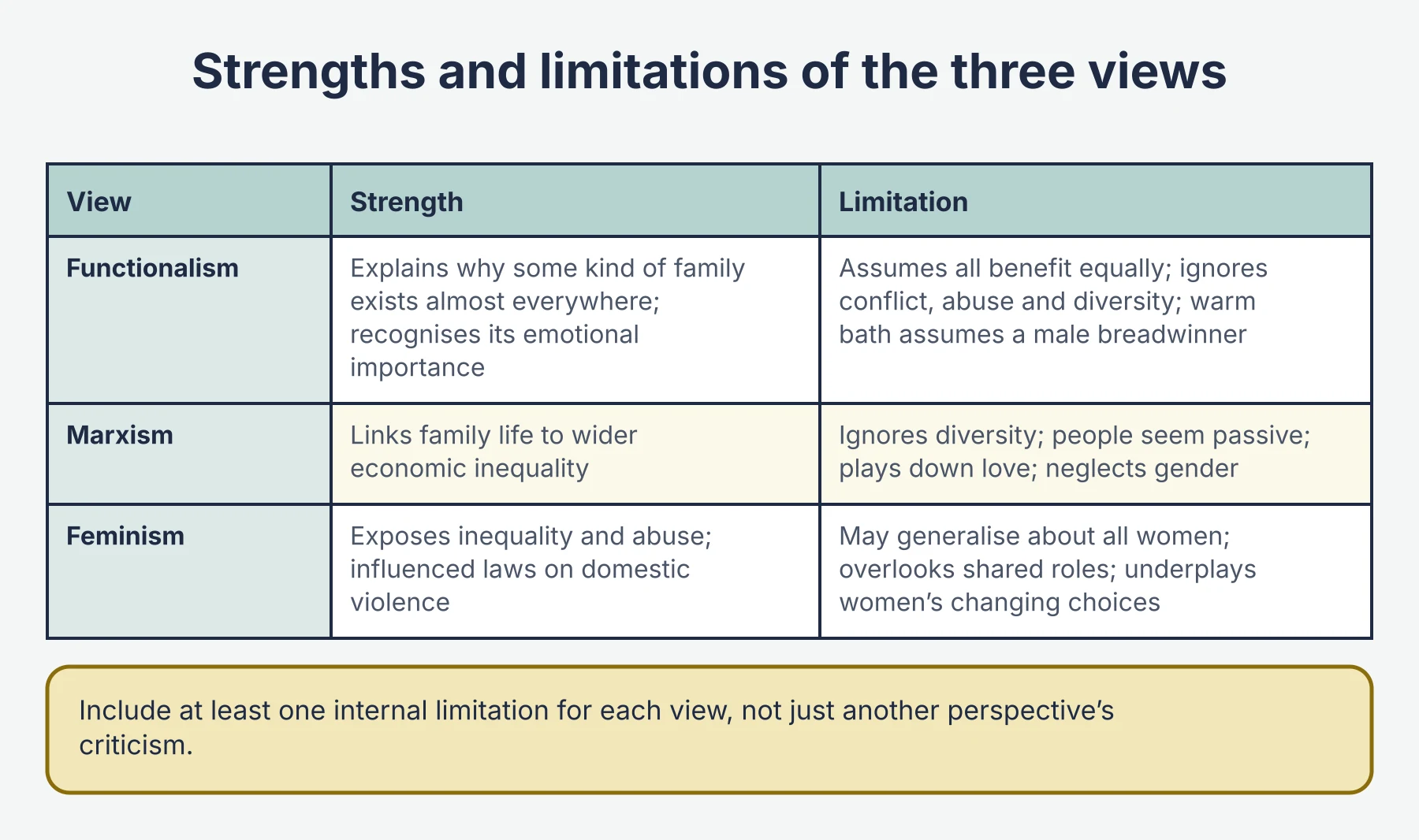
- Limitations: rosy picture; ignores abuse and conflict; ignores diversity; assumes a male breadwinner.
Marxism (4.2.2)
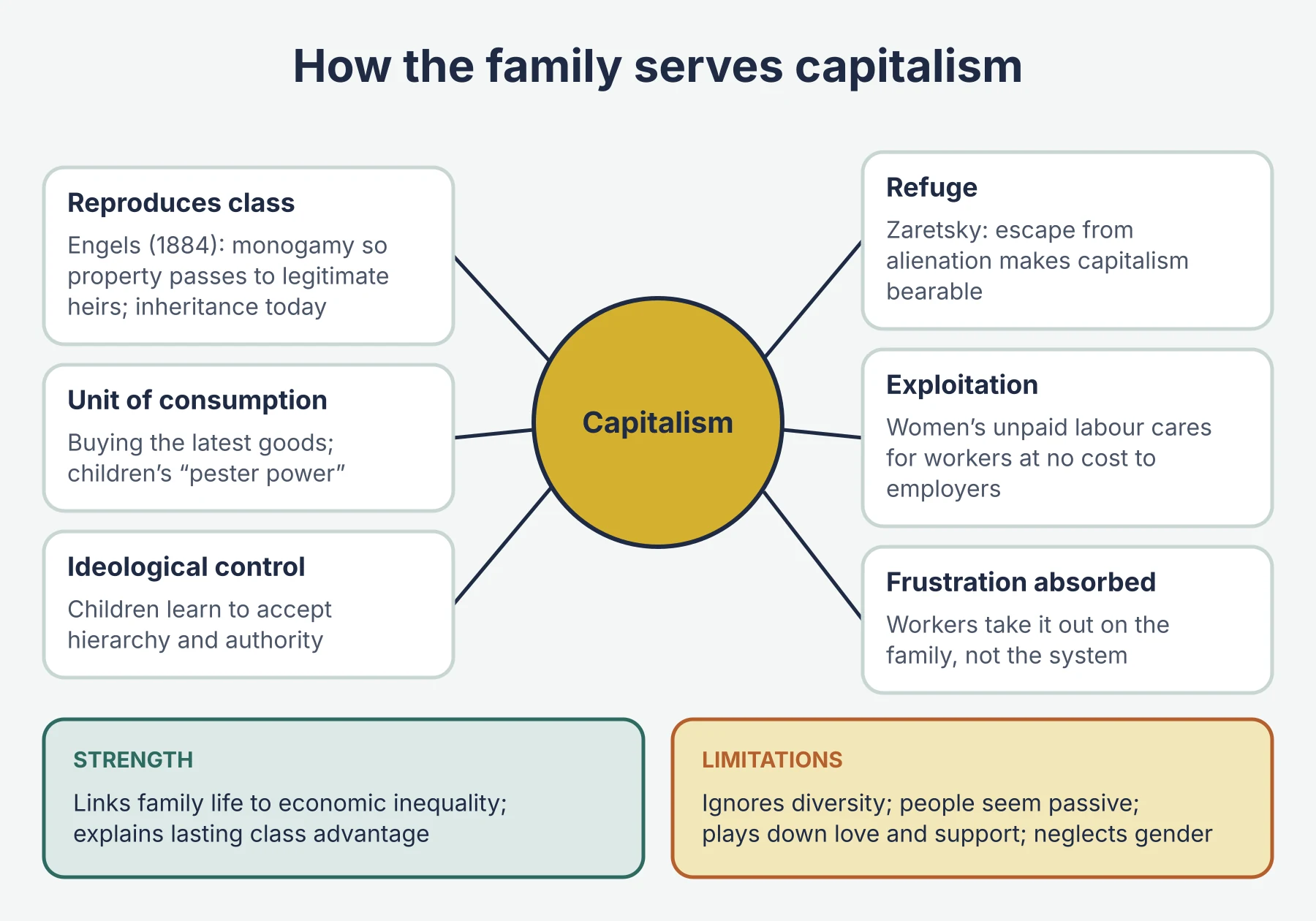
- Engels (1884): monogamy arose so men could pass property to legitimate heirs.
- Reproduces class inequality: wealth and advantage are inherited within classes.
- Unit of consumption: families buy goods; advertisers exploit children’s pester power.
- Ideological control: children learn obedience to authority; Zaretsky: the family is a refuge that makes capitalist work bearable.
- Exploitation: women’s unpaid labour reproduces the workforce free for employers.
- Limitations: ignores love and choice; ignores diversity; class-focused, so neglects gender.
Feminism (4.2.3)
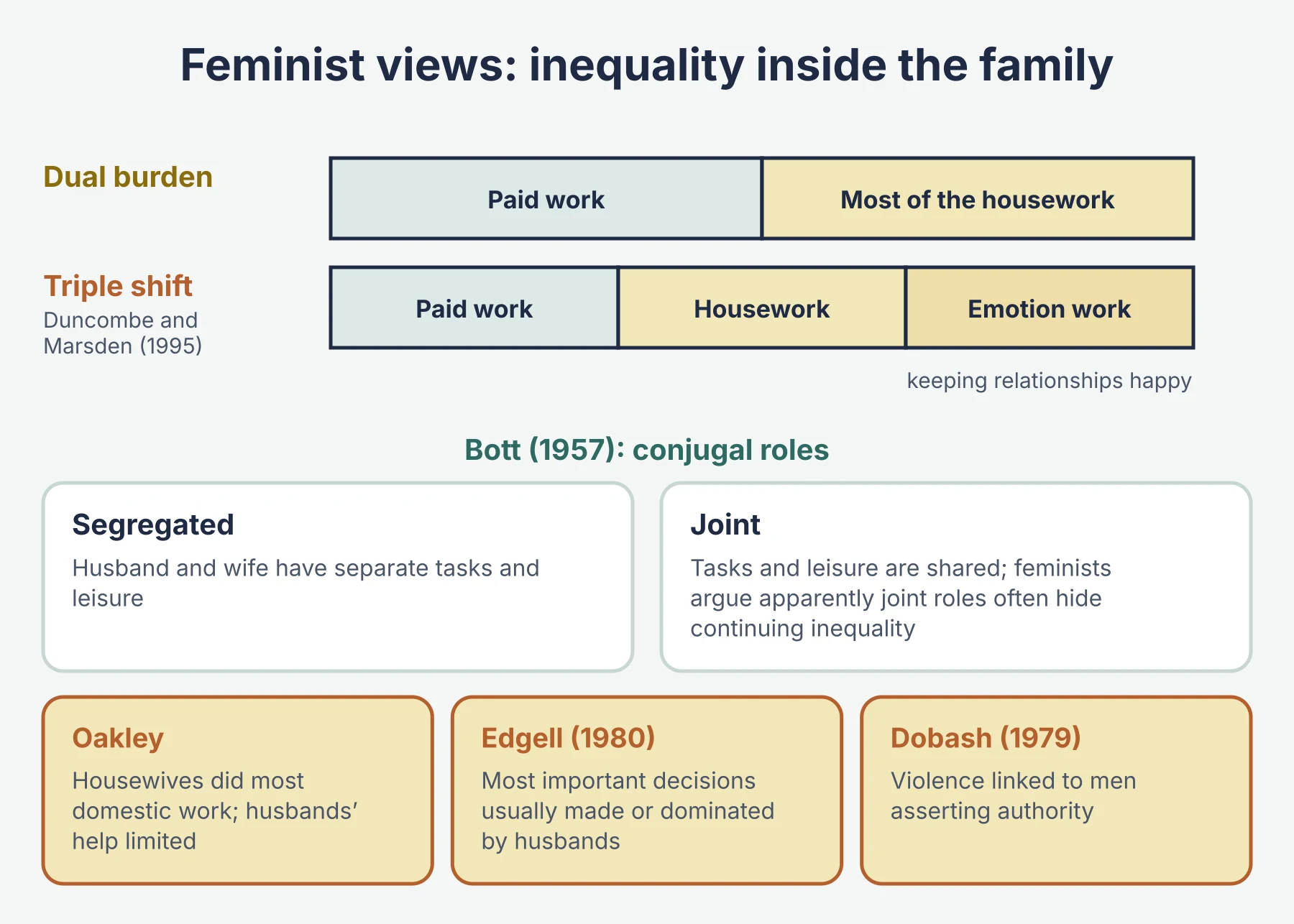
- Domestic division of labour: Oakley found housewives did most of the work in the 1970s.
- Conjugal roles: Bott’s joint v segregated distinction; feminists say “joint” often hides inequality.
- Dual burden and triple shift: paid work plus housework plus emotion work.
- Decision-making: Edgell (1980) found husbands dominated major decisions in middle-class couples.
- Domestic violence and abuse: Dobash and Dobash (1979) linked violence to men asserting authority.
- Gendered socialisation: manipulation and canalisation (Oakley).
- Limitations: may overgeneralise about women; overlooks genuinely equal couples and women’s growing choices.
Positive or negative? (4.2.5)
- Positive: love, identity, care, socialisation, financial support.
- Negative: abuse behind closed doors; inequality; Leach (1967) on the inward-looking family as a source of discontent; stress on carers.
- It depends: on gender, age, class, culture, and on which member you ask.
Exam traps
- Parsons did not say the family is useless: specialised is not the same as unimportant.
- Dual burden is not the triple shift: the third shift is emotion work.
- Concepts, not slogans: “unit of consumption” scores; “Marxists hate families” does not.
- Evaluate from inside as well as outside: give at least one limitation that is not just “Marxists disagree”.
- Answer the role, not the type: a functions question needs functions, not a list of family structures.
- Bott is about roles; Oakley is about housework and socialisation: do not swap them.
Self-test
- Name Murdock’s four functions of the family.
- What two functions did Parsons see as irreducible?
- Explain the warm bath theory in one sentence.
- What is the loss of functions debate?
- How did Fletcher disagree with the loss of functions view?
- According to Engels, why did monogamy develop?
- What is meant by the family as a unit of consumption?
- How does Zaretsky argue the family helps capitalism?
- Distinguish joint and segregated conjugal roles.
- What did Edgell find about decision-making?
- What is canalisation?
- Give one reason why family life may be negative for some members.
Answers: 1. Sexual, reproductive, economic, educational. 2. Primary socialisation of children and stabilisation of adult personalities. 3. Home life lets stressed adults relax and recover, so tension does not disrupt society. 4. The argument that industrialisation transferred family functions to other institutions such as schools and the state, leaving the family more specialised. 5. He argued functions have become more important, with families more involved in children’s health and education. 6. So men could pass their private property to children they knew were their own. 7. Families are encouraged to buy goods and services, creating profit for capitalists. 8. It is a refuge from alienating work, which makes capitalism bearable and less likely to be challenged. 9. Joint roles share tasks and leisure; segregated roles divide them into separate spheres. 10. Husbands made, or dominated, the most important decisions in middle-class couples. 11. Channelling children towards toys and activities seen as suitable for their gender. 12. Any one: domestic violence or abuse; an unequal workload for women; conflict and stress in an inward-looking nuclear family.
Test yourself with the key question 4.2 practice questions, then revise how family life is changing (key question 4.3).
Related resources
-
Study guides
Cambridge IGCSE Sociology (0495): Family – How is family life changing?
Cambridge IGCSE Sociology 0495 key question 4.3: demographic change, industrialisation, trends in marriage and divorce, and changing roles in the family.
Sociology · Cambridge · IGCSE
Read guide -
Practice questions
Cambridge IGCSE Sociology (0495): Family – How is family life changing? – Practice Questions
Original Cambridge IGCSE Sociology 0495 practice on key question 4.3: demographic change, divorce and cohabitation, and changing family roles, with answers.
Sociology · Cambridge · IGCSE
Try questions -
Revision notes
Cambridge IGCSE Sociology (0495): Family – How is family life changing? – Revision Notes
Revision notes for Cambridge IGCSE Sociology 0495 key question 4.3: demographic change, industrialisation, divorce trends and changing family roles.
Sociology · Cambridge · IGCSE
Revise topic
Related articles
Get free revision emails (optional)
Occasional emails with practice questions, worked explanations and links to free resources for the qualification and subjects you choose. No spam, and you can unsubscribe from any email. The free tools on this site never need an email.