
Study Guides
Cambridge IGCSE Sociology (0495): Family – How is family life changing?
Cambridge IGCSE Sociology 0495 key question 4.3: demographic change, industrialisation, trends in marriage and divorce, and changing roles in the family.
- Subject
- Sociology
- Level
- IGCSE
- Topic
- Paper 2 – Family, Education and Crime
- Author
- Marlbridge Academic Team
- Updated
- Reviewed by
- Naqiya Yousaf (what this means)
Aligned to Cambridge IGCSE Sociology (0495), 2025-2027. Official specification .
Syllabus page (what it covers and how it is assessed): Cambridge IGCSE Sociology.
Syllabus points this page covers
0495
- 4.3 Family – How is family life changing?
Found an error? Report a correction.
Need help with this topic? Request a free trial class for IGCSE Sociology (0495).
This guide covers key question 4.3 How is family life changing? in the Family topic of Cambridge IGCSE Sociology (0495) Paper 2, 2025–2027 syllabus. The family, education and crime study guide shows how an ageing population links to beanpole families; this page covers all five syllabus points, including the explanations for trends in marriage and divorce that the overview does not develop.
What key question 4.3 covers
- 4.3.1 Demographic factors and their effects on family life: family size, birth rates, life expectancy, ageing population, having children in later life.
- 4.3.2 The impact of industrialisation and urbanisation on family structures and roles.
- 4.3.3 Explanations of changing patterns in marriage, divorce and cohabitation: legislation; societal attitudes and values; the role of the internet; secularisation; cultural expectations; changes in the status and power of women.
- 4.3.4 Alternatives to marriage: cohabitation, singlehood, lone parents, civil partnerships.
- 4.3.5 Changing family roles: conjugal roles (more diverse family types; segregated to joint roles, such as the symmetrical and dual worker family; the pivot or sandwich generation); roles of children (economic burden, child-centredness, boomerang children); roles of grandparents (childcare, economic support, wisdom and advice, dependence).
The skill tested throughout is linking a cause to an effect on family life. A list of trends without explanation will not reach the higher levels.
Demographic factors (4.3.1)
| Factor | Typical trend in industrial societies | Main causes | Effect on family life |
|---|---|---|---|
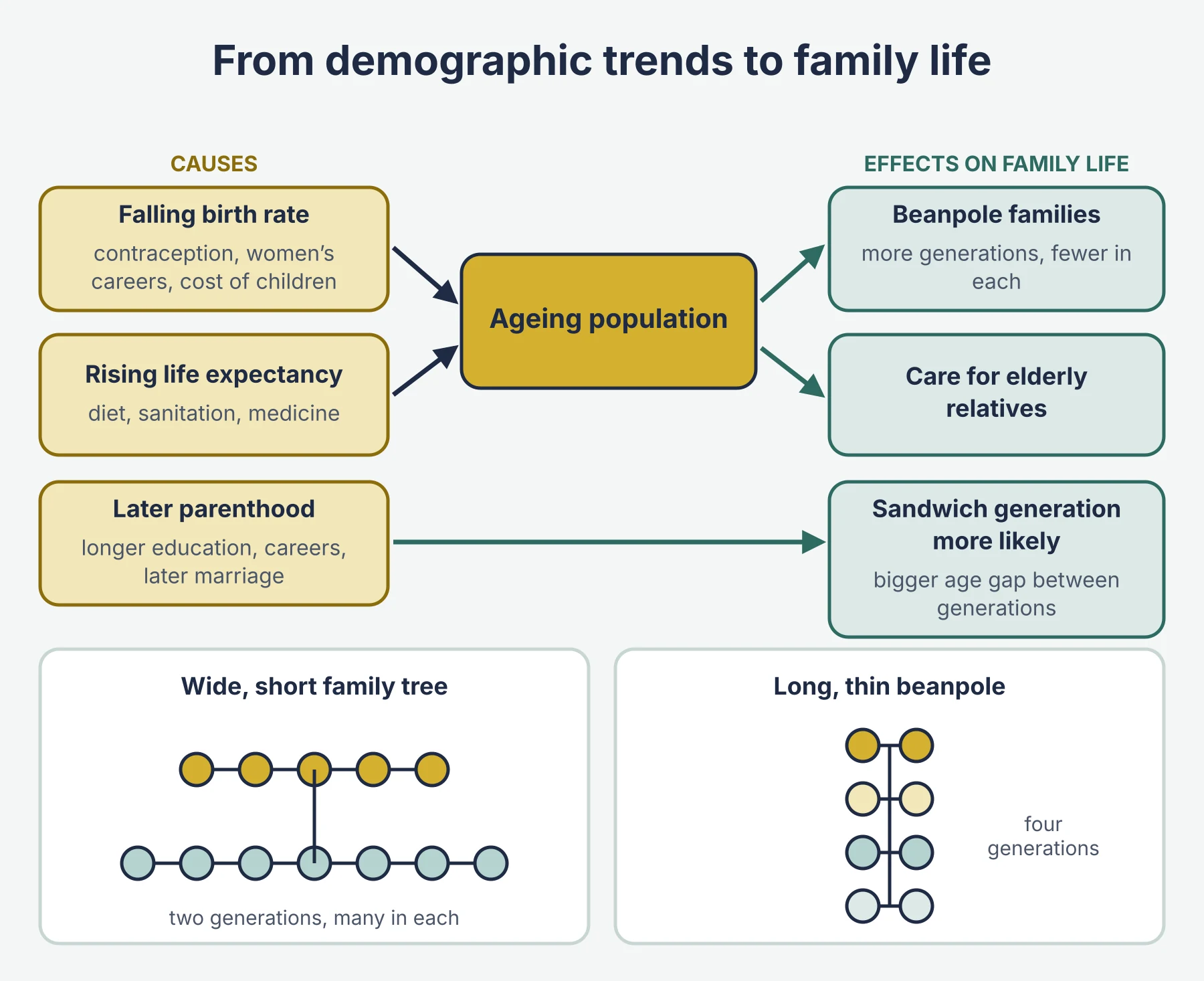
| Birth rate | Falling | Contraception; women’s education and careers; lower infant mortality; cost of raising children | Smaller families; more resources per child |
| Family size | Smaller | The same causes as falling birth rates | Fewer siblings, cousins, aunts and uncles |
| Life expectancy | Rising | Better diet, sanitation, medicine and living standards | More generations alive at once |
| Ageing population | Growing share of older people | Falling birth rates combined with longer lives | Beanpole families; care for elderly relatives |
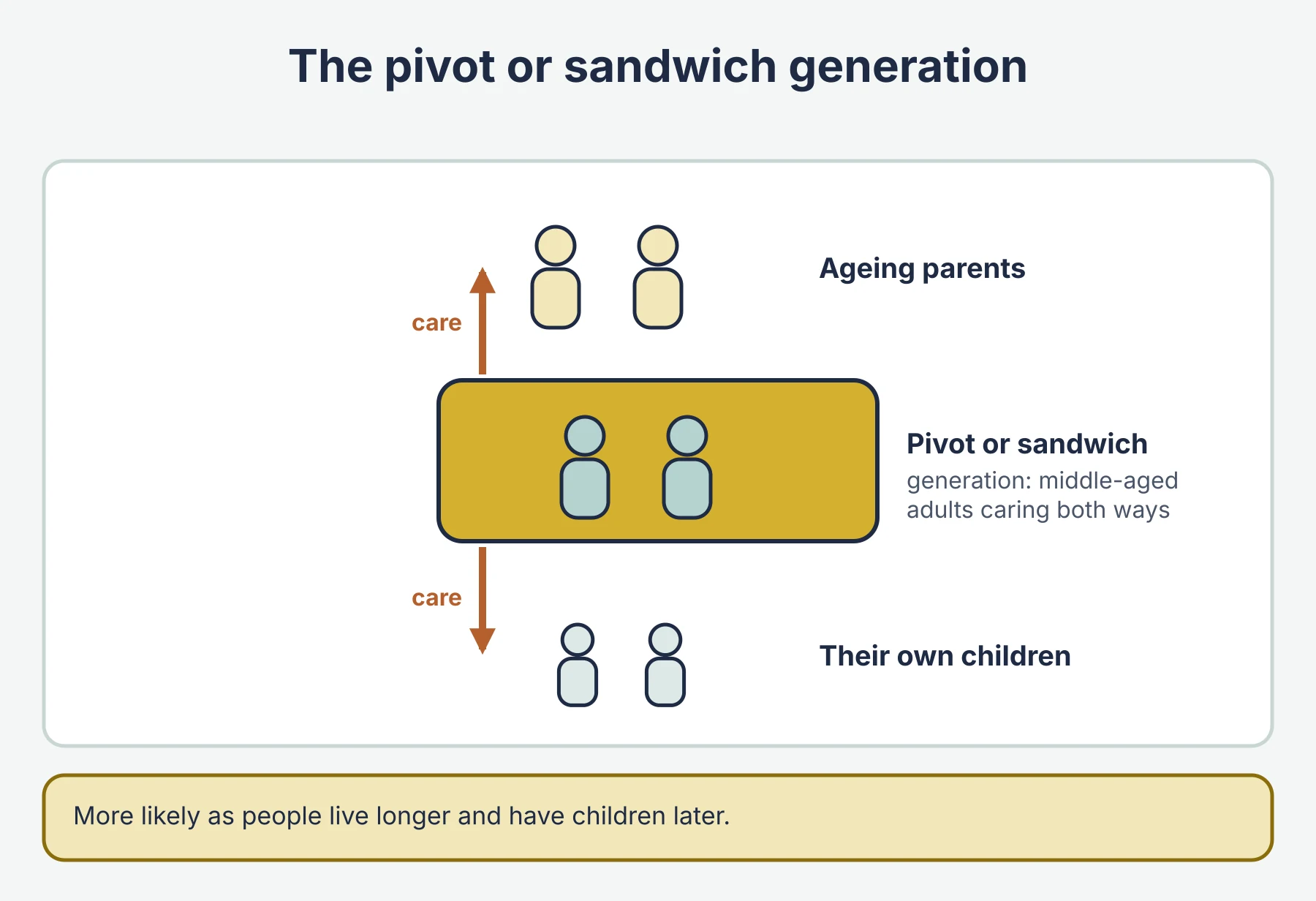
| Later parenthood | Average age at first birth rising | Longer education; establishing careers; later marriage | Bigger age gap between generations; the sandwich generation is more likely |
The trends are not universal. Many lower-income countries still have relatively high birth rates and young populations, where children may contribute to family income and support parents in old age. Comparing societies earns credit in “explain” and “discuss” parts.
Industrialisation and urbanisation (4.3.2)
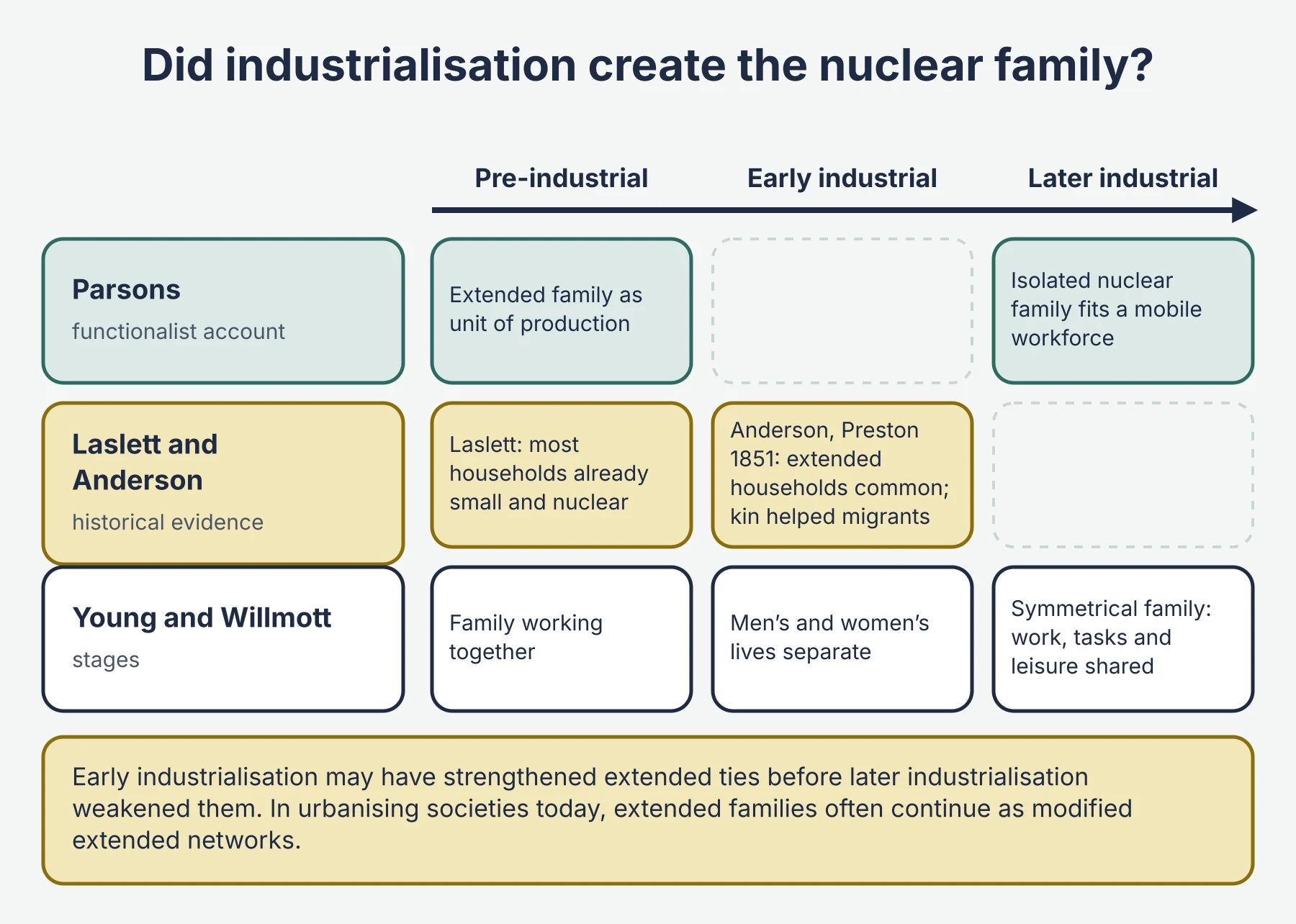
The functionalist account. Parsons argued that pre-industrial societies relied on the extended family as a unit of production, while industrial society needed a geographically mobile workforce. The isolated nuclear family fitted that need, so industrialisation produced a shift from extended to nuclear families.
The historical challenge. Peter Laslett’s research on English parish records found that most pre-industrial households were already small and nuclear, partly because people married late and died young. Michael Anderson’s (1971) study of census data from Preston in 1851 found that extended households were common in the early industrial town, because kin helped migrants find work and housing and shared costs. So early industrialisation may have strengthened extended ties before later industrialisation weakened them.
Young and Willmott’s stages. They described a move from the pre-industrial family working together, through the early industrial family where men and women’s lives were separate, to the symmetrical family, in which partners share paid work, domestic tasks and leisure.
Urbanisation today. In rapidly urbanising societies, migrants moving to cities may leave extended kin in rural areas, form nuclear households in the city and send money home. Extended families often continue as modified extended networks rather than disappearing.
Explaining trends in marriage, divorce and cohabitation (4.3.3)
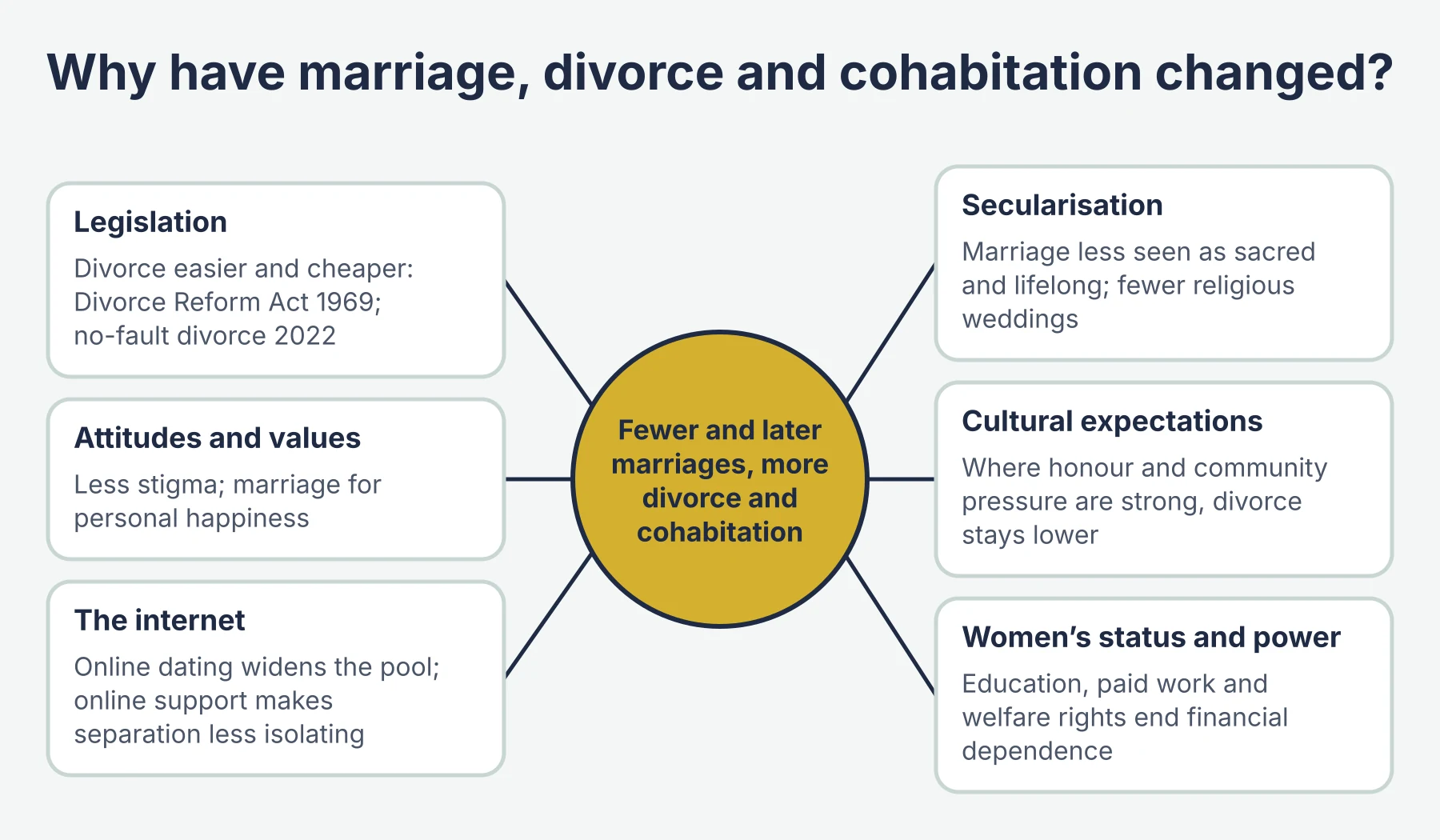
In many industrial societies marriage rates have fallen, people marry later, divorce has risen over the long term, and cohabitation has become common. The syllabus names six explanations.
- Legislation: laws have made divorce easier and cheaper. In England and Wales, for example, the Divorce Reform Act 1969 allowed divorce on the ground of “irretrievable breakdown”, and no-fault divorce took effect in 2022. Legal aid and the equalisation of grounds for men and women also widened access.
- Societal attitudes and values: less stigma attached to divorce, cohabitation and children born outside marriage. Marriage is increasingly seen as a relationship for personal happiness, so an unhappy marriage is more likely to end.
- Role of the internet: online dating widens the pool of potential partners, social media can make contacting former partners or forming new relationships easier, and online support and information make separation less isolating.
- Secularisation: the declining influence of religion weakens the belief that marriage is sacred and lifelong, and fewer weddings are religious.
- Cultural expectations: expectations of marriage differ between and within societies. Where family honour and community pressure remain strong, divorce rates tend to stay lower; migrant and second-generation families may blend expectations.
- Female empowerment: education, paid work and welfare rights mean women no longer depend financially on a husband, so they can leave unhappy marriages and delay or avoid marriage.
Alternatives to marriage (4.3.4)
- Cohabitation: a couple living together in a sexual relationship without marrying. For some it is a trial marriage, for others a permanent alternative.
- Singlehood: choosing to stay single, linked to careers, independence and reduced stigma.
- Lone parents: raising children without a partner, through divorce, separation, death or choice.
- Civil partnerships: a legally recognised union with rights similar to marriage. In England and Wales they were introduced in 2004 for same-sex couples and extended to opposite-sex couples in 2019.
Changing family roles (4.3.5)
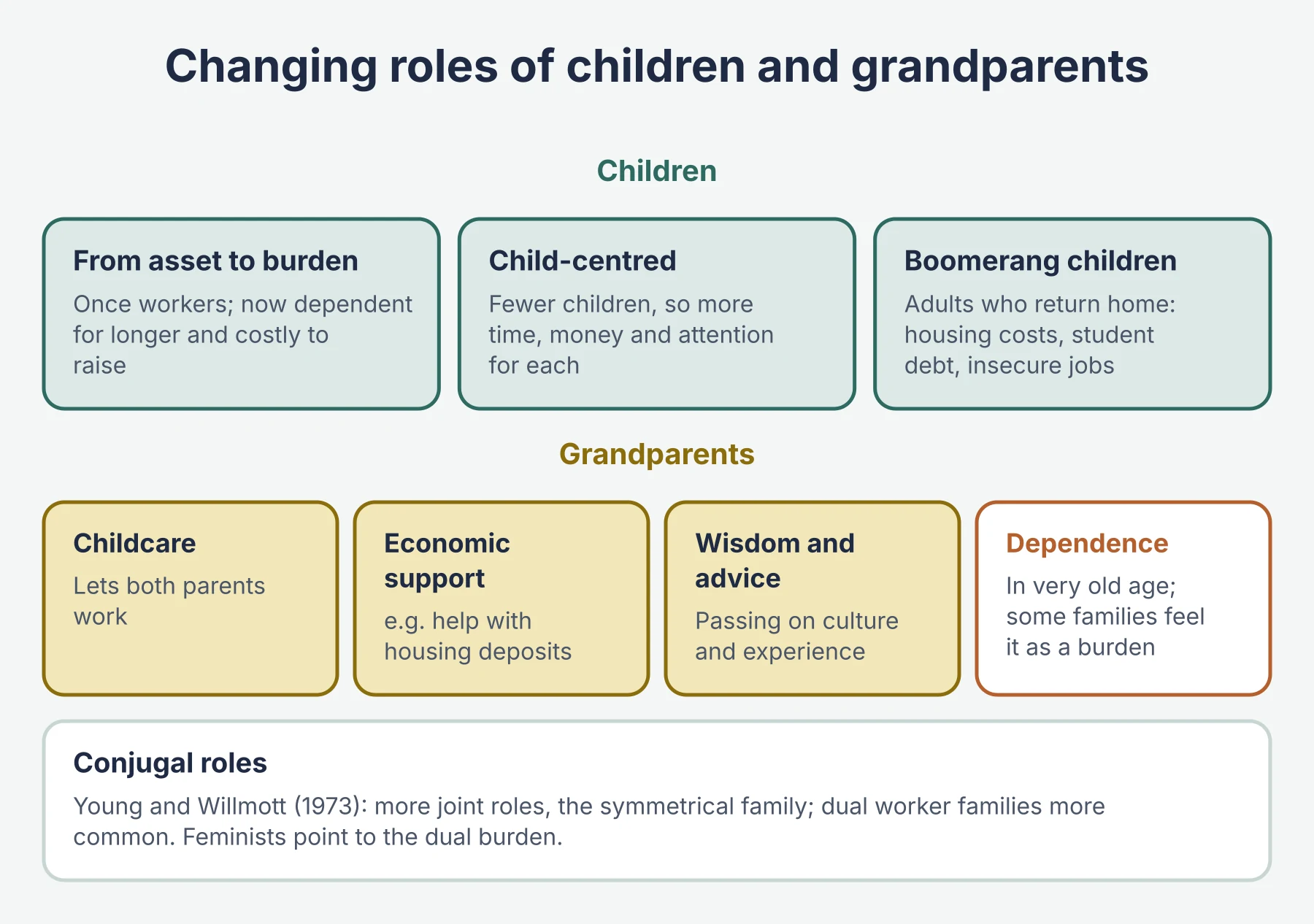
Conjugal roles. Young and Willmott (1973) argued that roles had become more joint, producing the symmetrical family. The dual worker family, in which both partners have paid jobs, has become more common. Feminists question how far equality has gone, pointing to the dual burden. Family diversity, such as same-sex or reconstituted families, also produces new role arrangements. The pivot or sandwich generation of middle-aged adults may care for ageing parents and their own children at the same time.
Children. In industrial societies children have shifted from being an economic asset who worked to being an economic burden: they are dependent for longer and cost a great deal to raise. Families have become more child-centred: with fewer children, parents invest more time, money and emotional attention in each one. Boomerang children are adult children who return to live with parents, often because of housing costs, student debt or insecure jobs.
Grandparents. Healthier, longer-lived grandparents often provide childcare, enabling both parents to work; economic support, such as help with housing deposits; and wisdom and advice, passing on culture and experience. In very old age they may become dependent, which some families experience as a burden.
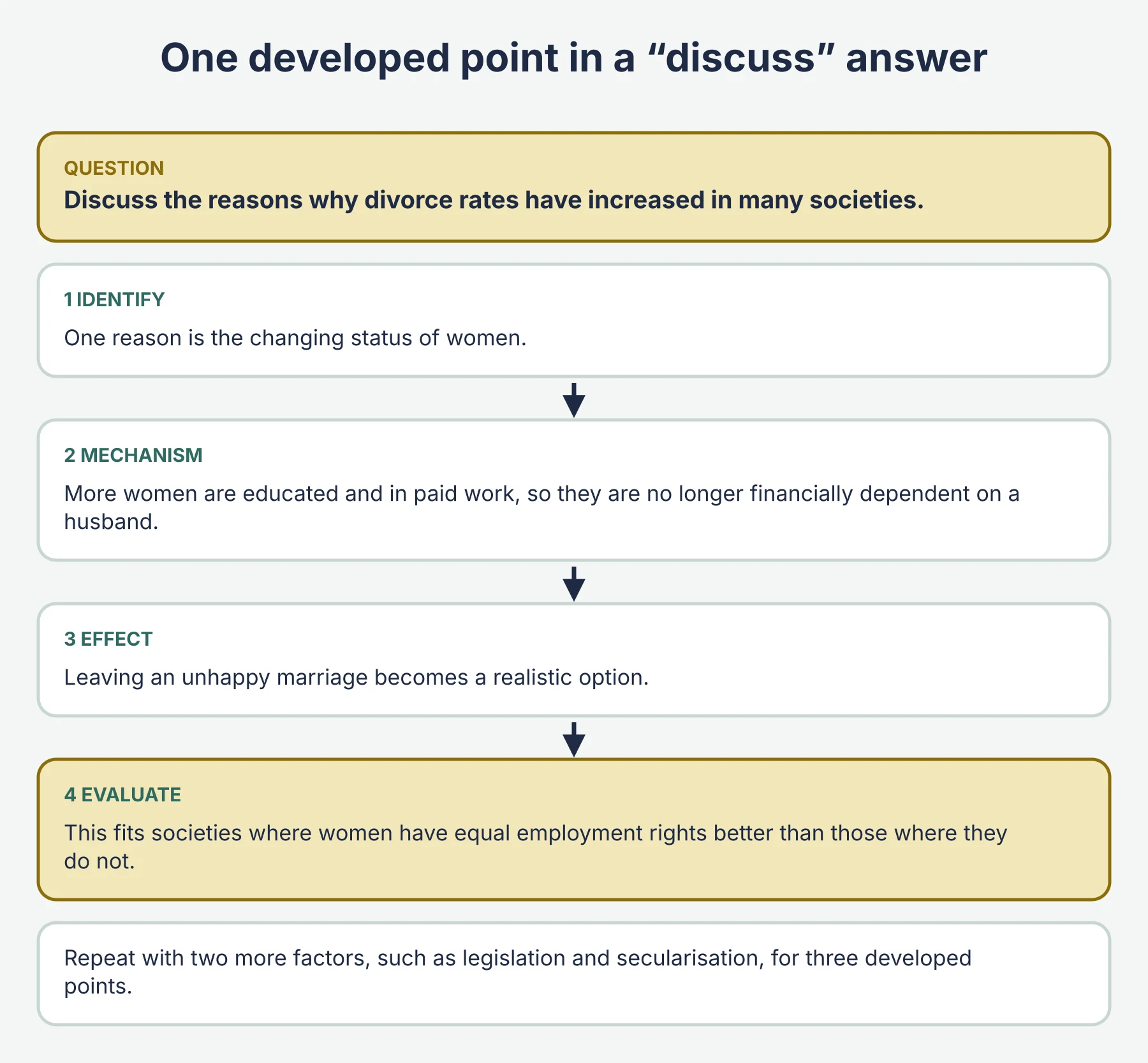
Worked example: an annotated part (e) answer extract
Discuss the reasons why divorce rates have increased in many societies.
“One reason is the changing status of women [identifies a syllabus explanation]. Because more women are educated and in paid work, they are no longer financially dependent on a husband [mechanism], so leaving an unhappy marriage is a realistic option [effect on divorce]. However, this explanation fits societies where women have equal employment rights better than those where they do not [evaluation].”
Two more points of the same shape, such as legislation and secularisation, would give the three developed points the part requires.
Common mistakes
- Treating falling birth rates or rising life expectancy as effects on family life: they are causes of an ageing population, which then affects families.
- Placing boomerang children under ageing: they belong to the changing roles of children.
- Assuming industrialisation simply destroyed the extended family, without mentioning Laslett or Anderson.
- Explaining divorce with “people don’t care about marriage any more” instead of a named factor such as secularisation or legislation.
- Writing about one society only when the question says “in many societies”.
Exam technique
- Explain questions about trends need cause, mechanism and consequence in each point.
- Discuss questions about changing roles reward contrast: what roles used to be, what they are now, and why.
- Evaluate questions, such as “Evaluate the view that conjugal roles have become joint”, need evidence for and against, and a conclusion that recognises differences by class, culture or ethnicity.
Condense this content with the key question 4.3 revision notes and practise with the key question 4.3 practice questions. For the other Family key questions, see types of families (4.1) and the role of the family (4.2).
Related resources
-
Practice questions
Cambridge IGCSE Sociology (0495): Family – How is family life changing? – Practice Questions
Original Cambridge IGCSE Sociology 0495 practice on key question 4.3: demographic change, divorce and cohabitation, and changing family roles, with answers.
Sociology · Cambridge · IGCSE
Try questions -
Revision notes
Cambridge IGCSE Sociology (0495): Family – How is family life changing? – Revision Notes
Revision notes for Cambridge IGCSE Sociology 0495 key question 4.3: demographic change, industrialisation, divorce trends and changing family roles.
Sociology · Cambridge · IGCSE
Revise topic -
Study guides
Cambridge IGCSE Sociology (0495): Education – What is education and schooling?
Cambridge IGCSE Sociology 0495 key question 5.1: formal and informal education, the official and hidden curriculum, types of school and alternative approaches.
Sociology · Cambridge · IGCSE
Read guide
Related articles
Get free revision emails (optional)
Occasional emails with practice questions, worked explanations and links to free resources for the qualification and subjects you choose. No spam, and you can unsubscribe from any email. The free tools on this site never need an email.