
Revision Notes
Cambridge IGCSE Sociology (0495): Family – How is family life changing? – Revision Notes
Revision notes for Cambridge IGCSE Sociology 0495 key question 4.3: demographic change, industrialisation, divorce trends and changing family roles.
- Subject
- Sociology
- Level
- IGCSE
- Topic
- Paper 2 – Family, Education and Crime
- Author
- Marlbridge Academic Team
- Updated
- Reviewed by
- Naqiya Yousaf (what this means)
Aligned to Cambridge IGCSE Sociology (0495), 2025-2027. Official specification .
Syllabus page (what it covers and how it is assessed): Cambridge IGCSE Sociology.
Syllabus points this page covers
0495
- 4.3 Family – How is family life changing?
Found an error? Report a correction.
Need help with this topic? Request a free trial class for IGCSE Sociology (0495).
Condensed notes for key question 4.3 How is family life changing? (Cambridge IGCSE Sociology 0495, Paper 2). For the full explanations and an annotated answer, see the key question 4.3 study guide.
Cause-and-effect chains to learn
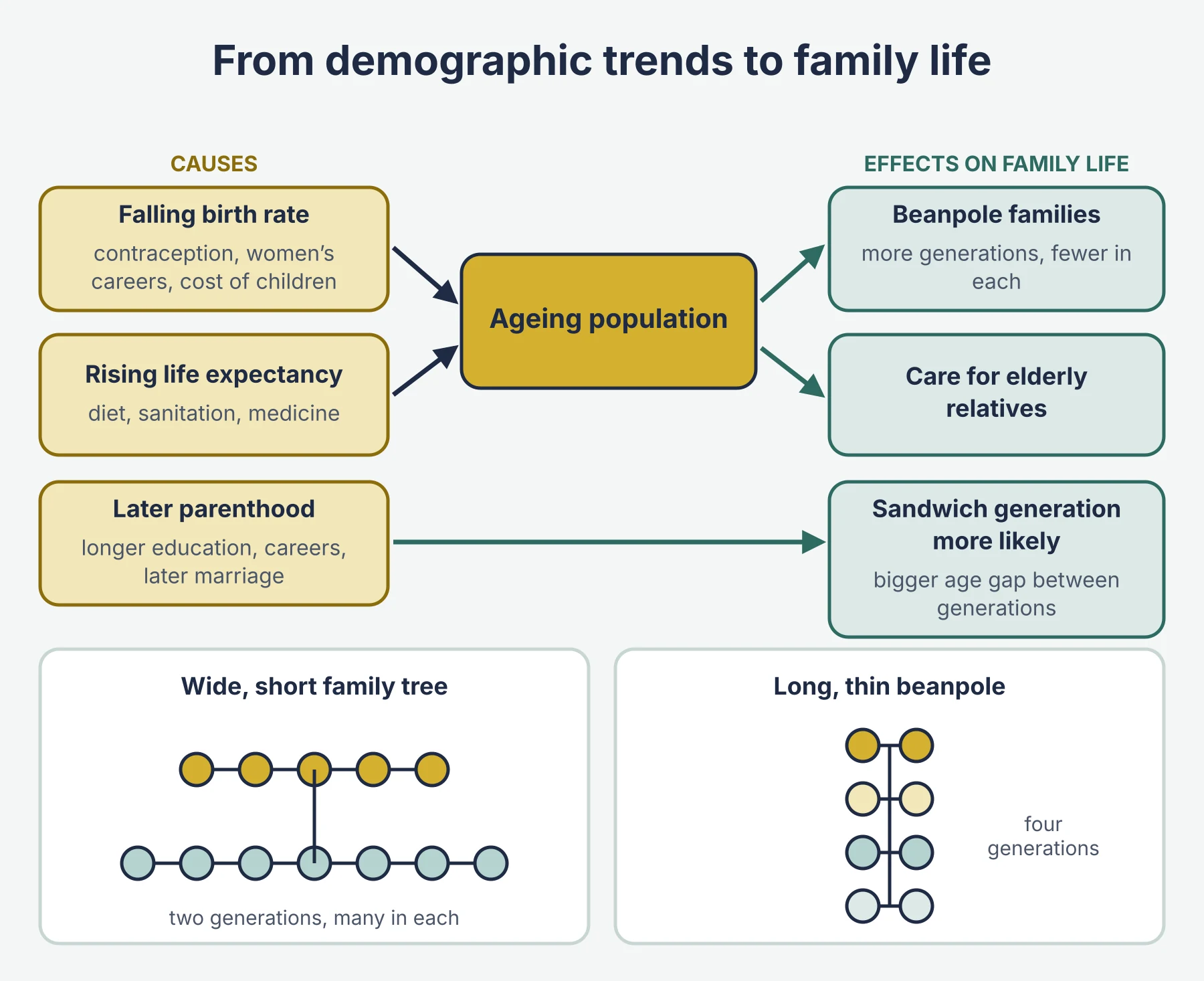
- Contraception + women’s careers + cost of children → falling birth rate → smaller families → more child-centred parenting.
- Better medicine, diet and sanitation → rising life expectancy → more generations alive → beanpole families.
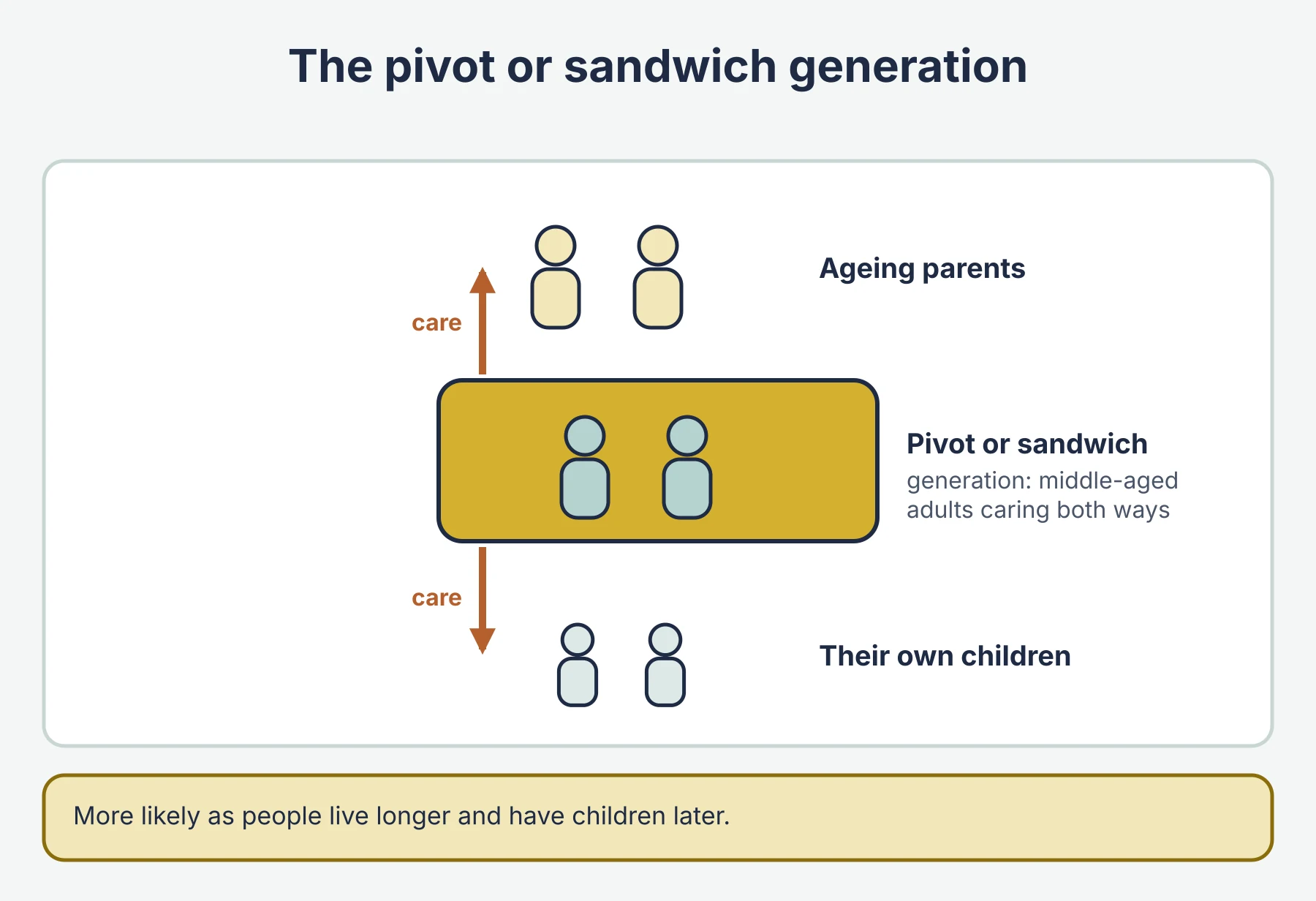
- Falling births + longer lives → ageing population → caring for elderly relatives; active grandparents; sandwich generation.
- Longer education and careers → later parenthood → wider gaps between generations.
- Easier divorce law + female empowerment + secularisation + changing attitudes → more divorce and cohabitation → more lone-parent, reconstituted and single person households.
Key terms
| Term | Meaning |
|---|---|
| Birth rate | Number of live births per thousand people in a year |
| Life expectancy | Average number of years a person can expect to live |
| Ageing population | A rising proportion of older people in the population |
| Industrialisation | The shift from agricultural to factory-based production |
| Urbanisation | The growing share of people living in towns and cities |
| Secularisation | The declining influence of religion in society |
| Cohabitation | Living together as a couple without being married |
| Civil partnership | A legally recognised union similar in rights to marriage |
| Symmetrical family | A family in which partners share paid work, domestic tasks and leisure (Young and Willmott, 1973) |
| Dual worker family | A family in which both partners have paid jobs |
| Sandwich (pivot) generation | Adults caring for both their own children and their ageing parents |
| Child-centredness | Family life organised around children’s needs and interests |
| Boomerang children | Adult children who return to live in the parental home |
Industrialisation and urbanisation (4.3.2)
| View | Claim |
|---|---|
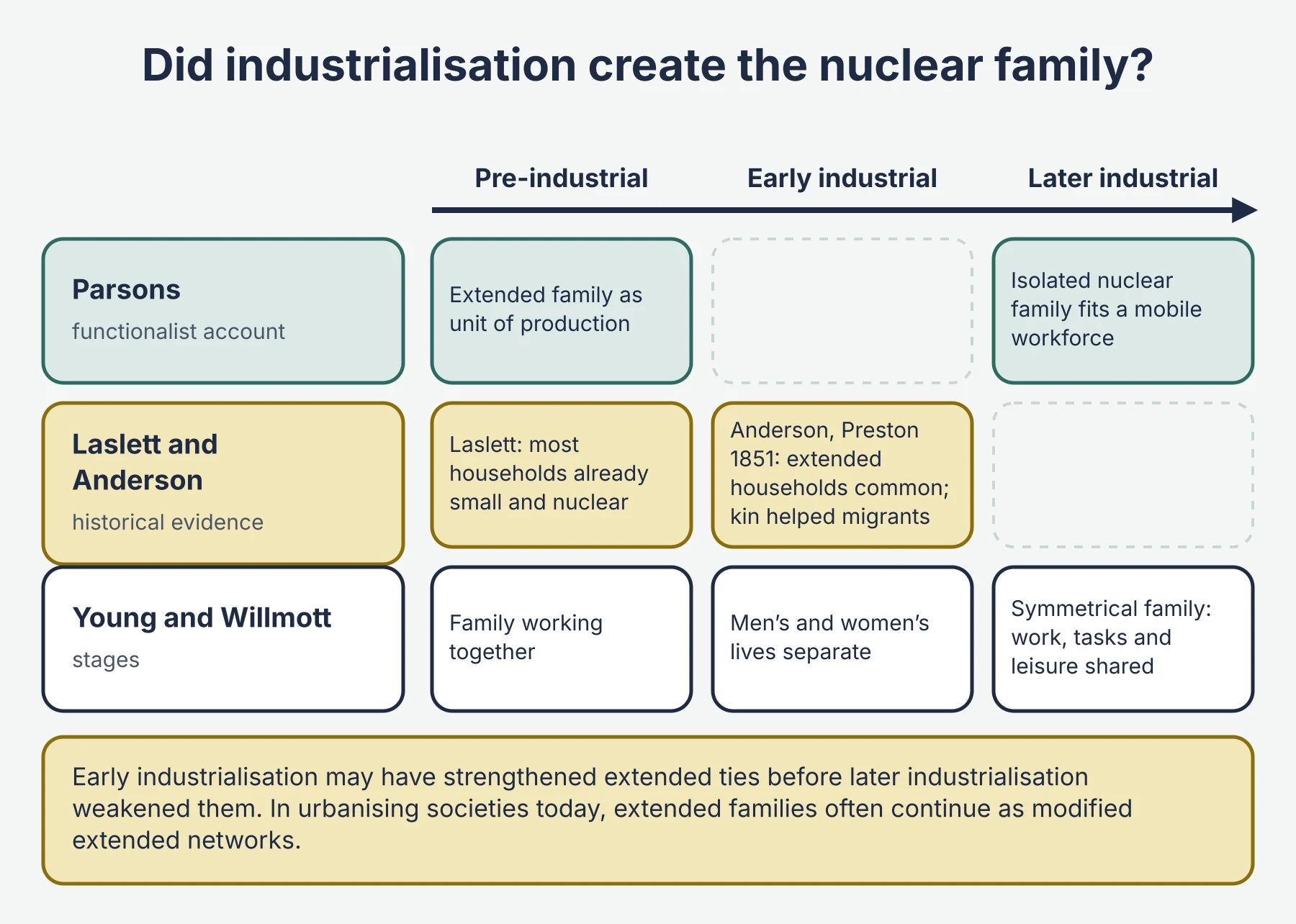
| Parsons | Industry needed a mobile workforce, so extended families gave way to the isolated nuclear family |
| Laslett | Pre-industrial English households were already mostly small and nuclear |
| Anderson (1971) | Preston 1851: extended households helped migrants in the early industrial town |
| Young and Willmott | Stages ending in the symmetrical family |
| Urbanising societies today | Migrants form nuclear households in cities but keep extended ties at a distance |
Six explanations for marriage, divorce and cohabitation trends (4.3.3)
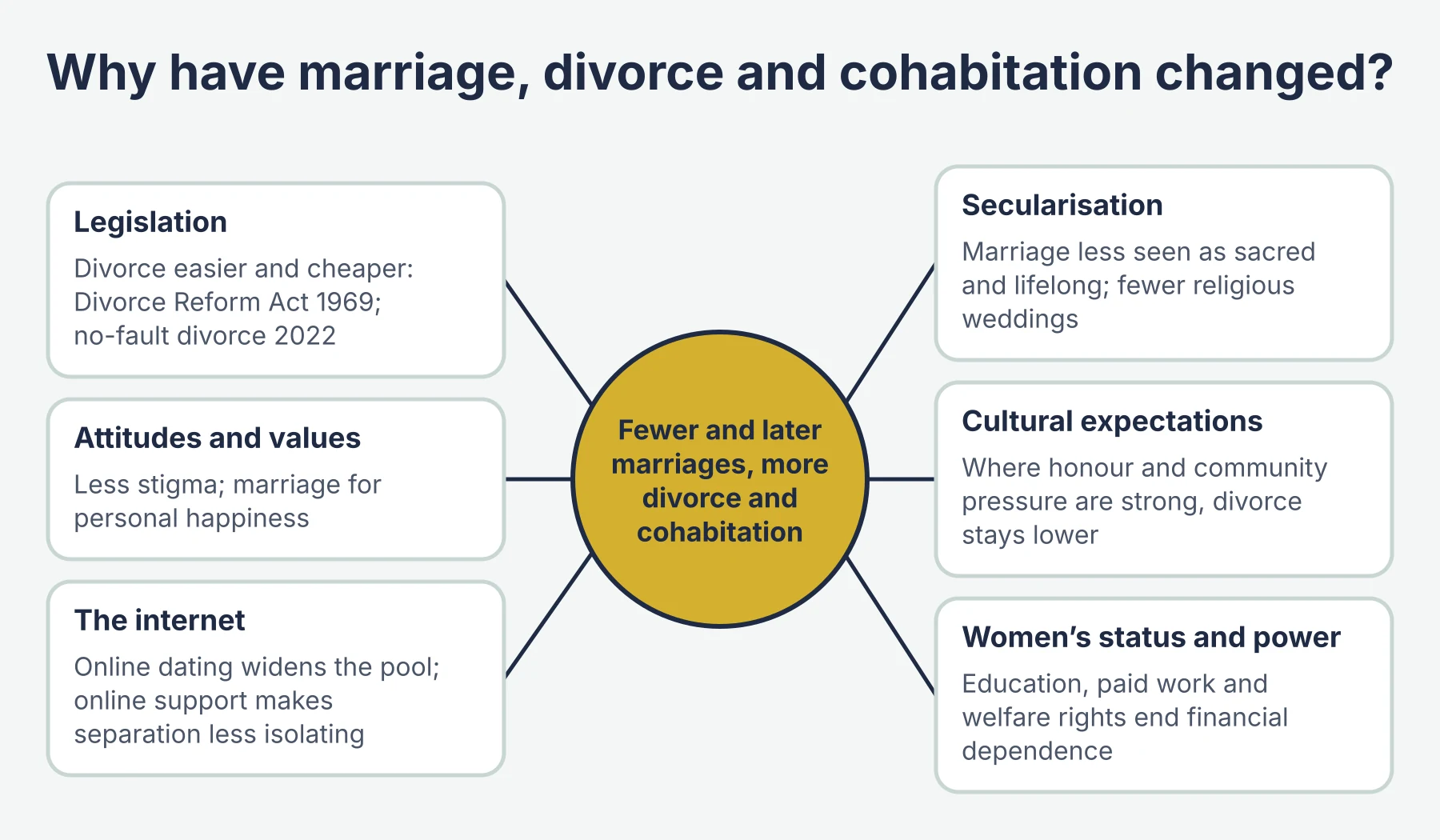
- Legislation: easier, cheaper divorce; in England and Wales, “irretrievable breakdown” from the 1969 Act and no-fault divorce from 2022.
- Attitudes and values: less stigma; marriage judged by personal happiness.
- Internet: online dating widens choice; easier to form new relationships; online support during separation.
- Secularisation: marriage less seen as sacred and lifelong.
- Cultural expectations: strong community and family expectations keep divorce lower in some groups.
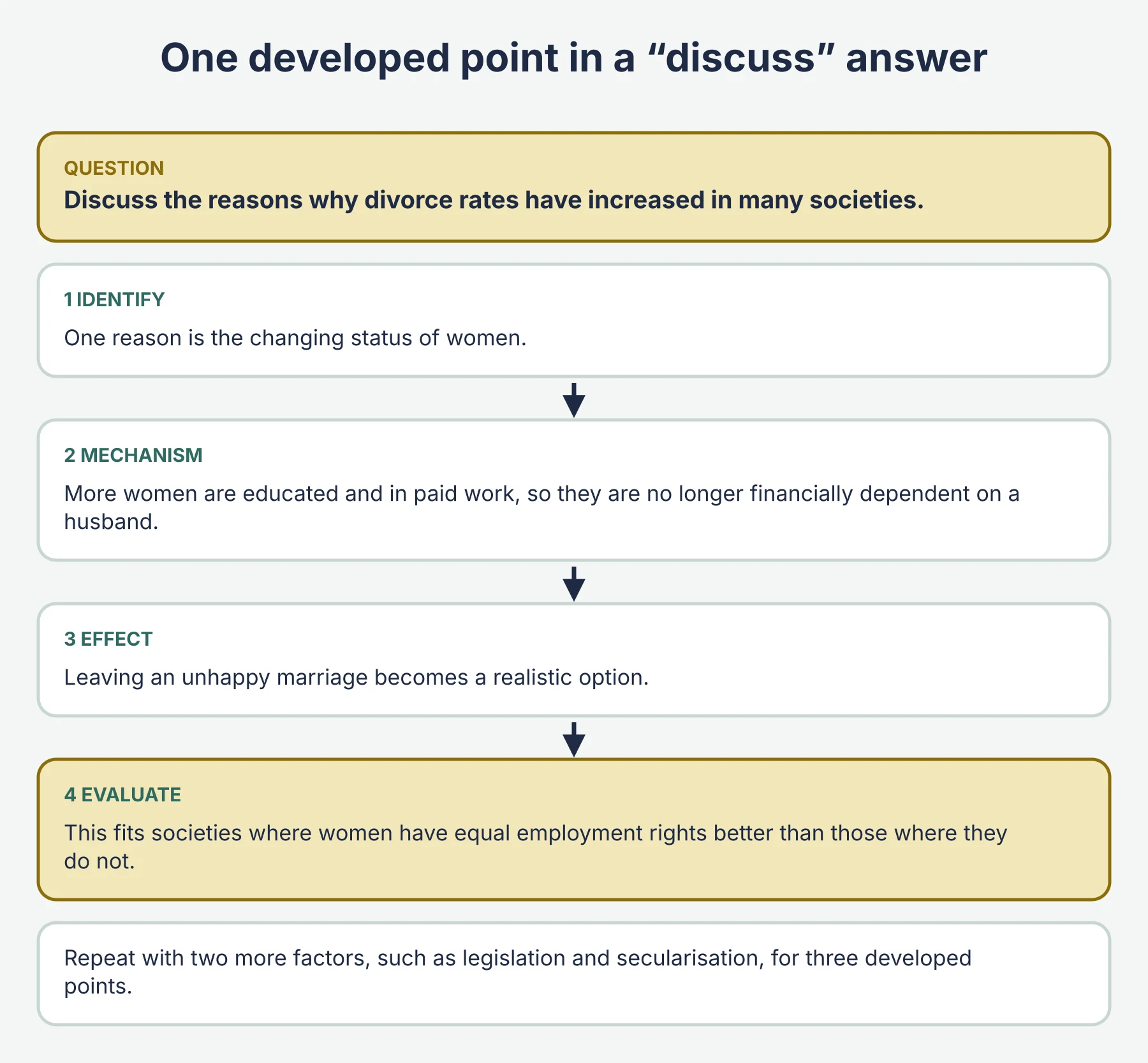
- Female empowerment: financial independence lets women leave or avoid marriage.
Alternatives to marriage (4.3.4)
Cohabitation (trial or permanent); singlehood (by choice); lone parents (divorce, separation, death or choice); civil partnerships (England and Wales: same-sex from 2004, opposite-sex from 2019).
Changing roles (4.3.5)
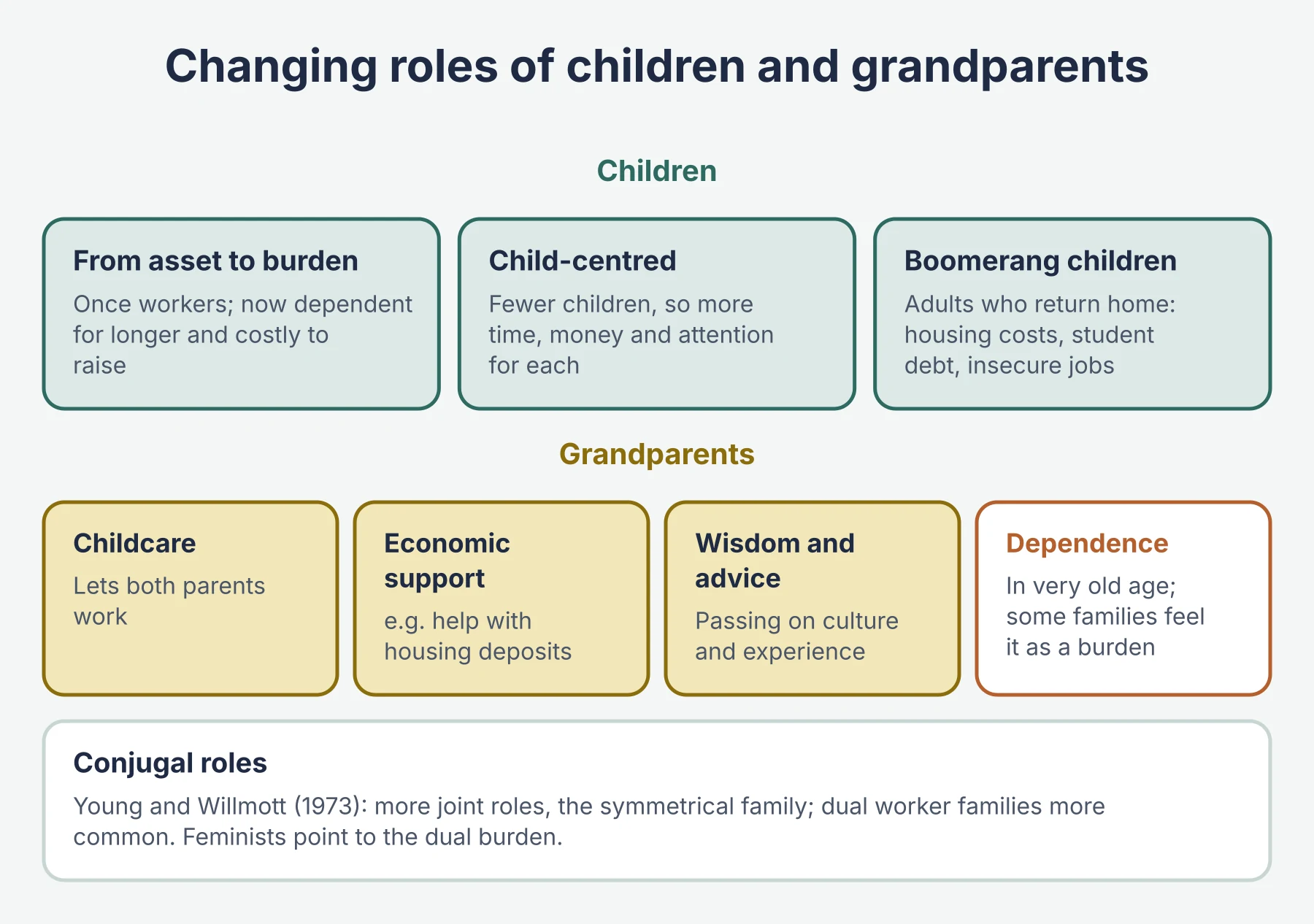
- Conjugal: from segregated to joint roles (symmetrical family, dual worker family); feminists point to the persisting dual burden; diverse family types create new arrangements; the sandwich generation carries extra care.
- Children: from economic asset to economic burden; child-centred families invest more in fewer children; boomerang children return because of housing costs, debt and insecure work.
- Grandparents: childcare; economic support; wisdom and advice; in later old age, dependent and sometimes seen as a burden.
Exam traps
- Cause versus effect: the birth rate is a cause; the beanpole family is an effect.
- Boomerang children are not about ageing: they are a change in the role of children.
- Industrialisation did not simply kill the extended family: name Laslett or Anderson to challenge the simple story.
- Name the factor: “secularisation” or “legislation” scores; “people stopped caring” does not.
- Not every society: many lower-income societies still have higher birth rates and young populations; say “in many industrial societies”.
- Civil partnership is not cohabitation: one is a legal union; the other is not.
Self-test
- Give three reasons why birth rates have fallen in many societies.
- How does rising life expectancy change family structure?
- What is the sandwich generation?
- What did Parsons argue about industrialisation and the family?
- How did Anderson’s Preston study challenge Parsons?
- Name the six explanations for trends in marriage and divorce listed in the syllabus.
- How can secularisation help explain rising divorce?
- Give two ways the internet may affect relationships.
- What is the symmetrical family?
- Why are children described as an economic burden in industrial societies?
- Give two reasons for boomerang children.
- Give two roles grandparents may play in modern families.
Answers: 1. Any three: contraception; women’s education and careers; lower infant mortality; the cost of raising children; later marriage. 2. More generations are alive at once, producing long, thin beanpole families. 3. Middle-aged adults caring at the same time for their own children and their ageing parents. 4. It replaced the extended family with the isolated nuclear family, which suited the need for geographical mobility. 5. He found extended households were common in an early industrial town in 1851, because kin helped one another with work and housing. 6. Legislation; societal attitudes and values; the internet; secularisation; cultural expectations; changes in the status and power of women. 7. With less religious influence, marriage is less often seen as a sacred lifelong commitment, so divorce carries less moral stigma. 8. Any two: online dating widens the choice of partners; contact with new or former partners is easier; online support during separation. 9. Young and Willmott’s term for a family in which partners share paid work, domestic tasks and leisure. 10. They are dependent for longer in education and cost a lot to raise, rather than earning for the family. 11. Any two: high housing costs; student debt; insecure or low-paid jobs; relationship breakdown. 12. Any two: childcare; economic support; wisdom and advice.
Try the key question 4.3 practice questions, then revise the earlier Family key questions with the key question 4.1 revision notes and key question 4.2 revision notes.
Related resources
-
Study guides
Cambridge IGCSE Sociology (0495): Education – What is education and schooling?
Cambridge IGCSE Sociology 0495 key question 5.1: formal and informal education, the official and hidden curriculum, types of school and alternative approaches.
Sociology · Cambridge · IGCSE
Read guide -
Practice questions
Cambridge IGCSE Sociology (0495): Education – What is education and schooling? – Practice Questions
Original Cambridge IGCSE Sociology 0495 practice on key question 5.1: formal and informal education, curricula, types of school and alternatives, with answers.
Sociology · Cambridge · IGCSE
Try questions -
Revision notes
Cambridge IGCSE Sociology (0495): Education – What is education and schooling? – Revision Notes
Revision notes for Cambridge IGCSE Sociology 0495 key question 5.1: formal and informal education, curricula, school types and alternative approaches.
Sociology · Cambridge · IGCSE
Revise topic
Related articles
Get free revision emails (optional)
Occasional emails with practice questions, worked explanations and links to free resources for the qualification and subjects you choose. No spam, and you can unsubscribe from any email. The free tools on this site never need an email.