
Revision Notes
Cambridge IGCSE Sociology (0495): Education – What is education and schooling? – Revision Notes
Revision notes for Cambridge IGCSE Sociology 0495 key question 5.1: formal and informal education, curricula, school types and alternative approaches.
- Subject
- Sociology
- Level
- IGCSE
- Topic
- Paper 2 – Family, Education and Crime
- Author
- Marlbridge Academic Team
- Updated
- Reviewed by
- Naqiya Yousaf (what this means)
Aligned to Cambridge IGCSE Sociology (0495), 2025-2027. Official specification .
Syllabus page (what it covers and how it is assessed): Cambridge IGCSE Sociology.
Syllabus points this page covers
0495
- 5.1 Education – What is education and schooling?
Found an error? Report a correction.
Need help with this topic? Request a free trial class for IGCSE Sociology (0495).
Condensed notes for key question 5.1 What is education and schooling? (Cambridge IGCSE Sociology 0495, Paper 2, Education). The key question 5.1 study guide gives full explanations and a part (f) plan.
Map of 5.1
- 5.1.1 Formal v informal education; the official curriculum (testing, content, subjects); the hidden curriculum (norms and values, punctuality, conformity, gender roles).
- 5.1.2 Seven types of school and how effective each is.
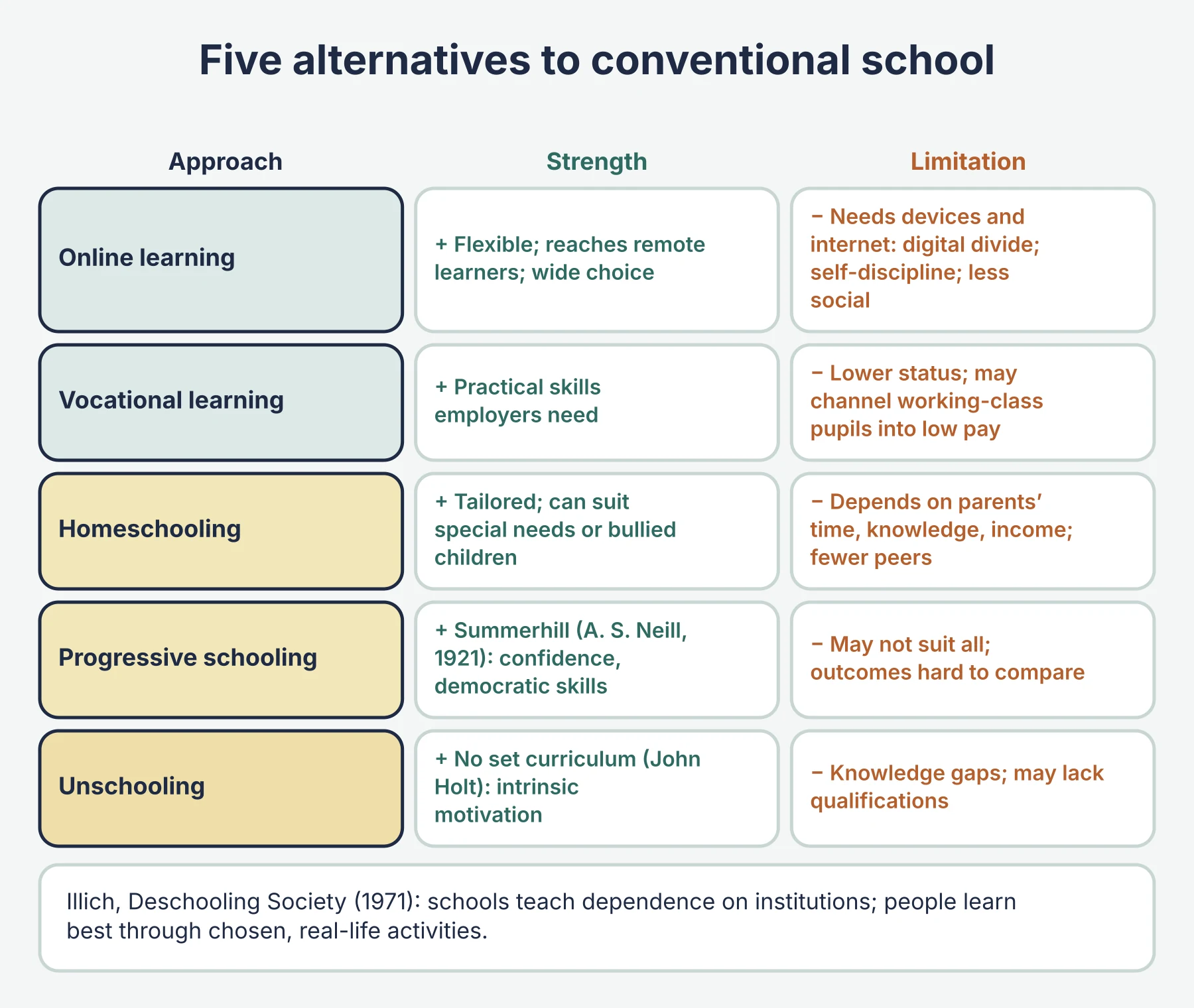
- 5.1.3 Five alternative approaches and their strengths and limitations.
Key terms
| Term | Meaning |
|---|---|
| Education | Learning knowledge, skills, norms and values, in or out of school |
| Schooling | Education delivered by schools |
| Formal education | Planned, assessed learning in institutions, leading to qualifications |
| Informal education | Unplanned learning in everyday life from family, peers and media |
| Official curriculum | The subjects, content and tests a school openly sets out to teach |
| Hidden curriculum | Norms and values learned from how school is organised (term popularised by Jackson, 1968) |
| Selective school | A school that admits pupils by test, interview or other criteria |
| Comprehensive (non-selective) school | A school that admits pupils of all abilities |
| Faith school | A school with a religious character or ethos |
| Value added | The progress pupils make from their starting point |
| Homeschooling | Education at home organised by parents |
| Unschooling | Home-based, interest-led learning with no set curriculum |
| Vocational learning | Education and training for particular occupations |
| Progressive schooling | Child-centred schooling giving pupils choice and a voice |
Formal v informal: four contrasts
Place (institution v everyday life); planning (curriculum v unplanned); teachers (trained professionals v family, peers, media); outcomes (qualifications v skills and behaviour without certificates).
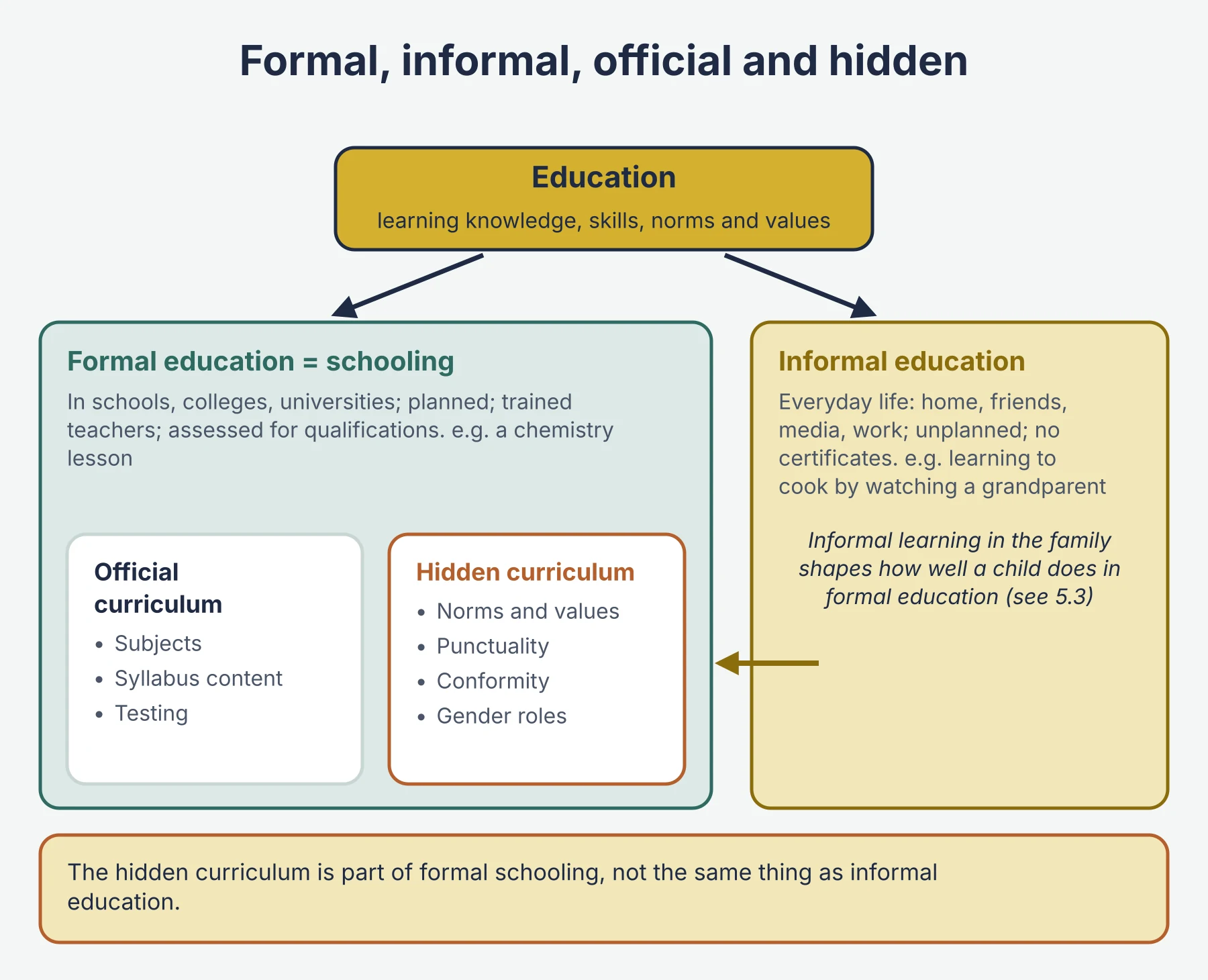
Official curriculum: three parts
- Subjects: some carry more status than others.
- Content: choices about what knowledge counts.
- Testing: ranks pupils and drives teaching to the test.
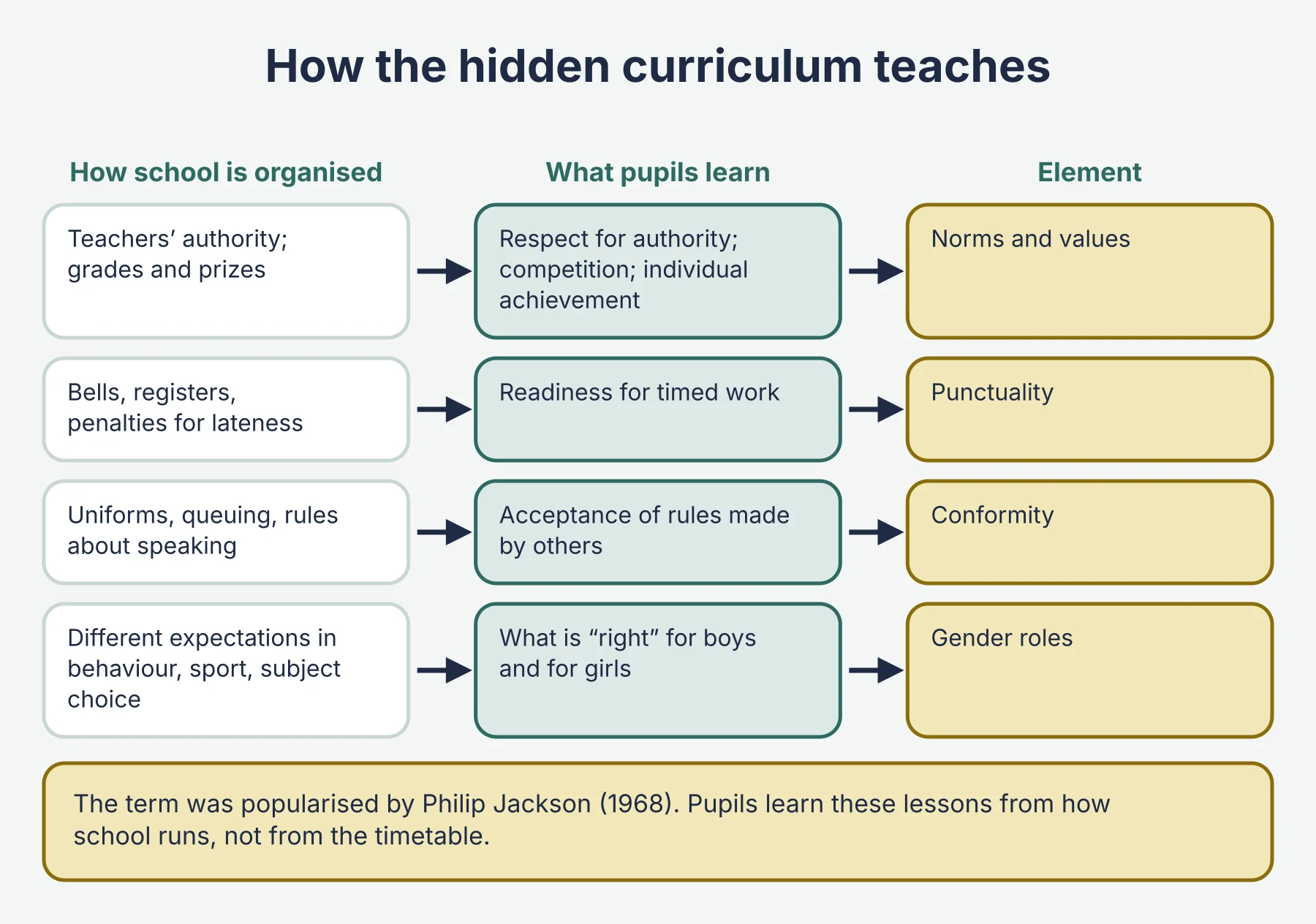
Hidden curriculum: one example for each element
| Element | Example |
|---|---|
| Norms and values | Prize-giving rewards individual competition |
| Punctuality | Detentions for lateness |
| Conformity | Uniform rules; raising a hand to speak |
| Gender roles | Different sports offered to boys and girls |
Types of school: quick judgement
| Type | Plus | Minus |
|---|---|---|
| State/public | Free, mixed intake | Resources vary by area |
| Private | Small classes, resources, networks | Fees reproduce class advantage |
| Selective | Pace suits high attainers | Favours tutored, middle-class children; labels others |
| Non-selective | Equal access | Catchment areas sort by house prices |
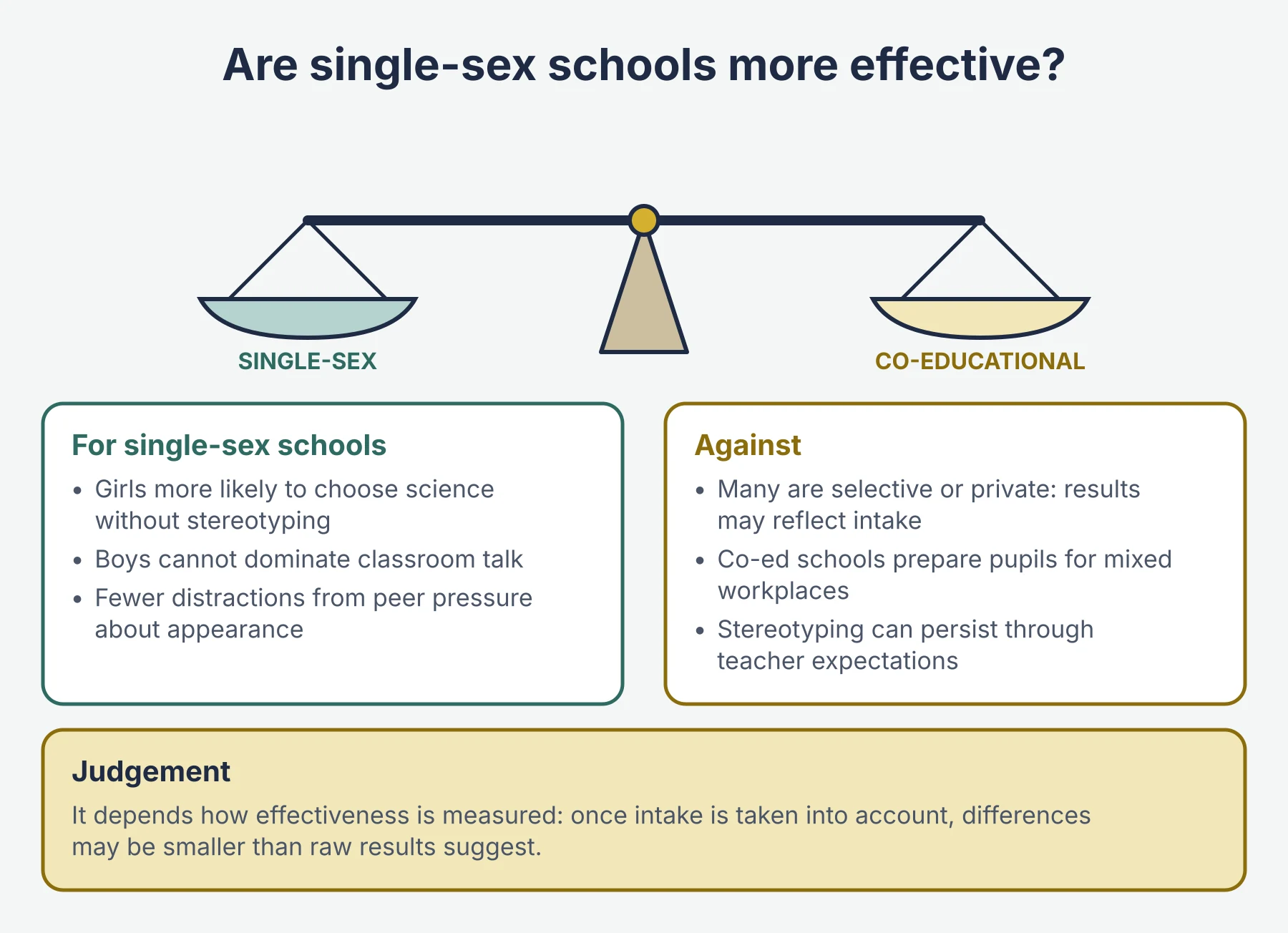
| Single-sex | Less gender stereotyping in subjects | Less mixed social experience |
| Co-educational | Mirrors wider society | Boys may dominate attention |
| Faith | Strong ethos | May be socially selective |
| International | Global outlook, languages | Usually fee-paying and elite |
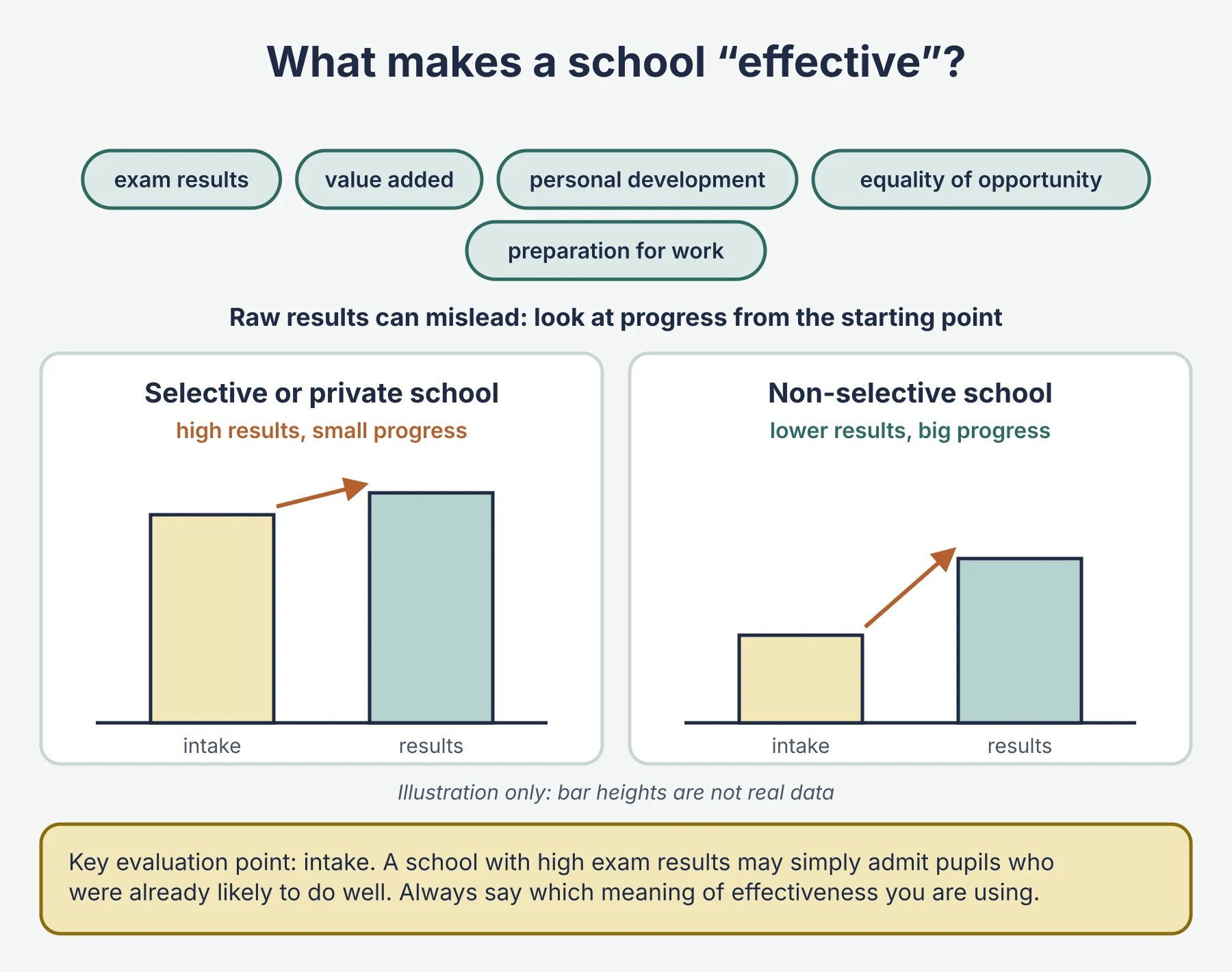
Golden rule: raw results reflect intake. Compare progress (value added), not just grades.
Alternative approaches
| Approach | Strength | Limitation |
|---|---|---|
| Online learning | Flexible; reaches remote learners | Digital divide; isolation; self-discipline needed |
| Homeschooling | Tailored; refuge from bullying | Depends on parents’ time, knowledge and money |
| Unschooling (Holt) | Motivation; independence | Knowledge gaps; may lack qualifications |
| Vocational learning | Job-ready skills | Lower status; may channel working-class pupils |
| Progressive schooling (Summerhill, A. S. Neill, 1921) | Confidence; democratic skills | Hard to compare outcomes; may not suit all |
Background critic: Illich, Deschooling Society (1971), argued schools create dependence on institutions.
Exam traps
- Hidden curriculum is not informal education: it happens inside formal schooling.
- “Public school” is ambiguous: free state school in many countries; elite fee-paying school in England. Define it.
- Effectiveness needs a measure: results, progress, wellbeing or equality.
- Intake effect: high results in private or selective schools may reflect who is admitted.
- Unschooling is not homeschooling: no set curriculum.
- Both sides: the syllabus asks for strengths and limitations of each type and approach.
Self-test
- Give two differences between formal and informal education.
- Name the three parts of the official curriculum listed in the syllabus.
- Name the four elements of the hidden curriculum listed in the syllabus.
- Give one example of the hidden curriculum teaching gender roles.
- What is a selective school?
- Give one strength and one limitation of private schools.
- Why might single-sex schools reduce gender stereotyping?
- Why should raw exam results be treated with caution when comparing schools?
- How does unschooling differ from homeschooling?
- Give one limitation of online learning.
- What is progressive schooling? Name an example.
- Give one criticism of vocational learning.
Answers: 1. Any two: formal takes place in institutions, informal in everyday life; formal is planned and assessed, informal is unplanned; formal leads to qualifications, informal does not; formal uses trained teachers. 2. Testing, syllabus content, subjects. 3. Norms and values, punctuality, conformity, gender roles. 4. For example, boys and girls being offered different sports, or girls being praised for neatness and boys for confidence. 5. A school that chooses pupils by test, interview or other criteria. 6. Strength: smaller classes and more resources; limitation: fees exclude most families and reproduce class advantage. 7. Without boys present, girls may feel freer to choose subjects such as physics, and boys cannot dominate classroom talk. 8. They reflect the pupils a school admits, so value added is a fairer measure of effectiveness. 9. Homeschooling usually follows a curriculum set by parents; unschooling is led by the child’s interests with no set curriculum. 10. Any one: needs devices and internet access (digital divide); limited social interaction; requires self-discipline. 11. Child-centred schooling where pupils have choice and a voice, such as Summerhill, founded by A. S. Neill. 12. It often has lower status than academic routes and may steer working-class pupils into lower-paid jobs.
Apply these notes in the key question 5.1 practice questions, then move on to the key question 5.2 revision notes.
Related resources
-
Study guides
Cambridge IGCSE Sociology (0495): Education – What are the roles and functions of education?
Cambridge IGCSE Sociology 0495 key question 5.2: functionalist, Marxist and feminist views of the roles of education, with named evidence and evaluation.
Sociology · Cambridge · IGCSE
Read guide -
Practice questions
Cambridge IGCSE Sociology (0495): Education – What are the roles and functions of education? – Practice Questions
Original Cambridge IGCSE Sociology 0495 practice on key question 5.2: functionalist, Marxist and feminist views of education's roles, with full answers.
Sociology · Cambridge · IGCSE
Try questions -
Revision notes
Cambridge IGCSE Sociology (0495): Education – What are the roles and functions of education? – Revision Notes
Revision notes for Cambridge IGCSE Sociology 0495 key question 5.2: functionalist, Marxist and feminist views of education, key terms, traps and a self-test.
Sociology · Cambridge · IGCSE
Revise topic
Related articles
Get free revision emails (optional)
Occasional emails with practice questions, worked explanations and links to free resources for the qualification and subjects you choose. No spam, and you can unsubscribe from any email. The free tools on this site never need an email.