
Revision Notes
Cambridge IGCSE Sociology (0495): Education – What are the roles and functions of education? – Revision Notes
Revision notes for Cambridge IGCSE Sociology 0495 key question 5.2: functionalist, Marxist and feminist views of education, key terms, traps and a self-test.
- Subject
- Sociology
- Level
- IGCSE
- Topic
- Paper 2 – Family, Education and Crime
- Author
- Marlbridge Academic Team
- Updated
- Reviewed by
- Naqiya Yousaf (what this means)
Aligned to Cambridge IGCSE Sociology (0495), 2025-2027. Official specification .
Syllabus page (what it covers and how it is assessed): Cambridge IGCSE Sociology.
Syllabus points this page covers
0495
- 5.2 Education – What are the roles and functions of education?
Found an error? Report a correction.
Need help with this topic? Request a free trial class for IGCSE Sociology (0495).
Condensed notes for key question 5.2 What are the roles and functions of education? (Cambridge IGCSE Sociology 0495, Paper 2, Education). Full explanations and an annotated answer are in the key question 5.2 study guide.
Three views in one table
| Functionalist | Marxist | Feminist | |
|---|---|---|---|
| Education benefits | Everyone and society | The capitalist class | Men (patriarchy) |
| Key idea | Meritocracy and role allocation | Reproduction of class inequality | Perpetuation of gender inequality |
| Key names | Durkheim; Parsons; Davis and Moore (1945) | Althusser; Bowles and Gintis (1976); Bourdieu | Spender (1982) |
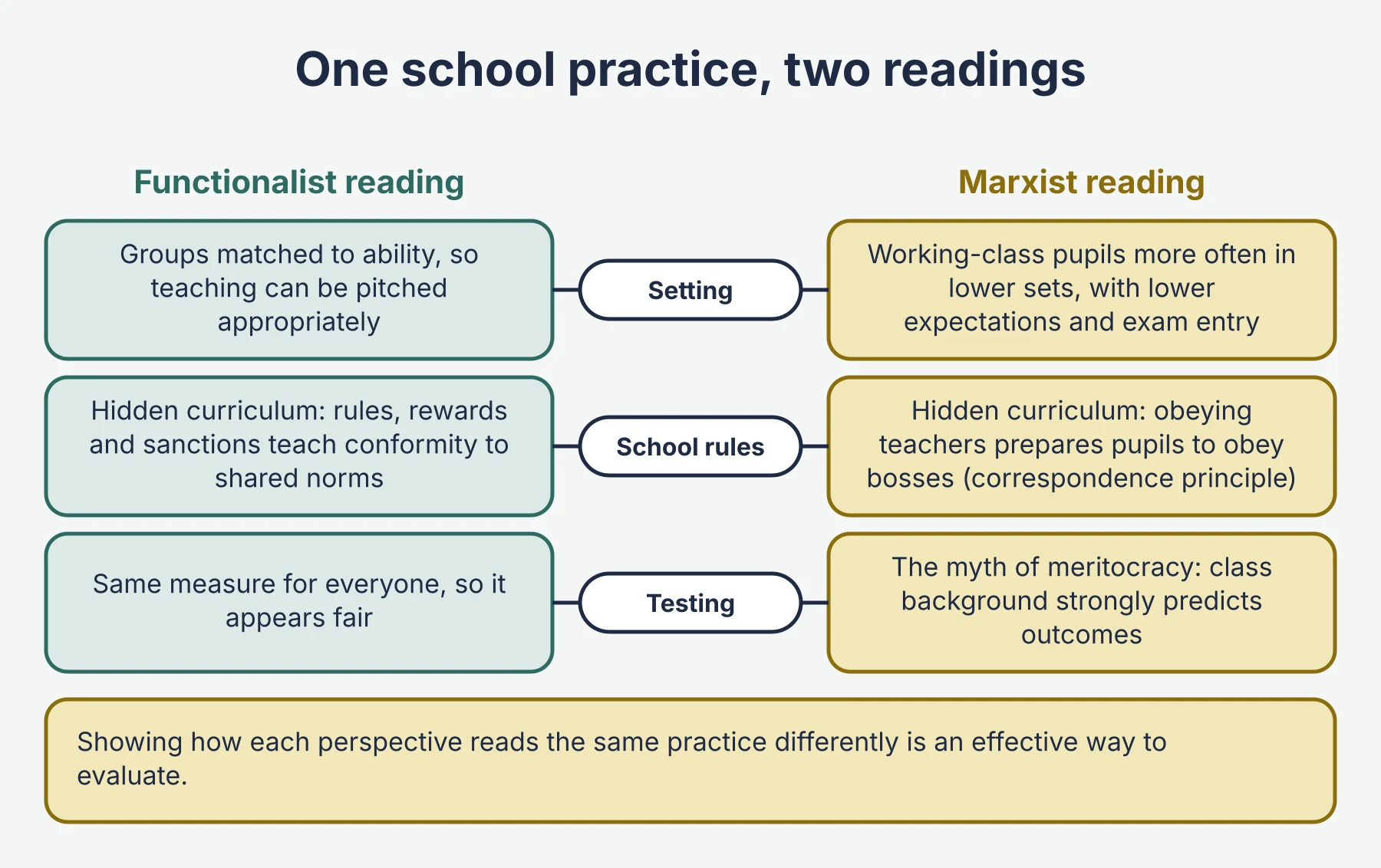
| Setting by ability | Efficient teaching matched to ability | Sorts working-class pupils into lower sets | Can steer girls and boys into gendered tiers and subjects |
| Hidden curriculum | Teaches shared values | Teaches obedience for work | Teaches gender roles |
Key terms
| Term | Meaning |
|---|---|
| Social solidarity | A sense of belonging to society (Durkheim) |
| Meritocracy | A system where rewards are based on ability and effort |
| Role allocation | Sorting people into jobs that match their talents (Davis and Moore) |
| Universalistic standards | The same rules and measures applied to everyone (Parsons) |
| Value consensus | Agreement on shared norms and values |
| Vocationalism | Education focused on preparing people for work |
| Ideological state apparatus | An institution that passes on ruling-class ideas (Althusser) |
| Correspondence principle | The hidden curriculum mirrors the workplace (Bowles and Gintis) |
| Cultural capital | Middle-class knowledge, tastes and language that schools reward (Bourdieu) |
| Myth of meritocracy | The false belief that success depends only on merit |
| Patriarchal culture | Ways of organising school that reflect male power |
| Gendered subject choice | Boys and girls choosing different subjects in line with stereotypes |
| Teacher expectations | Teachers’ beliefs about what pupils can achieve |
Functionalist checklist (5.2.1)
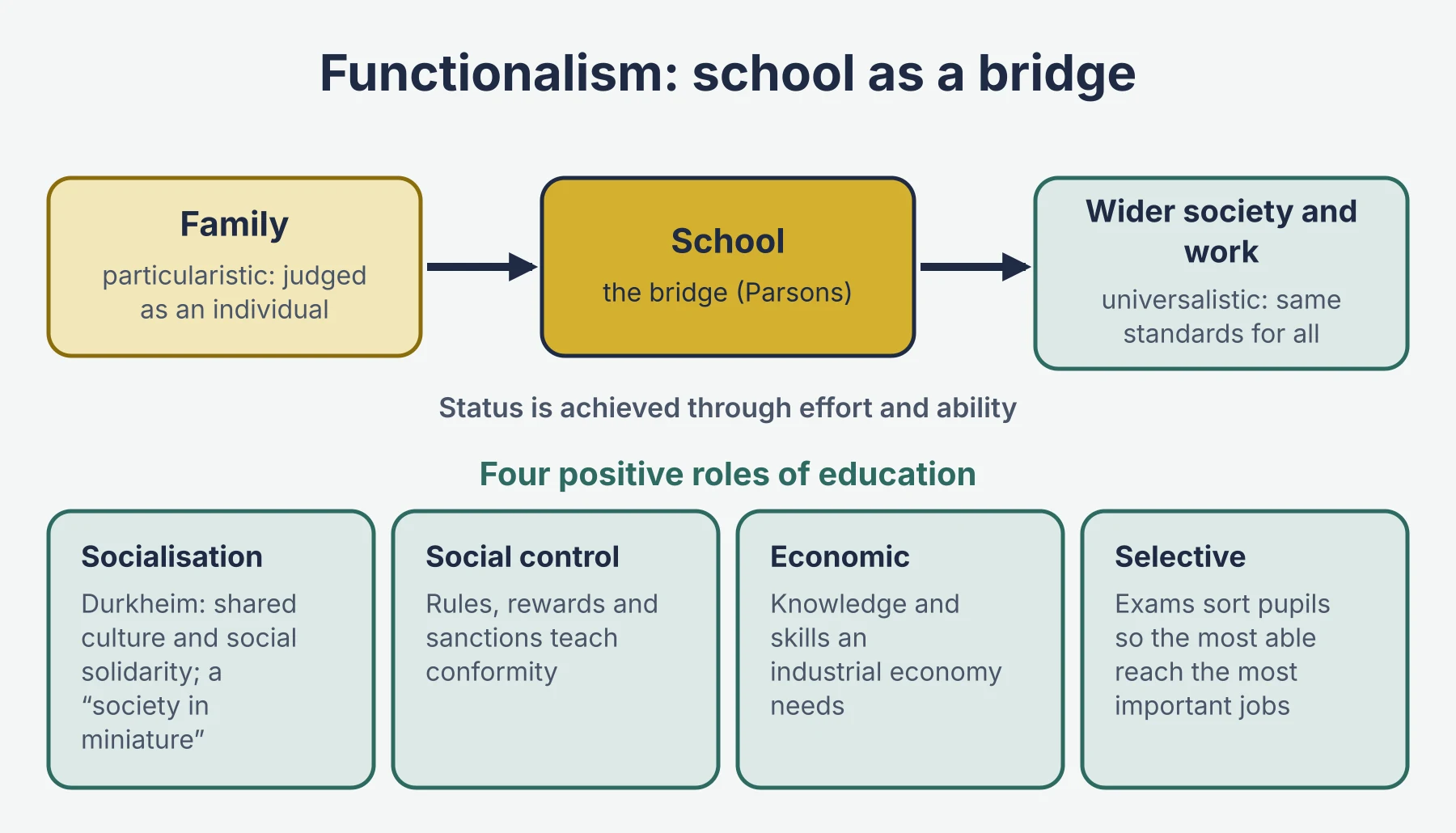
- Roles: socialisation, social control, economic, selective.
- Durkheim: school as a society in miniature; social solidarity; specialist skills.
- Parsons: bridge from particularistic family to universalistic society; achieved status.
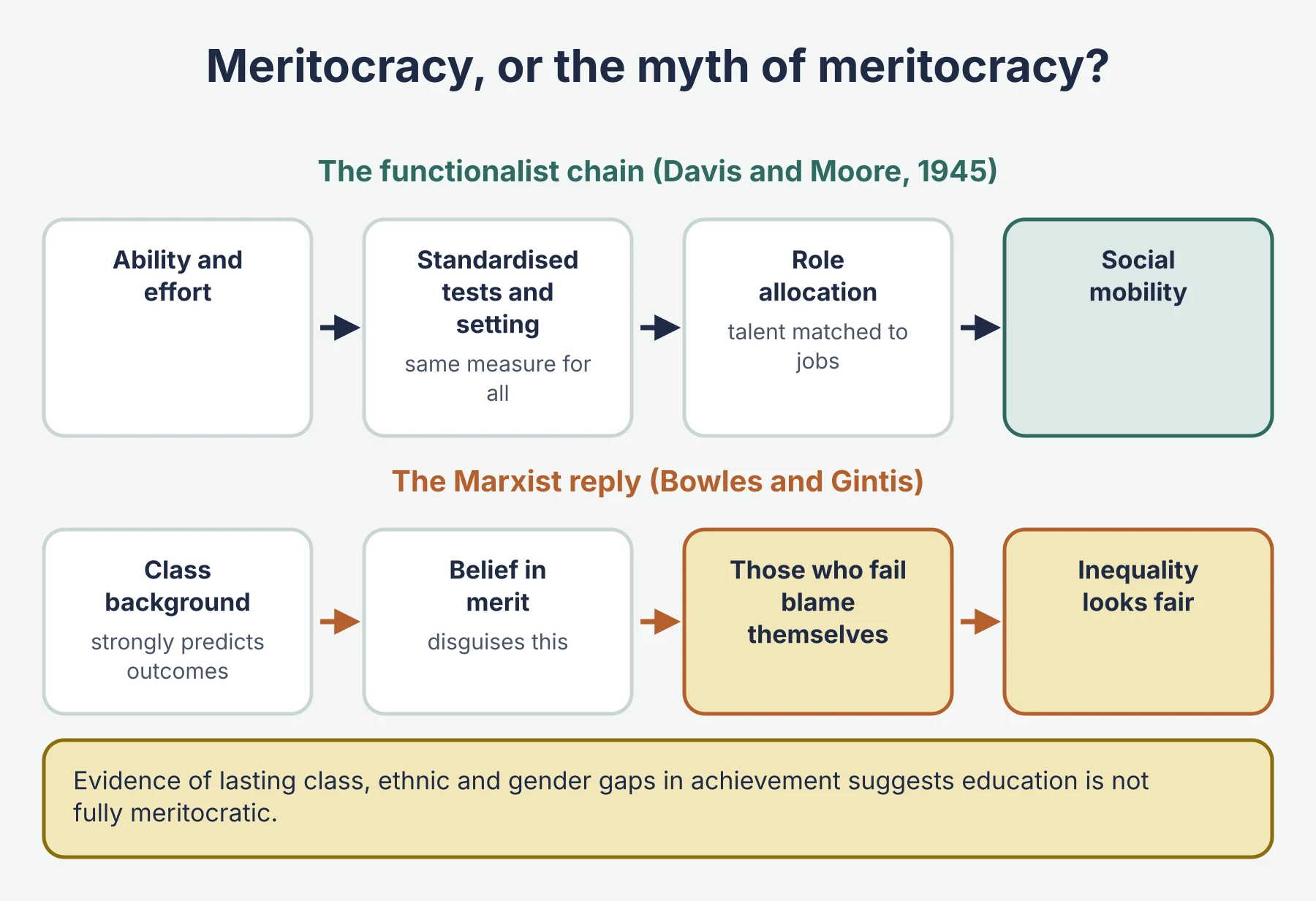
- Davis and Moore: role allocation; most important jobs, highest rewards.
- Also: social mobility; value consensus; equal opportunities; standardised testing; setting by ability; vocationalism.
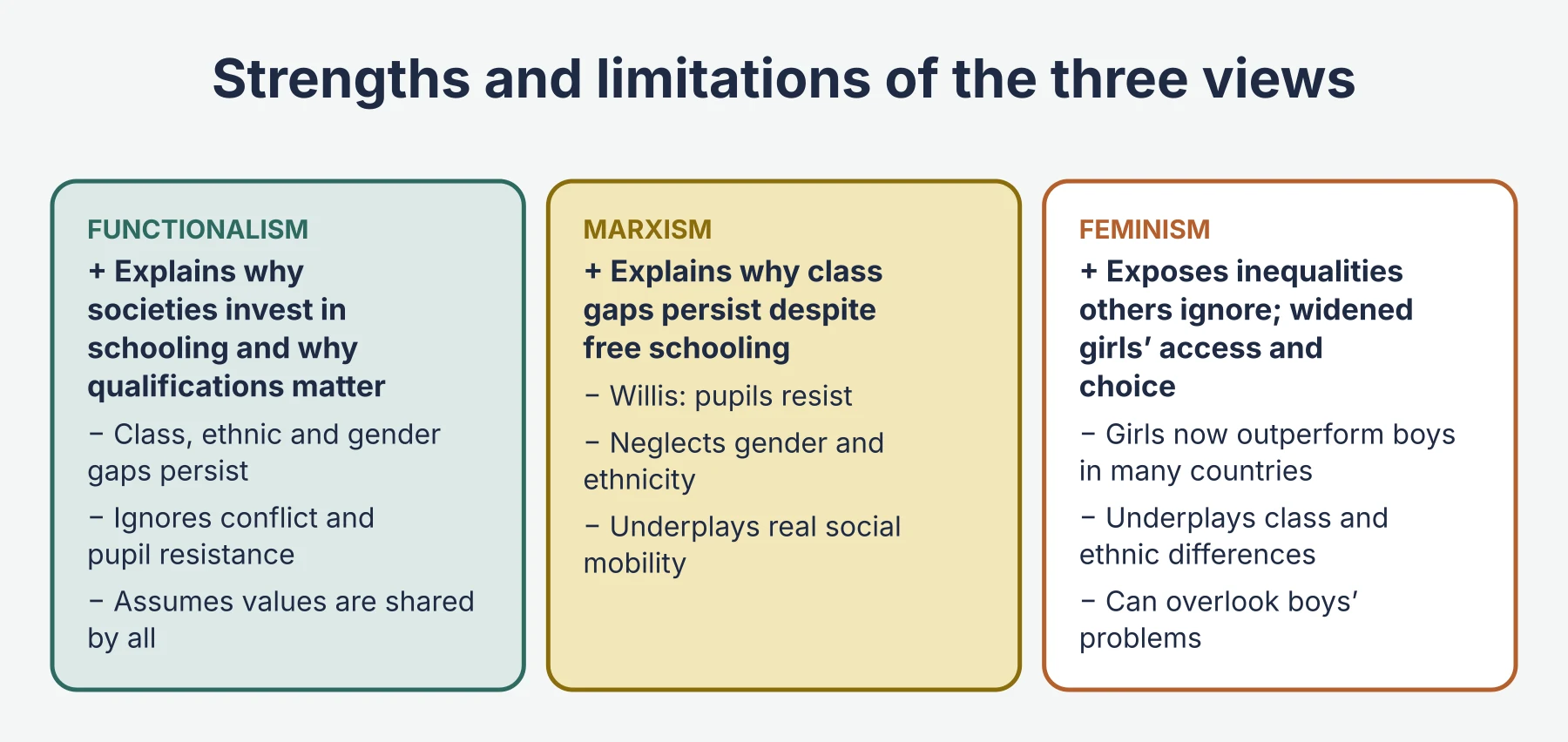
- Strength: explains the link between qualifications and jobs. Limitation: achievement gaps by class, ethnicity and gender suggest it is not a meritocracy.
Marxist checklist (5.2.2)
- Socialisation and social control as ideological control (Althusser).
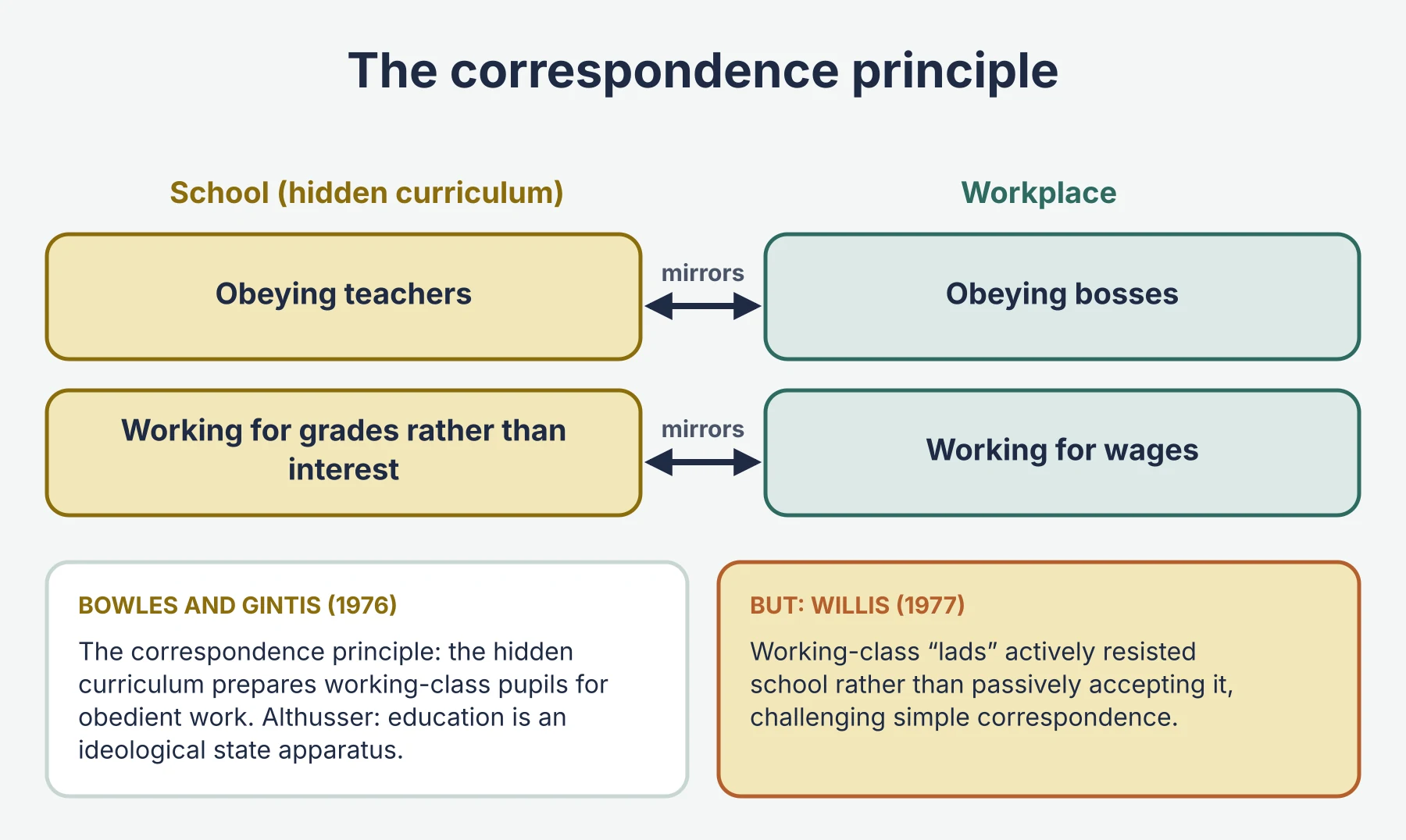
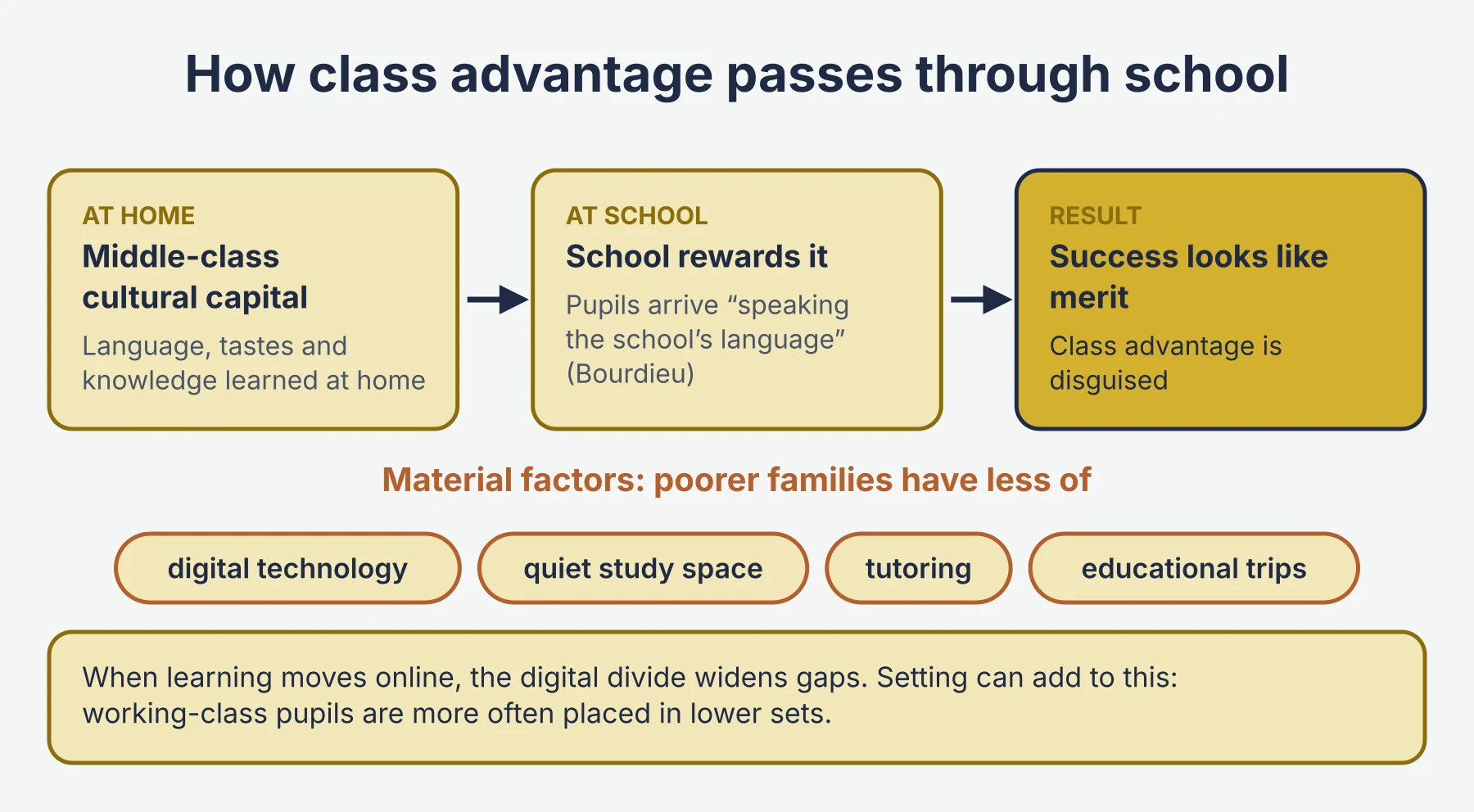
- Correspondence principle: obeying teachers is like obeying bosses; working for grades is like working for wages.
- Cultural capital (Bourdieu): middle-class children fit the school’s culture.
- Myth of meritocracy: failure blamed on the individual.
- Material factors: digital technology, study space, tutoring.
- Setting: working-class pupils over-represented in lower sets.
- Strength: explains persistent class gaps. Limitation: Willis (1977) showed resistance, not passive acceptance; neglects gender and ethnicity.
Feminist checklist (5.2.3)
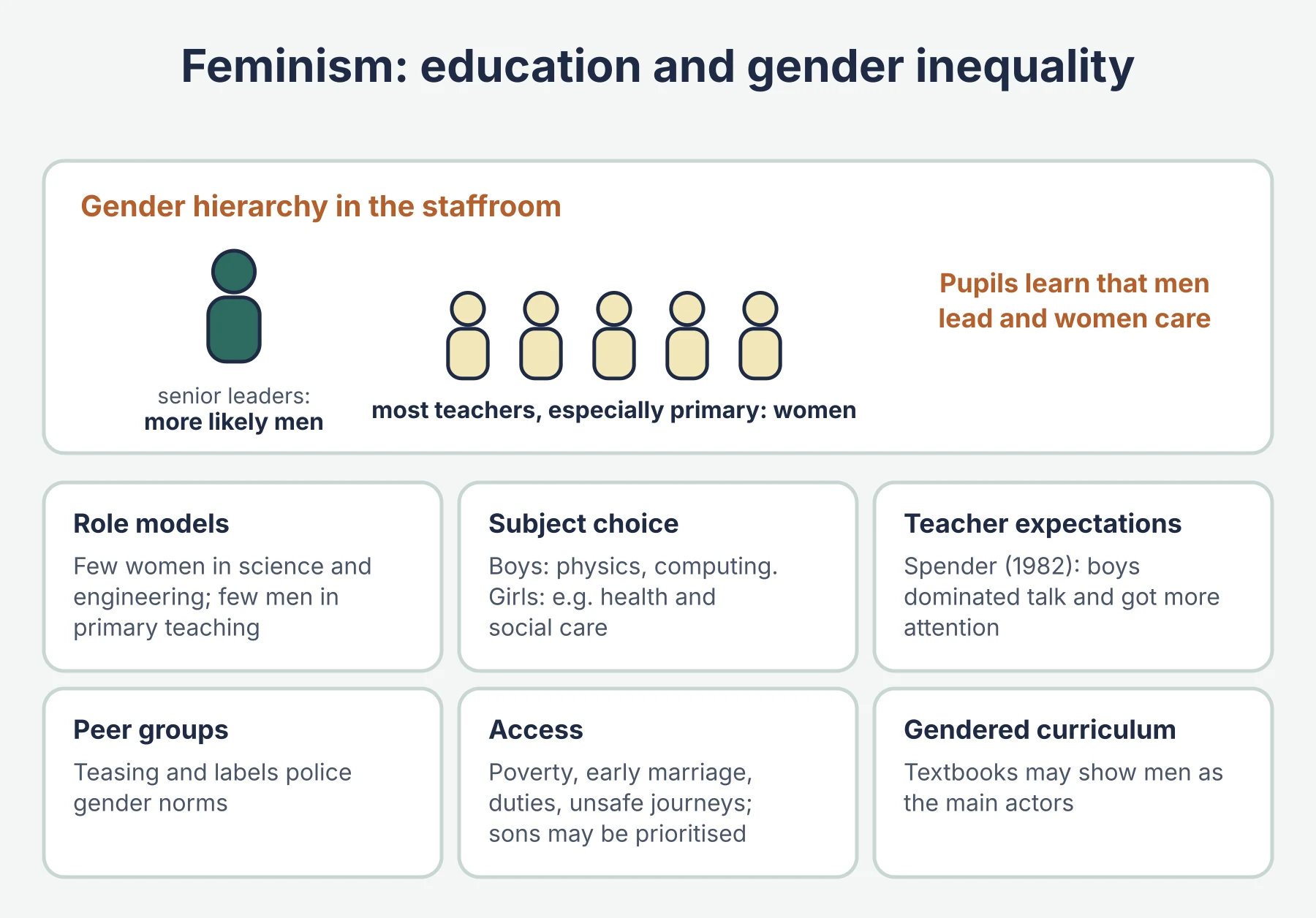
- Patriarchal culture and male power: men often over-represented in senior posts.
- Gender hierarchy and role models: who leads and who teaches young children.
- Access: girls in some societies kept from school by poverty, early marriage and domestic duties.
- Gendered curriculum and subject choice.
- Teacher expectations: Spender found boys dominated classroom talk and attention.
- Peer groups and social control: teasing and labels police gender norms.
- Strength: exposes inequalities others ignore. Limitation: girls now outperform boys at school level in many countries; may overlook class and ethnicity.
Exam traps
- One practice, three readings: setting and the hidden curriculum appear in every view. Use the contrast to evaluate.
- Name the parallel in the correspondence principle: obedience, hierarchy, extrinsic rewards.
- Durkheim is functionalist, Bourdieu is not: Bourdieu is used for the Marxist and class-based arguments.
- “Girls now do better” is not the end of feminism: subject choice, careers and leadership still show gender gaps.
- Both strengths and limitations: the syllabus asks for them for each view.
- Willis is the key critic of passive-pupil Marxism; use him in evaluation.
Self-test
- Name the four roles of education listed under the functionalist view.
- What did Durkheim mean by school as a “society in miniature”?
- How did Parsons distinguish the family and school?
- What is role allocation?
- What is the correspondence principle?
- What did Althusser call education?
- How does cultural capital give middle-class pupils an advantage?
- What is meant by the myth of meritocracy?
- How does Willis challenge the Marxist view?
- What did Spender find about classroom interaction?
- Give two reasons why girls in some societies have less access to education.
- Give one limitation of the feminist view of education.
Answers: 1. Socialisation, social control, economic, selective. 2. Children learn to cooperate with people who are not family and to follow shared rules, as they will in wider society. 3. In the family children are judged as individuals by particularistic standards; at school everyone is judged by the same universalistic standards. 4. Sorting people into the jobs that best suit their abilities. 5. Bowles and Gintis’s idea that the hidden curriculum of school mirrors the relationships of the workplace. 6. An ideological state apparatus. 7. Their home culture, language and knowledge match what schools value and reward, so they succeed more easily. 8. The belief that success depends on merit, which hides the influence of class background and makes failures blame themselves. 9. His study showed working-class lads actively resisting school rather than passively accepting its values. 10. Boys dominated classroom talk and received more teacher attention. 11. Any two: poverty; early marriage; household duties; safety concerns on the way to school; families prioritising sons. 12. Any one: girls now outperform boys at school level in many countries; it treats girls as one group, ignoring class and ethnicity; it may overlook boys’ underachievement.
Practise with the key question 5.2 practice questions, then revise achievement differences with the key question 5.3 revision notes.
Related resources
-
Study guides
Cambridge IGCSE Sociology (0495): Education – What factors help to explain differences in educational achievement and experience?
Cambridge IGCSE Sociology 0495 key question 5.3: patterns and explanations of achievement by class, ethnicity, gender and between countries, with evaluation.
Sociology · Cambridge · IGCSE
Read guide -
Practice questions
Cambridge IGCSE Sociology (0495): Education – What factors help to explain differences in educational achievement and experience? – Practice Questions
Original Cambridge IGCSE Sociology 0495 practice on key question 5.3: achievement differences by class, ethnicity, gender and globally, with mark guidance.
Sociology · Cambridge · IGCSE
Try questions -
Revision notes
Cambridge IGCSE Sociology (0495): Education – What factors help to explain differences in educational achievement and experience? – Revision Notes
Revision notes for Cambridge IGCSE Sociology 0495 key question 5.3: achievement by class, ethnicity, gender and globally, with key terms and a self-test.
Sociology · Cambridge · IGCSE
Revise topic
Related articles
Get free revision emails (optional)
Occasional emails with practice questions, worked explanations and links to free resources for the qualification and subjects you choose. No spam, and you can unsubscribe from any email. The free tools on this site never need an email.