
Revision Notes
Cambridge IGCSE Sociology (0495): Education – What factors help to explain differences in educational achievement and experience? – Revision Notes
Revision notes for Cambridge IGCSE Sociology 0495 key question 5.3: achievement by class, ethnicity, gender and globally, with key terms and a self-test.
- Subject
- Sociology
- Level
- IGCSE
- Topic
- Paper 2 – Family, Education and Crime
- Author
- Marlbridge Academic Team
- Updated
- Reviewed by
- Naqiya Yousaf (what this means)
Aligned to Cambridge IGCSE Sociology (0495), 2025-2027. Official specification .
Syllabus page (what it covers and how it is assessed): Cambridge IGCSE Sociology.
Syllabus points this page covers
0495
- 5.3 Education – What factors help to explain differences in educational achievement and experience?
Found an error? Report a correction.
Need help with this topic? Request a free trial class for IGCSE Sociology (0495).
Condensed notes for key question 5.3 What factors help to explain differences in educational achievement and experience? (Cambridge IGCSE Sociology 0495, Paper 2, Education). For full explanations and an annotated answer, see the key question 5.3 study guide.
Sort every explanation three ways
| Type | Class | Ethnicity | Gender |
|---|---|---|---|
| Home and culture | Material deprivation; cultural capital; parental interest; restricted code | Poverty in some groups; family expectations; second-language learning | Gendered socialisation; changing priorities (Sharpe) |
| In-school | Labelling; setting; anti-school subcultures | Institutional racism; ethnocentric curriculum; labelling; ethnic subcultures | Teacher expectations; gendered subcultures |
| Structural | Marxism; selective and private schools | Racism in wider society | Patriarchy (feminism) |
Key terms
| Term | Meaning |
|---|---|
| Material deprivation | Lack of money and physical resources, such as devices, books and space |
| Cultural capital | Knowledge, attitudes and tastes, typically middle-class, that schools reward (Bourdieu) |
| Social capital | Useful contacts and networks |
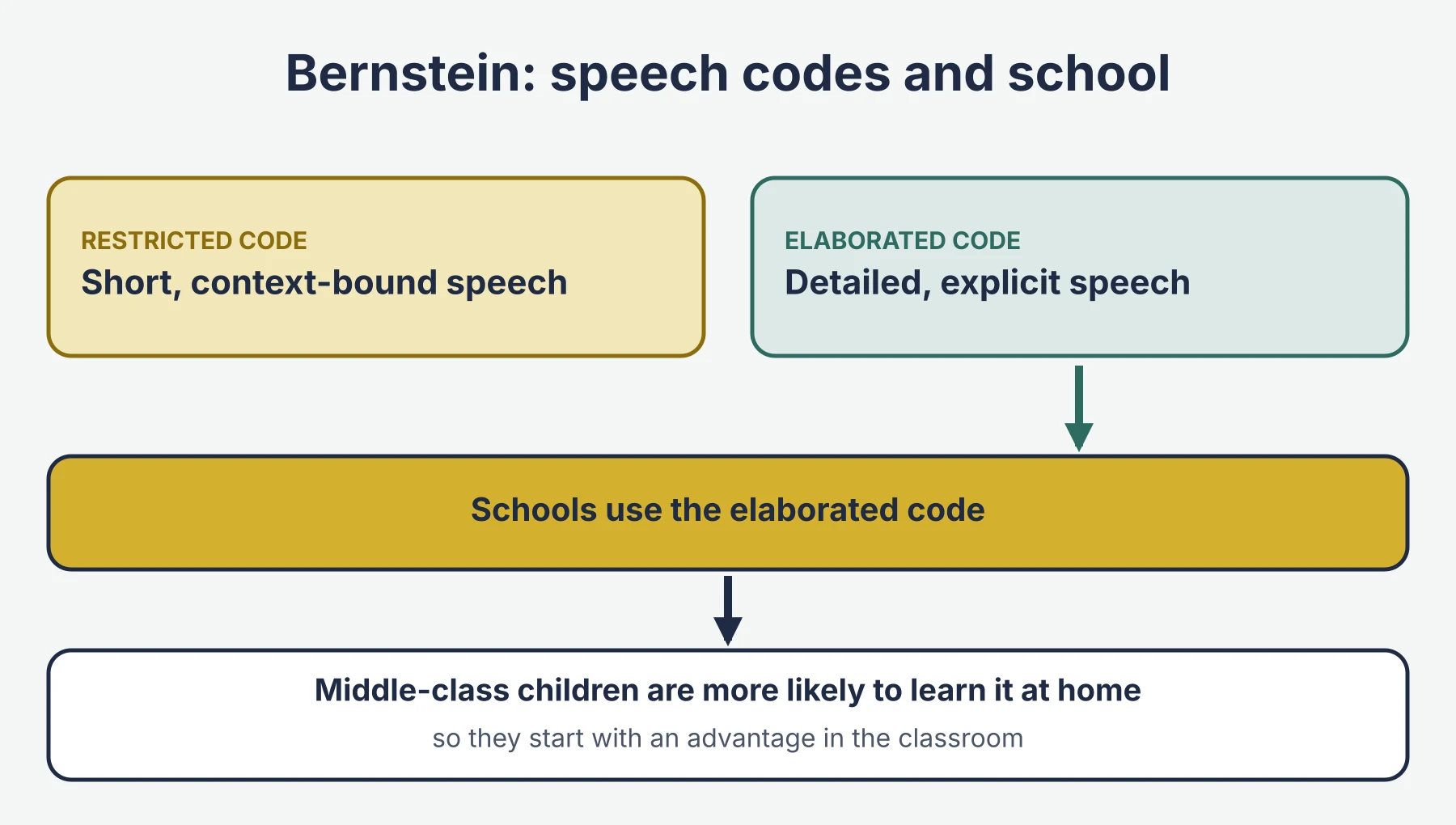
| Restricted code | Short, context-bound speech (Bernstein) |
| Elaborated code | Detailed, explicit speech used in schools (Bernstein) |
| Compensatory education | Extra provision to offset disadvantage, such as Head Start or Sure Start |
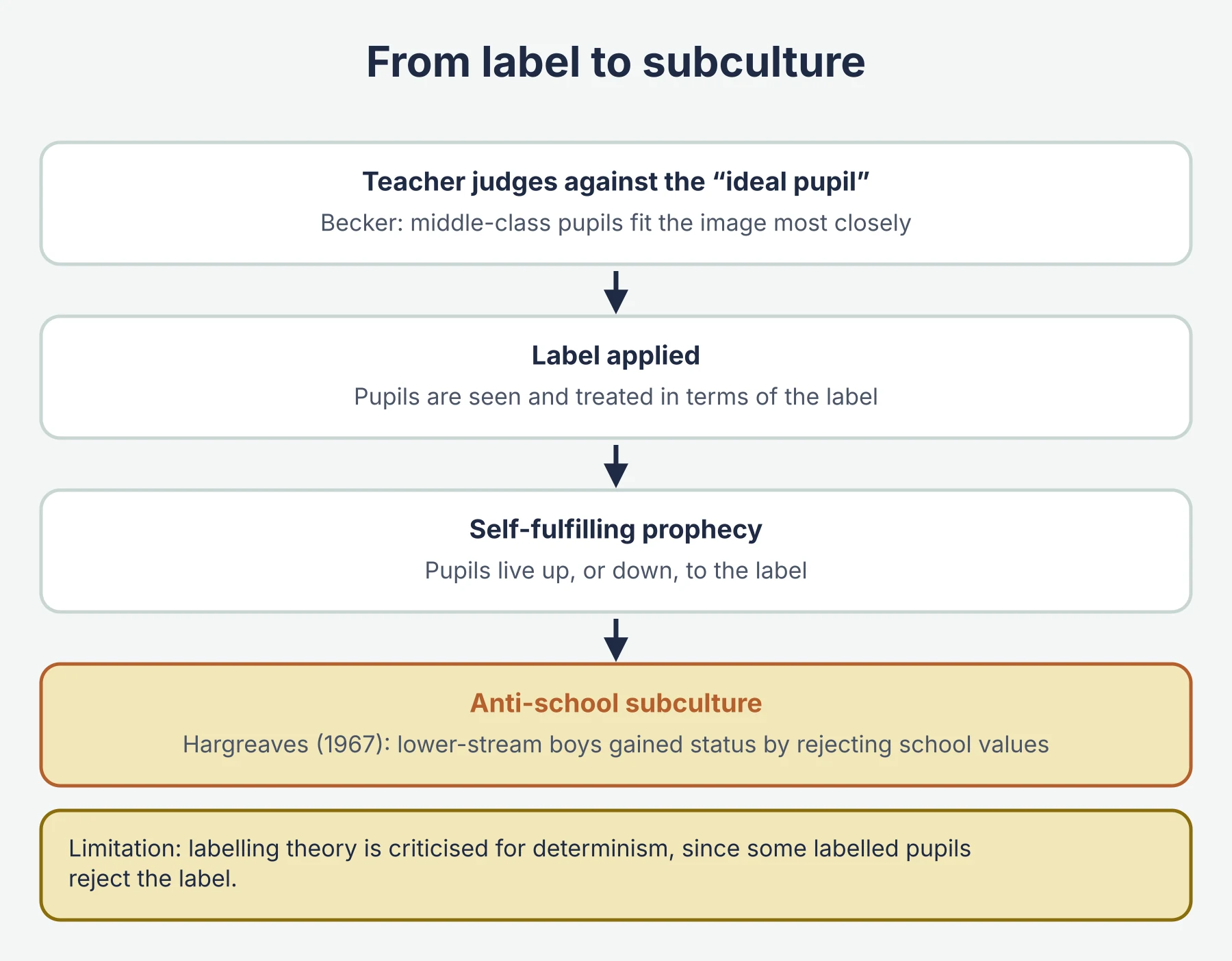
| Ideal pupil | Teachers’ image of the model student (Becker) |
| Self-fulfilling prophecy | A prediction that comes true because people act on it |
| Anti-school subculture | A peer group that gains status by rejecting school values |
| Institutional racism | Discrimination built into an organisation’s routines |
| Ethnocentric curriculum | A curriculum centred on one culture’s knowledge and values |
| Gendered subculture | A peer group built around ideas of masculinity or femininity |
| Digital divide | The gap between those with and without good access to digital technology |
Class (5.3.2): names to use
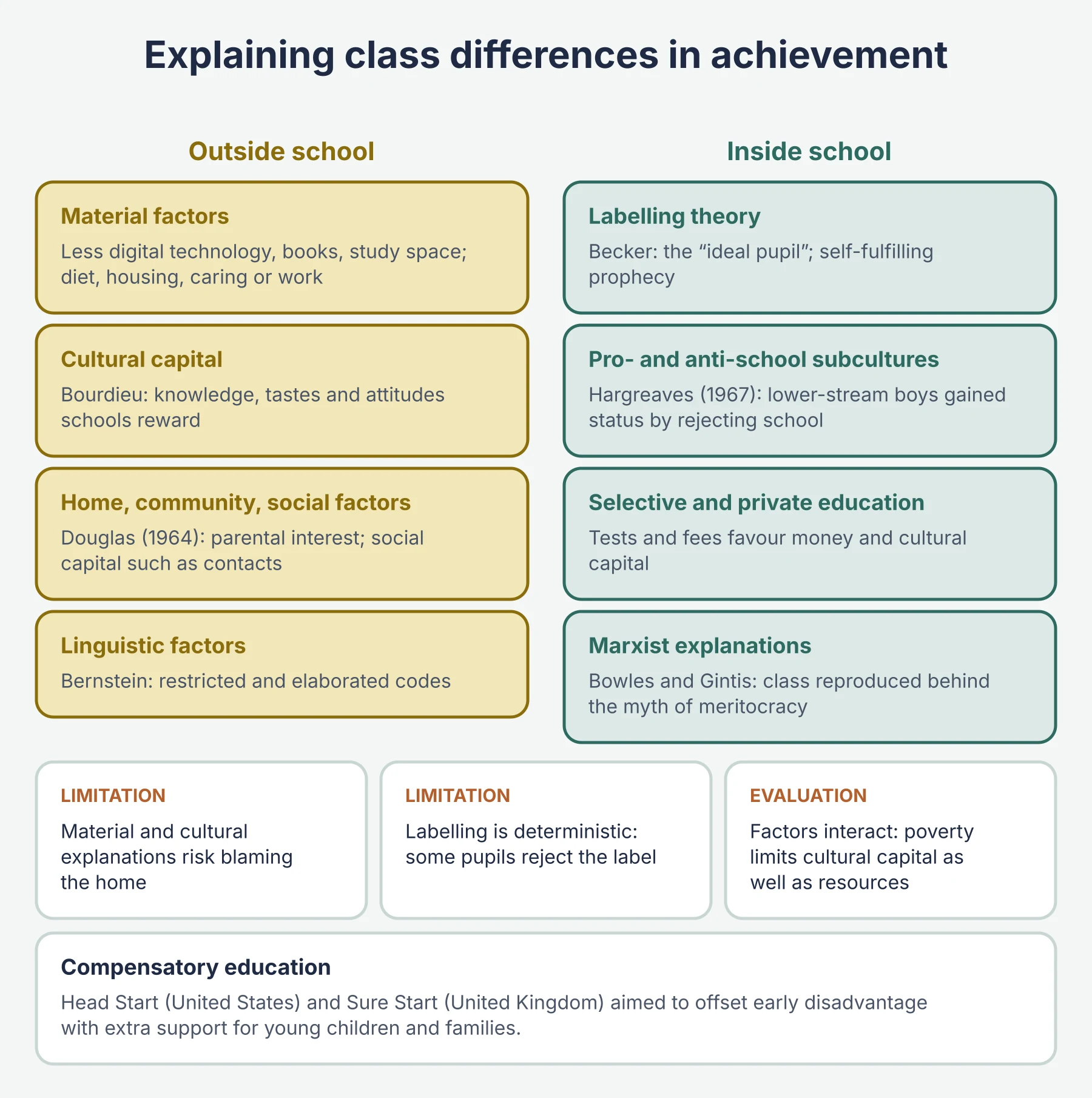
- Douglas (1964): parental interest.
- Bernstein: restricted v elaborated code.
- Bourdieu: cultural capital.
- Becker: the ideal pupil.
- Hargreaves (1967): lower-stream boys formed anti-school subcultures.
- Bowles and Gintis: myth of meritocracy.
- Compensatory education: Head Start (United States), Sure Start (United Kingdom).
- Limitations: blaming the home; determinism of labelling; factors overlap.
Ethnicity (5.3.3): names to use
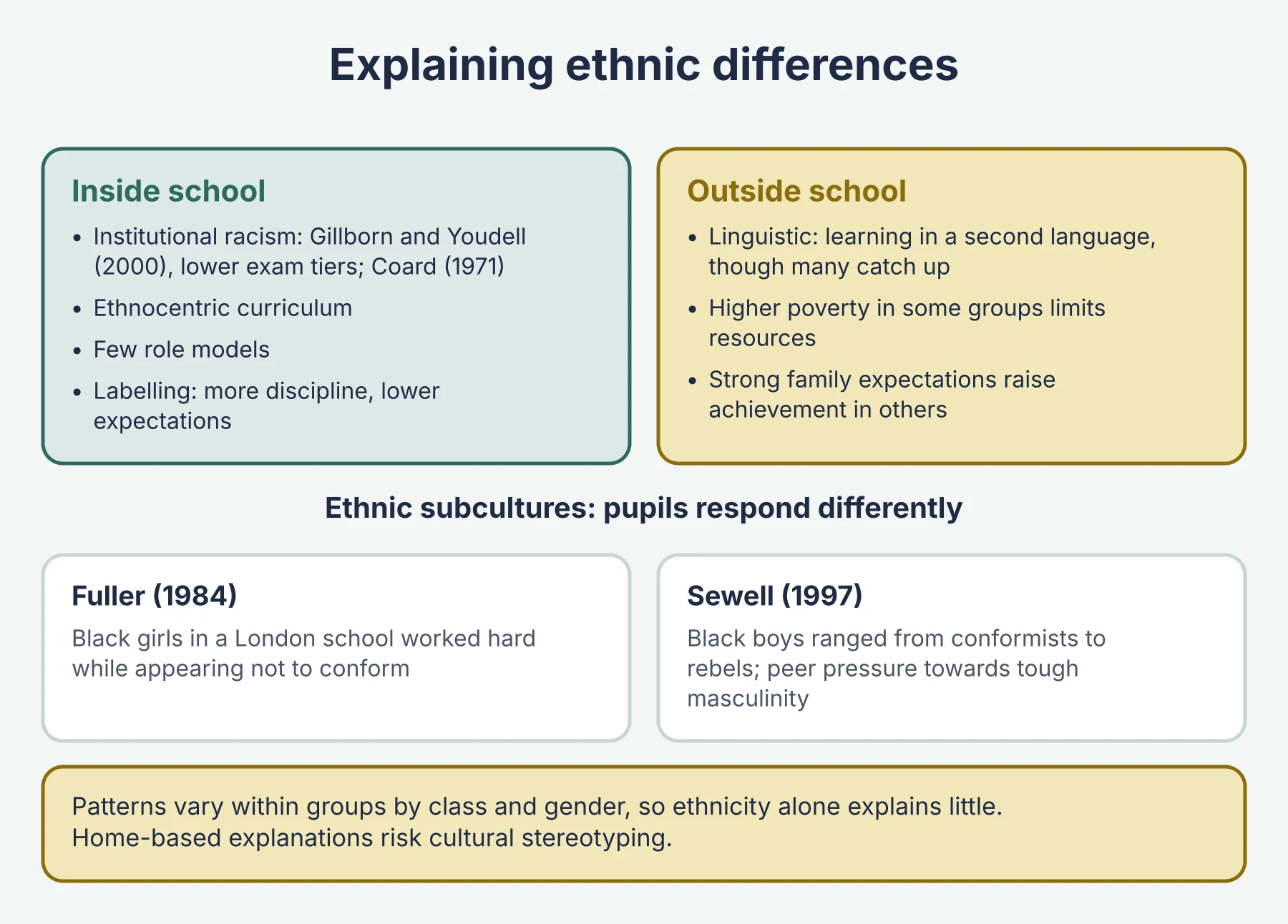
- Coard (1971): West Indian pupils wrongly placed in “educationally subnormal” schools.
- Gillborn and Youdell (2000): teacher expectations and lower-tier exam entry for Black pupils.
- Fuller (1984): Black girls’ pro-education subculture.
- Sewell (1997): a range of responses among Black boys, from conformists to rebels.
- Also: ethnocentric curriculum; role models; second-language learning; poverty; family expectations.
- Limitations: wide variation within groups by class and gender; risk of cultural stereotyping.
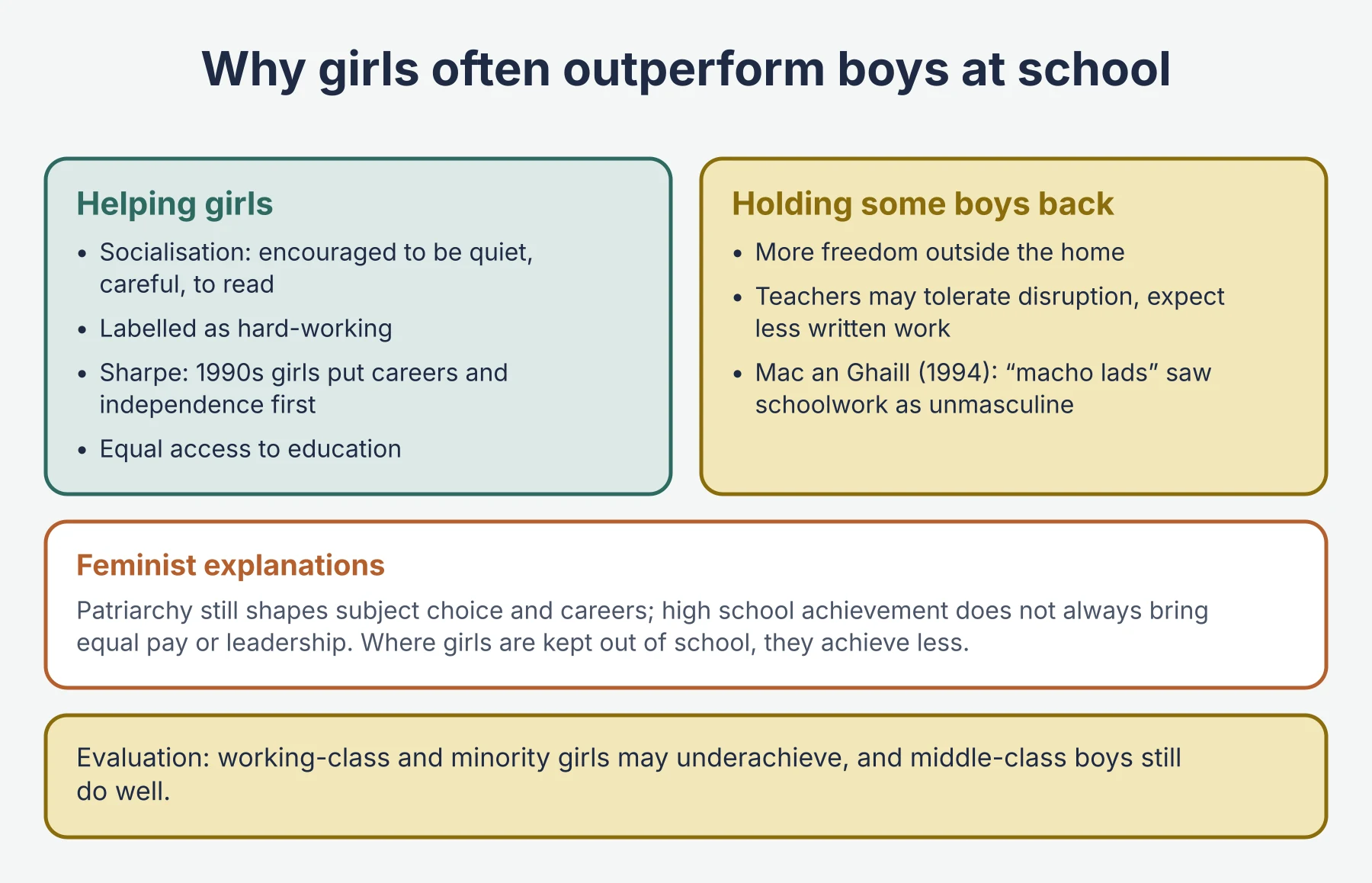
Gender (5.3.4): names to use
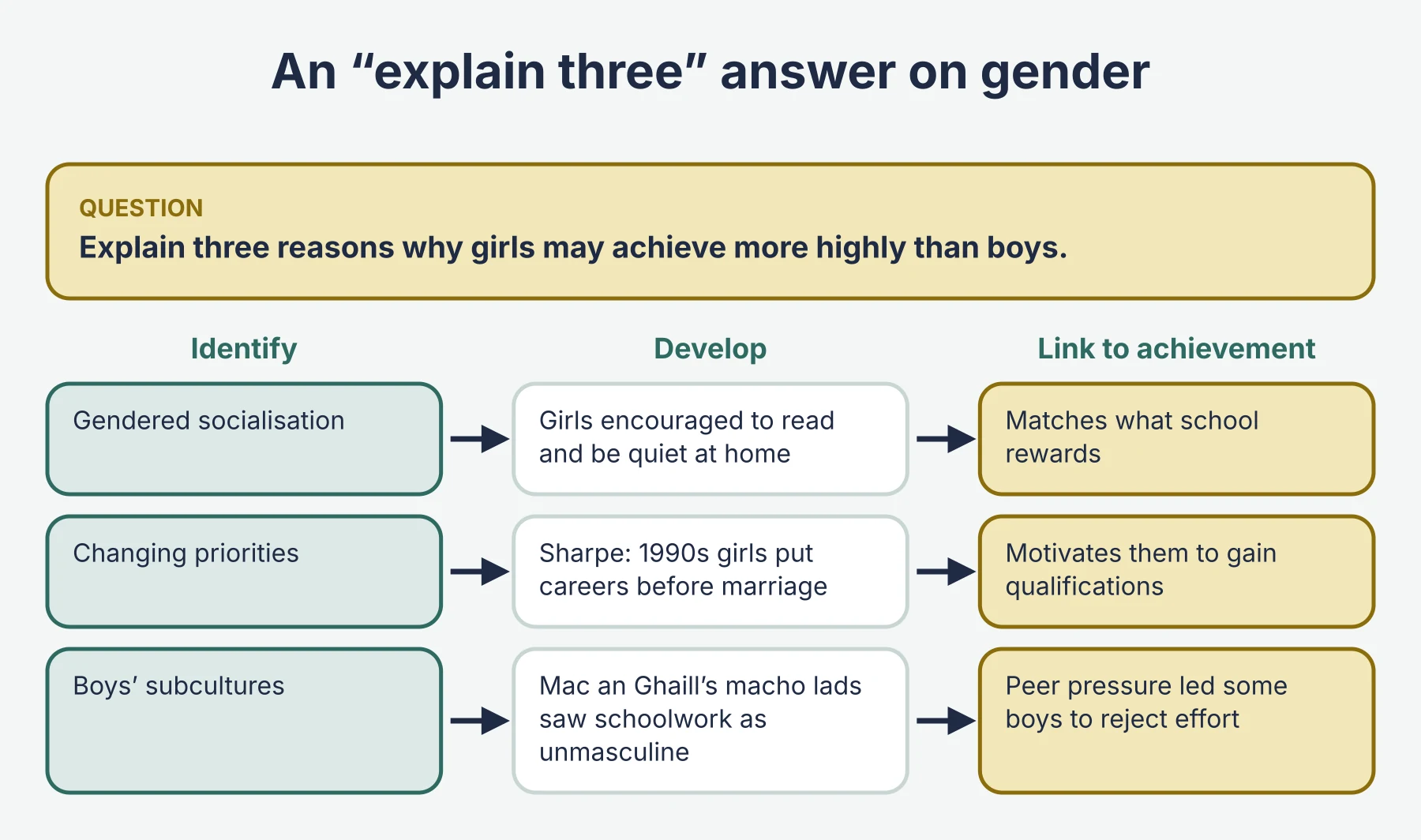
- Sharpe: girls’ priorities moved from marriage (1970s) to careers (1990s).
- Mac an Ghaill (1994): macho lads reject schoolwork as unmasculine.
- Also: girls’ socialisation suits school; teacher expectations; access; patriarchy shapes subject choice and careers.
- Limitations: not all girls succeed; middle-class boys still do well; school success does not equal workplace equality.
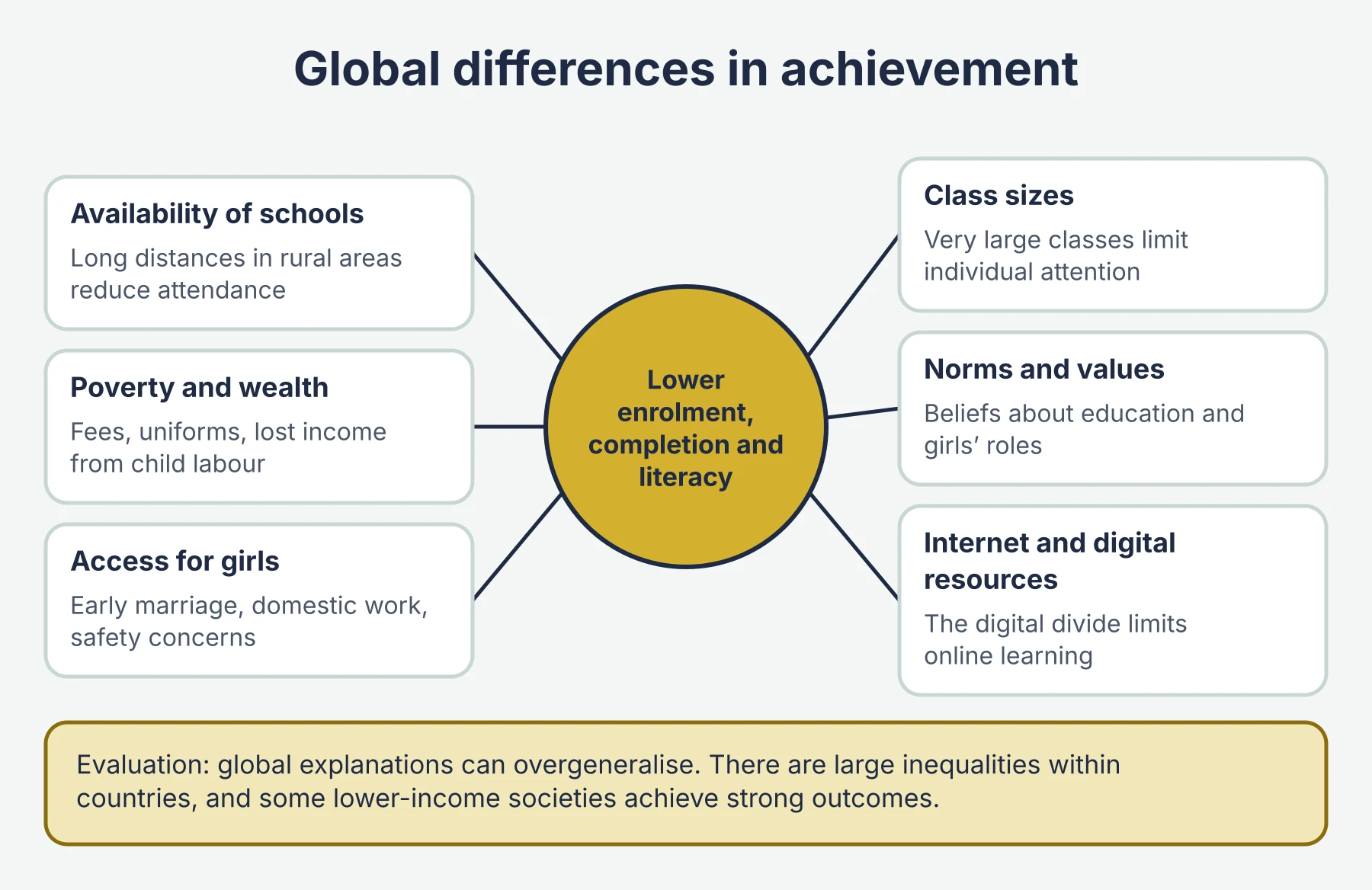
Global (5.3.5): six factors
Availability of schools; poverty and wealth; girls’ access; class sizes; norms, values and culture; internet and digital resources. Limitation: within-country gaps can be as large as between-country gaps.
Strengths and limitations at a glance (5.3.6)
| Explanation type | Strength | Limitation |
|---|---|---|
| Material | Clear, measurable link between poverty and resources for learning | Some poor pupils succeed, so material factors are not the whole story |
| Cultural and linguistic | Explains why gaps open before school starts | Risks treating home culture as deficient |
| In-school (labelling, setting, subcultures) | Shows schools themselves produce inequality | Deterministic; pupils can reject labels |
| Structural (Marxist, feminist, racism) | Links schools to wider inequality | Can underplay individual agency and real progress |
| Global factors | Explain large differences between countries | Overgeneralise; hide gaps within countries |
Exam traps
- Name the group: an explanation scores only if applied to the pattern asked about.
- Different, not deficient: describe working-class or minority culture as different from school culture, not inferior.
- Combine factors: class, ethnicity and gender interact.
- No invented statistics: describe direction (“higher on average”), not made-up percentages.
- Achievement v experience: experience includes exclusion, discipline and feelings about school.
- Evaluate every explanation (5.3.6), not only the last one you write about.
Self-test
- Give two material factors that affect working-class achievement.
- What is cultural capital?
- Distinguish Bernstein’s restricted and elaborated codes.
- What did Douglas find in 1964?
- Give an example of compensatory education.
- What did Hargreaves find about lower-stream pupils?
- What did Gillborn and Youdell find about exam tiers?
- What is an ethnocentric curriculum?
- What did Fuller find about Black girls in a London school?
- How did girls’ priorities change in Sharpe’s research?
- Who are Mac an Ghaill’s macho lads?
- Give three factors that explain global differences in achievement.
Answers: 1. Any two: lack of digital technology; lack of study space; poor diet or health; needing to work or care for siblings; unable to pay for tutoring or trips. 2. Knowledge, tastes and attitudes, usually middle-class, that schools value and reward. 3. The restricted code is short and context-bound; the elaborated code is detailed and explicit, and is the code schools use. 4. Parental interest in education was linked to children’s achievement. 5. Head Start in the United States or Sure Start in the United Kingdom. 6. They formed an anti-school subculture, gaining status by rejecting school values. 7. Teachers’ expectations meant Black pupils were more likely to be entered for lower-tier exams. 8. A curriculum centred on the knowledge and values of the majority culture. 9. They formed a pro-education subculture, working hard while appearing not to conform. 10. From love and marriage in the 1970s to careers and independence in the 1990s. 11. Working-class boys who rejected schoolwork as unmasculine. 12. Any three: availability of schools; poverty; girls’ access; class sizes; norms and values; internet access.
Try the key question 5.3 practice questions, then revise the whole Education topic with the family, education and crime revision notes.
Related resources
-
Study guides
Cambridge IGCSE Sociology (0495): Crime, deviance and social control – What are crime, deviance and social control?
Cambridge IGCSE Sociology 0495 key question 6.1: crime and deviance, relativity, formal and informal social control, types of crime and measuring crime.
Sociology · Cambridge · IGCSE
Read guide -
Practice questions
Cambridge IGCSE Sociology (0495): Crime, deviance and social control – What are crime, deviance and social control? – Practice Questions
Original Cambridge IGCSE Sociology 0495 practice on key question 6.1: deviance, relativity, social control, crime types and measuring crime, with answers.
Sociology · Cambridge · IGCSE
Try questions -
Revision notes
Cambridge IGCSE Sociology (0495): Crime, deviance and social control – What are crime, deviance and social control? – Revision Notes
Revision notes for Cambridge IGCSE Sociology 0495 key question 6.1: crime, deviance, social control, eleven crime types and measuring crime, with a self-test.
Sociology · Cambridge · IGCSE
Revise topic
Related articles
Get free revision emails (optional)
Occasional emails with practice questions, worked explanations and links to free resources for the qualification and subjects you choose. No spam, and you can unsubscribe from any email. The free tools on this site never need an email.