
Study Guides
Cambridge IGCSE Sociology (0495): Crime, deviance and social control – What are crime, deviance and social control?
Cambridge IGCSE Sociology 0495 key question 6.1: crime and deviance, relativity, formal and informal social control, types of crime and measuring crime.
- Subject
- Sociology
- Level
- IGCSE
- Topic
- Paper 2 – Family, Education and Crime
- Author
- Marlbridge Academic Team
- Updated
- Reviewed by
- Naqiya Yousaf (what this means)
Aligned to Cambridge IGCSE Sociology (0495), 2025-2027. Official specification .
Syllabus page (what it covers and how it is assessed): Cambridge IGCSE Sociology.
Syllabus points this page covers
0495
- 6.1 Crime, deviance and social control – What are crime, deviance and social control?
Found an error? Report a correction.
Need help with this topic? Request a free trial class for IGCSE Sociology (0495).
This guide covers key question 6.1 What are crime, deviance and social control? in the Crime, deviance and social control topic of Cambridge IGCSE Sociology (0495) Paper 2, 2025–2027 syllabus. The family, education and crime study guide introduces the crime/deviance distinction, the two lists of agencies and the problem of official statistics. This page goes further: examples of relativity, how each agency actually controls behaviour, how effective control is, a definition and example for each of the eleven crime types, and a full comparison of the three ways of measuring crime.
What key question 6.1 covers
- 6.1.1 The difference between crime and deviance; the relativity of crime and deviance within and between societies, cultures, situations and across time.
- 6.1.2 Formal social control: the police, courts, armed forces, government and penal system, and how they control individuals and prevent crime and deviance.
- 6.1.3 Informal social control: family, education, workplace, peer group, traditional and digital media, and religion, and how they control individuals.
- 6.1.4 The effectiveness of agencies and methods of social control in achieving conformity and preventing crime and deviance.
- 6.1.5 Types and examples of crime: violent, property, white-collar/corporate, expressive, instrumental, gang, green, global (such as organised crime), cyber, hate and domestic crime.
- 6.1.6 Measuring crime: official statistics, self-report studies, victim surveys (local and national), their strengths and limitations, and the problem of unreported and unrecorded crime.
Crime, deviance and relativity (6.1.1)
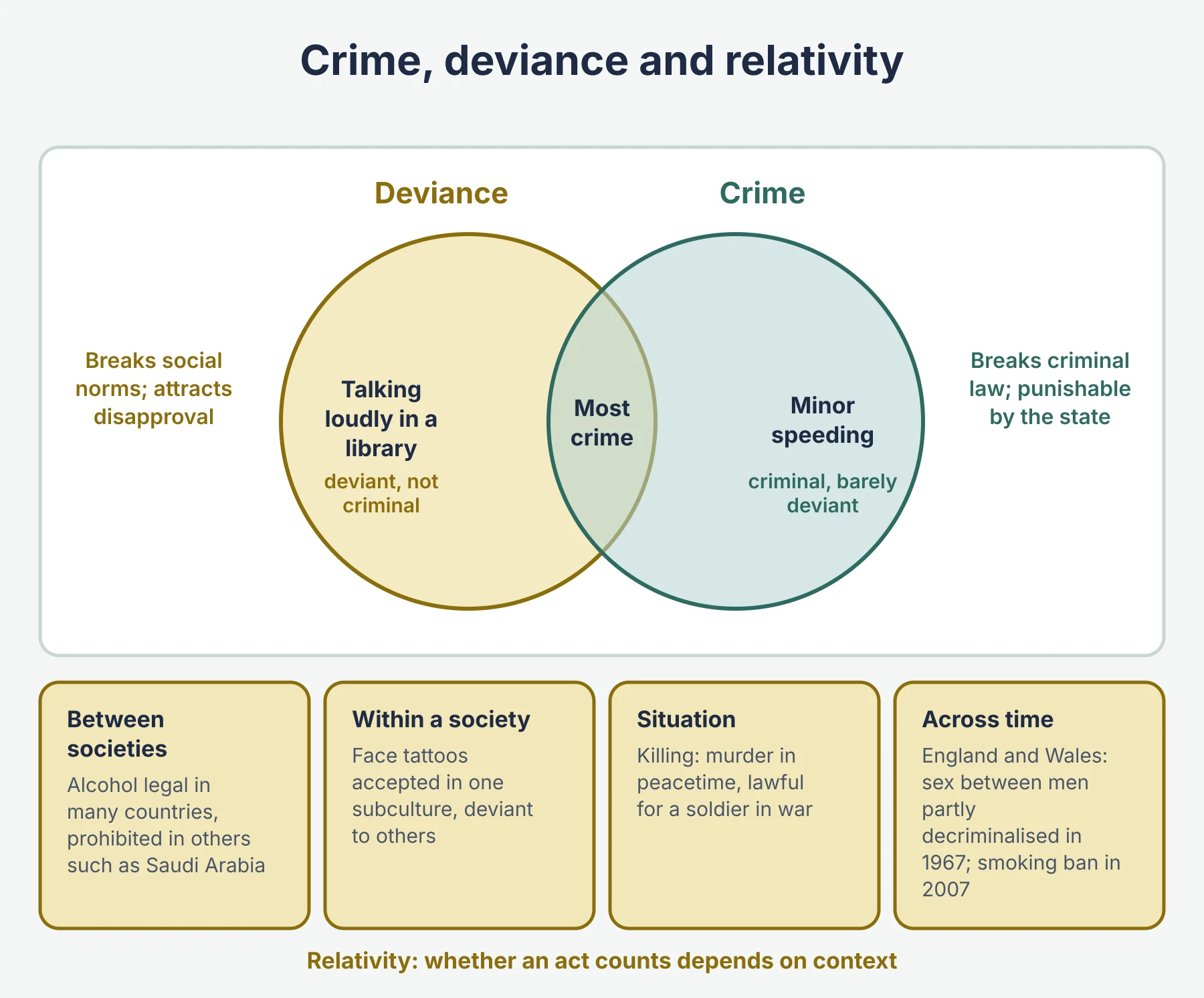
Crime is behaviour that breaks the criminal law and can be punished by the state. Deviance is behaviour that breaks social norms and attracts disapproval. Most crime is deviant, but not all deviance is criminal (talking loudly in a library), and some crime is barely seen as deviant (minor speeding).
Both are relative: whether an act counts as criminal or deviant depends on context.
| Dimension | Example |
|---|---|
| Between societies | Drinking alcohol is legal and common in many countries but prohibited in others, such as Saudi Arabia |
| Within a society | Behaviour accepted in one subculture, such as tattooing the face, may be seen as deviant by others |
| Situation | Killing is murder in peacetime but can be lawful for a soldier in war; nudity is normal in a changing room but deviant in the street |
| Across time | In England and Wales, sex between men in private was partly decriminalised in 1967; smoking in enclosed public places became illegal in 2007 |
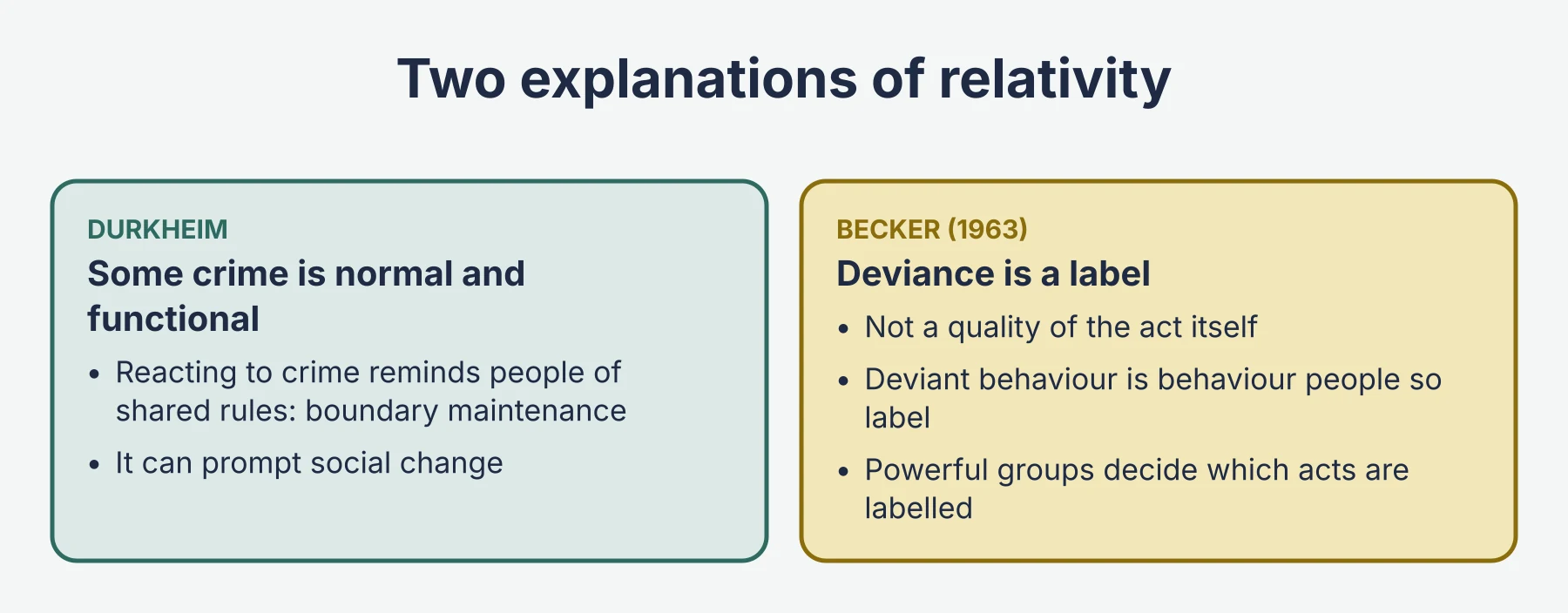
Two theorists help explain relativity. Émile Durkheim argued some crime is normal and functional: reacting to it reminds people of shared rules (boundary maintenance) and can prompt social change. Howard Becker (1963) argued deviance is not a quality of the act but of the label: deviant behaviour is behaviour that people so label, and powerful groups decide which acts are labelled.
Formal social control (6.1.2)
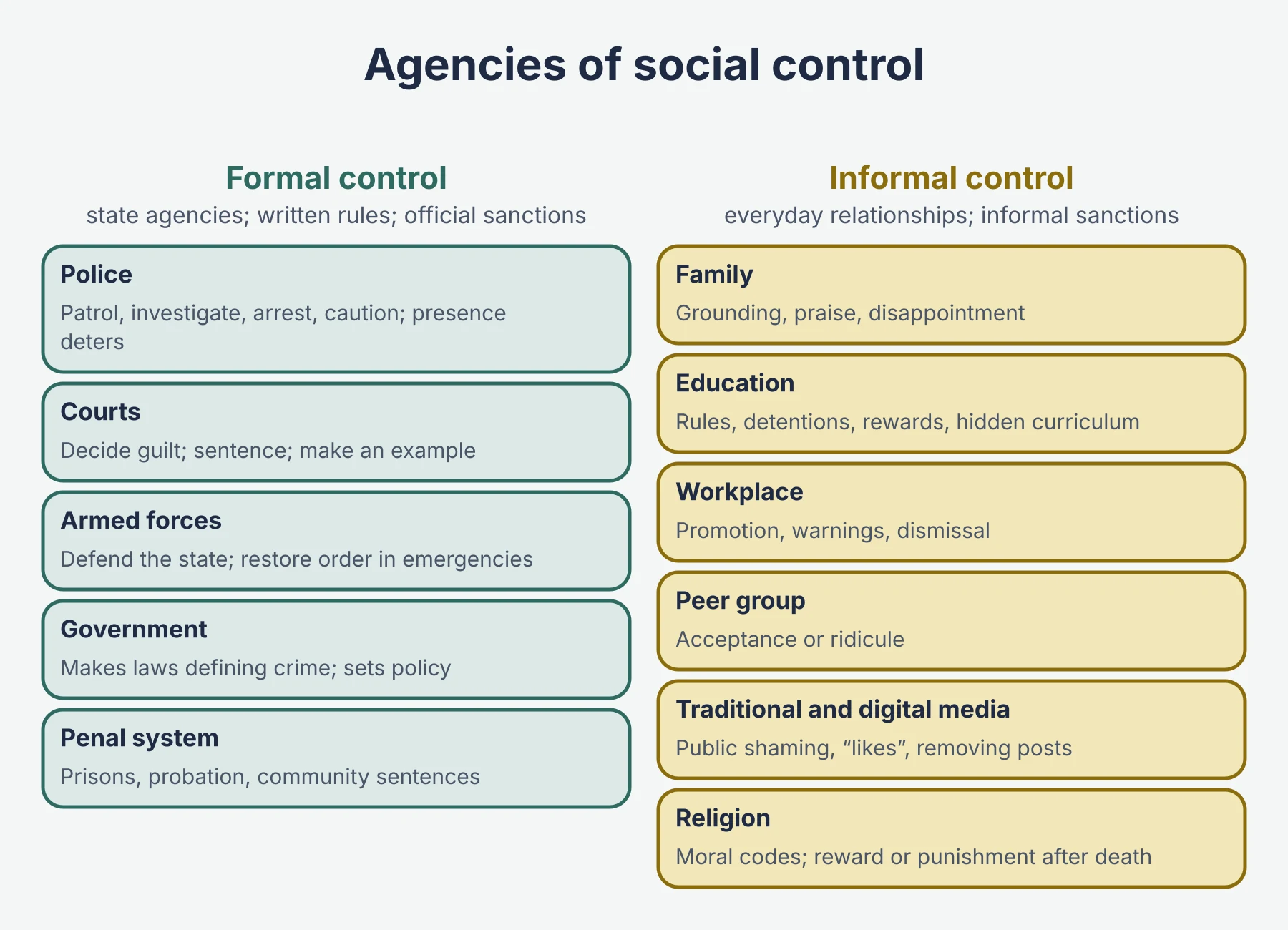
Formal control is exercised by agencies of the state, using written rules and official sanctions.
- Police: patrol, investigate, arrest and caution. Their visible presence deters some offending.
- Courts: decide guilt and impose sentences, making an example of offenders.
- Armed forces: defend the state and may be used to restore order in emergencies or under martial law.
- Government: makes the laws that define crime and sets policing and punishment policy.
- Penal system: prisons, probation and community sentences punish, incapacitate and attempt to rehabilitate.
Informal social control (6.1.3)
Informal control works through everyday relationships and informal sanctions: positive (praise, reward) and negative (disapproval, gossip, exclusion).
- Family: primary socialisation; grounding, praise and disappointment.
- Education: school rules, detentions, rewards and the hidden curriculum.
- Workplace: promotion, warnings, dismissal and the expectations of colleagues.
- Peer group: acceptance or ridicule; peers may enforce conformity or encourage deviance.
- Traditional and digital media: newspapers and television shape ideas about acceptable behaviour; on social media, public shaming and “likes” act as sanctions, and online platforms remove posts that break their rules.
- Religion: moral codes, the promise of reward or punishment after death, and community pressure.
How effective is social control? (6.1.4)
Arguments that informal control is more effective:
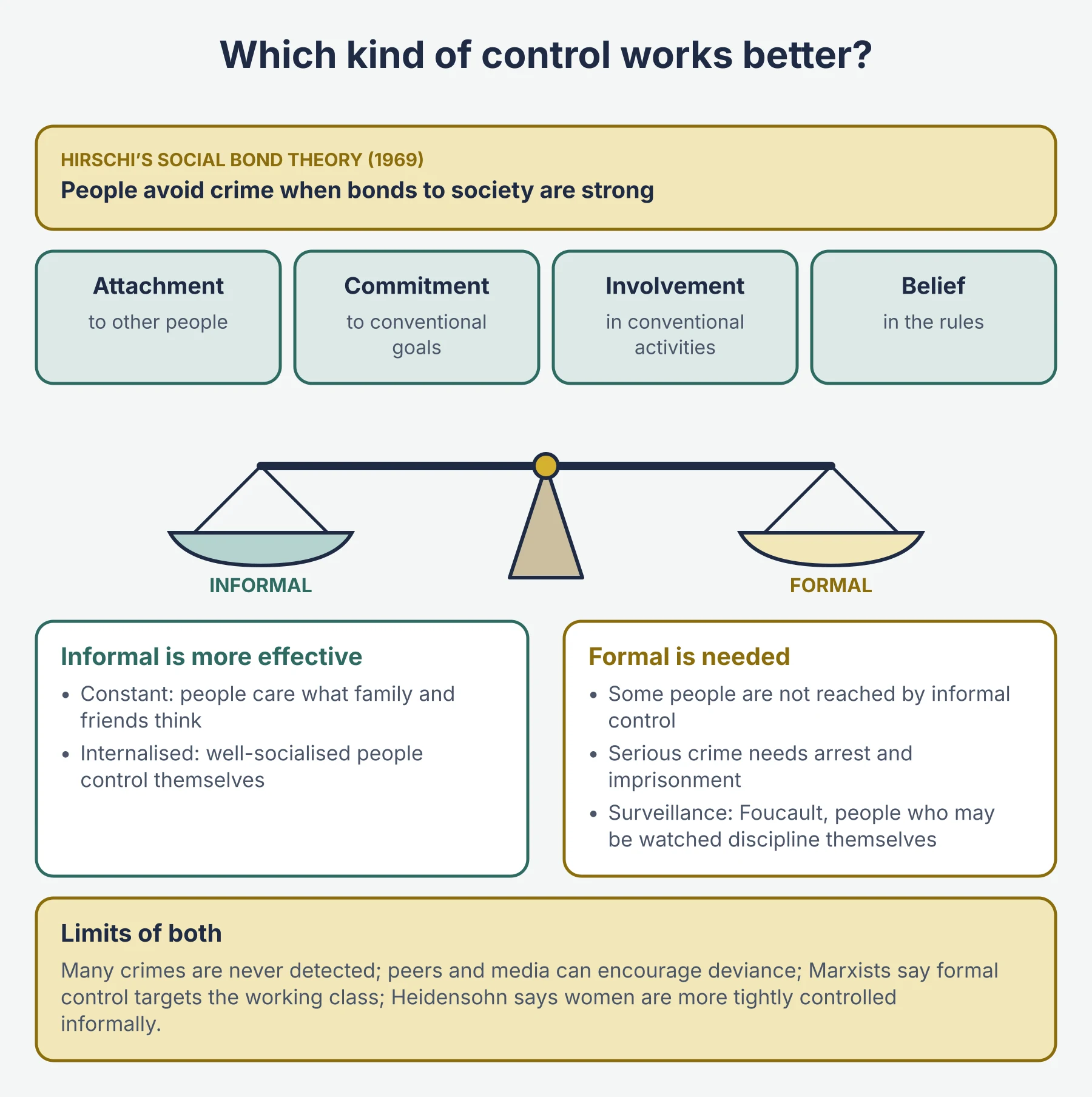
- It is constant. People conform mostly because they care what family and friends think, not because police are watching. Travis Hirschi’s social bond theory (1969) argued people avoid crime when they have strong attachment to others, commitment to conventional goals, involvement in conventional activities and belief in the rules.
- It is internalised: well-socialised people control themselves.
Arguments for formal control:
- Some people are not reached by informal control, and serious crime needs the power of arrest and imprisonment.
- Surveillance, such as CCTV, may deter offending; Michel Foucault argued that people who believe they may be watched start to discipline themselves.
Limitations of both:
- Many crimes are never detected, which weakens deterrence.
- Peer groups and some media can encourage deviance rather than prevent it.
- Marxists argue formal control targets the working class while crimes of the powerful escape; feminists such as Frances Heidensohn argue women are more tightly controlled informally, in the home and in public, than men.
Types of crime (6.1.5)
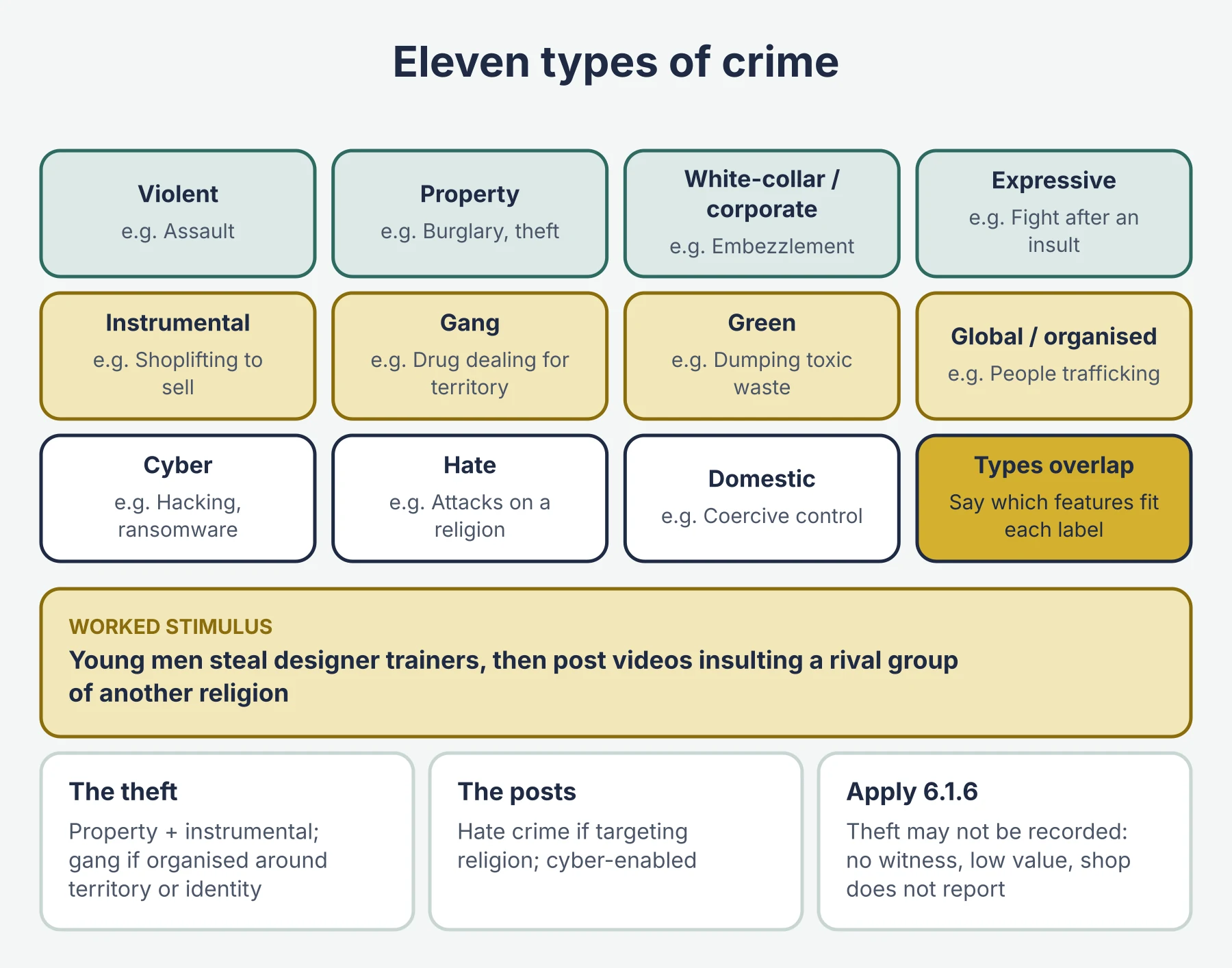
| Type | Definition | Example |
|---|---|---|
| Violent | Causing or threatening physical harm | Assault, robbery with violence |
| Property | Taking or damaging property | Burglary, theft, vandalism |
| White-collar / corporate | Crime by middle-class employees in the course of their jobs, or by companies for their benefit | Embezzlement; a company ignoring safety laws (term “white-collar crime” coined by Edwin Sutherland) |
| Expressive | Crime that expresses emotion rather than seeking gain | Vandalism out of anger; a fight after an insult |
| Instrumental | Crime as a means to an end, usually money | Shoplifting to sell goods |
| Gang | Crime committed by or for a gang | Drug dealing for territory |
| Green | Crime that harms the environment | Illegal dumping of toxic waste; illegal logging |
| Global / organised | Crime across borders by organised groups | People trafficking; international drug smuggling |
| Cyber | Crime using computers and the internet | Hacking, online fraud, ransomware |
| Hate | Crime motivated by hostility to a group | Attacks targeting religion, ethnicity, sexuality or disability |
| Domestic | Crime between family members or partners | Domestic abuse, coercive control |
Types overlap: a gang robbery can be violent, instrumental and gang crime at once. Say which features of the case fit each label.
Measuring crime (6.1.6)
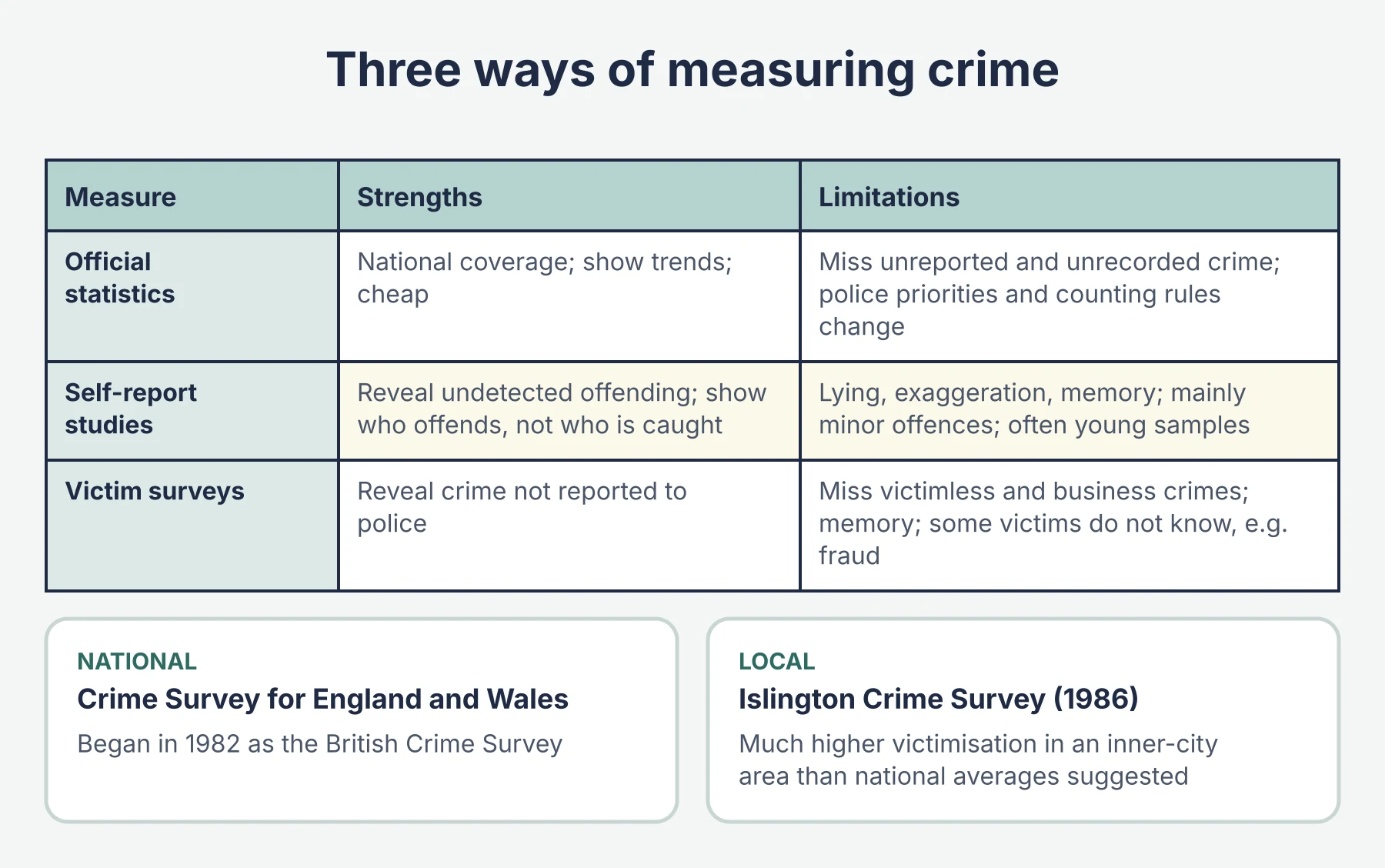
| Measure | What it is | Strengths | Limitations |
|---|---|---|---|
| Official statistics | Crimes recorded by the police and court data | National coverage; show trends; cheap to use | Miss unreported and unrecorded crime; affected by police priorities and changing counting rules |
| Self-report studies | Anonymous questionnaires asking people what offences they have committed | Reveal offending never detected; show who offends, not who is caught | Lying, exaggeration and memory errors; mainly minor offences; samples often young people |
| Victim surveys | Asking people what crimes they have experienced | Reveal crime not reported to police | Miss victimless crimes and crimes against businesses; rely on memory; some victims do not know they are victims, as in fraud |
National victim surveys cover a whole country: the Crime Survey for England and Wales began in 1982 as the British Crime Survey. Local surveys focus on one area; the Islington Crime Survey (1986) found much higher victimisation in an inner-city area than national averages suggested, especially for some groups.
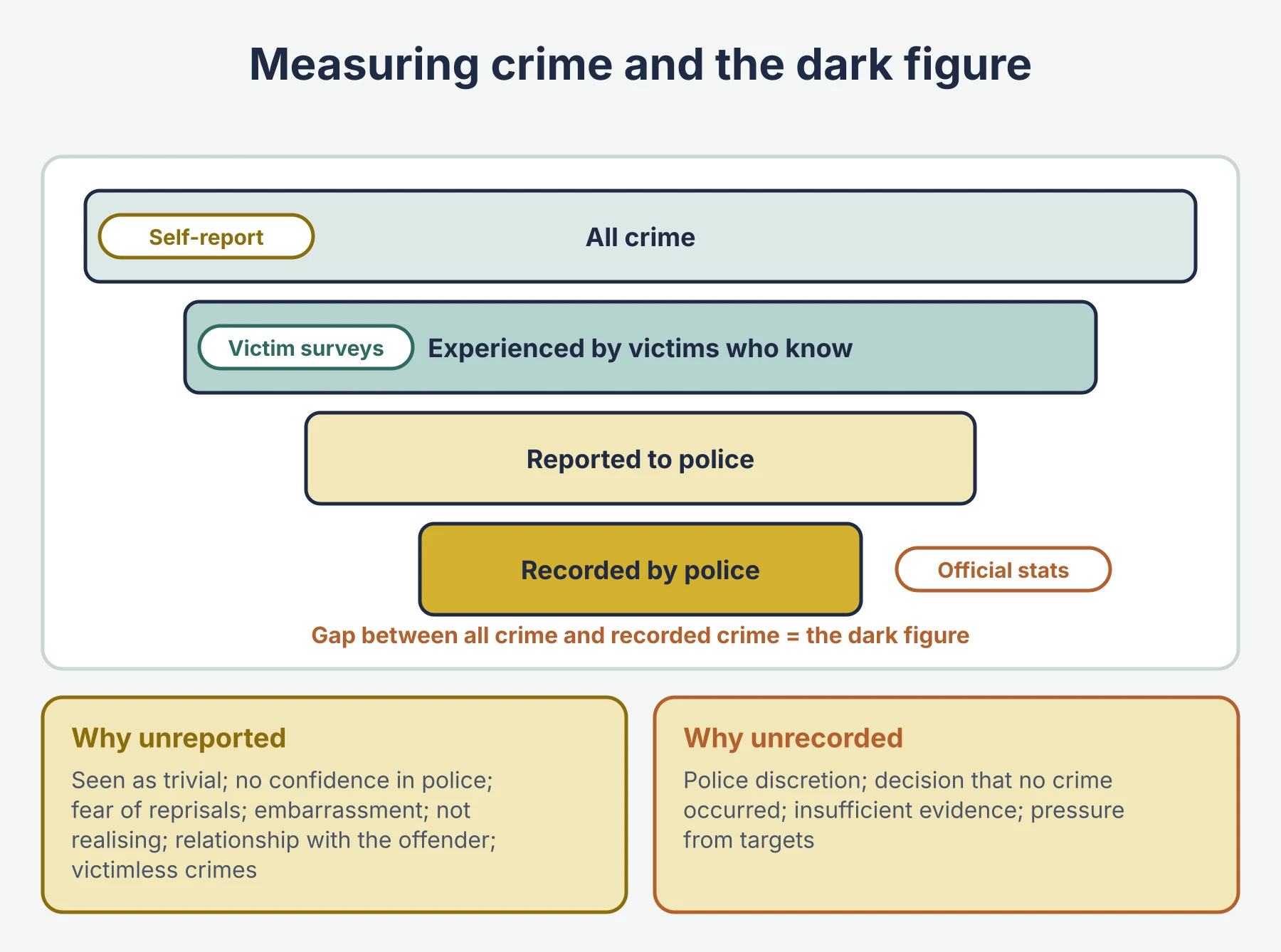
Why crime goes unreported: the victim sees it as trivial, has no confidence in the police, fears reprisals, is embarrassed, does not realise a crime happened, or is in a relationship with the offender, as in domestic abuse. Victimless crimes, such as drug possession, have no victim to report them.
Why crime goes unrecorded: police discretion, a decision that no crime occurred, insufficient evidence, or pressure from targets. The gap between all crime and recorded crime is often called the dark figure of crime.
Worked example: classifying a stimulus
A group of young men steal designer trainers from a shop, then post videos online insulting a rival group from another religion.
- The theft is property and instrumental crime (for gain). If the group is organised around territory or identity, it may also be gang crime.
- The posts could be hate crime if they target religion, and cyber-enabled crime because they use the internet.
- An answer that then explains why the theft might not appear in official statistics (no witness, low value, shop does not report) shows application to 6.1.6.
Common mistakes
- Defining deviance as “bad behaviour”: it is behaviour that breaks norms, which may not be harmful.
- Giving relativity examples without saying which dimension (society, culture, situation or time) they show.
- Listing agencies without explaining how they control people.
- Saying victim surveys capture all crime: they miss victimless and corporate crimes.
- Treating “unreported” and “unrecorded” as the same.
Exam technique
- Define: one precise sentence plus an example for each crime type.
- Explain three: for “Explain three ways the media act as informal social control”, give a different mechanism for each.
- Discuss: for measurement questions, compare at least two methods.
- Evaluate: for “Evaluate the view that informal social control is more effective than formal social control”, use Hirschi on one side and the need for state power on the other, then judge.
Revise with the key question 6.1 revision notes and practise with the key question 6.1 practice questions. Then move on to patterns of and explanations for crime (key question 6.2).
Related resources
-
Practice questions
Cambridge IGCSE Sociology (0495): Crime, deviance and social control – What are crime, deviance and social control? – Practice Questions
Original Cambridge IGCSE Sociology 0495 practice on key question 6.1: deviance, relativity, social control, crime types and measuring crime, with answers.
Sociology · Cambridge · IGCSE
Try questions -
Revision notes
Cambridge IGCSE Sociology (0495): Crime, deviance and social control – What are crime, deviance and social control? – Revision Notes
Revision notes for Cambridge IGCSE Sociology 0495 key question 6.1: crime, deviance, social control, eleven crime types and measuring crime, with a self-test.
Sociology · Cambridge · IGCSE
Revise topic -
Study guides
Cambridge IGCSE Sociology (0495): Crime, deviance and social control – What are the patterns of and explanations for crime and deviance?
Cambridge IGCSE Sociology 0495 key question 6.2: crime and victimisation by age, class, gender and ethnicity, five theories of crime and how to evaluate them.
Sociology · Cambridge · IGCSE
Read guide
Related articles
Get free revision emails (optional)
Occasional emails with practice questions, worked explanations and links to free resources for the qualification and subjects you choose. No spam, and you can unsubscribe from any email. The free tools on this site never need an email.