
Revision Notes
Cambridge IGCSE Sociology (0495): Crime, deviance and social control – What are crime, deviance and social control? – Revision Notes
Revision notes for Cambridge IGCSE Sociology 0495 key question 6.1: crime, deviance, social control, eleven crime types and measuring crime, with a self-test.
- Subject
- Sociology
- Level
- IGCSE
- Topic
- Paper 2 – Family, Education and Crime
- Author
- Marlbridge Academic Team
- Updated
- Reviewed by
- Naqiya Yousaf (what this means)
Aligned to Cambridge IGCSE Sociology (0495), 2025-2027. Official specification .
Syllabus page (what it covers and how it is assessed): Cambridge IGCSE Sociology.
Syllabus points this page covers
0495
- 6.1 Crime, deviance and social control – What are crime, deviance and social control?
Found an error? Report a correction.
Need help with this topic? Request a free trial class for IGCSE Sociology (0495).
Condensed notes for key question 6.1 What are crime, deviance and social control? (Cambridge IGCSE Sociology 0495, Paper 2). For full explanations and a worked classification example, see the key question 6.1 study guide.
Six syllabus points
- 6.1.1 Crime v deviance; relativity (societies, cultures, situations, time).
- 6.1.2 Formal control: police, courts, armed forces, government, penal system.
- 6.1.3 Informal control: family, education, workplace, peer group, traditional and digital media, religion.
- 6.1.4 Effectiveness of control.
- 6.1.5 Eleven types of crime.
- 6.1.6 Official statistics, self-report studies, victim surveys; unreported and unrecorded crime.
Key terms
| Term | Meaning |
|---|---|
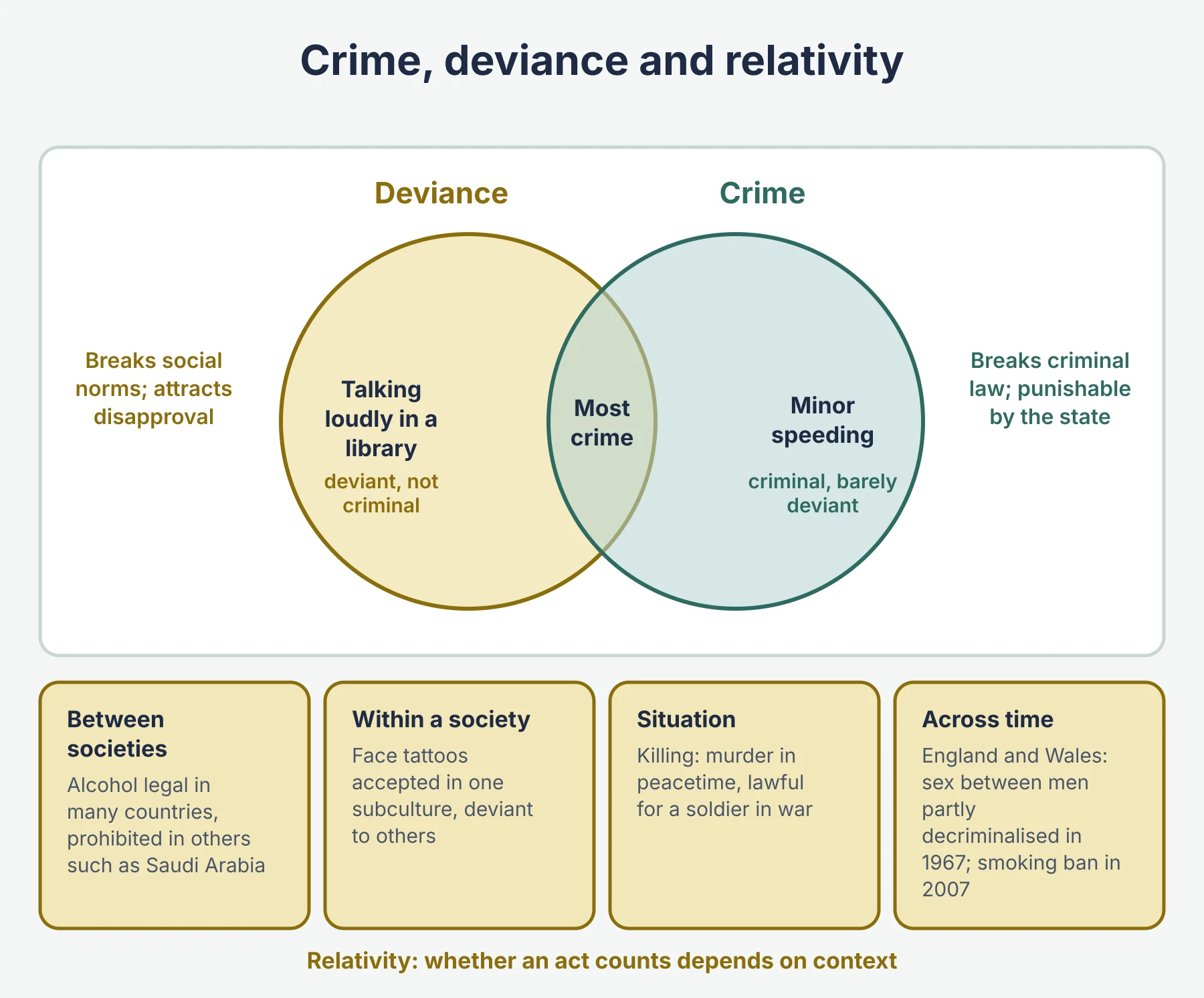
| Crime | Breaking the criminal law; punishable by the state |
| Deviance | Breaking social norms; attracts disapproval |
| Relativity | What counts as crime or deviance varies by society, culture, situation and time |
| Social control | Methods used to make people conform to norms and laws |
| Formal social control | Control by state agencies using written rules and official sanctions |
| Informal social control | Control through everyday relationships and unofficial sanctions |
| Positive sanction | A reward for conforming |
| Negative sanction | A punishment for deviating |
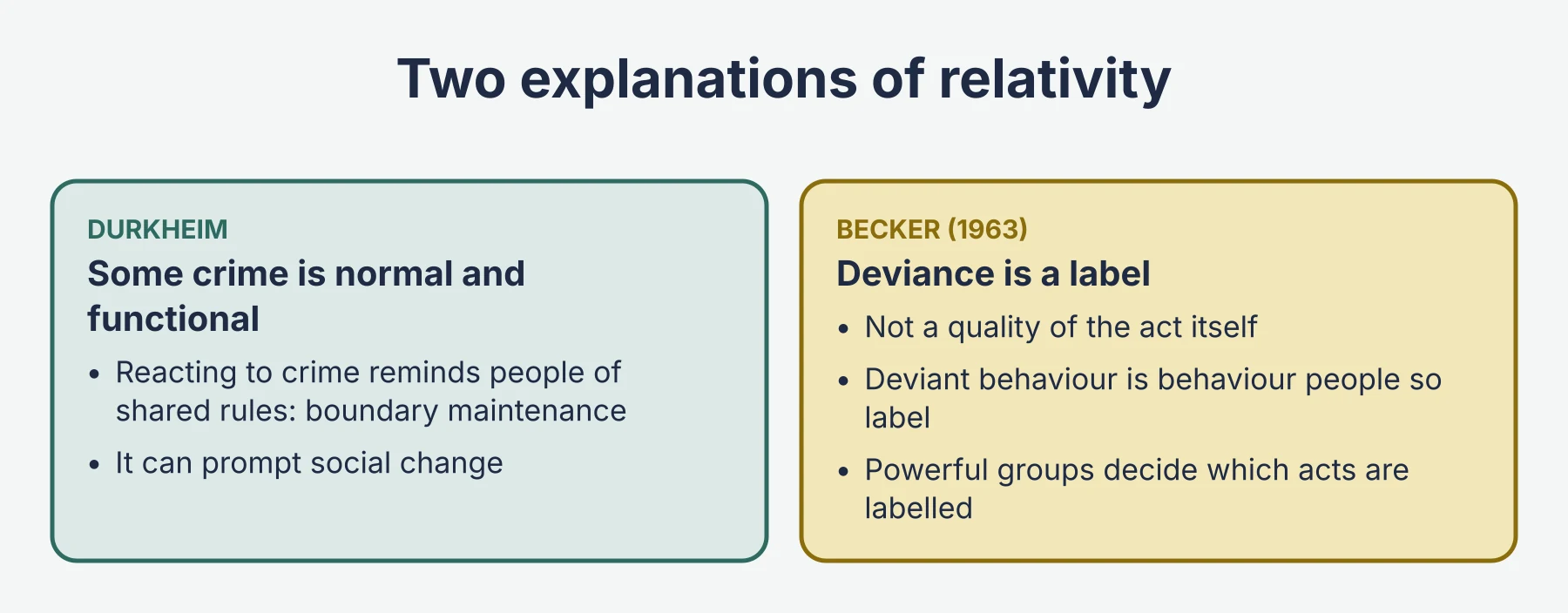
| Boundary maintenance | Durkheim’s idea that reacting to crime reinforces shared rules |
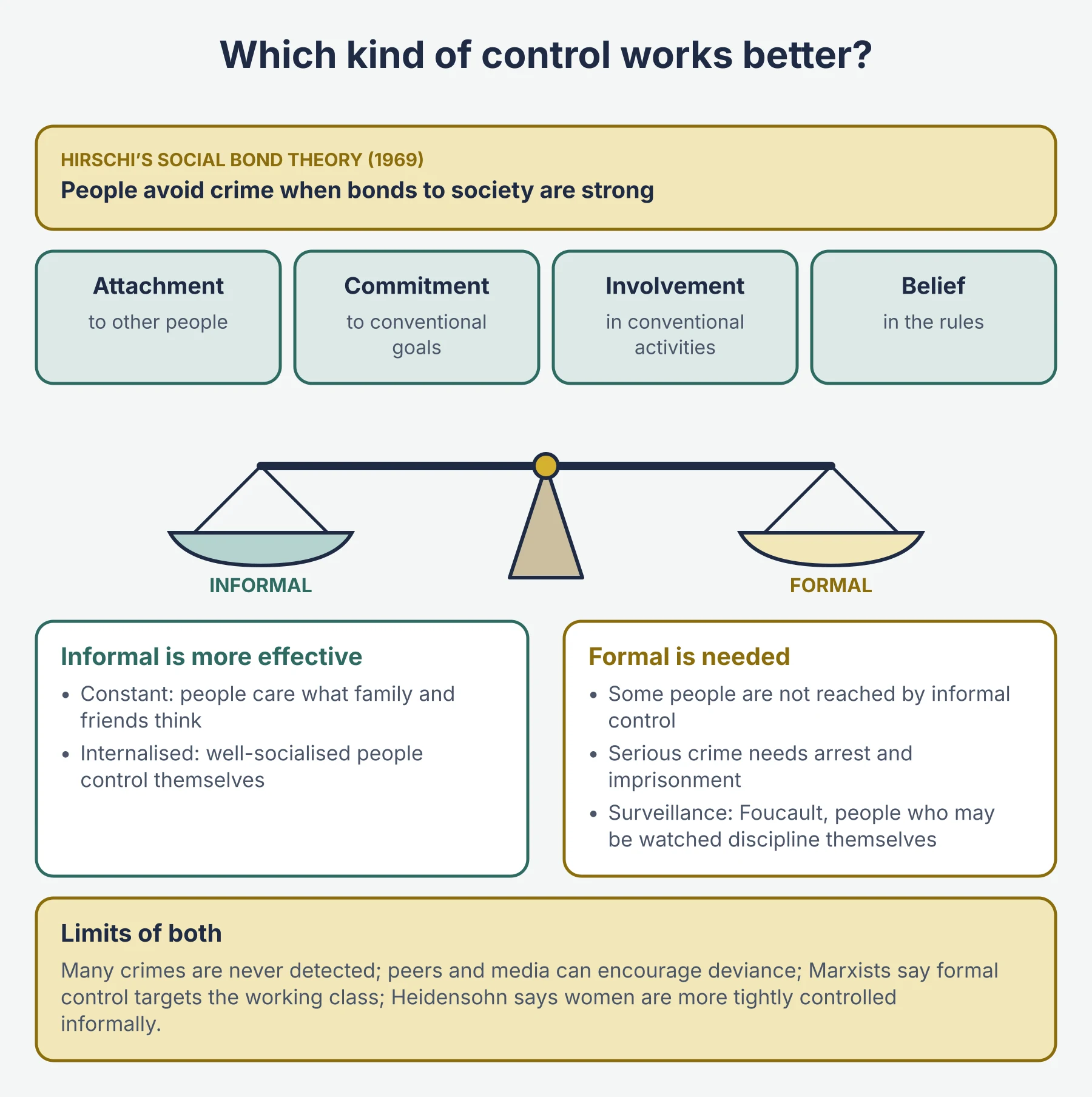
| Social bond | Hirschi’s attachment, commitment, involvement and belief that keep people from crime |
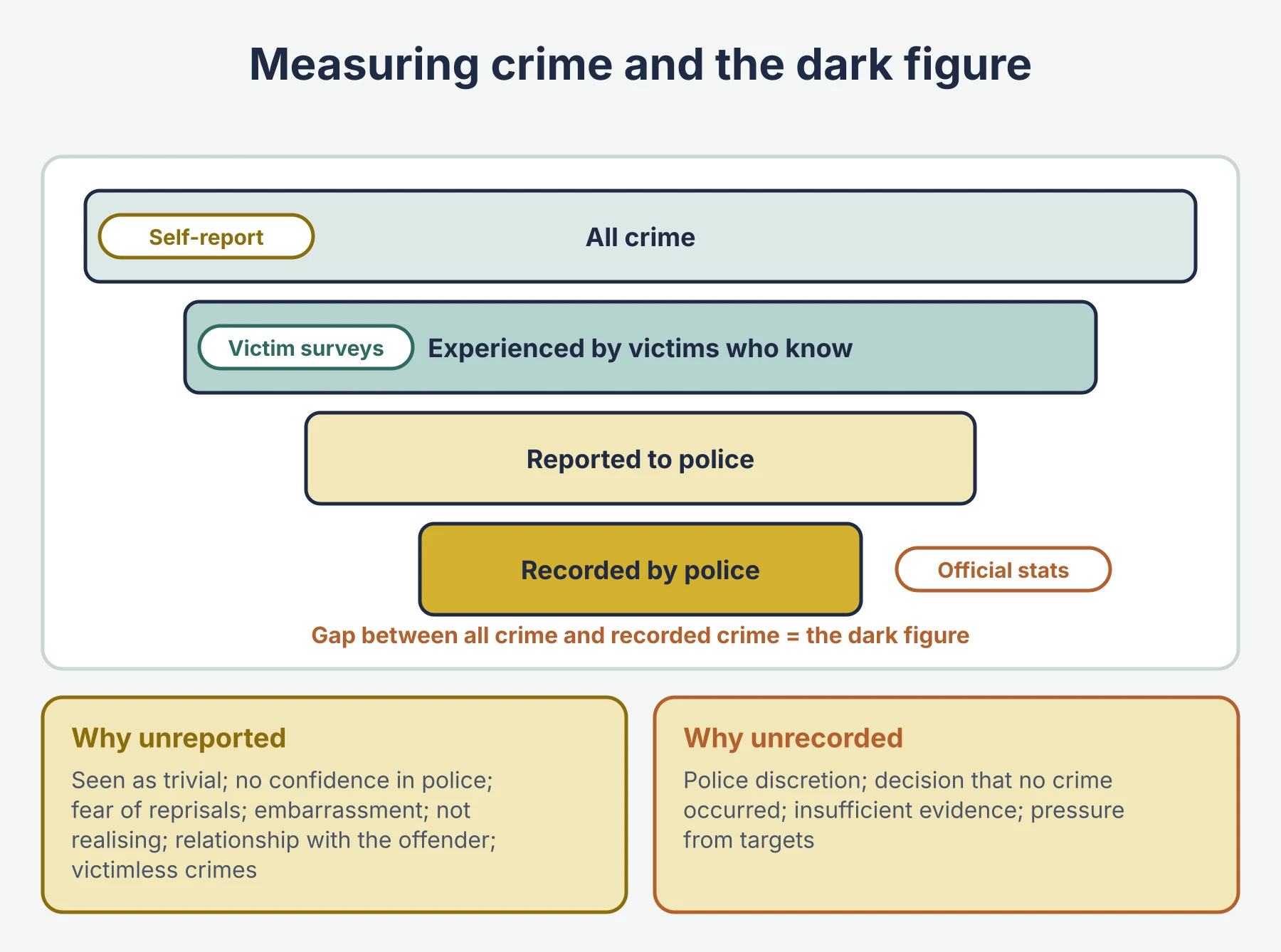
| Dark figure of crime | Crime that is never reported or recorded |
| Self-report study | Survey asking people which offences they have committed |
| Victim survey | Survey asking people which crimes they have experienced |
Relativity: one example per dimension
- Between societies: alcohol legal in many countries, prohibited in others.
- Within a society (culture or subculture): facial tattoos accepted in some groups, frowned on by others.
- Situation: killing in war v murder; nudity in a changing room v the street.
- Time: England and Wales partly decriminalised sex between men in 1967 and banned smoking in enclosed public places in 2007.
- Theory: Durkheim (crime is normal and functional); Becker (1963) (deviance is a label).
How agencies control
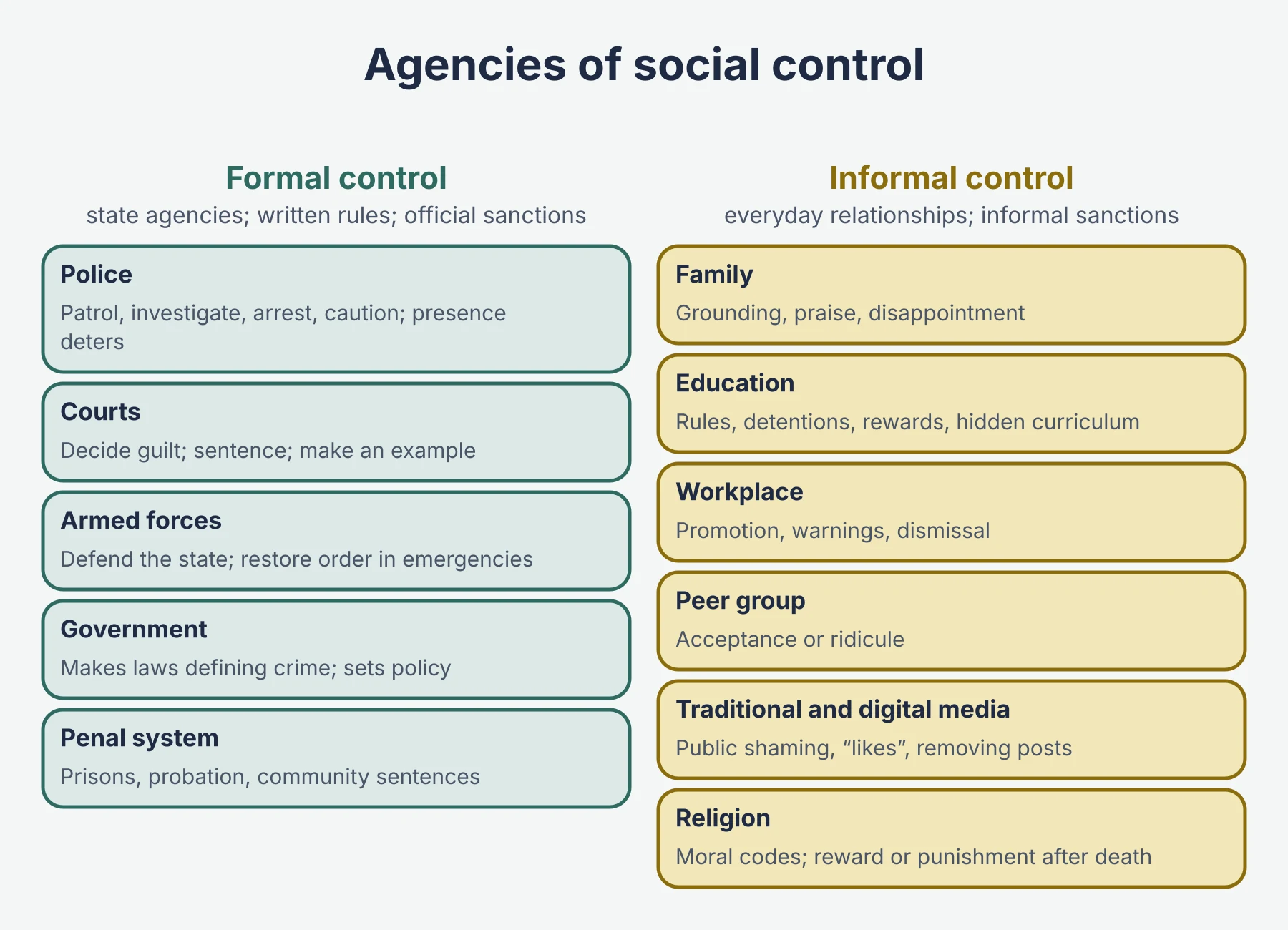
| Formal | Method | Informal | Method |
|---|---|---|---|
| Police | Patrol, arrest, caution | Family | Praise, grounding, disappointment |
| Courts | Verdicts, sentences | Education | Rules, detentions, rewards |
| Armed forces | Defence; emergency order | Workplace | Promotion, warnings, dismissal |
| Government | Makes laws and policy | Peer group | Acceptance or ridicule |
| Penal system | Prison, probation, community sentences | Media | Shaping norms; online shaming |
| Religion | Moral codes; community pressure |
Effectiveness (6.1.4)
- Informal is stronger day to day: constant and internalised; Hirschi’s social bonds.
- Formal is needed for serious crime: power to arrest and imprison; surveillance may deter (Foucault: people who think they are watched discipline themselves).
- Limits: low detection weakens deterrence; peers and media can encourage deviance; Marxists say control targets the working class; Heidensohn says women face tighter informal control.
Eleven crime types: quick examples
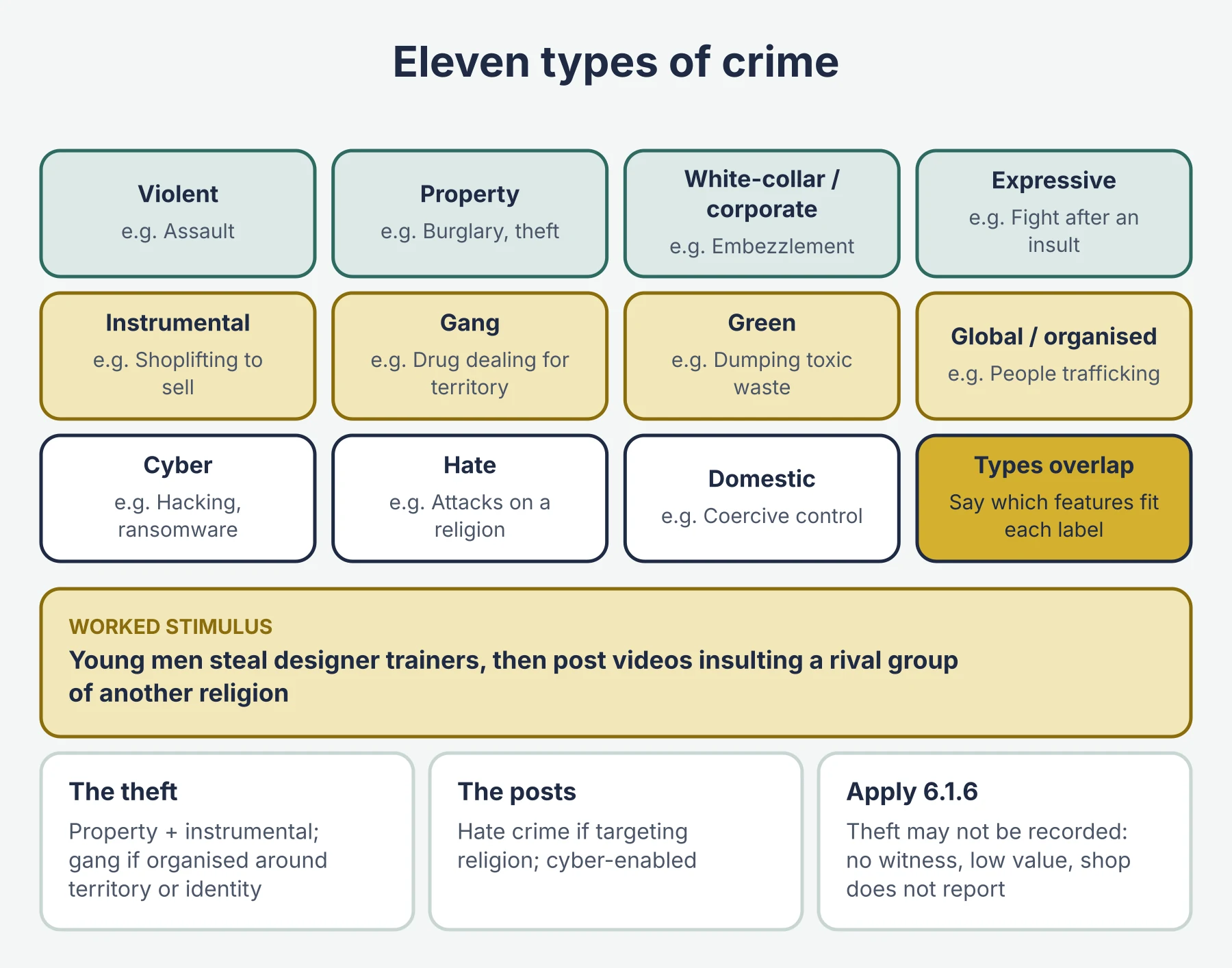
Violent (assault); property (burglary); white-collar/corporate (embezzlement; safety breaches; Sutherland coined “white-collar crime”); expressive (anger-driven vandalism); instrumental (theft for money); gang (territorial drug dealing); green (toxic dumping); global/organised (people trafficking); cyber (hacking, online fraud); hate (attacks motivated by religion, ethnicity, sexuality or disability); domestic (abuse between partners or family members).
Measuring crime (6.1.6)
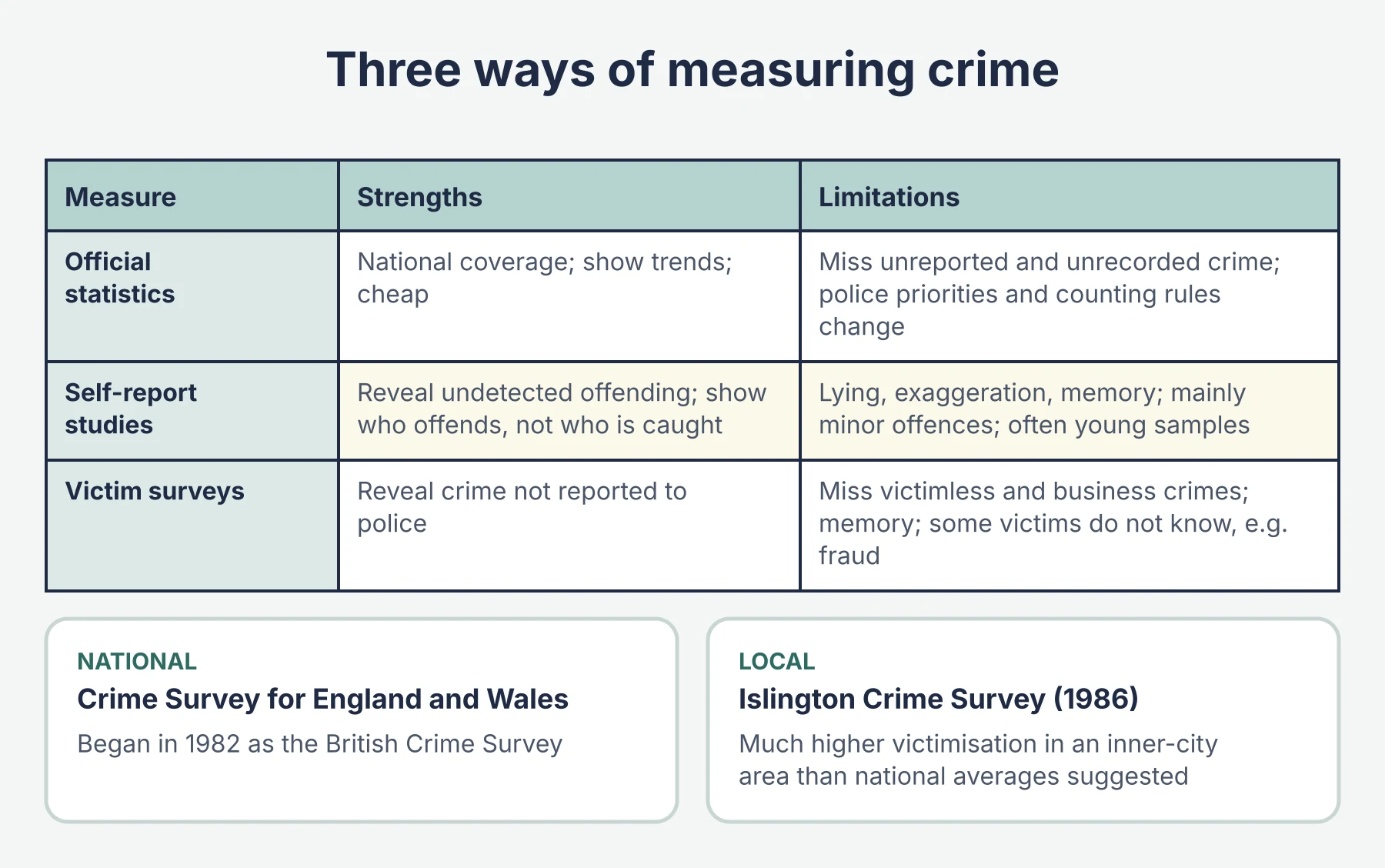
| Official statistics | Self-report studies | Victim surveys | |
|---|---|---|---|
| Plus | National; trends; cheap | Hidden offending revealed | Unreported crime revealed |
| Minus | Dark figure; police priorities; rule changes | Lies and memory; minor crimes; young samples | Miss victimless and corporate crime; memory |
- National: Crime Survey for England and Wales (began 1982 as the British Crime Survey).
- Local: Islington Crime Survey (1986) found higher inner-city victimisation than national figures suggested.
- Unreported because: trivial; distrust of police; fear of reprisals; embarrassment; unaware; offender is a partner or relative; victimless.
- Unrecorded because: police discretion; judged not a crime; insufficient evidence; targets.
Exam traps
- Deviance is not the same as harm: it is about breaking norms.
- Name the dimension of relativity your example shows.
- Show the mechanism of each agency, not just its name.
- Unreported is not unrecorded: victims decide the first; police decide the second.
- Crime types overlap: one act can fit several labels.
- No measure is complete: each method misses something different, so compare them.
Self-test
- Define crime and deviance.
- Give an example of an act that is deviant but not criminal.
- Give an example of relativity across time.
- Name the five formal agencies of social control in the syllabus.
- Give two informal sanctions used by peer groups.
- What are Hirschi’s four elements of the social bond?
- What is the difference between expressive and instrumental crime?
- Give an example of green crime.
- What is a self-report study?
- Give two limitations of victim surveys.
- Give three reasons why victims may not report crime.
- What is the dark figure of crime?
Answers: 1. Crime breaks the criminal law; deviance breaks social norms. 2. Any suitable example, such as talking loudly in a library or wearing pyjamas to a formal event. 3. Smoking in enclosed public places became illegal in England in 2007, or the partial decriminalisation of sex between men in 1967. 4. Police, courts, armed forces, government, penal system. 5. Any two: ridicule; exclusion; gossip; praise and acceptance. 6. Attachment, commitment, involvement, belief. 7. Expressive crime expresses emotion; instrumental crime is a means to an end such as money. 8. Illegal dumping of toxic waste, or illegal logging. 9. An anonymous survey asking people which offences they have committed. 10. Any two: miss victimless crimes; miss crimes against businesses; rely on memory; some victims do not know they were victims. 11. Any three: seen as trivial; no confidence in police; fear of reprisals; embarrassment; unaware; offender is a partner or relative. 12. The crime that is never reported to or recorded by the police.
Practise with the key question 6.1 practice questions, then revise patterns and explanations of crime with the key question 6.2 revision notes.
Related resources
-
Study guides
Cambridge IGCSE Sociology (0495): Crime, deviance and social control – What are the patterns of and explanations for crime and deviance?
Cambridge IGCSE Sociology 0495 key question 6.2: crime and victimisation by age, class, gender and ethnicity, five theories of crime and how to evaluate them.
Sociology · Cambridge · IGCSE
Read guide -
Revision notes
Cambridge IGCSE Sociology (0495): Crime, deviance and social control – What are the patterns of and explanations for crime and deviance? – Revision Notes
Revision notes for Cambridge IGCSE Sociology 0495 key question 6.2: crime patterns, explanations by group, five theories and evaluation, with a self-test.
Sociology · Cambridge · IGCSE
Revise topic -
Study guides
Cambridge IGCSE Sociology (0495): Crime, deviance and social control – How is crime dealt with in different societies?
Cambridge IGCSE Sociology 0495 key question 6.3: aims of punishment, how effective twelve punishments are, and policing, surveillance and crime prevention.
Sociology · Cambridge · IGCSE
Read guide
Related articles
Get free revision emails (optional)
Occasional emails with practice questions, worked explanations and links to free resources for the qualification and subjects you choose. No spam, and you can unsubscribe from any email. The free tools on this site never need an email.