
Study Guides
Cambridge IGCSE Sociology (0495): Crime, deviance and social control – What are the patterns of and explanations for crime and deviance?
Cambridge IGCSE Sociology 0495 key question 6.2: crime and victimisation by age, class, gender and ethnicity, five theories of crime and how to evaluate them.
- Subject
- Sociology
- Level
- IGCSE
- Topic
- Paper 2 – Family, Education and Crime
- Author
- Marlbridge Academic Team
- Updated
- Reviewed by
- Naqiya Yousaf (what this means)
Aligned to Cambridge IGCSE Sociology (0495), 2025-2027. Official specification .
Syllabus page (what it covers and how it is assessed): Cambridge IGCSE Sociology.
Syllabus points this page covers
0495
- 6.2 Crime, deviance and social control – What are the patterns of and explanations for crime and deviance?
Found an error? Report a correction.
Need help with this topic? Request a free trial class for IGCSE Sociology (0495).
This guide covers key question 6.2 What are the patterns of and explanations for crime and deviance? in Cambridge IGCSE Sociology (0495) Paper 2, 2025–2027 syllabus. The crime patterns, explanations and punishment revision notes list each explanation in a table; this guide shows how each explanation works, how the theories connect to the patterns, and how to build evaluation into parts (e) and (f).
What key question 6.2 covers
- 6.2.1 Patterns of crime and victimisation by age, social class, gender and ethnicity.
- 6.2.2–6.2.5 Explanations based on age, ethnicity, gender and social class, using the factors the syllabus names for each.
- 6.2.6 Theories: postmodernism; interactionism (including labelling and moral panic theory); functionalism (including the New Right, subculturalism and strain theory); Marxism; feminism.
- 6.2.7 Strengths and limitations of the explanations for each group and of the theories.
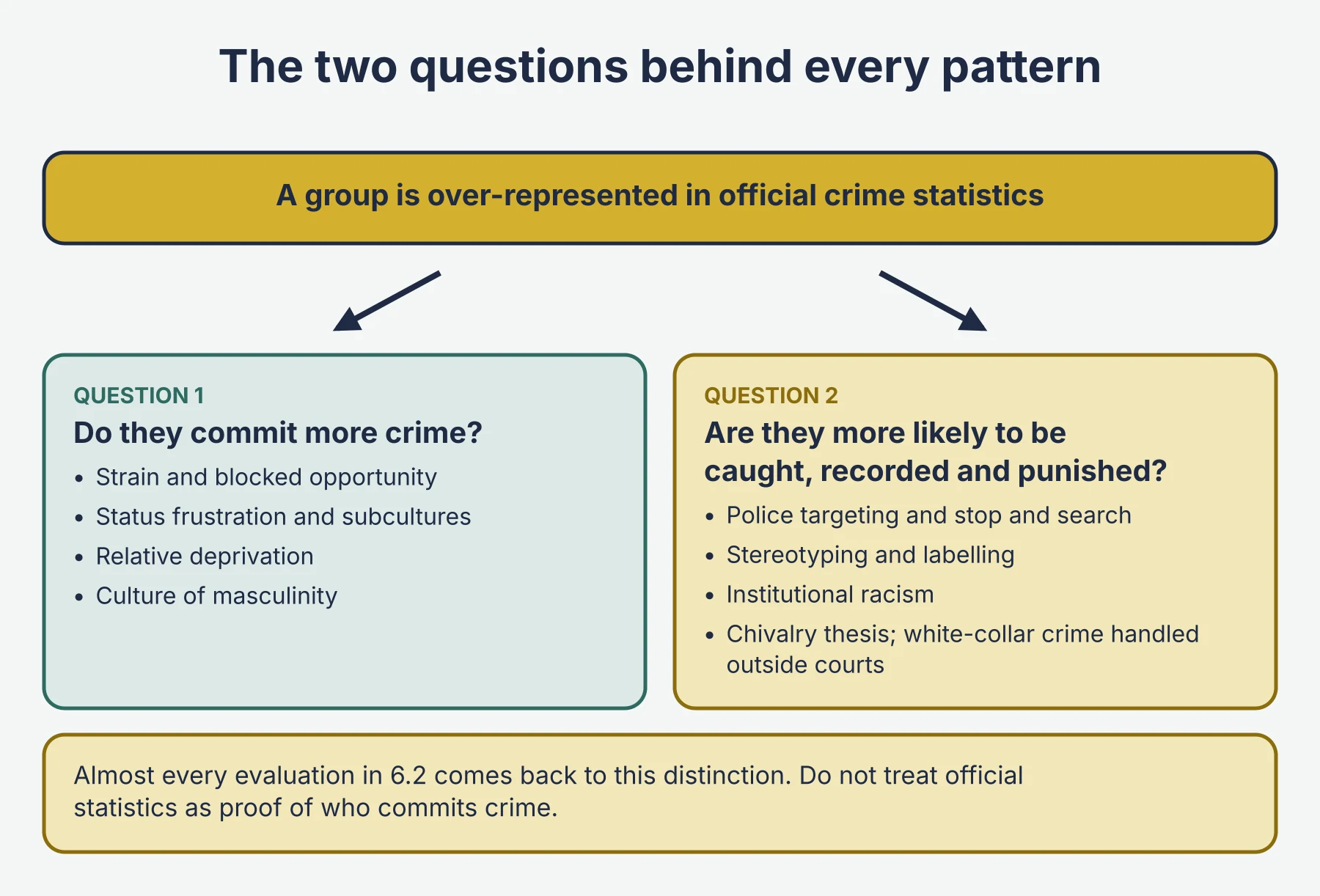
The central skill is to separate two questions. Do some groups commit more crime? And are some groups more likely to be caught, recorded and punished? Almost every evaluation in 6.2 comes back to that distinction.
Patterns of crime and victimisation (6.2.1)
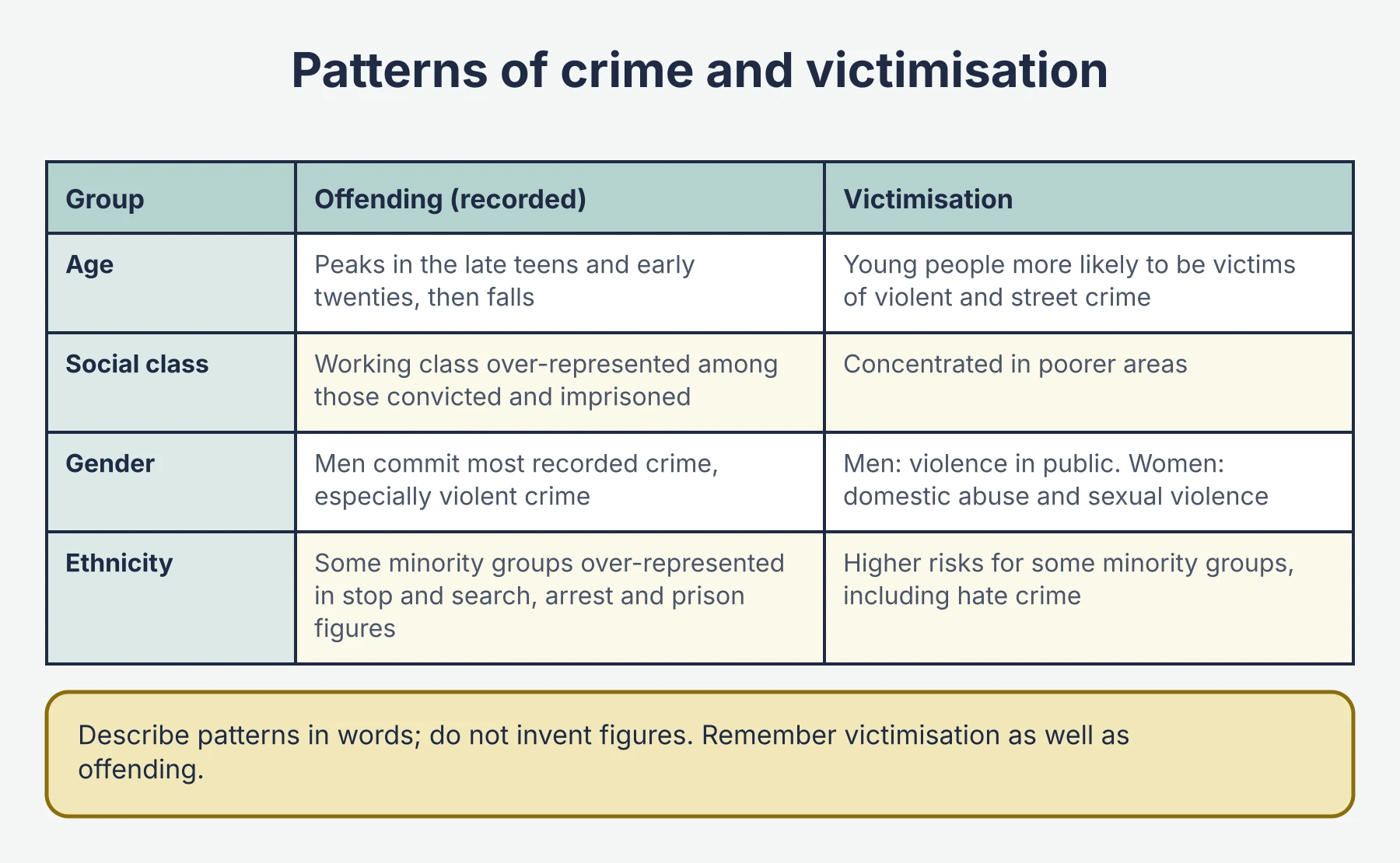
Official statistics in many societies show four broad patterns. Describe them in words; do not invent figures.
- Age: recorded offending peaks in the late teens and early twenties and then falls. Young people are also more likely to be victims of violent and street crime.
- Social class: working-class people are over-represented among those convicted and imprisoned. Victimisation is also concentrated in poorer areas.
- Gender: men commit most recorded crime, especially violent crime. Men are more often victims of violence in public; women are more often victims of domestic abuse and sexual violence.
- Ethnicity: in some societies, members of certain minority ethnic groups are over-represented in stop and search, arrest and prison figures, and minority groups may also face higher risks of victimisation, including hate crime.
Explanations by social characteristic (6.2.2–6.2.5)
Age
- Police targeting and stop and search: young people spend more time in public spaces, where police patrol and stop people.
- Stereotyping and self-fulfilling prophecy: if police and the public expect youths to cause trouble, more youthful behaviour is treated as crime, and labelled young people may live up to the label.
- Gang culture and status frustration: young people with little status at school or work may seek respect from peers through deviance.
- Socialisation and social control: teenagers are moving away from parental control but are not yet tied down by jobs, mortgages or children, so informal control is weaker.
- Lack of opportunity: youth unemployment and low-paid work block legitimate routes to goals.
Social class
- Material and relative deprivation: poverty creates motives for property crime. John Lea and Jock Young (1984) stressed relative deprivation, feeling deprived compared with others, which can motivate crime even where absolute poverty is low.
- Social exclusion and lack of opportunity: people shut out of education and work have less stake in conformity.
- Inadequate socialisation: the New Right blames weak parenting in an “underclass”.
- Status frustration: Albert Cohen (1955) argued working-class boys who fail at school form delinquent subcultures to gain status.
- Power inequalities and police targeting: working-class areas are policed more heavily, while middle-class white-collar crime is harder to detect and often handled outside the courts.
Gender
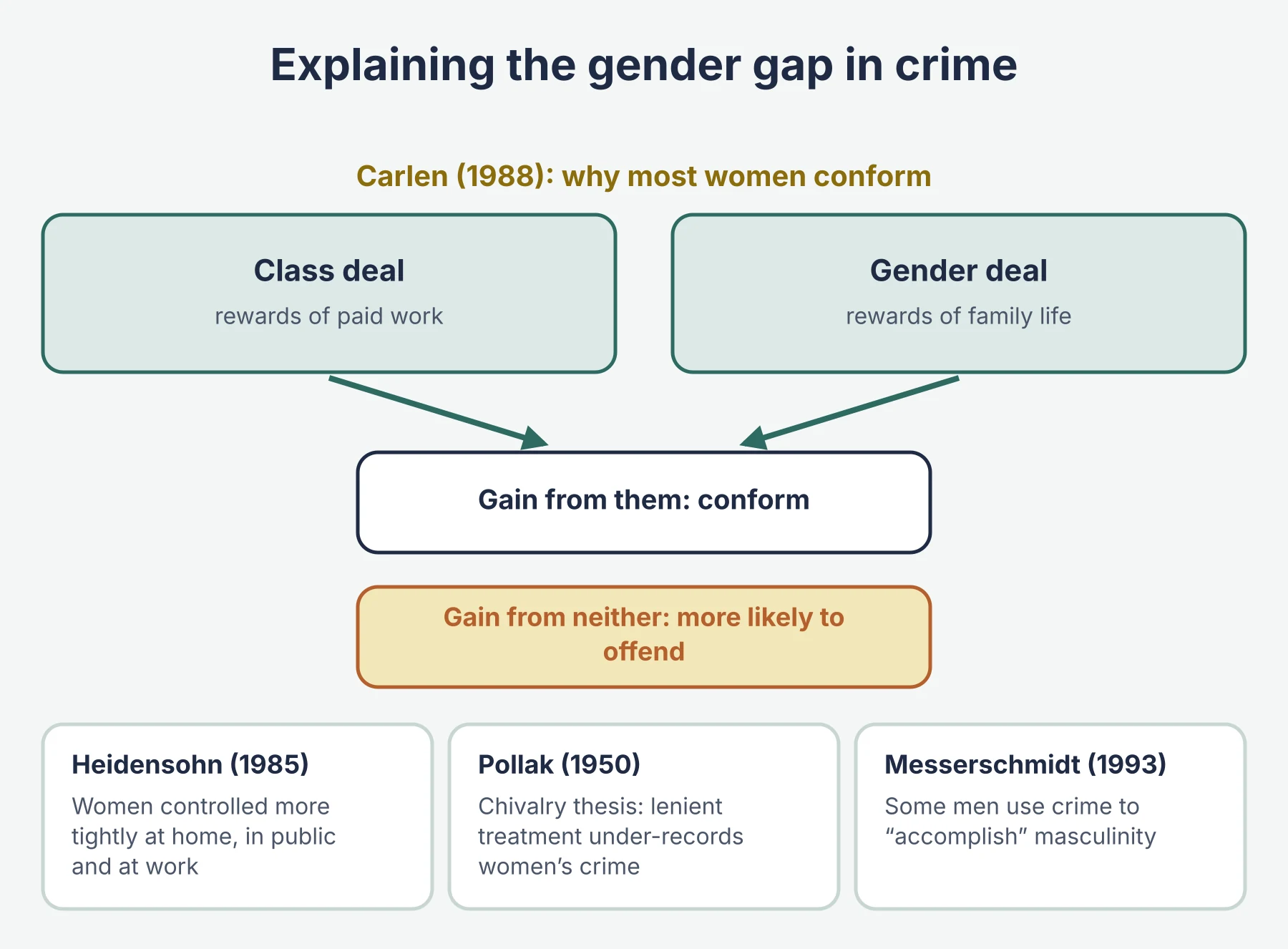
- Chivalry thesis: Otto Pollak (1950) argued male police officers and judges treat women more leniently, so women’s crime is under-recorded.
- Culture of masculinity: toughness, risk-taking and dominance are valued among some groups of men; James Messerschmidt (1993) argued some men use crime to “accomplish” masculinity when other routes are blocked.
- Socialisation and social control: Frances Heidensohn (1985) argued women are controlled more tightly at home, in public and at work, leaving fewer opportunities to offend.
- Misogyny: hostility towards women helps explain men’s violence against women and is relevant to patterns of victimisation.
- Stereotyping, gang culture and lack of opportunity: women may be seen as less likely to offend; gang membership is mainly male; women have had fewer opportunities for some crimes, such as corporate crime.
Ethnicity
- Institutional racism: the Macpherson Report (1999) found the Metropolitan Police institutionally racist, which can affect who is stopped, arrested and charged.
- Prejudice, discrimination, stereotyping and police targeting: Paul Gilroy argued in the 1980s that a “myth of black criminality” shaped policing and public attitudes in Britain.
- Material and relative deprivation: some minority groups are more likely to live in poverty and in heavily policed inner-city areas.
- Gang culture and status frustration: blocked opportunities, including through discrimination in education and employment, may lead some young people to seek status in gangs.
Theories of crime (6.2.6)
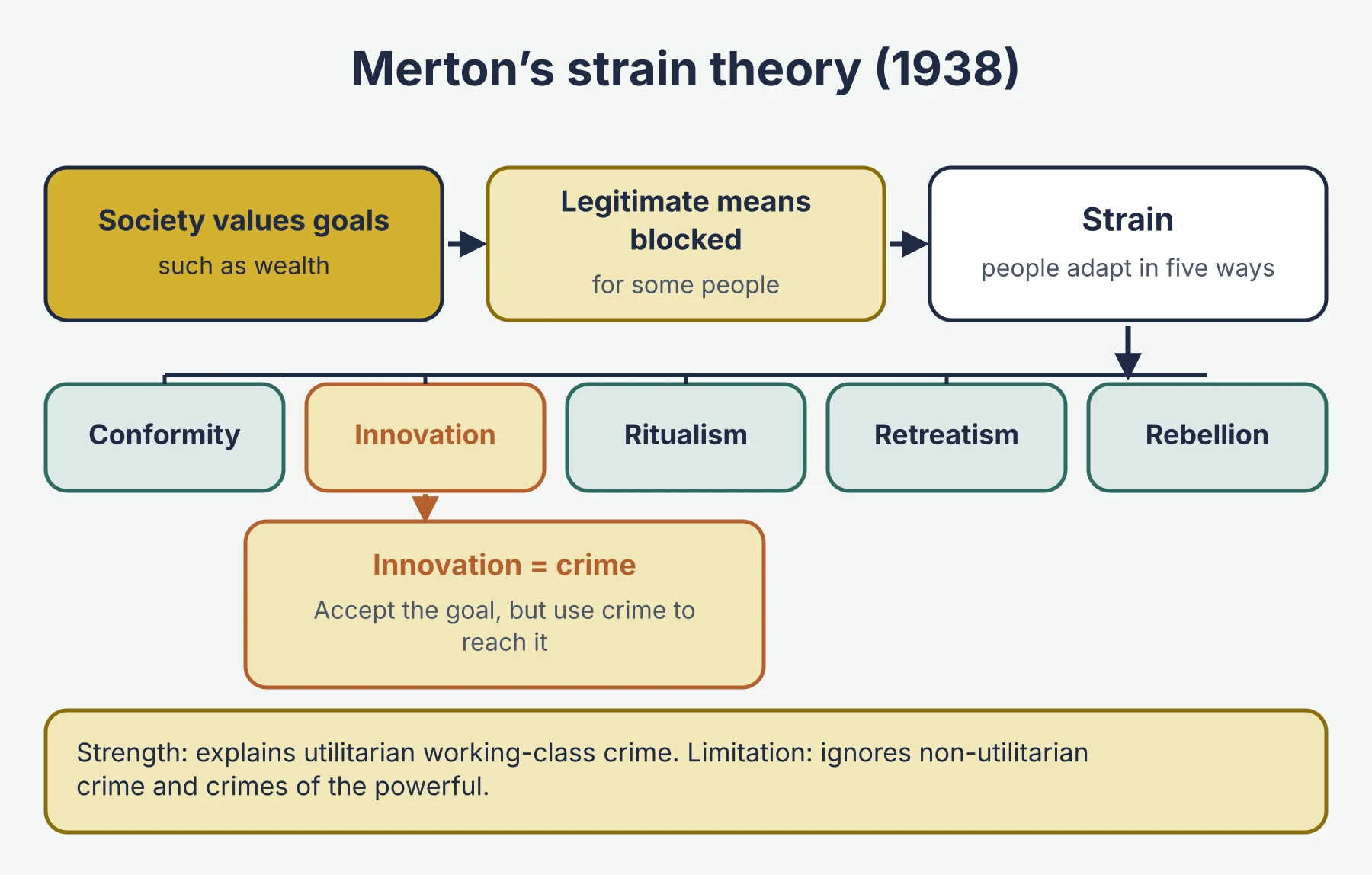
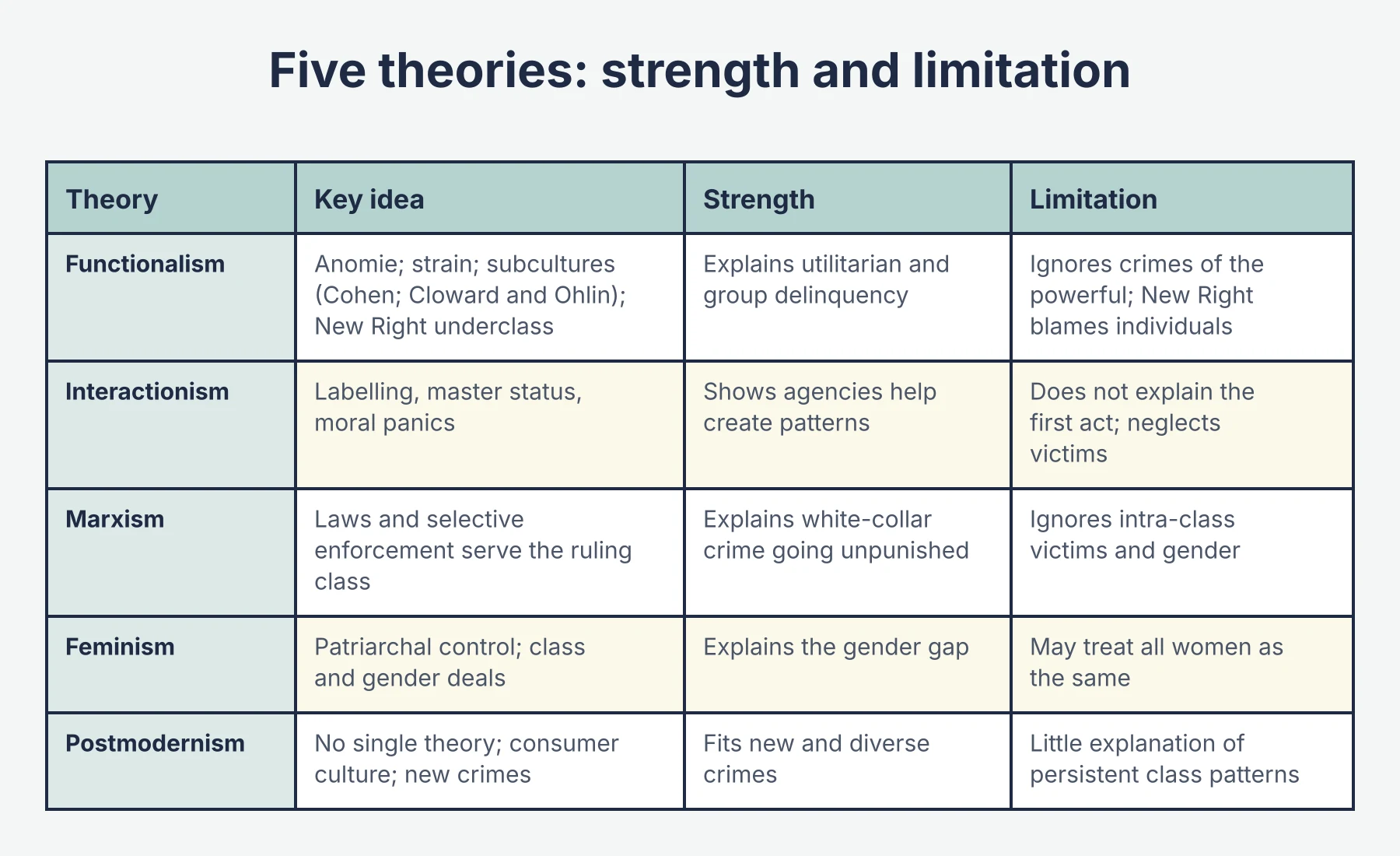
Functionalism. Émile Durkheim saw some crime as normal and functional, but too much crime as a sign of anomie (normlessness). Robert Merton’s (1938) strain theory argued that when society values goals such as wealth but blocks legitimate means, people adapt in five ways: conformity, innovation (crime to reach goals), ritualism, retreatism and rebellion. Subculturalism includes Albert Cohen’s status frustration and Richard Cloward and Lloyd Ohlin’s (1960) three subcultures (criminal, conflict and retreatist), which depend on what illegitimate opportunities exist locally. The New Right, represented by Charles Murray, blames inadequate socialisation in an underclass.
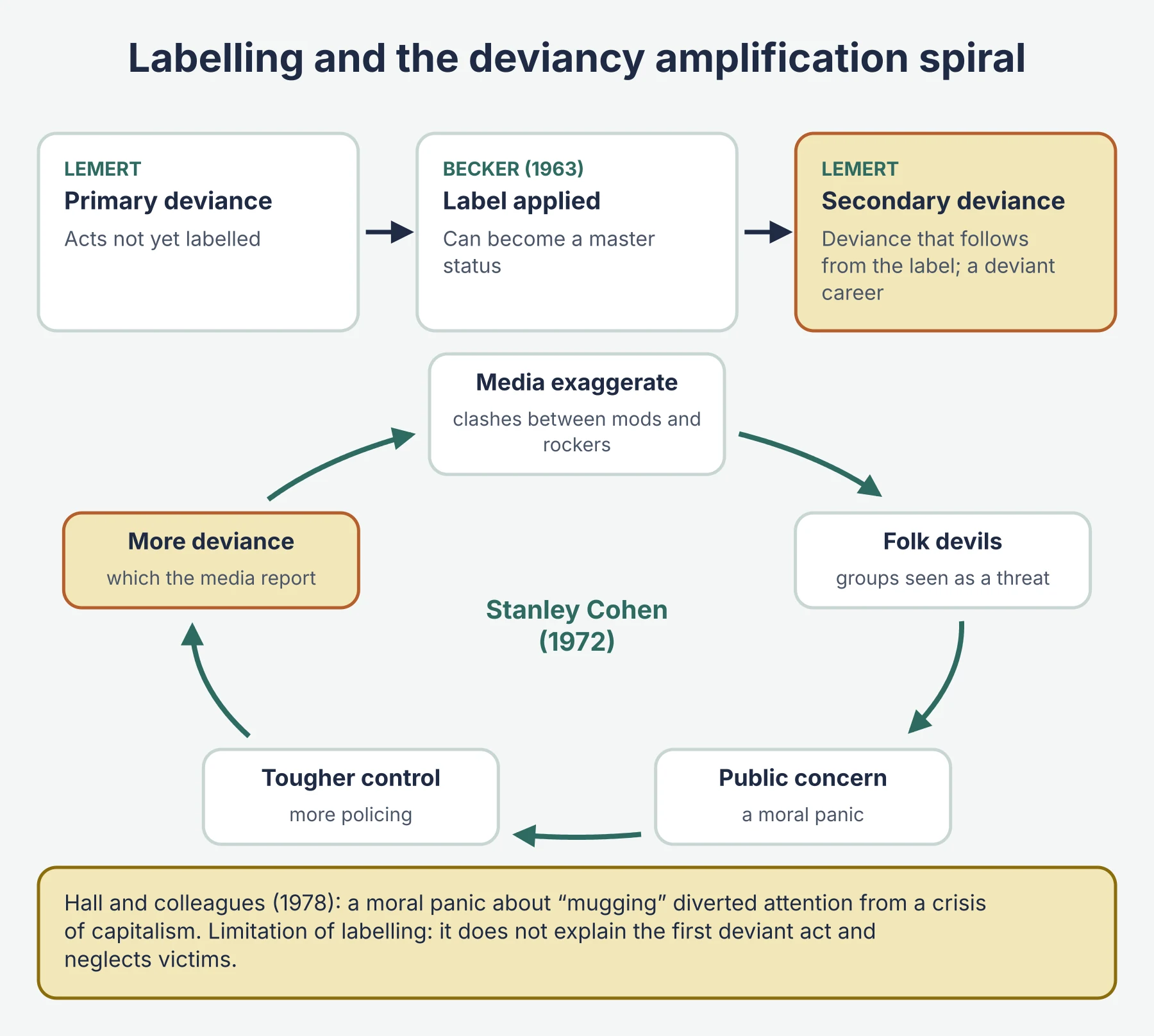
Interactionism. Howard Becker (1963) argued deviance is created by labelling. A label can become a master status, pushing a person into a deviant career. Edwin Lemert distinguished primary deviance (acts not yet labelled) from secondary deviance (deviance that follows from the label). Moral panic theory: Stanley Cohen (1972) showed how media exaggeration of clashes between mods and rockers turned them into folk devils, leading to tougher control and more deviance (a deviancy amplification spiral). Stuart Hall and colleagues (1978) argued a moral panic about “mugging” in the 1970s diverted attention from a crisis of capitalism.
Marxism. Laws protect the property and interests of the ruling class; enforcement is selective, falling heavily on the working class; crimes of the powerful, such as corporate fraud and safety violations, are under-policed. Capitalism itself encourages greed, which motivates crime across classes.
Feminism. Feminists explain women’s low recorded crime through patriarchal control (Heidensohn). Pat Carlen (1988) argued women conform when they gain from the class deal (rewards of paid work) and the gender deal (rewards of family life); those who gain from neither are more likely to offend. Feminists also highlight women as victims of domestic and sexual violence.
Postmodernism. Postmodernists argue no single theory explains crime in a diverse, fragmented society. Consumer culture creates desires and identities some pursue through crime; new forms of crime, such as cyber crime and hate crime, reflect changing identities and technologies; and some crime is about excitement and emotion rather than material need.
Evaluating explanations (6.2.7)
| Explanation | Strength | Limitation |
|---|---|---|
| Strain theory | Explains utilitarian working-class crime | Ignores non-utilitarian crime and crimes of the powerful |
| Subcultural theory | Explains group delinquency | Assumes working-class boys share middle-class goals |
| New Right | Highlights parenting and community | Blames individuals; ignores structural poverty |
| Labelling | Shows agencies help create crime patterns | Does not explain the first deviant act; neglects victims |
| Marxism | Explains white-collar crime going unpunished | Ignores intra-class victims and gender |
| Feminism | Explains the gender gap | May treat all women as the same |
| Postmodernism | Fits new and diverse crimes | Offers little explanation of persistent patterns by class |
Worked example: planning a part (f) answer
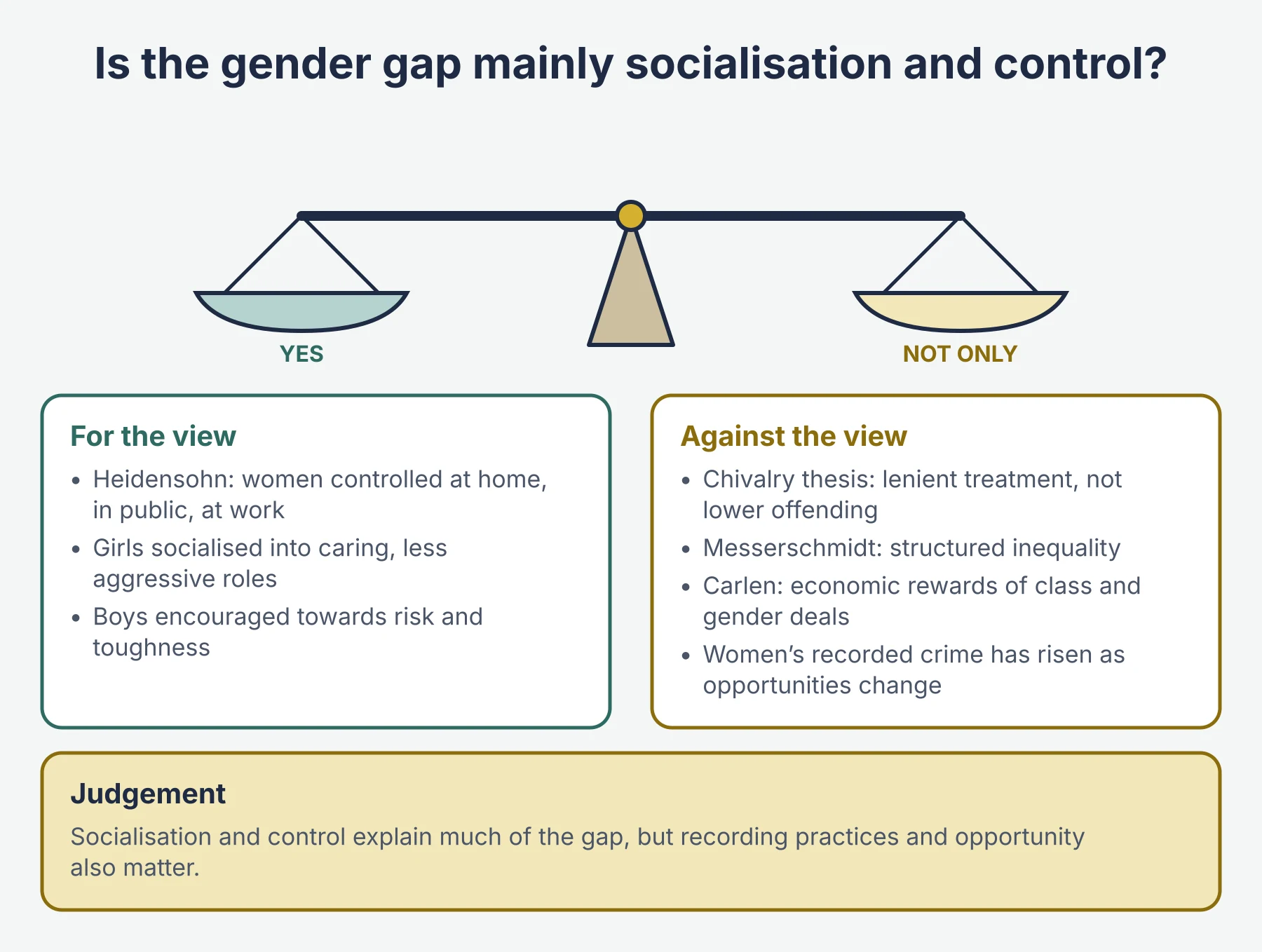
Evaluate the view that gender differences in crime are mainly the result of socialisation and social control.
- For: Heidensohn’s argument that women are more controlled at home, in public and at work; girls socialised into caring, less aggressive roles; boys encouraged towards risk and toughness.
- Against: the chivalry thesis suggests part of the gap is lenient treatment, not lower offending; Messerschmidt’s masculinity argument stresses structured inequality as well as socialisation; Carlen’s class and gender deals stress economic rewards; women’s recorded crime has risen in some societies as opportunities change.
- Judgement: socialisation and control explain much of the gap, but recording practices and opportunity also matter.
Annotated sample sentence: “However, the chivalry thesis [names an alternative] suggests the statistics exaggerate the gap, because police may caution women where they would charge men [mechanism], so lower recorded female crime may not mean lower offending [link to the view].”
Common mistakes
- Treating official statistics as proof of who commits crime.
- Confusing Albert Cohen (status frustration) with Stanley Cohen (moral panics).
- Listing Merton’s adaptations without explaining which one is crime (innovation) and why.
- Using one theory for every group: apply each explanation to the pattern asked about.
- Ignoring victimisation, which 6.2.1 includes explicitly.
Exam technique
- Explain three: name the explanation, show the mechanism, link it to the group in the question.
- Discuss: for a theory question, give three developed points and a strength or limitation.
- Evaluate: always include the statistics debate, plus at least one alternative explanation, and conclude.
Condense with the key question 6.2 revision notes and practise with the crime patterns and explanations practice questions. Review the foundations in what are crime, deviance and social control (key question 6.1), then continue with how crime is dealt with (key question 6.3).
Related resources
-
Revision notes
Cambridge IGCSE Sociology (0495): Crime, deviance and social control – What are the patterns of and explanations for crime and deviance? – Revision Notes
Revision notes for Cambridge IGCSE Sociology 0495 key question 6.2: crime patterns, explanations by group, five theories and evaluation, with a self-test.
Sociology · Cambridge · IGCSE
Revise topic -
Study guides
Cambridge IGCSE Sociology (0495): Crime, deviance and social control – How is crime dealt with in different societies?
Cambridge IGCSE Sociology 0495 key question 6.3: aims of punishment, how effective twelve punishments are, and policing, surveillance and crime prevention.
Sociology · Cambridge · IGCSE
Read guide -
Practice questions
Cambridge IGCSE Sociology (0495): Crime, deviance and social control – How is crime dealt with in different societies? – Practice Questions
Original Cambridge IGCSE Sociology 0495 practice on key question 6.3: aims and effectiveness of punishment, policing and crime prevention, with full answers.
Sociology · Cambridge · IGCSE
Try questions
Related articles
Get free revision emails (optional)
Occasional emails with practice questions, worked explanations and links to free resources for the qualification and subjects you choose. No spam, and you can unsubscribe from any email. The free tools on this site never need an email.