
Study Guides
Cambridge IGCSE Sociology (0495): Crime, deviance and social control – How is crime dealt with in different societies?
Cambridge IGCSE Sociology 0495 key question 6.3: aims of punishment, how effective twelve punishments are, and policing, surveillance and crime prevention.
- Subject
- Sociology
- Level
- IGCSE
- Topic
- Paper 2 – Family, Education and Crime
- Author
- Marlbridge Academic Team
- Updated
- Reviewed by
- Naqiya Yousaf (what this means)
Aligned to Cambridge IGCSE Sociology (0495), 2025-2027. Official specification .
Syllabus page (what it covers and how it is assessed): Cambridge IGCSE Sociology.
Syllabus points this page covers
0495
- 6.3 Crime, deviance and social control – How is crime dealt with in different societies?
Found an error? Report a correction.
Need help with this topic? Request a free trial class for IGCSE Sociology (0495).
This guide covers key question 6.3 How is crime dealt with in different societies? in Cambridge IGCSE Sociology (0495) Paper 2, 2025–2027 syllabus. The crime patterns, explanations and punishment revision notes summarise each punishment in one line; this guide explains how to judge effectiveness, compares how societies differ, and shows how sociological theory adds depth to answers on punishment and policing.
What key question 6.3 covers
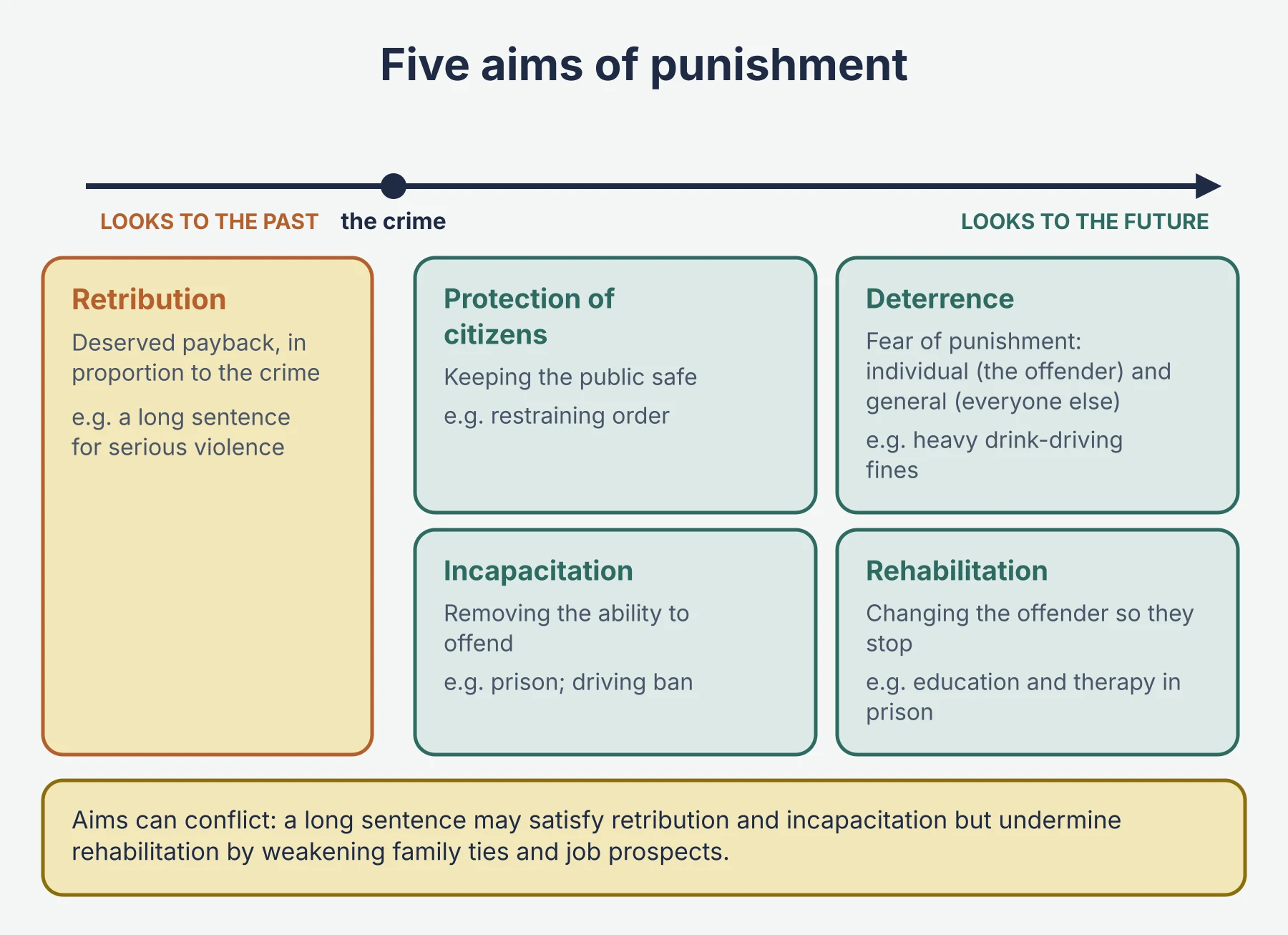
- 6.3.1 Aims of punishment: protection of citizens, deterrence, retribution, incapacitation, rehabilitation.
- 6.3.2 The effectiveness of different types of punishment: community sentencing; financial penalties; prison; rehabilitation programmes; capital punishment; corporal punishment; exile; ostracism; non-custodial sentencing such as electronic tagging, curfews and restraining orders; probation; police cautions; social media and vigilante groups.
- 6.3.3 The effectiveness of policing and law enforcement: policing strategies such as targeting and stop and search; surveillance, including digital surveillance; crime prevention; community and military style policing.
The word that matters is effectiveness. Every answer should say effective at what (which aim), for whom and compared with what.
The aims of punishment (6.3.1)
| Aim | Meaning | Looks to | Example |
|---|---|---|---|
| Protection of citizens | Keeping the public safe from offenders | The future | Restraining order keeping an abuser away |
| Deterrence | Discouraging crime by fear of punishment; individual (the offender) and general (everyone else) | The future | Heavy fines for drink-driving |
| Retribution | Punishment as deserved payback, in proportion to the crime | The past | Long sentence for a serious violent offence |
| Incapacitation | Removing the ability to offend | The future | Prison; driving ban |
| Rehabilitation | Changing the offender so they stop offending | The future | Education and therapy in prison |
Aims can conflict. A long sentence may satisfy retribution and incapacitation but undermine rehabilitation if prison weakens family ties and job prospects.
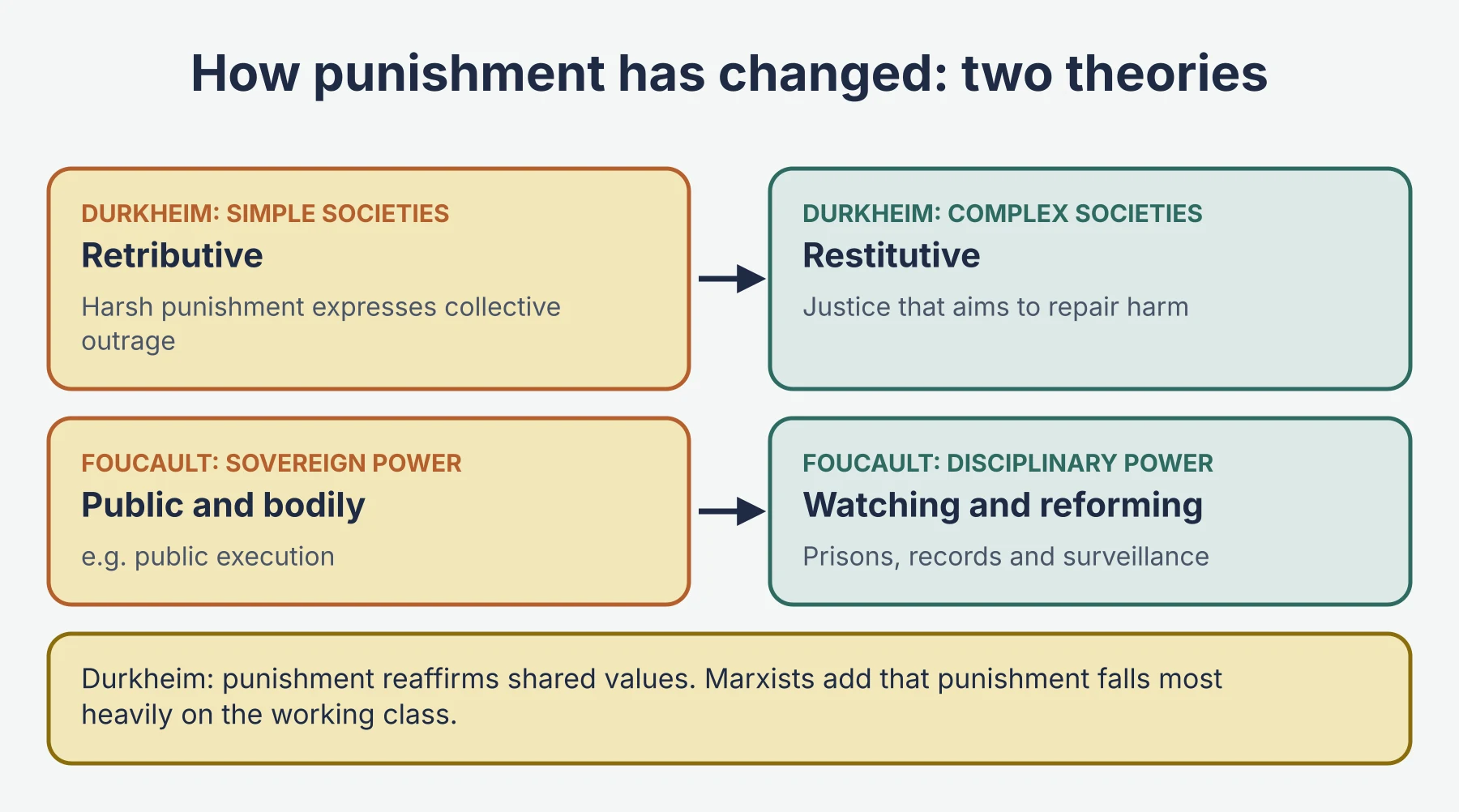
Theory adds depth. Émile Durkheim argued punishment reaffirms shared values: simple societies used harsh, retributive punishment to express collective outrage, while complex modern societies rely more on restitutive justice, which aims to repair harm. Michel Foucault argued punishment changed from public, bodily sovereign power (such as public execution) to disciplinary power, which watches and reforms people through prisons, records and surveillance. Marxists add that punishment falls most heavily on the working class.
How effective are different punishments? (6.3.2)
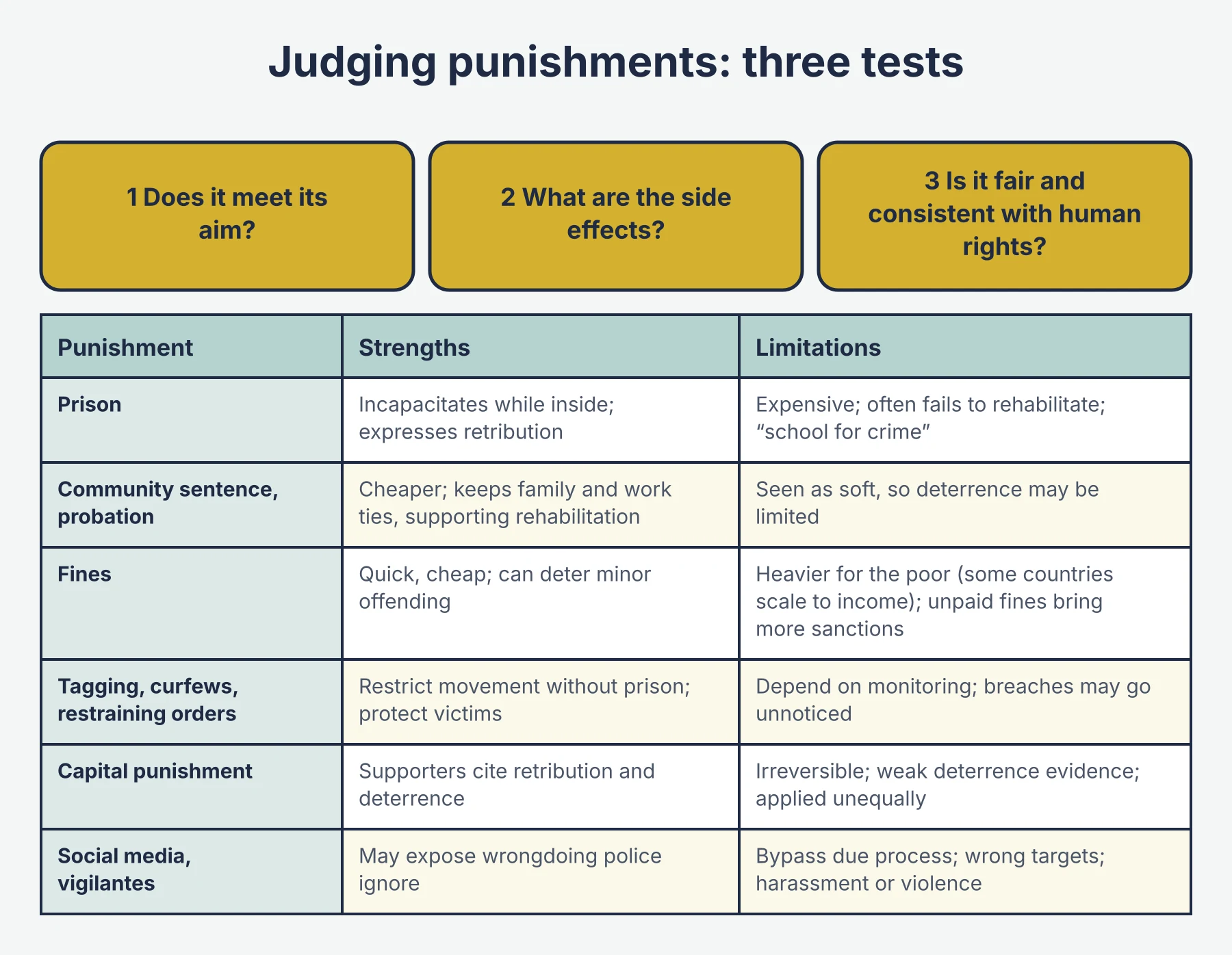
Judge each punishment against three tests: does it meet its aim; what are its side effects; is it fair and consistent with human rights?
Prison. It incapacitates offenders while they are inside and expresses retribution. Critics argue it is expensive, often fails to rehabilitate, and can act as a “school for crime” where offenders learn new skills and contacts. Some Scandinavian countries, such as Norway, are often cited for prison systems designed around rehabilitation and normal daily routines.
Community sentencing and probation. Offenders do unpaid work or follow programmes while living at home, supervised by probation officers. They are cheaper than prison and keep family and work ties, which supports rehabilitation, but the public may see them as soft, so their deterrent effect may be limited.
Rehabilitation programmes. Education, drug treatment, anger management and job training address the causes of offending. They can reduce reoffending when properly funded and attended, but depend on the offender’s willingness and on resources.
Financial penalties. Fines are quick and cheap and can deter minor offending. But a fixed fine is a heavier punishment for a poor person than a rich one, and an unpaid fine can lead to further sanctions. Some countries scale fines to income to address this.
Non-custodial sentencing. Electronic tagging and curfews restrict movement without prison; restraining orders protect victims. They depend on monitoring and compliance, and breaches may go unnoticed.
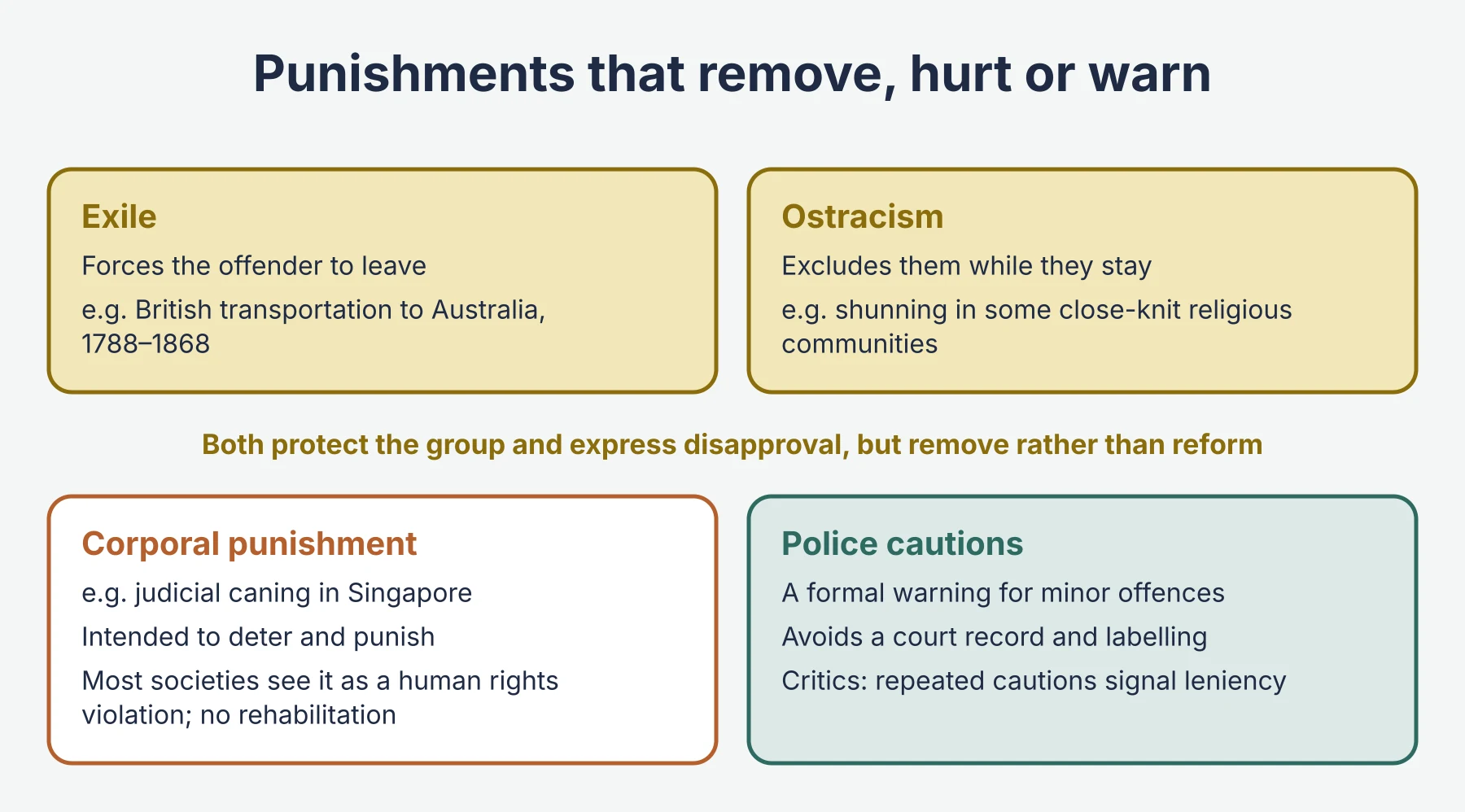
Police cautions. A formal warning for minor offences avoids a court record and labelling, fitting interactionist concerns. Critics say repeated cautions send a message of leniency.
Capital punishment. The death penalty is retained in some countries and some US states but has been abolished in many others, including every member state of the European Union. Supporters cite retribution and deterrence; opponents argue it is irreversible, so miscarriages of justice cannot be corrected, that evidence of a deterrent effect is weak, and that it is applied unequally.
Corporal punishment. Physical punishment, such as judicial caning in Singapore, is intended to deter and to punish. Most societies regard it as a violation of human rights, and it does nothing to rehabilitate.
Exile and ostracism. Exile forces the offender to leave a society; Britain, for example, transported convicts to Australia between 1788 and 1868. Ostracism excludes a person from the community while they remain in it, as in shunning in some close-knit religious communities. Both protect the group and express disapproval but remove rather than reform.
Social media and vigilante groups. Online “naming and shaming” and groups that track suspected offenders act as informal punishment. They may expose wrongdoing the police ignore, but they bypass due process, risk targeting the wrong people, and can lead to harassment or violence.
Policing and law enforcement (6.3.3)
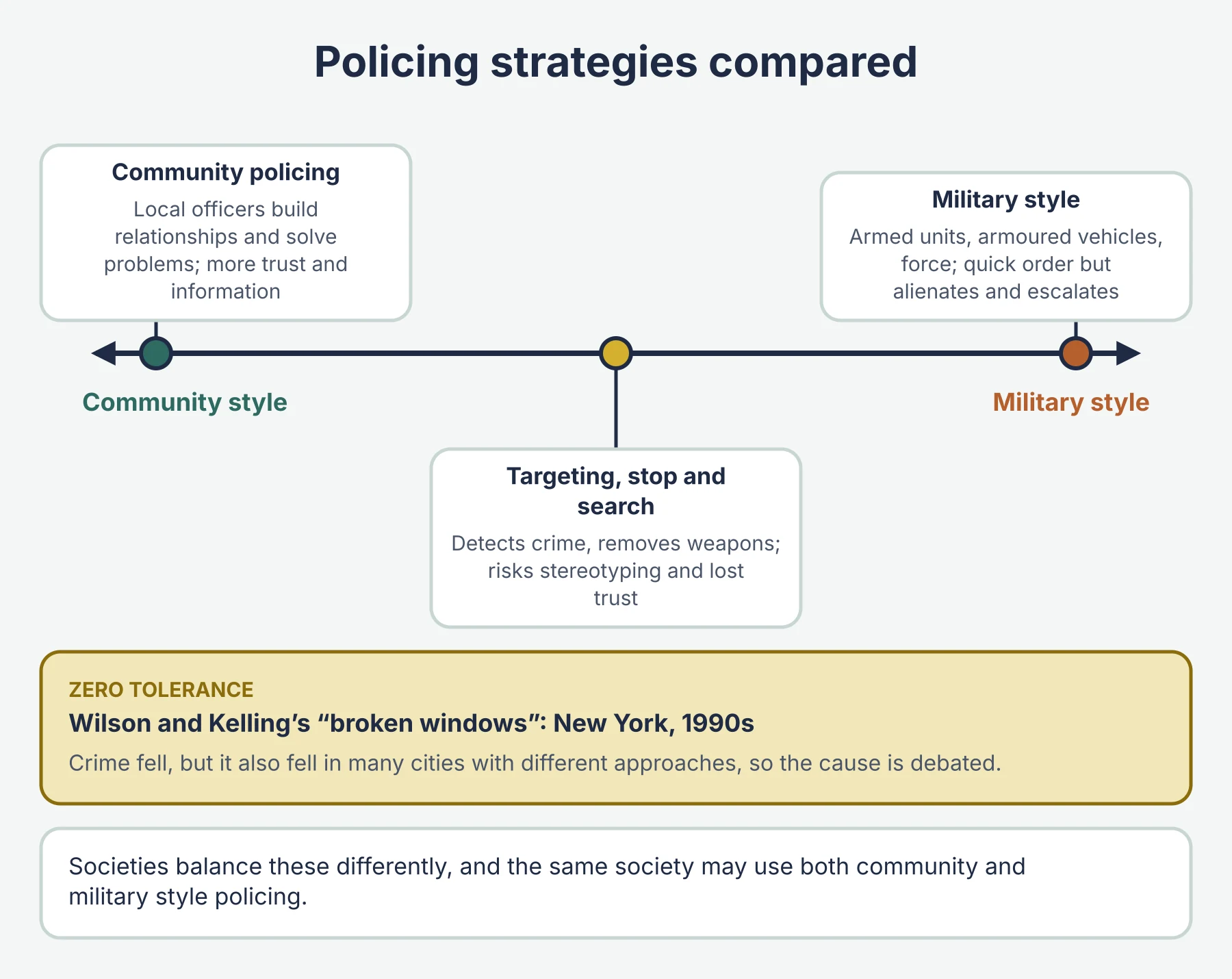
Targeting and stop and search. Concentrating on high-crime areas, known offenders or particular offences can detect crime and remove weapons. But targeting can reflect stereotyping, damage trust in communities, and produce statistics that exaggerate offending by the targeted groups. Zero tolerance policing, based on Wilson and Kelling’s “broken windows” argument, was associated with New York in the 1990s; crime fell, but so it did in many other cities with different approaches, so the cause is debated.
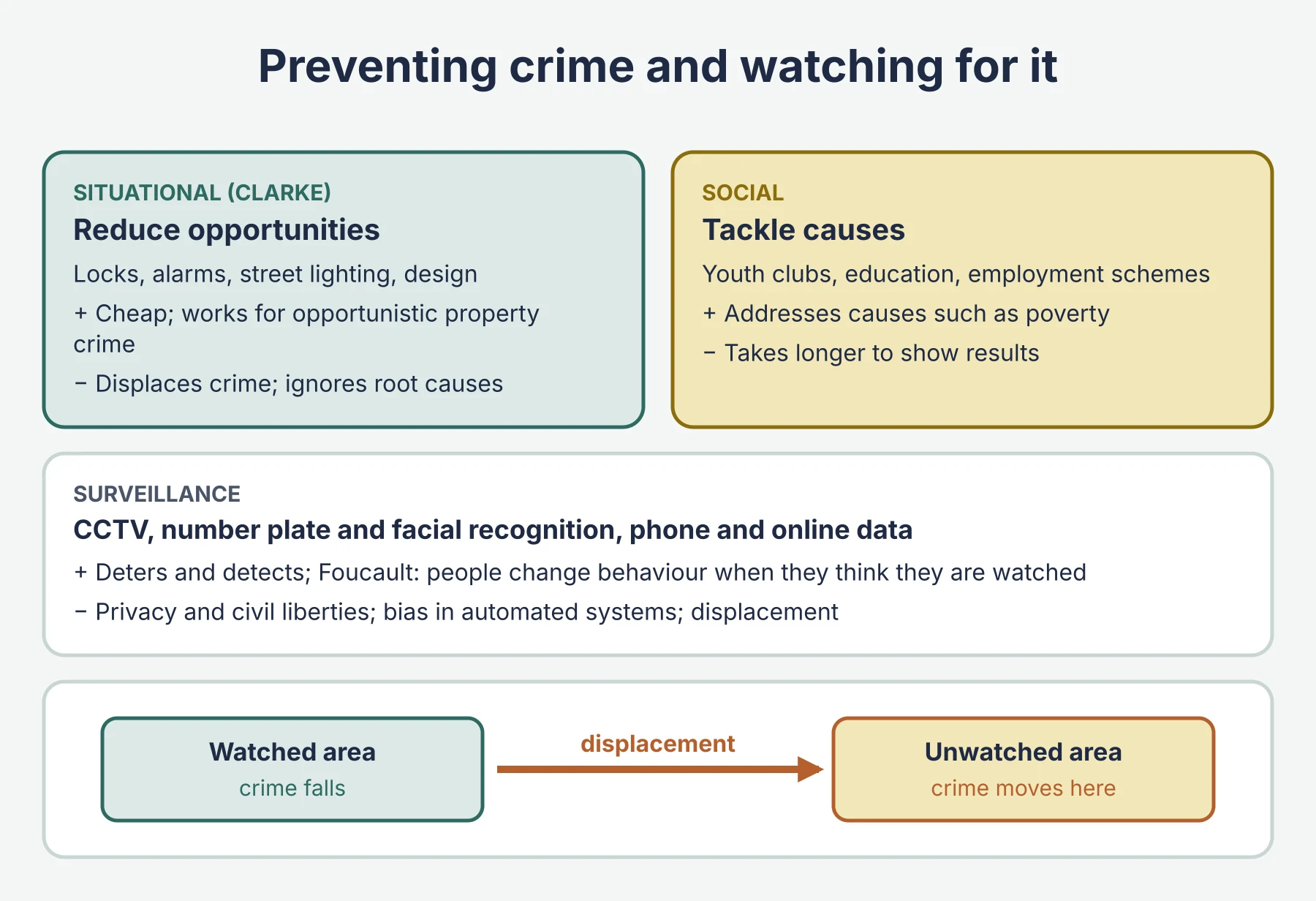
Surveillance, including digital surveillance. CCTV, automatic number plate recognition, facial recognition and analysis of phone and online data can deter and detect crime. Foucault’s idea of disciplinary surveillance helps explain why people change behaviour when they think they are watched. Limitations: privacy and civil liberties; the risk of bias in automated systems; and displacement, where crime moves to unwatched places.
Crime prevention. Situational crime prevention, associated with Ronald Clarke, reduces opportunities: target hardening (locks, alarms), better street lighting, and design that makes offending harder. It is cheap and often effective for opportunistic property crime, but critics argue it displaces crime and ignores root causes such as poverty. Social crime prevention, such as youth clubs, education and employment schemes, tackles causes but takes longer to show results.
Community versus military style policing. Community policing relies on local officers who build relationships, gather information and solve problems with residents, increasing trust and the flow of information. Military style policing uses armed units, armoured vehicles and force to control disorder. It may restore order quickly, but it can alienate communities, escalate conflict and reduce cooperation. Societies balance these differently, and the same society may use both.
Worked example: planning a part (f) answer
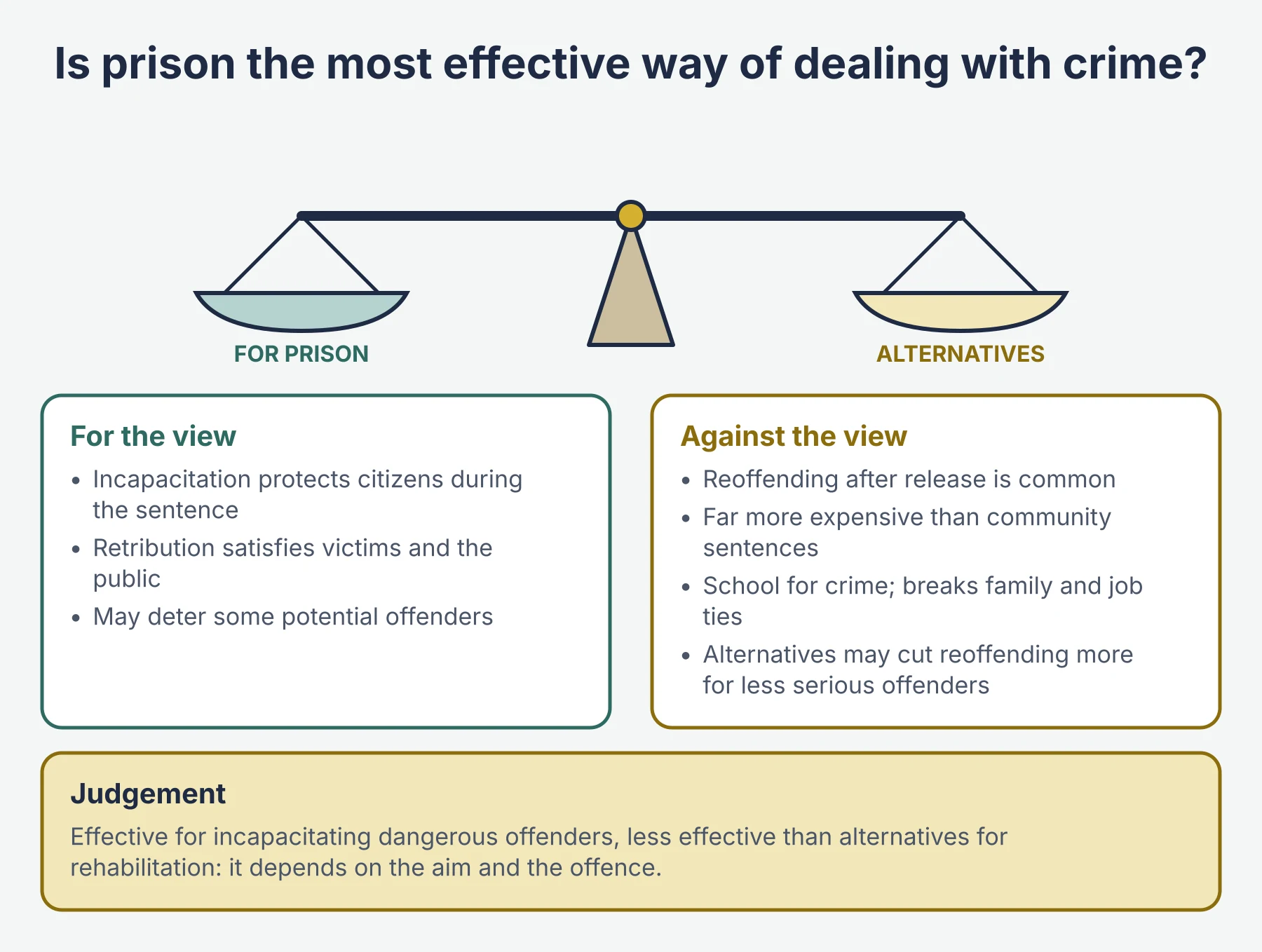
Evaluate the view that prison is the most effective way of dealing with crime.
- For: incapacitation protects citizens during the sentence; retribution satisfies victims and the public; prison may deter some potential offenders.
- Against: reoffending after release is common, suggesting it fails to rehabilitate; it is far more expensive than community sentences; prison can be a school for crime and breaks family and job ties; alternatives such as rehabilitation programmes and community sentences may reduce reoffending more for less serious offenders.
- Judgement: prison is effective for incapacitating dangerous offenders, but less effective than alternatives for rehabilitation; effectiveness depends on the aim and the offence.
Annotated sample sentence: “Prison achieves incapacitation [aim named] because offenders cannot commit crimes in the community while inside [mechanism], but this protection ends on release [limitation], so its effectiveness depends on whether prison also rehabilitates [link to judgement].”
Common mistakes
- Describing punishments without assessing effectiveness.
- Using “deterrence” without saying whether it is individual or general.
- Assuming one society’s system is universal; the key question asks about different societies.
- Calling crime prevention “the police” only: much of it is situational design and social programmes.
- Forgetting the costs of surveillance, such as privacy and displacement.
Exam technique
- Explain three aims or punishments: define each and give a concrete example.
- Discuss: for “Discuss the effectiveness of community policing”, give developed strengths and limitations with comparison.
- Evaluate: identify the aim, test the punishment or strategy against it, consider side effects and fairness, and conclude.
Condense with the key question 6.3 revision notes and practise with the key question 6.3 practice questions. For the explanations of crime that punishments respond to, see patterns and explanations (key question 6.2).
Related resources
-
Practice questions
Cambridge IGCSE Sociology (0495): Crime, deviance and social control – How is crime dealt with in different societies? – Practice Questions
Original Cambridge IGCSE Sociology 0495 practice on key question 6.3: aims and effectiveness of punishment, policing and crime prevention, with full answers.
Sociology · Cambridge · IGCSE
Try questions -
Revision notes
Cambridge IGCSE Sociology (0495): Crime, deviance and social control – How is crime dealt with in different societies? – Revision Notes
Revision notes for Cambridge IGCSE Sociology 0495 key question 6.3: aims of punishment, effectiveness of punishments and policing strategies, with a self-test.
Sociology · Cambridge · IGCSE
Revise topic -
Practice questions
Cambridge IGCSE Sociology: Patterns of and Explanations for Crime — Practice Questions (0495)
Original Cambridge IGCSE Sociology 0495 Paper 2 style practice on crime by age, class, gender and ethnicity and five theories of crime, with full answers.
Sociology · Cambridge · IGCSE
Try questions
Related articles
Get free revision emails (optional)
Occasional emails with practice questions, worked explanations and links to free resources for the qualification and subjects you choose. No spam, and you can unsubscribe from any email. The free tools on this site never need an email.