
Revision Notes
Cambridge IGCSE Sociology (0495): Crime, deviance and social control – How is crime dealt with in different societies? – Revision Notes
Revision notes for Cambridge IGCSE Sociology 0495 key question 6.3: aims of punishment, effectiveness of punishments and policing strategies, with a self-test.
- Subject
- Sociology
- Level
- IGCSE
- Topic
- Paper 2 – Family, Education and Crime
- Author
- Marlbridge Academic Team
- Updated
- Reviewed by
- Naqiya Yousaf (what this means)
Aligned to Cambridge IGCSE Sociology (0495), 2025-2027. Official specification .
Syllabus page (what it covers and how it is assessed): Cambridge IGCSE Sociology.
Syllabus points this page covers
0495
- 6.3 Crime, deviance and social control – How is crime dealt with in different societies?
Found an error? Report a correction.
Need help with this topic? Request a free trial class for IGCSE Sociology (0495).
Condensed notes for key question 6.3 How is crime dealt with in different societies? (Cambridge IGCSE Sociology 0495, Paper 2). The key question 6.3 study guide explains each punishment and policing strategy in full.
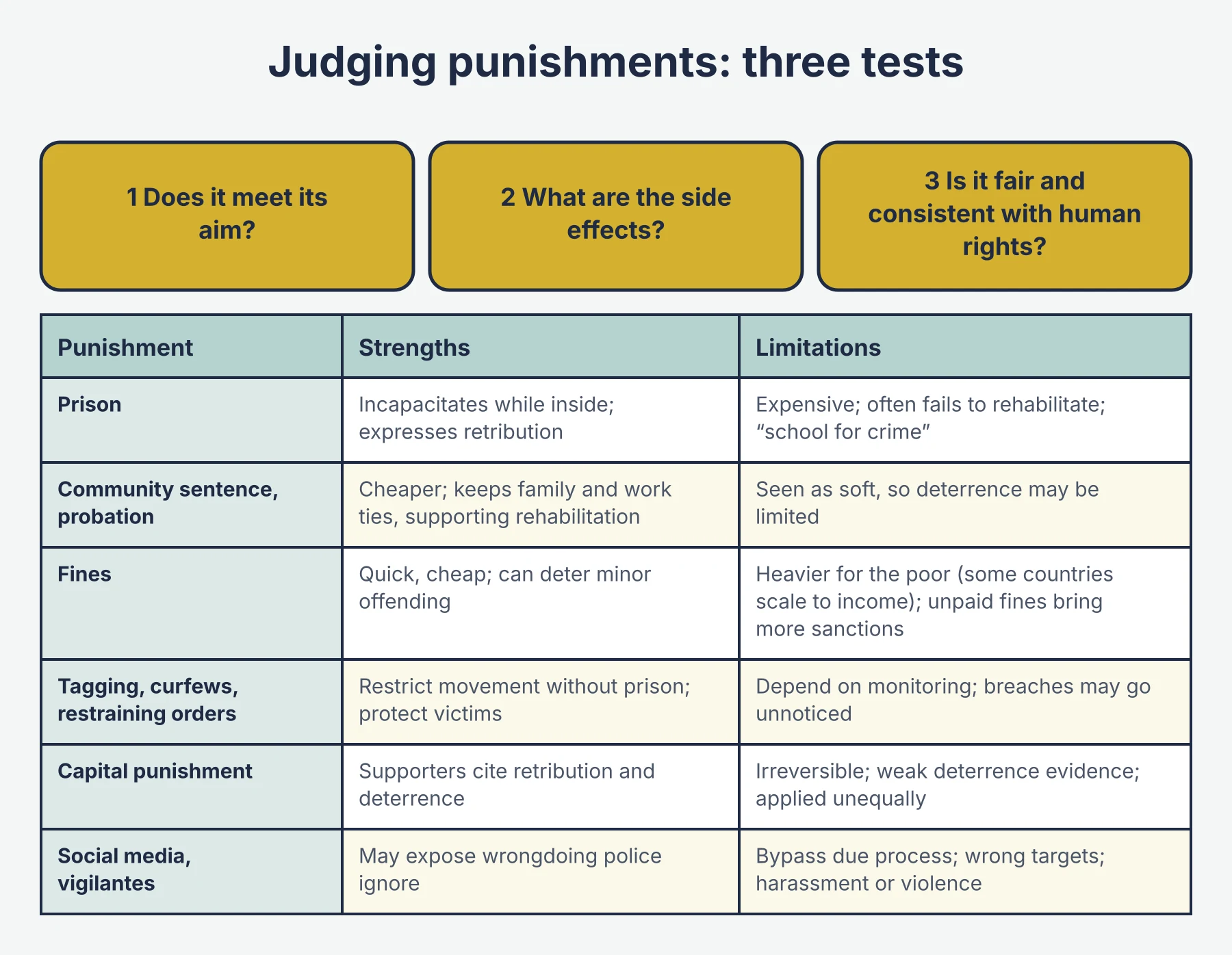
The three tests for “effectiveness”
- Aim: does it achieve the aim it is meant to serve?
- Side effects: cost, labelling, reoffending, damage to trust.
- Fairness: equal impact on rich and poor; human rights; risk of error.
Key terms
| Term | Meaning |
|---|---|
| Protection of citizens | Keeping the public safe from offenders |
| Individual deterrence | Discouraging the punished offender from reoffending |
| General deterrence | Discouraging others by making an example of offenders |
| Retribution | Deserved punishment in proportion to the crime |
| Incapacitation | Making offending physically impossible, as in prison |
| Rehabilitation | Reforming the offender so they stop offending |
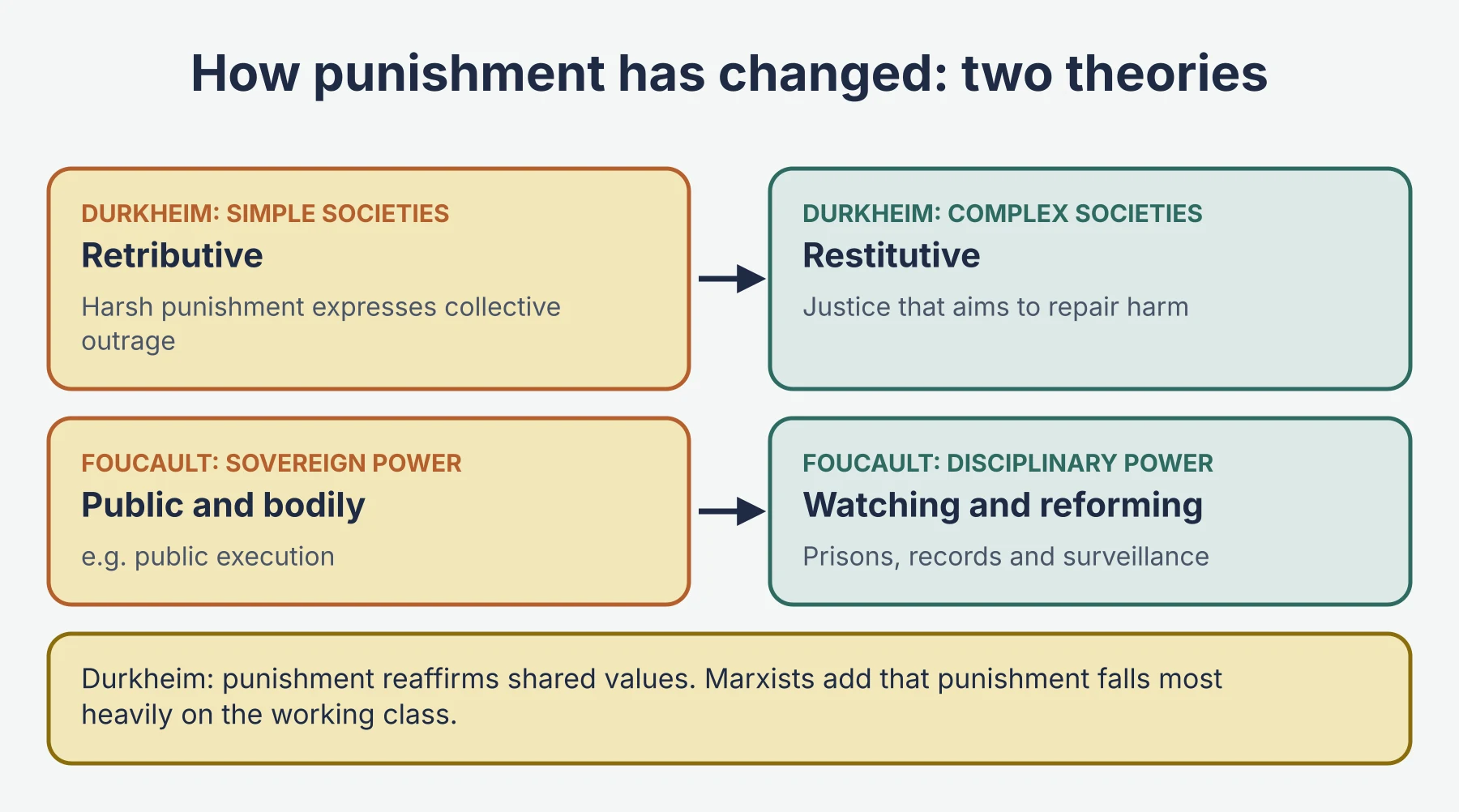
| Restitutive justice | Repairing harm caused (Durkheim) |
| Disciplinary power | Control through surveillance and reform rather than bodily punishment (Foucault) |
| Probation | Supervision of an offender in the community |
| Police caution | A formal warning instead of prosecution |
| Ostracism | Excluding someone from a community while they remain in it |
| Exile | Forcing an offender to leave a society |
| Situational crime prevention | Reducing opportunities for crime through design and security (Clarke) |
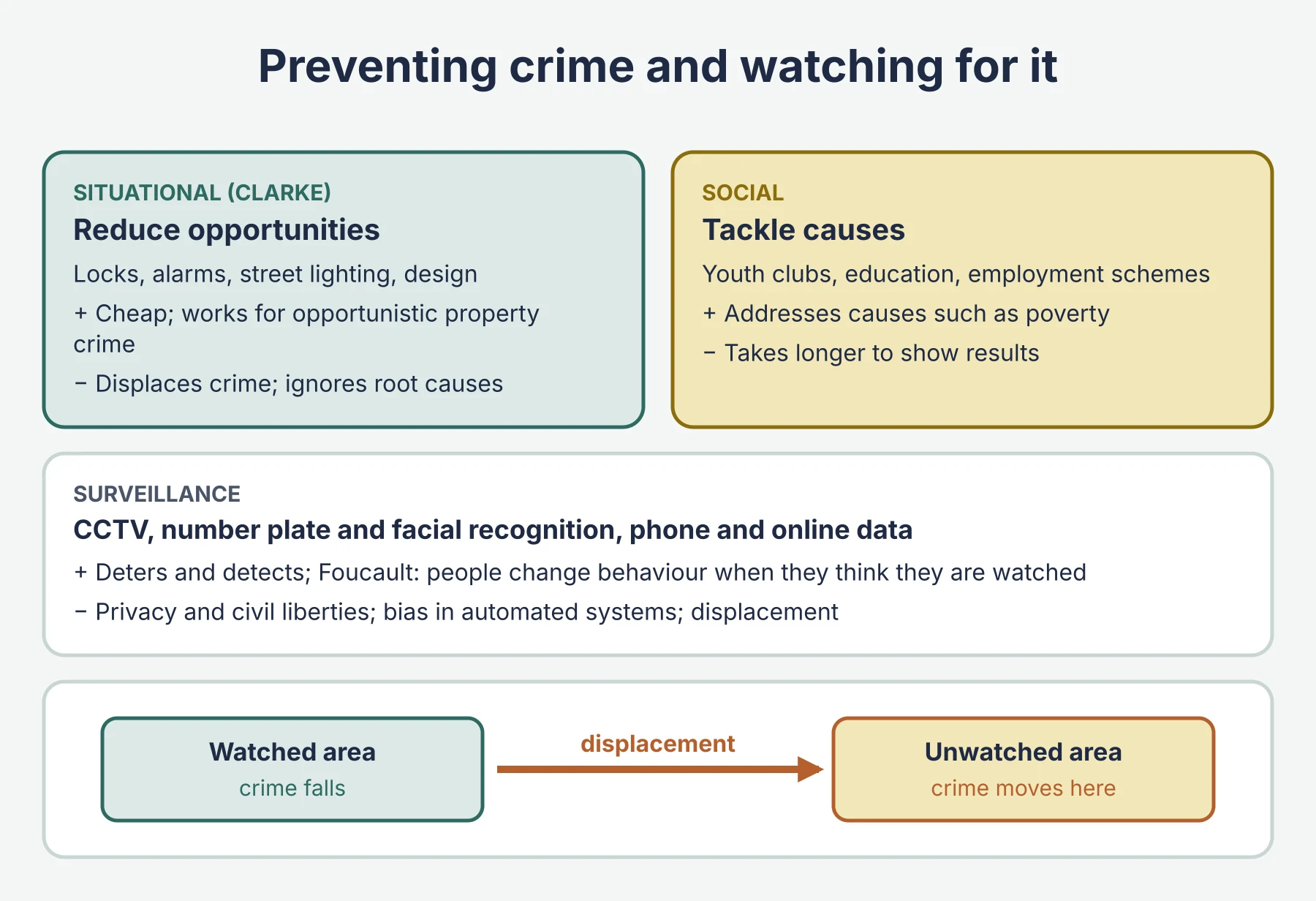
| Displacement | Crime moving to another place or time when prevented in one |
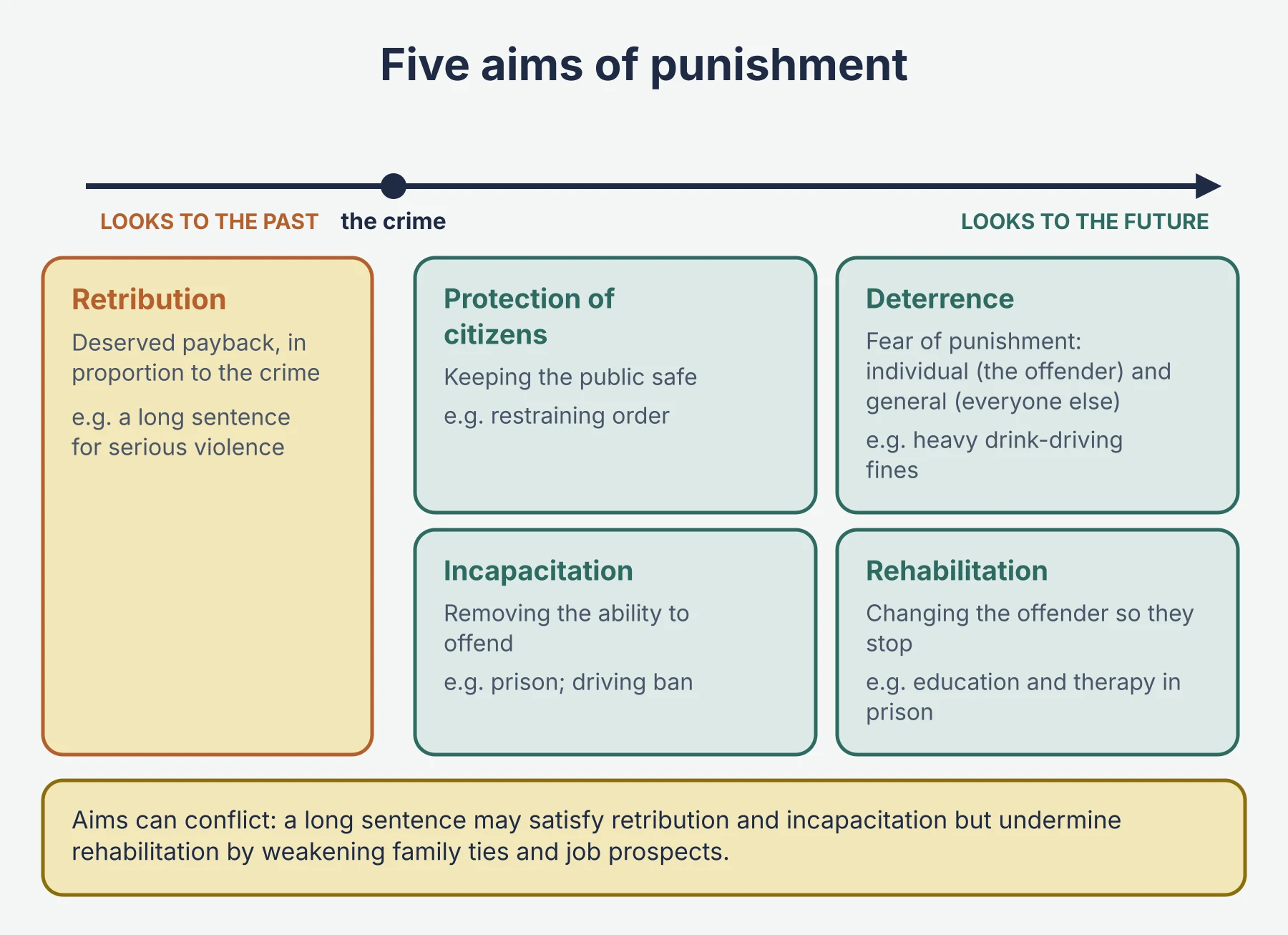
Which aim does each punishment mainly serve?
| Punishment | Main aim(s) | Key weakness |
|---|---|---|
| Prison | Incapacitation; retribution | Reoffending; cost; school for crime |
| Community sentence | Rehabilitation; reparation | Seen as soft |
| Probation | Rehabilitation; protection | Depends on supervision |
| Rehabilitation programme | Rehabilitation | Needs funding and willingness |
| Fine | Deterrence | Unequal impact on rich and poor |
| Tagging, curfew | Protection; incapacitation in part | Breaches may go unnoticed |
| Restraining order | Protection | Relies on compliance and enforcement |
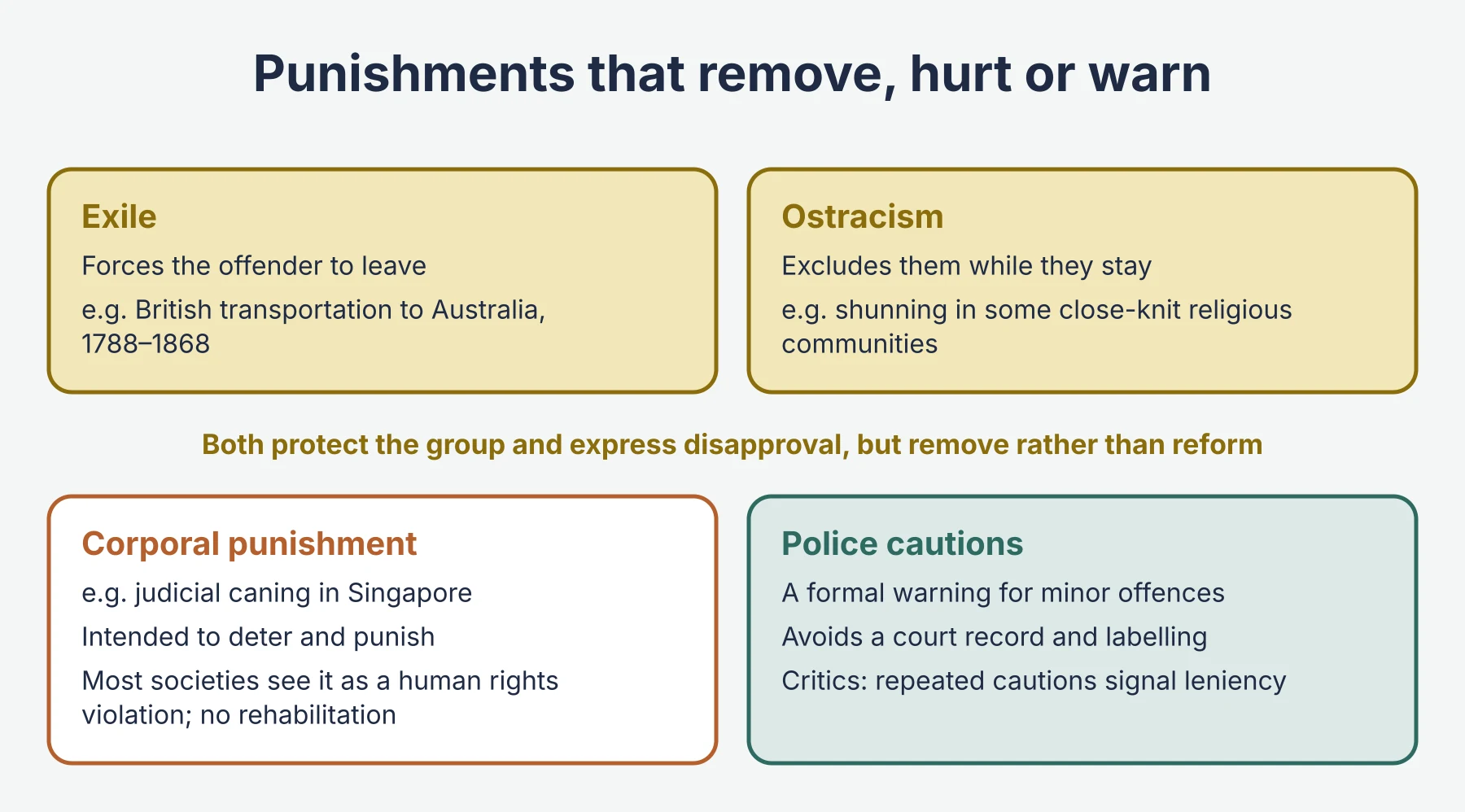
| Caution | Avoids labelling | May seem lenient |
| Capital punishment | Retribution; deterrence | Irreversible; weak evidence of deterrence |
| Corporal punishment | Deterrence; retribution | Human rights; no rehabilitation |
| Exile | Protection | Removes rather than reforms |
| Ostracism | Shaming; protection | Isolation; no due process |
| Social media and vigilantes | Informal shaming | Wrong targets; harassment; no due process |
Different societies
- Capital punishment: retained in some countries and some US states; abolished in many others, including all EU member states.
- Corporal punishment: judicial caning in Singapore; seen as a human rights violation in most societies.
- Rehabilitation-centred prisons: Norway is often cited.
- Exile in history: Britain transported convicts to Australia between 1788 and 1868.
- Ostracism: shunning in some close-knit religious communities.
- Theory: Durkheim, retributive (simple societies) to restitutive (complex societies); Foucault, sovereign to disciplinary power.
Policing (6.3.3)
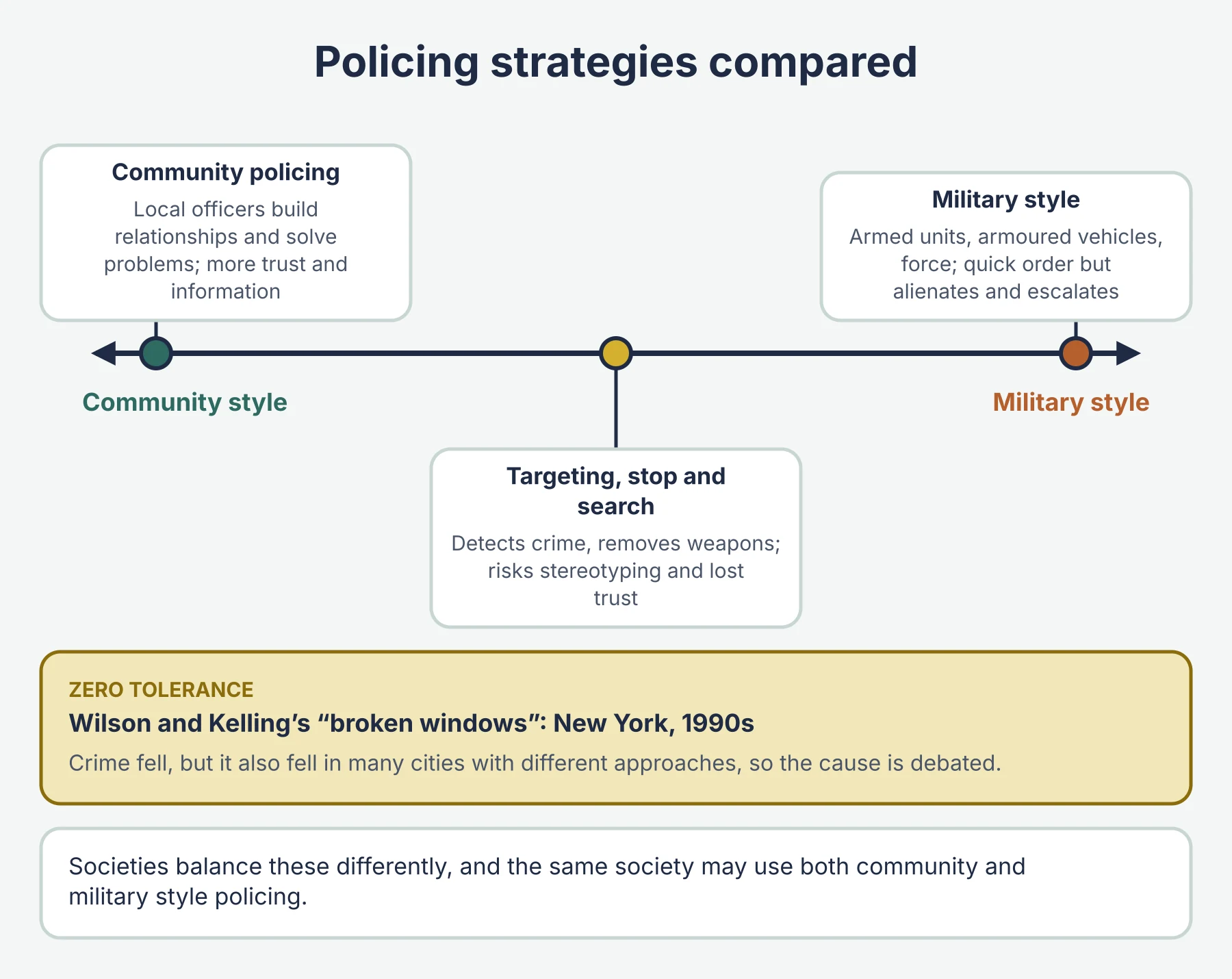
| Strategy | For | Against |
|---|---|---|
| Targeting, stop and search | Detects crime; removes weapons | Stereotyping; damages trust; skews statistics |
| Zero tolerance (“broken windows”) | Associated with falling crime in 1990s New York | Crime also fell elsewhere; heavy-handed |
| Surveillance (CCTV, facial recognition, data) | Deters and detects | Privacy; bias; displacement |
| Situational prevention | Cheap; reduces opportunist crime | Displacement; ignores causes |
| Social prevention | Tackles causes | Slow and costly |
| Community policing | Trust; local information | Slower response to serious disorder |
| Military style policing | Rapid control of disorder | Alienation; escalation |
Model evaluation sentence
“Electronic tagging protects citizens by restricting an offender’s movements [aim], and it avoids the costs and criminal contacts of prison [comparison], but it only works if breaches are monitored and acted on [limitation], so it is more effective for low-risk offenders than for dangerous ones [judgement].” Use the same four moves, aim, comparison, limitation and judgement, for any punishment or policing strategy.
Exam traps
- Assess, do not just describe: 6.3.2 and 6.3.3 ask for effectiveness.
- Specify the aim: a punishment can succeed at one aim and fail at another.
- Deterrence has two forms: individual and general.
- “Different societies”: compare at least two approaches or countries.
- Prevention is not only policing: include design and social programmes.
- Vigilante action is not formal control: it is informal and lacks due process.
Self-test
- Name the five aims of punishment listed in the syllabus.
- Distinguish individual and general deterrence.
- Which aim looks backwards rather than forwards?
- Give two criticisms of prison.
- Why might a fine be unfair?
- Give one strength of community sentencing.
- Give two arguments against capital punishment.
- What is the difference between exile and ostracism?
- What did Durkheim say about punishment in simple and complex societies?
- What is situational crime prevention? Give an example.
- What is displacement?
- Compare community and military style policing in one sentence each.
Answers: 1. Protection of citizens, deterrence, retribution, incapacitation, rehabilitation. 2. Individual deterrence discourages the punished offender; general deterrence discourages everyone else. 3. Retribution. 4. Any two: high reoffending; high cost; school for crime; breaks family and job ties. 5. A fixed fine is a heavier burden for a poor person than for a rich one. 6. Any one: cheaper than prison; keeps family and work ties; supports rehabilitation; can repair harm to the community. 7. Any two: irreversible, so errors cannot be corrected; weak evidence of deterrence; applied unequally; human rights objections. 8. Exile forces the offender to leave the society; ostracism excludes them while they stay. 9. Simple societies used harsh retributive punishment; complex societies rely more on restitutive justice that repairs harm. 10. Reducing opportunities for crime, for example better street lighting, locks or CCTV. 11. Crime moving to another place, time or target when it is prevented in one. 12. Community policing builds trust and gathers local information through relationships; military style policing uses force and armed units to control disorder, but risks alienating communities.
Practise with the key question 6.3 practice questions, then revise the whole topic with the family, education and crime revision notes.
Related resources
-
Practice questions
Cambridge IGCSE Sociology: Patterns of and Explanations for Crime — Practice Questions (0495)
Original Cambridge IGCSE Sociology 0495 Paper 2 style practice on crime by age, class, gender and ethnicity and five theories of crime, with full answers.
Sociology · Cambridge · IGCSE
Try questions -
Revision notes
Cambridge IGCSE Sociology: Crime Patterns, Explanations and Punishment — Revision Notes (0495)
Revision notes for Cambridge IGCSE Sociology 0495 key questions 6.2 and 6.3: crime by age, class, gender and ethnicity, five theories, punishment and policing.
Sociology · Cambridge · IGCSE
Revise topic -
Study guides
Cambridge IGCSE Sociology: Family, Education and Crime (0495)
Cambridge IGCSE Sociology (0495) Paper 2 guide, 2025-2027: family structures and perspectives, education, and crime, deviance and social control.
Sociology · Cambridge · IGCSE
Read guide
Related articles
Get free revision emails (optional)
Occasional emails with practice questions, worked explanations and links to free resources for the qualification and subjects you choose. No spam, and you can unsubscribe from any email. The free tools on this site never need an email.