
Revision Notes
Cambridge IGCSE Sociology (0495): Crime, deviance and social control – What are the patterns of and explanations for crime and deviance? – Revision Notes
Revision notes for Cambridge IGCSE Sociology 0495 key question 6.2: crime patterns, explanations by group, five theories and evaluation, with a self-test.
- Subject
- Sociology
- Level
- IGCSE
- Topic
- Paper 2 – Family, Education and Crime
- Author
- Marlbridge Academic Team
- Updated
- Reviewed by
- Naqiya Yousaf (what this means)
Aligned to Cambridge IGCSE Sociology (0495), 2025-2027. Official specification .
Syllabus page (what it covers and how it is assessed): Cambridge IGCSE Sociology.
Syllabus points this page covers
0495
- 6.2 Crime, deviance and social control – What are the patterns of and explanations for crime and deviance?
Found an error? Report a correction.
Need help with this topic? Request a free trial class for IGCSE Sociology (0495).
Condensed notes for key question 6.2 What are the patterns of and explanations for crime and deviance? (Cambridge IGCSE Sociology 0495, Paper 2). The key question 6.2 study guide explains each mechanism and plans a part (f) answer.
The question behind every answer
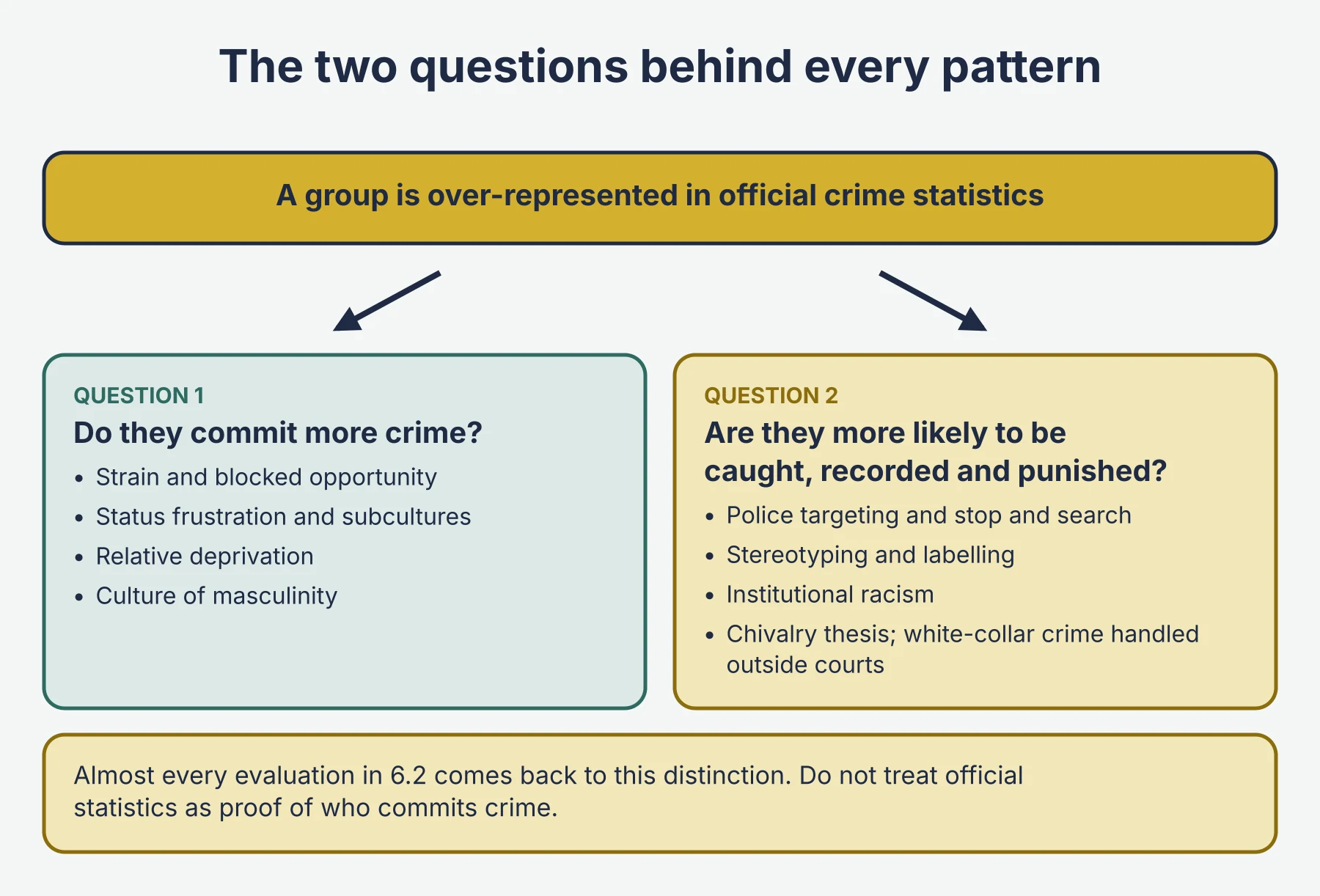
For each pattern, ask: real difference in offending, or difference in being policed, recorded and punished? Use both sides to evaluate.
| Pattern | “Real offending” reading | “Recording” reading |
|---|---|---|
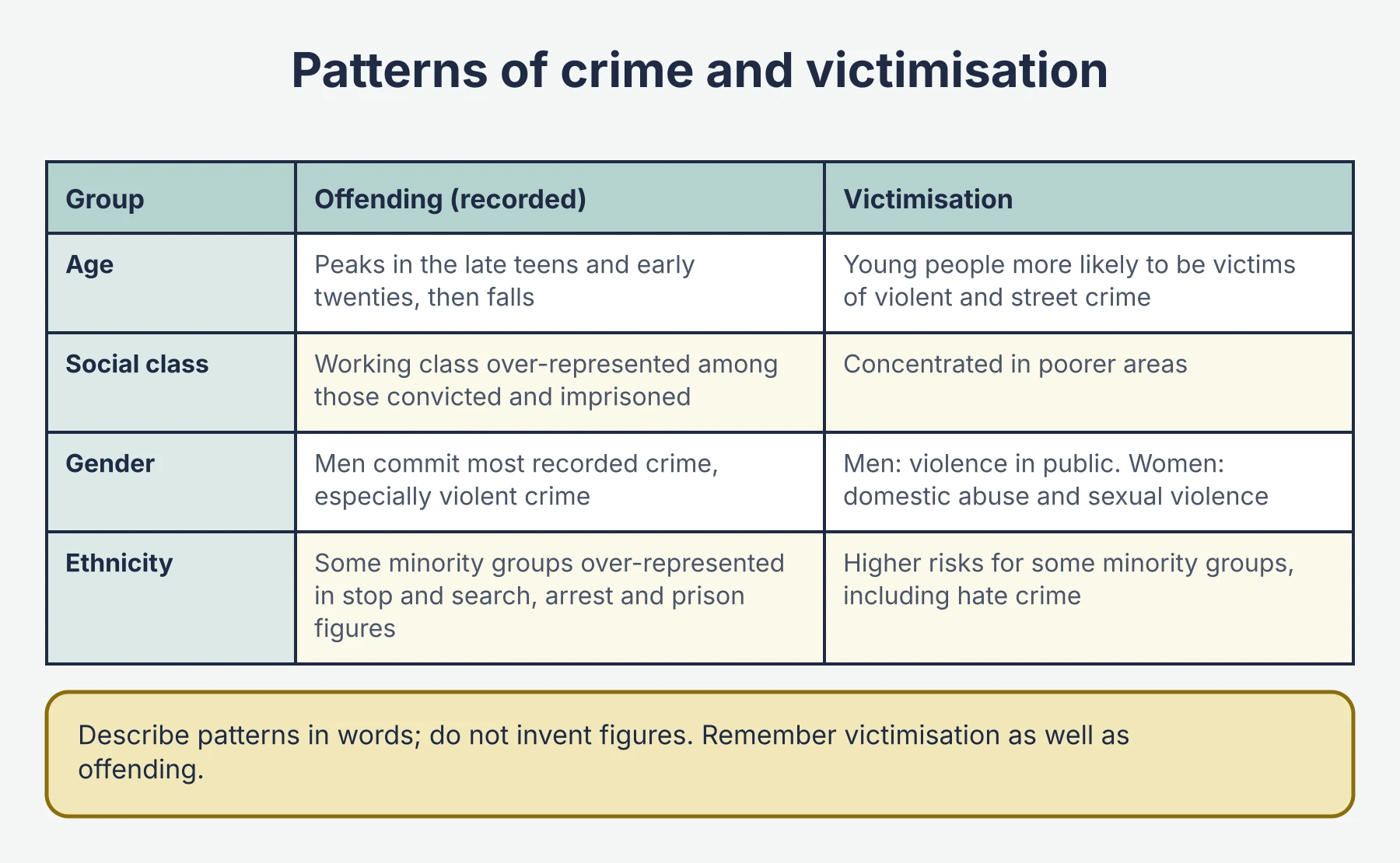
| Young people offend more | Weaker social control; status frustration; gang culture | Police targeting of public spaces; stereotyping |
| Working class offend more | Deprivation; exclusion; blocked opportunity | White-collar crime hidden; heavy policing of poor areas |
| Men offend more | Culture of masculinity; less control | Chivalry thesis: women’s crime under-recorded |
| Some minority groups over-represented | Relative deprivation; gang culture | Institutional racism; stop and search; stereotyping |
Key terms
| Term | Meaning |
|---|---|
| Anomie | Normlessness when rules break down (Durkheim) |
| Innovation | Merton’s adaptation: accepting goals but using illegitimate means |
| Retreatism | Rejecting both goals and means, as in drug addiction |
| Delinquent subculture | A group with norms opposed to mainstream values |
| Illegitimate opportunity structure | Local chances to learn and commit crime (Cloward and Ohlin) |
| Underclass | The New Right’s term for a group outside mainstream society, dependent on welfare |
| Master status | A label that overrides a person’s other identities |
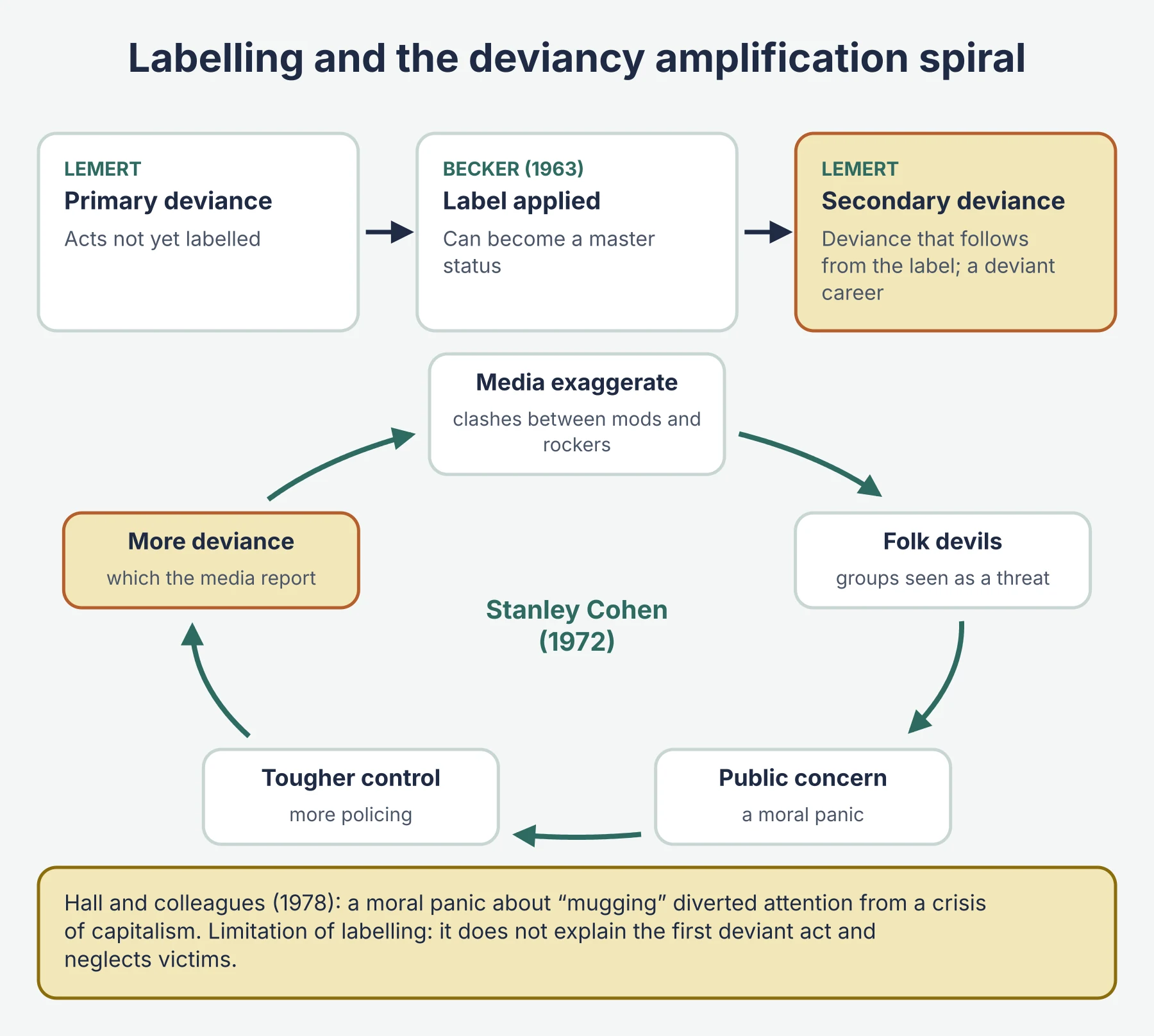
| Primary and secondary deviance | Unlabelled acts v deviance that follows from a label (Lemert) |
| Folk devil | A group portrayed by the media as a threat (Stanley Cohen) |
| Deviancy amplification | Reaction to deviance producing more deviance |
| Selective enforcement | Laws applied more strictly to some groups than others |
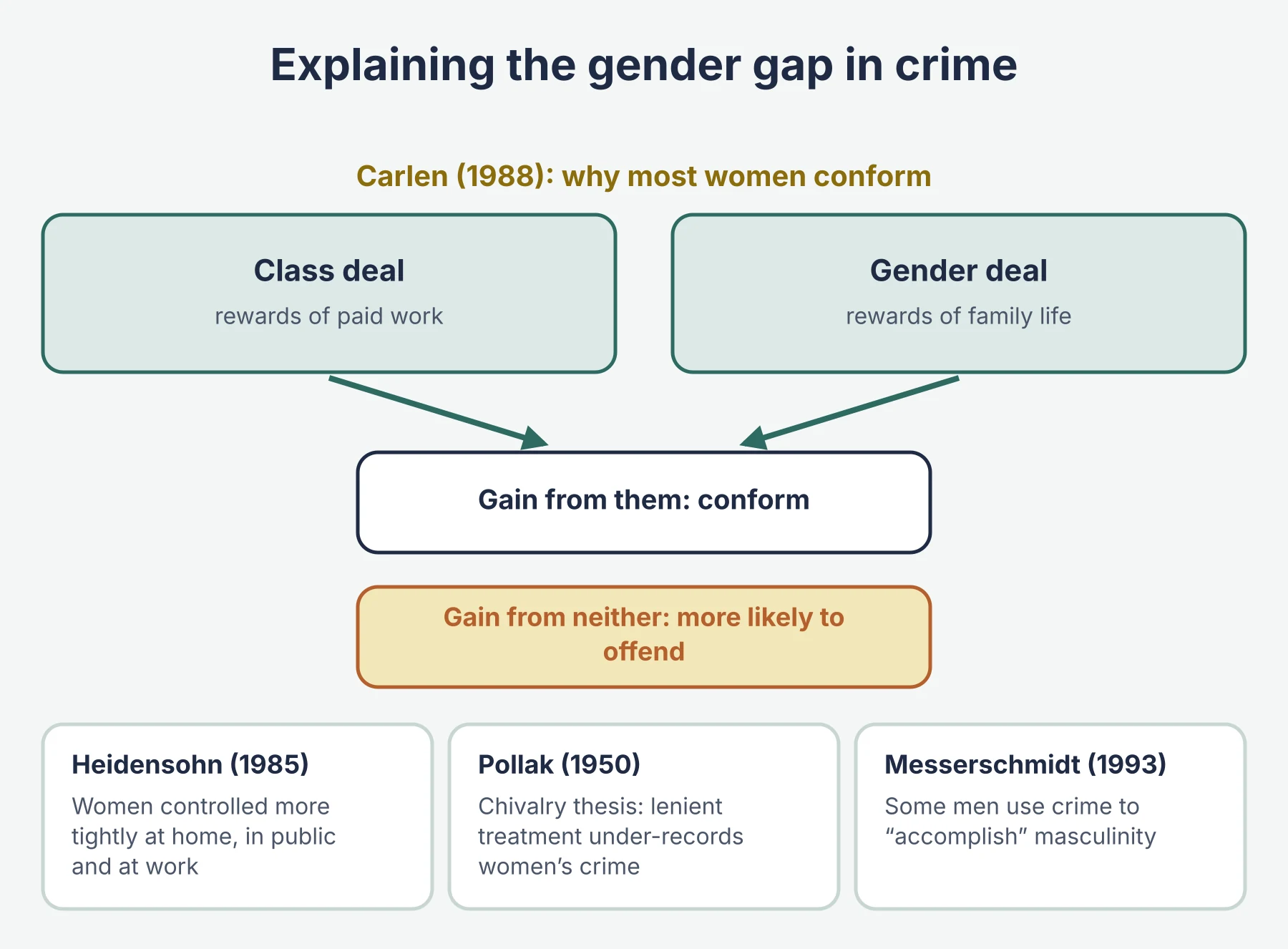
| Class deal and gender deal | Carlen’s rewards that encourage women to conform |
| Accomplishing masculinity | Using crime to display manhood (Messerschmidt) |
Five theories in five lines
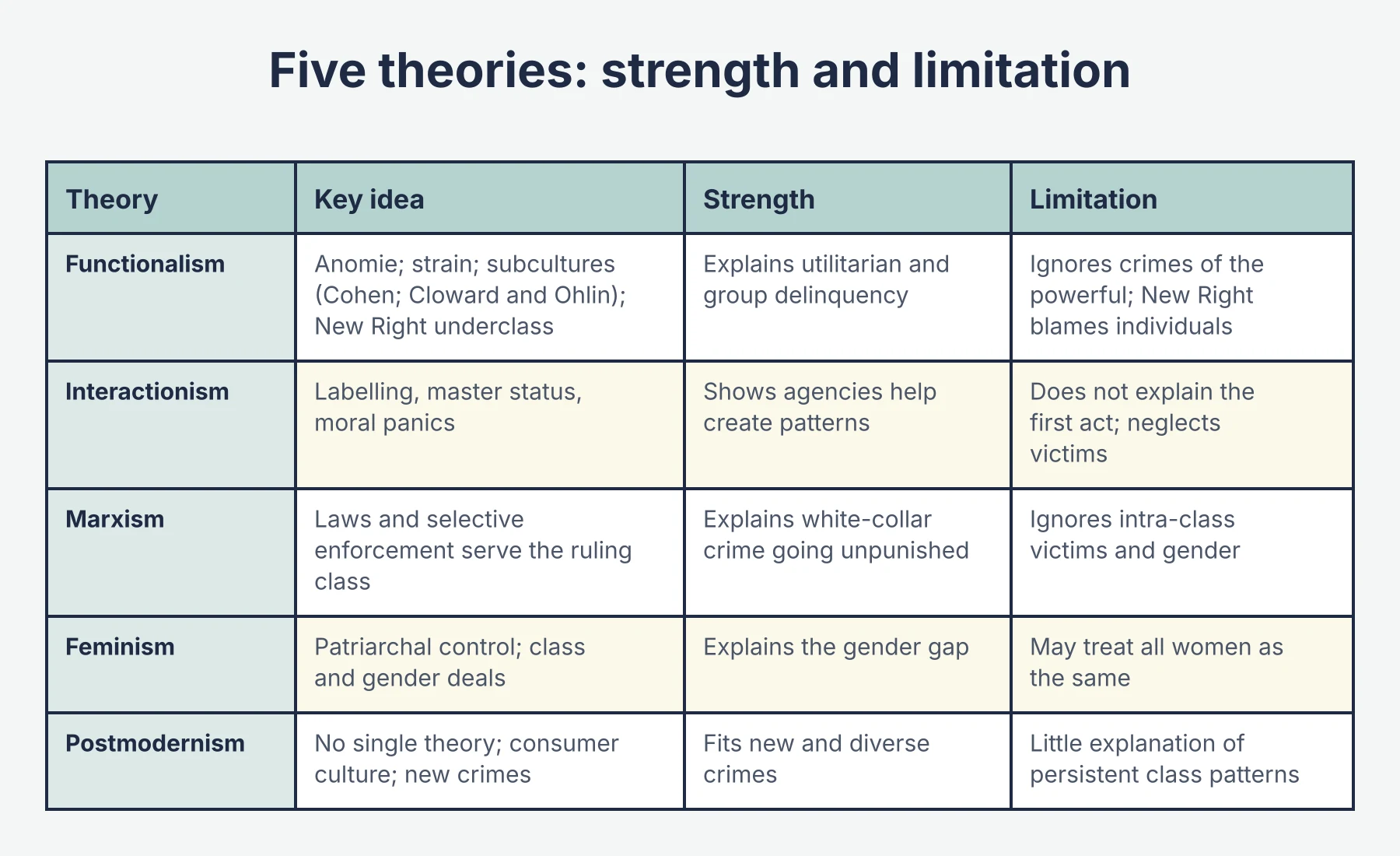
- Functionalism: Durkheim (functional crime; anomie); Merton (1938) strain, five adaptations; A. Cohen (1955) status frustration; Cloward and Ohlin (1960) criminal, conflict and retreatist subcultures; New Right (Murray) underclass.
- Interactionism: Becker (1963) labelling and master status; Lemert primary/secondary deviance; S. Cohen (1972) mods and rockers, moral panic; Hall et al. (1978) mugging panic.
- Marxism: laws protect property; selective enforcement; crimes of the powerful ignored; capitalism breeds greed.
- Feminism: Heidensohn (1985) control of women; Carlen (1988) class and gender deals; Pollak (1950) chivalry; women as victims.
- Postmodernism: no single explanation; consumer desires; new crimes (cyber, hate); excitement and emotion.
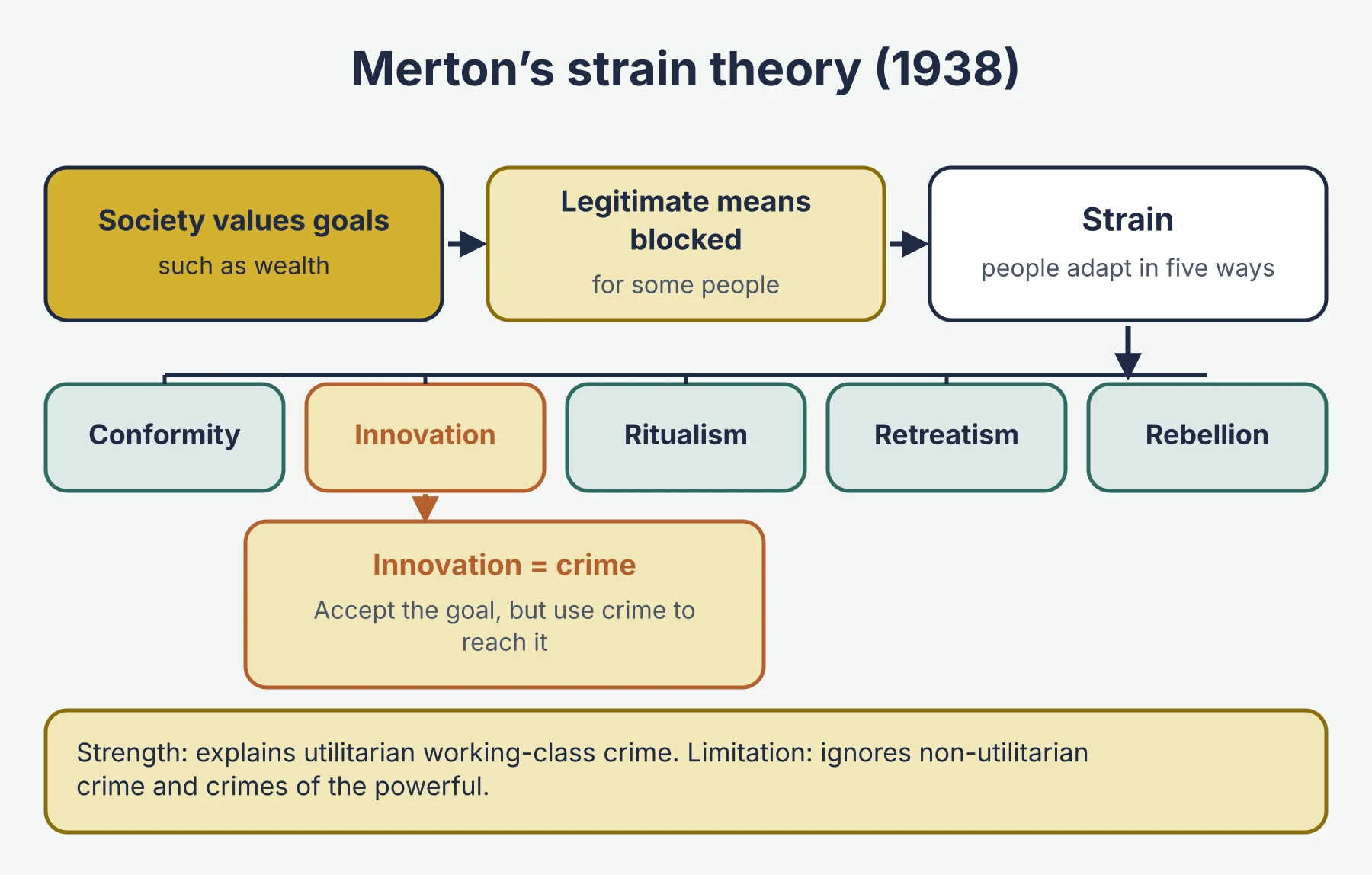
Merton’s five adaptations
| Adaptation | Goals | Means | Example |
|---|---|---|---|
| Conformity | Accept | Accept | Working hard for promotion |
| Innovation | Accept | Reject | Theft or fraud to get rich |
| Ritualism | Reject | Accept | Following rules in a dead-end job without ambition |
| Retreatism | Reject | Reject | Dropping out through addiction |
| Rebellion | Replace | Replace | Revolutionary political movements |
Evaluation shortcuts (6.2.7)
- Age: strong evidence of police targeting, but young people also report more offending in self-report studies.
- Class: deprivation explains some property crime; most poor people do not offend; white-collar crime shows the wealthy offend too.
- Gender: control theory explains much; chivalry may be outdated or apply only to “respectable” women.
- Ethnicity: discrimination in the system is well documented; deprivation and area also matter; ethnicity alone explains little.
- Theories: functionalist strain ignores crimes of the powerful; labelling ignores first causes and victims; Marxism neglects gender and working-class victims; feminism may generalise; postmodernism struggles with persistent patterns.
Exam traps
- Two Cohens: Albert (1955, status frustration); Stanley (1972, moral panic).
- Innovation is the criminal adaptation in Merton, not rebellion.
- New Right sits under functionalism in this syllabus.
- Victimisation counts: 6.2.1 asks for victim patterns too.
- No made-up statistics: describe patterns as “over-represented” or “higher on average”.
- Apply the explanation to the group named: a gender question needs gender explanations, even if you use a general theory.
Self-test
- Describe the age pattern of recorded offending.
- Give one reason working-class people may appear more often in crime statistics without offending more.
- What is relative deprivation, and who stressed it?
- What did Heidensohn argue about women and crime?
- What is the chivalry thesis?
- What did the Macpherson Report (1999) conclude?
- Which of Merton’s adaptations describes most crime?
- Name Cloward and Ohlin’s three subcultures.
- What is the difference between primary and secondary deviance?
- Explain a moral panic, using Stanley Cohen’s study.
- What are Carlen’s class deal and gender deal?
- Give one strength and one limitation of the Marxist theory of crime.
Answers: 1. It peaks in the late teens and early twenties, then declines. 2. Any one: heavier policing of working-class areas; white-collar crime is hidden and often dealt with outside court; stereotyping by agencies. 3. Feeling deprived in comparison with others; Lea and Young (1984). 4. Women are controlled more tightly at home, in public and at work, so they have fewer opportunities to offend. 5. Pollak’s idea that the justice system treats women more leniently, so their crime is under-recorded. 6. That the Metropolitan Police was institutionally racist. 7. Innovation: accepting goals but using illegitimate means. 8. Criminal, conflict, retreatist. 9. Primary deviance is not yet labelled; secondary deviance results from being labelled. 10. An exaggerated public and media reaction to a group seen as a threat; mods and rockers were turned into folk devils, leading to more control. 11. The class deal is the reward of paid work and consumer goods; the gender deal is the reward of family life; women who gain from neither are more likely to offend. 12. Strength: explains why crimes of the powerful go unpunished; limitation: neglects gender and the fact that working-class people are often victims of working-class crime.
Test yourself with the crime patterns and explanations practice questions, then move on to the key question 6.3 revision notes.
Related resources
-
Study guides
Cambridge IGCSE Sociology (0495): Crime, deviance and social control – How is crime dealt with in different societies?
Cambridge IGCSE Sociology 0495 key question 6.3: aims of punishment, how effective twelve punishments are, and policing, surveillance and crime prevention.
Sociology · Cambridge · IGCSE
Read guide -
Practice questions
Cambridge IGCSE Sociology (0495): Crime, deviance and social control – How is crime dealt with in different societies? – Practice Questions
Original Cambridge IGCSE Sociology 0495 practice on key question 6.3: aims and effectiveness of punishment, policing and crime prevention, with full answers.
Sociology · Cambridge · IGCSE
Try questions -
Revision notes
Cambridge IGCSE Sociology (0495): Crime, deviance and social control – How is crime dealt with in different societies? – Revision Notes
Revision notes for Cambridge IGCSE Sociology 0495 key question 6.3: aims of punishment, effectiveness of punishments and policing strategies, with a self-test.
Sociology · Cambridge · IGCSE
Revise topic
Related articles
Get free revision emails (optional)
Occasional emails with practice questions, worked explanations and links to free resources for the qualification and subjects you choose. No spam, and you can unsubscribe from any email. The free tools on this site never need an email.