
Study Guides
Cambridge IGCSE Sociology (0495): Education – What factors help to explain differences in educational achievement and experience?
Cambridge IGCSE Sociology 0495 key question 5.3: patterns and explanations of achievement by class, ethnicity, gender and between countries, with evaluation.
- Subject
- Sociology
- Level
- IGCSE
- Topic
- Paper 2 – Family, Education and Crime
- Author
- Marlbridge Academic Team
- Updated
- Reviewed by
- Naqiya Yousaf (what this means)
Aligned to Cambridge IGCSE Sociology (0495), 2025-2027. Official specification .
Syllabus page (what it covers and how it is assessed): Cambridge IGCSE Sociology.
Syllabus points this page covers
0495
- 5.3 Education – What factors help to explain differences in educational achievement and experience?
Found an error? Report a correction.
Need help with this topic? Request a free trial class for IGCSE Sociology (0495).
This guide covers key question 5.3 What factors help to explain differences in educational achievement and experience? in Cambridge IGCSE Sociology (0495) Paper 2, 2025–2027 syllabus. The family, education and crime study guide shows how to sort explanations into material, cultural and in-school types; this page goes through the explanations the syllabus names for each social group and for global differences, with evidence and evaluation.
What key question 5.3 covers
- 5.3.1 Patterns: social class, ethnicity, gender, global differences.
- 5.3.2 Social class: material factors (such as access to digital technology); cultural and social factors; cultural capital; home and community factors; linguistic factors; compensatory education; in-school factors (pro- and anti-school subcultures); selective and private education; labelling theory; Marxist explanations.
- 5.3.3 Ethnicity: institutional racism; ethnocentric curriculum; role models; linguistic factors; cultural, material and social factors; home and community factors; in-school factors including ethnic subcultures; labelling theory.
- 5.3.4 Gender: differential gendered socialisation and social control; teacher expectations; cultural and social factors; access to education; in-school factors including gendered subcultures; labelling theory; feminist explanations such as patriarchy.
- 5.3.5 Global differences: availability of schools; poverty and wealth; access for girls; class sizes; norms, values and cultural differences; access to the internet and digital resources.
- 5.3.6 Strengths and limitations of the explanations for each.
“Achievement” means results and qualifications; “experience” means how pupils are treated and how they feel about school. Questions may target either.
Patterns (5.3.1)
Describe patterns without inventing figures.
- Class: in most societies, children from middle-class and wealthier families achieve higher results on average and are more likely to go to university than working-class children.
- Ethnicity: patterns differ between societies. In England, for example, pupils of Chinese and Indian heritage have on average achieved above the national average, while some groups, such as Black Caribbean and Gypsy, Roma and Traveller pupils, have on average achieved below it.
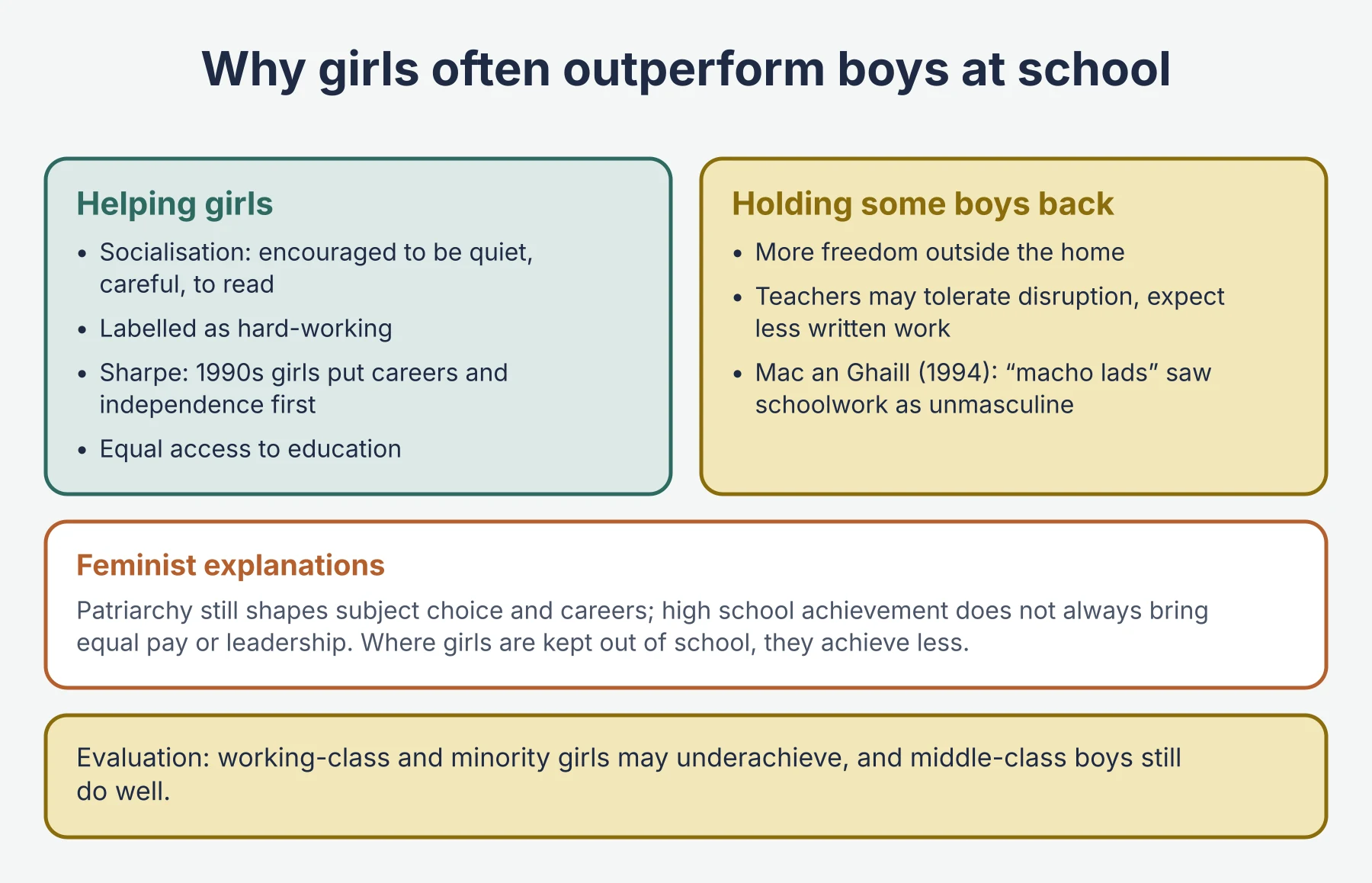
- Gender: in many countries girls now outperform boys at school level in most subjects, although subject choice remains gendered and, in some societies, girls have less access to schooling.
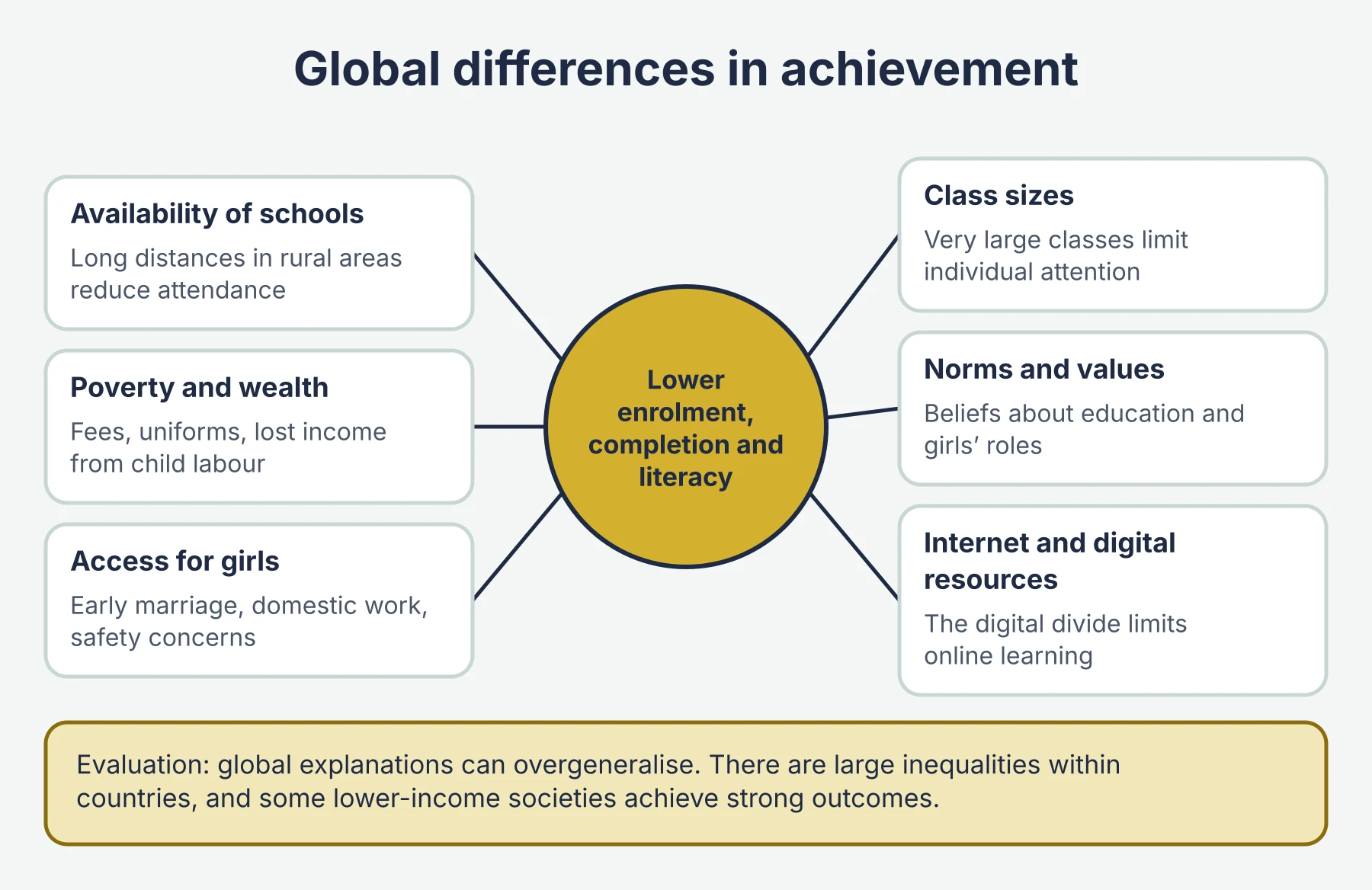
- Global: enrolment, completion and literacy are generally lower in low-income countries, with the widest gaps often affecting rural girls.
Social class (5.3.2)
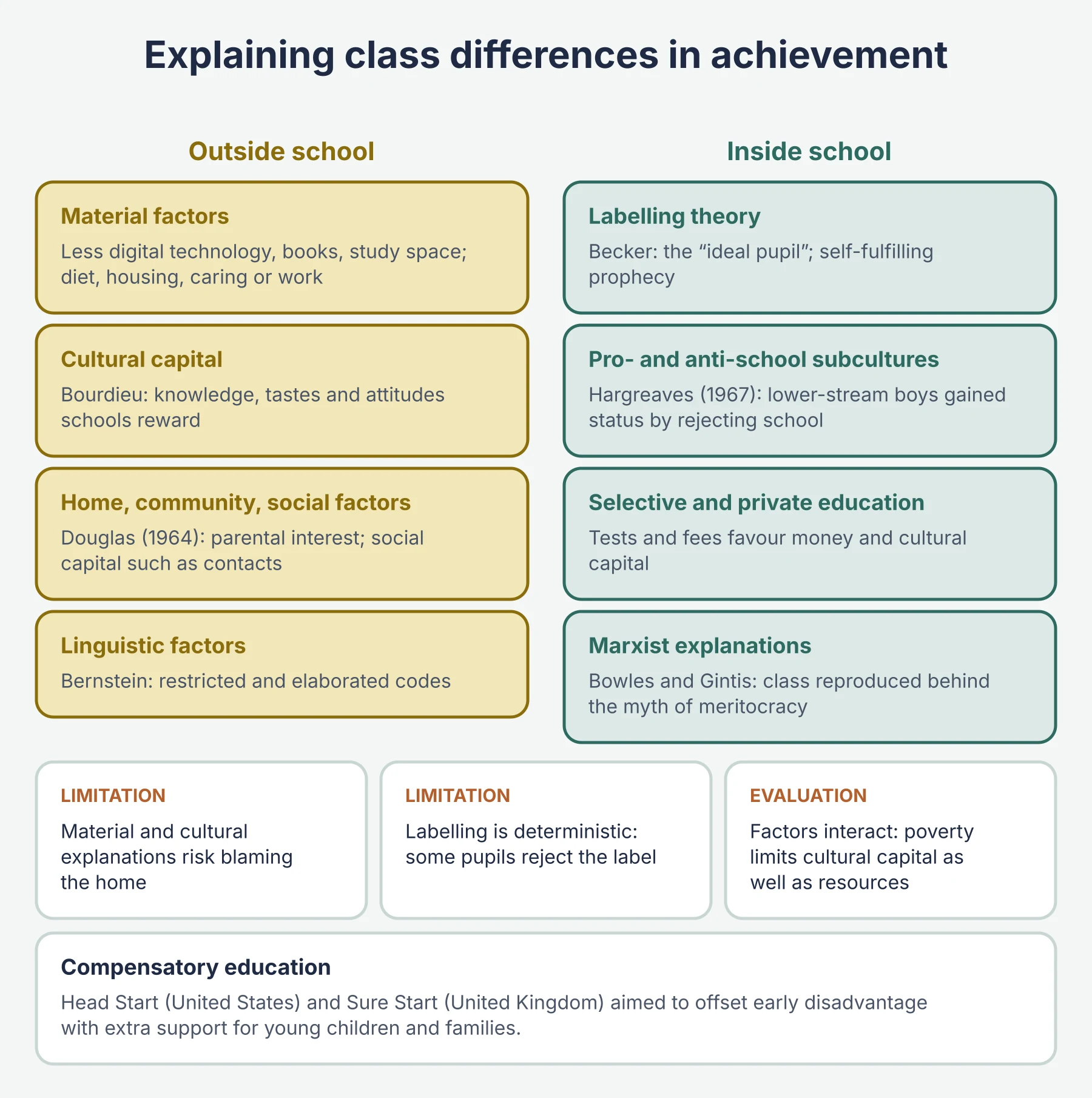
Outside school
- Material factors: poverty means less access to digital technology, books and quiet study space; poorer diet and housing can affect health and attendance; older children may work or care for siblings.
- Cultural capital: Bourdieu argued middle-class children bring knowledge, tastes and attitudes that schools reward.
- Cultural and social factors, home and community: J. W. B. Douglas (1964) linked achievement to parental interest in children’s education. Middle-class parents may also use social capital, such as contacts with professionals, to help their children.
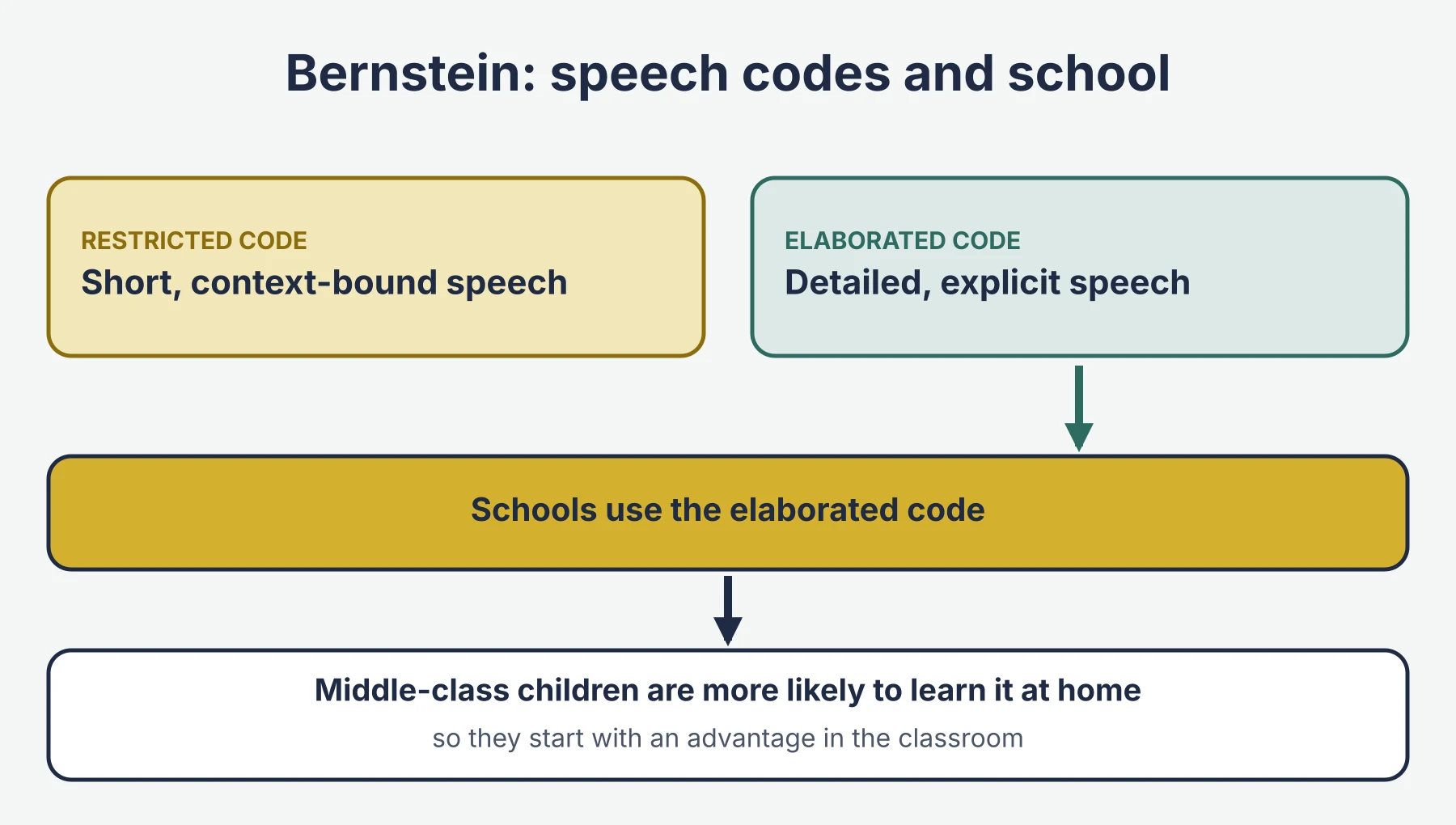
- Linguistic factors: Basil Bernstein distinguished the restricted code (short, context-bound speech) from the elaborated code (detailed, explicit speech). He argued schools use the elaborated code, which middle-class children are more likely to learn at home.
- Compensatory education: programmes such as Head Start in the United States and Sure Start in the United Kingdom aimed to offset early disadvantage with extra support for young children and families.
Inside school
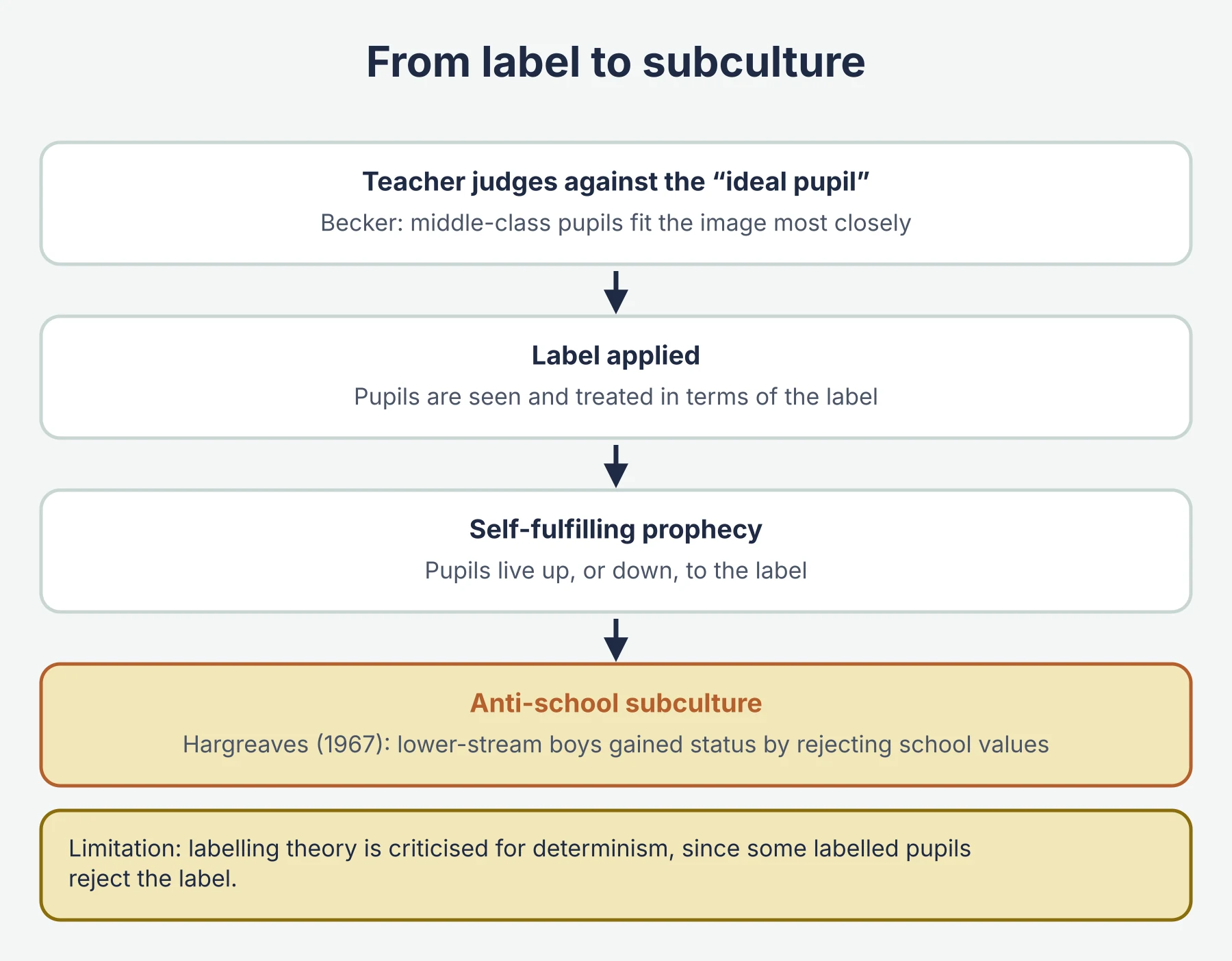
- Labelling theory: Howard Becker found teachers judged pupils against an image of the “ideal pupil”, which middle-class pupils fitted most closely. Labels can create a self-fulfilling prophecy.
- Pro- and anti-school subcultures: David Hargreaves (1967) found boys in lower streams formed an anti-school subculture that gave them status by rejecting school values.
- Selective and private education: entry tests and fees favour families with money and cultural capital.
- Marxist explanations: Bowles and Gintis argued education reproduces class inequality behind the myth of meritocracy.
Evaluation: material and cultural explanations risk blaming the home; labelling theory is criticised for determinism, since some labelled pupils reject the label; the factors interact, as poverty limits cultural capital as well as resources.
Ethnicity (5.3.3)
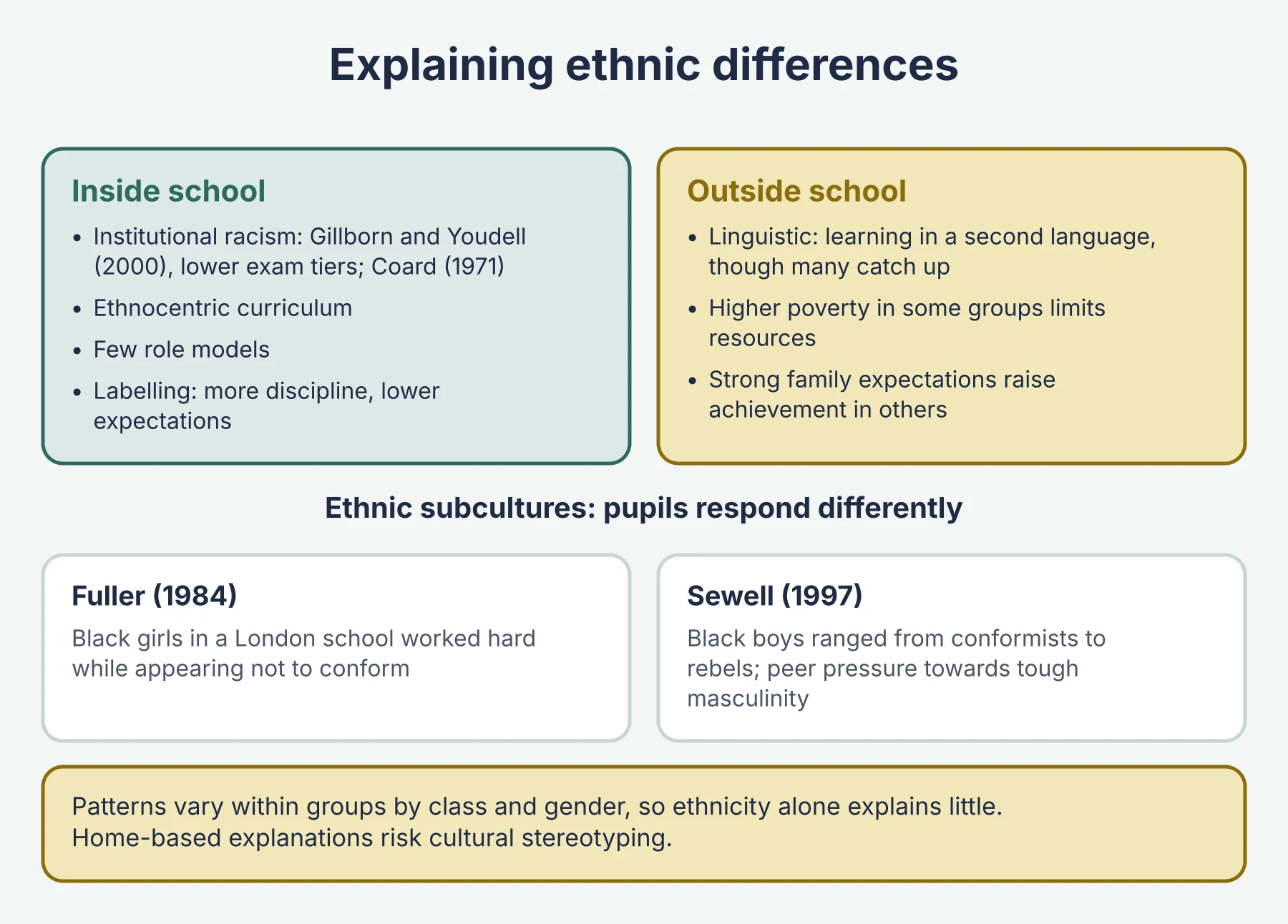
- Institutional racism: David Gillborn and Deborah Youdell (2000) found teachers’ expectations shaped which pupils were entered for higher-tier exams, with Black pupils more likely to be placed in lower tiers. Earlier, Bernard Coard (1971) argued that West Indian children in Britain were wrongly placed in schools for the “educationally subnormal”.
- Ethnocentric curriculum: a curriculum centred on the majority culture, for example in history or literature, may leave minority pupils feeling excluded.
- Role models: few teachers or leaders from some ethnic groups can lower aspirations.
- Linguistic factors: pupils learning in a second language may fall behind at first, although many catch up.
- Cultural, material and social factors; home and community: higher poverty rates in some groups limit resources, while strong family expectations of education in others raise achievement.
- In-school factors and ethnic subcultures: Mary Fuller (1984) found Black girls in a London school formed a pro-education subculture, working hard while appearing not to conform. Tony Sewell (1997) described different responses among Black boys, from conformists to rebels, and argued peer pressure towards a tough masculinity affected some.
- Labelling theory: teachers’ stereotypes can lead to more frequent discipline and lower expectations for some groups.
Evaluation: patterns vary within ethnic groups by class and gender, so ethnicity alone explains little; school-based explanations show the system can disadvantage pupils, while home-based ones risk cultural stereotyping.
Gender (5.3.4)
- Differential socialisation and social control: girls are often encouraged to be quiet, careful and to read, habits that suit schoolwork; boys are given more freedom outside the home.
- Teacher expectations and labelling: teachers may tolerate boys’ disruption or expect less written work from them, and may label girls as hard-working.
- Cultural and social factors: Sue Sharpe’s research found girls’ priorities in the 1970s centred on love and marriage, while by the 1990s they placed careers and independence first.
- Access to education: where girls are kept out of school, they achieve less; where access is equal, they often outperform boys.
- In-school factors and gendered subcultures: Máirtín Mac an Ghaill (1994) described “macho lads” who rejected schoolwork as unmasculine.
- Feminist explanations: patriarchy still shapes subject choice and careers, and girls’ high achievement at school does not always translate into equal pay or leadership.
Evaluation: explanations of girls’ success may overlook working-class and minority girls who underachieve; claims that boys “fail” can hide the fact that middle-class boys still do well.
Global differences (5.3.5)
| Factor | How it shapes achievement |
|---|---|
| Availability of schools | Long distances to school in rural areas reduce attendance, especially at secondary level |
| Poverty and wealth | Fees, uniforms and lost income from child labour keep poorer children out of school |
| Access for girls | Early marriage, domestic work and safety concerns reduce girls’ schooling in some societies |
| Class sizes | Very large classes limit individual attention |
| Norms, values and culture | Beliefs about the value of education, and about girls’ roles, affect enrolment |
| Internet and digital resources | The digital divide limits online learning in poorer regions |
Evaluation: global explanations can overgeneralise about whole countries; there are large inequalities within countries, and some lower-income societies achieve strong outcomes.
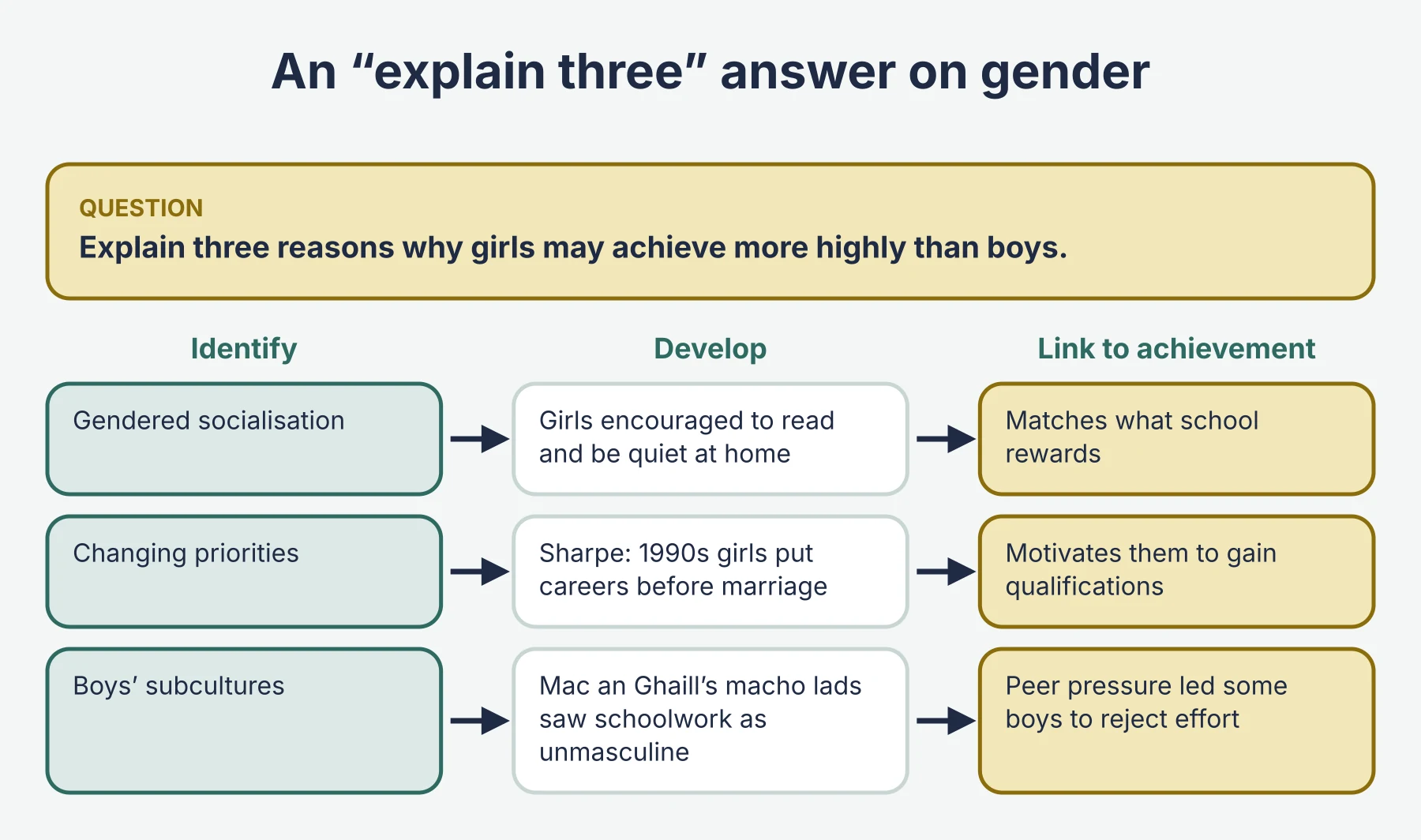
Worked example: an annotated part (d) answer
Explain three reasons why girls may achieve more highly than boys.
“First, gendered socialisation [identified]: girls are often encouraged to read and be quiet at home, which matches what school rewards, so they adapt to classroom expectations more easily [developed]. Second, changing priorities [identified]: Sharpe found girls in the 1990s put careers before marriage, which motivates them to gain qualifications [developed]. Third, boys’ subcultures [identified]: Mac an Ghaill’s macho lads saw schoolwork as unmasculine, so peer pressure led some boys to reject effort [developed].”
Common mistakes
- Giving explanations without saying which group or pattern they explain.
- Treating “working-class culture” as inferior: say it differs from the culture schools reward.
- Ignoring interaction: class, ethnicity and gender combine.
- Describing global patterns with invented statistics. Use the factors the syllabus names.
- Forgetting 5.3.6: every explanation needs a strength and a limitation.
Exam technique
- Explain three: one explanation per paragraph, each applied to the named group.
- Discuss: for example, “Discuss how in-school factors affect the achievement of ethnic minority pupils”: three developed points with evidence.
- Evaluate: for “Evaluate the view that home factors are the main cause of class differences in achievement”, set home factors (material, cultural, linguistic) against in-school factors and Marxist structural explanations, then conclude.
Revise with the key question 5.3 revision notes and practise with the key question 5.3 practice questions. For the perspectives behind these explanations, see the roles and functions of education (key question 5.2).
Related resources
-
Practice questions
Cambridge IGCSE Sociology (0495): Education – What factors help to explain differences in educational achievement and experience? – Practice Questions
Original Cambridge IGCSE Sociology 0495 practice on key question 5.3: achievement differences by class, ethnicity, gender and globally, with mark guidance.
Sociology · Cambridge · IGCSE
Try questions -
Revision notes
Cambridge IGCSE Sociology (0495): Education – What factors help to explain differences in educational achievement and experience? – Revision Notes
Revision notes for Cambridge IGCSE Sociology 0495 key question 5.3: achievement by class, ethnicity, gender and globally, with key terms and a self-test.
Sociology · Cambridge · IGCSE
Revise topic -
Study guides
Cambridge IGCSE Sociology (0495): Crime, deviance and social control – What are crime, deviance and social control?
Cambridge IGCSE Sociology 0495 key question 6.1: crime and deviance, relativity, formal and informal social control, types of crime and measuring crime.
Sociology · Cambridge · IGCSE
Read guide
Related articles
Get free revision emails (optional)
Occasional emails with practice questions, worked explanations and links to free resources for the qualification and subjects you choose. No spam, and you can unsubscribe from any email. The free tools on this site never need an email.