
Study Guides
Cambridge IGCSE Sociology (0495): Education – What are the roles and functions of education?
Cambridge IGCSE Sociology 0495 key question 5.2: functionalist, Marxist and feminist views of the roles of education, with named evidence and evaluation.
- Subject
- Sociology
- Level
- IGCSE
- Topic
- Paper 2 – Family, Education and Crime
- Author
- Marlbridge Academic Team
- Updated
- Reviewed by
- Naqiya Yousaf (what this means)
Aligned to Cambridge IGCSE Sociology (0495), 2025-2027. Official specification .
Syllabus page (what it covers and how it is assessed): Cambridge IGCSE Sociology.
Syllabus points this page covers
0495
- 5.2 Education – What are the roles and functions of education?
Found an error? Report a correction.
Need help with this topic? Request a free trial class for IGCSE Sociology (0495).
This guide covers key question 5.2 What are the roles and functions of education? in Cambridge IGCSE Sociology (0495) Paper 2, 2025–2027 syllabus. The family, education and crime study guide gives one mechanism per perspective; here every concept the syllabus lists under each view is explained, with named evidence and the strengths and limitations you need for parts (e) and (f).
What key question 5.2 covers
- 5.2.1 The functionalist view: the positive roles of education (socialisation, social control, economic, selective); meritocracy and social mobility; role allocation; value consensus; equal opportunities; standardised testing; setting by ability; vocationalism; strengths and limitations.
- 5.2.2 The Marxist view: education’s role in reproducing class inequality through socialisation and social control as capitalist ideological control; the hidden and official curriculum; middle-class school culture and cultural capital; the myth of meritocracy; material factors such as access to digital technology; setting by ability; strengths and limitations.
- 5.2.3 The feminist view: education’s role in perpetuating gender inequality through the patriarchal culture of education; male power; gender hierarchy; role models; access to education; gendered curriculum and subject choice; teacher expectations; peer groups and social control; strengths and limitations.
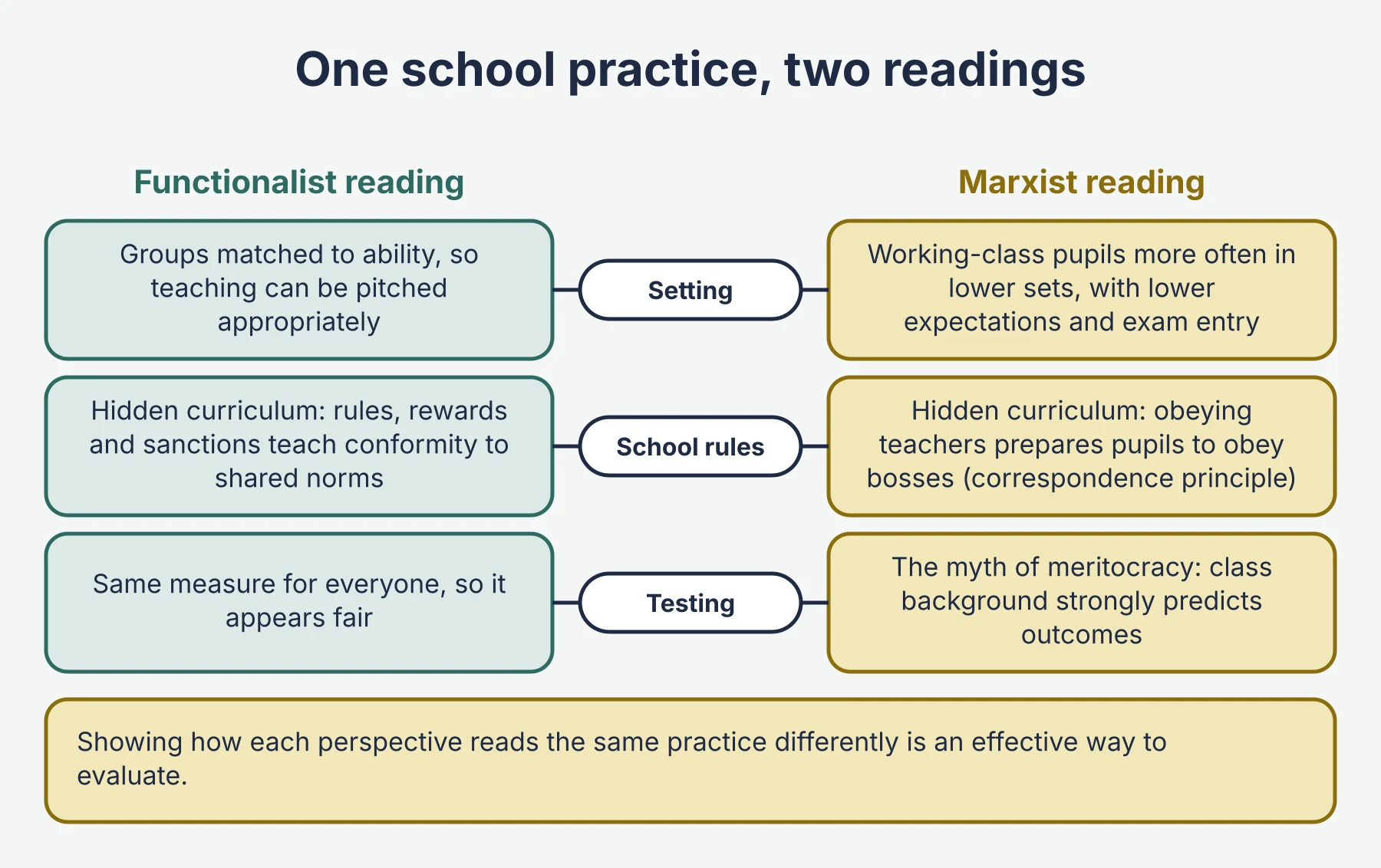
Notice that setting by ability and the hidden curriculum appear under more than one view. The same school practice is interpreted differently by each perspective, and showing that contrast is an effective way to evaluate.
The functionalist view (5.2.1)
Functionalists see education as meeting society’s needs and benefiting everyone.
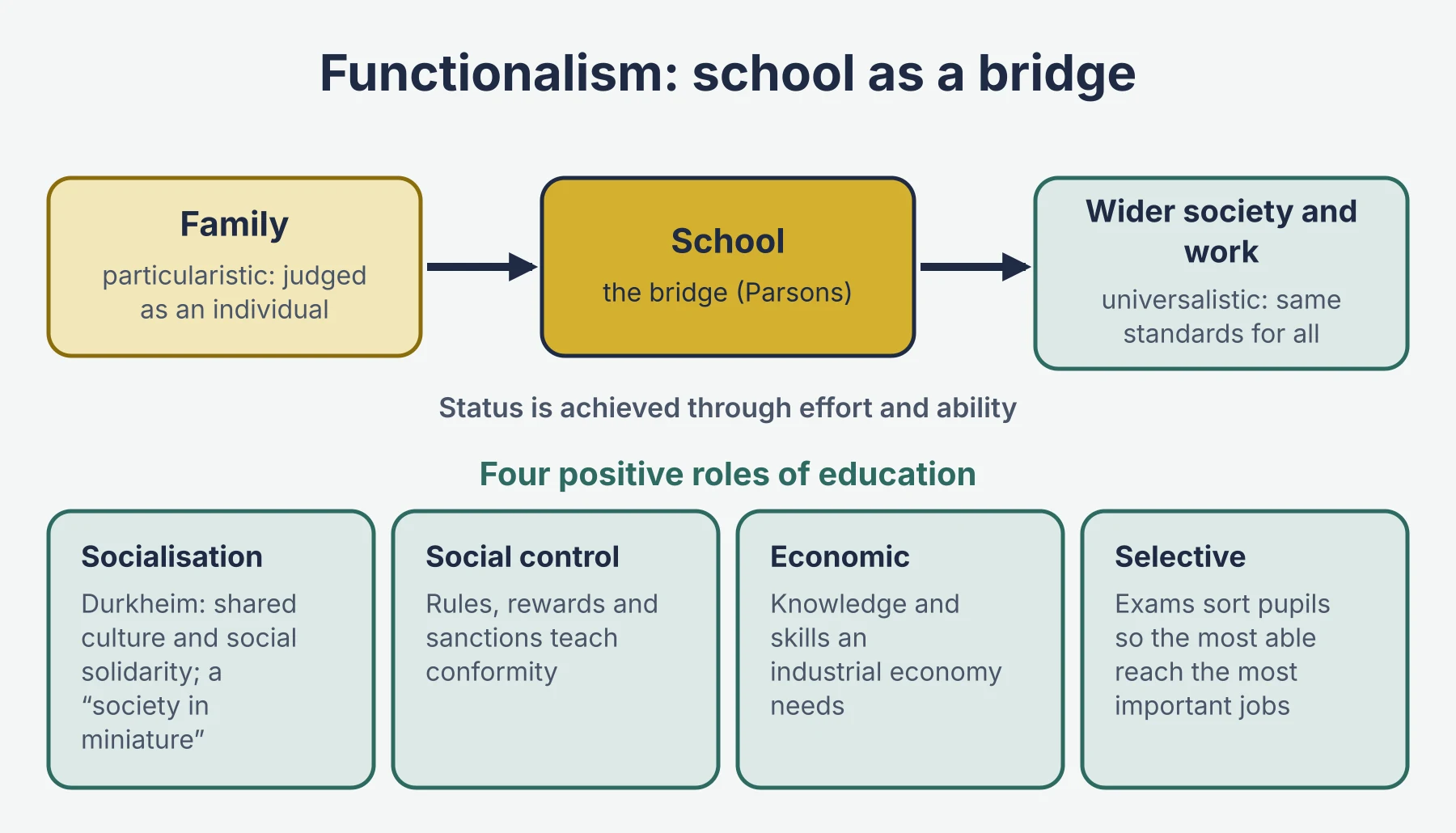
The four roles.
- Socialisation: Émile Durkheim argued that schools pass on society’s shared culture, creating social solidarity. The school is a “society in miniature” where children learn to cooperate with people who are not family.
- Social control: rules, rewards and sanctions teach pupils to conform to norms.
- Economic: schools teach the knowledge and skills an industrial economy needs.
- Selective: exams sort pupils by ability so the most able reach the most important jobs.
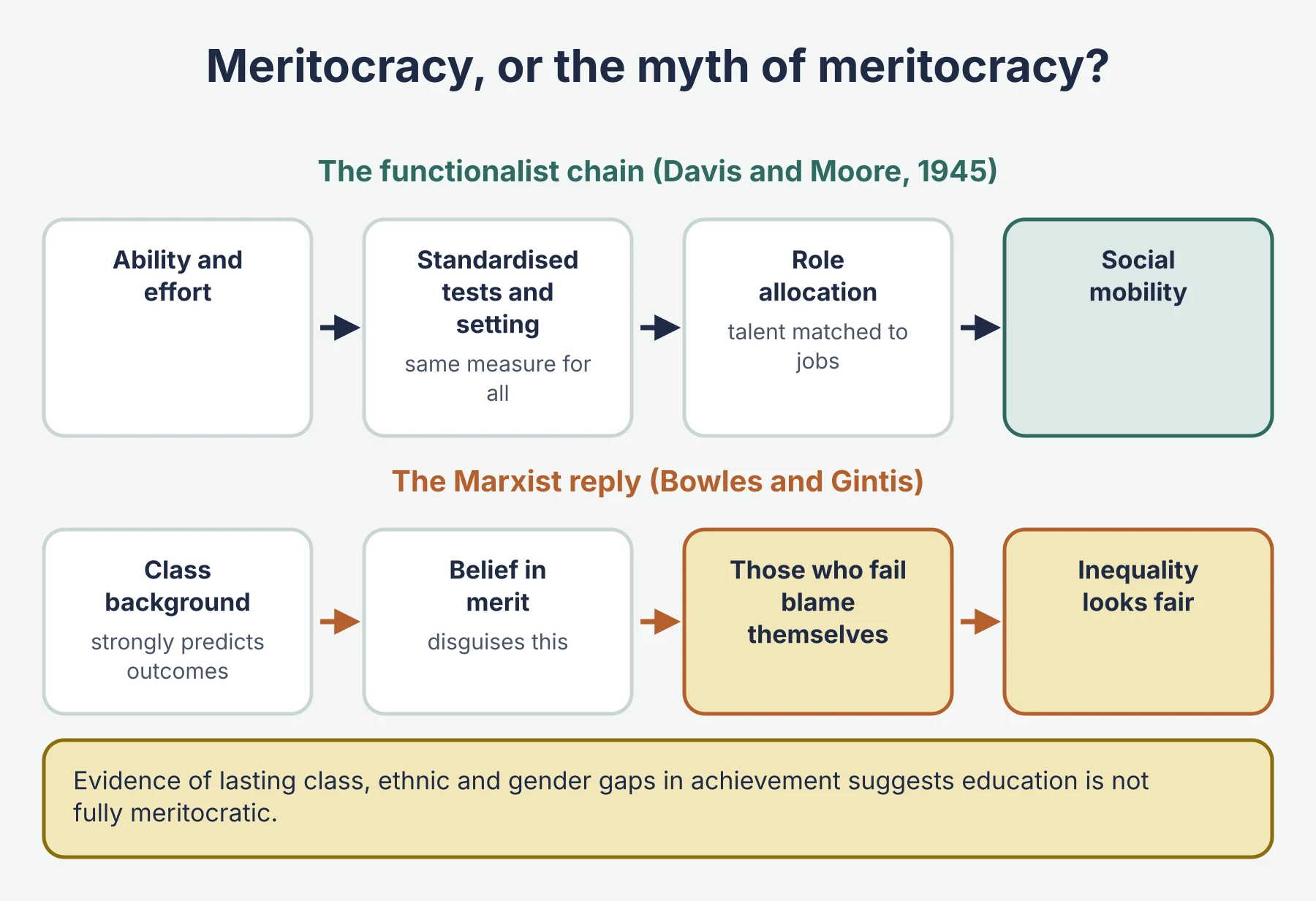
Meritocracy, role allocation and social mobility. Talcott Parsons saw school as a bridge between the family and wider society. In the family a child is judged by particularistic standards (as an individual known to the parents); at school and work everyone is judged by the same universalistic standards. Status is achieved through effort and ability. Kingsley Davis and Wilbert Moore (1945) argued education performs role allocation: it identifies talent and matches people to jobs, with the most important jobs rewarded most. In a meritocracy, a working-class child who works hard can rise: education is the route to social mobility.
Value consensus and equal opportunities. Shared values, such as achievement and fairness, are taught to all, and free, compulsory schooling gives every child the same formal chance.
Standardised testing, setting by ability and vocationalism. Tests apply the same measure to everyone, so they appear fair. Setting places pupils in groups matched to their ability so teaching can be pitched appropriately. Vocational courses train young people in the skills employers need.
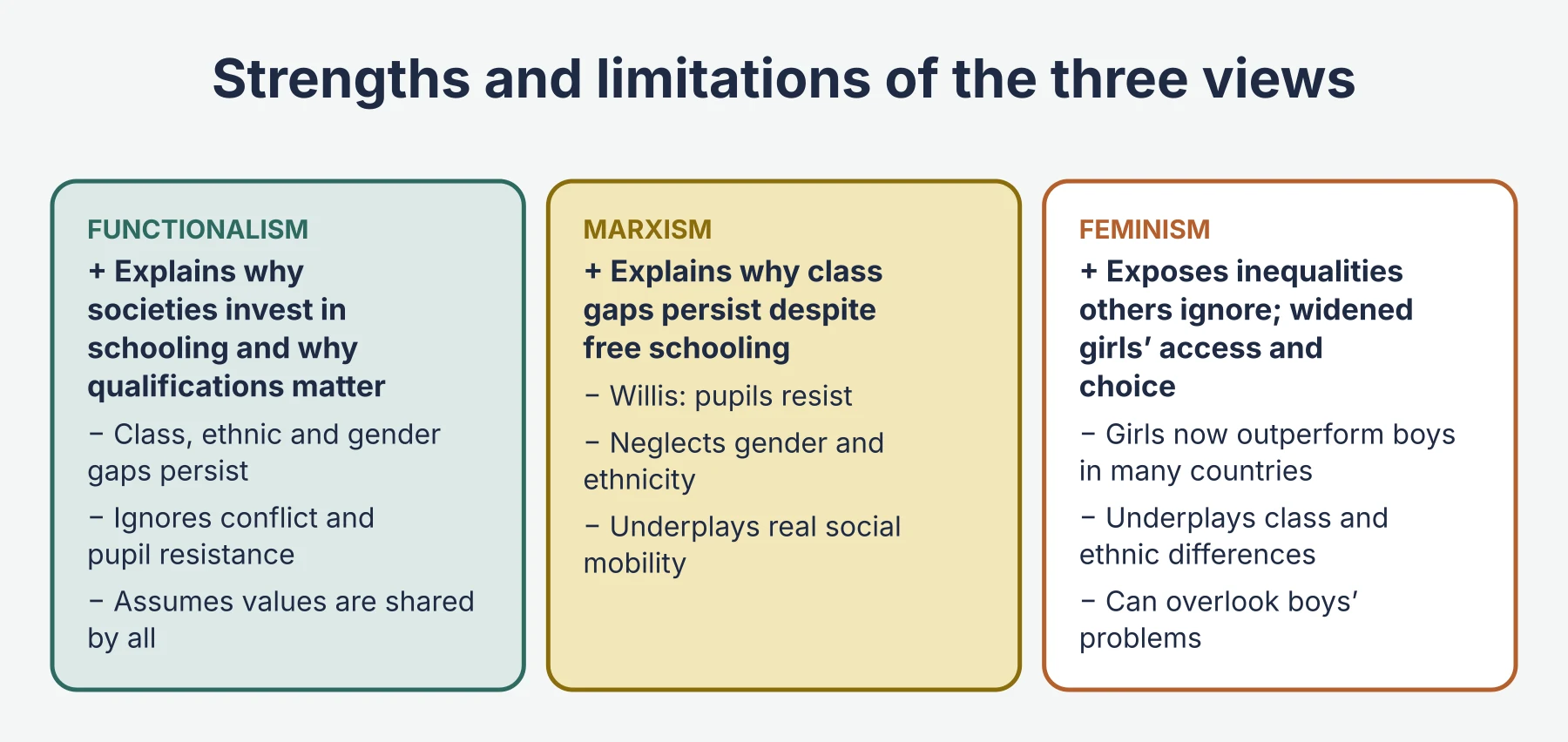
Strengths and limitations. Functionalism explains why societies invest heavily in schooling and why qualifications matter for jobs. But evidence of persistent class, ethnic and gender gaps in achievement suggests education is not meritocratic; it ignores conflict and pupil resistance; and it assumes the values schools teach are shared by everyone rather than those of powerful groups.
The Marxist view (5.2.2)
Marxists argue education reproduces class inequality and legitimates it, so that the working class accepts its position.
- Socialisation and social control as ideological control. Louis Althusser called education an ideological state apparatus: it passes on ruling-class ideas so that inequality seems natural.
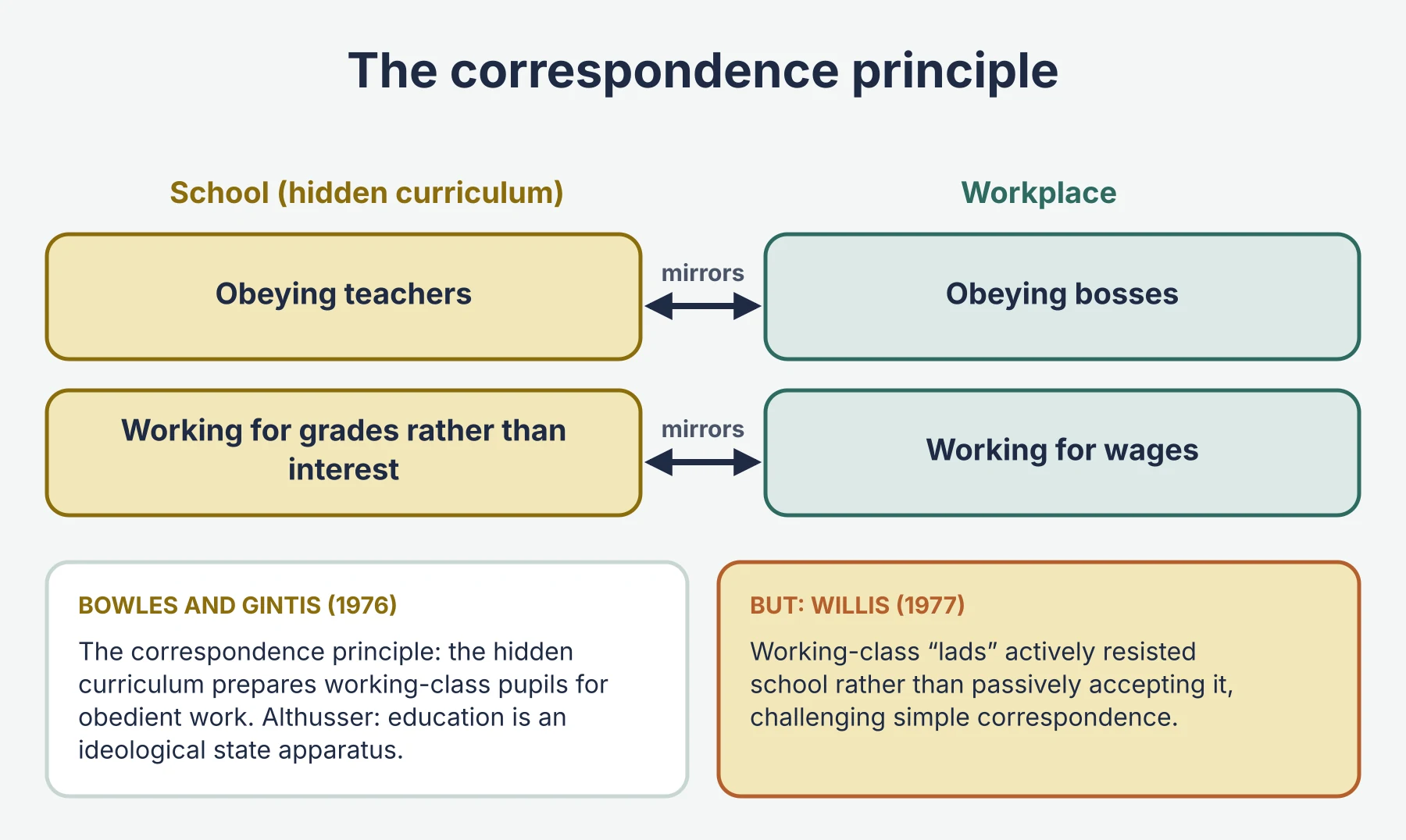
- The hidden and official curriculum. Samuel Bowles and Herbert Gintis (1976), in their study of American schooling, proposed the correspondence principle: the hidden curriculum mirrors the workplace. Obeying teachers prepares pupils to obey bosses; working for grades rather than interest prepares them for work done for wages. The official curriculum also privileges some knowledge, such as academic subjects with middle-class associations, over others.
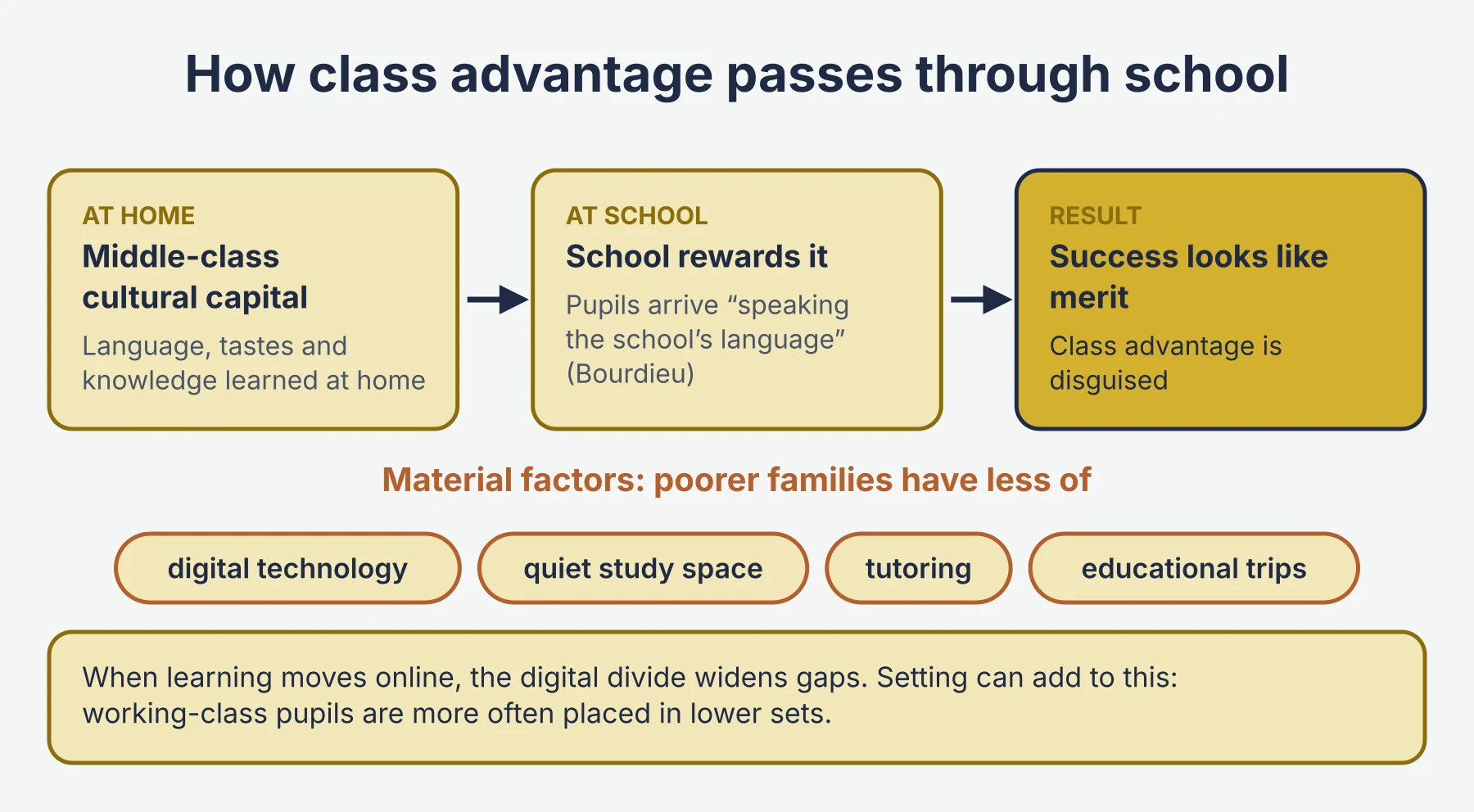
- Middle-class culture and cultural capital. Pierre Bourdieu argued schools reward the cultural capital of the middle class: language, tastes and knowledge learned at home. Middle-class children arrive already “speaking the school’s language”, so their success looks like merit.
- The myth of meritocracy. Bowles and Gintis argued the belief that success depends on ability disguises the fact that class background strongly predicts outcomes. Those who fail blame themselves, not the system.
- Material factors. Poorer families have less access to digital technology, quiet study space, tutoring and educational trips. When learning moves online, the digital divide widens gaps.
- Setting by ability. Working-class pupils are more often placed in lower sets, where expectations and exam entry levels may be lower, limiting their chances.
Strengths and limitations. Marxism explains why class gaps persist despite free schooling and links education to the economy. But Paul Willis (1977), studying working-class “lads”, showed that pupils actively resist school rather than passively accepting it, which challenges the idea of simple correspondence. Marxism neglects gender and ethnicity, and it underplays the real social mobility that some working-class pupils achieve.
The feminist view (5.2.3)
Feminists argue education has helped perpetuate gender inequality, although liberal feminists stress real progress while radical feminists stress continuing patriarchy.
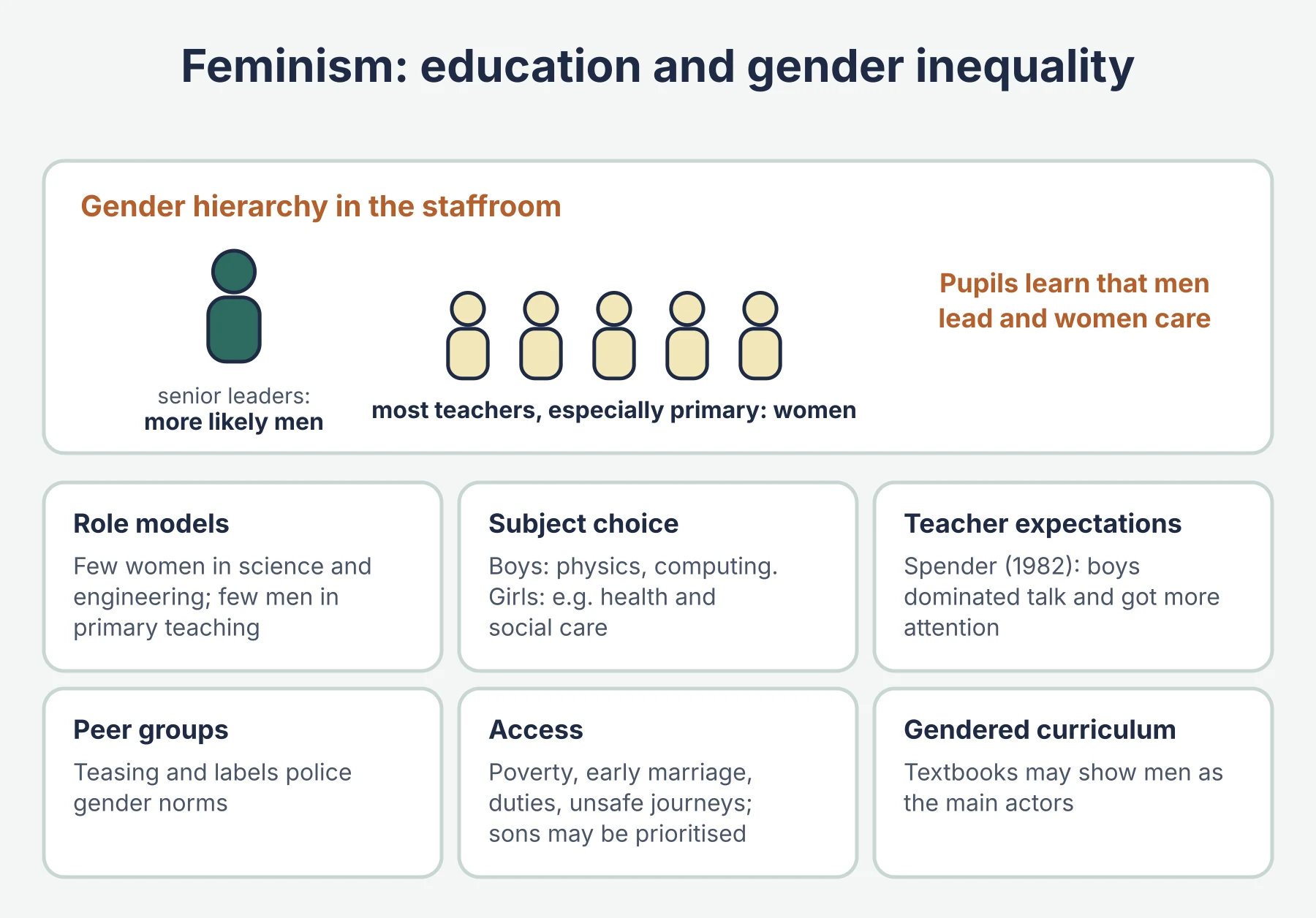
- Patriarchal culture and male power. Schools have historically been organised around male norms. In many education systems women make up most of the teaching workforce, especially in primary schools, while men are more likely to hold senior leadership posts.
- Gender hierarchy and role models. Seeing men as head teachers and women as classroom teachers teaches pupils that men lead and women care. Few female role models in science and engineering, and few male role models in primary teaching, reinforce stereotypes.
- Access to education. In some societies girls have less access to schooling because of poverty, early marriage, household duties or safety on the journey to school. Where resources are scarce, families may prioritise sons.
- Gendered curriculum and subject choice. Boys are more likely to choose physics and computing and girls more likely to choose subjects such as health and social care. Textbooks and examples may present men as the main actors in history and science.
- Teacher expectations. Teachers may expect boys to be confident and girls to be quiet and neat. Dale Spender (1982) found boys dominated classroom talk and received more teacher attention.
- Peer groups and social control. Peers police gender norms through teasing and labels, for example criticising girls who are seen as too assertive or boys who are seen as studious or “unmasculine”.
Strengths and limitations. Feminism draws attention to inequalities others ignore and has influenced policies to widen girls’ access and subject choice. But in many countries girls now outperform boys at school level, which suggests the picture has changed; the view may underplay class and ethnic differences between girls; and it can overlook the problems some boys face.
Worked example: an annotated part (e) answer extract
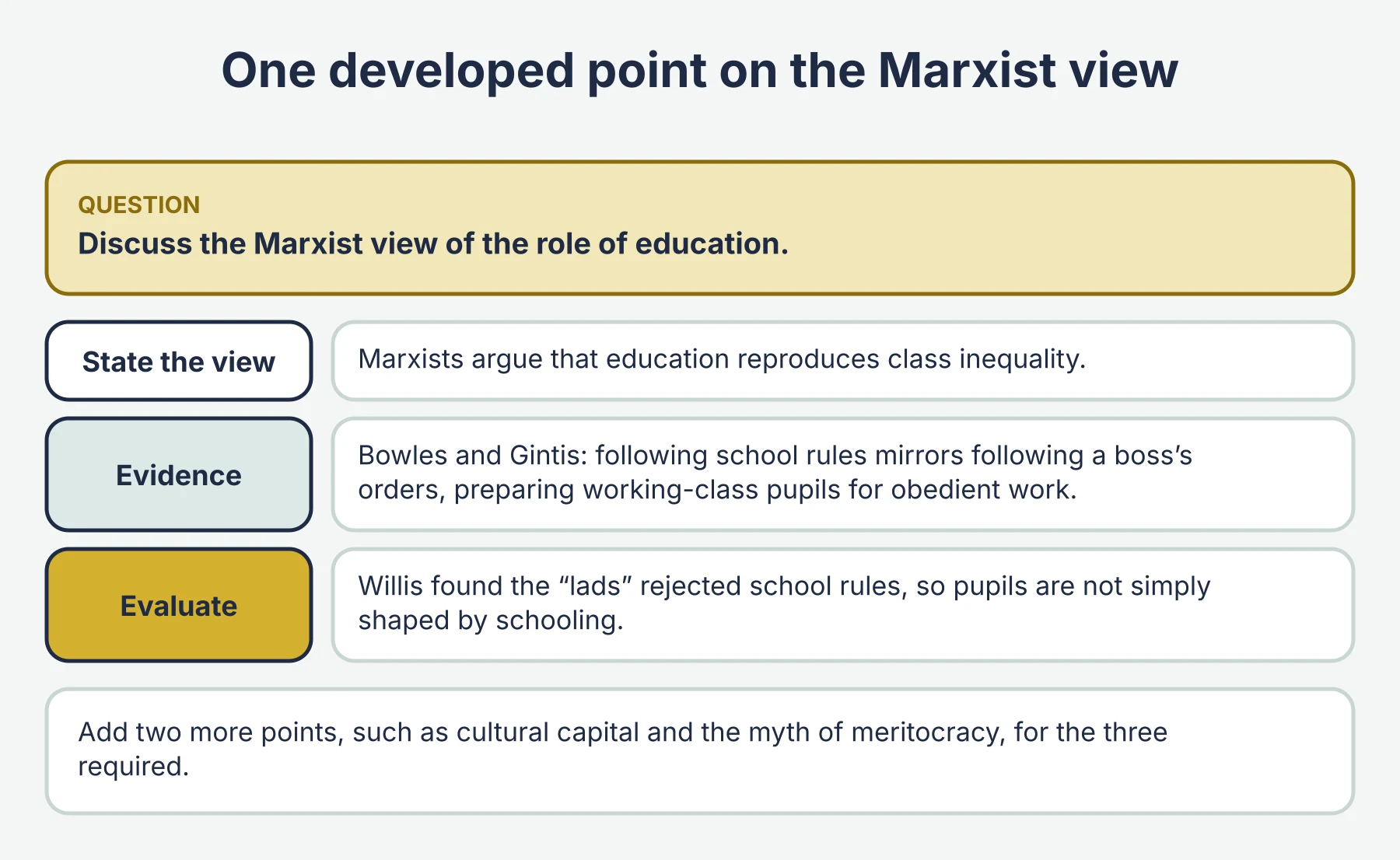
Discuss the Marxist view of the role of education.
“Marxists argue that education reproduces class inequality [states the view]. Bowles and Gintis’s correspondence principle suggests the hidden curriculum prepares working-class pupils for obedient work, because following school rules mirrors following a boss’s orders [named evidence and mechanism]. However, Willis found the ‘lads’ rejected school rules, which suggests pupils are not simply shaped by schooling [evaluation].”
Two further developed points, such as cultural capital and the myth of meritocracy, complete the three required.
Common mistakes
- Treating setting by ability as only positive or only negative. Functionalists see efficient teaching; Marxists see class sorting; both readings should appear in evaluation.
- Describing the correspondence principle as “school is like work” without explaining the specific parallel.
- Saying “feminists think school is sexist” with no mechanism such as teacher expectations or subject choice.
- Forgetting that the syllabus asks for strengths and limitations of each view.
- Using global access to education as a feminist point without linking it to patriarchal norms or poverty.
Exam technique
- Explain three: one concept per paragraph, each with a mechanism. For “Explain three functions of education”, use socialisation, social control and role allocation, not three versions of socialisation.
- Discuss: three developed points plus brief evaluation, ideally using a named sociologist.
- Evaluate: for “Evaluate the view that education is meritocratic”, use functionalism for the view, Marxist and feminist arguments against, and conclude with a judgement about who benefits.
Condense with the key question 5.2 revision notes and test yourself with the key question 5.2 practice questions. Then move to differences in educational achievement (key question 5.3), or review education and schooling (key question 5.1).
Related resources
-
Practice questions
Cambridge IGCSE Sociology (0495): Education – What are the roles and functions of education? – Practice Questions
Original Cambridge IGCSE Sociology 0495 practice on key question 5.2: functionalist, Marxist and feminist views of education's roles, with full answers.
Sociology · Cambridge · IGCSE
Try questions -
Revision notes
Cambridge IGCSE Sociology (0495): Education – What are the roles and functions of education? – Revision Notes
Revision notes for Cambridge IGCSE Sociology 0495 key question 5.2: functionalist, Marxist and feminist views of education, key terms, traps and a self-test.
Sociology · Cambridge · IGCSE
Revise topic -
Study guides
Cambridge IGCSE Sociology (0495): Education – What factors help to explain differences in educational achievement and experience?
Cambridge IGCSE Sociology 0495 key question 5.3: patterns and explanations of achievement by class, ethnicity, gender and between countries, with evaluation.
Sociology · Cambridge · IGCSE
Read guide
Related articles
Get free revision emails (optional)
Occasional emails with practice questions, worked explanations and links to free resources for the qualification and subjects you choose. No spam, and you can unsubscribe from any email. The free tools on this site never need an email.