
Study Guides
Cambridge IGCSE Sociology (0495): Education – What is education and schooling?
Cambridge IGCSE Sociology 0495 key question 5.1: formal and informal education, the official and hidden curriculum, types of school and alternative approaches.
- Subject
- Sociology
- Level
- IGCSE
- Topic
- Paper 2 – Family, Education and Crime
- Author
- Marlbridge Academic Team
- Updated
- Reviewed by
- Naqiya Yousaf (what this means)
Aligned to Cambridge IGCSE Sociology (0495), 2025-2027. Official specification .
Syllabus page (what it covers and how it is assessed): Cambridge IGCSE Sociology.
Syllabus points this page covers
0495
- 5.1 Education – What is education and schooling?
Found an error? Report a correction.
Need help with this topic? Request a free trial class for IGCSE Sociology (0495).
This guide covers key question 5.1 What is education and schooling? in the Education topic of Cambridge IGCSE Sociology (0495) Paper 2, 2025–2027 syllabus. The family, education and crime study guide introduces the hidden curriculum; this page covers the whole of 5.1, including the effectiveness of seven types of school and five alternative approaches, which the overview only lists.
What key question 5.1 covers
- 5.1.1 Formal and informal education: the differences between them; the official curriculum (testing, syllabus content and subjects); the hidden curriculum (norms and values, punctuality, conformity, gender roles).
- 5.1.2 Different types of schools: the effectiveness, strengths and limitations of state/public, private, selective/non-selective, single-sex, co-educational, faith and international schools.
- 5.1.3 Alternative approaches to education: online learning, homeschooling, unschooling, vocational learning, progressive schooling, and their strengths and limitations.
Key question 5.1 is mainly descriptive and evaluative; the theories of what education does for society belong to 5.2. You can still use theory as evidence, for example a Marxist reading of the hidden curriculum, but the question set on 5.1 will usually ask about types, features or effectiveness.
Formal and informal education (5.1.1)
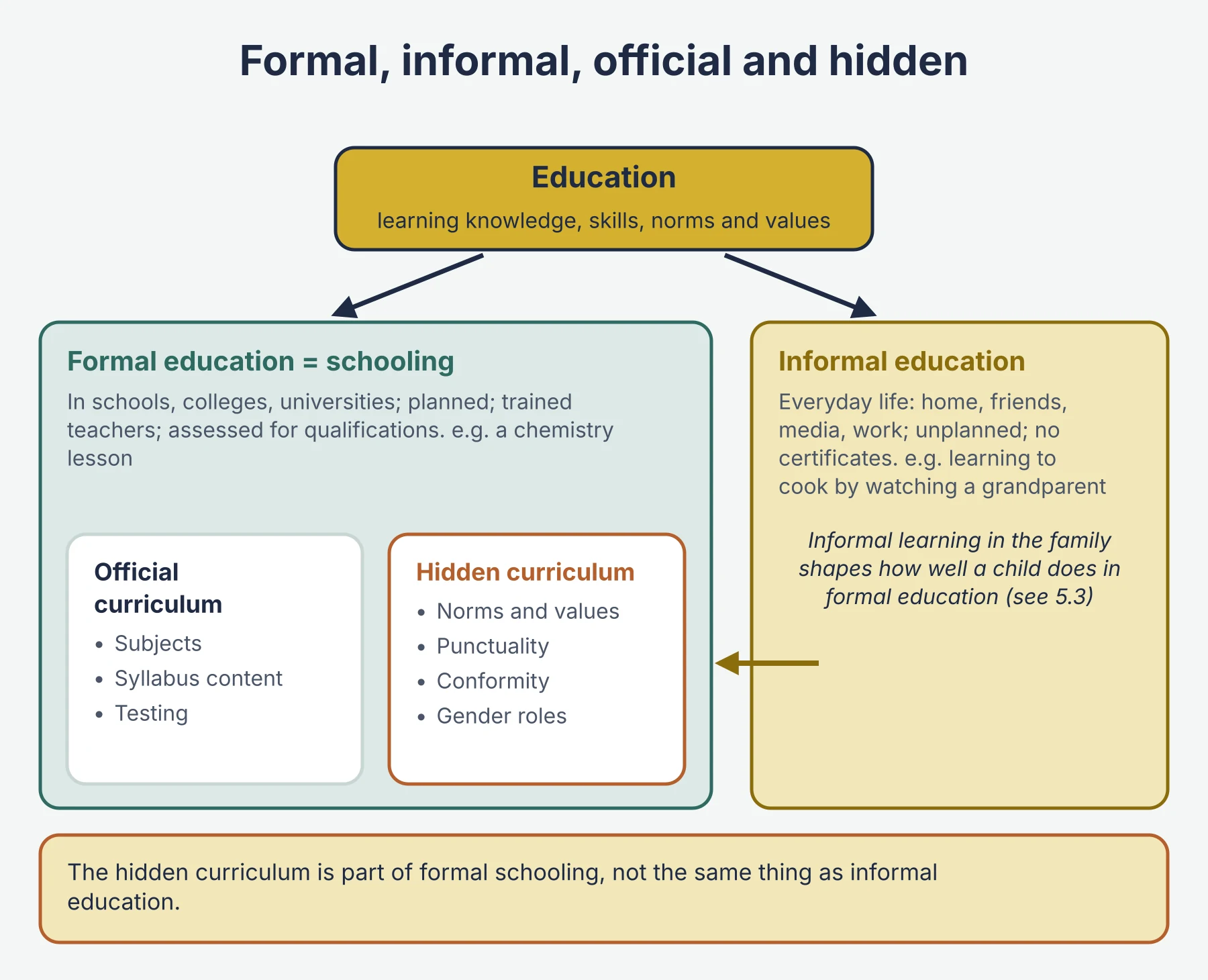
Education is the process of learning knowledge, skills, norms and values. Schooling is the part of education delivered by schools.
| Formal education | Informal education |
|---|---|
| Takes place in institutions such as schools, colleges and universities | Takes place in everyday life: at home, among friends, through media and work |
| Planned curriculum and timetable | Unplanned and often unconscious |
| Trained, paid teachers | Parents, peers, relatives, online content creators |
| Assessed, leading to qualifications | No certificates; learning shows in behaviour and skills |
| Example: a chemistry lesson | Example: a child learning to cook by watching a grandparent |
The distinction matters because many sociologists argue informal learning, particularly in the family, shapes how well a child does in formal education. That link is developed in 5.3.
The official curriculum is what schools openly set out to teach. It has three parts named in the syllabus:
- Subjects: which subjects are compulsory and which have higher status (for example, sciences and mathematics often carry more prestige than arts or vocational subjects).
- Syllabus content: what is taught within each subject, such as whose history or which literature. Choices about content reflect decisions about what knowledge counts.
- Testing: examinations and assessment measure attainment, rank pupils and shape what teachers emphasise (“teaching to the test”).
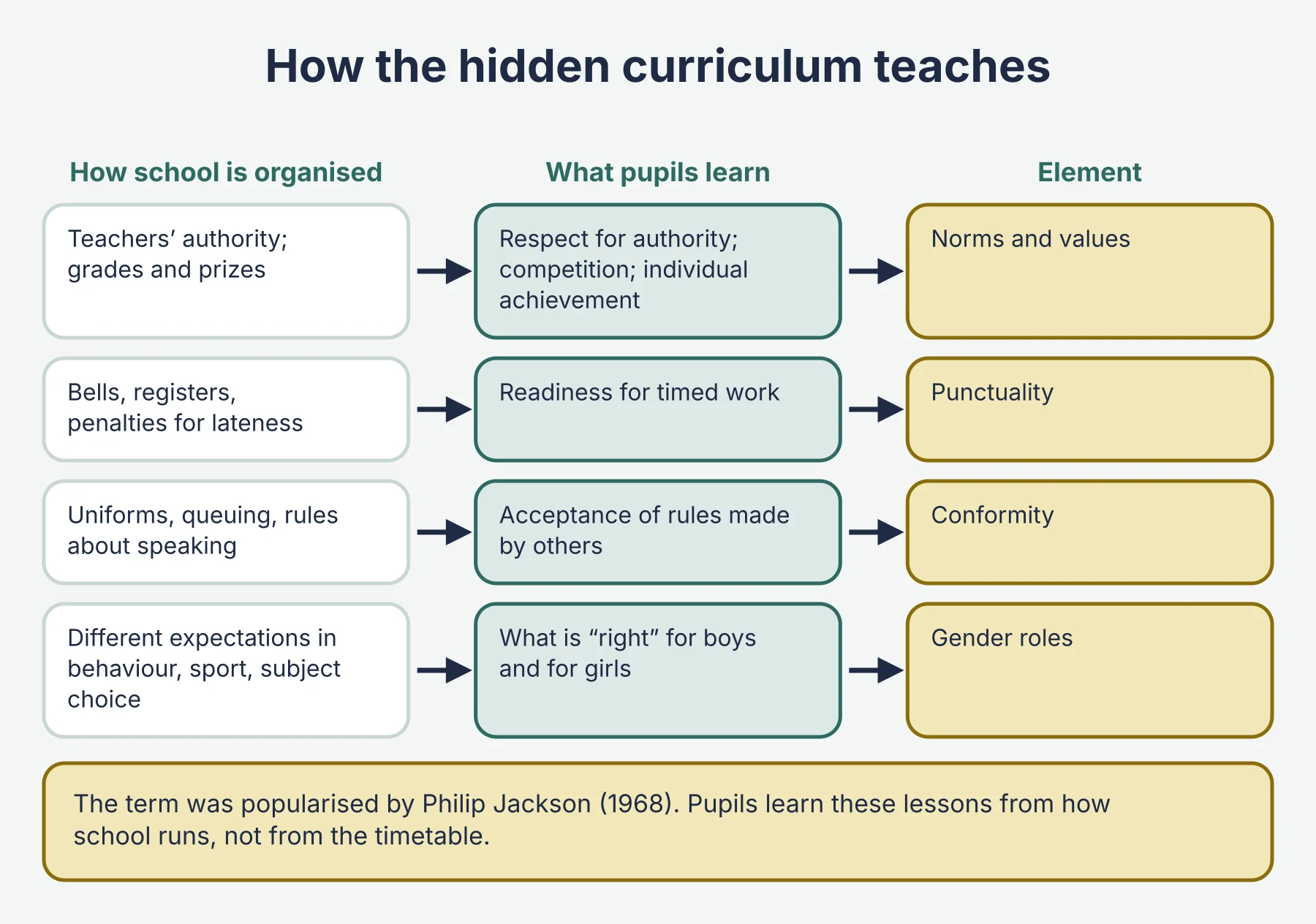
The hidden curriculum is what pupils learn from the way schooling is organised rather than from lessons. The term was popularised by Philip Jackson (1968). The syllabus names four elements:
- Norms and values: respect for authority, competition through grades and prizes, individual achievement.
- Punctuality: bells, registers and penalties for lateness prepare pupils for timed work.
- Conformity: uniforms, queuing and rules about speaking teach acceptance of rules made by others.
- Gender roles: different expectations of boys and girls in behaviour, sport or subject choice.
Types of schools and their effectiveness (5.1.2)
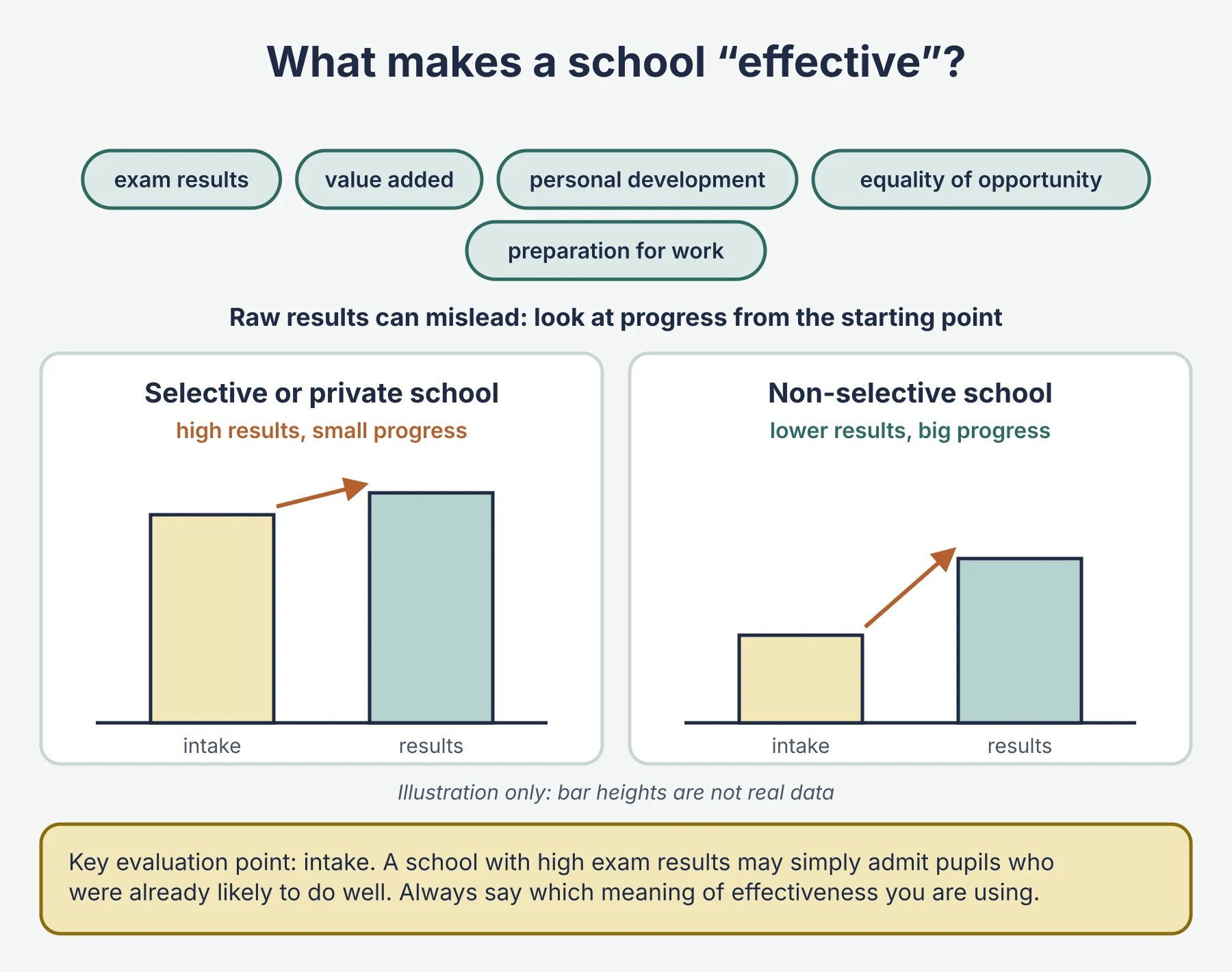
“Effectiveness” can mean exam results, value added (progress from the starting point), personal development, equality of opportunity or preparation for work. Always say which meaning you are using.
| Type | Strength | Limitation |
|---|---|---|
| State / public (government-funded, free) | Free access for all; often mixed intake, encouraging social cohesion | Larger classes and fewer resources in some areas; quality may depend on neighbourhood |
| Private (fee-paying) | Smaller classes, more resources, strong networks | Fees exclude most families, reproducing class advantage |
| Selective (entry by test or interview) | Teaching pitched to high attainers | Tests favour children with tutoring and cultural capital; rejected pupils may be labelled as failures |
| Non-selective (comprehensive) | Equal access; avoids early labelling | Admissions by catchment can still sort pupils by house prices |
| Single-sex | May reduce gender stereotyping in subject choice and classroom dominance | Less everyday experience of working with the other sex; results may reflect intake |
| Co-educational | Reflects wider society; prepares pupils to work together | Boys may dominate classroom talk and teacher attention |
| Faith | Shared ethos and community; often good discipline | May be socially selective; may limit exposure to other beliefs |
| International | Global curricula and multilingual skills; prepares for mobility | Usually fee-paying; may separate elites from the local population |
Note that “public school” means a free, government-funded school in many countries but an elite fee-paying school in England. Define your term if you use it.
The key evaluation point for any comparison is intake. A private or selective school with high exam results may simply admit pupils who were already likely to do well. Measuring effectiveness fairly means looking at progress, not raw results.
Alternative approaches to education (5.1.3)
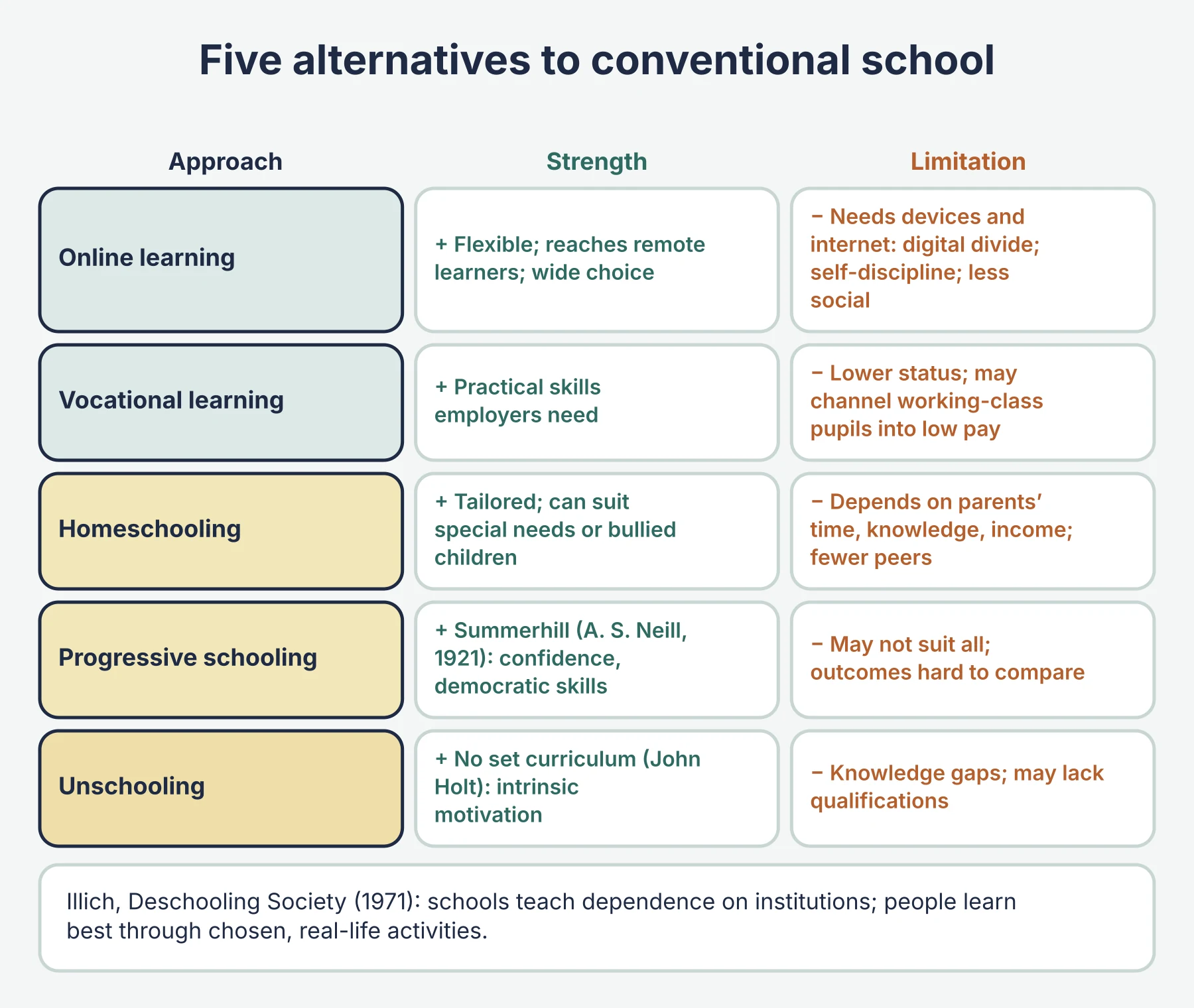
- Online learning: lessons delivered through the internet, live or self-paced. Strengths: flexible, reaches remote learners, wide choice of courses. Limitations: needs reliable devices and internet access, so it can widen the digital divide; requires self-discipline; less social interaction.
- Homeschooling: parents educate children at home, often following a curriculum. Strengths: tailored to the child; can suit children with special needs or those who were bullied. Limitations: depends heavily on parents’ time, knowledge and income; reduced contact with peers; harder to monitor for quality.
- Unschooling: a form of home education with no set curriculum, where children follow their own interests; associated with the American educator John Holt. Strengths: intrinsic motivation and independence. Limitations: gaps in knowledge; may leave young people without recognised qualifications.
- Vocational learning: education for particular jobs, such as apprenticeships and technical courses. Strengths: practical skills that meet employers’ needs. Limitations: often lower status than academic routes; may channel working-class pupils into lower-paid work.
- Progressive schooling: child-centred schools that give pupils a say in how they learn. Summerhill, founded by A. S. Neill in 1921, lets pupils choose whether to attend lessons and run the school through meetings. Strengths: confidence and democratic skills. Limitations: may not suit all children; outcomes are hard to compare.
Ivan Illich’s Deschooling Society (1971) offers a critical background to these alternatives: he argued schools teach dependence on institutions and that people learn best through chosen, real-life activities.
Worked example: planning a part (f) answer
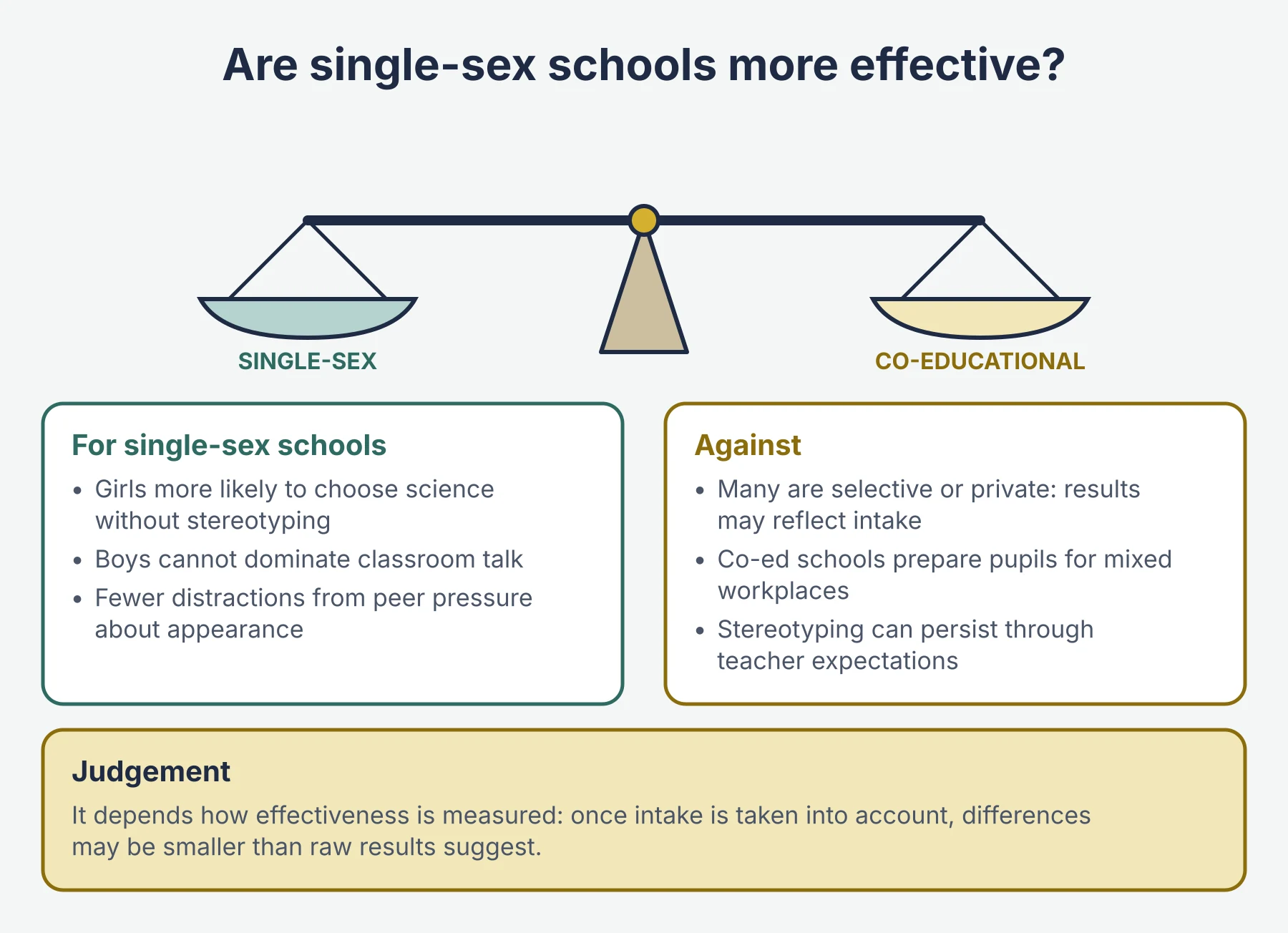
Evaluate the view that single-sex schools are more effective than co-educational schools.
- For: girls in single-sex schools may be more likely to choose science subjects without gender stereotyping; boys cannot dominate classroom talk; fewer distractions from peer pressure about appearance.
- Against: many single-sex schools are selective or private, so high results may reflect intake, not the type of school; co-educational schools prepare pupils for mixed workplaces; gender stereotyping can still occur in single-sex settings through teacher expectations and the hidden curriculum.
- Judgement: effectiveness depends on how it is measured; when intake is taken into account, the differences may be smaller than raw results suggest.
Common mistakes
- Using “hidden curriculum” and “informal education” as synonyms: the hidden curriculum is part of formal schooling.
- Saying a type of school is “better” without defining effectiveness.
- Forgetting intake when comparing results of private, selective or faith schools.
- Describing homeschooling and unschooling as the same: unschooling has no set curriculum.
- Giving strengths of an alternative approach without any limitation, when the syllabus asks for both.
Exam technique
- Define: one precise sentence with an example (“vocational learning is education for a particular job, such as an electrician’s apprenticeship”).
- Explain three: one paragraph per point, each identifying a feature and saying why it matters.
- Discuss: for example, “Discuss the strengths and limitations of online learning”: three developed points with evidence and some balance.
- Evaluate: argue both sides and conclude with a judgement that refers back to how effectiveness is measured.
Use the key question 5.1 revision notes to condense this and the key question 5.1 practice questions to test yourself. Then continue with the roles and functions of education (key question 5.2).
Related resources
-
Practice questions
Cambridge IGCSE Sociology (0495): Education – What is education and schooling? – Practice Questions
Original Cambridge IGCSE Sociology 0495 practice on key question 5.1: formal and informal education, curricula, types of school and alternatives, with answers.
Sociology · Cambridge · IGCSE
Try questions -
Revision notes
Cambridge IGCSE Sociology (0495): Education – What is education and schooling? – Revision Notes
Revision notes for Cambridge IGCSE Sociology 0495 key question 5.1: formal and informal education, curricula, school types and alternative approaches.
Sociology · Cambridge · IGCSE
Revise topic -
Study guides
Cambridge IGCSE Sociology (0495): Education – What are the roles and functions of education?
Cambridge IGCSE Sociology 0495 key question 5.2: functionalist, Marxist and feminist views of the roles of education, with named evidence and evaluation.
Sociology · Cambridge · IGCSE
Read guide
Related articles
Get free revision emails (optional)
Occasional emails with practice questions, worked explanations and links to free resources for the qualification and subjects you choose. No spam, and you can unsubscribe from any email. The free tools on this site never need an email.