
Study Guides
Cambridge IGCSE Sociology (0495): Family – What is the role of the family for the individual and society?
Cambridge IGCSE Sociology 0495 key question 4.2: functionalist, Marxist and feminist views of the family, their evaluation and whether family life is positive.
- Subject
- Sociology
- Level
- IGCSE
- Topic
- Paper 2 – Family, Education and Crime
- Author
- Marlbridge Academic Team
- Updated
- Reviewed by
- Naqiya Yousaf (what this means)
Aligned to Cambridge IGCSE Sociology (0495), 2025-2027. Official specification .
Syllabus page (what it covers and how it is assessed): Cambridge IGCSE Sociology.
Syllabus points this page covers
0495
- 4.2 Family – What is the role of the family for the individual and society?
Found an error? Report a correction.
Need help with this topic? Request a free trial class for IGCSE Sociology (0495).
This guide covers key question 4.2 What is the role of the family for the individual and society? in Cambridge IGCSE Sociology (0495) Paper 2, 2025–2027 syllabus. The family, education and crime study guide gives one mechanism for each perspective; this page works through every bullet point the syllabus lists, with named evidence and the evaluation each perspective attracts.
What key question 4.2 covers
- 4.2.1 Functionalist views: how the family benefits its members and society; functions of the family; the loss of functions debate; how functions have changed over time; “warm bath” theory; the importance of the nuclear family.
- 4.2.2 Marxist views: how the family benefits capitalism; exploitation of family members; reproduction of class inequalities; the family as a unit of consumption; the family and ideological control.
- 4.2.3 Feminist views: how the family benefits patriarchy and male power; the domestic division of labour; domestic violence and abuse; joint and segregated conjugal roles; the dual burden and triple shift; decision-making; gendered socialisation.
- 4.2.4 Strengths and limitations of all three views.
- 4.2.5 Debates about whether family life is positive or negative for family members.
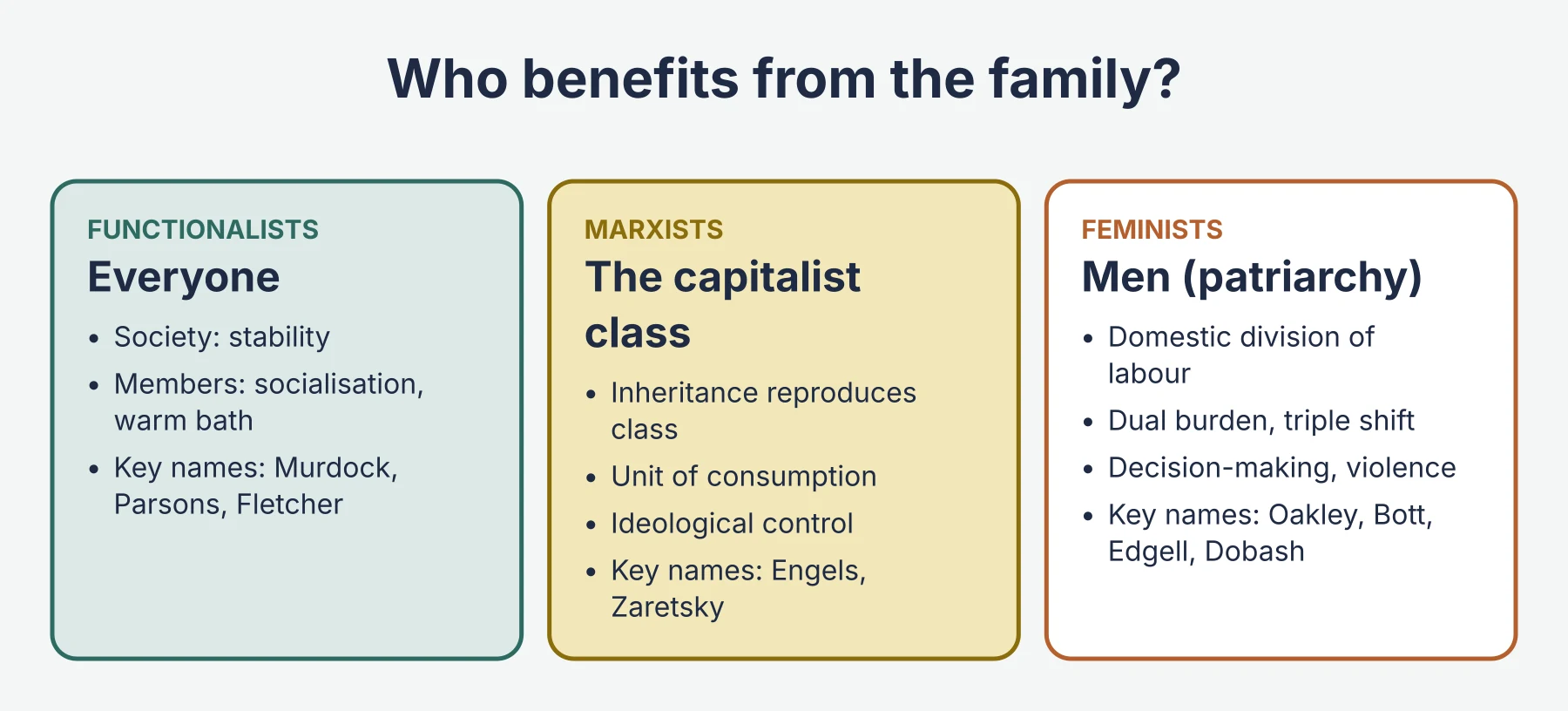
The three perspectives answer one question differently: who benefits from the family? Functionalists say everyone, Marxists say the capitalist class, feminists say men. Keeping that question in mind makes every comparison easier.
Functionalist views (4.2.1)
Functionalists see society as a system of interdependent institutions, each meeting needs that keep society stable. The family is the foundation.
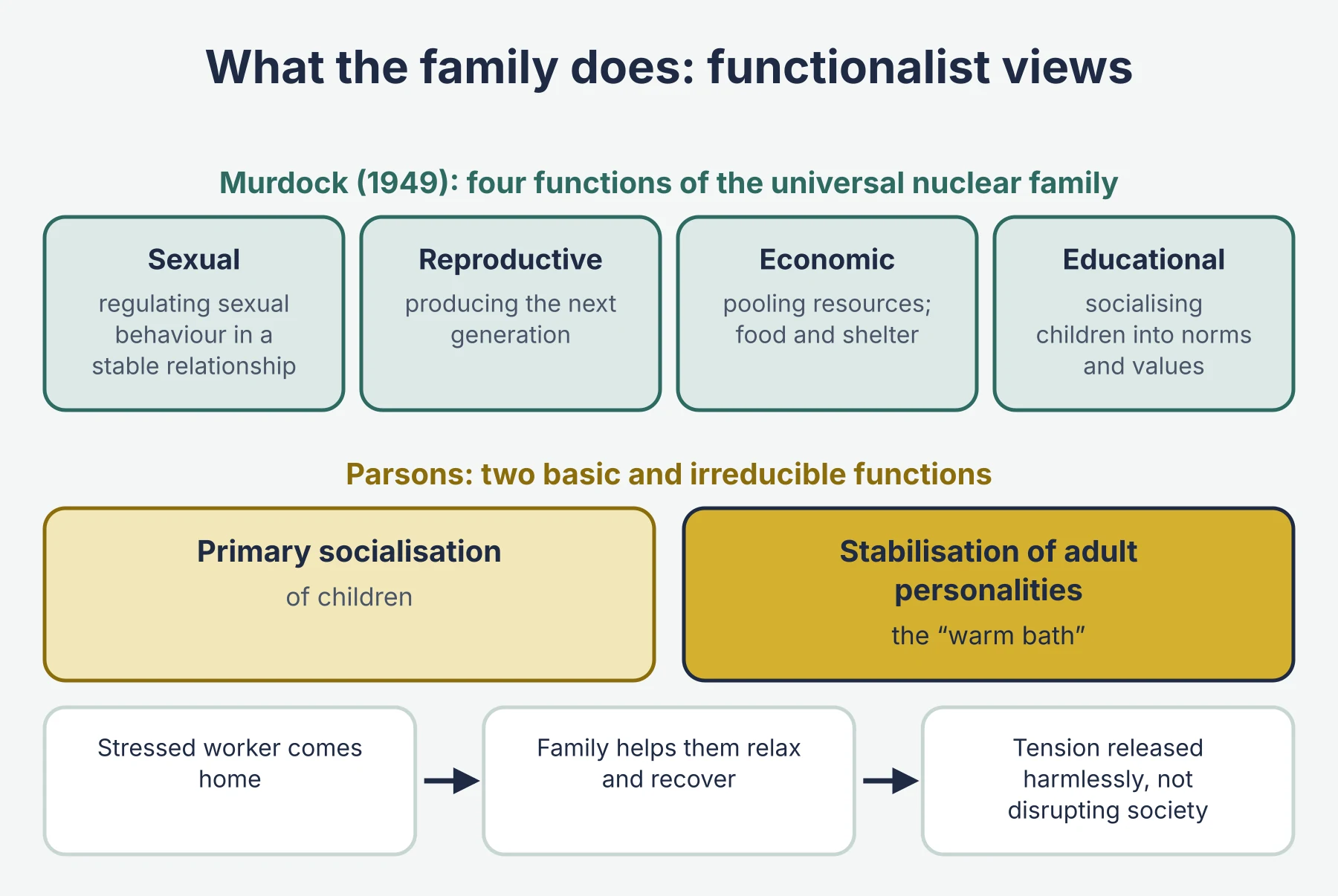
Functions of the family. George Murdock (1949), comparing a large sample of societies, claimed the nuclear family is universal because it performs four essential functions:
- Sexual: regulating sexual behaviour within a stable relationship.
- Reproductive: producing the next generation.
- Economic: pooling resources and providing food and shelter.
- Educational: socialising children into society’s norms and values.
Warm bath theory. Talcott Parsons argued the modern family has two basic and irreducible functions: the primary socialisation of children and the stabilisation of adult personalities. The second is often called the “warm bath” theory: the family is a place where a stressed worker can relax and recover, so tension is released harmlessly rather than disrupting society.
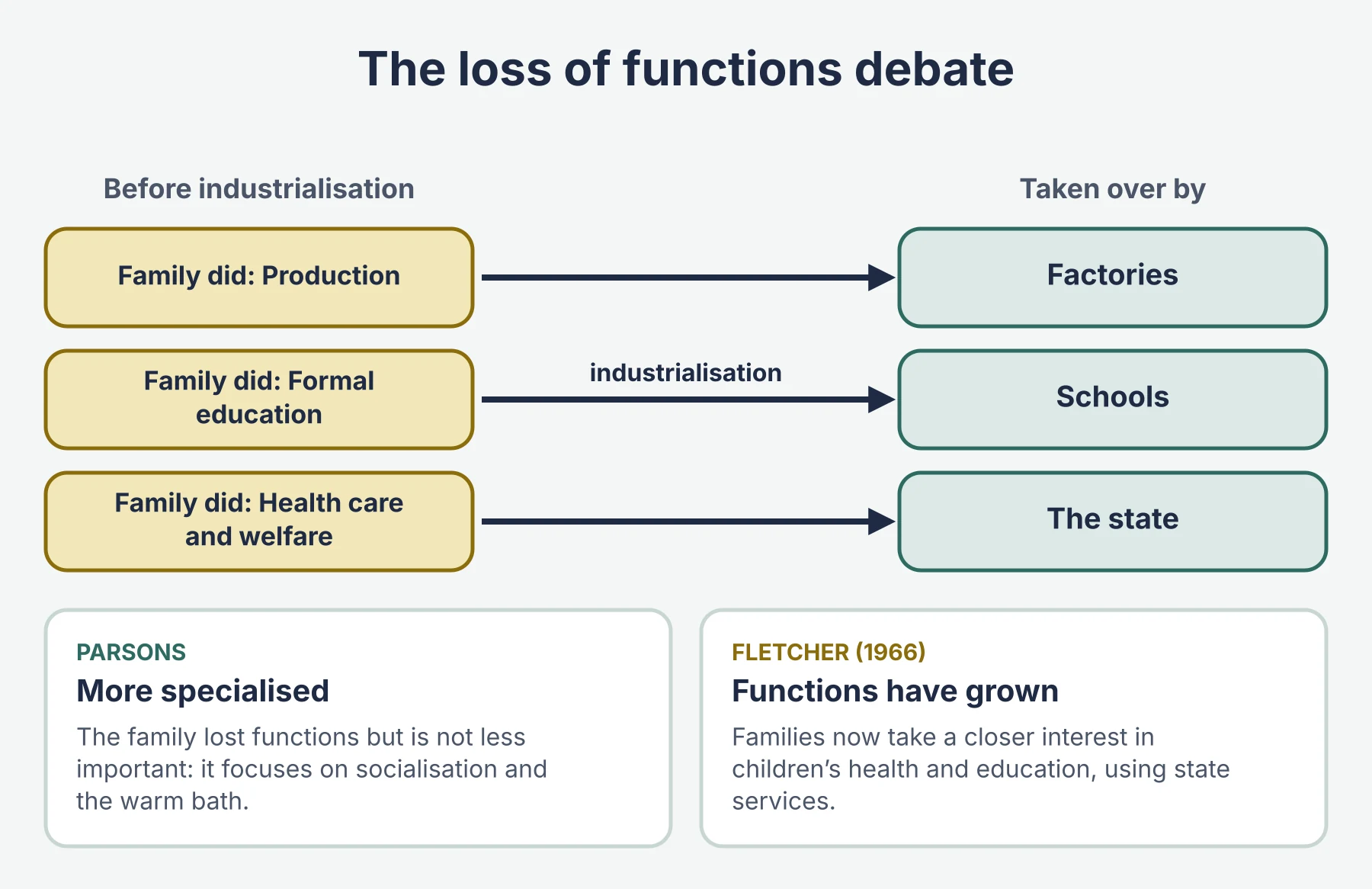
The loss of functions debate and change over time. Parsons argued that with industrialisation, other institutions took over functions the family once performed: factories took over production, schools took over formal education, and the state took over health care and welfare. The family became more specialised, not less important. Ronald Fletcher (1966) went further, arguing that the family’s functions have actually grown in importance, because families now take a closer interest in children’s health and education, using the services the state provides.
The importance of the nuclear family. Parsons argued the isolated nuclear family “fits” industrial society. It is small enough to move to where jobs are, and status in it is achieved through work rather than inherited from kin.
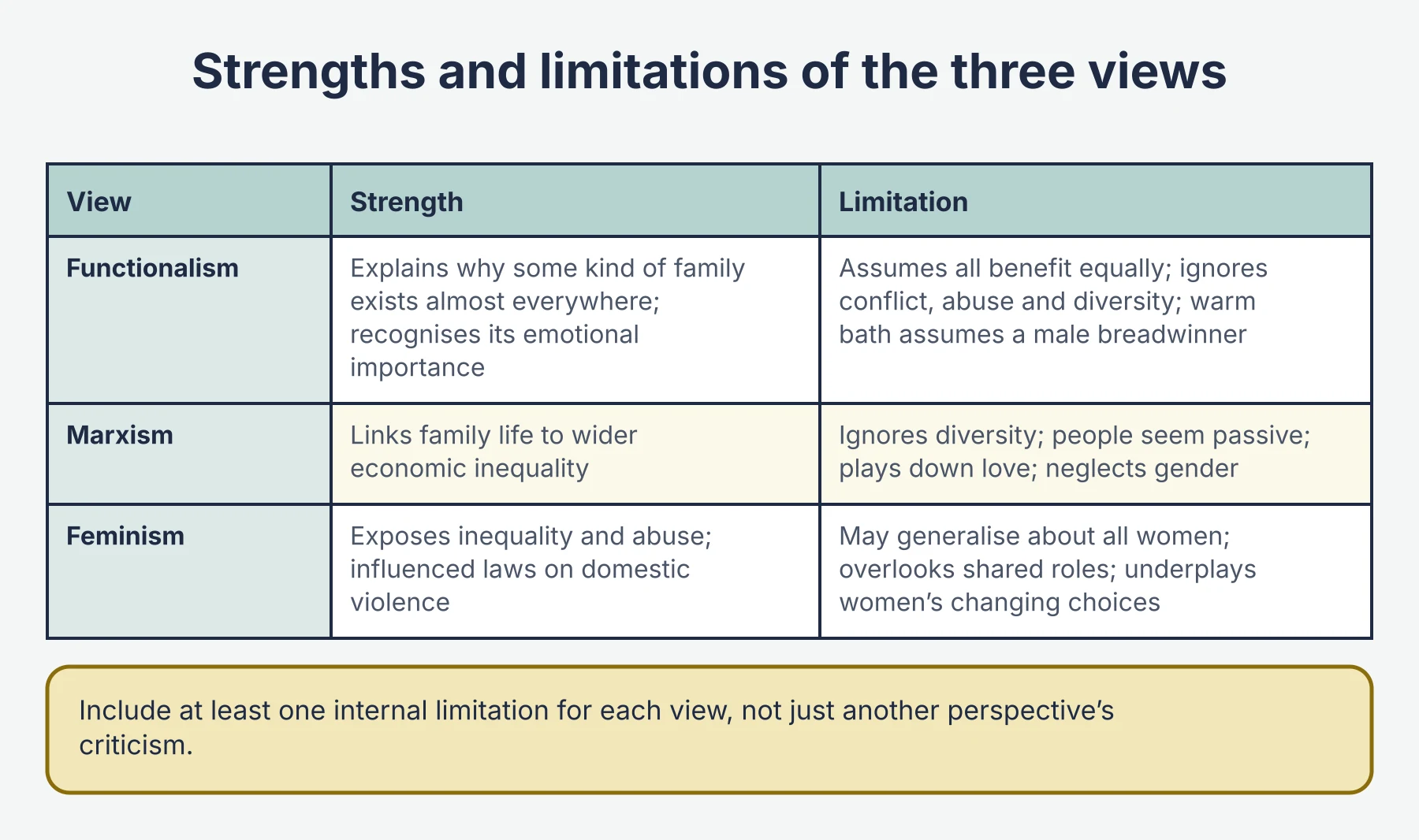
Evaluation. Functionalism explains why some kind of family exists in almost every society, and recognises its emotional importance. But it assumes all members benefit equally, ignores conflict and abuse, treats the nuclear family as the norm despite diversity, and its “warm bath” model reflects a male breadwinner whose wife provides the warmth.
Marxist views (4.2.2)
Marxists see society as divided between a ruling class that owns the means of production and a working class that sells its labour. The family serves the ruling class.
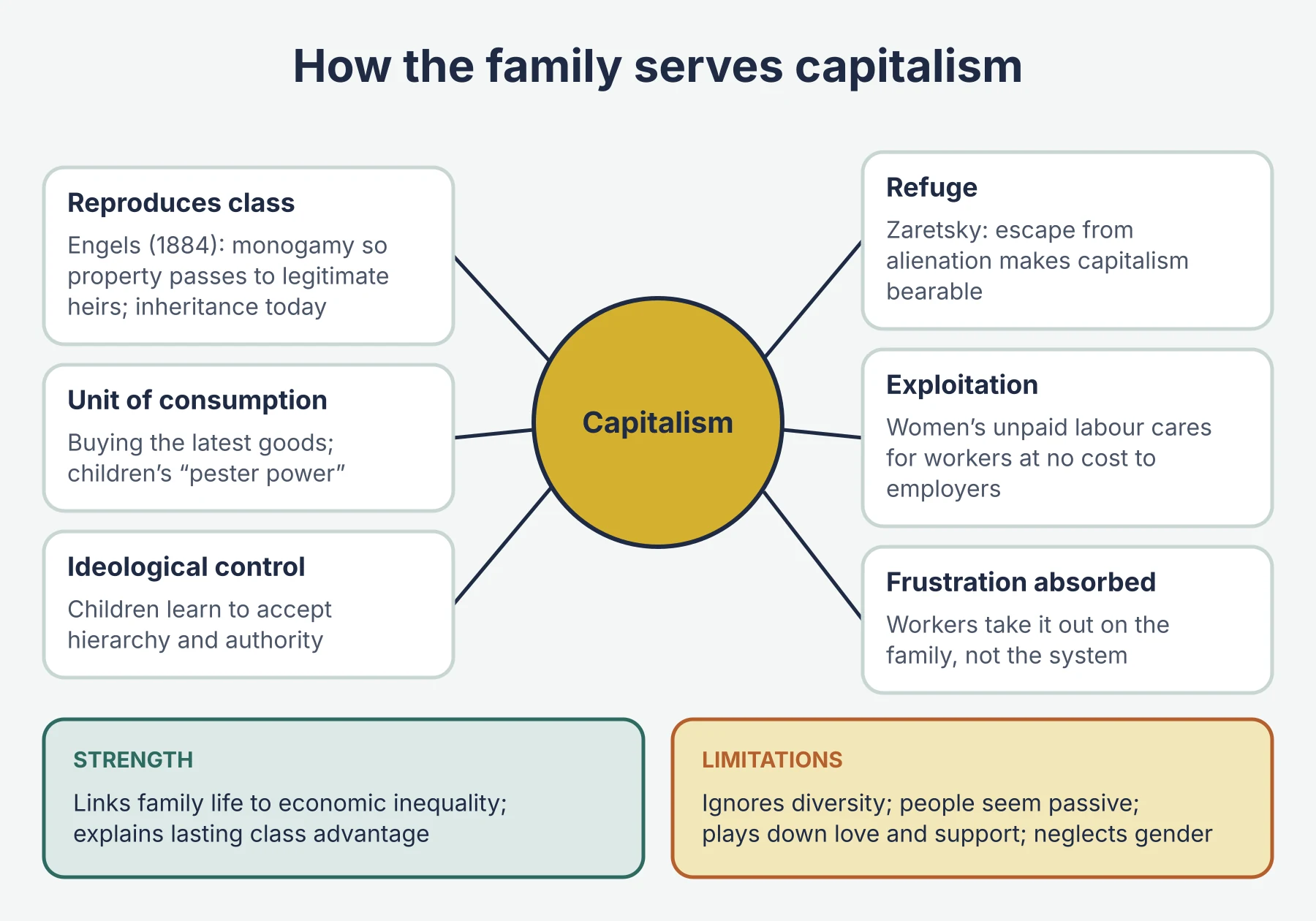
- Benefits capitalism and reproduces class inequality. Friedrich Engels (1884) argued that monogamous marriage developed so that men could be sure their property passed to their own legitimate children. Inheritance today still passes wealth, and the advantages it buys, down the generations within the same class.
- Unit of consumption. Families are encouraged to buy the latest goods, and advertisers target children, whose “pester power” adds to demand. Spending on the home generates profit for capitalists.
- Ideological control. The family teaches children to accept hierarchy and authority, preparing obedient workers. Eli Zaretsky argued the family acts as a refuge from the alienation of work, which makes capitalism bearable and so less likely to be challenged.
- Exploitation of family members. Women’s unpaid domestic labour feeds, cleans and cares for the current workforce and raises the next one at no cost to employers. A worker frustrated at work may take it out on the family rather than on the system.
Evaluation. Marxism links family life to wider economic inequality and explains the persistence of class advantage. But it ignores family diversity, treats people as passive, struggles to explain why families in non-capitalist societies were not very different, and plays down the love and support families give. Feminists argue it focuses on class and neglects gender.
Feminist views (4.2.3)
Feminists argue the family benefits patriarchy, the system of male power.
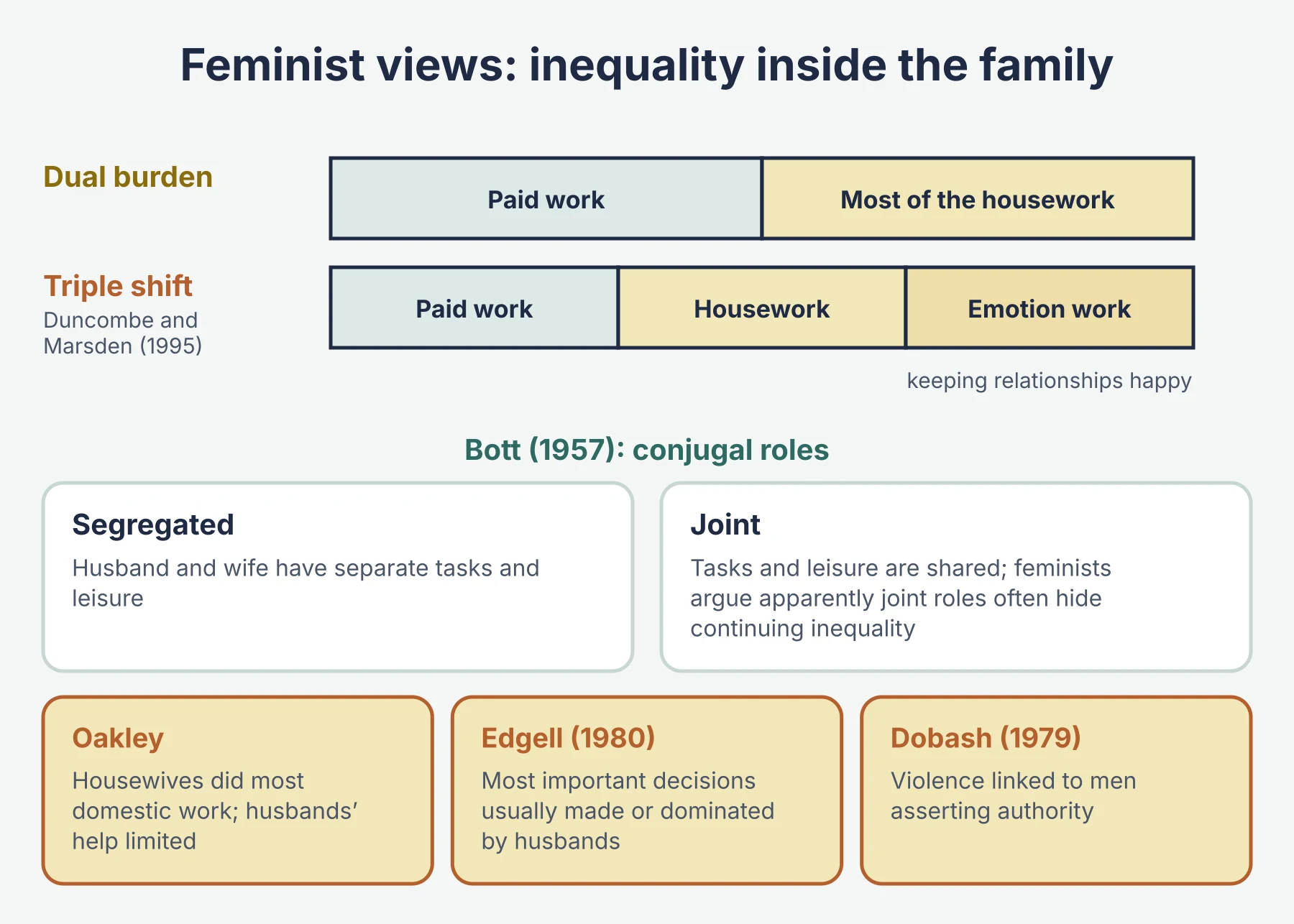
- Domestic division of labour. Ann Oakley’s research on housework in the 1970s found that housewives did most domestic work and that husbands’ help was limited, challenging claims that families had become equal.
- Joint and segregated conjugal roles. Elizabeth Bott (1957) distinguished segregated roles, where husband and wife have separate tasks and leisure, from joint roles, where tasks and leisure are shared. Feminists argue apparently joint roles often hide continuing inequality.
- Dual burden and triple shift. Women in paid work often return home to do most of the housework: the dual burden. Jean Duncombe and Dennis Marsden (1995) added emotion work, such as keeping relationships happy, to make a triple shift.
- Decision-making. Stephen Edgell’s (1980) study of middle-class couples found that the most important decisions, such as moving house or major spending, were usually made by the husband or by husband dominating a joint decision.
- Domestic violence and abuse. Russell and Rebecca Dobash (1979) argued that violence against wives was linked to men’s attempts to assert authority, showing the family can be a site of control rather than care.
- Gendered socialisation. Oakley described how parents shape gender through manipulation (encouraging “appropriate” behaviour) and canalisation (channelling children towards gendered toys and activities).
Evaluation. Feminism exposes inequality and abuse that functionalism ignores, and has influenced laws on domestic violence. But it may generalise about all women, overlook families where roles are genuinely shared, and underplay how women’s choices, education and employment have changed family life. Different feminists also disagree: some argue for reform within the family, others for its radical change.
Is family life positive or negative? (4.2.5)
| Positive | Negative |
|---|---|
| Love, emotional security and identity | Domestic violence and child abuse take place mainly in private |
| Practical and financial support across generations | Unequal division of labour and decision-making |
| Primary socialisation into norms and values | Edmund Leach (1967) argued the inward-looking nuclear family breeds tension, calling it the source of “all our discontents” |
| Care for children, sick and elderly members | Pressure on carers, such as the sandwich generation |
A strong answer recognises that experiences differ by gender, age, class and culture: family life may be positive for some members and negative for others in the same household.
Worked example: an annotated part (c) answer
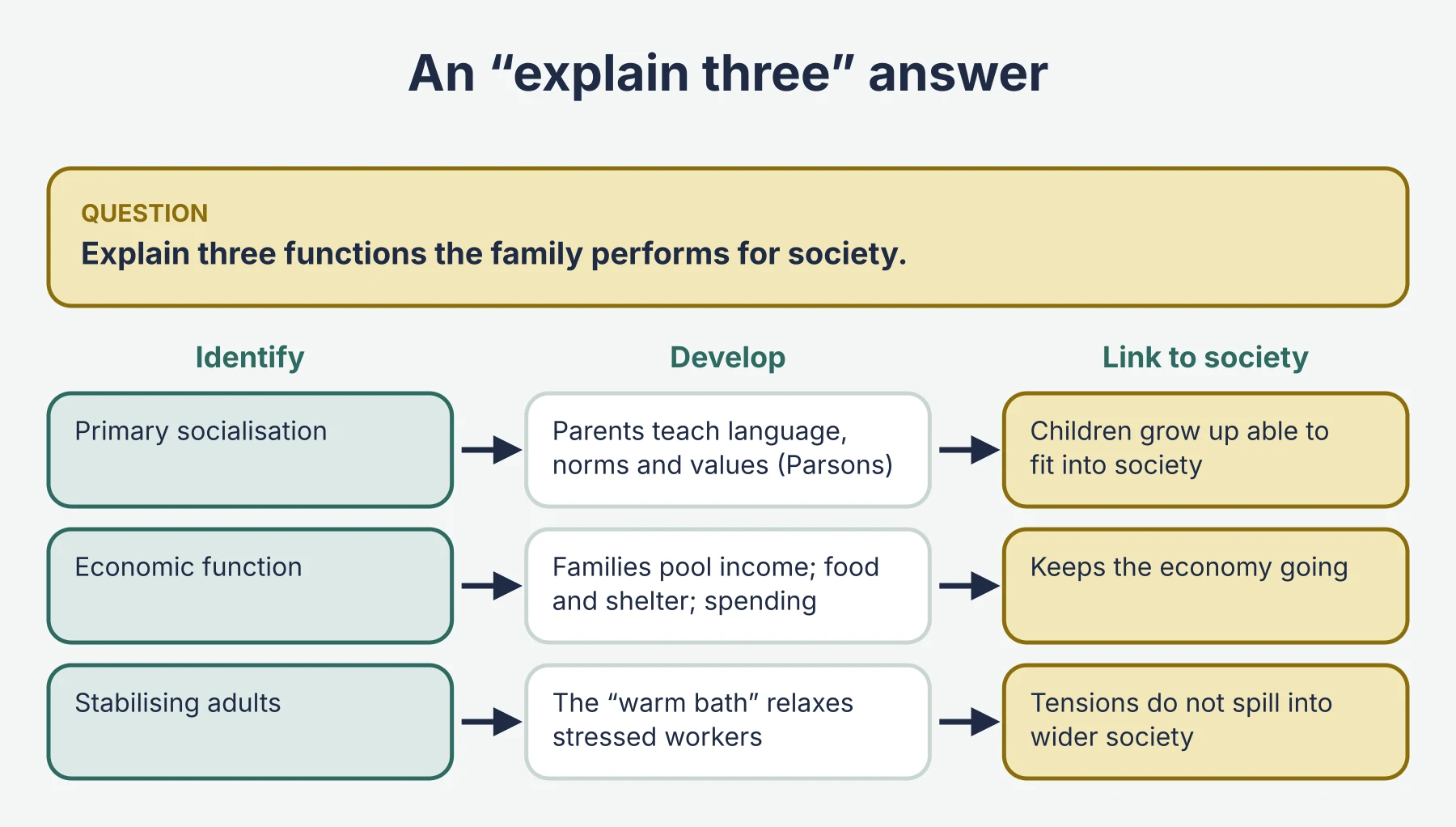
Explain three functions the family performs for society.
“First, the family carries out primary socialisation [identified]. Parents teach children language, norms and values, so they grow up able to fit into society; Parsons saw this as one of the family’s two irreducible functions [developed]. Second, it has an economic function [identified]: families pool income and provide food and shelter, and as a unit of consumption they also keep the economy going through spending [developed]. Third, it stabilises adult personalities [identified]: the ‘warm bath’ of home life relaxes stressed workers, so tensions do not spill into wider society [developed].”
Each point is named in its first sentence and then developed with a reason linking the function to society. That is the structure the “explain three” format rewards.
Common mistakes
- Describing a perspective without its specific concept: say “unit of consumption”, not “Marxists think families spend money”.
- Confusing the dual burden (paid work plus housework) with the triple shift (adding emotion work).
- Claiming Parsons said the family has become unimportant: he argued it became more specialised.
- Evaluating one perspective only with another perspective’s view; include at least one internal limitation, such as functionalism ignoring diversity.
- Writing about family types (4.1) instead of family roles when the question asks about functions.
Exam technique
- Explain questions on perspectives: name the concept, then show the mechanism (how the family does it) and the beneficiary (who gains).
- Discuss questions such as “Discuss the Marxist view of the role of the family”: three developed points, each with evidence, plus brief evaluation.
- Evaluate questions such as “Evaluate the view that the family benefits all its members”: use functionalism for the view, Marxism and feminism against it, and conclude on whether benefits depend on gender, class or age.
Revise with the key question 4.2 revision notes and practise with the key question 4.2 practice questions. Then move on to how family life is changing (key question 4.3), or review types of families (key question 4.1).
Related resources
-
Practice questions
Cambridge IGCSE Sociology (0495): Family – What is the role of the family for the individual and society? – Practice Questions
Original Cambridge IGCSE Sociology 0495 practice on key question 4.2: functionalist, Marxist and feminist views of the family's role, with full mark guidance.
Sociology · Cambridge · IGCSE
Try questions -
Revision notes
Cambridge IGCSE Sociology (0495): Family – What is the role of the family for the individual and society? – Revision Notes
Revision notes for Cambridge IGCSE Sociology 0495 key question 4.2: functionalist, Marxist and feminist roles of the family, with key terms and a self-test.
Sociology · Cambridge · IGCSE
Revise topic -
Study guides
Cambridge IGCSE Sociology (0495): Family – How is family life changing?
Cambridge IGCSE Sociology 0495 key question 4.3: demographic change, industrialisation, trends in marriage and divorce, and changing roles in the family.
Sociology · Cambridge · IGCSE
Read guide
Related articles
Get free revision emails (optional)
Occasional emails with practice questions, worked explanations and links to free resources for the qualification and subjects you choose. No spam, and you can unsubscribe from any email. The free tools on this site never need an email.