
Revision Notes
Cambridge IGCSE World History (0470): What Caused the First World War? – Revision Notes
Recall notes for Cambridge IGCSE History 0470 key question 1.6: alliances, arms race, Moroccan crises, the Balkans and July 1914, with a self-test.
- Subject
- World History
- Level
- IGCSE
- Topic
- Core Content – Option A: The Nineteenth Century, 1848–1914
- Author
- Marlbridge Academic Team
- Updated
- Reviewed by
- Azam Siddique (what this means)
Aligned to Cambridge IGCSE World History (0470), 2024-2026. Official specification .
Syllabus page (what it covers and how it is assessed): Cambridge IGCSE World History.
Syllabus points this page covers
0470
- 1.6 What caused the First World War?
Found an error? Report a correction.
Need help with this topic? Request a free trial class for IGCSE World History (0470).
Key question 1.6, Cambridge IGCSE History 0470: “What caused the First World War?” The specification covers the origins of the war from 1890 to 1914: the Alliance System, the 1902 Anglo-Japanese Alliance, the arms race, colonial rivalries, the Balkans and the crisis of June-July 1914. Explanations are in the causes of the First World War study guide; practise with the causes of the First World War practice questions.
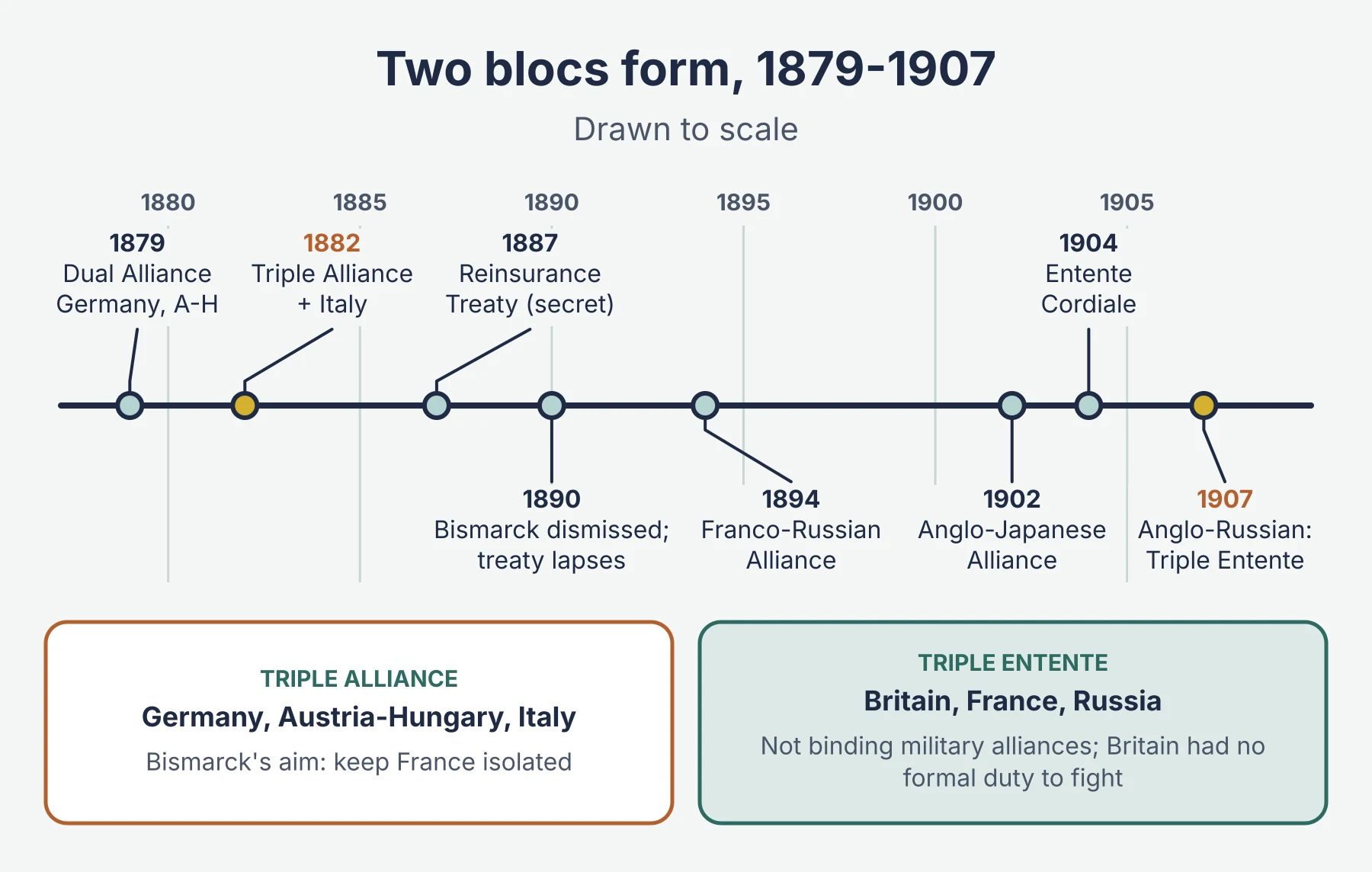
The two blocs
| Triple Alliance | Triple Entente |
|---|---|
| Dual Alliance: Germany and Austria-Hungary (1879) | Franco-Russian Alliance (1894) |
| Italy joins (1882) | Entente Cordiale: Britain and France (1904) |
| A formal military alliance | Anglo-Russian Convention (1907): an understanding, not a binding alliance |
Also learn: the Reinsurance Treaty (1887) with Russia, allowed to lapse after Bismarck’s dismissal (1890); the Anglo-Japanese Alliance (1902), which ended British isolation and let Japan fight Russia in 1904-05.
Timeline of rising tension
| Date | Event | Effect |
|---|---|---|
| 1890 | Bismarck dismissed; Reinsurance Treaty lapses | Russia moves towards France |
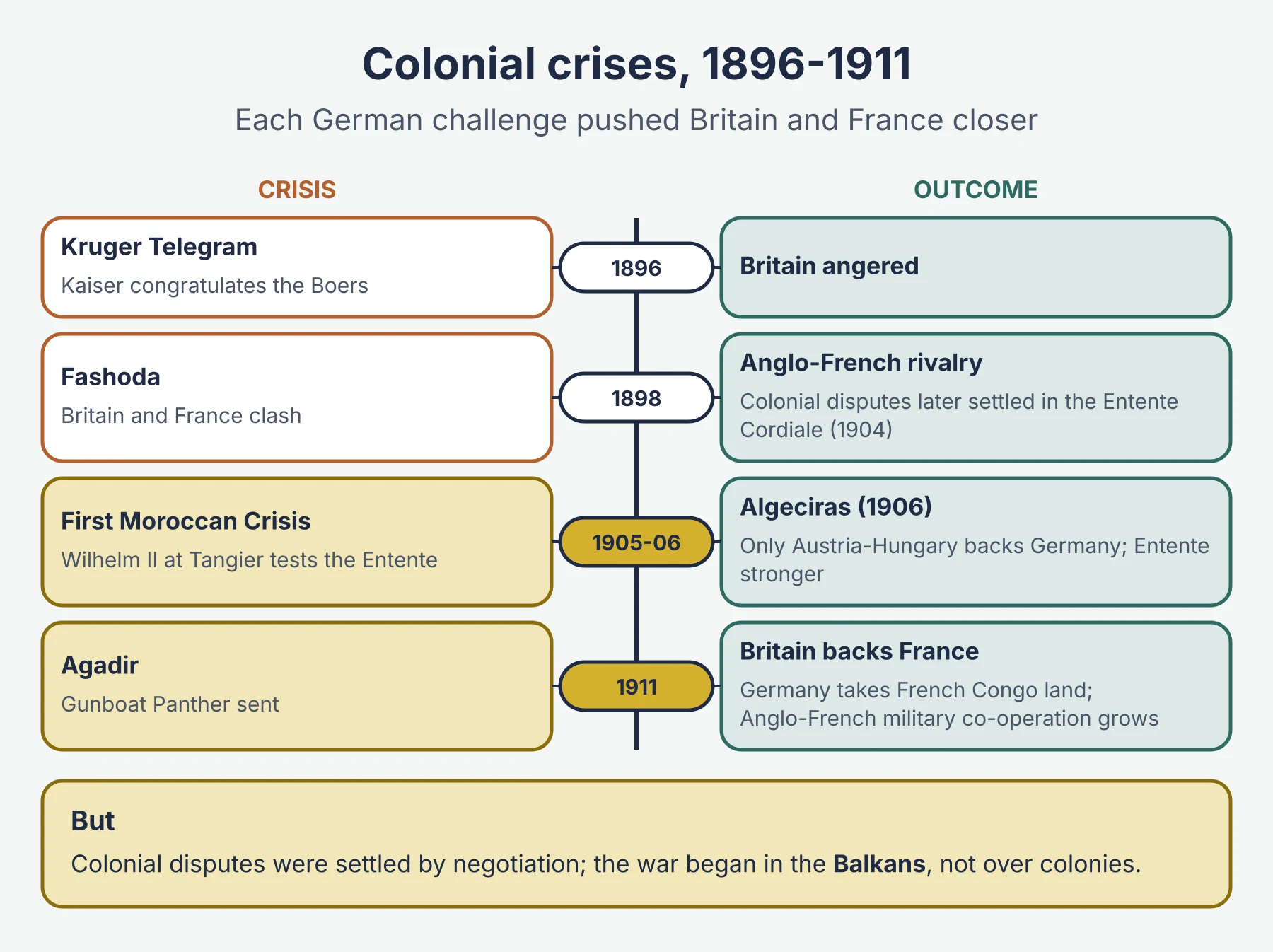
| 1896 | Kruger Telegram | British anger at Germany |
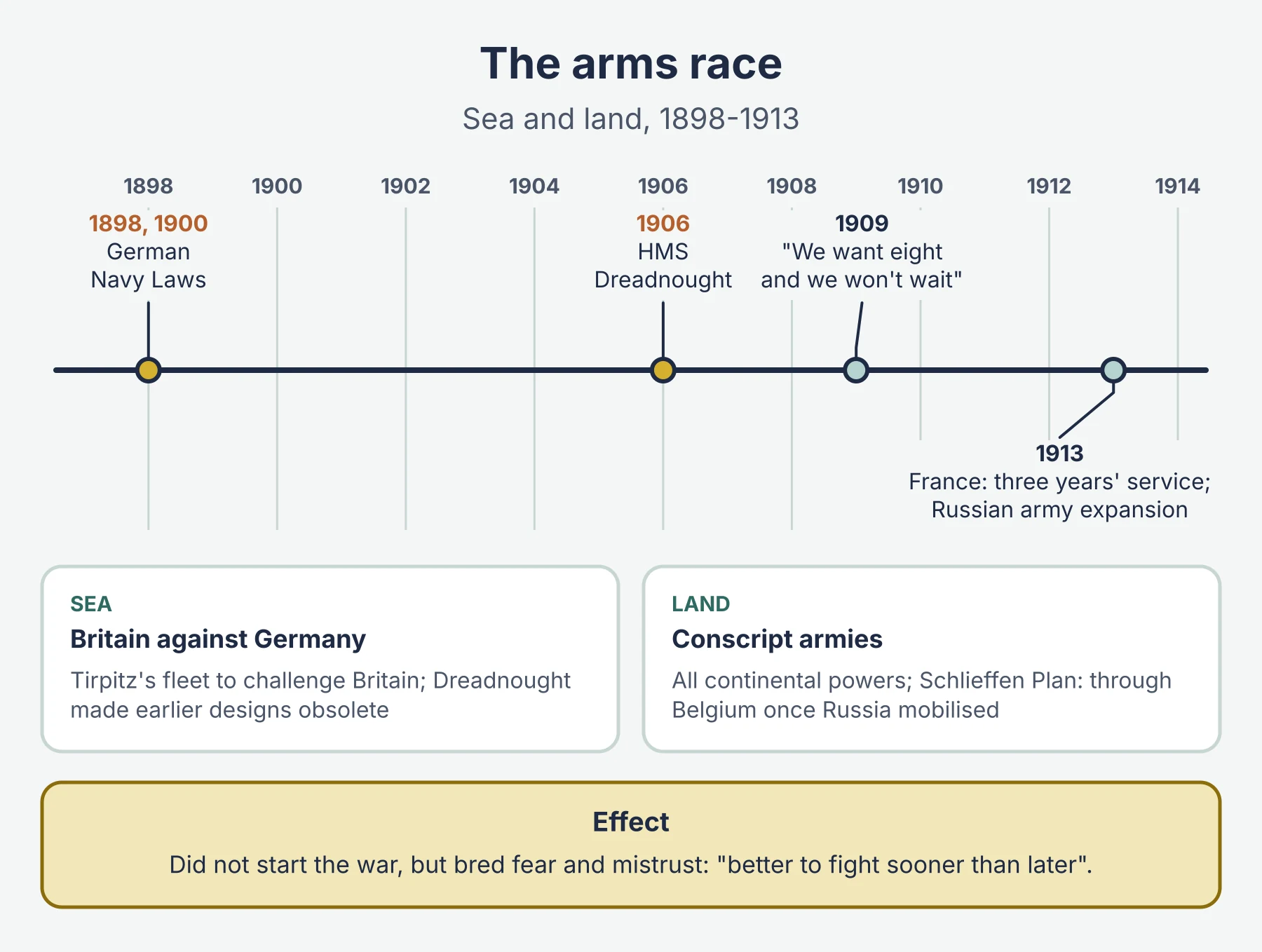
| 1898, 1900 | German Navy Laws (Tirpitz) | Start of the naval race |
| 1898 | Fashoda crisis | Britain and France clash, then settle |
| 1902 | Anglo-Japanese Alliance | Britain leaves isolation |
| 1904 | Entente Cordiale | Colonial deal: Egypt for Britain, Morocco for France |
| 1904-05 | Russo-Japanese War | Russia defeated; turns to the Balkans |
| 1905-06 | First Moroccan Crisis; Algeciras | Germany isolated; Entente strengthened |
| 1906 | HMS Dreadnought launched | Naval race intensifies |
| 1907 | Anglo-Russian Convention | Triple Entente complete |
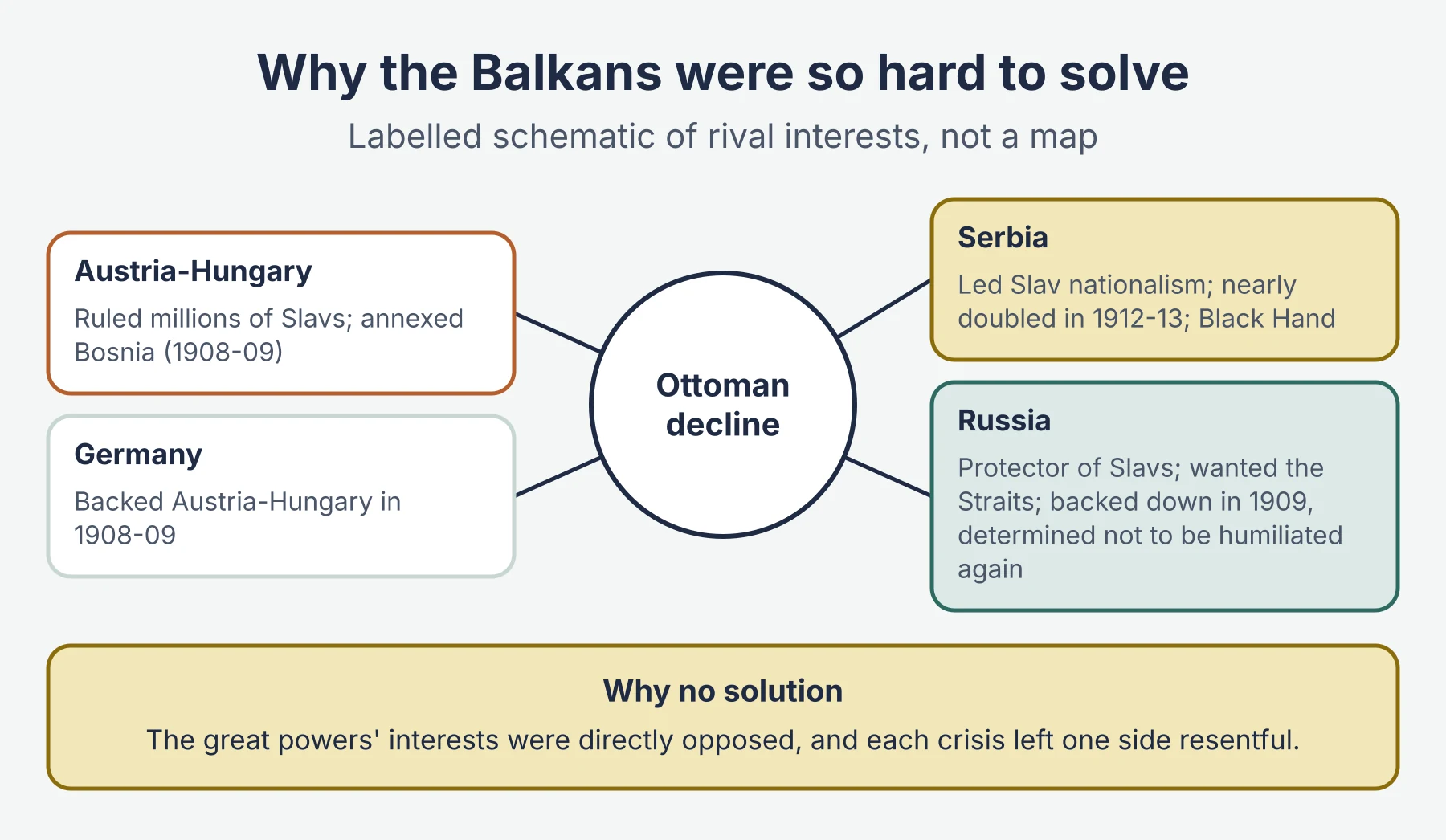
| 1908-09 | Bosnian Crisis | Russia humiliated; Serbia furious |
| 1909 | “We want eight and we won’t wait” | British public demands more dreadnoughts |
| 1911 | Agadir Crisis | Britain backs France; Germany gains part of the French Congo |
| 1912-13 | Balkan Wars | Serbia nearly doubles in size |
| 1913 | French three-year service law; Russian army expansion | Land arms race |
The July Crisis chain
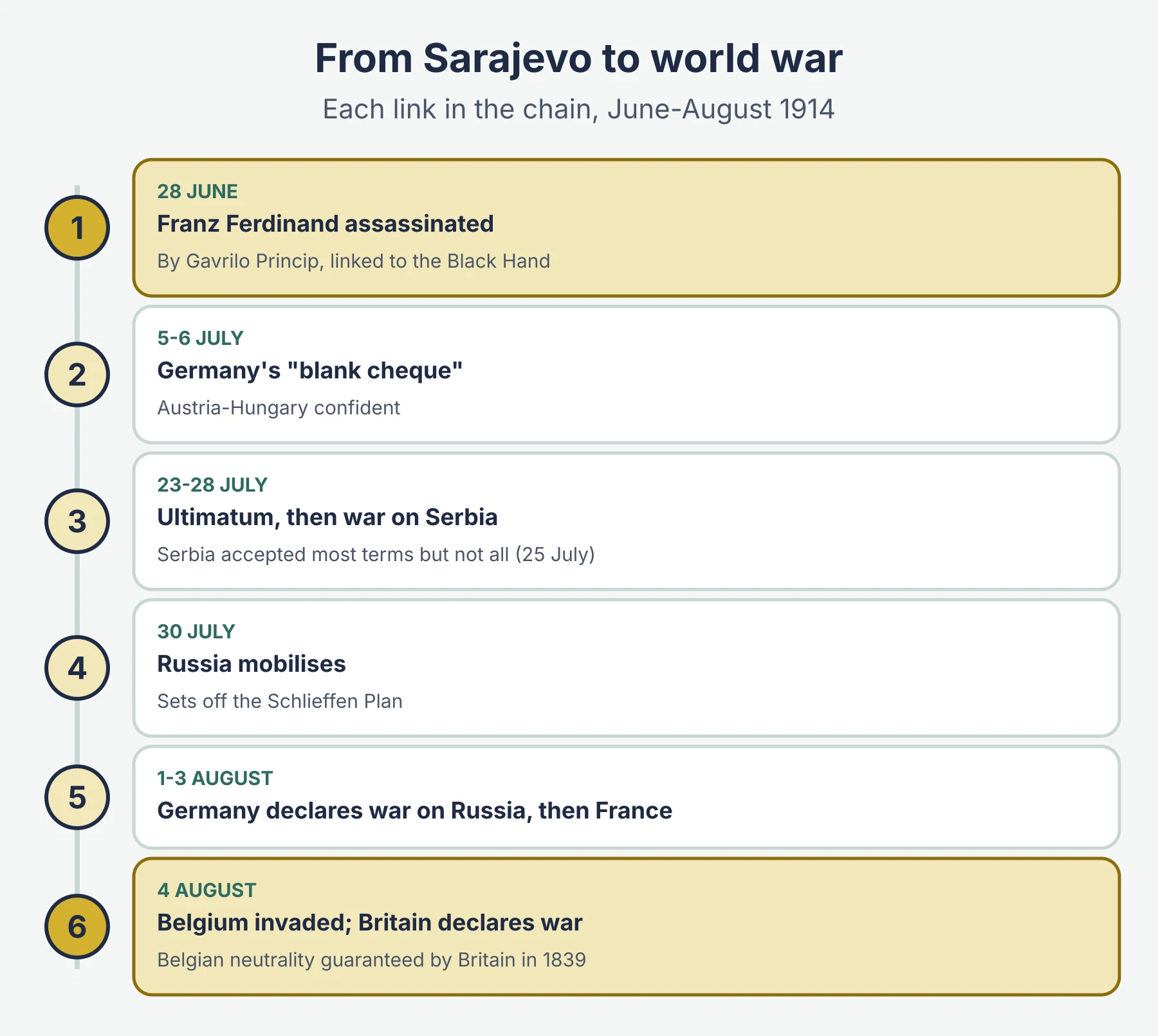
- 28 June: Princip assassinates Franz Ferdinand in Sarajevo.
- 5-6 July: German “blank cheque” to Austria-Hungary.
- 23 July: Austrian ultimatum to Serbia.
- 25 July: Serbia accepts most, not all, of the terms.
- 28 July: Austria-Hungary declares war on Serbia.
- 30 July: Russian general mobilisation.
- 1 August: Germany declares war on Russia; 3 August on France.
- 4 August: Germany invades Belgium; Britain declares war, citing the 1839 Treaty of London.
Key terms
| Term | Meaning |
|---|---|
| Splendid isolation | Britain’s policy of avoiding permanent alliances, abandoned after 1902 |
| Entente | A friendly understanding rather than a binding military alliance |
| Weltpolitik | Germany’s “world policy” of colonies and naval power after 1897 |
| Dreadnought | A fast, big-gun battleship type, first launched by Britain in 1906 |
| Schlieffen Plan | German plan to defeat France through Belgium before Russia mobilised |
| Mobilisation | Calling up and moving an army ready for war |
| Pan-Slavism | The idea that Slav peoples should be united, often under Russian protection |
| Black Hand | Serbian nationalist secret society, linked to the assassination |
| Blank cheque | Germany’s unconditional promise of support to Austria-Hungary, July 1914 |
Weighing the causes
| Cause | Strongest argument | Best counter-argument |
|---|---|---|
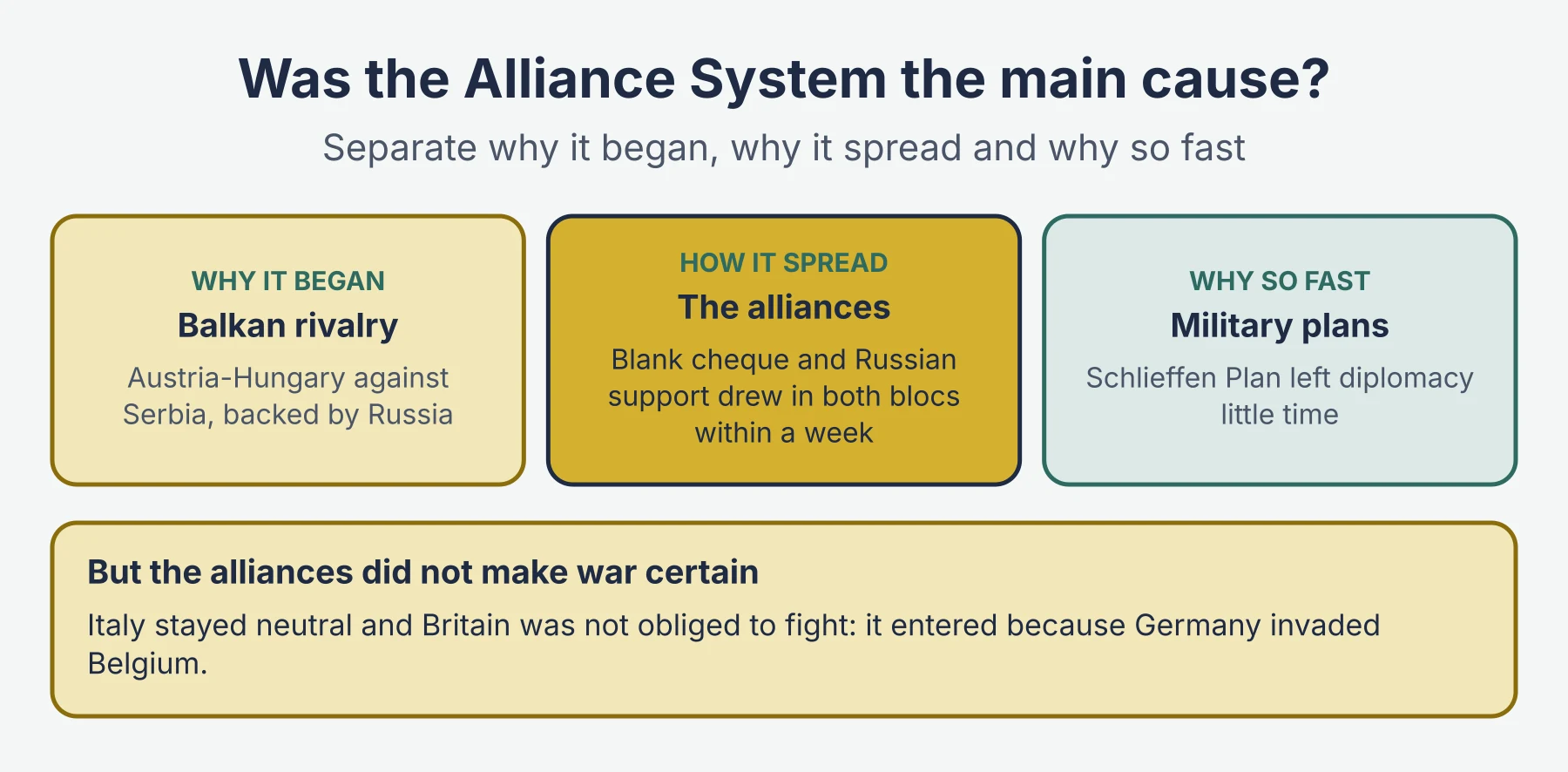
| Alliances | Turned a local war into a European one within a week | Italy stayed neutral; Britain was not bound |
| Arms race | Created fear; the Schlieffen Plan left no time for diplomacy | By 1912 Britain had a clear lead in dreadnoughts, easing that tension |
| Colonial rivalry | Moroccan crises tightened the Entente against Germany | Crises were settled; the war began in the Balkans |
| Balkans | The trigger and the direct clash of Austrian and Russian interests | Balkan crises in 1908 and 1912-13 did not cause a general war |
One-line answers to the focus points
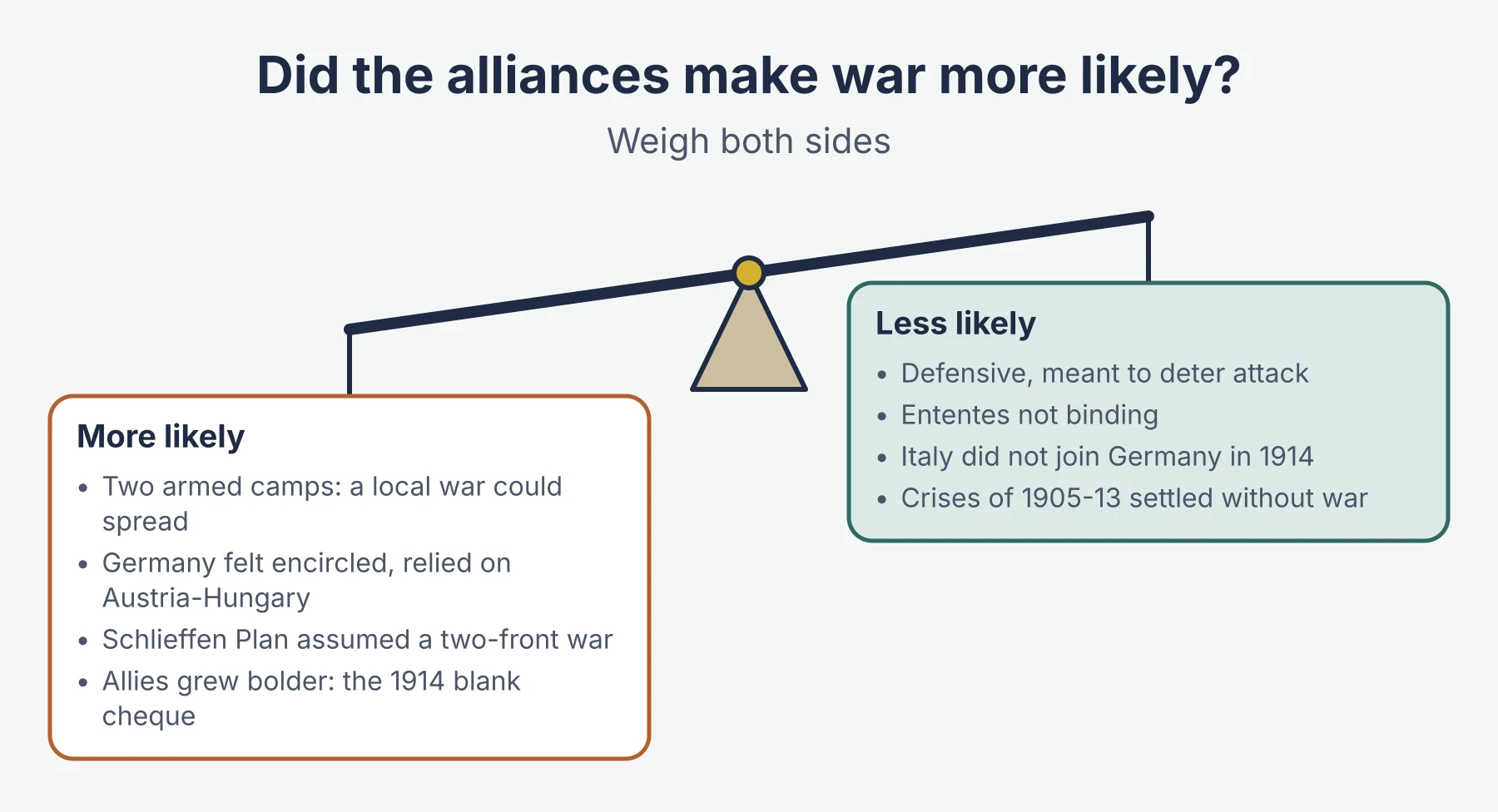
- Did the Alliance System make war more or less likely? More likely, because it divided Europe into two camps and made allies bolder; but it was defensive, and Italy and Britain show it did not decide action automatically.
- How far did colonial problems create tension? The Moroccan crises tightened the Entente and isolated Germany, but they were settled peacefully; the war began in the Balkans.
- Why were Balkan problems so hard to solve? Austria-Hungary and Russia had directly opposed interests, Serbian nationalism threatened Austria’s survival, and each crisis left one side humiliated.
- How did the assassination lead to war? Austria-Hungary used it to attack Serbia with German backing; Russia mobilised; the Schlieffen Plan turned an eastern war into a western one and brought Britain in over Belgium.
Exam traps
- Dates of the alliances. Triple Alliance 1882, Franco-Russian 1894, Entente Cordiale 1904, Anglo-Russian 1907.
- The ententes were not alliances. Britain chose to fight in 1914; it was not obliged to.
- Morocco versus Bosnia. The Moroccan crises were colonial; the Bosnian Crisis was Balkan.
- The war itself is not this key question. Stop at early August 1914.
- Japan matters. The Anglo-Japanese Alliance is named in the specification.
Self-test
- Which two powers formed the Dual Alliance in 1879? Germany and Austria-Hungary.
- Why did Russia ally with France in 1894? Germany had let the Reinsurance Treaty lapse, leaving Russia without a German partner.
- What did the Anglo-Japanese Alliance (1902) promise? Neutrality if either fought one power; help if either fought two.
- What did Britain and France agree in 1904? To settle colonial disputes: Britain in Egypt, France in Morocco.
- Why was HMS Dreadnought important? It made earlier battleships obsolete, restarting the naval race.
- What happened at Algeciras in 1906? Germany was isolated, supported only by Austria-Hungary, and France’s position in Morocco was confirmed.
- What did Germany send to Agadir in 1911? The gunboat Panther.
- Why did the Bosnian Crisis make war more likely? Russia was humiliated and determined not to back down again; Serbia was angered.
- Who assassinated Franz Ferdinand? Gavrilo Princip, a Bosnian Serb linked to the Black Hand.
- What was the blank cheque? Germany’s promise of full support for Austria-Hungary in July 1914.
- Why did Russian mobilisation lead to war with France? The Schlieffen Plan required Germany to attack France first once Russia mobilised.
- Why did Britain enter the war? Germany invaded Belgium, whose neutrality Britain had guaranteed in 1839.
Related resources
-
Study guides
Cambridge IGCSE World History (0470): Why, and With What Effects, Did Nations Gain and Expand Their Overseas Empires?
Cambridge IGCSE History 0470 key question 1.5 in depth: weighing imperial motives, comparing impacts in Africa, India after 1857 and US rule in Cuba.
World History · Cambridge · IGCSE
Read guide -
Practice questions
Cambridge IGCSE World History (0470): Why, and With What Effects, Did Nations Gain and Expand Their Overseas Empires? – Practice Questions
Twelve original questions with mark-scheme answers on imperial motives, Africa, India after 1857 and US rule overseas, for Cambridge IGCSE History 0470.
World History · Cambridge · IGCSE
Try questions -
Revision notes
Cambridge IGCSE World History (0470): Why, and With What Effects, Did Nations Gain and Expand Their Overseas Empires? – Revision Notes
Recall notes for Cambridge IGCSE History 0470 key question 1.5: motives, impacts in Africa compared, 1857 by group, Cuba and the Philippines, self-test.
World History · Cambridge · IGCSE
Revise topic
Get free revision emails (optional)
Occasional emails with practice questions, worked explanations and links to free resources for the qualification and subjects you choose. No spam, and you can unsubscribe from any email. The free tools on this site never need an email.