
Revision Notes
Cambridge IGCSE World History (0470): Why, and With What Effects, Did Nations Gain and Expand Their Overseas Empires? – Revision Notes
Recall notes for Cambridge IGCSE History 0470 key question 1.5: motives, impacts in Africa compared, 1857 by group, Cuba and the Philippines, self-test.
- Subject
- World History
- Level
- IGCSE
- Topic
- Core Content – Option A: The Nineteenth Century, 1848–1914
- Author
- Marlbridge Academic Team
- Updated
- Reviewed by
- Azam Siddique (what this means)
Aligned to Cambridge IGCSE World History (0470), 2024-2026. Official specification .
Syllabus page (what it covers and how it is assessed): Cambridge IGCSE World History.
Syllabus points this page covers
0470
- 1.5 Why, and with what effects, did nations gain and expand their overseas empires in the nineteenth century?
Found an error? Report a correction.
Need help with this topic? Request a free trial class for IGCSE World History (0470).
Key question 1.5, Cambridge IGCSE History 0470: “Why, and with what effects, did nations gain and expand their overseas empires in the nineteenth century?” These notes add comparison grids and extra evidence to the core facts in the overseas empires revision notes. The analysis behind them is in the 0470 overseas empires study guide; test yourself with the 0470 overseas empires practice questions.
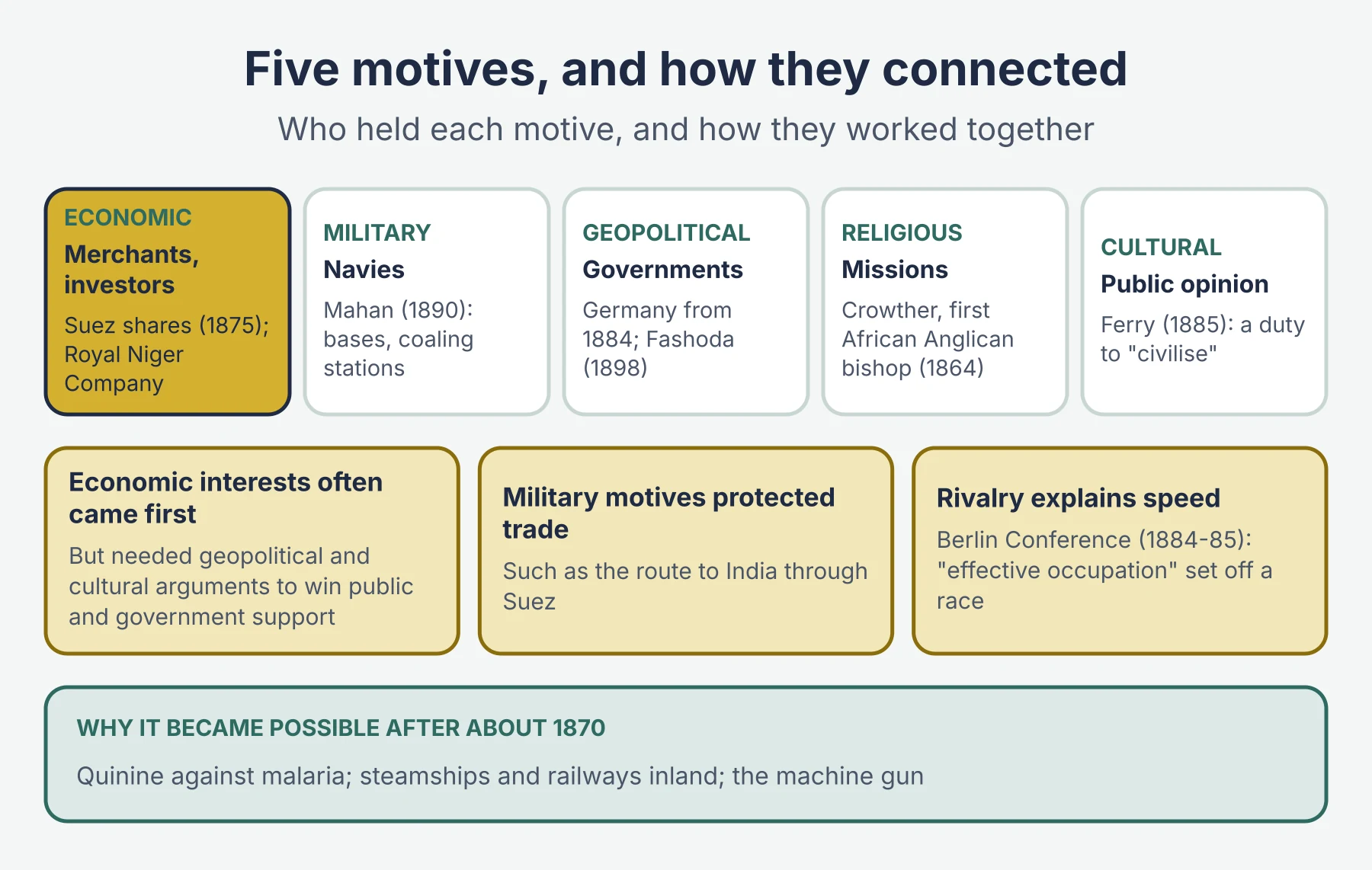
Motives: evidence beyond the obvious
| Motive | Extra evidence |
|---|---|
| Economic | Suez Canal shares bought by Britain (1875); Royal Niger Company on the Niger; groundnuts from Senegal |
| Military | Mahan (1890): sea power needs bases and coaling stations; Guantánamo base from the Platt Amendment |
| Geopolitical | Germany’s first African colonies (1884); Fashoda crisis (1898); “effective occupation” rule of the Berlin Conference |
| Religious | Missionary societies; Samuel Ajayi Crowther, first African Anglican bishop (1864) |
| Cultural | Jules Ferry (1885): a “duty” to civilise; McKinley’s “benevolent assimilation” (1898) |
Enablers, not motives: quinine, steamships, railways, the telegraph, the machine gun.
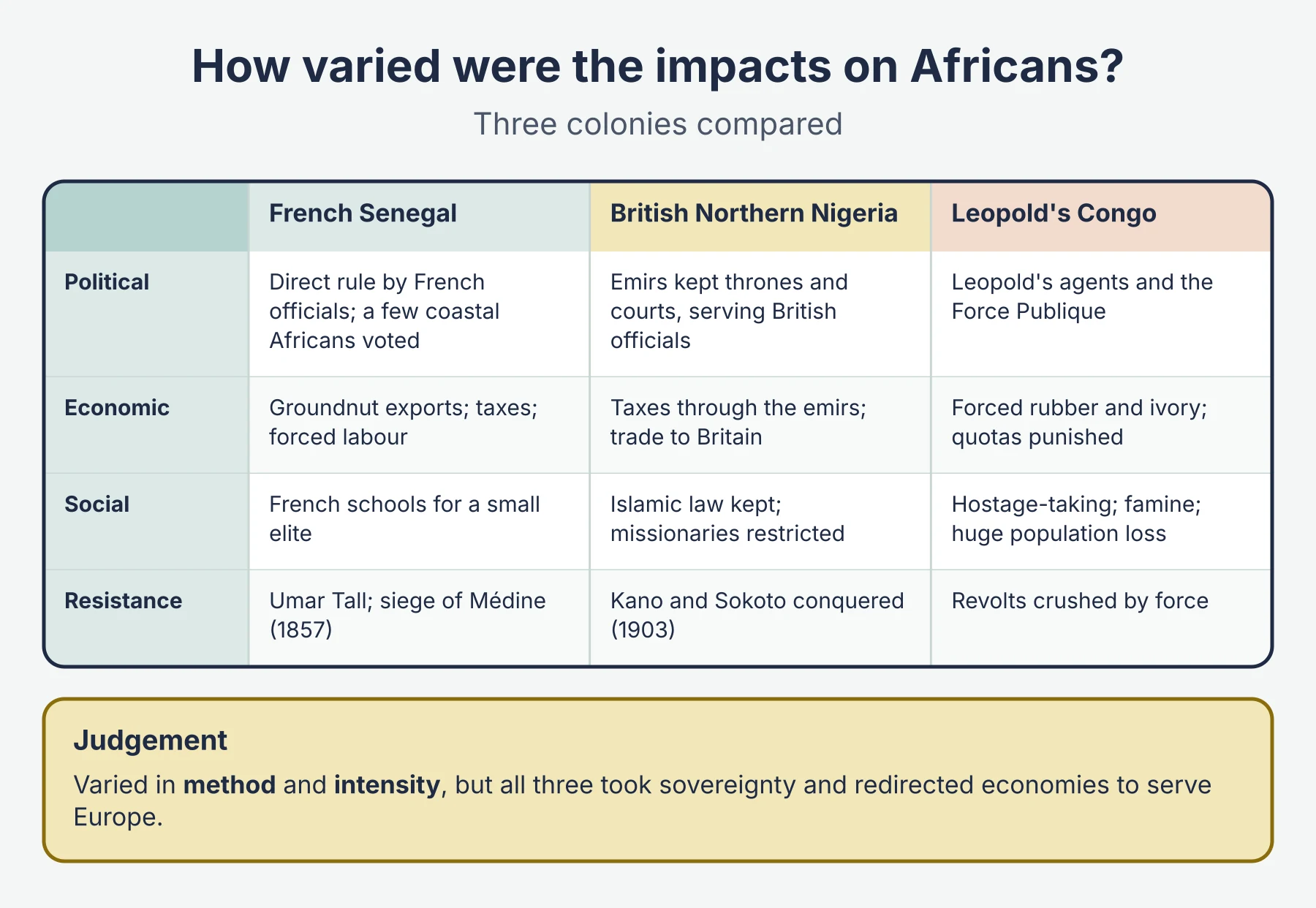
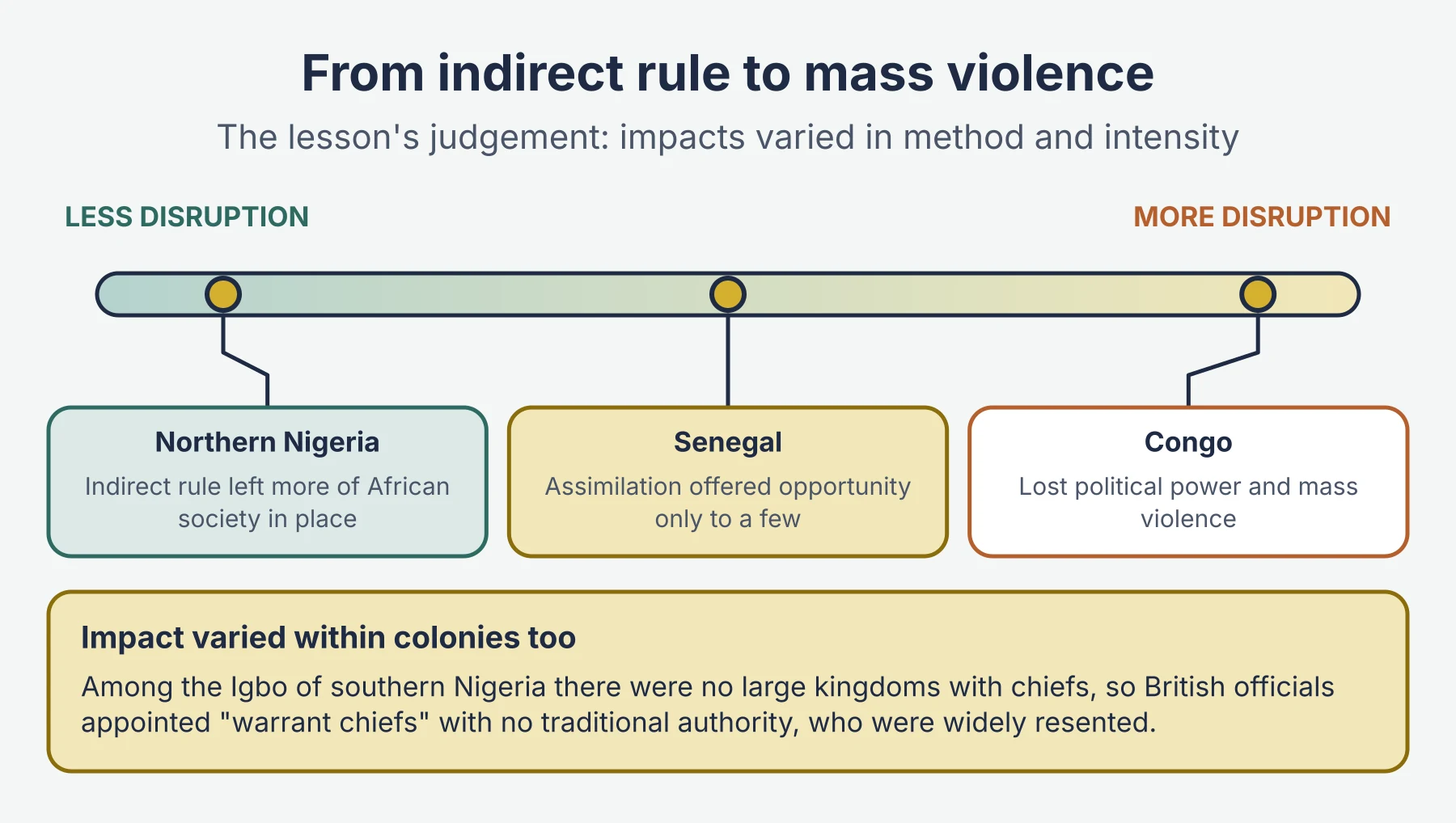
Impacts on Africans compared
| Senegal (France) | Northern Nigeria (Britain) | Congo (Leopold II) | |
|---|---|---|---|
| System | Assimilation, direct rule | Indirect rule through emirs | Private colony run for profit |
| Political | Local states conquered; French officials | Emirs kept courts but obeyed British residents | Leopold’s agents and the Force Publique held all power |
| Economic | Groundnut exports; taxes; labour for public works | Taxes via emirs; trade tied to Britain | Rubber and ivory quotas; forced labour |
| Social | French schooling for a small elite | Islamic law kept; missions restricted | Hostage-taking, mutilation, famine, mass deaths |
| Resistance | Umar Tall; siege of Médine (1857) | Kano and Sokoto conquered (1903) | Revolts crushed by force |
Variation inside a colony: in south-eastern Nigeria British “warrant chiefs” had no traditional authority and were resented.
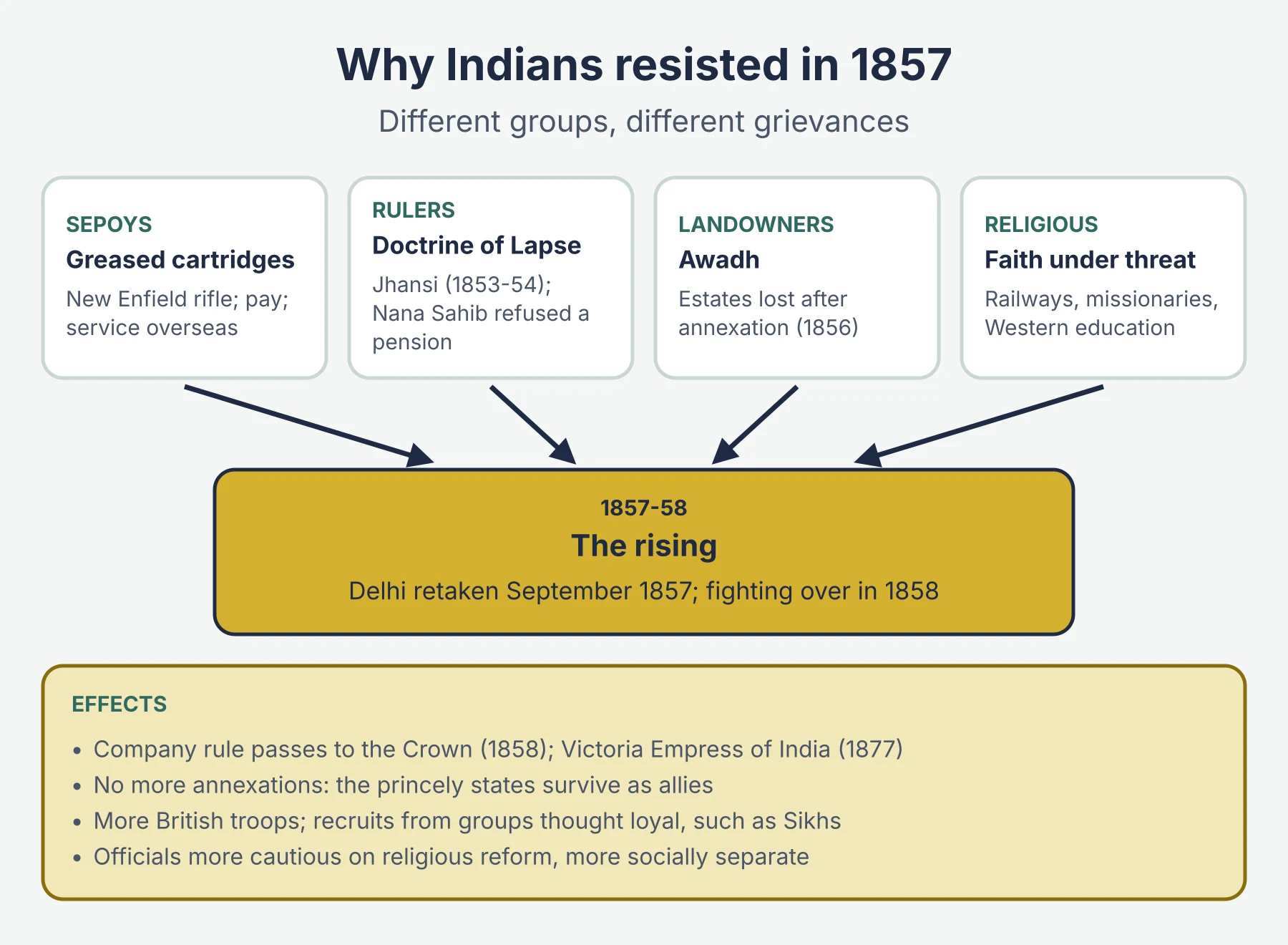
India, 1857: who resisted and why
| Group | Grievance |
|---|---|
| Sepoys | Greased Enfield cartridges; pay; service overseas |
| Rulers | Doctrine of Lapse (Jhansi); Nana Sahib refused the Peshwa’s pension |
| Awadh landowners | Lost estates after annexation in 1856 |
| Religious communities | Fear of conversion through missions, schools and reforms |
Effects: defeated by 1858, with reprisals on both sides; Crown rule (Government of India Act 1858); no more annexations, so princely states survived; Victoria Empress of India (1877); army reorganised with more British troops and more recruits from groups such as Punjabi Sikhs; British more cautious about religion but more separate from Indians.
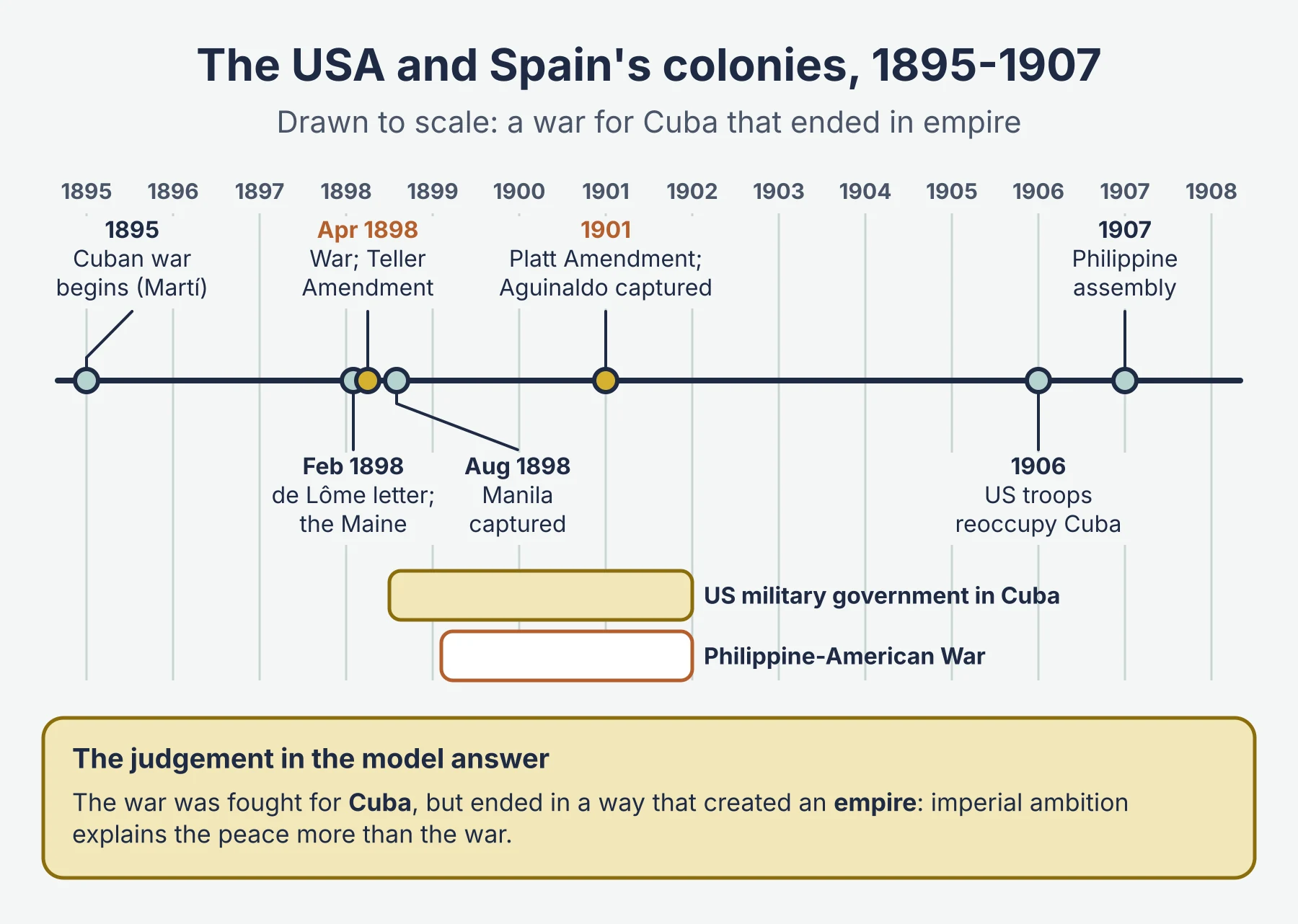
The USA, Spain and its colonies
| Date | Event |
|---|---|
| 1895 | Cuban war of independence begins; José Martí killed in battle |
| February 1898 | De Lôme letter published; USS Maine explodes in Havana harbour |
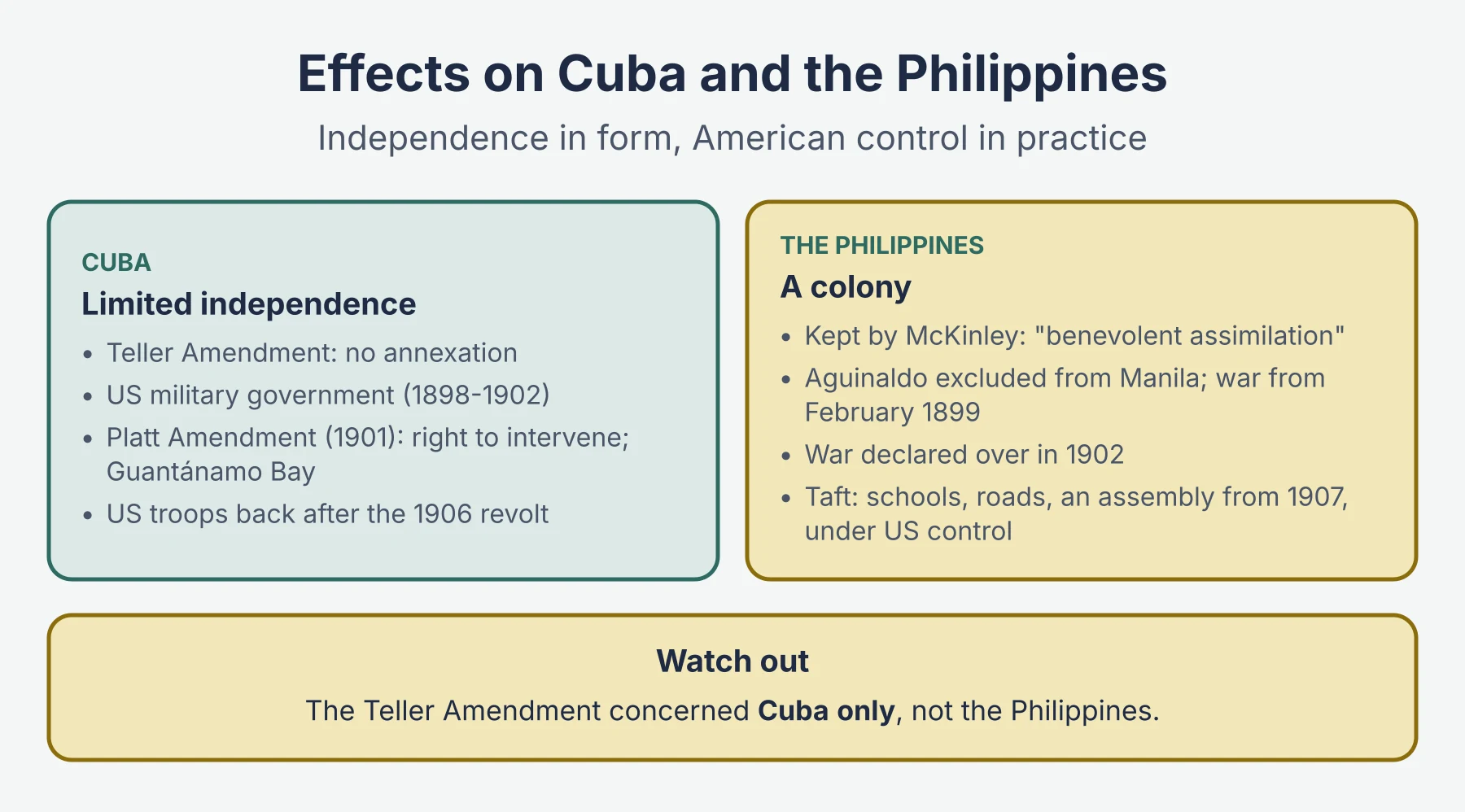
| April 1898 | War declared; Teller Amendment: no annexation of Cuba |
| 1 May 1898 | Dewey destroys the Spanish fleet at Manila Bay |
| June 1898 | Aguinaldo declares Philippine independence |
| August 1898 | Manila taken by US forces, excluding Filipino troops |
| December 1898 | Treaty of Paris; McKinley’s “benevolent assimilation” |
| February 1899 | Philippine-American War begins |
| 1901 | Aguinaldo captured; Platt Amendment; Taft civil governor of the Philippines |
| 1902 | US forces leave Cuba; war in the Philippines declared over |
| 1906 | Revolt in Cuba; second US occupation |
| 1907 | Elected Philippine Assembly |
Key terms
| Term | Meaning |
|---|---|
| Scramble for Africa | Rapid European division of Africa, mainly after 1880 |
| Effective occupation | Berlin Conference rule that a claim needed real control on the ground |
| Assimilation | French policy of turning colonised elites into French citizens in culture |
| Indirect rule | British rule through existing local rulers |
| Warrant chiefs | Chiefs appointed by Britain where none had existed |
| Force Publique | Leopold’s army in the Congo, which enforced rubber quotas |
| Doctrine of Lapse | British annexation of states whose rulers had no natural heir |
| Princely states | Indian states ruled by their own princes under British supremacy |
| Yellow press | Sensational US newspapers, such as those of Hearst and Pulitzer |
| Teller Amendment | 1898 pledge not to annex Cuba |
| Platt Amendment | 1901 terms allowing US intervention in Cuba and a base at Guantánamo |
| Benevolent assimilation | McKinley’s description of US rule in the Philippines |
Exam traps
- Answering half the question. Every focus point except the first asks “with what effects”.
- Motives as a list. Link them and say whose motive each was.
- Treating all of Nigeria as one. Indirect rule worked differently in the north and the south-east.
- Teller versus Platt. Teller (1898) promised no annexation; Platt (1901) allowed intervention.
- Ending US involvement in 1902. The specification runs to the 1906 intervention.
Self-test
- Why did Britain buy Suez Canal shares in 1875? To protect the shortest sea route to India.
- What did Mahan argue in 1890? That a great power needed sea power, and so overseas bases and coaling stations.
- What did the Berlin Conference mean by “effective occupation”? A power had to control territory on the ground to claim it.
- Who was Samuel Ajayi Crowther? A formerly enslaved Yoruba man who became the first African Anglican bishop in 1864.
- Which export did France encourage in Senegal? Groundnuts (peanuts).
- Who fought Faidherbe at Médine in 1857? The forces of Umar Tall.
- What were warrant chiefs? Chiefs appointed by the British in areas, such as Igboland, with no traditional chiefs.
- Why did Nana Sahib join the rising? The British refused him the pension of his adoptive father, the last Peshwa.
- Give one change to the Indian army after 1857. More British troops, or more recruits from groups such as Punjabi Sikhs.
- What was the de Lôme letter? A letter by the Spanish minister in Washington insulting McKinley, published in February 1898.
- When did the Philippine-American War begin? February 1899.
- Why did US troops occupy Cuba again in 1906? A revolt broke out and the USA intervened under the Platt Amendment.
Related resources
-
Study guides
Cambridge IGCSE World History (0470): Were the Revolutions of 1848 Important?
Study guide to Cambridge IGCSE History 0470 key question 1.1: liberalism, nationalism and the 1848 revolutions in France, Italy, Germany and Austria.
World History · Cambridge · IGCSE
Read guide -
Practice questions
Cambridge IGCSE World History (0470): Were the Revolutions of 1848 Important? – Practice Questions
Twelve original questions with mark-scheme answers on the 1848 revolutions in France, Italy, Germany and Austria, for Cambridge IGCSE History 0470.
World History · Cambridge · IGCSE
Try questions -
Revision notes
Cambridge IGCSE World History (0470): Were the Revolutions of 1848 Important? – Revision Notes
Recall notes for Cambridge IGCSE History 0470 key question 1.1: causes, events and failure of the 1848 revolutions, key terms, traps and a self-test.
World History · Cambridge · IGCSE
Revise topic
Get free revision emails (optional)
Occasional emails with practice questions, worked explanations and links to free resources for the qualification and subjects you choose. No spam, and you can unsubscribe from any email. The free tools on this site never need an email.