
Revision Notes
Cambridge IGCSE World History (0470): Were the Revolutions of 1848 Important? – Revision Notes
Recall notes for Cambridge IGCSE History 0470 key question 1.1: causes, events and failure of the 1848 revolutions, key terms, traps and a self-test.
- Subject
- World History
- Level
- IGCSE
- Topic
- Core Content – Option A: The Nineteenth Century, 1848–1914
- Author
- Marlbridge Academic Team
- Updated
- Reviewed by
- Azam Siddique (what this means)
Aligned to Cambridge IGCSE World History (0470), 2024-2026. Official specification .
Syllabus page (what it covers and how it is assessed): Cambridge IGCSE World History.
Syllabus points this page covers
0470
- 1.1 Were the revolutions of 1848 important?
Found an error? Report a correction.
Need help with this topic? Request a free trial class for IGCSE World History (0470).
Key question 1.1, Cambridge IGCSE History 0470: “Were the revolutions of 1848 important?” You need the causes, events and results of the revolutions in France, Italy, Germany and the Austrian Empire, the influence of liberalism and nationalism, and the reasons for failure. Full explanations are in the 1848 study guide; test yourself with the 1848 practice questions.
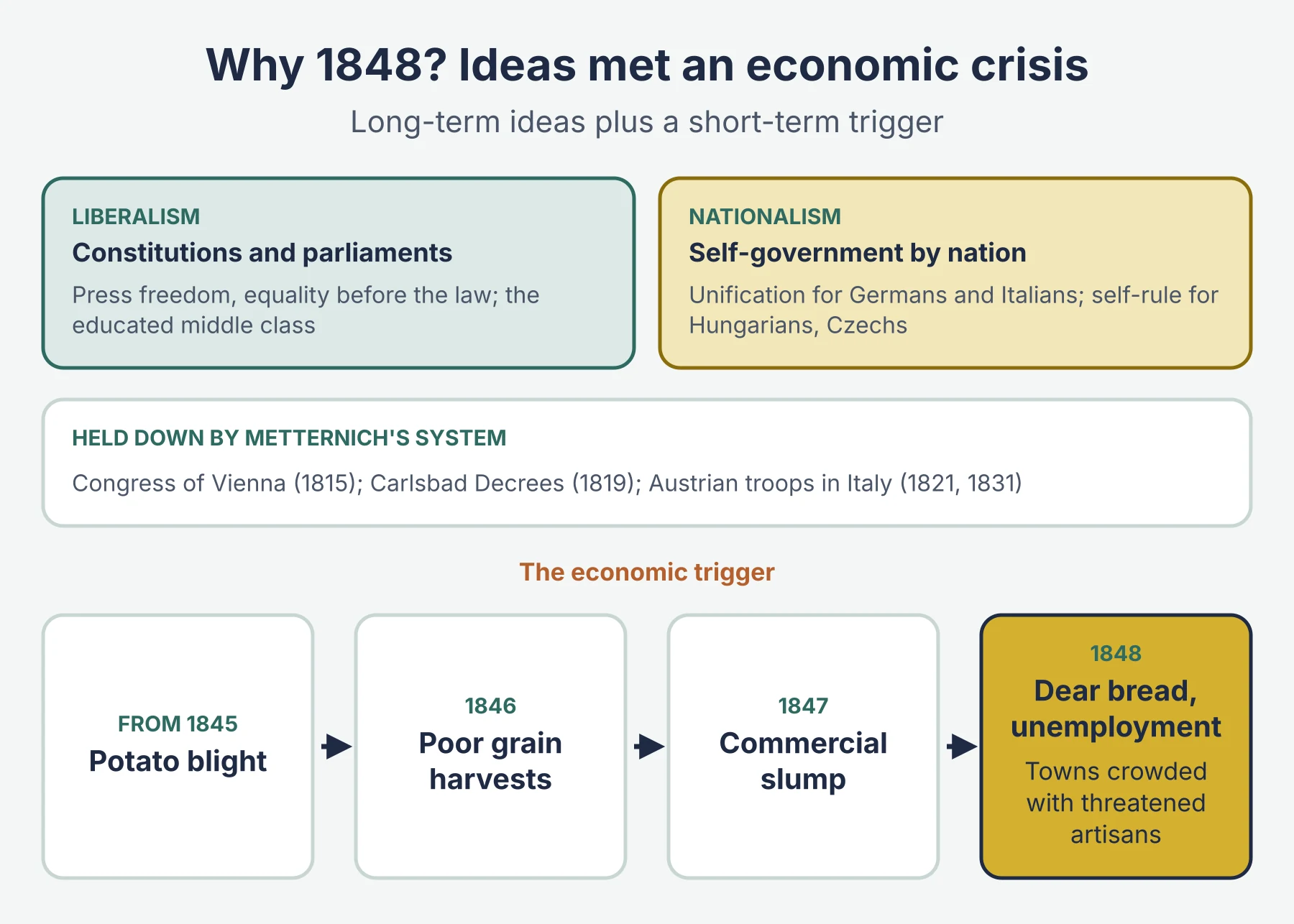
Long-term and short-term causes
| Long-term | Short-term |
|---|---|
| Liberal ideas: constitutions, parliaments, a free press | Potato blight (1845) and poor harvests (1846) |
| Nationalism among Germans, Italians, Hungarians, Czechs | Commercial slump (1847): unemployment, high bread prices |
| Repression under Metternich: Carlsbad Decrees (1819) | Example of Paris, February 1848, spread by newspapers and railways |
| Growing, excluded middle class; threatened artisans | Weak or hesitant rulers who gave way at first |
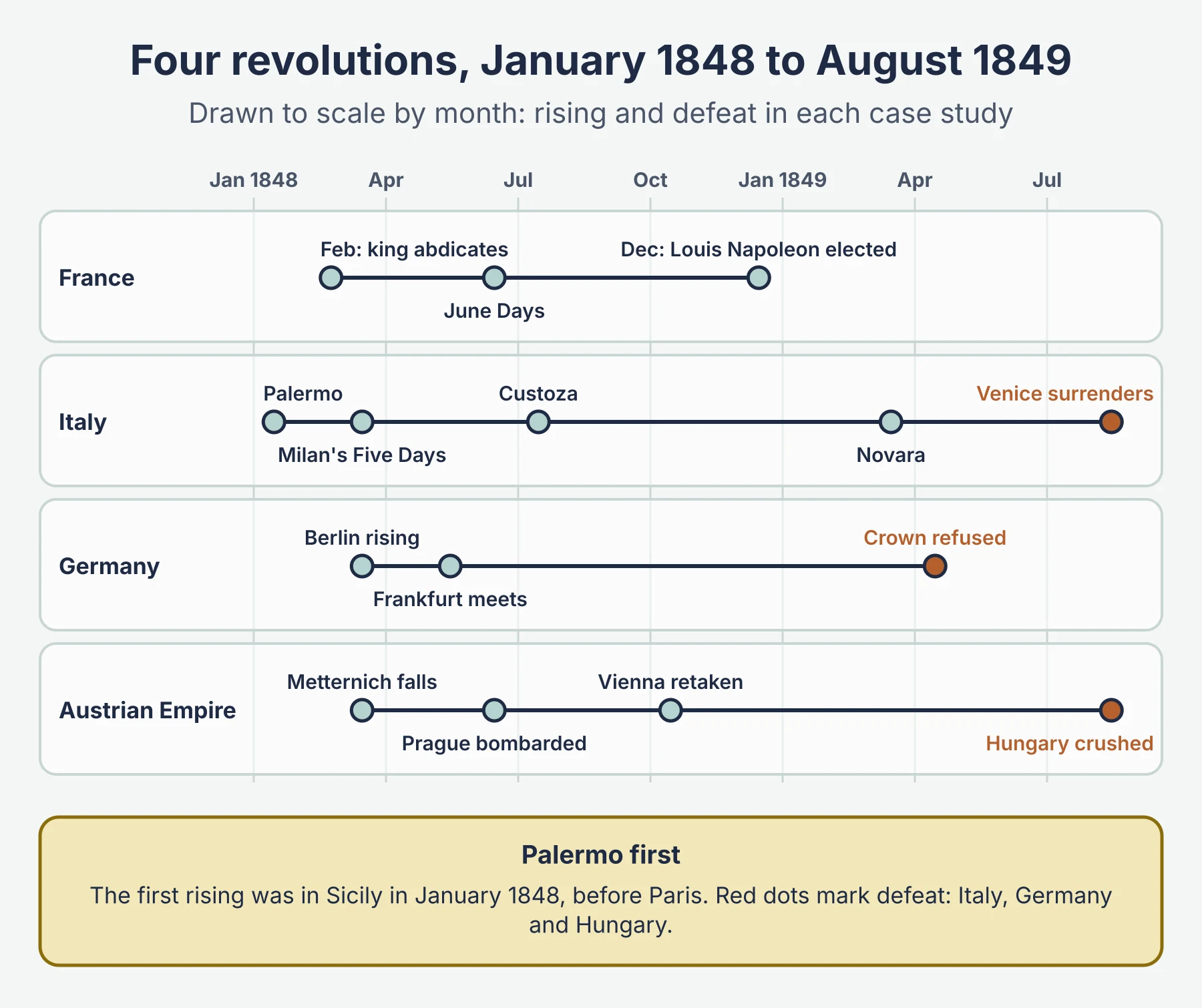
Timeline to learn
| Date | Event |
|---|---|
| January 1848 | Rising in Palermo, Sicily: the first revolution of the year |
| 22-24 February 1848 | Banquet banned; barricades in Paris; Louis-Philippe abdicates; Second Republic |
| March 1848 | Vienna rising; Metternich flees. Berlin street fighting. Milan’s Five Days; Venice republic. Piedmont’s Statuto |
| April 1848 | Hungary’s April Laws; French elections return a cautious assembly |
| May 1848 | Frankfurt Parliament opens |
| June 1848 | June Days in Paris crushed by Cavaignac; Windischgrätz bombards Prague |
| July 1848 | Piedmont defeated by Radetzky at Custoza |
| September 1848 | Labour services (robot) abolished in the Austrian Empire |
| October 1848 | Windischgrätz retakes Vienna |
| December 1848 | Louis Napoleon elected president; Franz Joseph becomes emperor; Prussian assembly dissolved |
| February 1849 | Roman Republic proclaimed (Mazzini; Garibaldi defends it) |
| March-April 1849 | Piedmont defeated at Novara; Frederick William IV refuses Frankfurt’s crown |
| July-August 1849 | French troops take Rome; Venice surrenders; Russians help crush Hungary |
| December 1851 | Louis Napoleon’s coup; Napoleon III emperor in 1852 |
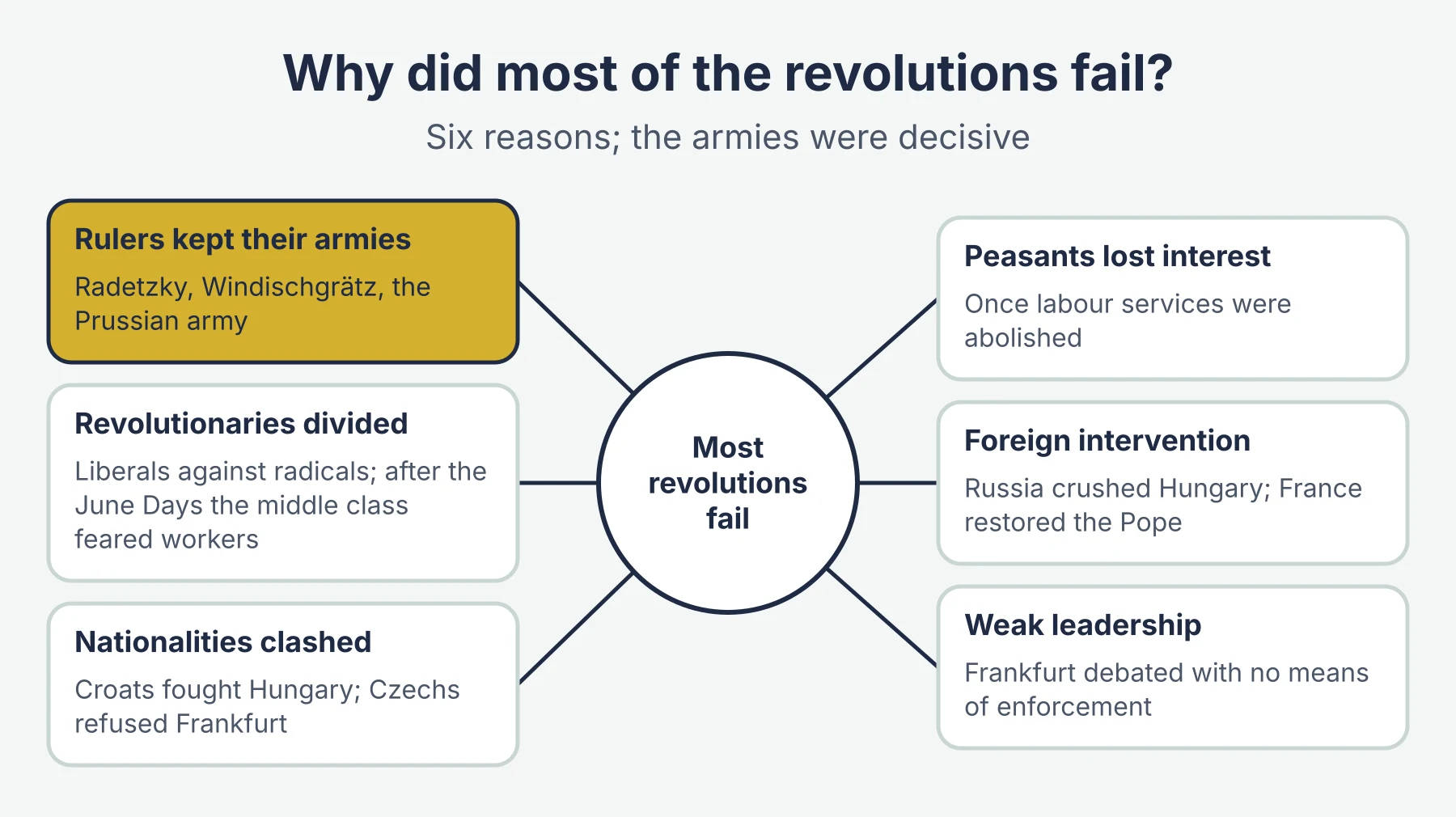
Why most revolutions failed
- Armies stayed loyal to rulers: Radetzky (Italy), Windischgrätz (Prague, Vienna), the Prussian army (Berlin).
- Liberals versus radicals: the June Days made the middle classes side with order against the workers.
- Nationalities divided: Croats fought Hungarians; Czechs rejected a German national state.
- Peasants satisfied once labour services ended in 1848.
- Foreign intervention: Russia in Hungary; France in Rome.
- Frankfurt’s weakness: no army, no tax income, long debates, dependence on Prussia over Schleswig-Holstein.
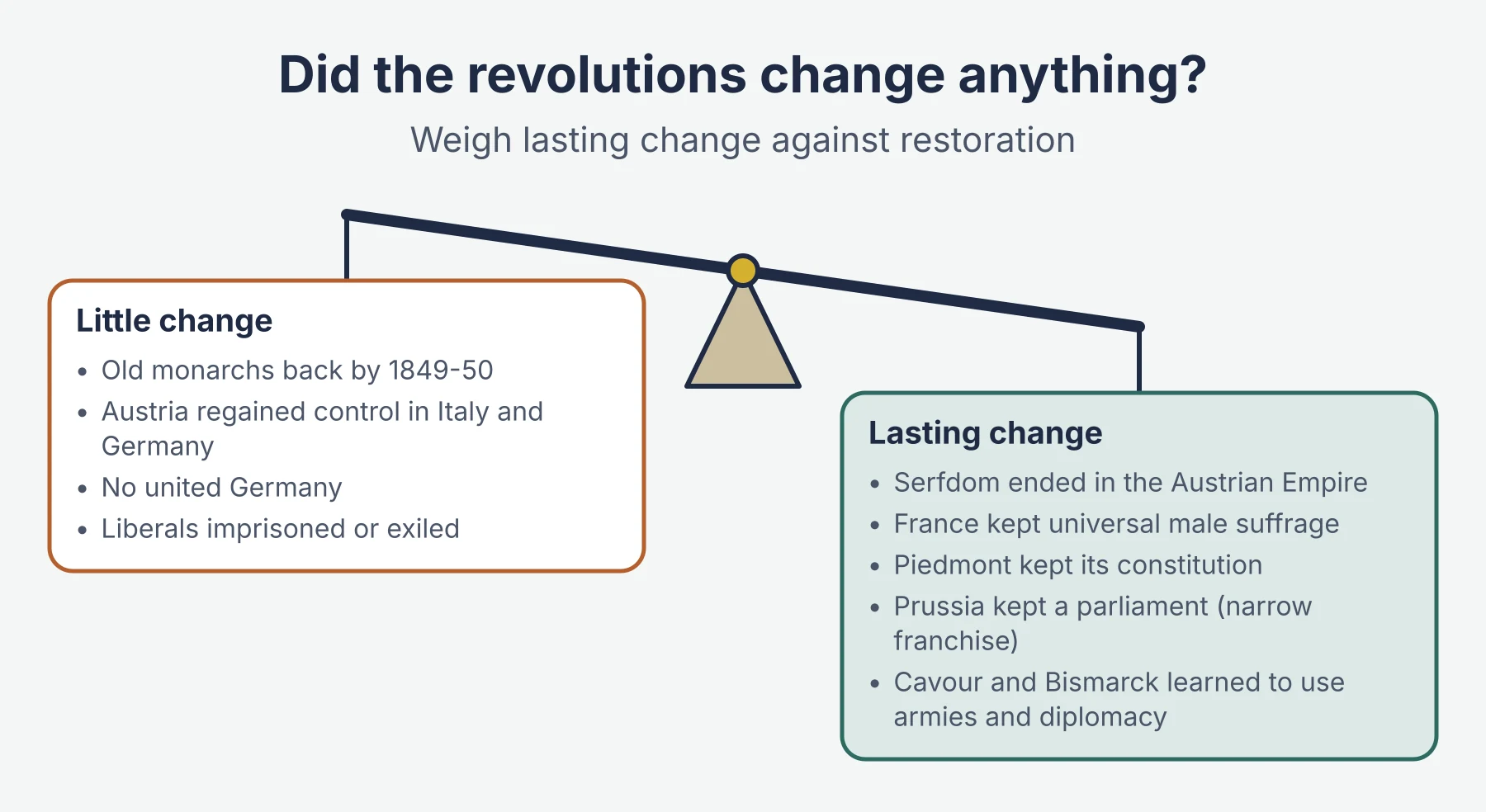
What changed
| Lasting change | Limit |
|---|---|
| Serfdom abolished in the Austrian Empire | Absolute rule restored by Franz Joseph |
| Universal male suffrage in France | Used by Napoleon III to approve his own power |
| Piedmont’s Statuto survives | The only Italian constitution to survive |
| Prussia keeps a parliament | Elected on an unequal three-class system |
| Nationalism now a mass issue | Unification would need war and diplomacy |
Key terms
| Term | Meaning |
|---|---|
| Liberalism | Belief in constitutions, elected parliaments and individual rights |
| Nationalism | Belief that a nation sharing language and culture should govern itself |
| July Monarchy | Louis-Philippe’s regime in France, 1830-48, with a very narrow franchise |
| National Workshops | French scheme of public works for the unemployed, closed in June 1848 |
| June Days | Rising of Paris workers in June 1848, crushed by the army |
| Statuto | Piedmont’s constitution, granted by Charles Albert in 1848 |
| Frankfurt Parliament | Elected German national assembly, 1848-49 |
| Grossdeutsch / Kleindeutsch | A “greater Germany” including Austria, or a “smaller Germany” led by Prussia |
| April Laws | Reforms of 1848 giving Hungary its own government |
| Robot | Unpaid labour peasants owed to landlords in the Austrian Empire |
Exam traps
- Writing one generic story. Examiners want named, country-specific examples.
- Saying nothing changed. Weigh lasting changes against the restoration of the old rulers.
- Mixing up Napoleons. Louis Napoleon (Napoleon III) is the nephew of Napoleon I.
- Confusing Custoza. Piedmont lost at Custoza in 1848; Italy lost a second battle there in 1866.
- Forgetting peasants. Their withdrawal after the end of labour services is a reason for failure in Austria.
- Ignoring the question’s date range. A question on “1848” may expect events of 1849, when most revolutions were defeated.
One-line answers to the focus points
- Why had liberalism and nationalism grown? French revolutionary ideas, a larger educated middle class, and resentment of repression after 1815.
- Why so many revolutions? Economic crisis made ordinary people ready to act, and the fall of Louis-Philippe showed that thrones could fall.
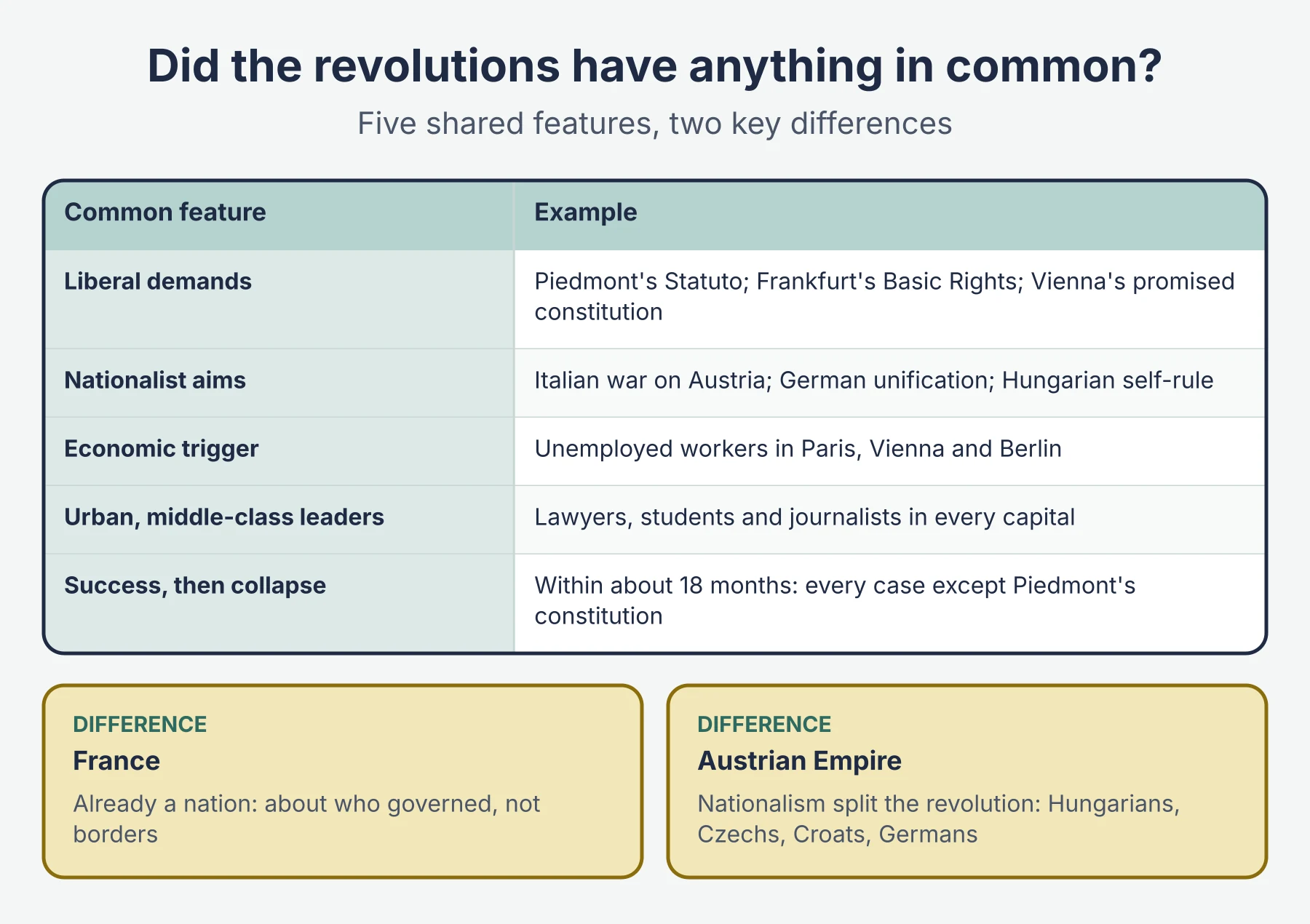
- Anything in common? Liberal and national demands, urban leadership and quick early success.
- Why did most fail? Loyal armies, divisions among revolutionaries and between nationalities, and foreign help for rulers.
- Did they change anything? Some lasting reforms, and the lesson that unity would need force.
Self-test
- Where did the first revolution of 1848 break out? Palermo, Sicily, in January 1848.
- What event in February 1848 triggered revolution in Paris? The government’s ban on a reform banquet.
- Why did the June Days happen? The assembly closed the National Workshops, leaving Paris workers without income.
- Who won the French presidential election of December 1848? Louis Napoleon Bonaparte.
- What happened in Milan in March 1848? The Five Days: citizens forced Radetzky’s Austrian army out of the city.
- Name the two battles in which Piedmont was defeated in 1848-49. Custoza (1848) and Novara (1849).
- Who defended the Roman Republic, and who destroyed it? Garibaldi defended it; French troops sent by Louis Napoleon took Rome.
- Why did the Frankfurt Parliament rely on Prussia? It had no army, so it needed Prussian troops, for example in the war with Denmark over Schleswig-Holstein.
- What did Frederick William IV do in April 1849? He refused the crown of a united Germany offered by Frankfurt.
- Which Austrian general retook Vienna in October 1848? Windischgrätz.
- Which foreign power helped crush Hungary in 1849? Russia, under Tsar Nicholas I.
- Give one lasting change from 1848 in the Austrian Empire. The abolition of labour services and serfdom.
Related resources
-
Study guides
Cambridge IGCSE World History (0470): How Was Germany Unified?
Study guide to Cambridge IGCSE History 0470 key question 1.3: the Zollverein, 1848-50, Bismarck's three wars and the German Empire of 1871.
World History · Cambridge · IGCSE
Read guide -
Practice questions
Cambridge IGCSE World History (0470): How Was Germany Unified? – Practice Questions
Twelve original questions with mark-scheme answers on the Zollverein, Frankfurt, Bismarck and the wars of 1864-71, for Cambridge IGCSE History 0470.
World History · Cambridge · IGCSE
Try questions -
Revision notes
Cambridge IGCSE World History (0470): How Was Germany Unified? – Revision Notes
Recall notes for Cambridge IGCSE History 0470 key question 1.3: German unification to 1871, Bismarck's three wars, key terms, traps and a self-test.
World History · Cambridge · IGCSE
Revise topic
Get free revision emails (optional)
Occasional emails with practice questions, worked explanations and links to free resources for the qualification and subjects you choose. No spam, and you can unsubscribe from any email. The free tools on this site never need an email.