
Study Guides
Cambridge IGCSE World History (0470): How Was Germany Unified?
Study guide to Cambridge IGCSE History 0470 key question 1.3: the Zollverein, 1848-50, Bismarck's three wars and the German Empire of 1871.
- Subject
- World History
- Level
- IGCSE
- Topic
- Core Content – Option A: The Nineteenth Century, 1848–1914
- Author
- Marlbridge Academic Team
- Updated
- Reviewed by
- Azam Siddique (what this means)
Aligned to Cambridge IGCSE World History (0470), 2024-2026. Official specification .
Syllabus page (what it covers and how it is assessed): Cambridge IGCSE World History.
Syllabus points this page covers
0470
- 1.3 How was Germany unified?
Found an error? Report a correction.
Need help with this topic? Request a free trial class for IGCSE World History (0470).
This guide covers key question 3 of Core Content Option A in Cambridge IGCSE History 0470 (2024-2026): “How was Germany unified?” The four focus points are: why Germany was not unified in 1848-50; how Bismarck brought about Austria’s defeat in 1866; how he brought about France’s defeat in 1870; and how far Bismarck was responsible for unification. The specified content includes German nationalism, the Zollverein, the 1848 revolution in Prussia, the Frankfurt Parliament, the restoration of Austrian influence by 1850, and Bismarck’s foreign policy to 1871. “How was Germany unified?” was the Paper 2 prescribed topic for the June 2025 series.
Revise the facts with the Germany revision notes and test yourself with the Germany practice questions. The Nineteenth Century 1848-1914 guide compares German and Italian unification.
German nationalism and the Zollverein
The German Confederation of 1815 linked 39 states, with Austria presiding over its Diet at Frankfurt. It was a league of princes, not a nation, and Metternich used it to suppress nationalist and liberal activity through measures such as the Carlsbad Decrees (1819). National feeling grew among students, writers and the middle class, through festivals, gymnastic and choral societies, and patriotic songs, but it had little organised mass support.
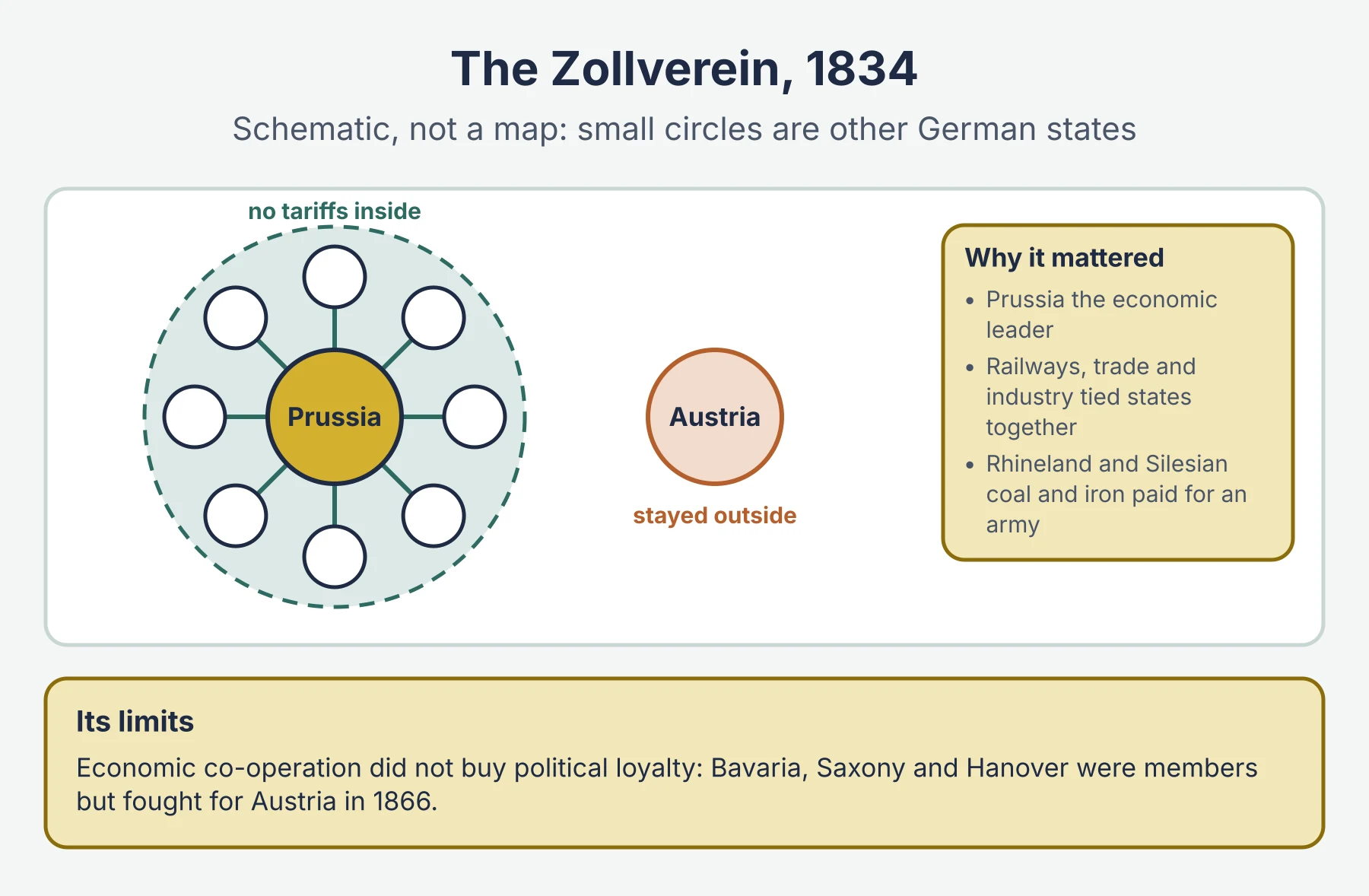
The Zollverein, a customs union led by Prussia, came into force in 1834. Member states removed tariffs between themselves, so goods moved freely across most of Germany. Austria stayed outside. The Zollverein mattered because:
- it made Prussia the economic leader of Germany, and other states grew used to following Prussian policy;
- it encouraged railways, trade and industry, which tied the German states together;
- it gave Prussia wealth from the coal and iron of the Rhineland and Silesia to pay for a modern army.
Its limits are also worth knowing: economic co-operation did not make states politically loyal. Bavaria, Saxony and Hanover were Zollverein members but fought on Austria’s side in 1866.
Why was Germany not unified in 1848-50?
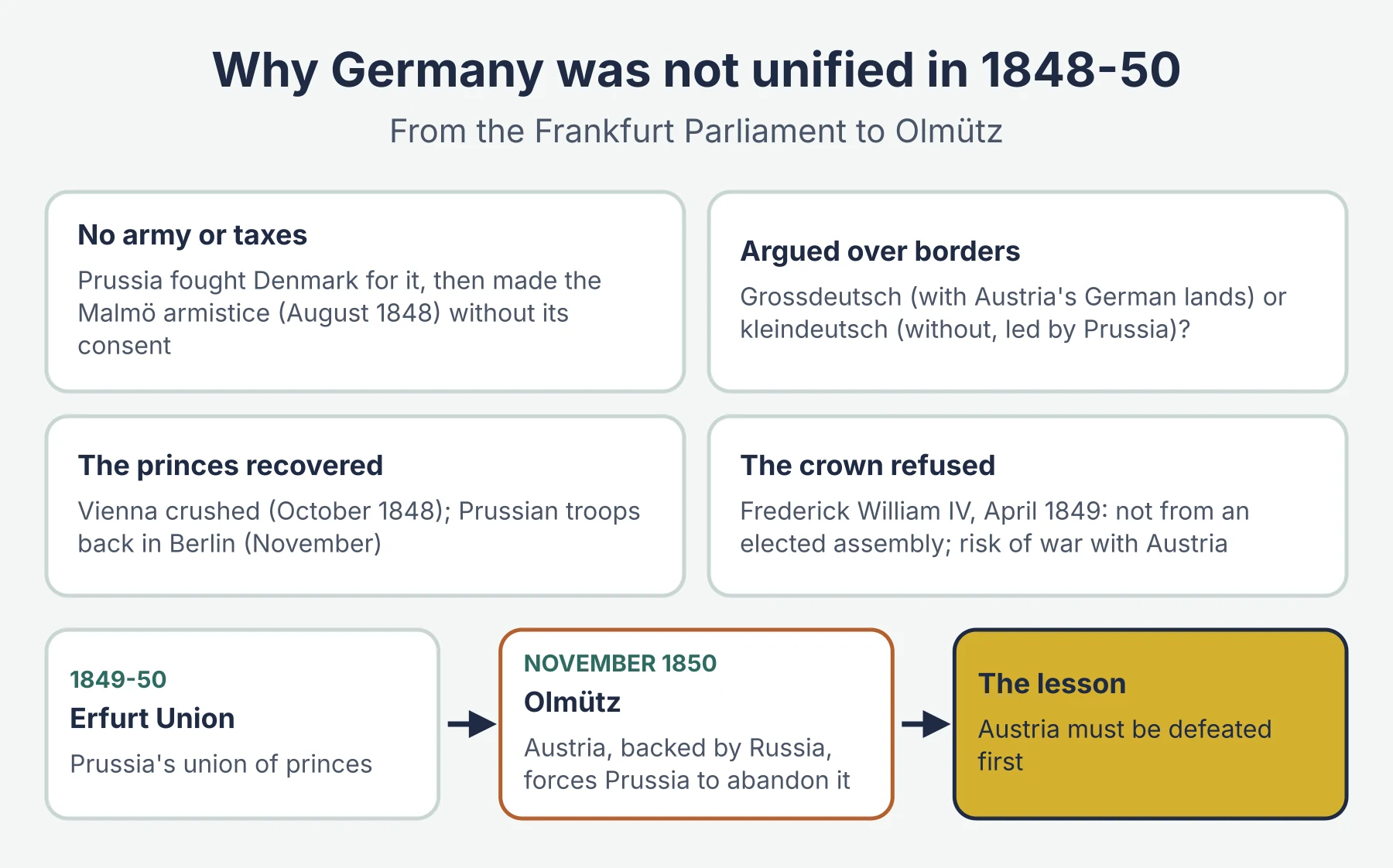
In March 1848 street fighting in Berlin forced Frederick William IV to withdraw his troops and promise a constitution. The Frankfurt Parliament met in May 1848. It failed because:
- It had no army or tax income and had to ask Prussia to fight Denmark over Schleswig-Holstein; Prussia then made the armistice of Malmö (August 1848) without its consent.
- It argued over borders. A grossdeutsch Germany would include Austria’s German lands; a kleindeutsch Germany would exclude Austria and be led by Prussia. Austria would not divide its empire.
- The princes recovered. Austria’s army crushed Vienna in October 1848, and Prussian troops returned to Berlin in November.
- Frederick William IV refused the crown in April 1849. He would not accept a throne from an elected assembly, and accepting it risked war with Austria.
Prussia then tried to unite Germany its own way, through a union of princes (the Erfurt Union, 1849-50). Austria, backed by Russia, forced Prussia to abandon it at Olmütz (November 1850), an agreement Prussians called a humiliation. The old Confederation was restored under Austrian leadership. The lesson was clear: Austria would have to be defeated before Germany could be united under Prussia.
Bismarck as Minister-President
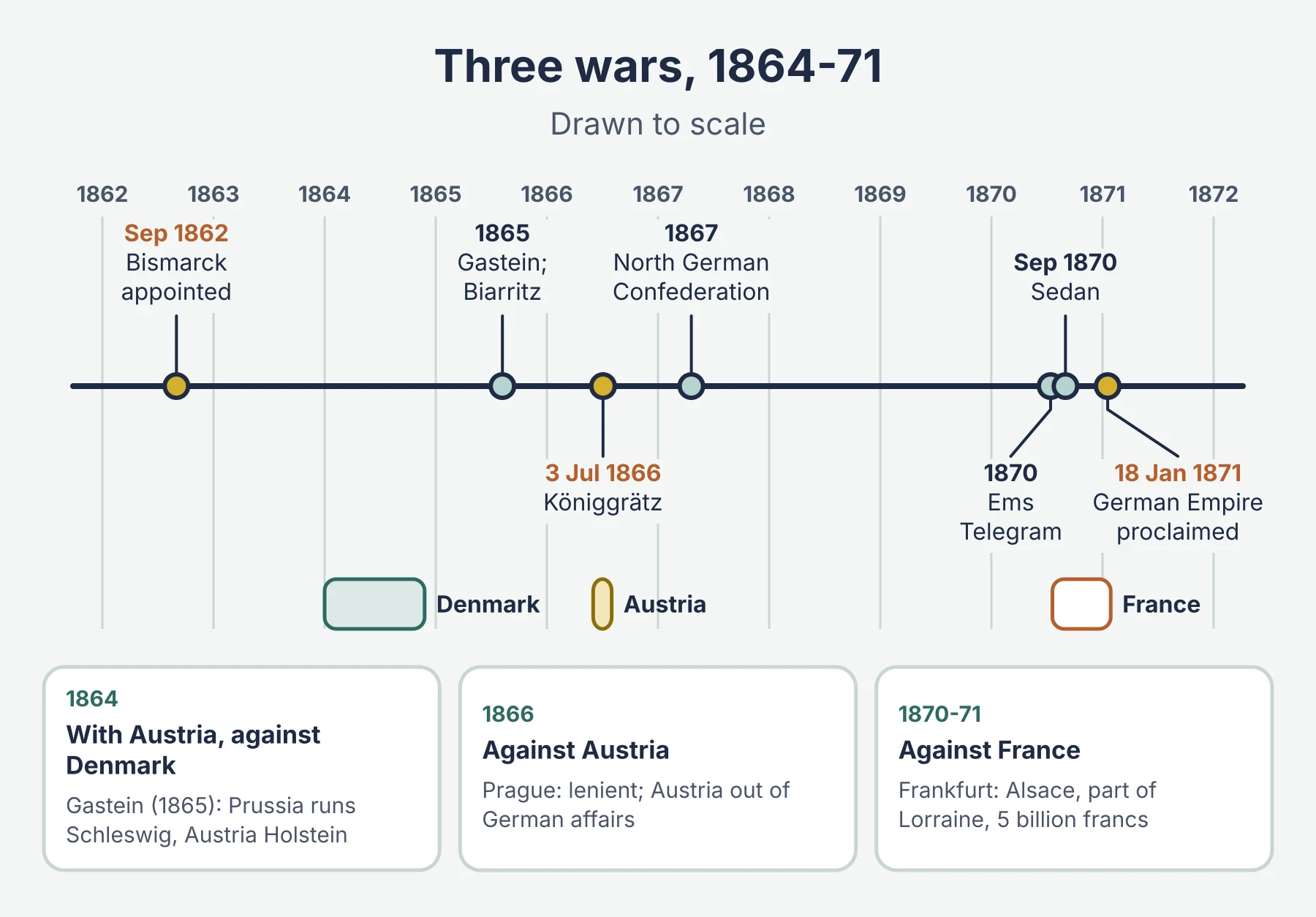
In 1862 King William I was in conflict with the Prussian parliament, whose liberal majority refused to pay for army reforms planned by the war minister Roon. William appointed Otto von Bismarck as Minister-President in September 1862. Bismarck told the parliament’s budget committee that the great questions of the day would be decided not by speeches and majority votes, “the great mistake of 1848 and 1849”, but by “iron and blood”. He collected taxes and carried out the reforms without parliamentary approval. Under the chief of staff Moltke, the army was trained to use railways and the breech-loading needle gun.
Schleswig-Holstein, 1864
In 1863 the Danish king tried to bind the duchy of Schleswig more closely to Denmark. German nationalists were outraged, since Holstein was a member of the German Confederation and both duchies had many German speakers. Bismarck persuaded Austria to join Prussia in a war that defeated Denmark in 1864. The Convention of Gastein (1865) gave Prussia the administration of Schleswig and Austria that of Holstein, a cramped arrangement that Bismarck could use to pick a quarrel.
How did Bismarck bring about Austria’s defeat in 1866?
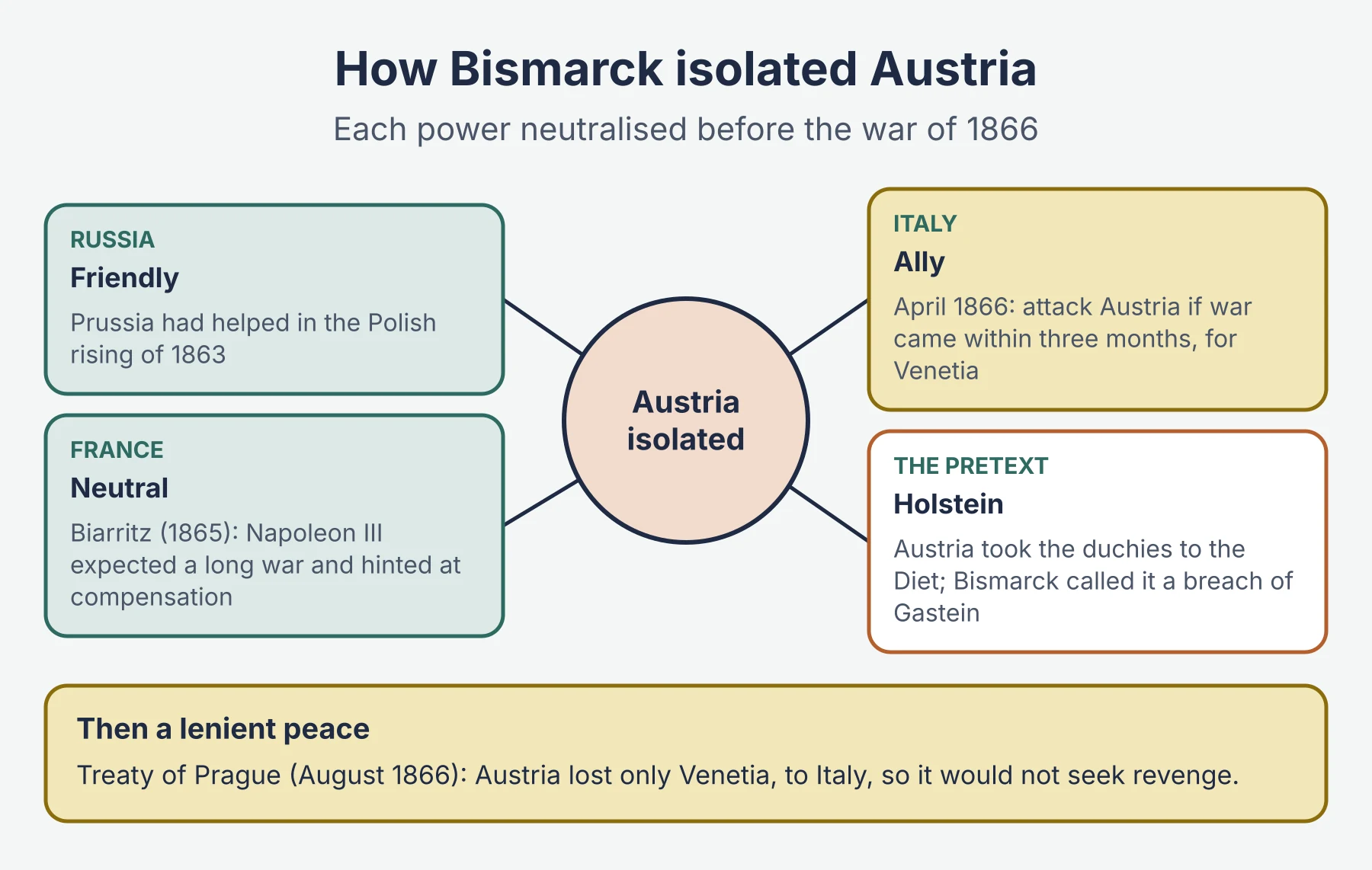
Bismarck’s method was to isolate Austria first:
- Russia was friendly, because Prussia had helped it during the Polish rising of 1863.
- France: at Biarritz (1865) Bismarck met Napoleon III, who expected to gain from a long war and hinted at compensation for staying neutral.
- Italy agreed (April 1866) to attack Austria if war began within three months, in return for Venetia.
When Austria asked the Confederation’s Diet to decide the future of the duchies, Bismarck said it had broken the Gastein agreement and sent troops into Holstein. The Diet voted to mobilise against Prussia, and war followed in June 1866. Prussian armies, moved quickly by rail, won the decisive Battle of Königgrätz (Sadowa), 3 July 1866.
The Treaty of Prague (August 1866) was deliberately lenient: Austria lost no land to Prussia, only Venetia to Italy, but it was excluded from German affairs. The Confederation was dissolved. Prussia annexed Schleswig-Holstein, Hanover, Hesse-Kassel, Nassau and Frankfurt, and created the North German Confederation (1867) under Prussian leadership. The southern states (Bavaria, Württemberg, Baden and southern Hesse) stayed independent but signed secret military alliances with Prussia. Leniency mattered: Austria would not seek revenge, and Bismarck might need it later.
How did Bismarck bring about France’s defeat in 1870?
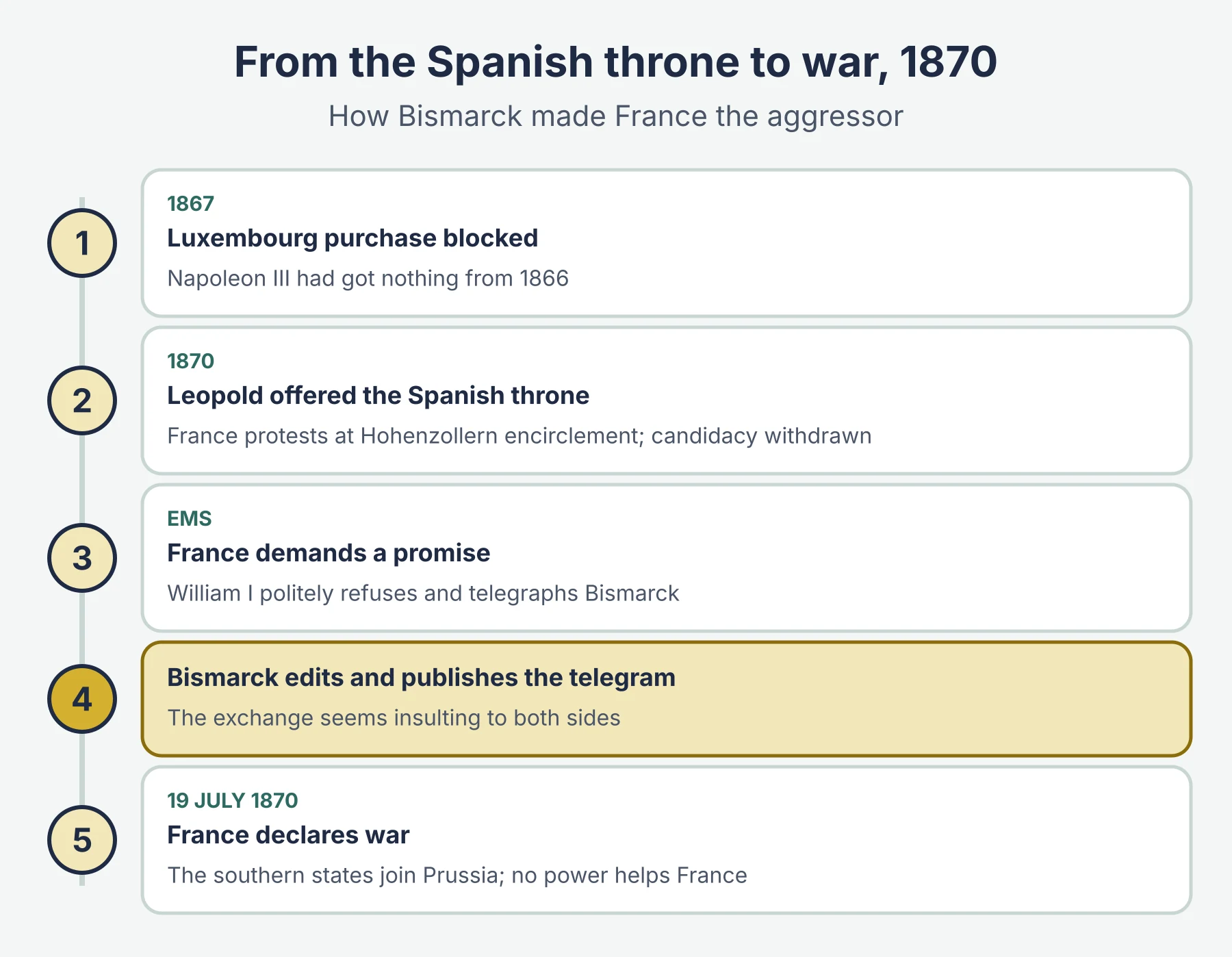
Napoleon III had expected a long war in 1866 and got nothing. His attempt to buy Luxembourg (1867) was blocked. In 1870 the Spanish throne was offered to Prince Leopold of Hohenzollern-Sigmaringen, a relative of William I. France protested at being surrounded by Hohenzollerns, and Leopold’s candidacy was withdrawn. The French ambassador then approached William I at Ems to demand a promise that it would never be renewed. William politely refused and telegraphed an account to Bismarck, who edited the Ems Telegram and published it so that the exchange seemed insulting to both sides. France declared war on 19 July 1870.
Because France appeared the aggressor, the southern German states joined Prussia, and no other power helped France. At Sedan (September 1870) Napoleon III was captured; Paris was besieged until January 1871. On 18 January 1871 William I was proclaimed German Emperor in the Hall of Mirrors at Versailles. The Treaty of Frankfurt (May 1871) gave Germany Alsace and part of Lorraine and a war indemnity of 5 billion francs.
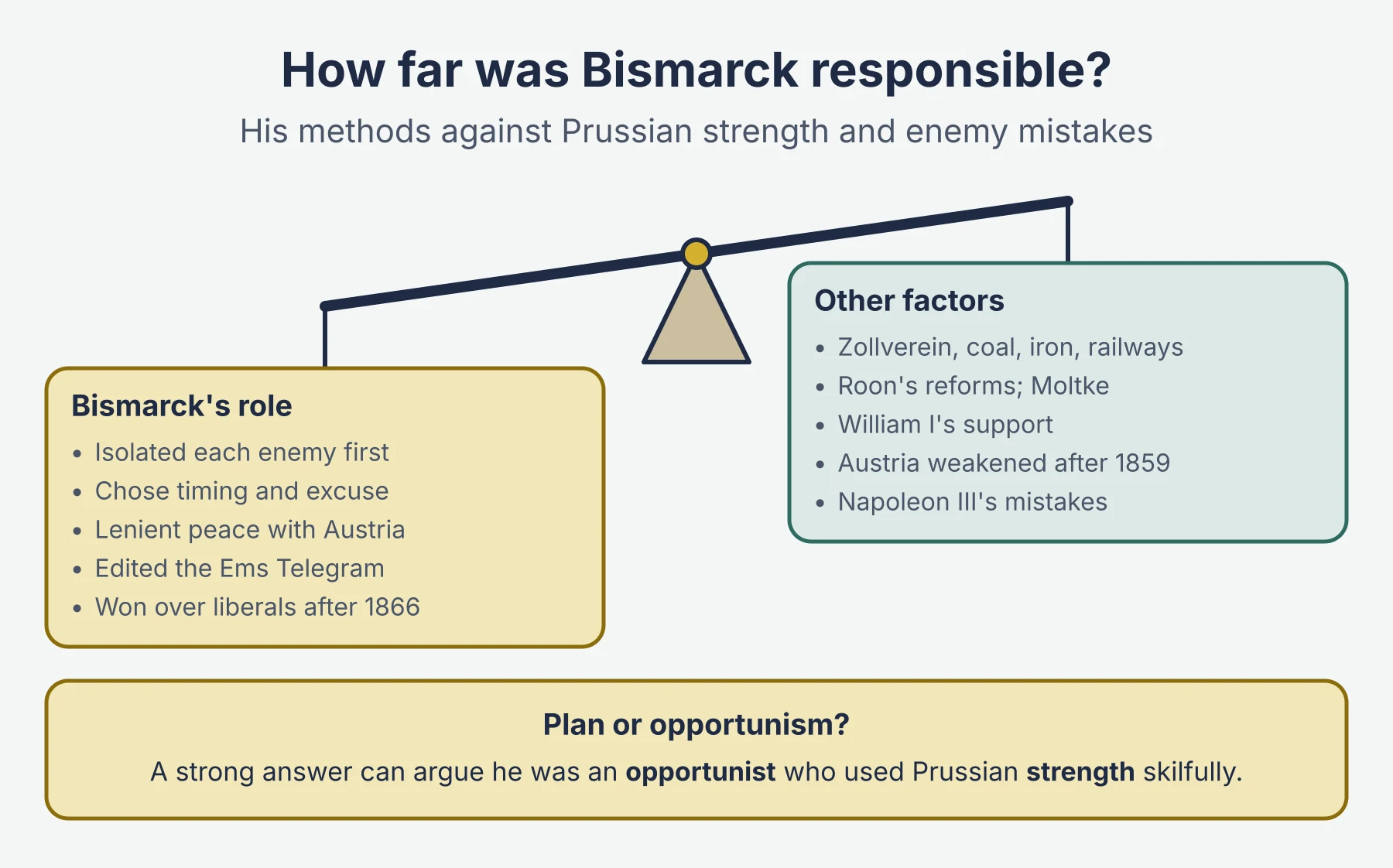
How far was Bismarck responsible?
| Bismarck’s role | Other factors |
|---|---|
| Isolated each enemy before each war | Prussia’s economic strength through the Zollverein, coal, iron and railways |
| Chose the timing and the excuse for war | The army reforms of Roon and the generalship of Moltke |
| Lenient peace with Austria kept it neutral in 1870 | William I backed him through the constitutional crisis |
| Edited the Ems Telegram to make France the aggressor | Austria’s weakness after its defeat in Italy in 1859 |
| Won over liberals after 1866 with success | Napoleon III’s mistakes and French public opinion |
Historians disagree about whether Bismarck followed a long-term plan or exploited opportunities as they came. A strong answer can argue that he was an opportunist who used Prussian strength skilfully.
Annotated model answer
An original practice question: “Bismarck brought about the war with Austria in 1866.” How far do you agree? [10]
Bismarck did bring about the war. He secured Russian friendship, French neutrality at Biarritz and an alliance with Italy that only worked if war came within three months, so he set the timetable. When Austria referred the duchies to the Diet, he sent troops into Holstein to force a confrontation. [Agree, explained.] However, the rivalry existed before him: Olmütz had shown in 1850 that Austria would block Prussian leadership, and Austria itself mobilised and persuaded the Diet to act against Prussia. [Disagree, explained.] Bismarck did not create the rivalry, but he chose the moment when Austria was isolated and Prussia ready. [Judgement.]
Common mistakes
- Calling 1864 a war against Austria. Austria and Prussia fought Denmark together.
- Saying Austria lost territory to Prussia in 1866. It lost only Venetia, to Italy.
- Forgetting that the southern states joined only in 1870-71.
- Claiming Bismarck invented the Ems Telegram. He edited a real report.
Exam technique
“How did Bismarck bring about” questions want his methods: diplomacy, timing, provocation. “How far was Bismarck responsible” questions want his methods weighed against Prussian strength and enemy mistakes.
Official syllabus
Cambridge IGCSE History (0470) syllabus for 2024, 2025 and 2026, Core Content Option A, key question 3 – cambridgeinternational.org.
Related resources
-
Practice questions
Cambridge IGCSE World History (0470): How Was Germany Unified? – Practice Questions
Twelve original questions with mark-scheme answers on the Zollverein, Frankfurt, Bismarck and the wars of 1864-71, for Cambridge IGCSE History 0470.
World History · Cambridge · IGCSE
Try questions -
Revision notes
Cambridge IGCSE World History (0470): How Was Germany Unified? – Revision Notes
Recall notes for Cambridge IGCSE History 0470 key question 1.3: German unification to 1871, Bismarck's three wars, key terms, traps and a self-test.
World History · Cambridge · IGCSE
Revise topic -
Study guides
Cambridge IGCSE World History (0470): How Was Italy Unified?
Study guide to Cambridge IGCSE History 0470 key question 1.2: Austrian rule, Mazzini, 1848-49, Cavour, Garibaldi and the completion of unity by 1870.
World History · Cambridge · IGCSE
Read guide
Get free revision emails (optional)
Occasional emails with practice questions, worked explanations and links to free resources for the qualification and subjects you choose. No spam, and you can unsubscribe from any email. The free tools on this site never need an email.