
Revision Notes
Cambridge IGCSE World History (0470): How Was Italy Unified? – Revision Notes
Recall notes for Cambridge IGCSE History 0470 key question 1.2: Italian unification timeline, key people and terms, Cavour versus Garibaldi, self-test.
- Subject
- World History
- Level
- IGCSE
- Topic
- Core Content – Option A: The Nineteenth Century, 1848–1914
- Author
- Marlbridge Academic Team
- Updated
- Reviewed by
- Azam Siddique (what this means)
Aligned to Cambridge IGCSE World History (0470), 2024-2026. Official specification .
Syllabus page (what it covers and how it is assessed): Cambridge IGCSE World History.
Syllabus points this page covers
0470
- 1.2 How was Italy unified?
Found an error? Report a correction.
Need help with this topic? Request a free trial class for IGCSE World History (0470).
Key question 1.2, Cambridge IGCSE History 0470: “How was Italy unified?” Learn Austrian influence, Mazzini, the events of 1848-49, Cavour and Plombières, the war of 1859, Garibaldi’s invasion of Sicily and Naples, and the completion of unity by 1870. This is the Paper 2 prescribed topic for November 2026. Explanations are in the Italy study guide; practise with the Italy practice questions.
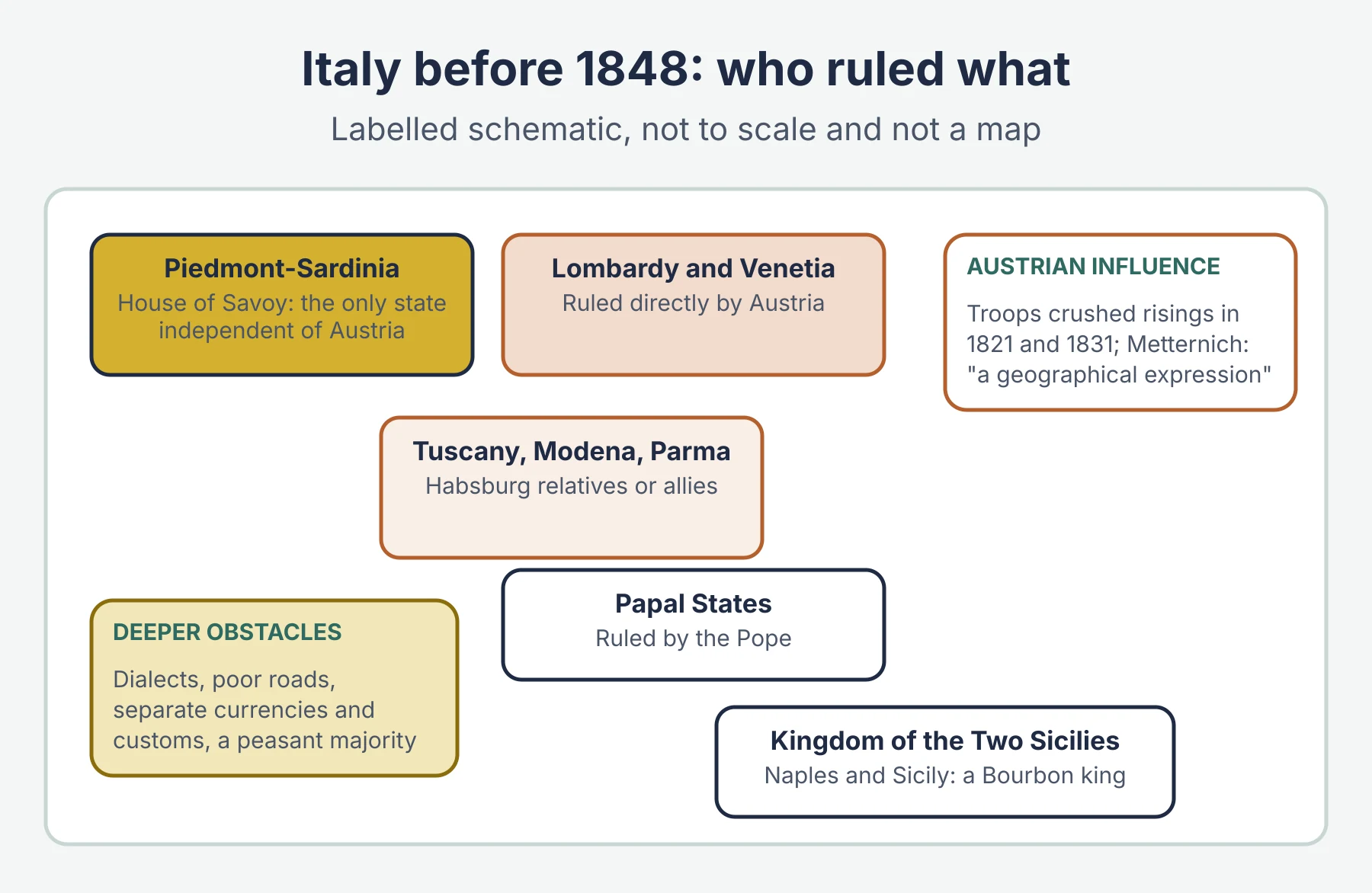
The map in 1815-48
| State | Ruler |
|---|---|
| Lombardy and Venetia | Austria, directly |
| Tuscany, Modena, Parma | Habsburg relatives or Austrian allies |
| Papal States | The Pope |
| Kingdom of the Two Sicilies | Bourbon king in Naples |
| Piedmont-Sardinia | House of Savoy: independent, the only native dynasty able to stand up to Austria |
Obstacles to unity: Austrian armies; the Pope’s lands across the centre; dialects and regional loyalty; poor communications; separate currencies and tariffs; peasant indifference.
Timeline to learn
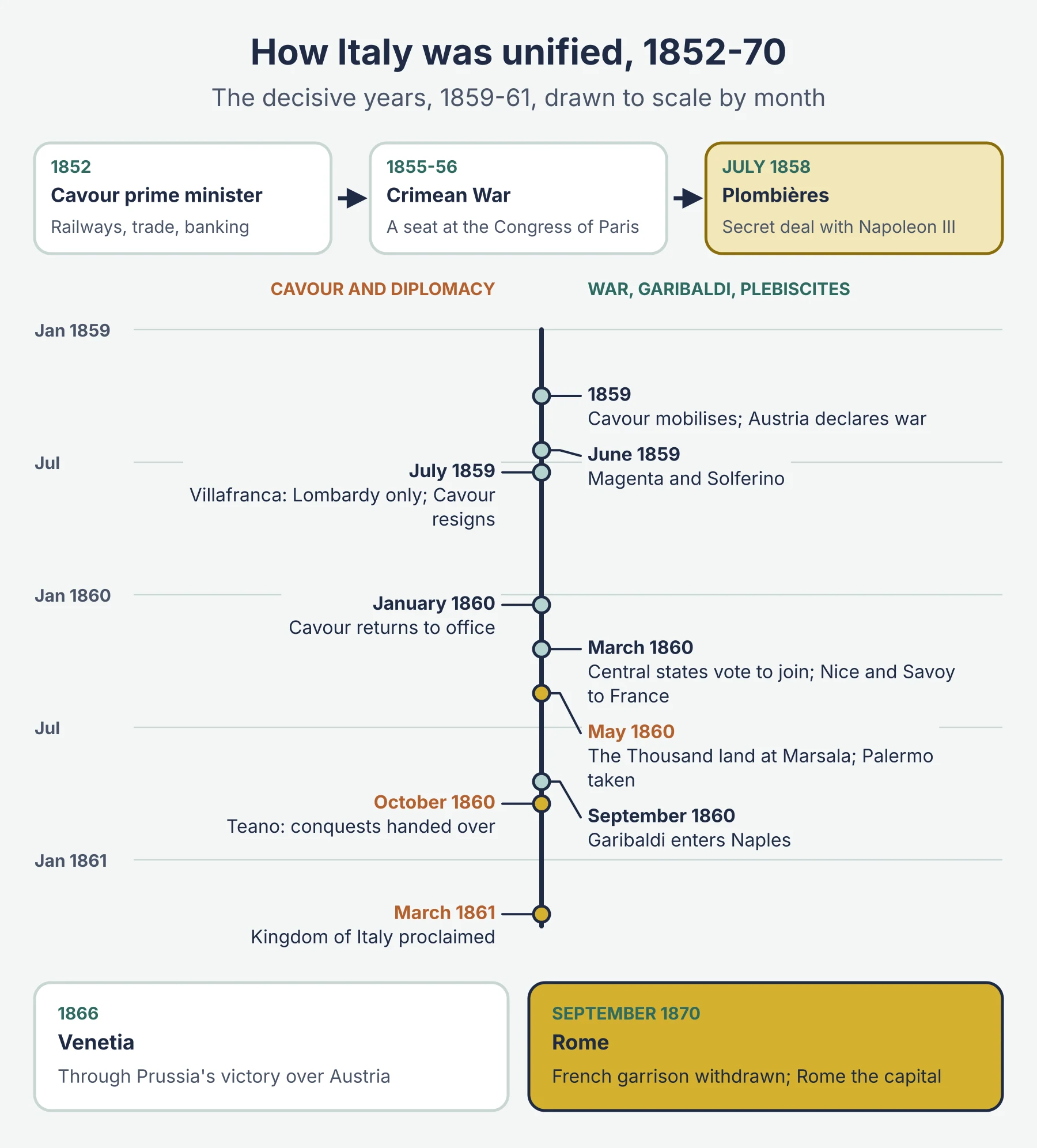
| Date | Event |
|---|---|
| 1831 | Mazzini founds Young Italy |
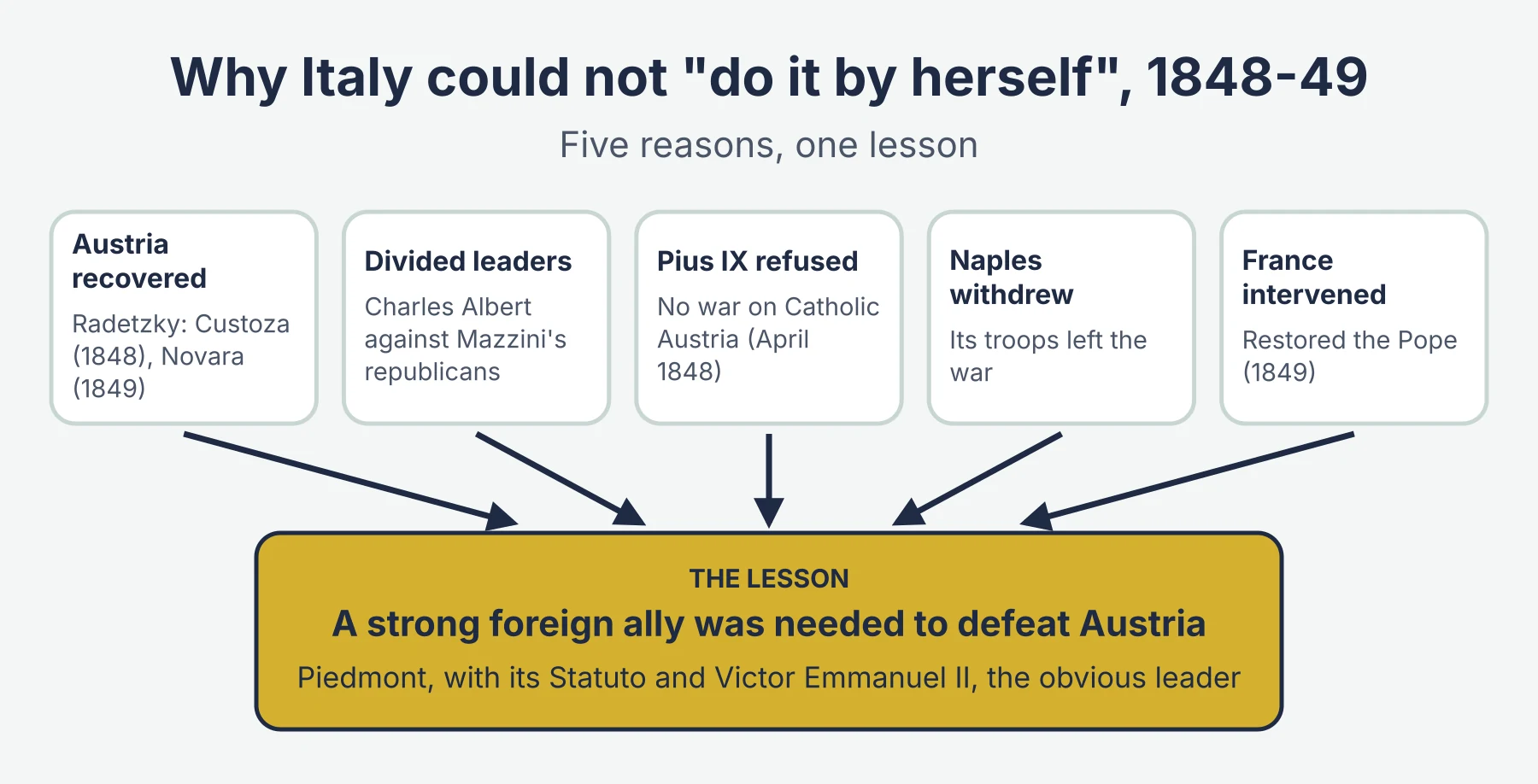
| 1848 | Five Days of Milan; Venice republic; Piedmont declares war; defeated at Custoza; Pope refuses to fight Austria |
| 1849 | Piedmont defeated at Novara; Charles Albert abdicates for Victor Emmanuel II; Roman Republic falls to France |
| 1852 | Cavour becomes prime minister of Piedmont |
| 1855-56 | Piedmont fights in the Crimean War; Congress of Paris |
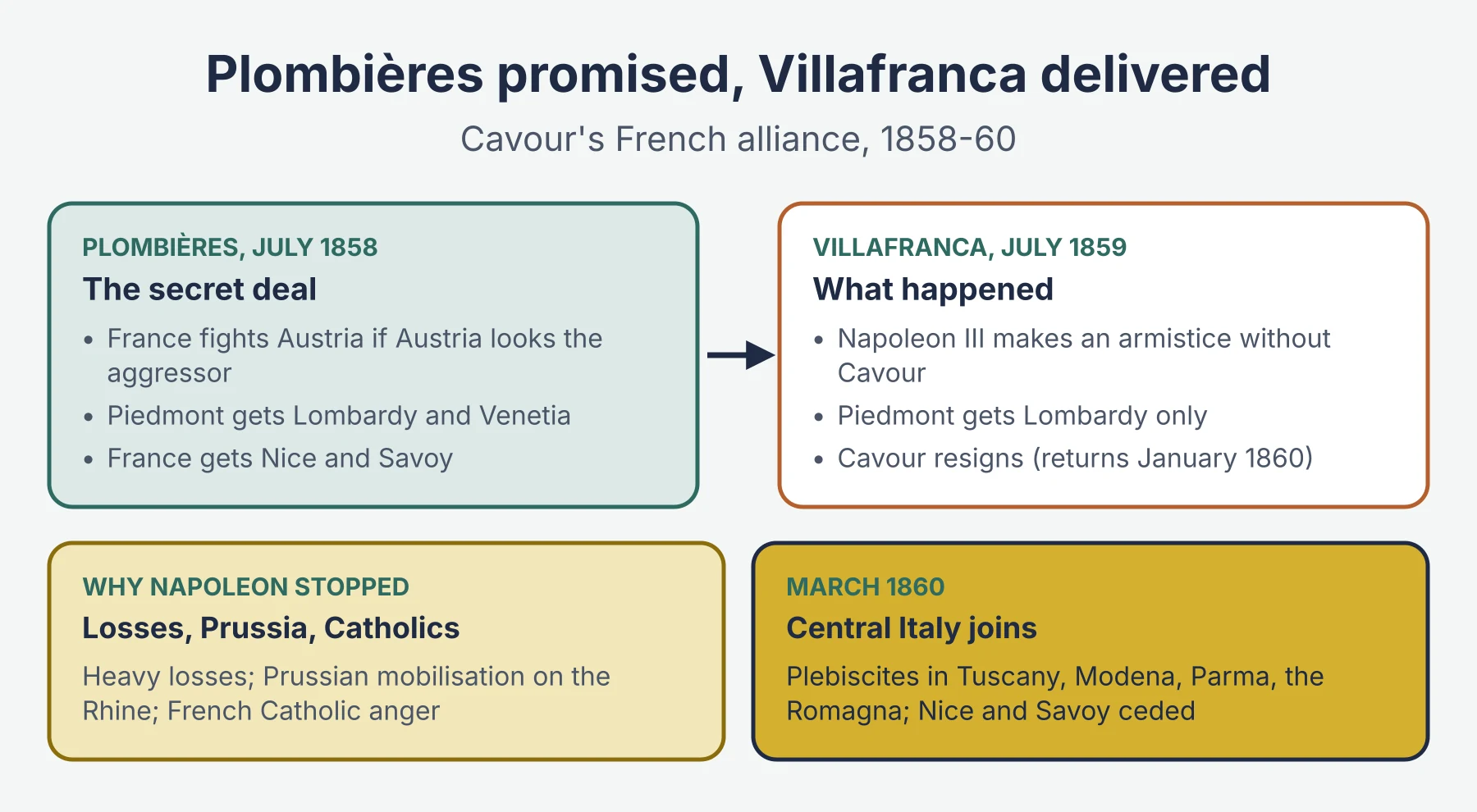
| July 1858 | Plombières agreement between Cavour and Napoleon III |
| 1859 | War with Austria: Magenta and Solferino; armistice of Villafranca; Piedmont gains Lombardy |
| March 1860 | Plebiscites: central duchies and Romagna join Piedmont; Nice and Savoy go to France |
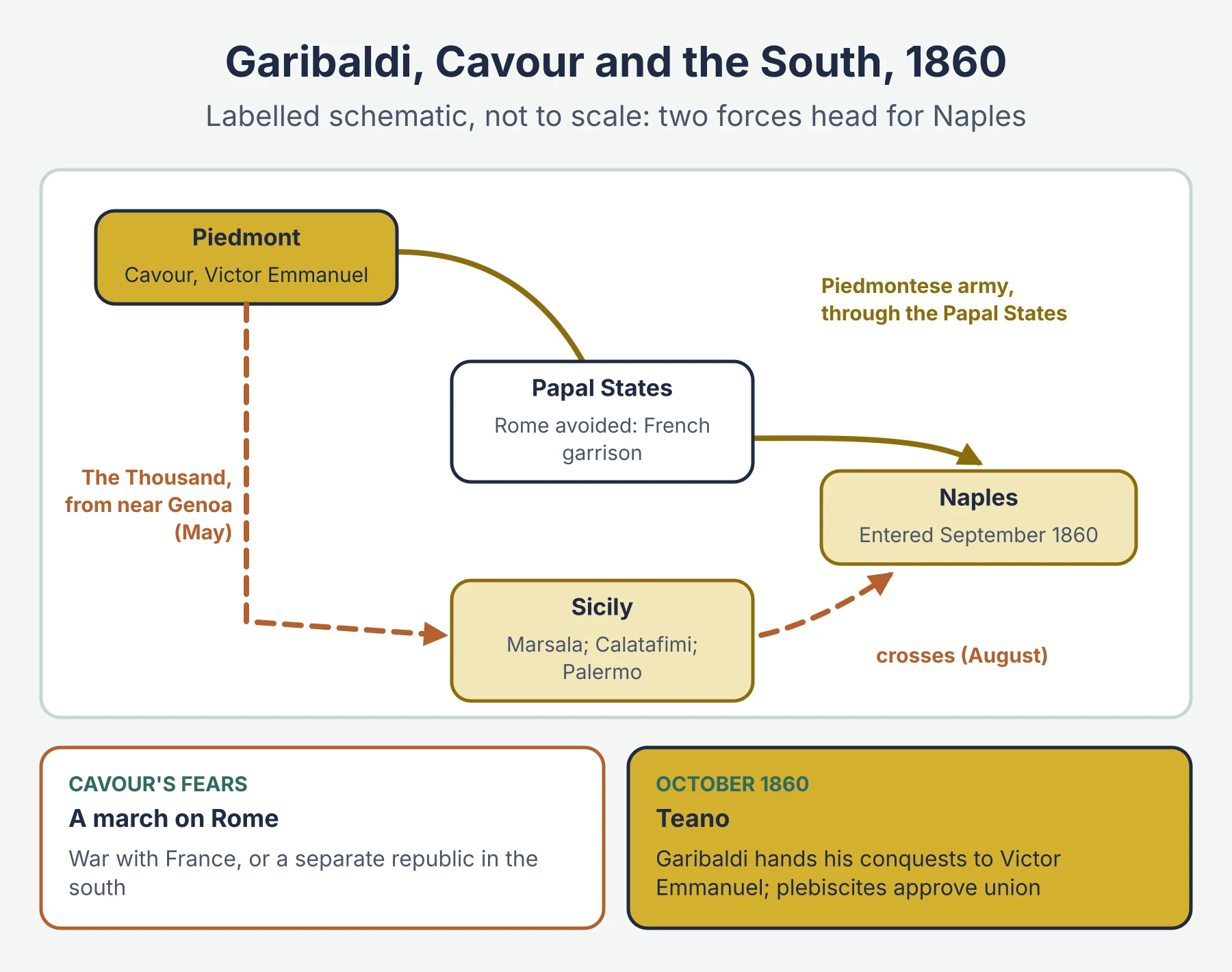
| May-September 1860 | Expedition of the Thousand: Marsala, Calatafimi, Palermo, Naples |
| October 1860 | Teano: Garibaldi hands his conquests to Victor Emmanuel |
| March 1861 | Kingdom of Italy proclaimed; Cavour dies in June |
| 1862, 1867 | Garibaldi fails to take Rome at Aspromonte and Mentana |
| 1866 | Italy allies with Prussia; gains Venetia after Austria’s defeat |
| September 1870 | French garrison withdrawn; Italian troops enter Rome |
Key people
| Person | Remember |
|---|---|
| Mazzini | Republican idealist; Young Italy; Roman Republic 1849; inspired but did not achieve unity |
| Charles Albert | King of Piedmont; granted the Statuto; lost to Austria in 1848-49 |
| Victor Emmanuel II | King of Piedmont from 1849; first King of Italy, 1861 |
| Cavour | Piedmont’s prime minister; modernised; won French alliance at Plombières |
| Napoleon III | Fought Austria in 1859, then made peace early; gained Nice and Savoy; protected Rome until 1870 |
| Garibaldi | Soldier; led the Thousand; conquered the south; handed it over at Teano |
| Pius IX | Pope; refused war on Austria in 1848; lost Rome in 1870 |
| Radetzky | Austrian commander who defeated Piedmont in 1848-49 |
Key terms
| Term | Meaning |
|---|---|
| Risorgimento | “Resurgence”: the movement for Italian unity |
| Young Italy | Mazzini’s society for a united, democratic republic |
| Statuto | Piedmont’s 1848 constitution, kept after 1849 |
| Plombières | Secret 1858 deal: French help against Austria in return for Nice and Savoy |
| Villafranca | 1859 armistice ending the war before Venetia was won |
| Plebiscite | A vote of the people on a single question, such as joining Piedmont |
| Redshirts | Garibaldi’s volunteers |
| Roman Question | The dispute over the Pope’s lost territory after 1870 |
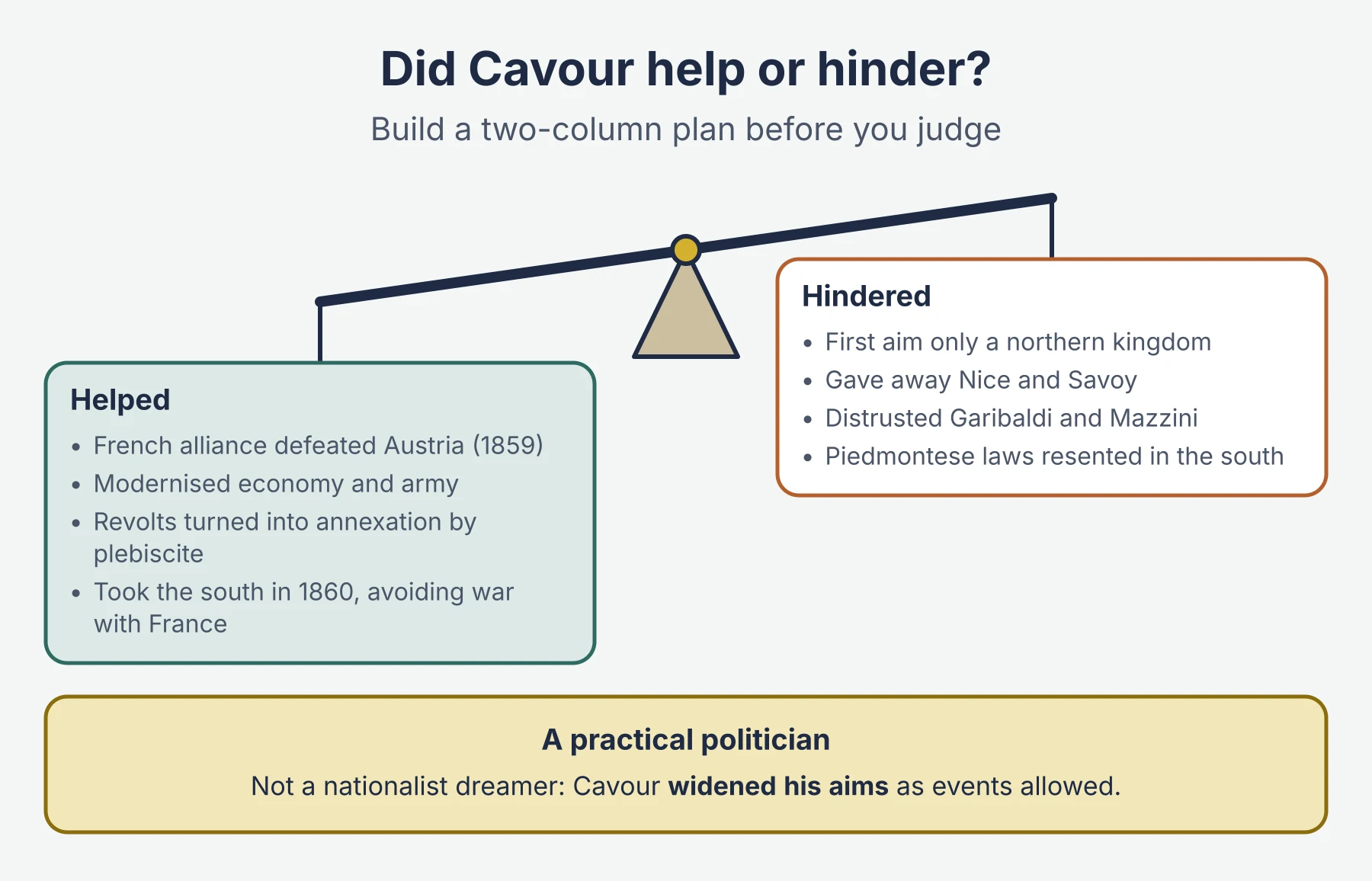
Cavour versus Garibaldi: the argument in brief
| Cavour | Garibaldi | |
|---|---|---|
| Aim | Strong northern kingdom under Piedmont, widened as events allowed | United Italy, with Rome as capital |
| Method | Diplomacy, alliances, regular armies | Volunteer military campaigns |
| Key achievement | Defeat of Austria in 1859; annexations of 1860 | Conquest of Sicily and Naples, 1860 |
| Weakness | Gave up Nice and Savoy; distrusted the south | Could not take Rome; risked war with France |
A balanced judgement: Garibaldi won the south, but Cavour’s alliance and state made the gains last.
Why other countries mattered
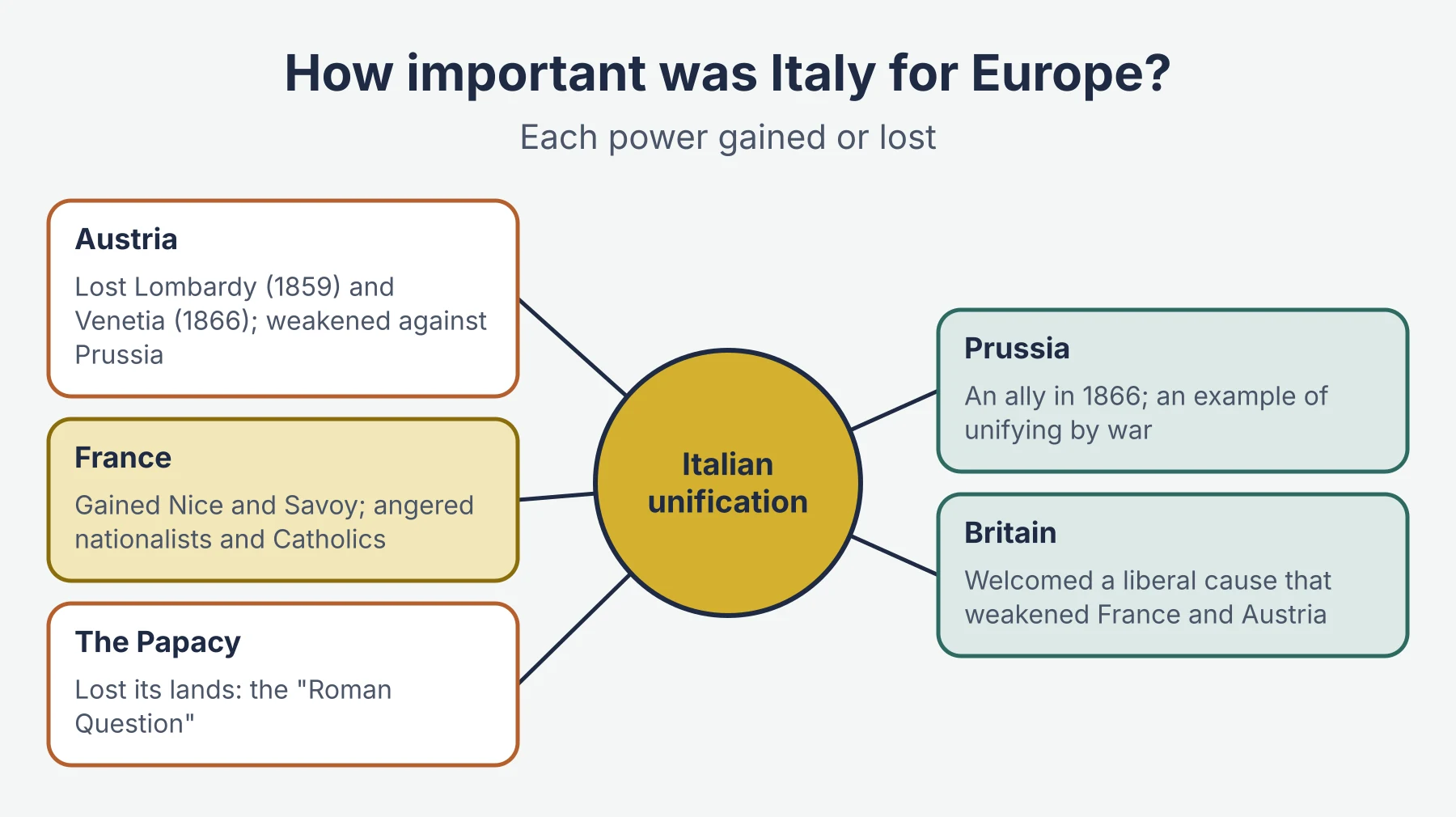
- France: essential ally in 1859; garrison in Rome blocked unity until 1870.
- Austria: the enemy; its defeats in 1859 and 1866 freed Lombardy and Venetia.
- Prussia: victory over Austria (1866) and France (1870) gave Italy Venetia and Rome.
- Britain: sympathetic, opposed intervention against Italy.
Exam traps
- 1861 is not the end. Venetia came in 1866 and Rome in 1870.
- Plombières was not the treaty that ended the war. It came before the war; Villafranca ended it.
- Garibaldi was not a king’s man by origin. He had been a Mazzinian republican, but accepted Victor Emmanuel.
- Italy did not win Venetia by its own victories. It lost at Custoza and Lissa in 1866.
- “Help or hinder” needs both columns. Cavour’s limited aims are evidence of hindrance.
Self-test
- Which parts of Italy did Austria rule directly before 1859? Lombardy and Venetia.
- What kind of Italy did Mazzini want? A united, democratic republic created by the people.
- Why was Pius IX’s statement of April 1848 important? He refused to fight Catholic Austria, ending hopes of a papal lead.
- Why did Piedmont join the Crimean War? To win the goodwill of Britain and France and raise the Italian question at the peace congress.
- What did France gain at Plombières? The promise of Nice and Savoy.
- Name the two victories over Austria in 1859. Magenta and Solferino.
- Give two reasons Napoleon III made peace at Villafranca. Heavy casualties; Prussian mobilisation; Catholic opinion in France; fear of a strong Piedmont (any two).
- How did central Italy join Piedmont in 1860? By plebiscites after its rulers fled.
- Where did the Thousand land in Sicily? Marsala.
- Why did Cavour send troops through the Papal States in 1860? To reach Naples before Garibaldi could attack Rome and provoke France.
- What happened at Teano? Garibaldi handed over southern Italy to Victor Emmanuel II.
- Why could Italy take Rome in 1870? France withdrew its garrison to fight Prussia.
Related resources
-
Study guides
Cambridge IGCSE World History (0470): Why Was There a Civil War in the United States and What Were Its Results?
Cambridge IGCSE History 0470 key question 1.4 in depth: failed compromises, Lincoln's election, how the war was won and lost, and Reconstruction.
World History · Cambridge · IGCSE
Read guide -
Practice questions
Cambridge IGCSE World History (0470): Why Was There a Civil War in the United States and What Were Its Results? – Practice Questions
Twelve original questions with mark-scheme answers on secession, the Civil War and Reconstruction, for Cambridge IGCSE History 0470 key question 1.4.
World History · Cambridge · IGCSE
Try questions -
Revision notes
Cambridge IGCSE World History (0470): Why Was There a Civil War in the United States and What Were Its Results? – Revision Notes
Recall notes for Cambridge IGCSE History 0470 key question 1.4: secession, turning points of the Civil War, Reconstruction's phases and a self-test.
World History · Cambridge · IGCSE
Revise topic
Get free revision emails (optional)
Occasional emails with practice questions, worked explanations and links to free resources for the qualification and subjects you choose. No spam, and you can unsubscribe from any email. The free tools on this site never need an email.