
Study Guides
Cambridge IGCSE World History (0470): How Was Italy Unified?
Study guide to Cambridge IGCSE History 0470 key question 1.2: Austrian rule, Mazzini, 1848-49, Cavour, Garibaldi and the completion of unity by 1870.
- Subject
- World History
- Level
- IGCSE
- Topic
- Core Content – Option A: The Nineteenth Century, 1848–1914
- Author
- Marlbridge Academic Team
- Updated
- Reviewed by
- Azam Siddique (what this means)
Aligned to Cambridge IGCSE World History (0470), 2024-2026. Official specification .
Syllabus page (what it covers and how it is assessed): Cambridge IGCSE World History.
Syllabus points this page covers
0470
- 1.2 How was Italy unified?
Found an error? Report a correction.
Need help with this topic? Request a free trial class for IGCSE World History (0470).
This guide covers key question 2 of Core Content Option A in Cambridge IGCSE History 0470 (2024-2026): “How was Italy unified?” The focus points ask why Italy was not unified in 1848-49, how important Garibaldi’s contribution was, whether Cavour helped or hindered unification, and how important moves towards Italian unity were for other European countries. The specified content runs from Austrian influence and Mazzini to the completion of unification by 1870. “How was Italy unified?” is the Paper 2 prescribed topic for the November 2026 series, so candidates sitting then need it for both Paper 1 and the document paper.
Use this alongside the Italy revision notes and the Italy practice questions. For how Italy compares with Germany, see the Nineteenth Century 1848-1914 guide.
Italy before 1848: Austrian influence
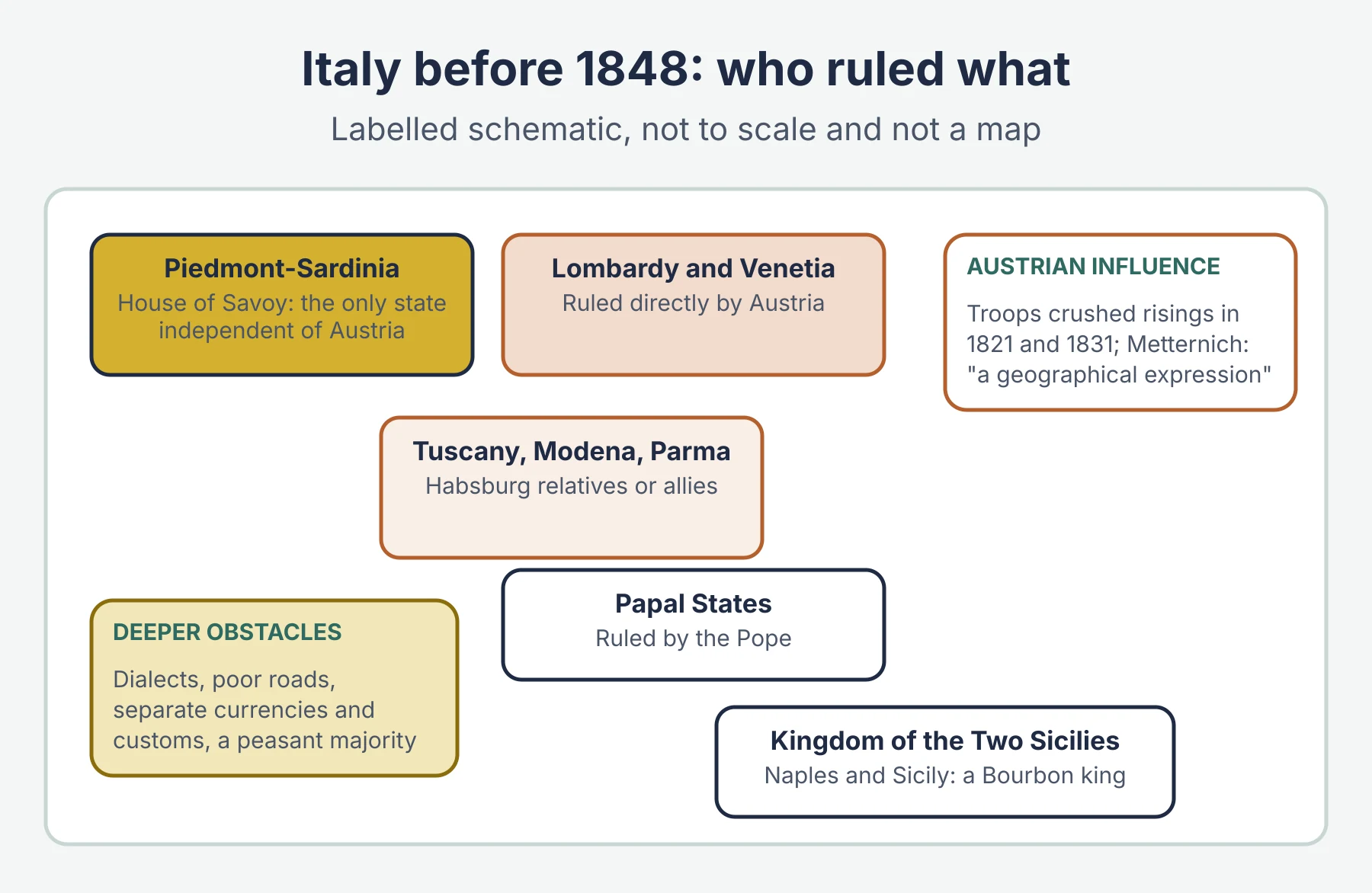
After 1815 the peninsula was divided into separate states. Lombardy and Venetia in the north were ruled directly by Austria. Tuscany, Modena and Parma were ruled by relatives or allies of the Habsburgs. The Papal States across the centre were ruled by the Pope, and the Kingdom of the Two Sicilies (Naples and Sicily) by a Bourbon king. Only Piedmont-Sardinia, ruled by the House of Savoy, was independent of Austria. Austrian troops crushed risings in 1821 and 1831, and Metternich dismissed Italy as merely “a geographical expression”.
Unity faced deeper obstacles too: different dialects, poor roads, separate currencies and customs barriers, and a peasant majority with little interest in national politics.
Mazzini and Italian nationalism
Giuseppe Mazzini founded Young Italy in 1831. He wanted a united, democratic republic, created by the Italian people rising together rather than by kings or foreign armies. His risings in the 1830s and 1840s all failed, and he spent most of his life in exile. His importance was as an inspiration: he made unity a cause young Italians were prepared to die for, and he recruited Garibaldi. Other nationalists had different plans: a federation of states under the Pope, or an enlarged northern kingdom under Piedmont.
Why was Italy not unified in 1848-49?
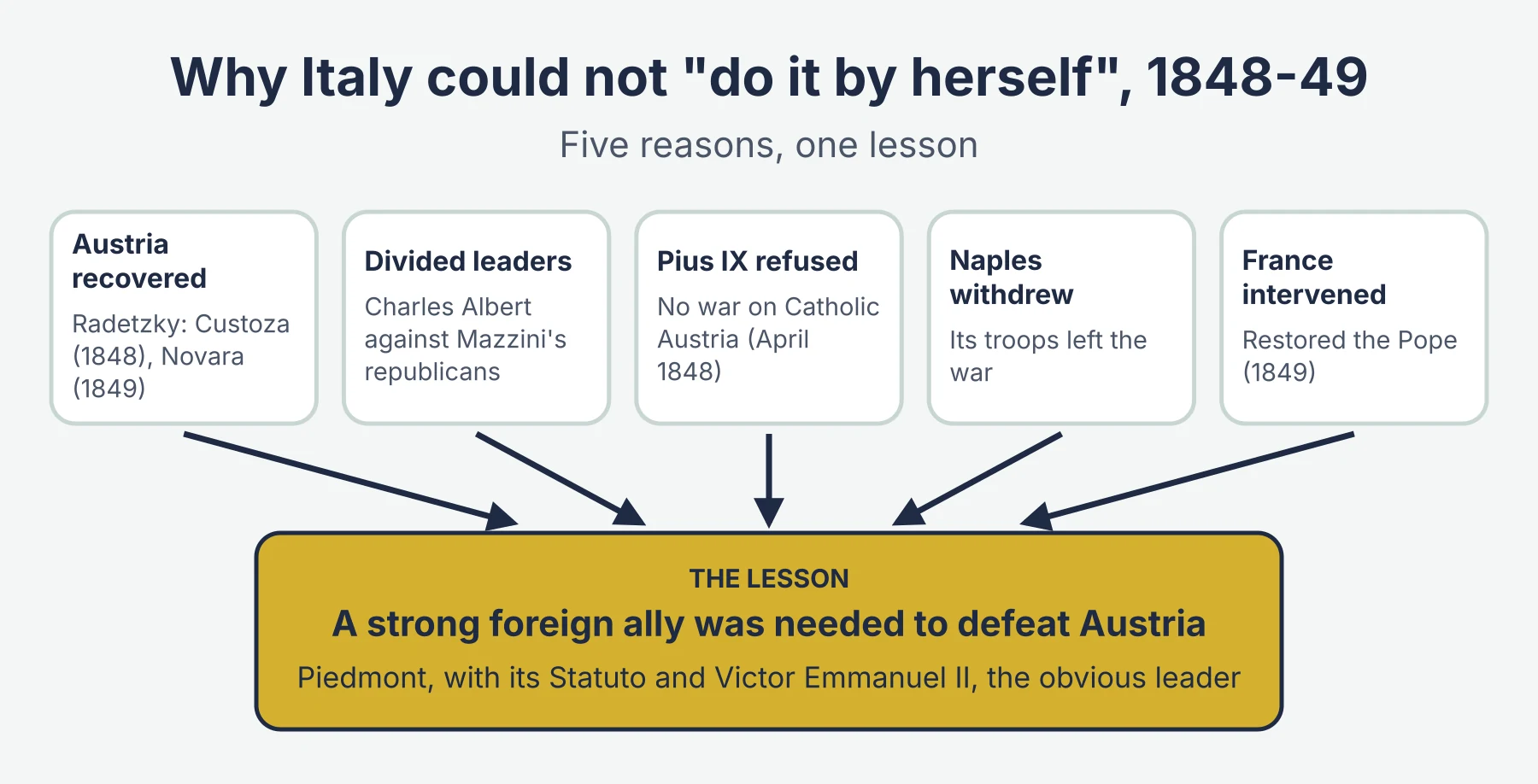
In 1848 Milan drove out the Austrians in the Five Days, Venice declared a republic, and Charles Albert of Piedmont declared war on Austria with the slogan that Italy would “do it by herself”. It failed because:
- Austria’s army recovered. Radetzky defeated Piedmont at Custoza (1848) and Novara (1849).
- Leaders and states were divided. Charles Albert wanted to enlarge Piedmont and distrusted the republicans; Mazzini wanted a republic.
- Pius IX refused to make war on Catholic Austria (April 1848), ending hopes of a papal lead.
- Naples withdrew its troops from the war.
- France intervened against the Roman Republic, restoring the Pope in 1849.
The lesson drawn by Piedmont’s leaders was that Italy could not “do it by herself”: it needed a foreign ally strong enough to defeat Austria. Piedmont’s survival with its Statuto constitution and its new king, Victor Emmanuel II, made it the obvious leader.
Cavour and the war of 1859
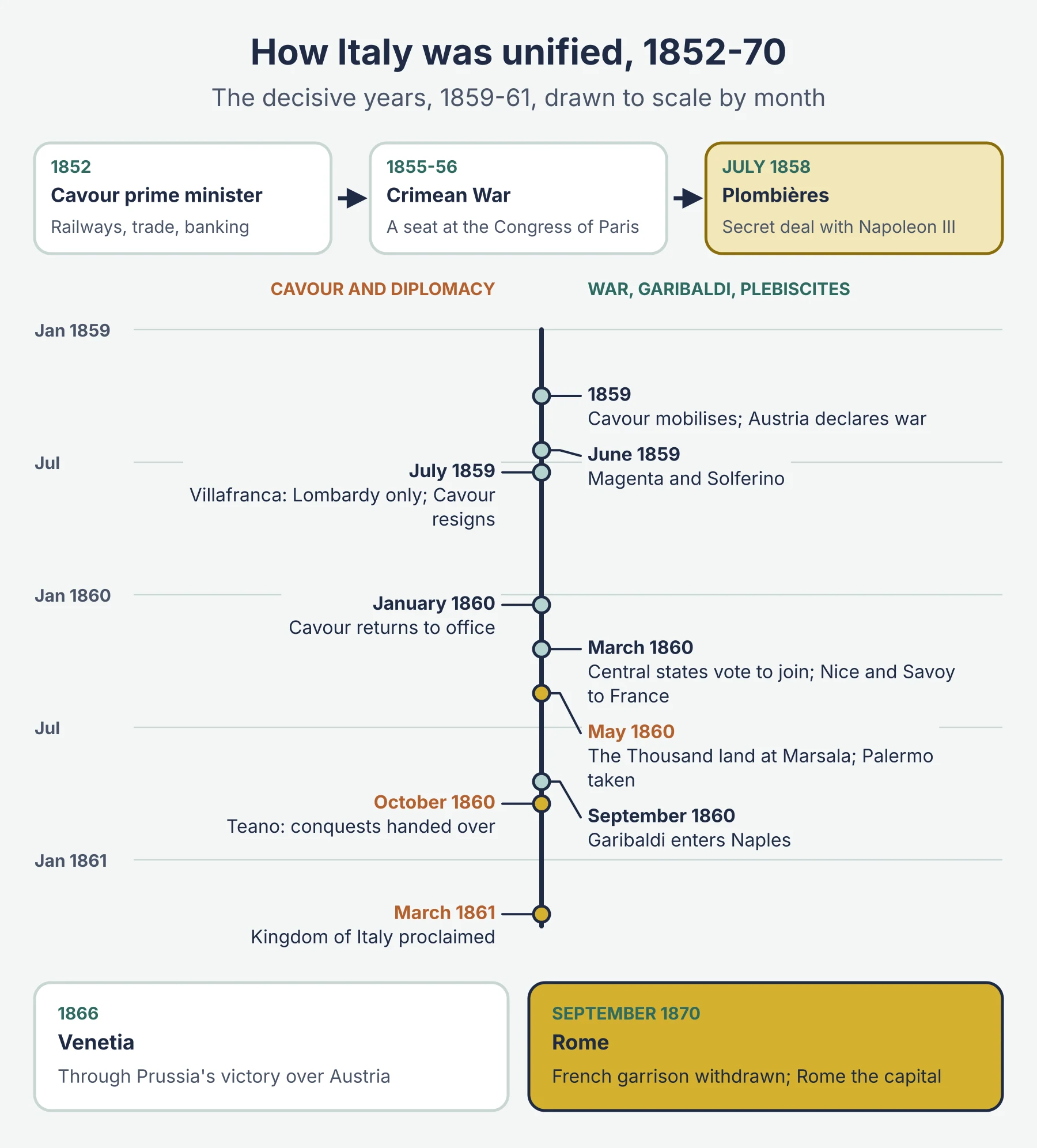
Count Camillo di Cavour became prime minister of Piedmont in 1852. He strengthened the state through railways, trade agreements and banking, and reduced the power of the Church. In 1855 he sent troops to the Crimean War on the side of Britain and France, which earned Piedmont a place at the Congress of Paris (1856) where the Italian question was raised.
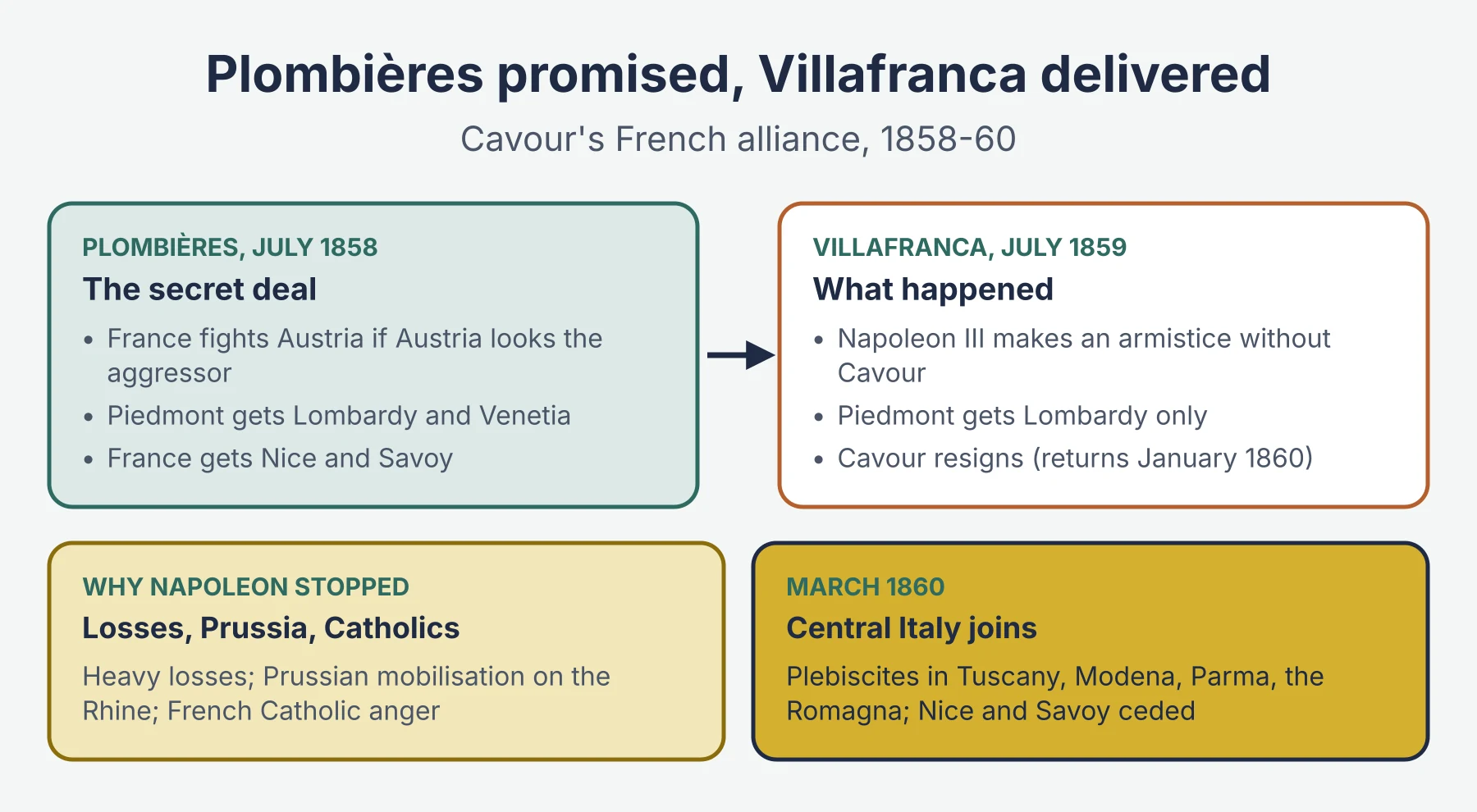
At Plombières (July 1858) Cavour met Napoleon III secretly. France would fight Austria if Austria could be made to appear the aggressor. Piedmont would gain Lombardy and Venetia to form a kingdom of northern Italy, and France would receive Nice and Savoy. In 1859 Cavour provoked Austria by mobilising; Austria sent an ultimatum demanding disarmament and then declared war. French and Piedmontese armies won at Magenta and Solferino (June 1859).
Then Napoleon III made the armistice of Villafranca with Austria (July 1859) without consulting Cavour. Piedmont gained Lombardy but not Venetia. Napoleon feared heavy losses, Prussian mobilisation on the Rhine and French Catholic anger at any threat to the Pope. Cavour resigned in fury, returning to office in January 1860.
Meanwhile the rulers of Tuscany, Modena, Parma and the Romagna had fled. In March 1860 plebiscites there voted to join Piedmont, and Cavour ceded Nice and Savoy to France in return for Napoleon’s agreement.
Garibaldi and the South
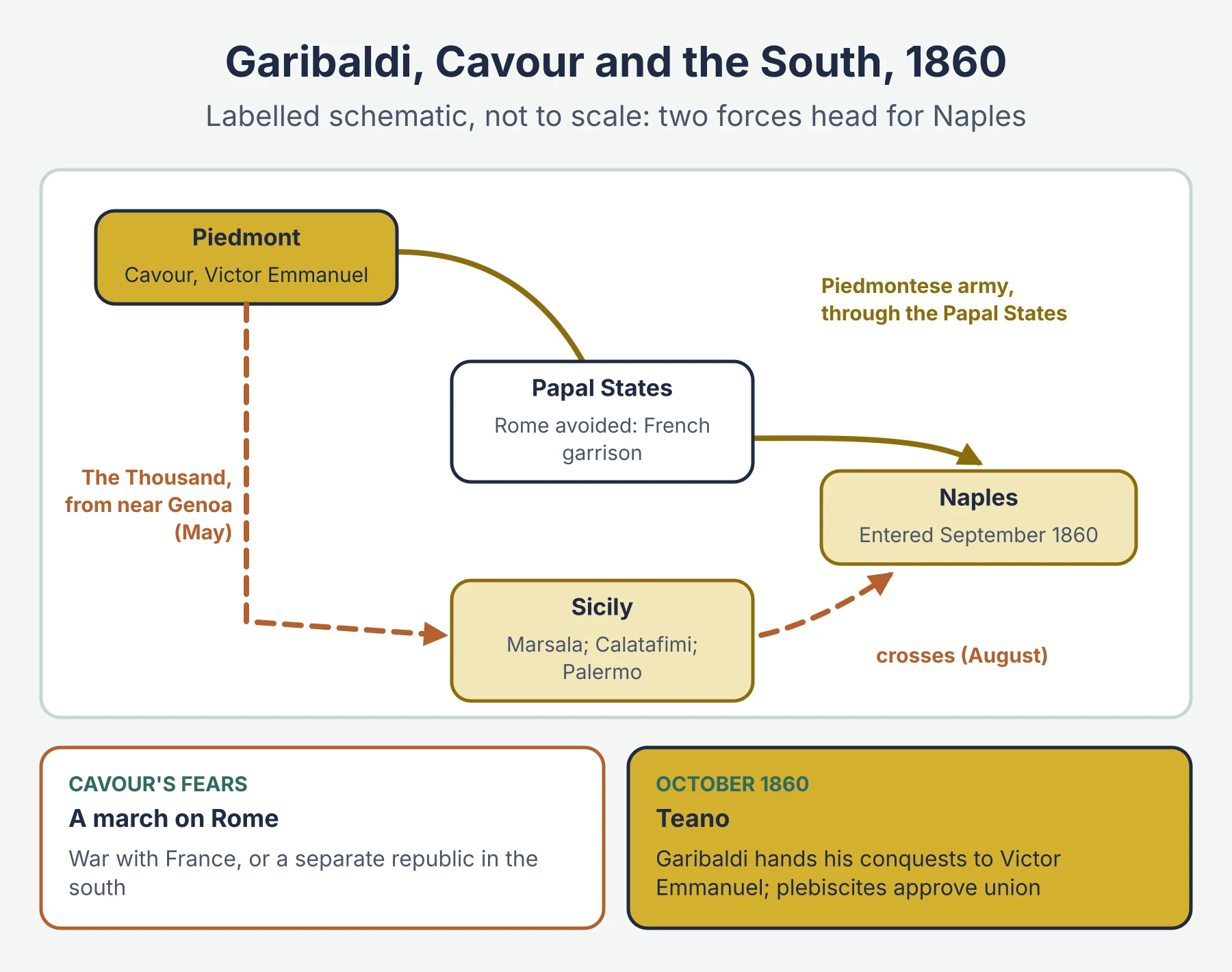
Giuseppe Garibaldi, a former follower of Mazzini born in Nice, set out from near Genoa in May 1860 with about a thousand volunteers, the Redshirts, to support a rising in Sicily. He landed at Marsala, won at Calatafimi and took Palermo. Peasants joined him, hoping for land. In August he crossed to the mainland and entered Naples in September 1860.
Cavour had not stopped the expedition but did not openly back it. He feared Garibaldi would march on Rome, which was protected by a French garrison, and provoke war with France, or set up a separate republic in the south. He sent the Piedmontese army south through the Papal States (avoiding Rome) to reach Naples first. At Teano (October 1860) Garibaldi met Victor Emmanuel and handed over his conquests. Plebiscites in Naples and Sicily approved union. The Kingdom of Italy was proclaimed in March 1861, with Victor Emmanuel II as king. Cavour died in June 1861.
Completing unification by 1870
- Venetia (1866): Italy allied with Prussia against Austria. Italy was defeated at Custoza and at sea at Lissa, but Prussia’s victory forced Austria to give up Venetia, handed over through France.
- Rome (1870): Garibaldi’s attempts to seize Rome failed at Aspromonte (1862) and Mentana (1867). When the Franco-Prussian War forced France to withdraw its garrison, Italian troops entered Rome in September 1870, and it became the capital. The Pope refused to accept the loss of his territory.
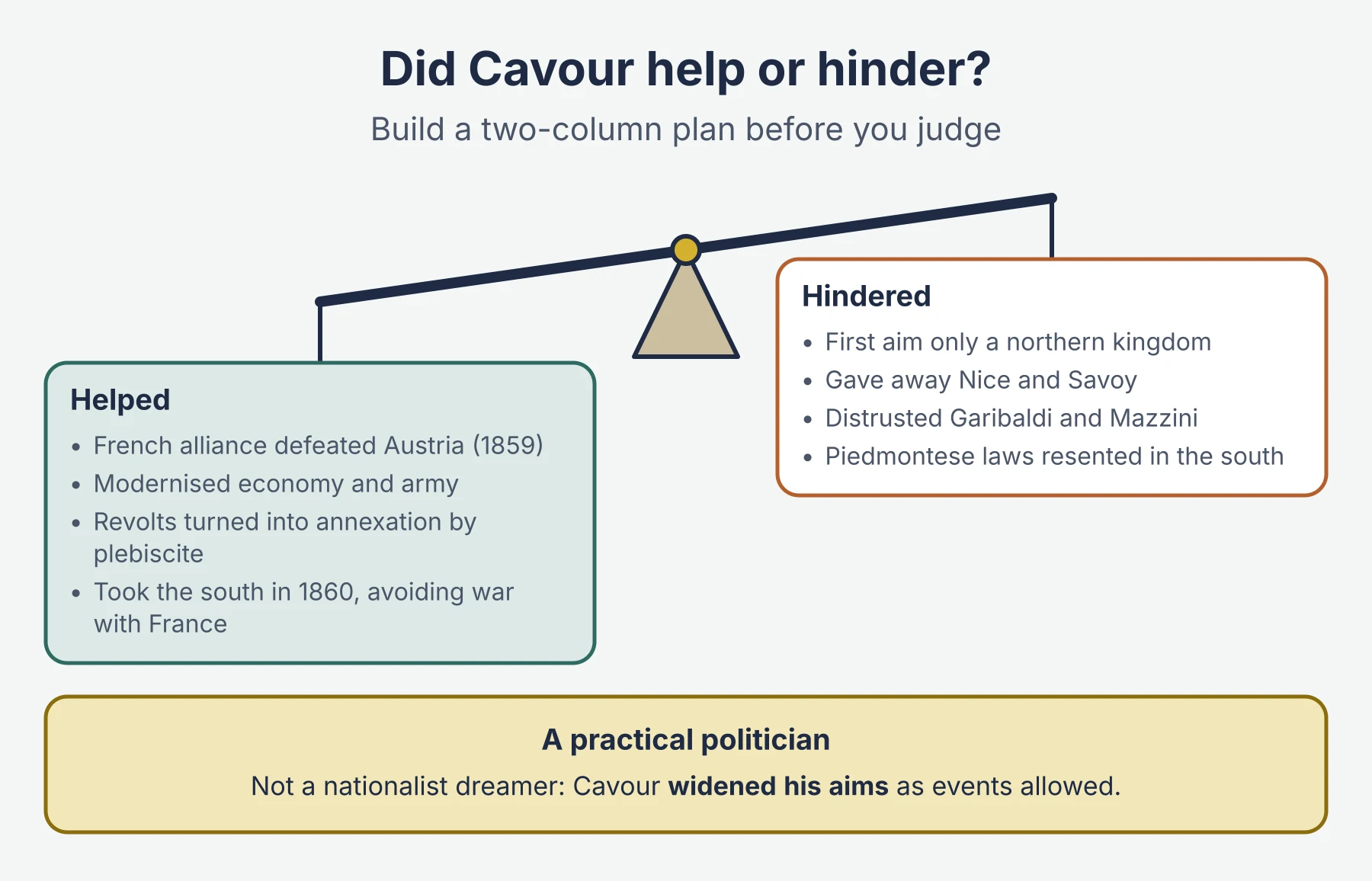
Did Cavour help or hinder?
| Helped | Hindered |
|---|---|
| Won the French alliance that defeated Austria in 1859 | His original aim was an enlarged northern kingdom, not all of Italy |
| Modernised Piedmont’s economy and army | Gave away Nice and Savoy |
| Turned the central Italian revolts into annexation by plebiscite | Distrusted Garibaldi and Mazzini and tried to control the expedition |
| Took control of the south in 1860, preventing war with France | Imposed Piedmontese laws, which caused resentment in the south |
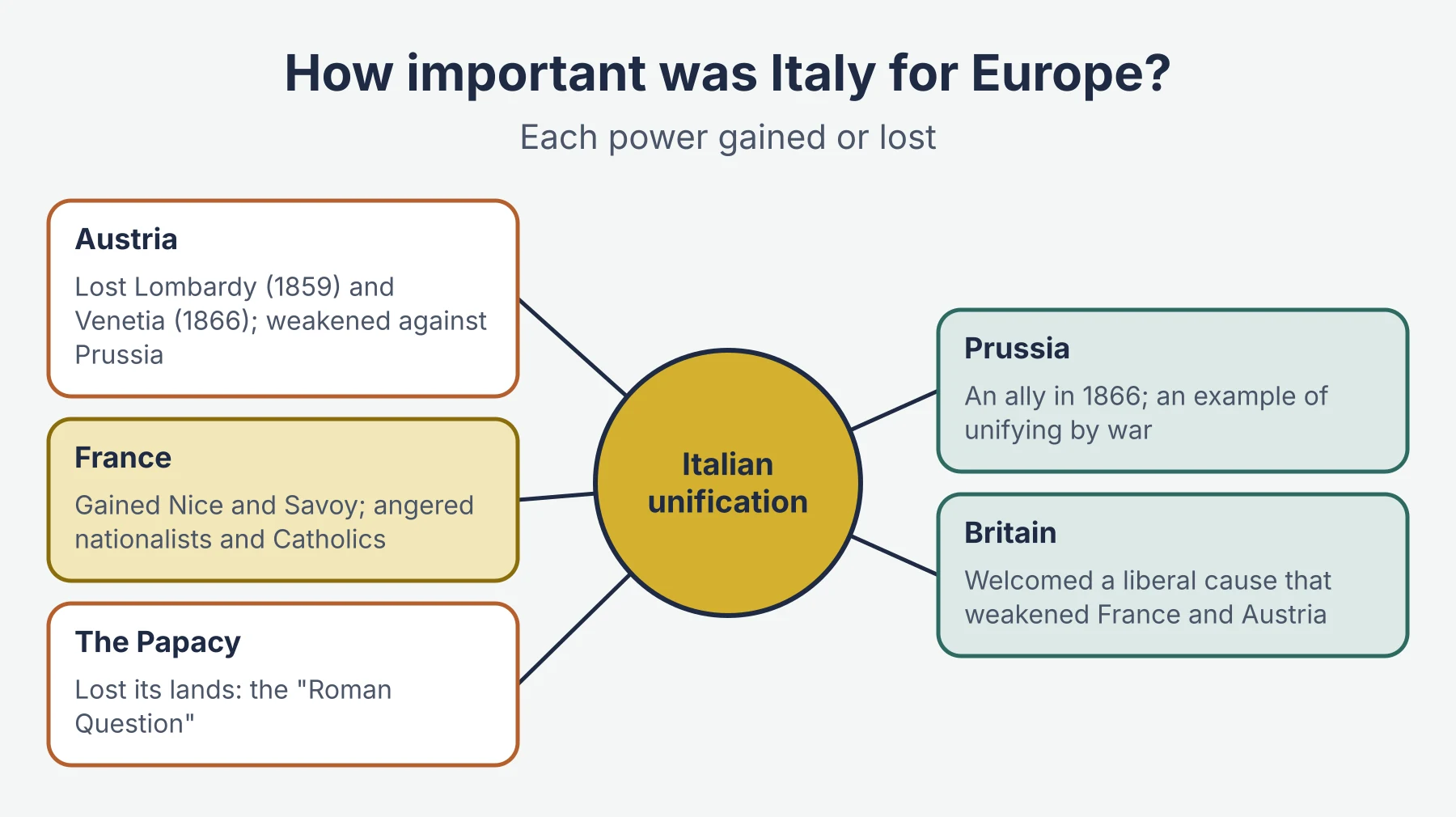
How important was Italy for other European countries?
- Austria lost Lombardy (1859) and Venetia (1866) and was pushed out of Italy, which weakened it as Prussia challenged it in Germany.
- France gained Nice and Savoy, but Napoleon III angered both Italian nationalists and French Catholics.
- Prussia gained an ally in 1866, and the Italian example showed how a strong state could unify a nation by war.
- The Papacy lost its lands; the “Roman Question” troubled Italian politics for decades.
- Britain welcomed Italian unity and refused to support moves against it, as a liberal cause that weakened France and Austria.
Annotated model answer
An original practice question: “Garibaldi’s contribution was more important than Cavour’s in unifying Italy.” How far do you agree? [10]
Garibaldi’s contribution was vital because he conquered the Kingdom of the Two Sicilies with only about a thousand volunteers in 1860, doubling the size of the new state. Without him, Cavour would probably have settled for a northern kingdom. [One side explained.] However, Cavour made Garibaldi’s success possible. The war of 1859, won with the French alliance agreed at Plombières, removed Austria from Lombardy, and in 1860 Cavour’s army took the Papal States and Naples, preventing a war with France that could have destroyed everything. [Other side.] Garibaldi supplied the south, but Cavour supplied the alliance and the state that held it together; by handing over his conquests at Teano, Garibaldi accepted that Piedmont, not he, would build Italy. [Weighted judgement.]
Common mistakes
- Saying Italy was unified in 1861. Venetia (1866) and Rome (1870) came later.
- Treating Cavour as a nationalist dreamer. He was a practical politician who widened his aims as events allowed.
- Forgetting the price of French help: Nice and Savoy.
- Describing Garibaldi’s march without explaining why Cavour sent troops south.
Exam technique
For “help or hinder” and “how important” focus points, build a two-column plan before writing, then decide your judgement. For Paper 2 in November 2026, link each source to its date: a British cartoon of 1860, for example, needs the context of the Expedition of the Thousand.
Official syllabus
Cambridge IGCSE History (0470) syllabus for 2024, 2025 and 2026, Core Content Option A, key question 2 – cambridgeinternational.org.
Related resources
-
Practice questions
Cambridge IGCSE World History (0470): How Was Italy Unified? – Practice Questions
Twelve original questions with mark-scheme answers on Mazzini, Cavour, Garibaldi and Italian unification to 1870, for Cambridge IGCSE History 0470.
World History · Cambridge · IGCSE
Try questions -
Revision notes
Cambridge IGCSE World History (0470): How Was Italy Unified? – Revision Notes
Recall notes for Cambridge IGCSE History 0470 key question 1.2: Italian unification timeline, key people and terms, Cavour versus Garibaldi, self-test.
World History · Cambridge · IGCSE
Revise topic -
Study guides
Cambridge IGCSE World History (0470): Why Was There a Civil War in the United States and What Were Its Results?
Cambridge IGCSE History 0470 key question 1.4 in depth: failed compromises, Lincoln's election, how the war was won and lost, and Reconstruction.
World History · Cambridge · IGCSE
Read guide
Get free revision emails (optional)
Occasional emails with practice questions, worked explanations and links to free resources for the qualification and subjects you choose. No spam, and you can unsubscribe from any email. The free tools on this site never need an email.