
Study Guides
Cambridge IGCSE World History (0470): Why Was There a Civil War in the United States and What Were Its Results?
Cambridge IGCSE History 0470 key question 1.4 in depth: failed compromises, Lincoln's election, how the war was won and lost, and Reconstruction.
- Subject
- World History
- Level
- IGCSE
- Topic
- Core Content – Option A: The Nineteenth Century, 1848–1914
- Author
- Marlbridge Academic Team
- Updated
- Reviewed by
- Azam Siddique (what this means)
Aligned to Cambridge IGCSE World History (0470), 2024-2026. Official specification .
Syllabus page (what it covers and how it is assessed): Cambridge IGCSE World History.
Syllabus points this page covers
0470
- 1.4 Why was there a civil war in the United States and what were its results?
Found an error? Report a correction.
Need help with this topic? Request a free trial class for IGCSE World History (0470).
This guide goes deeper into key question 4 of Core Content Option A in Cambridge IGCSE History 0470 (2024-2026): “Why was there a civil war in the United States and what were its results?” The specified content covers the causes and consequences of the war from 1820 to 1877: differences between North and South; slavery, slave and free states, abolitionism; the 1860 election and secession; reasons for the North’s victory and the South’s defeat; the role of Lincoln; and Reconstruction and the extent of its success. The four focus points ask how far slavery caused the war, what the significance of Lincoln’s election was, why the North won, and whether the war changed anything.
The question is the Paper 2 prescribed topic for the November 2025 and June 2026 series (and March 2025, India only), so source skills matter as much as essay knowledge. The core narrative of sectional differences and the crises of 1820-59 is set out in the US Civil War 1820-1877 study guide. This page concentrates on the arguments examiners reward: why compromise stopped working, what made Lincoln’s election decisive, how the war was won and lost, and how to judge Reconstruction. Recall facts with the 0470 Civil War revision notes and practise with the 0470 Civil War practice questions.
Why compromise stopped working
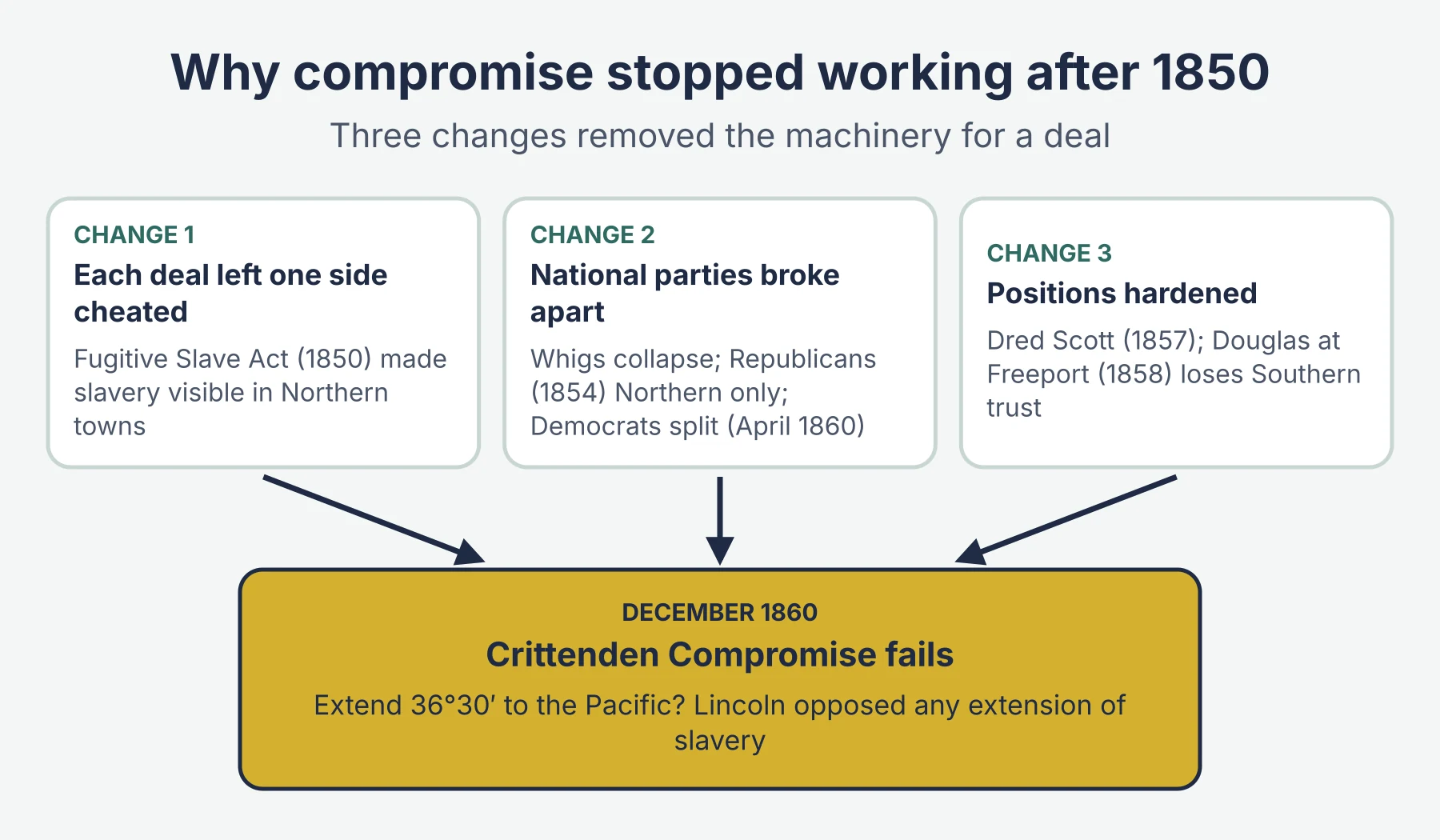
Between 1820 and 1850 Congress repeatedly found a deal. After 1850 it could not. Three changes explain why.
- Each compromise left one section feeling cheated. The Fugitive Slave Act of 1850 forced Northerners to help return people who had escaped slavery, so a deal meant to calm the issue made slavery visible in Northern towns.
- The national parties broke apart. The Whig Party collapsed in the 1850s, and the new Republican Party (1854) drew its support almost entirely from the North. In April 1860 the Democrats split at their Charleston convention. Once no party had strong support in both sections, there was no political machinery left to make a deal.
- Positions hardened on principle. The Dred Scott decision (1857) said Congress could not ban slavery in the territories, which made the Republicans’ central policy unconstitutional in Southern eyes. In the Lincoln-Douglas debates (1858) Douglas argued at Freeport that settlers could still keep slavery out by refusing to pass local laws to protect it, which cost him Southern trust.
The final attempt, the Crittenden Compromise (December 1860), proposed extending the old 36°30′ line to the Pacific. Lincoln, as president-elect, opposed any extension of slavery into the territories, and it failed.
The significance of Lincoln’s election
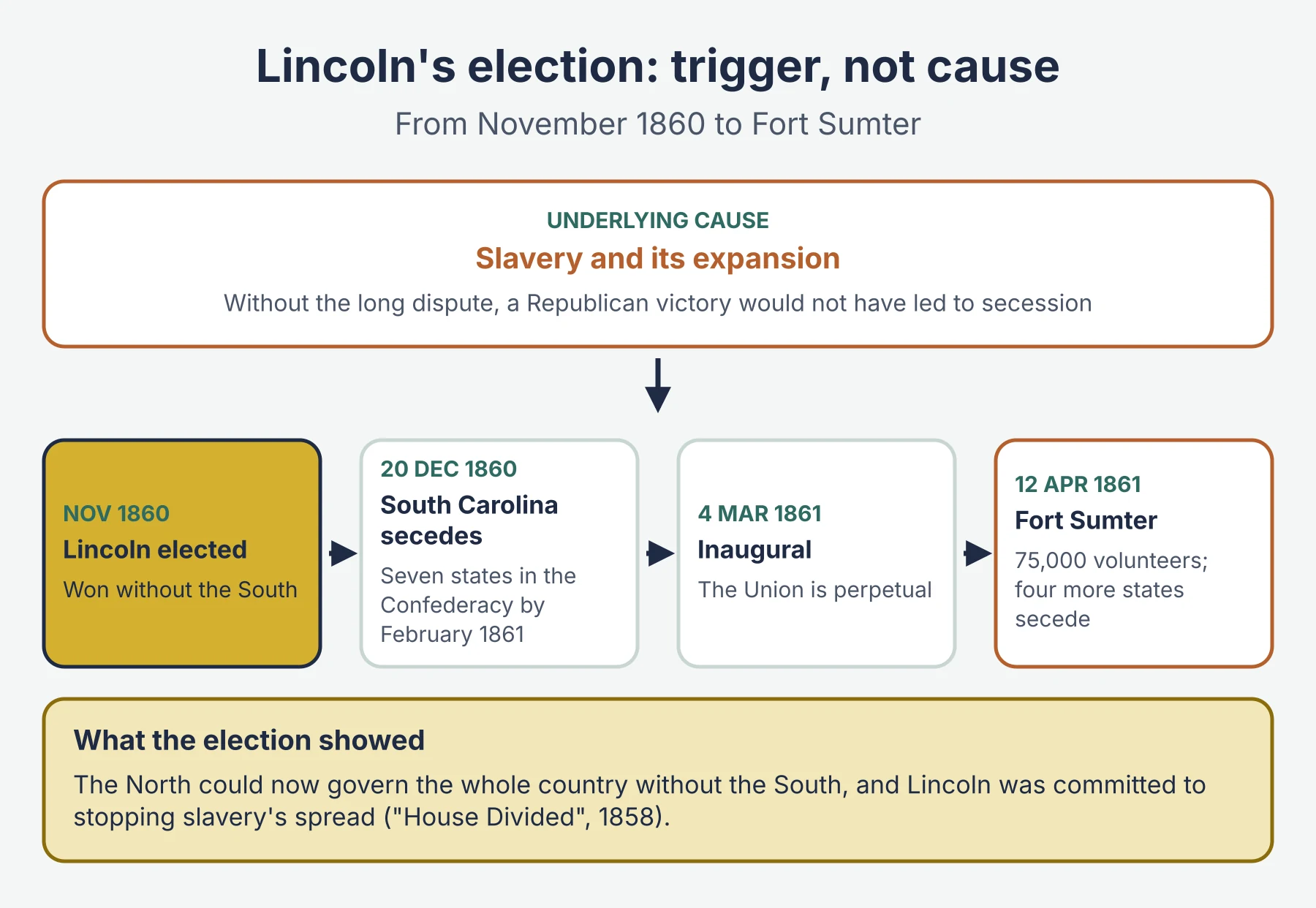
Lincoln’s election in November 1860 was significant because of what it showed, not what he did.
- He won without the South. He took every free state’s electoral votes except some in New Jersey, and was not on the ballot in most Southern states. Southern leaders concluded that the North could now govern the whole country without them.
- His views were known. In his “House Divided” speech (1858) he had said the nation could not endure “permanently half slave and half free”. Although he promised not to touch slavery where it existed, he was committed to stopping its spread, and Southerners believed slavery had to expand to survive.
- It triggered secession before he took office. South Carolina left on 20 December 1860, and seven states had formed the Confederacy by February 1861, before his inauguration on 4 March.
- His response decided the form of the conflict. In his inaugural address he called the Union perpetual. When Fort Sumter was fired on (12 April 1861), his call for 75,000 volunteers led four more states to secede.
A useful way to weigh significance: the election was the trigger, while slavery and its expansion were the underlying cause. Without the long dispute over slavery, a Republican victory would not have led to secession.
How the war was won and lost
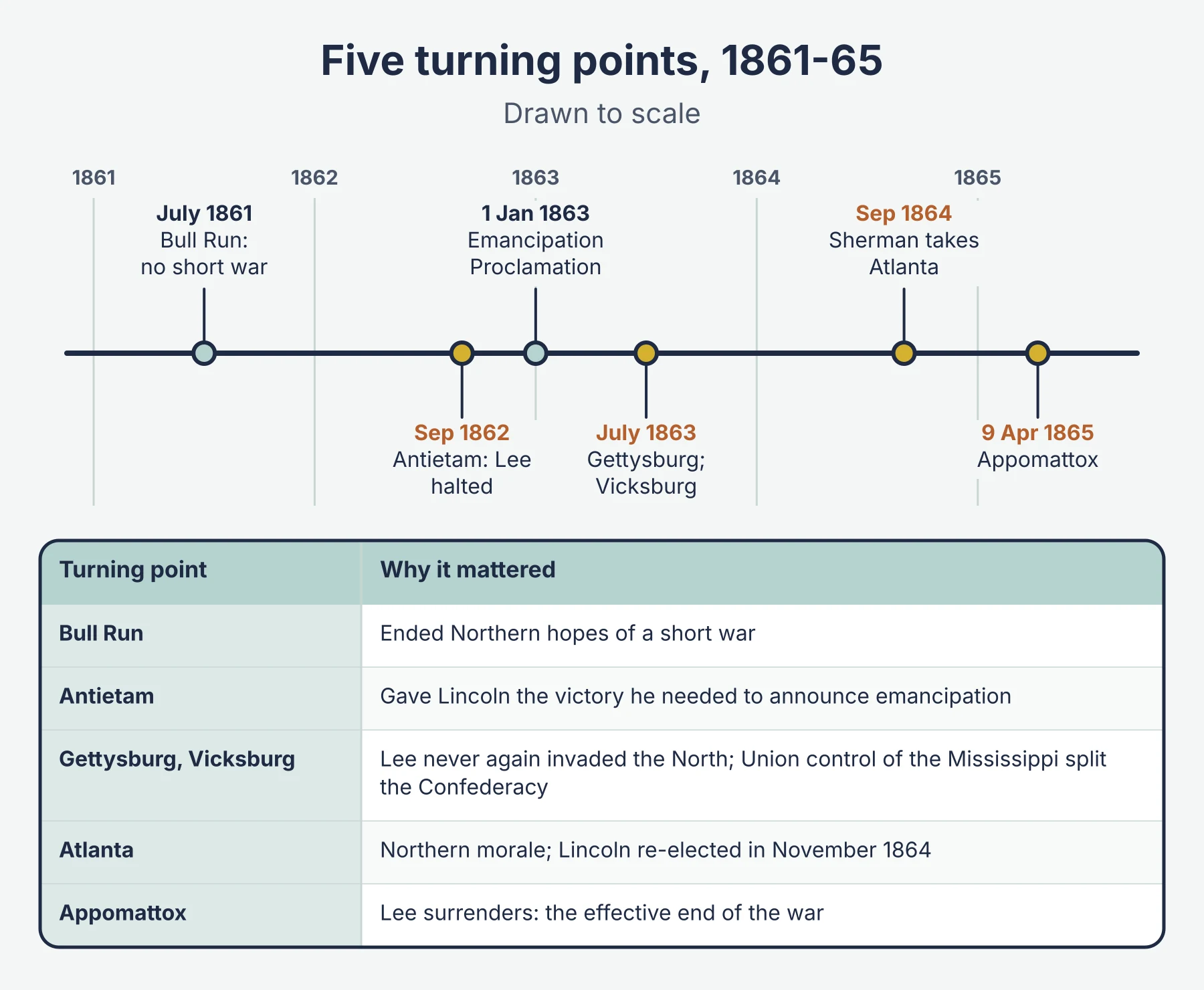
The course of the war in five turning points
| Date | Event | Why it mattered |
|---|---|---|
| July 1861 | First Battle of Bull Run (Manassas): Confederate victory | Ended Northern hopes of a short war |
| September 1862 | Antietam: Lee’s invasion of Maryland halted | Gave Lincoln the victory he needed to announce emancipation |
| July 1863 | Gettysburg (1-3 July) and the fall of Vicksburg (4 July) | Lee never again invaded the North; the Union controlled the Mississippi, splitting the Confederacy |
| September 1864 | Sherman takes Atlanta | Boosted Northern morale and helped Lincoln win re-election in November 1864 |
| April 1865 | Lee surrenders at Appomattox (9 April) | Effective end of the war |
Why the North won
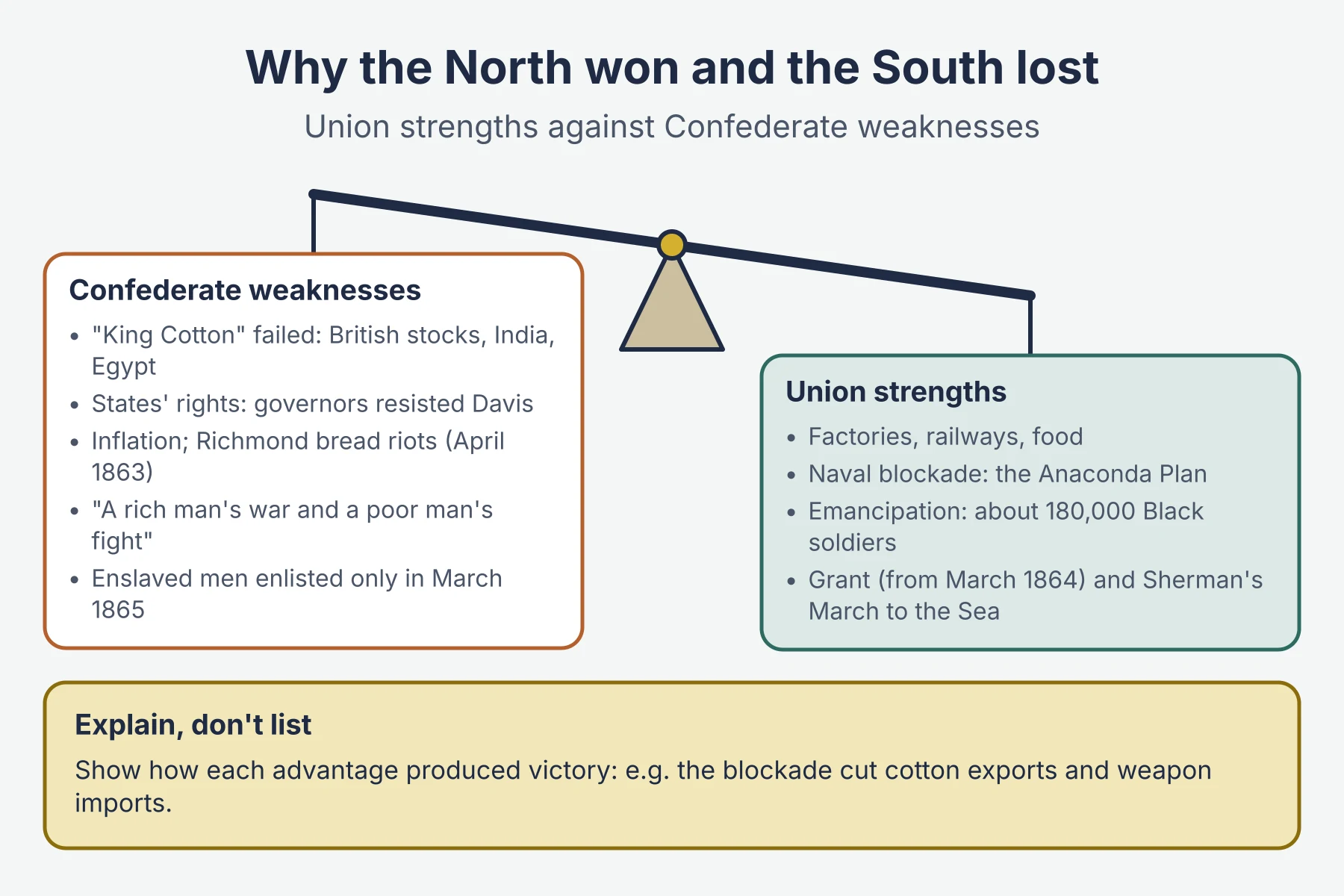
- Economic power: factories, railways and food production allowed the Union to equip and feed much larger armies for four years.
- The naval blockade (part of General Winfield Scott’s “Anaconda Plan”) cut Southern cotton exports and imports of weapons and goods.
- Emancipation and Black soldiers: the Emancipation Proclamation (1 January 1863) freed enslaved people in Confederate-held areas and allowed Black men to enlist. Around 180,000 served in the Union army by the end of the war, with thousands more in the navy.
- Generals who used Northern strength: Grant, general-in-chief from March 1864, kept constant pressure on Lee, while Sherman’s March to the Sea (November-December 1864) destroyed the South’s resources and will to fight.
Why the South lost
- “King Cotton” diplomacy failed. The South expected Britain and France to recognise it because they needed cotton; Britain had large stocks and found other sources in India and Egypt, and emancipation made support for the Confederacy harder to justify to British opinion.
- States’ rights weakened central government. Governors such as Joseph Brown of Georgia resisted Jefferson Davis over conscription and supplies.
- Inflation and hardship: the Confederacy printed money, prices soared, and in April 1863 there were bread riots in Richmond.
- Class resentment: a conscription law of 1862 exempted men who owned twenty or more enslaved people, leading to the complaint of “a rich man’s war and a poor man’s fight”.
- Manpower: the Confederacy could not replace its losses; it agreed to enlist enslaved men only in March 1865, far too late.
The role of Lincoln
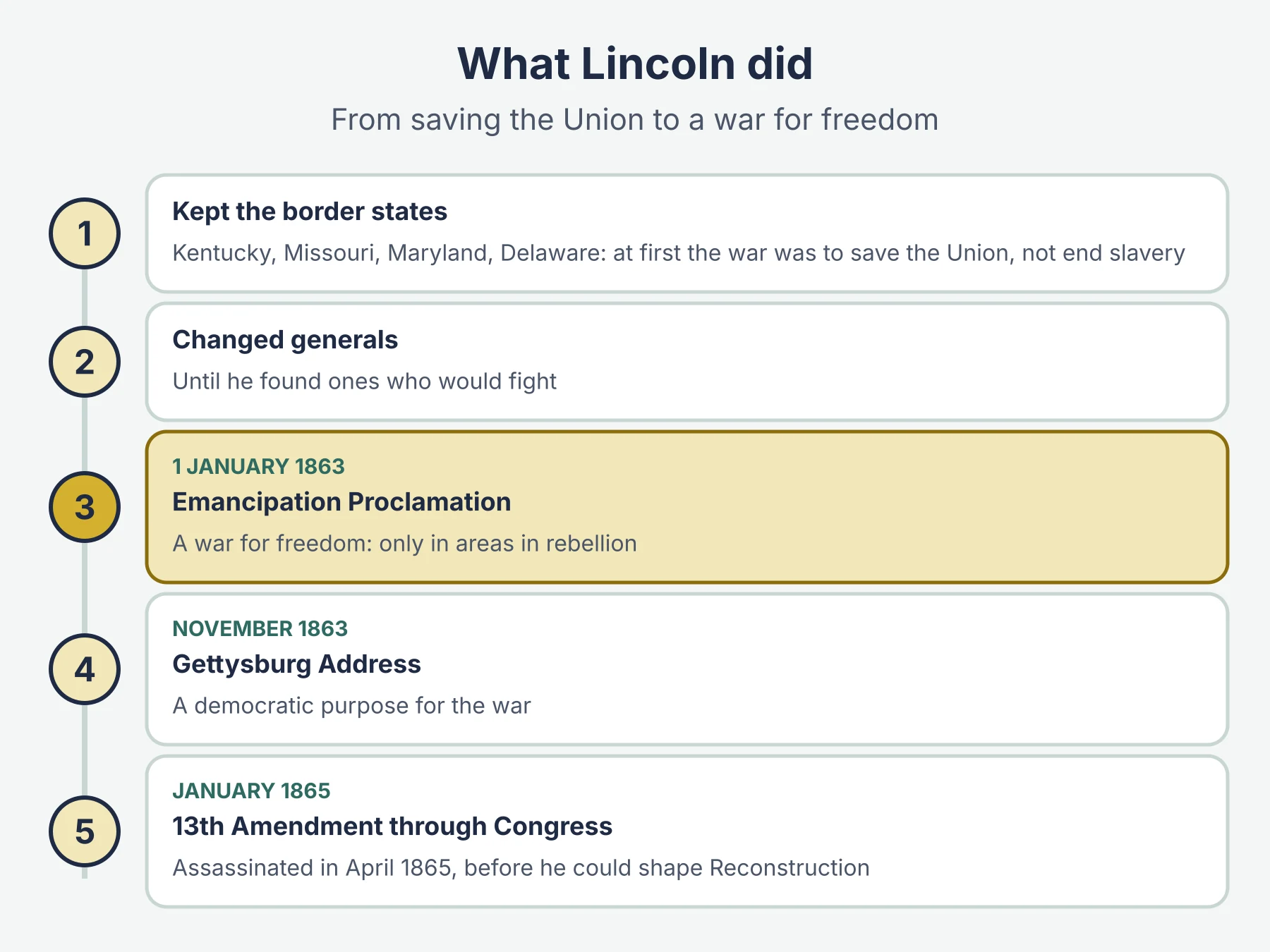
Lincoln kept the border states (Kentucky, Missouri, Maryland, Delaware) in the Union, partly by insisting at first that the war was to save the Union, not to end slavery. He changed generals until he found ones who would fight. He turned the war into a war for freedom with the Emancipation Proclamation and pushed the 13th Amendment through Congress in January 1865. His Gettysburg Address (November 1863) gave the war a democratic purpose. He was assassinated in April 1865, days after Lee’s surrender, before he could shape Reconstruction.
Did the war change anything? Judging Reconstruction
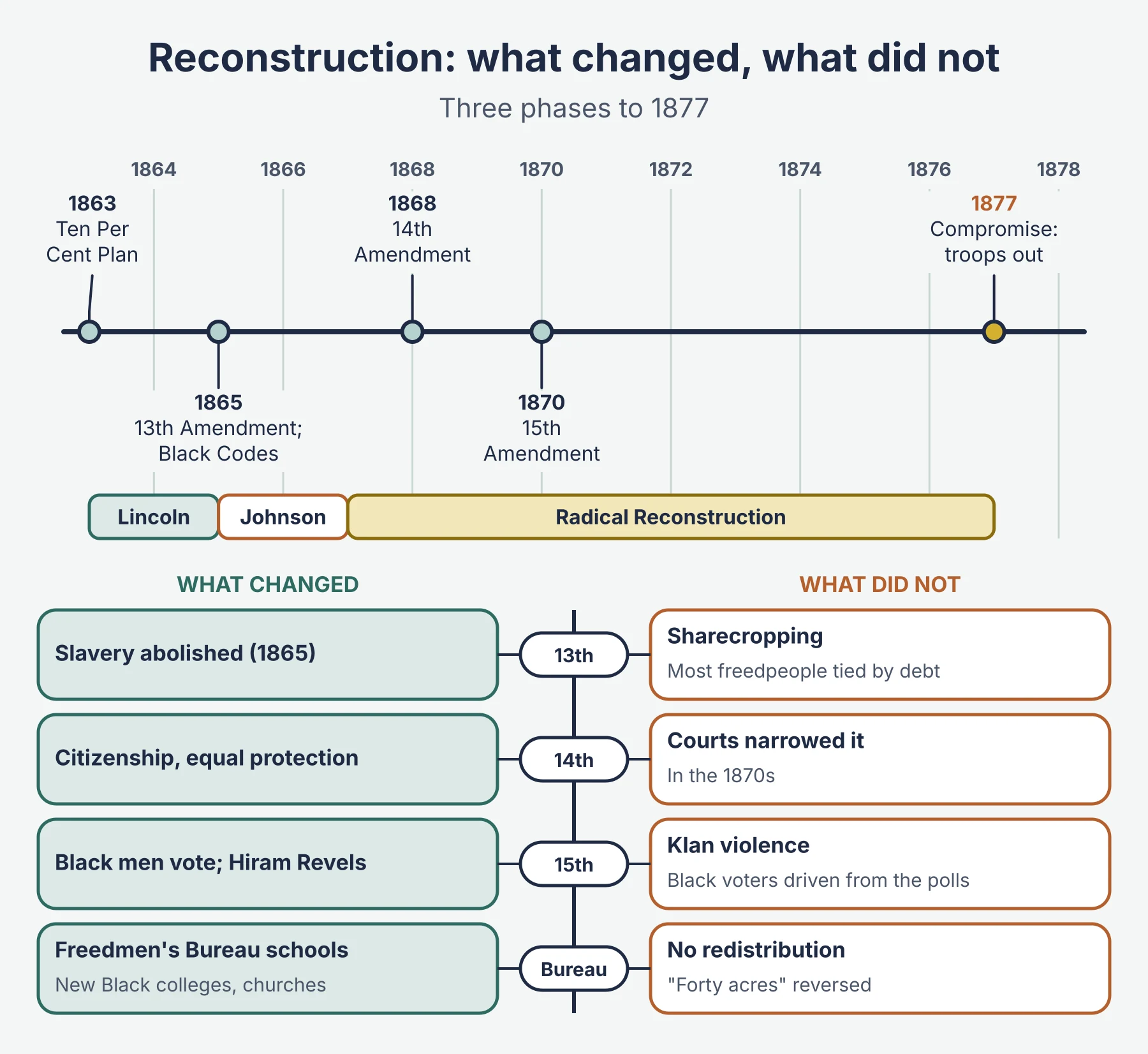
Reconstruction moved through three phases: Lincoln’s lenient Ten Per Cent Plan (1863); presidential Reconstruction under Andrew Johnson (1865-67), when Southern states passed Black Codes; and Radical Reconstruction (from 1867), when Congress divided the South into military districts and required Black male suffrage. It ended with the Compromise of 1877, when federal troops were withdrawn after the disputed election of 1876.
| What changed | What did not |
|---|---|
| Slavery abolished (13th Amendment, 1865) | Most freedpeople became sharecroppers, tied by debt to white landowners |
| Citizenship and equal protection (14th, 1868) | Courts narrowed these rights in the 1870s |
| Black men’s right to vote (15th, 1870); Black officeholders such as Senator Hiram Revels | Violence by the Ku Klux Klan and others drove Black voters from the polls |
| Freedmen’s Bureau schools; new Black colleges and churches | Land was not redistributed; “forty acres and a mule” was reversed |
| Federal government stronger; secession ended for good | White Democrats regained control of every Southern state by 1877 |
Annotated model answer
An original practice question: “Reconstruction was a failure.” How far do you agree? [10]
Reconstruction failed to give freedpeople lasting equality. Without land, most became sharecroppers, and once federal troops left in 1877 Southern states could ignore the 14th and 15th Amendments, so Black voting collapsed. [Agree, explained.] However, it achieved permanent legal changes. The 13th Amendment ended slavery for four million people, and the 14th Amendment’s promise of equal citizenship stayed in the Constitution, ready to be used by later civil rights campaigners. [Disagree, explained.] Reconstruction failed in practice by 1877 but succeeded in law; its failure was one of enforcement, caused by Northern loss of will. [Judgement with a criterion.]
Common mistakes
- Saying the Emancipation Proclamation freed all enslaved people. It applied only to areas in rebellion; the 13th Amendment ended slavery everywhere.
- Treating Lincoln as an abolitionist in 1860. He opposed the spread of slavery, not slavery in the existing states.
- Ending the topic in 1865. The specification runs to 1877.
- Listing Northern advantages without explaining how they produced victory.
Exam technique
On Paper 2, check each source’s date against the phases above: a Southern newspaper of 1866 is reacting to Johnson’s policies, not to Radical Reconstruction. On Paper 1, “Did the war change anything?” questions need a criterion, such as legal rights versus everyday life.
Official syllabus
Cambridge IGCSE History (0470) syllabus for 2024, 2025 and 2026, Core Content Option A, key question 4 – cambridgeinternational.org.
Related resources
-
Practice questions
Cambridge IGCSE World History (0470): Why Was There a Civil War in the United States and What Were Its Results? – Practice Questions
Twelve original questions with mark-scheme answers on secession, the Civil War and Reconstruction, for Cambridge IGCSE History 0470 key question 1.4.
World History · Cambridge · IGCSE
Try questions -
Revision notes
Cambridge IGCSE World History (0470): Why Was There a Civil War in the United States and What Were Its Results? – Revision Notes
Recall notes for Cambridge IGCSE History 0470 key question 1.4: secession, turning points of the Civil War, Reconstruction's phases and a self-test.
World History · Cambridge · IGCSE
Revise topic -
Study guides
Overseas Empires in the Nineteenth Century (Cambridge 0470 and 2147)
Guide to Cambridge 0470 and 2147 key question 1.5: motives for empire, Senegal, Nigeria and the Congo, India after 1857, and US gains from Spain in 1898.
World History · Cambridge · IGCSE, O Level
Read guide
Get free revision emails (optional)
Occasional emails with practice questions, worked explanations and links to free resources for the qualification and subjects you choose. No spam, and you can unsubscribe from any email. The free tools on this site never need an email.