
Revision Notes
Cambridge IGCSE World History (0470): How Was Germany Unified? – Revision Notes
Recall notes for Cambridge IGCSE History 0470 key question 1.3: German unification to 1871, Bismarck's three wars, key terms, traps and a self-test.
- Subject
- World History
- Level
- IGCSE
- Topic
- Core Content – Option A: The Nineteenth Century, 1848–1914
- Author
- Marlbridge Academic Team
- Updated
- Reviewed by
- Azam Siddique (what this means)
Aligned to Cambridge IGCSE World History (0470), 2024-2026. Official specification .
Syllabus page (what it covers and how it is assessed): Cambridge IGCSE World History.
Syllabus points this page covers
0470
- 1.3 How was Germany unified?
Found an error? Report a correction.
Need help with this topic? Request a free trial class for IGCSE World History (0470).
Key question 1.3, Cambridge IGCSE History 0470: “How was Germany unified?” Learn German nationalism, the Zollverein, 1848 in Prussia, the Frankfurt Parliament, Austria’s recovery by 1850, and Bismarck’s foreign policy to 1871. Full explanations are in the Germany study guide; practise with the Germany practice questions.
Timeline to learn
| Date | Event |
|---|---|
| 1815 | German Confederation of 39 states, Austria presiding |
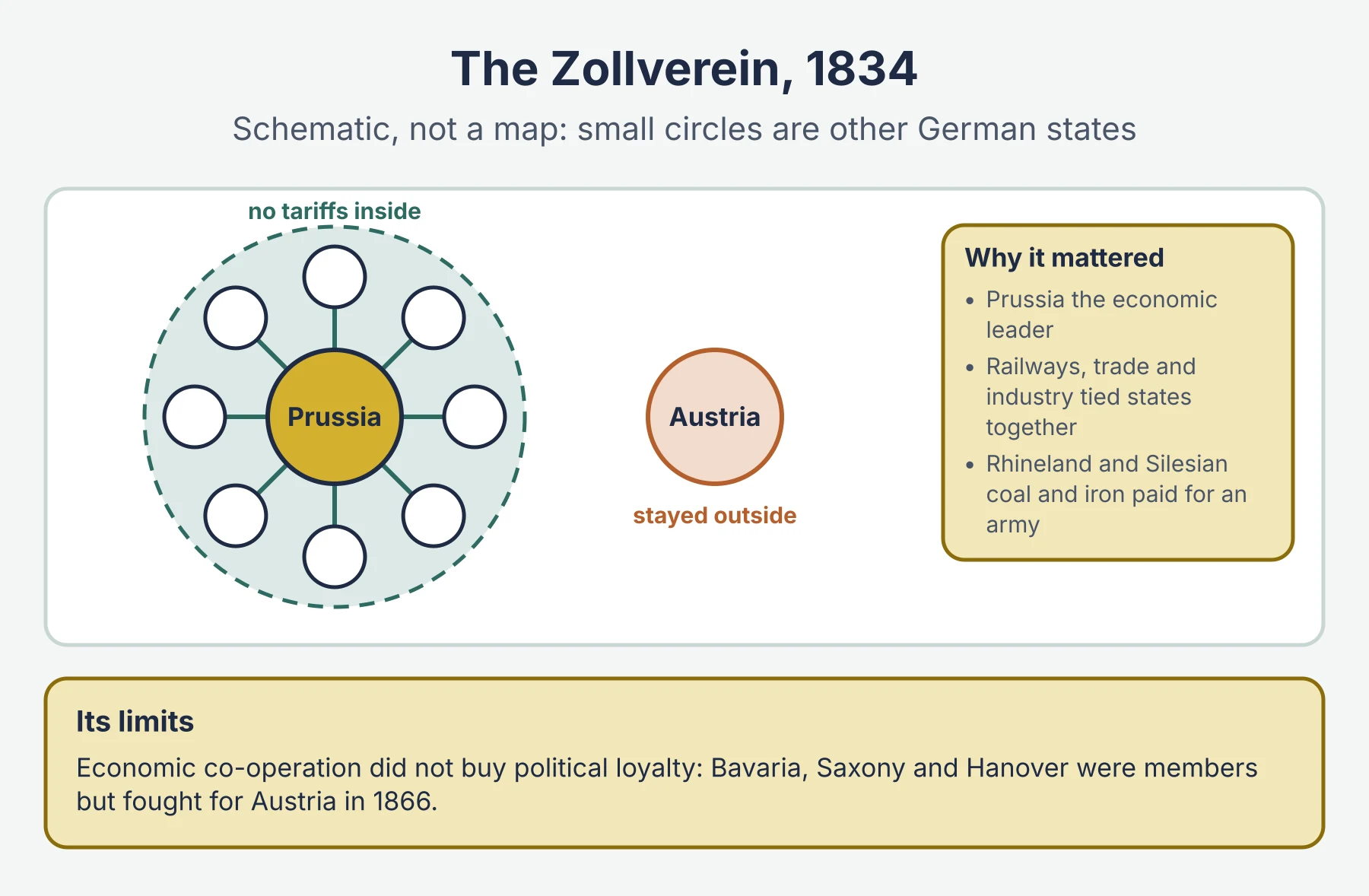
| 1834 | Zollverein customs union, led by Prussia, comes into force (Austria outside) |
| March 1848 | Berlin street fighting; Frederick William IV withdraws troops |
| May 1848 | Frankfurt Parliament meets |
| August 1848 | Prussia signs the armistice of Malmö with Denmark without Frankfurt’s consent |
| November-December 1848 | Prussian troops return to Berlin; Prussian assembly dissolved |
| April 1849 | Frederick William IV refuses the crown offered by Frankfurt |
| 1849-50 | Erfurt Union plan |
| November 1850 | Olmütz: Prussia gives up the union; Austrian-led Confederation restored |
| September 1862 | Bismarck appointed Minister-President; “iron and blood” speech |
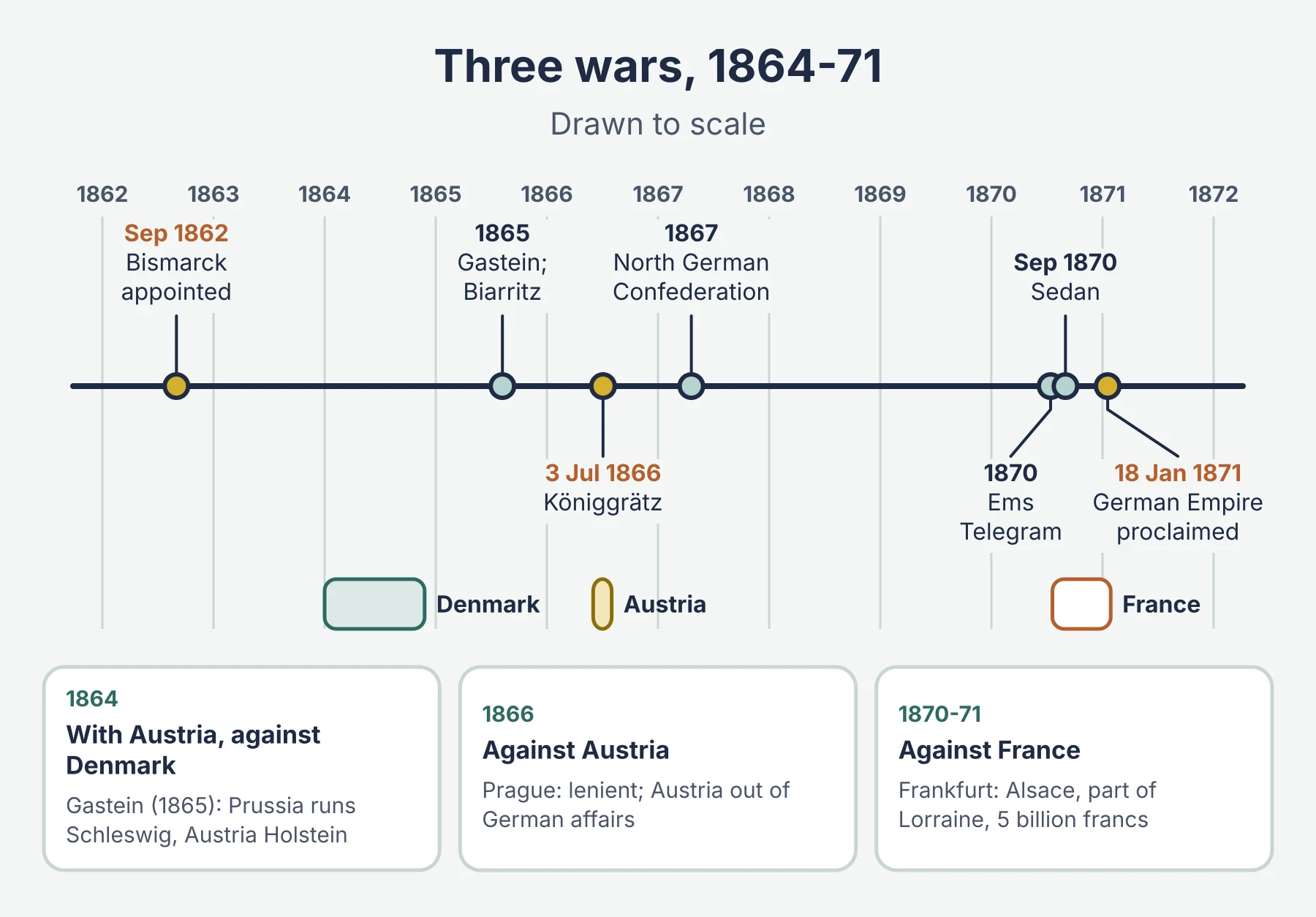
| 1864 | Prussia and Austria defeat Denmark |
| 1865 | Convention of Gastein; Biarritz meeting with Napoleon III |
| April 1866 | Alliance with Italy |
| 3 July 1866 | Königgrätz (Sadowa) |
| August 1866 | Treaty of Prague; Confederation dissolved |
| 1867 | North German Confederation; Luxembourg crisis |
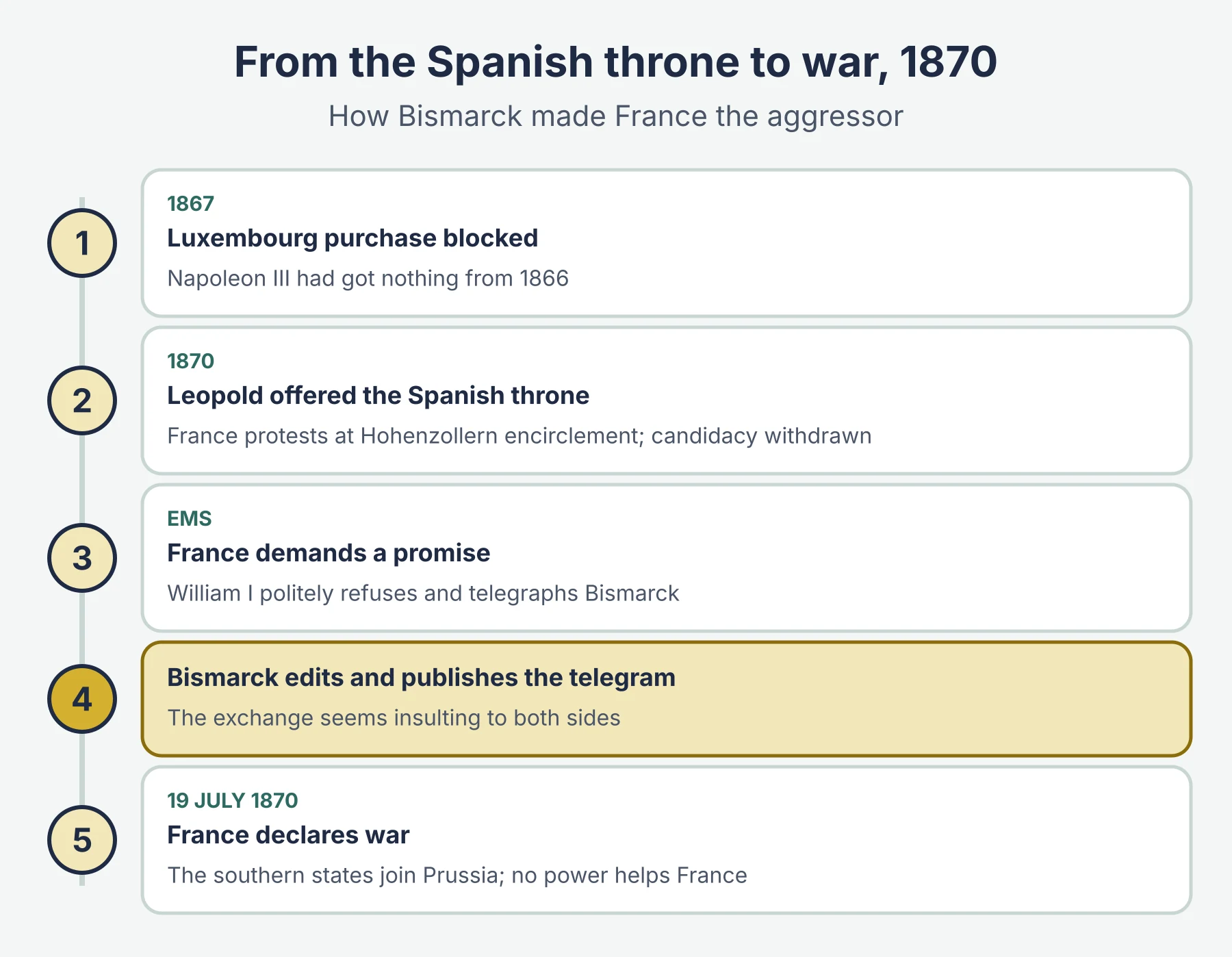
| July 1870 | Hohenzollern candidature; Ems Telegram; France declares war (19 July) |
| September 1870 | Sedan: Napoleon III captured |
| 18 January 1871 | German Empire proclaimed at Versailles |
| May 1871 | Treaty of Frankfurt: Alsace and part of Lorraine to Germany |
Bismarck’s method in three wars
| Denmark, 1864 | Austria, 1866 | France, 1870-71 | |
|---|---|---|---|
| Excuse | Danish attempt to bind Schleswig to Denmark | Dispute over Holstein after Gastein | Hohenzollern candidature and the Ems Telegram |
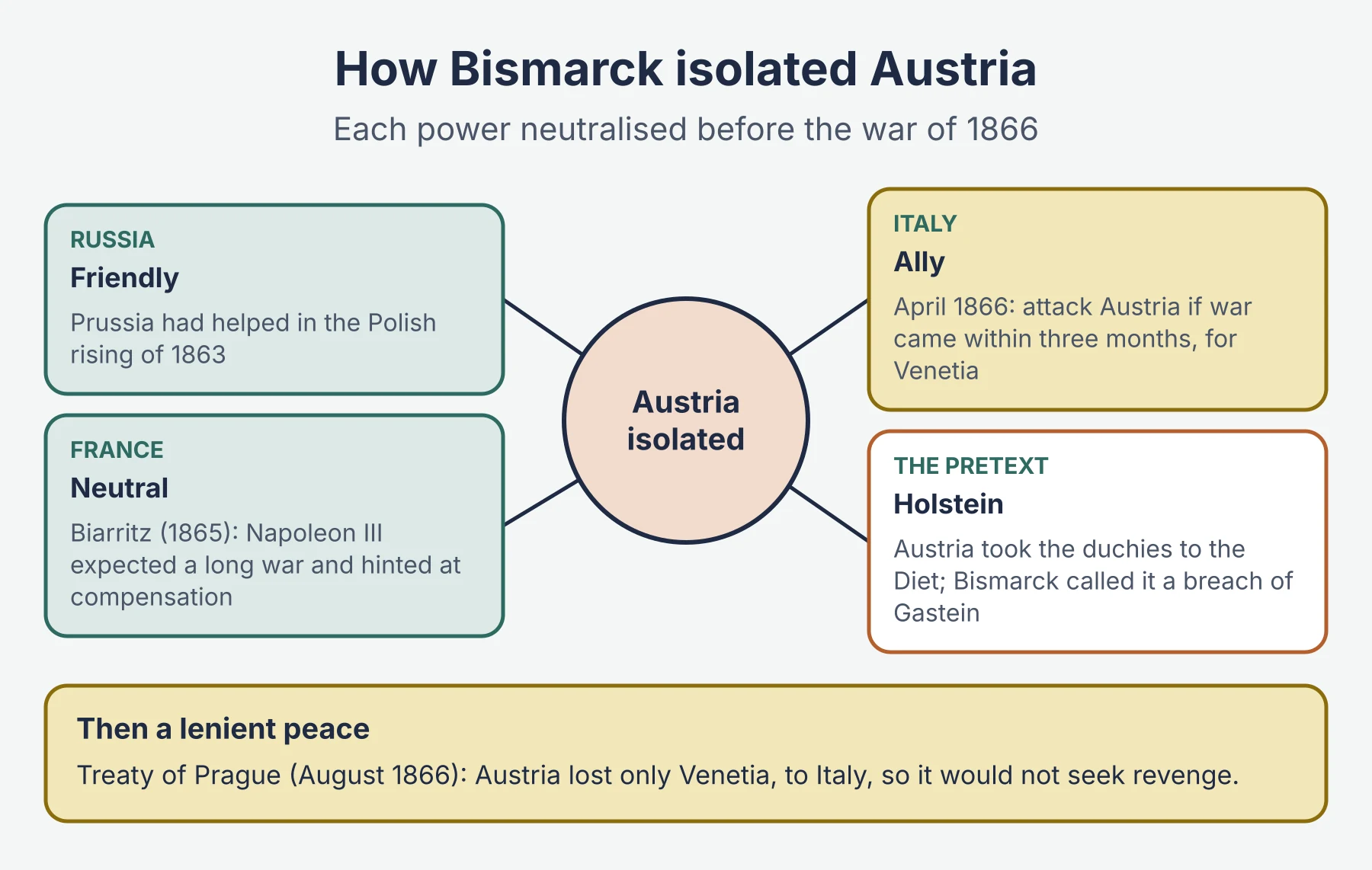
| Diplomacy | Allied with Austria | Russia friendly, France neutral (Biarritz), Italy allied | France isolated; southern states join Prussia |
| Military key | Joint Austro-Prussian forces | Railways, needle gun, Moltke at Königgrätz | Rapid mobilisation; Sedan; siege of Paris |
| Result | Duchies taken from Denmark | Austria excluded; North German Confederation | German Empire; Alsace-Lorraine |
Key people
| Person | Remember |
|---|---|
| Frederick William IV | King of Prussia; yielded in March 1848, then restored control; refused Frankfurt’s crown |
| William I | King from 1861 (regent from 1858); appointed Bismarck; German Emperor 1871 |
| Bismarck | Minister-President from 1862; “iron and blood”; architect of the three wars |
| Roon | War minister who planned the army reforms |
| Moltke | Chief of the general staff; used railways to move armies fast |
| Napoleon III | French emperor; neutral in 1866; defeated and captured at Sedan |
| Prince Leopold | Hohenzollern prince offered the Spanish throne in 1870 |
Key terms
| Term | Meaning |
|---|---|
| German Confederation | Loose league of German states, 1815-66, under Austrian presidency |
| Zollverein | Prussian-led customs union from 1834 |
| Grossdeutsch / Kleindeutsch | A Germany with or without Austria |
| Frankfurt Parliament | Elected German national assembly, 1848-49 |
| Olmütz | 1850 agreement in which Prussia backed down before Austria |
| Realpolitik | Politics based on power and practical advantage, not ideals |
| North German Confederation | Prussian-led union of northern states, 1867 |
| Ems Telegram | Report of William I’s talk with the French ambassador, edited and published by Bismarck |
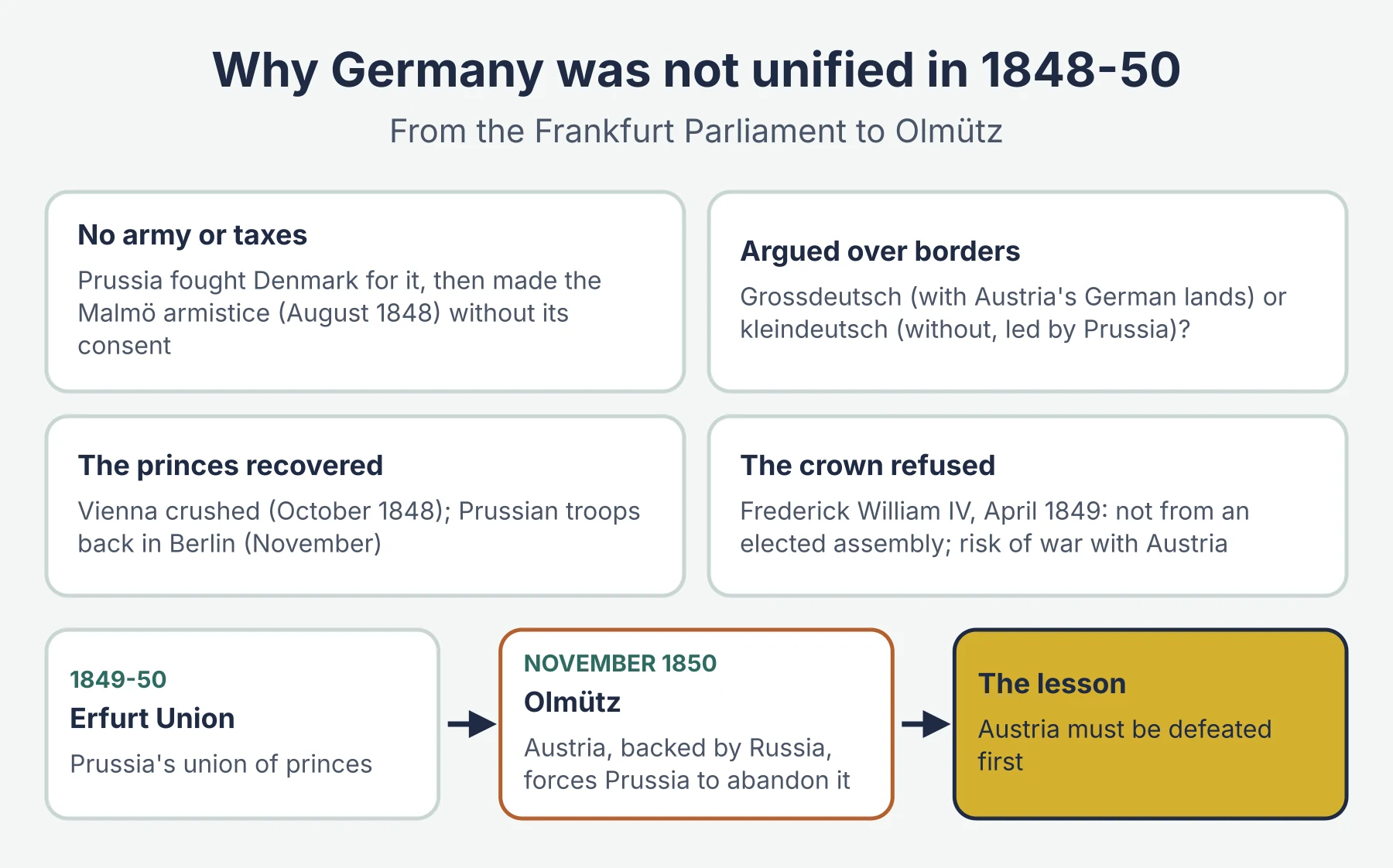
Why 1848-50 failed and 1866-71 succeeded
| 1848-50 | 1862-71 |
|---|---|
| Elected assembly with no army | Prussian state with a modern army |
| Austria strong and backed by Russia | Austria isolated in 1866 |
| Frederick William IV hesitant | William I backing a determined Bismarck |
| Liberal methods: debates and constitutions | War and diplomacy |
One-line answers to the focus points
- Why was Germany not unified in 1848-50? Frankfurt had no army, Frederick William IV refused its crown, and Austria, backed by Russia, restored its leadership at Olmütz.
- How did Bismarck bring about Austria’s defeat? By isolating Austria, allying with Italy and using the Holstein dispute to force a war that Prussia’s army won quickly.
- How did he bring about France’s defeat? By using the Hohenzollern candidature and the Ems Telegram to make France declare war alone, bringing the southern states in on Prussia’s side.
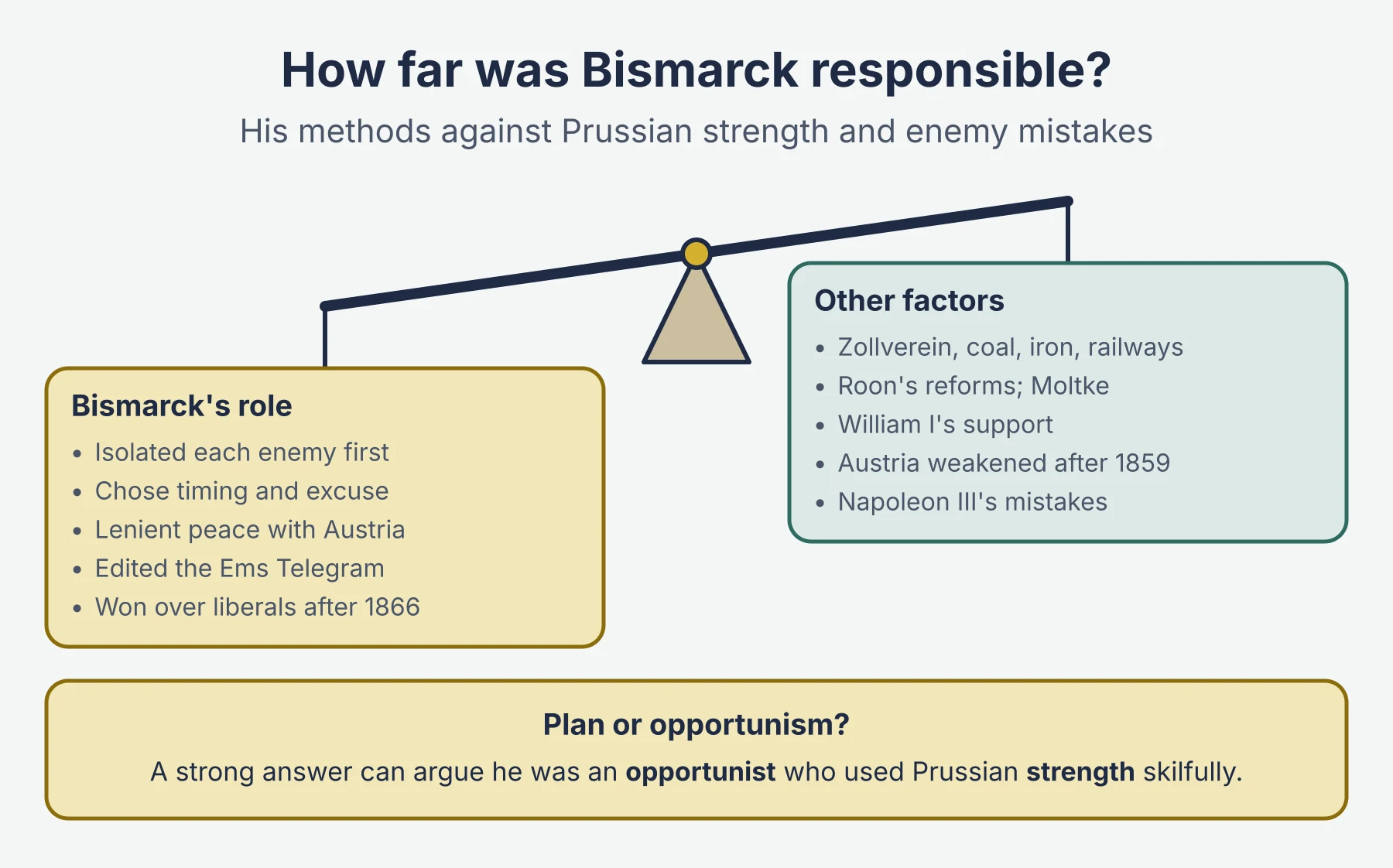
- How far was he responsible? He chose the timing and methods; Prussia’s economy and army and his enemies’ mistakes made success possible.
Exam traps
- Denmark 1864: Austria fought with Prussia, not against it.
- Treaty of Prague: Austria lost Venetia to Italy, not land to Prussia.
- The southern states were not in the North German Confederation.
- The Ems Telegram was a real report that Bismarck edited, not a forgery from nothing.
- “How far was Bismarck responsible?” needs other factors: the Zollverein, the army, Austrian and French mistakes.
Self-test
- When did the Zollverein come into force, and which great power stayed outside? 1834; Austria.
- Give one way the Zollverein helped Prussia. It made Prussia the economic leader of Germany, encouraged railways, or gave wealth for the army (any one).
- Why did the Frankfurt Parliament depend on Prussia in 1848? It had no army, so it needed Prussian troops to fight Denmark over Schleswig-Holstein.
- What happened at Olmütz in 1850? Prussia gave up the Erfurt Union under Austrian and Russian pressure; the Austrian-led Confederation was restored.
- Why was Bismarck appointed in 1862? To force through army reforms that the liberal parliament would not fund.
- What did the Convention of Gastein decide? Prussia would run Schleswig and Austria would run Holstein.
- How did Bismarck secure Italy’s help in 1866? He promised Venetia if Italy attacked Austria.
- Name the decisive battle of 1866. Königgrätz (Sadowa).
- Why was the Treaty of Prague lenient? So that Austria would not seek revenge and could become a future ally.
- Who was offered the Spanish throne in 1870? Prince Leopold of Hohenzollern-Sigmaringen.
- Why did the southern states join Prussia in 1870? France declared war and appeared the aggressor, triggering their alliances.
- What did Germany gain at the Treaty of Frankfurt? Alsace and part of Lorraine and a 5 billion franc indemnity.
Related resources
-
Study guides
Cambridge IGCSE World History (0470): How Was Italy Unified?
Study guide to Cambridge IGCSE History 0470 key question 1.2: Austrian rule, Mazzini, 1848-49, Cavour, Garibaldi and the completion of unity by 1870.
World History · Cambridge · IGCSE
Read guide -
Practice questions
Cambridge IGCSE World History (0470): How Was Italy Unified? – Practice Questions
Twelve original questions with mark-scheme answers on Mazzini, Cavour, Garibaldi and Italian unification to 1870, for Cambridge IGCSE History 0470.
World History · Cambridge · IGCSE
Try questions -
Revision notes
Cambridge IGCSE World History (0470): How Was Italy Unified? – Revision Notes
Recall notes for Cambridge IGCSE History 0470 key question 1.2: Italian unification timeline, key people and terms, Cavour versus Garibaldi, self-test.
World History · Cambridge · IGCSE
Revise topic
Get free revision emails (optional)
Occasional emails with practice questions, worked explanations and links to free resources for the qualification and subjects you choose. No spam, and you can unsubscribe from any email. The free tools on this site never need an email.