
Revision Notes
Cambridge IGCSE World History (0470): Why Was There a Civil War in the United States and What Were Its Results? – Revision Notes
Recall notes for Cambridge IGCSE History 0470 key question 1.4: secession, turning points of the Civil War, Reconstruction's phases and a self-test.
- Subject
- World History
- Level
- IGCSE
- Topic
- Core Content – Option A: The Nineteenth Century, 1848–1914
- Author
- Marlbridge Academic Team
- Updated
- Reviewed by
- Azam Siddique (what this means)
Aligned to Cambridge IGCSE World History (0470), 2024-2026. Official specification .
Syllabus page (what it covers and how it is assessed): Cambridge IGCSE World History.
Syllabus points this page covers
0470
- 1.4 Why was there a civil war in the United States and what were its results?
Found an error? Report a correction.
Need help with this topic? Request a free trial class for IGCSE World History (0470).
Key question 1.4, Cambridge IGCSE History 0470: “Why was there a civil war in the United States and what were its results?” The content runs from 1820 to 1877, and the topic is prescribed for Paper 2 in November 2025 and June 2026. These notes concentrate on the political breakdown, the war’s turning points and Reconstruction; for the sectional differences and the crises of the 1850s, also use the US Civil War revision notes. Explanations are in the 0470 Civil War study guide, and questions in the 0470 Civil War practice questions.
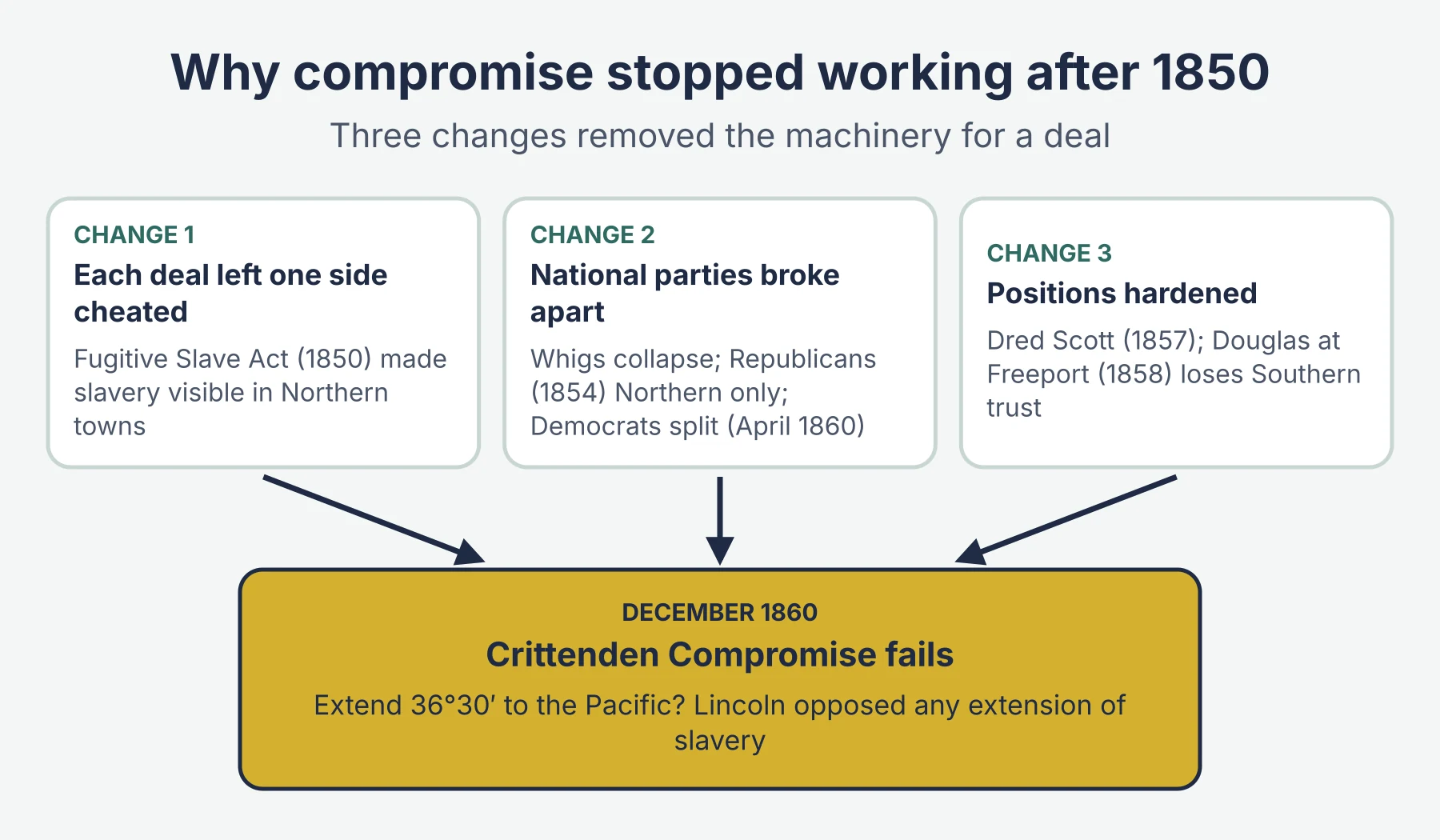
Why compromise broke down after 1850
| Factor | Evidence |
|---|---|
| Compromises created new grievances | Fugitive Slave Act (1850) angered Northerners |
| National parties collapsed | Whigs disappeared in the 1850s; Republicans (1854) were a Northern party; Democrats split at Charleston, April 1860 |
| The courts closed the middle ground | Dred Scott (1857): Congress could not ban slavery in the territories |
| Leaders lost cross-sectional trust | Douglas’s Freeport argument (1858) cost him Southern support |
| Last deal rejected | Crittenden Compromise (December 1860) failed; Lincoln opposed slavery’s extension |
Lincoln’s election: significance in four points
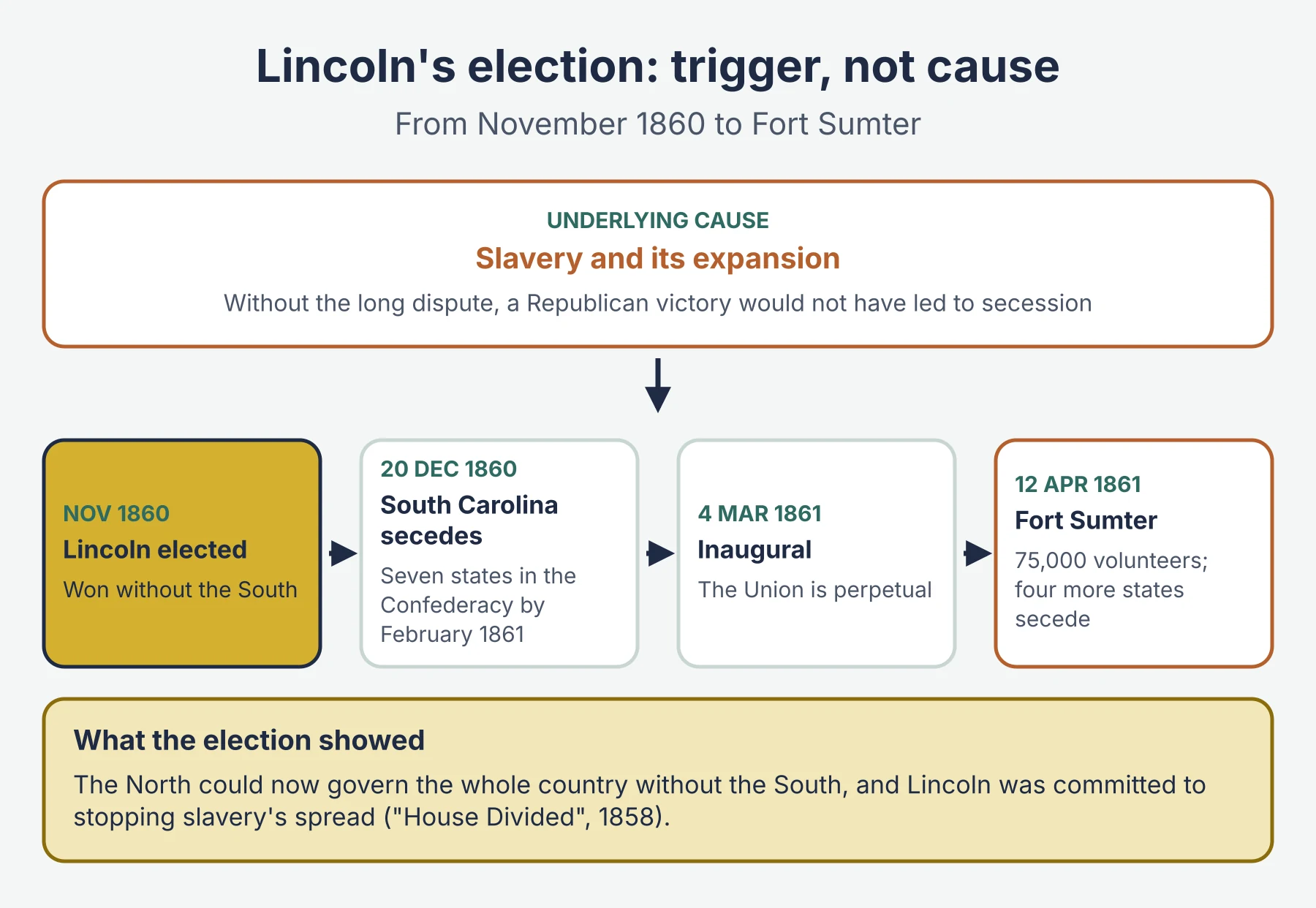
- Sectional victory: no Southern electoral votes; not on the ballot in most of the South.
- Known views: “House Divided” speech (1858); opposed the spread of slavery.
- Immediate secession: South Carolina, 20 December 1860; Confederacy formed February 1861, Jefferson Davis president, before Lincoln’s inauguration (4 March 1861).
- His response to Fort Sumter (12 April 1861): call for 75,000 volunteers; Virginia, North Carolina, Tennessee and Arkansas seceded.
Trigger versus cause: the election was the trigger; slavery’s expansion was the underlying cause.
Turning points of the war
| Date | Event | Significance |
|---|---|---|
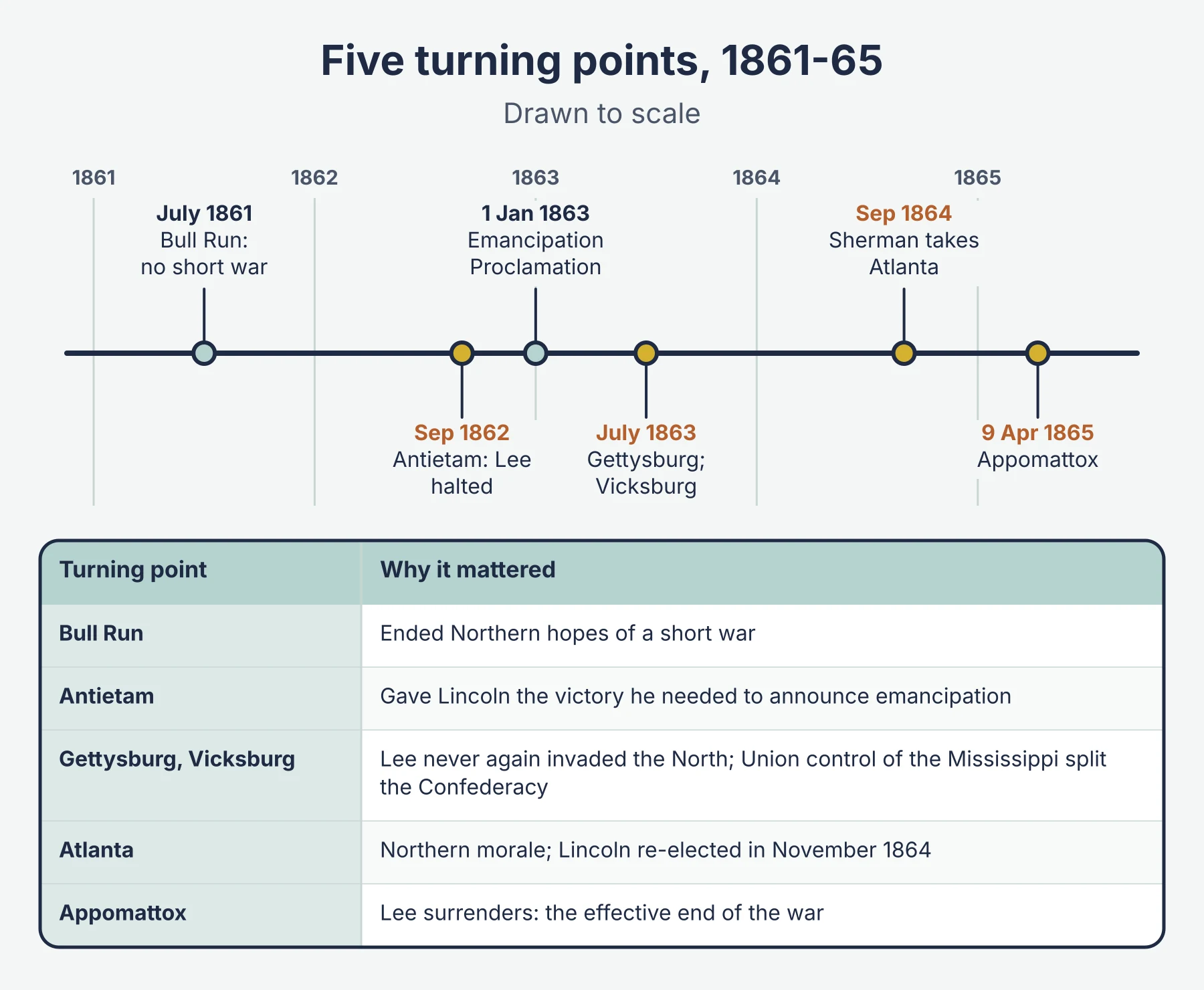
| July 1861 | First Bull Run | No short war |
| September 1862 | Antietam | Lee’s invasion halted; preliminary emancipation announced |
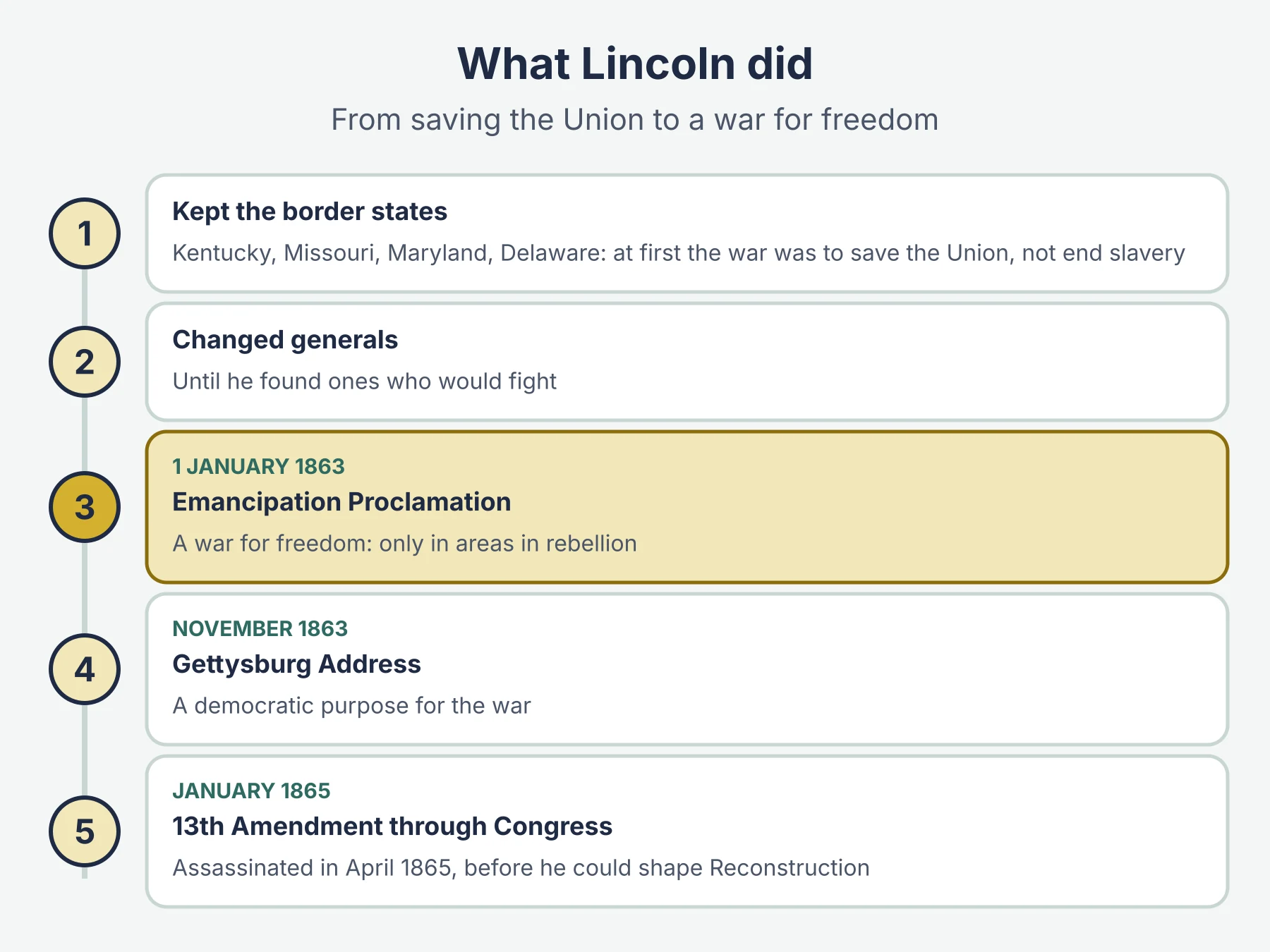
| 1 January 1863 | Emancipation Proclamation | Freedom in rebel areas; Black enlistment |
| July 1863 | Gettysburg; Vicksburg | South on the defensive; Confederacy split along the Mississippi |
| November 1863 | Gettysburg Address | War for “a new birth of freedom” |
| September 1864 | Atlanta taken | Lincoln re-elected in November |
| November-December 1864 | Sherman’s March to the Sea | Destruction of Southern resources |
| 9 April 1865 | Appomattox | Lee surrenders |
| 14 April 1865 | Lincoln shot by John Wilkes Booth | Dies next day; Andrew Johnson president |
Northern strengths and Southern weaknesses
| North | South |
|---|---|
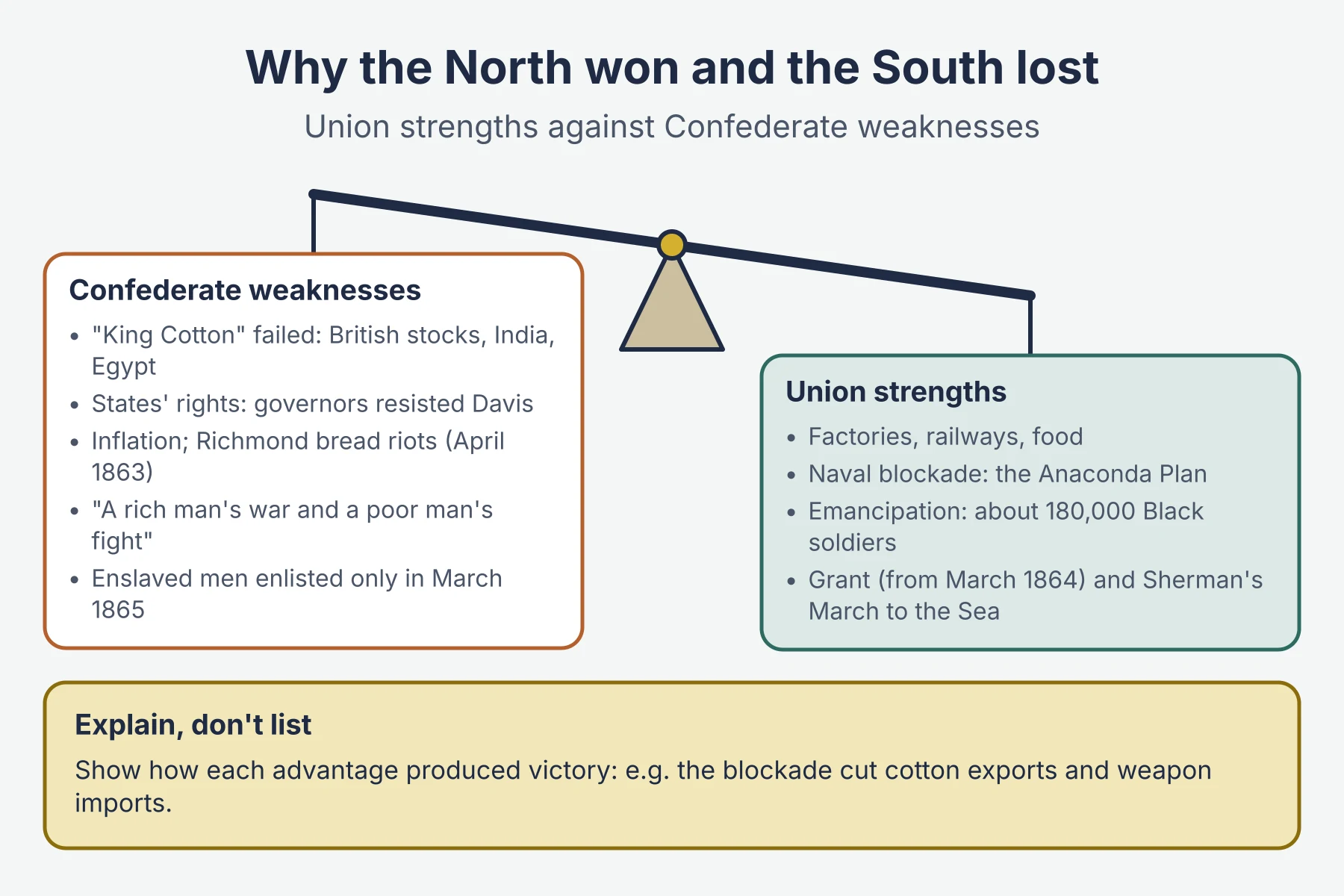
| Industry, railways, food supply | Few factories; railways broke down |
| Blockade (Anaconda Plan) | Cotton diplomacy failed: Britain used stocks and other sources |
| Around 180,000 Black soldiers in the army | Enlisted enslaved men only in March 1865 |
| Grant and Sherman used superior numbers | Lee won battles but could not replace losses |
| Lincoln’s political skill | Davis clashed with state governors (Joseph Brown) |
| Stable finance | Inflation; Richmond bread riots (1863); “rich man’s war” |
Reconstruction’s three phases
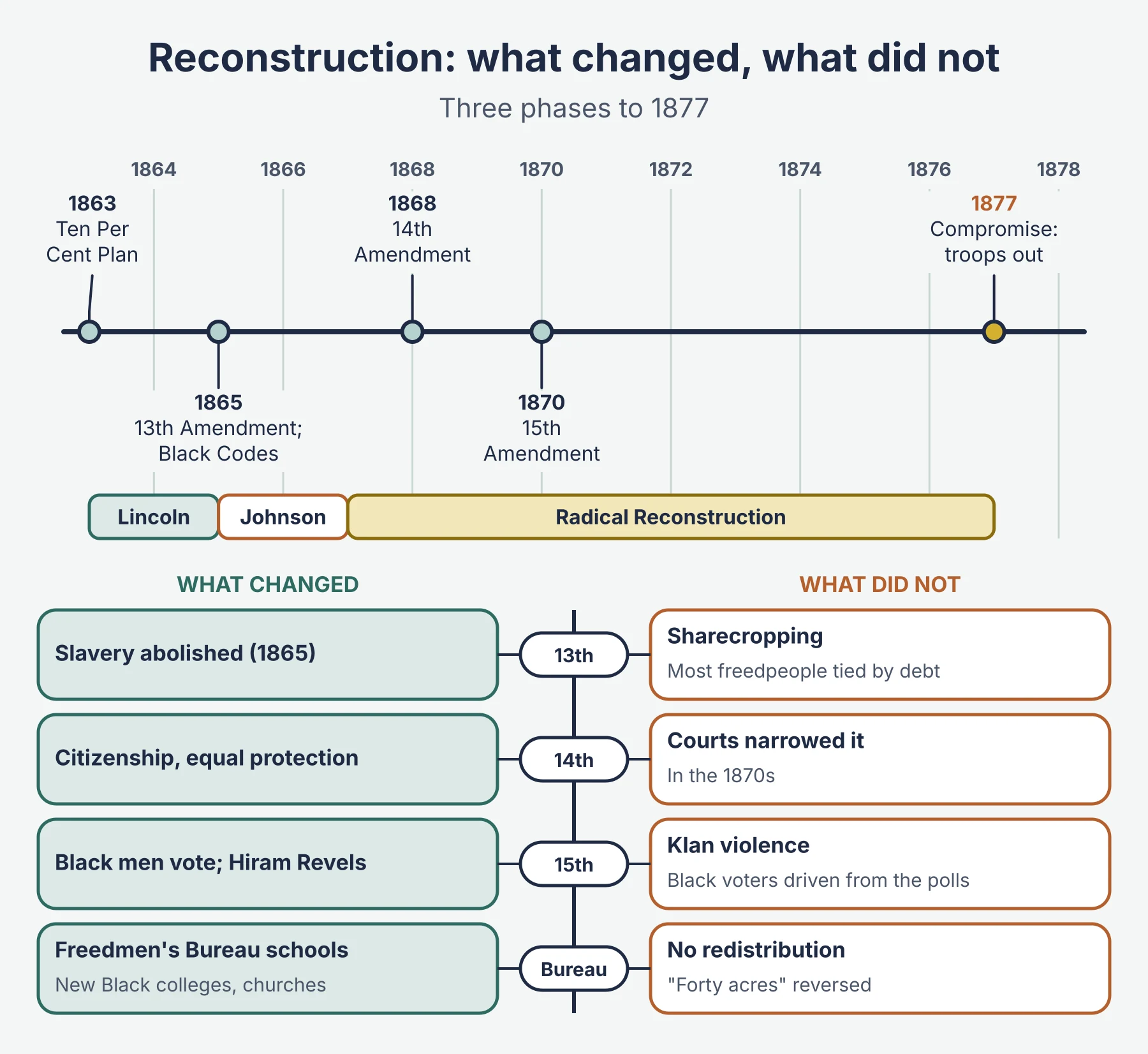
| Phase | Key features |
|---|---|
| Lincoln, 1863-65 | Ten Per Cent Plan: a state could return when 10% of voters swore loyalty |
| Johnson, 1865-67 | Pardons for Confederates; Black Codes; vetoes of the Freedmen’s Bureau extension and Civil Rights Act |
| Radical (Congress), 1867-77 | Reconstruction Acts (1867): five military districts; Black male suffrage; 14th and 15th Amendments; Johnson impeached (1868) and acquitted by one vote |
| End | Disputed election of 1876; Compromise of 1877; troops withdrawn |
Key terms
| Term | Meaning |
|---|---|
| Secession | A state leaving the Union |
| Confederacy | The Confederate States of America, 1861-65 |
| Border states | Slave states that stayed in the Union: Delaware, Maryland, Kentucky, Missouri |
| Anaconda Plan | Northern strategy of blockade and control of the Mississippi |
| Emancipation Proclamation | Lincoln’s order freeing enslaved people in rebel-held areas |
| Black Codes | Southern laws of 1865-66 restricting freedpeople’s rights |
| Freedmen’s Bureau | Federal agency helping formerly enslaved people with food, schools and contracts |
| Radical Republicans | Republicans, such as Thaddeus Stevens, who wanted full rights for freedpeople |
| Sharecropping | Farming land for a share of the crop, often trapping families in debt |
| Compromise of 1877 | Deal ending Reconstruction: Hayes became president and troops left the South |
Exam traps
- The Proclamation did not end slavery everywhere. The 13th Amendment did (ratified December 1865).
- Lincoln was not elected to abolish slavery. He promised not to touch it where it existed.
- Eleven states seceded, not all slave states. Four border states stayed.
- Reconstruction is part of the question. “Results” questions expect 1865-77.
- Use a criterion for “success”. Legal change and everyday life give different answers.
Self-test
- Why did the Fugitive Slave Act increase tension? It forced Northerners to help return people who had escaped slavery.
- What happened to the Democratic Party in 1860? It split into Northern and Southern wings.
- What did the Crittenden Compromise propose? Extending the 36°30′ line to the Pacific.
- Which state seceded first, and when? South Carolina, 20 December 1860.
- Who was president of the Confederacy? Jefferson Davis.
- Why was Vicksburg important? Its fall gave the Union control of the Mississippi and split the Confederacy.
- Why did the capture of Atlanta matter politically? It helped Lincoln win re-election in November 1864.
- Give one reason “King Cotton” diplomacy failed. Britain had large cotton stocks and found other sources in India and Egypt.
- What were the Black Codes? Laws passed by Southern states in 1865-66 restricting freedpeople’s rights.
- What did the Reconstruction Acts of 1867 do? Divided the South into military districts and required Black male suffrage for readmission.
- What did the 15th Amendment (1870) do? Stopped states denying the vote on grounds of race.
- How did Reconstruction end? Through the Compromise of 1877, when federal troops were withdrawn after the disputed election of 1876.
Related resources
-
Study guides
Overseas Empires in the Nineteenth Century (Cambridge 0470 and 2147)
Guide to Cambridge 0470 and 2147 key question 1.5: motives for empire, Senegal, Nigeria and the Congo, India after 1857, and US gains from Spain in 1898.
World History · Cambridge · IGCSE, O Level
Read guide -
Practice questions
Overseas Empires in the Nineteenth Century: Practice Questions
Original structured and source questions with answers on imperial motives, rule in Africa, India in 1857 and US expansion in 1898, for Cambridge 0470 and 2147.
World History · Cambridge · IGCSE, O Level
Try questions -
Revision notes
Overseas Empires in the Nineteenth Century: Revision Notes
Recall notes on motives for empire, Faidherbe, Lugard, Leopold II, India after 1857 and the Spanish–American War, for Cambridge IGCSE 0470 and O Level 2147.
World History · Cambridge · IGCSE, O Level
Revise topic
Get free revision emails (optional)
Occasional emails with practice questions, worked explanations and links to free resources for the qualification and subjects you choose. No spam, and you can unsubscribe from any email. The free tools on this site never need an email.